Natural Colors
By
Mr. S. G. Laware
Asst. Prof., Dept. of Pharmacognosy,
P.R.E.S’s Coolege of Pharmacy (For Women), Chincholi.
Natural Colors
Natural Colors:
• “Colorant” is used as a name for materials such as dyes and pigments.
• Ability of natural colorant to be used as natural dyes has been known since ancient
times. A dye can generally be described as “a colored substance that has an affinity to the
substrate to which it is being applied”.
• The dye is usually used as an aqueous solution, and may require a mordant to improve
the fastness of the dye on the fiber. In contrast, a pigment generally has no affinity for
the substrate and is insoluble.
• The chief source of coloring matter, until about a century ago, had been nature in
general and vegetation in particular. Man learnt to use different kinds of natural coloring
matters to dye cloths.
• Biochemists have identified that the vital activity of plants is also dependent on
colorants in the way that the bright color of flowers are important in attracting insects
and birds to act as pollinators. When these are used for dyeing fabrics, they not only
impart color to the fabric, but also act as antifungal agent whereby they impart
protection to fabric against bacterial or fungal infections or as moth reluctant. Some
dyes like Indigo has a cooling sensation also.
What is Color?
• Color is one of the elements of nature that made the human living more aesthetic and
fascinating in the world.
• They are supposed to be associated with emotions, human qualities, seasons, festivals
and passion in our life. In the past, at dawn of the civilization, the people tried to
ornament their surroundings similar to that of natural colors observed in the plant, soil,
sky and other sources.
• This gave birth to a new science of colors from natural origin.
What are Dyes?
• A natural or synthetic substance used to add color to any material including textile,
cosmetic products, food products etc.
• In textiles, they are incorporated into the fiber by chemical reaction, absorption or
dispersion.
• Dye is generally applied in an aqueous solution and may require a mordant to improve
the fastness of the dye on the fiber.
Natural dyes
• One can get coloring matter from almost all‐vegetable matter. However, only a few of
these sources yield colorants which can be extracted and work out to be commercially
viable. Similar is the case of colorants obtained from animal origin.
• Basically, three primary colors are required to get any given hue (or color). This type of
approach has been worked out for synthetic dyes. However in the case of natural dyes,
the dyeing procedures are different for different dyes and they cannot be blended to get
required color easily
Origin of Natural Dyes:
• It is known since ancient times.
• Written record of the use was found in china dated 2600 BC.
• Chemical tests of red fabrics found in the tomb of King Tutankhamun in Egypt show
the presence of alizarin.
• The remains of robes of Alexander the great dating back to 541BC shows the purple
color which was made from a mollusk and clothing made from it was so expensive that
only the royal families could afford it.
Why and how natural dyes are different?
• Never‐the‐less, while looking for different colors one finds that it is better to have a
limited number of dyes with good fastness properties, rather than having too many
colors (sources) with limited fastness properties.
• While selecting the proper palette of colors one would like to have at least one blue, one
red and a yellow to start with. Due to the limited number of natural dyes available, the
correct choice of the dyes is very important. Information of some important natural
dyes is given below.
Use of Natural dyes
• Ever since primitive people could create, they have been endeavoringto add colorto the
world around them. They used natural matter to stain hides, decorate shells and feathers,
and paint their story on the walls of ancient caves. Scientists have been able to date the
black, white, yellow and reddish pigments made from ochre used by primitive man in
cave paintings to over 15,000 BC Natural dyes have been used since ancient times for
coloring and printing fabrics. Until the middle of last century, most of the dyes were
derived from plants or animal sources by long and elaborate processes. Among these
Indigo, Tyrianpurple, Alizarin, Cochineal and Logwood dyes deserve special mention.
Advantages of Natural Dyes
• Eco-friendly • Clothes dyed with natural dyes yield
higher profits to the dyers & mfg’ers
• Unique • Variety of shades produced
• Free from carcinogenic components • Used in cosmetics
• Used as antioxidants
Disadvantages of Natural Dyes
• Requires vast areas of land while
production
• Time consuming dyeing process
• Color fades quickly • Reproducibility of shades is difficult
• Difficult to produce • Bright colors cannot be produced
• More expensive than synthetic dyes
Preparation of Natural Dyes:
• Collect plant materials when they are at their peak of color
• Dry them in shade
• Chop all plant materials into small pieces
• Take requisite amount of material and water depending upon the dye source and boil
maintaining the MLR
• Boil the mixture at least for an hour
• Strain the material and set the dye bath aside
Other Extraction Methods:
1. Aqueous Method:
• Boil dyestuff in soft water at 100 C, Filter the dye solution
2. Alkaline Method:
• Prepare 1% alkaline solution with of 1g sodium carbonate / Sodium hydroxide in 100
ml of water at 100 C, Filter the dye solution
3. Acidic Method:
• Prepare 1% of acidic solution by adding 1 ml HCL in 100 ml of soft water at 100 C,
Filter the dye solution
4. Alcoholic Method:
• Add 50 ml of alcohol to 50 ml of soft water, Enter the dye material and boil, Filter the
dye solution
a. Ethanol Method: The powder is initially defatted with pet. Benzene (60-80C) by
required amount of ethanol by using an extractor for 72 hrs. The extract is filtered by using
filter paper and then dried at 45C and extracts are kept in sterile bottles under refrigerated
conditions until use.
b. Methanol Method: Powder is taken and extract by 20% aqueous methanol using
soxhlet extraction method. The dye powder is slightly soluble in hot water and completely
soluble in alkaline medium at room temperature
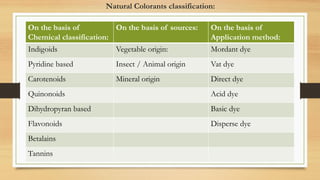
Natural Colorants classification:
On the basis of
Chemical classification:
On the basis of sources: On the basis of
Application method:
Indigoids Vegetable origin: Mordant dye
Pyridine based Insect / Animal origin Vat dye
Carotenoids Mineral origin Direct dye
Quinonoids Acid dye
Dihydropyran based Basic dye
Flavonoids Disperse dye
Betalains
Tannins
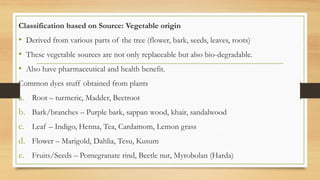
Classification based on Source: Vegetable origin
• Derived from various parts of the tree (flower, bark, seeds, leaves, roots)
• These vegetable sources are not only replaceable but also bio-degradable.
• Also have pharmaceutical and health benefit.
Common dyes stuff obtained from plants
a. Root – turmeric, Madder, Beetroot
b. Bark/branches – Purple bark, sappan wood, khair, sandalwood
c. Leaf – Indigo, Henna, Tea, Cardamom, Lemon grass
d. Flower – Marigold, Dahlia, Tesu, Kusum
e. Fruits/Seeds – Pomegranate rind, Beetle nut, Myrobolan (Harda)
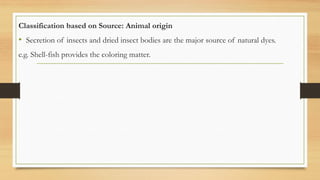
Classification based on Source: Animal origin
• Secretion of insects and dried insect bodies are the major source of natural dyes.
e.g. Shell-fish provides the coloring matter.
Classification based on Source: Mineral origin
• Used for fixing or improving the fastness of vegetable dye
• Covers natural resources including minerals which give coloring matter. e.g. cow urine,
cow dung, egg albumin
• Ocher dye obtained from an impure earthy ore of iron, usually red (hematite) or yellow
(limonite)
Classification based on Chemical composition: Carotenoids
• Class of natural fat-soluble pigments, which give color to plant parts.
• Found in plants, algae and photosynthetic bacteria, they play a critical role in the
photosynthetic process.
e.g. Reds of peppers and tomatoes, oranges, carrots and citrus fruits.
• Carotenoids are derived from a 40 carbon polyene chain, which could be considered the
backbone of the molecule
Classification based on Chemical composition: Flavonoids
• Flavones have yellowish colors and sensitive to pH.
• The yellow becomes much deeper in solutions of high pH.
• Class of flavonoids based on the backbone of 2-phenylchromen-4-one (2-phenyl-1-
benzopyran-4-one)
• Natural flavones includes Apigenin, Luteolin and Tangeritin.
• Synthetic flavones are Diosmin and Flavoxate.
Classification based on Chemical composition: Anthraquinone
• It is an aromatic organic compound with formula C14H8O2
• It is a yellow highly crystalline solid, poorly soluble in water but highly soluble in hot
organic solvents.
• Insoluble in ethanol near room temperature but 2.25g will dissolve in 100 g of boiling
ethanol.
• Alizarin and Madder plant (Red shades)
Classification based on Application: Mordant dye
• It is substance that used to set the dye on fabrics by forming a complex coordination.
• It is a important auxiliaries in case of natural dyes.
• Mordant enhance the color & help to improve the fastness of the dye.
• Each different metal used to produce a different range of colors for each dye.
• Classification of Mordant: On the basis of origin, two types of mordant dyes
• Natural mordant dyes:
• Synthetic mordant dyes:
005 natural colors
005 natural colors
005 natural colors
005 natural colors
005 natural colors
005 natural colors
005 natural colors

005 natural colors

  • 1.
    Natural Colors By Mr. S.G. Laware Asst. Prof., Dept. of Pharmacognosy, P.R.E.S’s Coolege of Pharmacy (For Women), Chincholi.
  • 2.
  • 3.
    Natural Colors: • “Colorant”is used as a name for materials such as dyes and pigments. • Ability of natural colorant to be used as natural dyes has been known since ancient times. A dye can generally be described as “a colored substance that has an affinity to the substrate to which it is being applied”. • The dye is usually used as an aqueous solution, and may require a mordant to improve the fastness of the dye on the fiber. In contrast, a pigment generally has no affinity for the substrate and is insoluble.
  • 4.
    • The chiefsource of coloring matter, until about a century ago, had been nature in general and vegetation in particular. Man learnt to use different kinds of natural coloring matters to dye cloths. • Biochemists have identified that the vital activity of plants is also dependent on colorants in the way that the bright color of flowers are important in attracting insects and birds to act as pollinators. When these are used for dyeing fabrics, they not only impart color to the fabric, but also act as antifungal agent whereby they impart protection to fabric against bacterial or fungal infections or as moth reluctant. Some dyes like Indigo has a cooling sensation also.
  • 5.
    What is Color? •Color is one of the elements of nature that made the human living more aesthetic and fascinating in the world. • They are supposed to be associated with emotions, human qualities, seasons, festivals and passion in our life. In the past, at dawn of the civilization, the people tried to ornament their surroundings similar to that of natural colors observed in the plant, soil, sky and other sources. • This gave birth to a new science of colors from natural origin.
  • 6.
    What are Dyes? •A natural or synthetic substance used to add color to any material including textile, cosmetic products, food products etc. • In textiles, they are incorporated into the fiber by chemical reaction, absorption or dispersion. • Dye is generally applied in an aqueous solution and may require a mordant to improve the fastness of the dye on the fiber.
  • 7.
    Natural dyes • Onecan get coloring matter from almost all‐vegetable matter. However, only a few of these sources yield colorants which can be extracted and work out to be commercially viable. Similar is the case of colorants obtained from animal origin. • Basically, three primary colors are required to get any given hue (or color). This type of approach has been worked out for synthetic dyes. However in the case of natural dyes, the dyeing procedures are different for different dyes and they cannot be blended to get required color easily
  • 8.
    Origin of NaturalDyes: • It is known since ancient times. • Written record of the use was found in china dated 2600 BC. • Chemical tests of red fabrics found in the tomb of King Tutankhamun in Egypt show the presence of alizarin. • The remains of robes of Alexander the great dating back to 541BC shows the purple color which was made from a mollusk and clothing made from it was so expensive that only the royal families could afford it.
  • 9.
    Why and hownatural dyes are different? • Never‐the‐less, while looking for different colors one finds that it is better to have a limited number of dyes with good fastness properties, rather than having too many colors (sources) with limited fastness properties. • While selecting the proper palette of colors one would like to have at least one blue, one red and a yellow to start with. Due to the limited number of natural dyes available, the correct choice of the dyes is very important. Information of some important natural dyes is given below.
  • 10.
    Use of Naturaldyes • Ever since primitive people could create, they have been endeavoringto add colorto the world around them. They used natural matter to stain hides, decorate shells and feathers, and paint their story on the walls of ancient caves. Scientists have been able to date the black, white, yellow and reddish pigments made from ochre used by primitive man in cave paintings to over 15,000 BC Natural dyes have been used since ancient times for coloring and printing fabrics. Until the middle of last century, most of the dyes were derived from plants or animal sources by long and elaborate processes. Among these Indigo, Tyrianpurple, Alizarin, Cochineal and Logwood dyes deserve special mention.
  • 11.
    Advantages of NaturalDyes • Eco-friendly • Clothes dyed with natural dyes yield higher profits to the dyers & mfg’ers • Unique • Variety of shades produced • Free from carcinogenic components • Used in cosmetics • Used as antioxidants Disadvantages of Natural Dyes • Requires vast areas of land while production • Time consuming dyeing process • Color fades quickly • Reproducibility of shades is difficult • Difficult to produce • Bright colors cannot be produced • More expensive than synthetic dyes
  • 12.
    Preparation of NaturalDyes: • Collect plant materials when they are at their peak of color • Dry them in shade • Chop all plant materials into small pieces • Take requisite amount of material and water depending upon the dye source and boil maintaining the MLR • Boil the mixture at least for an hour • Strain the material and set the dye bath aside
  • 13.
    Other Extraction Methods: 1.Aqueous Method: • Boil dyestuff in soft water at 100 C, Filter the dye solution 2. Alkaline Method: • Prepare 1% alkaline solution with of 1g sodium carbonate / Sodium hydroxide in 100 ml of water at 100 C, Filter the dye solution 3. Acidic Method: • Prepare 1% of acidic solution by adding 1 ml HCL in 100 ml of soft water at 100 C, Filter the dye solution
  • 14.
    4. Alcoholic Method: •Add 50 ml of alcohol to 50 ml of soft water, Enter the dye material and boil, Filter the dye solution a. Ethanol Method: The powder is initially defatted with pet. Benzene (60-80C) by required amount of ethanol by using an extractor for 72 hrs. The extract is filtered by using filter paper and then dried at 45C and extracts are kept in sterile bottles under refrigerated conditions until use. b. Methanol Method: Powder is taken and extract by 20% aqueous methanol using soxhlet extraction method. The dye powder is slightly soluble in hot water and completely soluble in alkaline medium at room temperature
  • 16.
    Natural Colorants classification: Onthe basis of Chemical classification: On the basis of sources: On the basis of Application method: Indigoids Vegetable origin: Mordant dye Pyridine based Insect / Animal origin Vat dye Carotenoids Mineral origin Direct dye Quinonoids Acid dye Dihydropyran based Basic dye Flavonoids Disperse dye Betalains Tannins
  • 18.
    Classification based onSource: Vegetable origin • Derived from various parts of the tree (flower, bark, seeds, leaves, roots) • These vegetable sources are not only replaceable but also bio-degradable. • Also have pharmaceutical and health benefit. Common dyes stuff obtained from plants a. Root – turmeric, Madder, Beetroot b. Bark/branches – Purple bark, sappan wood, khair, sandalwood c. Leaf – Indigo, Henna, Tea, Cardamom, Lemon grass d. Flower – Marigold, Dahlia, Tesu, Kusum e. Fruits/Seeds – Pomegranate rind, Beetle nut, Myrobolan (Harda)
  • 19.
    Classification based onSource: Animal origin • Secretion of insects and dried insect bodies are the major source of natural dyes. e.g. Shell-fish provides the coloring matter.
  • 20.
    Classification based onSource: Mineral origin • Used for fixing or improving the fastness of vegetable dye • Covers natural resources including minerals which give coloring matter. e.g. cow urine, cow dung, egg albumin • Ocher dye obtained from an impure earthy ore of iron, usually red (hematite) or yellow (limonite)
  • 22.
    Classification based onChemical composition: Carotenoids • Class of natural fat-soluble pigments, which give color to plant parts. • Found in plants, algae and photosynthetic bacteria, they play a critical role in the photosynthetic process. e.g. Reds of peppers and tomatoes, oranges, carrots and citrus fruits. • Carotenoids are derived from a 40 carbon polyene chain, which could be considered the backbone of the molecule
  • 23.
    Classification based onChemical composition: Flavonoids • Flavones have yellowish colors and sensitive to pH. • The yellow becomes much deeper in solutions of high pH. • Class of flavonoids based on the backbone of 2-phenylchromen-4-one (2-phenyl-1- benzopyran-4-one) • Natural flavones includes Apigenin, Luteolin and Tangeritin. • Synthetic flavones are Diosmin and Flavoxate.
  • 24.
    Classification based onChemical composition: Anthraquinone • It is an aromatic organic compound with formula C14H8O2 • It is a yellow highly crystalline solid, poorly soluble in water but highly soluble in hot organic solvents. • Insoluble in ethanol near room temperature but 2.25g will dissolve in 100 g of boiling ethanol. • Alizarin and Madder plant (Red shades)
  • 26.
    Classification based onApplication: Mordant dye • It is substance that used to set the dye on fabrics by forming a complex coordination. • It is a important auxiliaries in case of natural dyes. • Mordant enhance the color & help to improve the fastness of the dye. • Each different metal used to produce a different range of colors for each dye. • Classification of Mordant: On the basis of origin, two types of mordant dyes • Natural mordant dyes: • Synthetic mordant dyes: