T. Campbell McCuaig and Jon Hronsky1,2,3
1Centre for Exploration Targeting,
2ARC Centre of Excellence for Core to Crust Fluid Systems
3 Western Mining Services
Geological Survey of New South Wales
Exploration in the House
May 2016
Takeaway
Messages
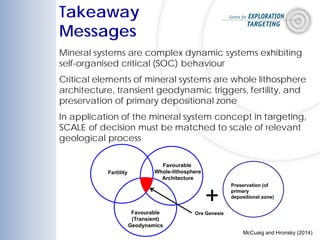
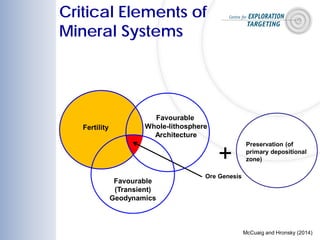
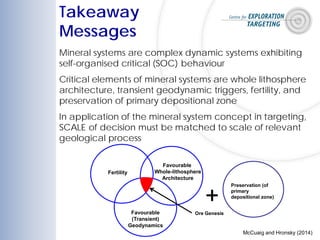
Mineral systems are complex dynamic systems exhibiting
self-organised critical (SOC) behaviour
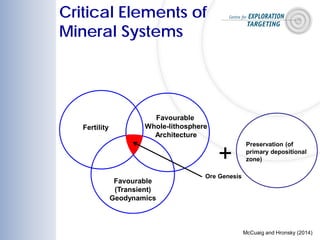
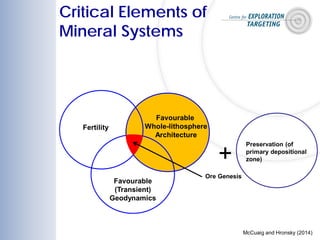
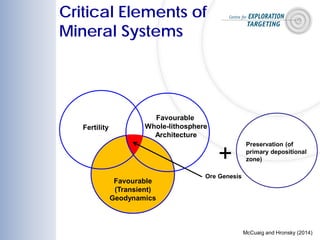
Critical elements of mineral systems are whole lithosphere
architecture, transient geodynamic triggers, fertility, and
preservation of primary depositional zone
In application of the mineral system concept in targeting,
SCALE of decision must be matched to scale of relevant
geological process
Fertility
Favourable
Whole-lithosphere
Architecture
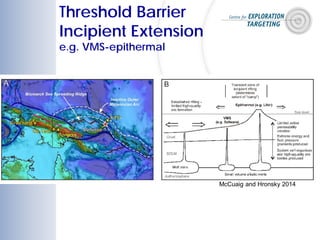
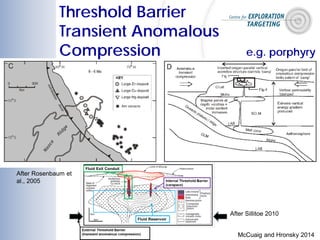
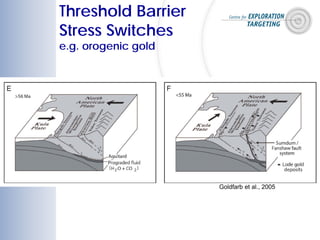
Favourable
(Transient)
Geodynamics
Ore Genesis
Preservation (of
primary
depositional zone)
+
McCuaig and Hronsky (2014)
The Problem
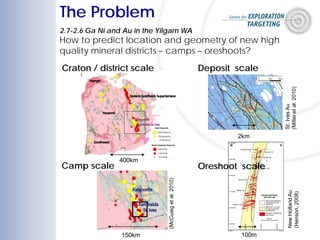
How to predict location and geometry of new high
quality mineral districts – camps – oreshoots?
2.7-2.6 Ga Ni and Au in the Yilgarn WA
Craton / district scale
150km
400km
NewHollandAu
(Henson,2008)
St.IvesAu
(Milleretal.2010)
(McCuaigetal.2010)
Deposit scale
Oreshoot scale
100m
2km
Camp scale
LOW
BROAD REGIONAL
PREDICTION
HIGH
PROSPECT SCALE
SCALE (km)
RELATIVE
EFFECTIVENESS DETECTION
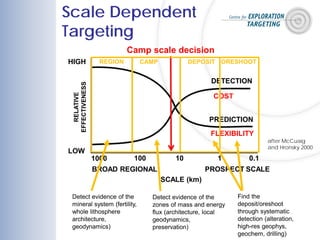
Camp scale decision
1000 100 10 1 0.1
COST
FLEXIBILITY
Alteration halos
High definition
geophysics
Drilling
Geochemistry
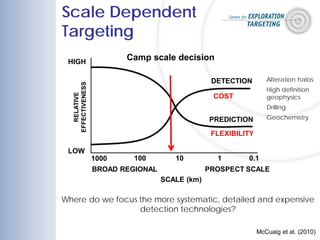
Where do we focus the more systematic, detailed and expensive
detection technologies?
Scale Dependent
Targeting
McCuaig et al. (2010)
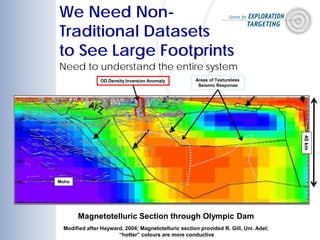
We Need Non-
Traditional Datasets
to See Large Footprints
Magnetotelluric Section through Olympic Dam
Modified after Hayward, 2004; Magnetotelluric section provided R. Gill, Uni. Adel;
ā€œhotterā€ colours are more conductive
Areas of Textureless
Seismic Response
OD Density Inversion Anomaly
40km
Moho
Need to understand the entire system
Mineral Systems –
Some Constraints
Take elements at low concentration from large volumes of
rock to high concentration in small volumes of rock
Only plausible mechanism is through advective mass flux –
needs a fluid (fluid/magma)
Ore deposits therefore are foci of large scale advective
mass and energy flux
Fluid needs to be low viscosity, available in large quantities
over short timeframes, highly organised (focussed in space
and time)
Mineral systems are dynamic complex systems
Olympic Dam
Perseverance
Norilsk
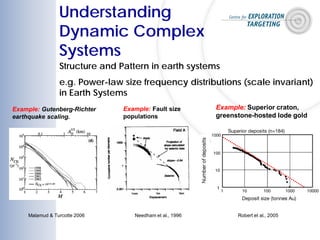
Structure and Pattern in earth systems
e.g. Power-law size frequency distributions (scale invariant)
in Earth Systems
Understanding
Dynamic Complex
Systems
Example: Fault size
populations
Needham et al., 1996Malamud & Turcotte 2006
Example: Gutenberg-Richter
earthquake scaling.
Example: Superior craton,
greenstone-hosted lode gold
Robert et al., 2005
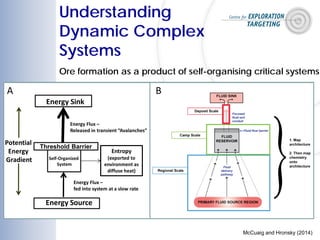
Energy Sink
Energy Source
Potential
Energy
Gradient Self-Organized
System
Entropy
(exported to
environment as
diffuse heat)
Energy Flux –
fed into system at a slow rate
Energy Flux –
Released in transient ā€œAvalanchesā€
Threshold Barrier
A B
Ore formation as a product of self-organising critical systems
Understanding
Dynamic Complex
Systems
McCuaig and Hronsky (2014)
Fertility
Favourable
Whole-lithosphere
Architecture
Favourable
(Transient)
Geodynamics
Ore Genesis
Preservation (of
primary depositional
zone)+
Critical Elements of
Mineral Systems
McCuaig and Hronsky (2014)
Fertility
Favourable
Whole-lithosphere
Architecture
Favourable
(Transient)
Geodynamics
Ore Genesis
Preservation (of
primary depositional
zone)+
Critical Elements of
Mineral Systems
McCuaig and Hronsky (2014)
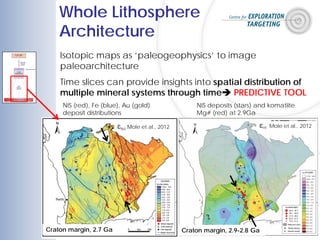
Whole Lithosphere
Architecture
Isotopic maps as ā€˜paleogeophysics’ to image
paleoarchitecture
Time slices can provide insights into spatial distribution of
multiple mineral systems through time PREDICTIVE TOOL
ʐNd Mole et al., 2012 ʐHf Mole et al., 2012
Craton margin, 2.7 Ga Craton margin, 2.9-2.8 Ga
NiS (red), Fe (blue), Au (gold)
deposit distributions
NiS deposits (stars) and komatiite
Mg# (red) at 2.9Ga
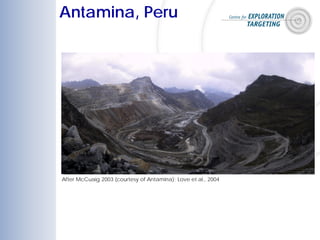
After McCuaig 2003 (courtesy of Antamina); Love et al., 2004
Antamina, Peru
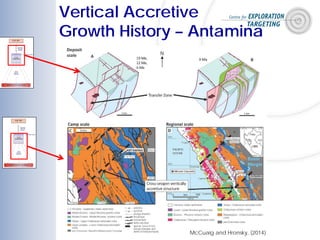
McCuaig and Hronsky, (2014)
Vertical Accretive
Growth History – Antamina
Vertical Accretive
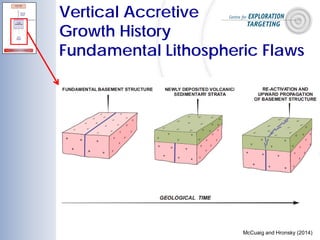
Growth History
Fundamental Lithospheric Flaws
McCuaig and Hronsky (2014)
Vertical Accretive
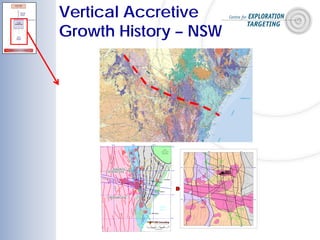
Growth History – NSW
Common
Characteristics of
Large Scale Ore-Controlling
Structures
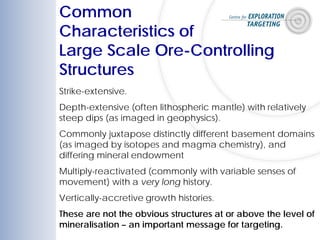
Strike-extensive.
Depth-extensive (often lithospheric mantle) with relatively
steep dips (as imaged in geophysics).
Commonly juxtapose distinctly different basement domains
(as imaged by isotopes and magma chemistry), and
differing mineral endowment
Multiply-reactivated (commonly with variable senses of
movement) with a very long history.
Vertically-accretive growth histories.
These are not the obvious structures at or above the level of
mineralisation – an important message for targeting.
Fertility
Favourable
Whole-lithosphere
Architecture
Favourable
(Transient)
Geodynamics
Ore Genesis
Preservation (of
primary depositional
zone)+
Critical Elements of
Mineral Systems
McCuaig and Hronsky (2014)
In recent years increasing availability of high-resolution
geochronology and better understanding of global
geodynamics
This is increasingly indicating that major ore-forming events
occur in narrow time windows, often over broad areas
These critical time horizons must reflect unusual regional-
scale geodynamic settings that are favourable for
mineralisation
These favourable settings must be transient, lasting for only
short periods of geological time
Transient
Geodynamic Triggers
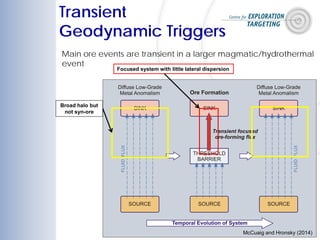
Focused system with little lateral dispersion
Broad halo but
not syn-ore
Transient
Geodynamic Triggers
Main ore events are transient in a larger magmatic/hydrothermal
event
McCuaig and Hronsky (2014)
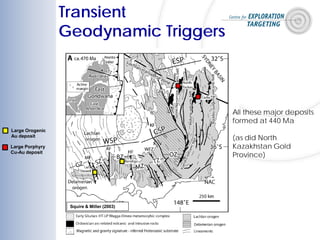
Large Orogenic
Au deposit
Large Porphyry
Cu-Au deposit
All these major deposits
formed at 440 Ma
(as did North
Kazakhstan Gold
Province)
Squire & Miller (2003)
Transient
Geodynamic Triggers
Favourable
Transient
Geodynamic Events
Empirically we recognise three common
scenarios:
Incipient Extension (VMS, Akalic LSE Au, LSE Au, NiS)
Transient Compression (Porphyry Suite deposits, Mafic
Intrusion NiS)
Switches in Far-Field Stress (All?)
Favourable
Transient
Geodynamic Events
During these events:
Active permeability creation is stopped, or
Vertical permeability is clamped
Energy and fluid input to the system continues
Extreme energy and fluid pressure gradients
are formed
The system self-organizes to form ore as long
as the geodynamic threshold barrier remains
intact.
McCuaig and Hronsky 2014
Threshold Barrier
Incipient Extension
e.g. VMS-epithermal
McCuaig and Hronsky 2014
Threshold Barrier
Transient Anomalous
Compression e.g. porphyry
After Rosenbaum et
al., 2005
After Sillitoe 2010
Goldfarb et al., 2005
Threshold Barrier
Stress Switches
e.g. orogenic gold
Fertility
Favourable
Whole-lithosphere
Architecture
Favourable
(Transient)
Geodynamics
Ore Genesis
Preservation (of
primary depositional
zone)+
Critical Elements of
Mineral Systems
McCuaig and Hronsky (2014)
Fertility
A geological region or time period
systematically better-endowed than otherwise
equivalent geological environments
4 components
Secular Earth Evolution
Lithosphere fertility (e.g. Au)
Geodynamic context (e.g. magmatic-hydrothermal
Cu)
Paleolatitude (Zn-Pb, U, Fe, others?)
Implications of
lithosphere
enrichment
McCuaig and Hronsky (2014)
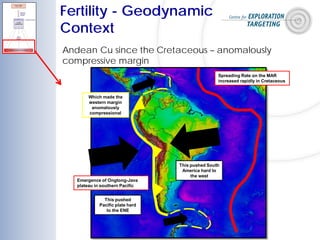
Fertility - Geodynamic
Context
Spreading Rate on the MAR
increased rapidly in Cretaceous
This pushed South
America hard to
the west
Which made the
western margin
anomalously
compressional
Andean Cu since the Cretaceous – anomalously
compressive margin
Emergence of Ongtong-Java
plateau in southern Pacific
This pushed
Pacific plate hard
to the ENE
McCuaig and Hronsky 2014
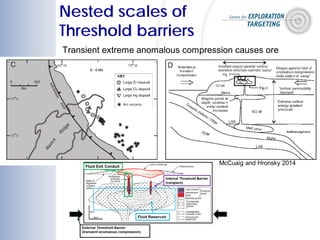
Nested scales of
Threshold barriers
Transient extreme anomalous compression causes ore
Mineral Systems in
Practice
At all scales, processes at site of deposition
get heavy weighting, despite their lower
relevance to regional targeting decisions
Bias is to data rich areas at expense of data
poor areas.
Challenge in practical application is in
keeping scale of decision matched to
scale of relevant mineral system process:
after McCuaig
and Hronsky 2000
LOW
BROAD REGIONAL
PREDICTION
HIGH
PROSPECT SCALE
SCALE (km)
RELATIVE
EFFECTIVENESS DETECTION
Camp scale decision
1000 100 10 1 0.1
COST
FLEXIBILITY
Scale Dependent
Targeting
Detect evidence of the
mineral system (fertility,
whole lithosphere
architecture,
geodynamics)
REGION
Detect evidence of the
zones of mass and energy
flux (architecture, local
geodynamics,
preservation)
CAMP
Find the
deposit/oreshoot
through systematic
detection (alteration,
high-res geophys,
geochem, drilling)
ORESHOOTDEPOSIT
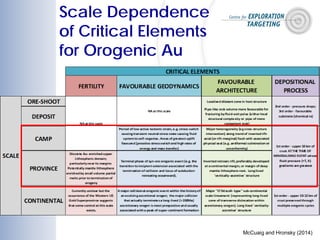
Scale Dependence
of Critical Elements
for Orogenic Au
McCuaig and Hronsky (2014)
Distal Footprints of
Giant Ore Systems
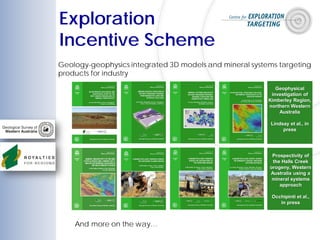
Largest integrated geoscience initiative in Australia
Exploration
Incentive Scheme
Geology-geophysics integrated 3D models and mineral systems targeting
products for industry
And more on the way…
Geophysical
investigation of
Kimberley Region,
northern Western
Australia
Lindsay et al., in
press
Prospectivity of
the Halls Creek
orogeny, Western
Australia using a
mineral systems
approach
Occhipinti et al.,
in press
Takeaway
Messages
Mineral systems are complex dynamic systems exhibiting
self-organised critical (SOC) behaviour
Critical elements of mineral systems are whole lithosphere
architecture, transient geodynamic triggers, fertility, and
preservation of primary depositional zone
In application of the mineral system concept in targeting,
SCALE of decision must be matched to scale of relevant
geological process
Fertility
Favourable
Whole-lithosphere
Architecture
Favourable
(Transient)
Geodynamics
Ore Genesis
Preservation (of
primary
depositional zone)
+
McCuaig and Hronsky (2014)
A New View
on Footprints
In exploration for new high quality mineral
districts under cover, it is the largest scale
footprint of the deposits that is relevant to our
targeting models
These large scale footprints differ substantially
from the local expressions captured by
traditional analogue models
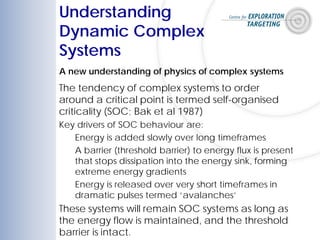
The tendency of complex systems to order
around a critical point is termed self-organised
criticality (SOC; Bak et al 1987)
Key drivers of SOC behaviour are:
Energy is added slowly over long timeframes
A barrier (threshold barrier) to energy flux is present
that stops dissipation into the energy sink, forming
extreme energy gradients
Energy is released over very short timeframes in
dramatic pulses termed ā€˜avalanches’
These systems will remain SOC systems as long as
the energy flow is maintained, and the threshold
barrier is intact.
A new understanding of physics of complex systems
Understanding
Dynamic Complex
Systems
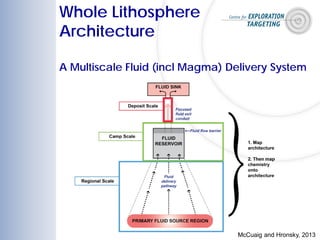
Whole Lithosphere
Architecture
A Multiscale Fluid (incl Magma) Delivery System
McCuaig and Hronsky, 2013
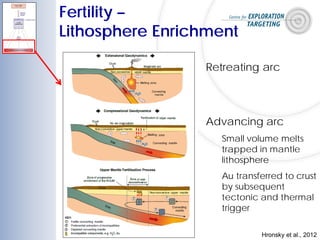
Retreating arc
Advancing arc
Small volume melts
trapped in mantle
lithosphere
Au transferred to crust
by subsequent
tectonic and thermal
trigger
Hronsky et al., 2012
Fertility –
Lithosphere Enrichment

Mineral systems: key to exploration targeting

  • 1.
    T. Campbell McCuaigand Jon Hronsky1,2,3 1Centre for Exploration Targeting, 2ARC Centre of Excellence for Core to Crust Fluid Systems 3 Western Mining Services Geological Survey of New South Wales Exploration in the House May 2016
  • 2.
    Takeaway Messages Mineral systems arecomplex dynamic systems exhibiting self-organised critical (SOC) behaviour Critical elements of mineral systems are whole lithosphere architecture, transient geodynamic triggers, fertility, and preservation of primary depositional zone In application of the mineral system concept in targeting, SCALE of decision must be matched to scale of relevant geological process Fertility Favourable Whole-lithosphere Architecture Favourable (Transient) Geodynamics Ore Genesis Preservation (of primary depositional zone) + McCuaig and Hronsky (2014)
  • 3.
    The Problem How topredict location and geometry of new high quality mineral districts – camps – oreshoots? 2.7-2.6 Ga Ni and Au in the Yilgarn WA Craton / district scale 150km 400km NewHollandAu (Henson,2008) St.IvesAu (Milleretal.2010) (McCuaigetal.2010) Deposit scale Oreshoot scale 100m 2km Camp scale
  • 4.
    LOW BROAD REGIONAL PREDICTION HIGH PROSPECT SCALE SCALE(km) RELATIVE EFFECTIVENESS DETECTION Camp scale decision 1000 100 10 1 0.1 COST FLEXIBILITY Alteration halos High definition geophysics Drilling Geochemistry Where do we focus the more systematic, detailed and expensive detection technologies? Scale Dependent Targeting McCuaig et al. (2010)
  • 5.
    We Need Non- TraditionalDatasets to See Large Footprints Magnetotelluric Section through Olympic Dam Modified after Hayward, 2004; Magnetotelluric section provided R. Gill, Uni. Adel; ā€œhotterā€ colours are more conductive Areas of Textureless Seismic Response OD Density Inversion Anomaly 40km Moho Need to understand the entire system
  • 6.
    Mineral Systems – SomeConstraints Take elements at low concentration from large volumes of rock to high concentration in small volumes of rock Only plausible mechanism is through advective mass flux – needs a fluid (fluid/magma) Ore deposits therefore are foci of large scale advective mass and energy flux Fluid needs to be low viscosity, available in large quantities over short timeframes, highly organised (focussed in space and time) Mineral systems are dynamic complex systems Olympic Dam Perseverance Norilsk
  • 7.
    Structure and Patternin earth systems e.g. Power-law size frequency distributions (scale invariant) in Earth Systems Understanding Dynamic Complex Systems Example: Fault size populations Needham et al., 1996Malamud & Turcotte 2006 Example: Gutenberg-Richter earthquake scaling. Example: Superior craton, greenstone-hosted lode gold Robert et al., 2005
  • 8.
    Energy Sink Energy Source Potential Energy GradientSelf-Organized System Entropy (exported to environment as diffuse heat) Energy Flux – fed into system at a slow rate Energy Flux – Released in transient ā€œAvalanchesā€ Threshold Barrier A B Ore formation as a product of self-organising critical systems Understanding Dynamic Complex Systems McCuaig and Hronsky (2014)
  • 9.
    Fertility Favourable Whole-lithosphere Architecture Favourable (Transient) Geodynamics Ore Genesis Preservation (of primarydepositional zone)+ Critical Elements of Mineral Systems McCuaig and Hronsky (2014)
  • 10.
    Fertility Favourable Whole-lithosphere Architecture Favourable (Transient) Geodynamics Ore Genesis Preservation (of primarydepositional zone)+ Critical Elements of Mineral Systems McCuaig and Hronsky (2014)
  • 11.
    Whole Lithosphere Architecture Isotopic mapsas ā€˜paleogeophysics’ to image paleoarchitecture Time slices can provide insights into spatial distribution of multiple mineral systems through time PREDICTIVE TOOL ʐNd Mole et al., 2012 ʐHf Mole et al., 2012 Craton margin, 2.7 Ga Craton margin, 2.9-2.8 Ga NiS (red), Fe (blue), Au (gold) deposit distributions NiS deposits (stars) and komatiite Mg# (red) at 2.9Ga
  • 12.
    After McCuaig 2003(courtesy of Antamina); Love et al., 2004 Antamina, Peru
  • 13.
    McCuaig and Hronsky,(2014) Vertical Accretive Growth History – Antamina
  • 14.
    Vertical Accretive Growth History FundamentalLithospheric Flaws McCuaig and Hronsky (2014)
  • 15.
  • 16.
    Common Characteristics of Large ScaleOre-Controlling Structures Strike-extensive. Depth-extensive (often lithospheric mantle) with relatively steep dips (as imaged in geophysics). Commonly juxtapose distinctly different basement domains (as imaged by isotopes and magma chemistry), and differing mineral endowment Multiply-reactivated (commonly with variable senses of movement) with a very long history. Vertically-accretive growth histories. These are not the obvious structures at or above the level of mineralisation – an important message for targeting.
  • 17.
    Fertility Favourable Whole-lithosphere Architecture Favourable (Transient) Geodynamics Ore Genesis Preservation (of primarydepositional zone)+ Critical Elements of Mineral Systems McCuaig and Hronsky (2014)
  • 18.
    In recent yearsincreasing availability of high-resolution geochronology and better understanding of global geodynamics This is increasingly indicating that major ore-forming events occur in narrow time windows, often over broad areas These critical time horizons must reflect unusual regional- scale geodynamic settings that are favourable for mineralisation These favourable settings must be transient, lasting for only short periods of geological time Transient Geodynamic Triggers
  • 19.
    Focused system withlittle lateral dispersion Broad halo but not syn-ore Transient Geodynamic Triggers Main ore events are transient in a larger magmatic/hydrothermal event McCuaig and Hronsky (2014)
  • 20.
    Large Orogenic Au deposit LargePorphyry Cu-Au deposit All these major deposits formed at 440 Ma (as did North Kazakhstan Gold Province) Squire & Miller (2003) Transient Geodynamic Triggers
  • 21.
    Favourable Transient Geodynamic Events Empirically werecognise three common scenarios: Incipient Extension (VMS, Akalic LSE Au, LSE Au, NiS) Transient Compression (Porphyry Suite deposits, Mafic Intrusion NiS) Switches in Far-Field Stress (All?)
  • 22.
    Favourable Transient Geodynamic Events During theseevents: Active permeability creation is stopped, or Vertical permeability is clamped Energy and fluid input to the system continues Extreme energy and fluid pressure gradients are formed The system self-organizes to form ore as long as the geodynamic threshold barrier remains intact.
  • 23.
    McCuaig and Hronsky2014 Threshold Barrier Incipient Extension e.g. VMS-epithermal
  • 24.
    McCuaig and Hronsky2014 Threshold Barrier Transient Anomalous Compression e.g. porphyry After Rosenbaum et al., 2005 After Sillitoe 2010
  • 25.
    Goldfarb et al.,2005 Threshold Barrier Stress Switches e.g. orogenic gold
  • 26.
    Fertility Favourable Whole-lithosphere Architecture Favourable (Transient) Geodynamics Ore Genesis Preservation (of primarydepositional zone)+ Critical Elements of Mineral Systems McCuaig and Hronsky (2014)
  • 27.
    Fertility A geological regionor time period systematically better-endowed than otherwise equivalent geological environments 4 components Secular Earth Evolution Lithosphere fertility (e.g. Au) Geodynamic context (e.g. magmatic-hydrothermal Cu) Paleolatitude (Zn-Pb, U, Fe, others?)
  • 28.
  • 29.
    Fertility - Geodynamic Context SpreadingRate on the MAR increased rapidly in Cretaceous This pushed South America hard to the west Which made the western margin anomalously compressional Andean Cu since the Cretaceous – anomalously compressive margin Emergence of Ongtong-Java plateau in southern Pacific This pushed Pacific plate hard to the ENE
  • 30.
    McCuaig and Hronsky2014 Nested scales of Threshold barriers Transient extreme anomalous compression causes ore
  • 31.
    Mineral Systems in Practice Atall scales, processes at site of deposition get heavy weighting, despite their lower relevance to regional targeting decisions Bias is to data rich areas at expense of data poor areas. Challenge in practical application is in keeping scale of decision matched to scale of relevant mineral system process:
  • 32.
    after McCuaig and Hronsky2000 LOW BROAD REGIONAL PREDICTION HIGH PROSPECT SCALE SCALE (km) RELATIVE EFFECTIVENESS DETECTION Camp scale decision 1000 100 10 1 0.1 COST FLEXIBILITY Scale Dependent Targeting Detect evidence of the mineral system (fertility, whole lithosphere architecture, geodynamics) REGION Detect evidence of the zones of mass and energy flux (architecture, local geodynamics, preservation) CAMP Find the deposit/oreshoot through systematic detection (alteration, high-res geophys, geochem, drilling) ORESHOOTDEPOSIT
  • 33.
    Scale Dependence of CriticalElements for Orogenic Au McCuaig and Hronsky (2014)
  • 34.
    Distal Footprints of GiantOre Systems Largest integrated geoscience initiative in Australia
  • 35.
    Exploration Incentive Scheme Geology-geophysics integrated3D models and mineral systems targeting products for industry And more on the way… Geophysical investigation of Kimberley Region, northern Western Australia Lindsay et al., in press Prospectivity of the Halls Creek orogeny, Western Australia using a mineral systems approach Occhipinti et al., in press
  • 36.
    Takeaway Messages Mineral systems arecomplex dynamic systems exhibiting self-organised critical (SOC) behaviour Critical elements of mineral systems are whole lithosphere architecture, transient geodynamic triggers, fertility, and preservation of primary depositional zone In application of the mineral system concept in targeting, SCALE of decision must be matched to scale of relevant geological process Fertility Favourable Whole-lithosphere Architecture Favourable (Transient) Geodynamics Ore Genesis Preservation (of primary depositional zone) + McCuaig and Hronsky (2014)
  • 37.
    A New View onFootprints In exploration for new high quality mineral districts under cover, it is the largest scale footprint of the deposits that is relevant to our targeting models These large scale footprints differ substantially from the local expressions captured by traditional analogue models
  • 38.
    The tendency ofcomplex systems to order around a critical point is termed self-organised criticality (SOC; Bak et al 1987) Key drivers of SOC behaviour are: Energy is added slowly over long timeframes A barrier (threshold barrier) to energy flux is present that stops dissipation into the energy sink, forming extreme energy gradients Energy is released over very short timeframes in dramatic pulses termed ā€˜avalanches’ These systems will remain SOC systems as long as the energy flow is maintained, and the threshold barrier is intact. A new understanding of physics of complex systems Understanding Dynamic Complex Systems
  • 39.
    Whole Lithosphere Architecture A MultiscaleFluid (incl Magma) Delivery System McCuaig and Hronsky, 2013
  • 40.
    Retreating arc Advancing arc Smallvolume melts trapped in mantle lithosphere Au transferred to crust by subsequent tectonic and thermal trigger Hronsky et al., 2012 Fertility – Lithosphere Enrichment