GREENSTONE-HOSTED QUARTZ-CARBONATE VEIN DEPOSITS
                                                 BENOÎT DUBÉ AND PATRICE GOSSELIN
                            Geological Survey of Canada, 490 de la Couronne, Quebec, Quebec G1K 9A9
                                     Corresponding author’s email: bdube@nrcan-rncan.gc.ca

                                                                      Abstract
               Greenstone-hosted quartz-carbonate vein deposits typically occur in deformed greenstone belts of all ages, espe-
          cially those with variolitic tholeiitic basalts and ultramafic komatiitic flows intruded by intermediate to felsic porphyry
          intrusions, and sometimes with swarms of albitite or lamprophyre dyke. They are distributed along major compressional
          to transtensional crustal-scale fault zones in deformed greenstone terranes commonly marking the convergent margins
          between major lithological boundaries, such as volcano-plutonic and sedimentary domains. The large greenstone-
          hosted quartz-carbonate vein deposits are commonly spatially associated with fluvio-alluvial conglomerate (e.g.
          Timiskaming conglomerate) distributed along major crustal fault zones (e.g. Destor Porcupine Fault). This association
          suggests an empirical time and space relationship between large-scale deposits and regional unconformities.
               These types of deposits are most abundant and significant, in terms of total gold content, in Archean terranes.
          However, a significant number of world-class deposits are also found in Proterozoic and Paleozoic terranes. In Canada,
          they represent the main source of gold and are mainly located in the Archean greenstone belts of the Superior and Slave
          provinces. They also occur in the Paleozoic greenstone terranes of the Appalachian orogen and in the oceanic terranes
          of the Cordillera.
               The greenstone-hosted quartz-carbonate vein deposits correspond to structurally controlled complex epigenetic
          deposits characterized by simple to complex networks of gold-bearing, laminated quartz-carbonate fault-fill veins.
          These veins are hosted by moderately to steeply dipping, compressional brittle-ductile shear zones and faults with
          locally associated shallow-dipping extensional veins and hydrothermal breccias. The deposits are hosted by greenschist
          to locally amphibolite-facies metamorphic rocks of dominantly mafic composition and formed at intermediate depth (5-
          10 km). The mineralization is syn- to late-deformation and typically post-peak greenschist -facies or syn-peak amphi-
          bolite-facies metamorphism. They are typically associated with iron-carbonate alteration. Gold is largely confined to
          the quartz-carbonate vein network but may also be present in significant amounts within iron-rich sulphidized wall-rock
          selvages or within silicified and arsenopyrite-rich replacement zones.
               There is a general consensus that the greenstone-hosted quartz-carbonate vein deposits are related to metamorphic
          fluids from accretionary processes and generated by prograde metamorphism and thermal re-equilibration of subducted
          volcano-sedimentary terranes. The deep-seated, Au-transporting metamorphic fluid has been channelled to higher
          crustal levels through major crustal faults or deformation zones. Along its pathway, the fluid has dissolved various com-
          ponents - notably gold - from the volcano-sedimentary packages, including a potential gold-rich precursor. The fluid
          then precipitated as vein material or wall-rock replacement in second and third order structures at higher crustal levels
          through fluid-pressure cycling processes and temperature, pH and other physico-chemical variations.
                                                                      Résumé
               Les gîtes de filoniens à veines de quartz-carbonates dans des roches vertes reposent généralement au sein de cein-
          tures de roches vertes de tout âge, mais tout particulièrement dans celles qui présentent des basaltes tholéiitiques à tex-
          ture variolaire et des coulées ultramafiques komatiitiques dans lesquels se sont mis en place des intrusions porphyriques
          de composition intermédiaire à felsique et, parfois, des essaims de dykes d’albitite ou de lamprophyre. Ces gîtes sont
          répartis le long d’importantes zones de failles d’échelle crustale formées dans un régime allant de la compression à la
          transtension, au sein de terrains de roches vertes déformés, où elles coïncident habituellement avec d’importantes lim-
          ites lithologiques qui témoignent d’une marge convergence, comme celles qui séparent des domaines sédimentaires de
          domaines volcano-plutoniques. Les plus gros gisements du genre sont souvent associés, sur le plan spatial, à des con-
          glomérats fluvio-alluvionnaires (p. ex. le conglomérat de Timiskaming) répartis le long d’importantes zones de failles
          d’échelle crustale (p. ex. la faille de Destor-Porcupine). Cette association suppose un lien empirique aussi bien temporel
          que spatial entre les gros gisements et les discordances régionales.
               Les gîtes de ce type sont plus abondants et importants, quant au contenu total en or, dans les terrains archéens.
          Cependant, de nombreux gisements de calibre mondial reposent aussi dans des terrains protérozoïques et paléozoïques.
          Au Canada, ils constituent la principale source d’or et sont concentrés dans les ceintures de roches vertes archéennes
          des provinces du lac Supérieur et des Esclaves, mais on en a aussi découvert dans le terrains de roches vertes paléo-
          zoïque de l’orogène des Appalaches et dans les terrains océaniques de la Cordillère.
               Ces gîtes constituent des minéralisations épigénétiques à contrôle structural complexe caractérisées par des réseaux
          simples à complexes de filons de quartz carbonates laminés porteurs d’or produits par le remplissage de failles. Ces
          filons sont logés dans des failles et des zones de cisaillement à comportement fragile-ductile formées en régime com-
          pressif, qui présentent un pendage moyen à fort, auxquels sont associés, par endroits, des brèches hydrothermales et des
          veines d’extension à faible pendage. Les gîtes, qui se sont formés à des profondeurs intermédiaires (de 5 à 10 km), sont
          encaissés dans des roches métamorphiques, de composition principalement mafique, du faciès des schistes verts et, par
          endroits, du faciès des amphibolites. La mise en place de la minéralisation est contemporaine des phases intermédiaires
          et tardives de la déformation et s’est déroulée après l’atteinte des conditions maximales du métamorphisme au faciès
          des schistes verts ou lors de l’atteinte des conditions maximales du métamorphisme au faciès des amphibolites. La
          minéralisation est généralement associée à une altération à carbonates de fer. L’or est en grande partie piégé dans un
          réseau de filons de quartz-carbonates, mais il est aussi présent en quantités importantes dans les épontes de roches
          encaissantes sulfurées riches en fer ou de zones des remplacement silicifiées et riches en arsénopyrite.

Dubé, B., and Gosselin, P., 2007, Greenstone-hosted quartz-carbonate vein deposits, in Goodfellow, W.D., ed., Mineral Deposits of Canada: A Synthesis of
Major Deposit-Types, District Metallogeny, the Evolution of Geological Provinces, and Exploration Methods: Geological Association of Canada, Mineral
Deposits Division, Special Publication No. 5, p. 49-73.
B. Dubé and P. Gosselin

                   On croit que l’existence des gîtes de filons de quartz-carbonates dans des roches vertes est liée à celle de fluides
               métamorphiques issus de processus d’accrétion, et qu’ils sont le produit d’un métamorphisme prograde et d’une remise
               en équilibre thermique de terrains volcano-sédimentaires subductés. Les fluides métamorphiques de grande profondeur
               qui ont transporté l’or se sont élevés dans la croûte en empruntant d’importantes failles ou zones de déformation
               d’échelle crustale. Le long de leur parcours, ils ont dissous divers éléments, dont l’or, dans les assemblages volcano-
               sédimentaires, qui pouvaient comprendre un précurseur riche en or. Les fluides ont ensuite précipité sous forme de
               veines ou ont remplacé les roches encaissantes dans des structures de deuxième et de troisième ordres, à des niveaux
               crustaux supérieurs, selon une succession de cycles liés à des variations de la pression hydrostatique, de la température,
               du pH et d’autres paramètres physico-chimiques.


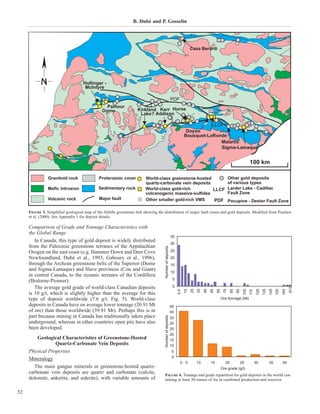
                 Definition                                                                 EPITHERMAL CLAN
     Simplified Definition                                                                                 ADVANCED ARGILLIC
                                                                                    HOTSPRING
        Greenstone-hosted quartz-car-          km                                                            HIGH-SULPHIDATION
                                                                                                                                                       sea level
     bonate vein deposits occur as              0                                LOW SULFIDATION                                     Rhyolite dome
                                                             PALEOPLACER
     quartz and quartz-carbonate veins,                                                                                             AU-RICH MASSIVE
                                                                                                                                    SULPHIDE
                                                                                           ARGILLIC
     with valuable amounts of gold and                                                                                              (mainly from
                                                                                                                                    Hannington et al., 1999)
     silver, in faults and shear zones          1                                      STOCKWORK-      SERICITE           BRECCIA-PIPE AU
                                                                                      DISSEMINATED
     located within deformed terranes                                                           AU
                                                                                                                                        Carbonate
     of ancient to recent greenstone                                                     Permeable
                                                                                                                                        rocks
     belts commonly metamorphosed                                                              Unit
                                                                                                                                    CARLIN TYPE
     at greenschist facies.                                    GREENSTONE VEIN                  PORPHYRY
                                                             AND SLATE BELT CLANS                     AU                         AU MANTO

     Scientific Definition                    5                                                          Dyke                       AU SKARN
                                                 TURBIDITE-HOSTED                                              Stock          Vein
         Greenstone-hosted quartz-car-                           VEIN
     bonate vein deposits are a subtype            BIF-HOSTED VEIN
                                                                                         Wacke-shale          INTRUSION-RELATED CLAN
                                                                                                        (mainly from Sillitoe and Bonham, 1990)
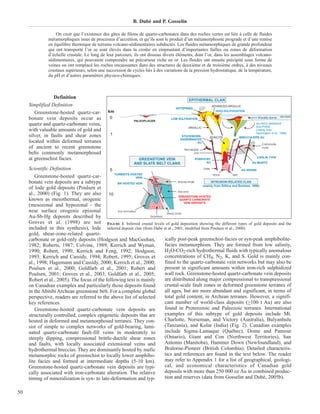
     of lode gold deposits (Poulsen et
                                                                                         Volcanic
     al., 2000) (Fig. 1). They are also 10                                               GREENSTONE-HOSTED
     known as mesothermal, orogenic                                                       QUARTZ-CARBONATE
                                                                                             VEIN DEPOSITS
     (mesozonal and hypozonal - the
     near surface orogenic epizonal                Iron formation
                                                                                 Shear zone
     Au-Sb-Hg deposits described by                                   Granitoid

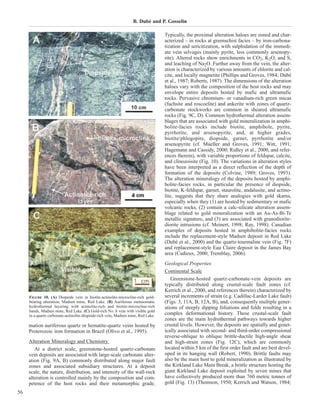
     Groves et al. (1998) are not FIGURE 1. Inferred crustal levels of gold deposition showing the different types of gold deposits and the
     included in this synthesis), lode inferred deposit clan (from Dubé et al., 2001; modified from Poulsen et al., 2000).
     gold, shear-zone-related quartz-
     carbonate or gold-only deposits (Hodgson and MacGeehan,                    ically post-peak greenschist-facies or syn-peak amphibolite-
     1982; Roberts, 1987; Colvine, 1989; Kerrich and Wyman,                     facies metamorphism. They are formed from low salinity,
     1990; Robert, 1990; Kerrich and Feng, 1992; Hodgson,                       H2O-CO2-rich hydrothermal fluids with typically anomalous
     1993; Kerrich and Cassidy, 1994; Robert, 1995; Groves et                   concentrations of CH4, N2, K, and S. Gold is mainly con-
     al., 1998; Hagemann and Cassidy, 2000; Kerrich et al., 2000;               fined to the quartz-carbonate vein networks but may also be
     Poulsen et al., 2000; Goldfarb et al., 2001; Robert and                    present in significant amounts within iron-rich sulphidized
     Poulsen, 2001; Groves et al., 2003; Goldfarb et al., 2005;                 wall rock. Greenstone-hosted quartz-carbonate vein deposits
     Robert et al., 2005). The focus of the following text is mainly            are distributed along major compressional to transpressional
     on Canadian examples and particularly those deposits found                 crustal-scale fault zones in deformed greenstone terranes of
     in the Abitibi Archean greenstone belt. For a complete global              all ages, but are more abundant and significant, in terms of
     perspective, readers are referred to the above list of selected            total gold content, in Archean terranes. However, a signifi-
     key references.                                                            cant number of world-class deposits (>100 t Au) are also
         Greenstone-hosted quartz-carbonate vein deposits are                   found in Proterozoic and Paleozoic terranes. International
     structurally controlled, complex epigenetic deposits that are              examples of this subtype of gold deposits include Mt.
     hosted in deformed and metamorphosed terranes. They con-                   Charlotte, Norseman, and Victory (Australia), Bulyanhulu
     sist of simple to complex networks of gold-bearing, lami-                  (Tanzania), and Kolar (India) (Fig. 2). Canadian examples
     nated quartz-carbonate fault-fill veins in moderately to                   include Sigma-Lamaque (Québec), Dome and Pamour
     steeply dipping, compressional brittle-ductile shear zones                 (Ontario), Giant and Con (Northwest Territories), San
     and faults, with locally associated extensional veins and                  Antonio (Manitoba), Hammer Down (Newfoundland), and
     hydrothermal breccias. They are dominantly hosted by mafic                 Bralorne-Pioneer (British Columbia). Detailed characteris-
     metamorphic rocks of greenschist to locally lower amphibo-                 tics and references are found in the text below. The reader
     lite facies and formed at intermediate depths (5-10 km).                   may refer to Appendix 1 for a list of geographical, geologi-
     Greenstone-hosted quartz-carbonate vein deposits are typi-                 cal, and economical characteristics of Canadian gold
     cally associated with iron-carbonate alteration. The relative              deposits with more than 250 000 oz Au in combined produc-
     timing of mineralization is syn- to late-deformation and typ-              tion and reserves (data from Gosselin and Dubé, 2005b).

50
Greenstone-Hosted Quartz-Carbonate Vein Deposits

                                           New Brittannia                                                                      Berezovskoe
                                  Discovery                                                                                            Kochkar
                                                                                                                                            Stepnyak                             Darasun
              Yellowknife                                                                                            Svetlinskoe
                                                                                                                                                                                                       Karalveem
                                                                                                                                                Olimpiada
                                                                                                                                                        Duolanasayi
                       Alaska-Juneau                                   Casa Berardi                                                     Aksu
                                                                                                                     Daugyztau
           Treadwell                                                    Chibougamau
          Bralorne-Pioneer                                                    Val d'Or                                                                       Zun-Holba
                                  San Antonio
                                                                            Timmins                                                             Qiyiqiu No. 1
         Alleghany District    Grass Valley District                Kirkland Lake ?
         Mother Lode System                                                                                                                        Akbakay                                      Paishanlou
                                                                Larder Lake                                                                          Baguamiao
                                                            Renabie                                                                                                                        Shanggong
                   La Herradura                                                Amesmessa                                                                   Woxi
                                                                                                                                                                                           Wenyu
                                                                                                                                                                                  Hetai
                                                                                                                                   Zarmitan                              Erjia
                                                                   El Callao                                                          Kolar         Hutti
                                                                                    Yatela
                                                                      Gross Rosebel Morila
                                                                        Omai                                                   Lega Dembi
                                                                                         Syama
                                                                                                                            Bulyanhulu
                                                                                            Poura
                                                                                                    Bibiani                       Shamva
                                                                                                 Obuasi                           Mazoe
                                                                               Fazenda Brasileiro                                                                Plutonic
                                                                                              Cam & Motor                           Dalny                                                      Bronzewing
                                                                               Morro do Ouro                                       Golden Valley                                                 Lancefield
                                                                              Morro Velho                                        Lonely                     Meekatharra
                                                                          Passagem de Mariana        Navachab                                    Day Dawn                                           Gympie
                                                                                                                                 Blanket
                                                                                                                        Fairview         Morning Star / Evening Star                                 Granny Smith
                                                                                               Globe and Phoenix
                                                                                                                       New Consort
                                                                                                                     Sheba                      Sons of Gwalia
                                                                                                                                                     Golden Mile
                                                                                                                                                       Mount Charlotte                         Sunrise Dam - Cleo
                                                                                                                                                                           Royal
                                                                                                                                                                  New Celebration
                                                                                                                                                                                    Norseman
                                                                                                                                                                                      Victory-Defiance
                                                                                     Legend
                              Cenozoic           Paleozoic               Archean                     Precambrian                         Greenstone-hosted
                                                                                                                                          quartz-carbonate
                              Mesozoic           Proterozoic             Phanerozoic                 Proterozoic-Phanerozoic             vein deposit


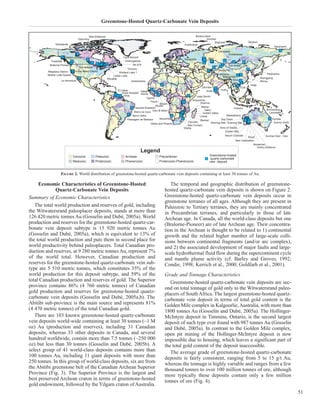
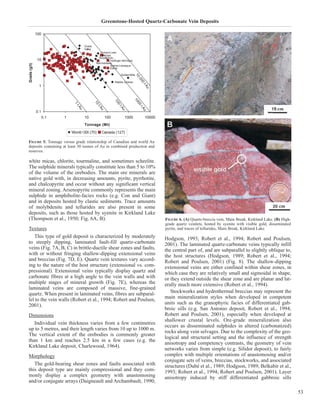
                   FIGURE 2. World distribution of greenstone-hosted quartz-carbonate vein deposits containing at least 30 tonnes of Au.

     Economic Characteristics of Greenstone-Hosted                                                          The temporal and geographic distribution of greenstone-
              Quartz-Carbonate Vein Deposits                                                             hosted quartz-carbonate vein deposits is shown on Figure 2.
Summary of Economic Characteristics                                                                      Greenstone-hosted quartz-carbonate vein deposits occur in
                                                                                                         greenstone terranes of all ages. Although they are present in
   The total world production and reserves of gold, including                                            Paleozoic to Tertiary terranes, they are mainly concentrated
the Witwatersrand paleoplacer deposits, stands at more than                                              in Precambrian terranes, and particularly in those of late
126 420 metric tonnes Au (Gosselin and Dubé, 2005a). World                                               Archean age. In Canada, all the world-class deposits but one
production and reserves for the greenstone-hosted quartz-car-                                            (Bralorne-Pioneer) are of late Archean age. Their concentra-
bonate vein deposit subtype is 15 920 metric tonnes Au                                                   tion in the Archean is thought to be related to 1) continental
(Gosselin and Dubé, 2005a), which is equivalent to 13% of                                                growth and the related higher number of large-scale colli-
the total world production and puts them in second place for                                             sions between continental fragments (and/or arc complex),
world productivity behind paleoplacers. Total Canadian pro-                                              and 2) the associated development of major faults and large-
duction and reserves, at 9 280 metric tonnes Au, represent 7%                                            scale hydrothermal fluid flow during the supercontinent cycle
of the world total. However, Canadian production and                                                     and mantle plume activity (cf. Barley and Groves, 1992;
reserves for the greenstone-hosted quartz-carbonate vein sub-                                            Condie, 1998; Kerrich et al., 2000; Goldfarb et al., 2001).
type are 5 510 metric tonnes, which constitutes 35% of the
world production for this deposit subtype, and 59% of the                                                Grade and Tonnage Characteristics
total Canadian production and reserves of gold. The Superior                                                Greenstone-hosted quartz-carbonate vein deposits are sec-
province contains 86% (4 760 metric tonnes) of Canadian                                                  ond on total tonnage of gold only to the Witwatersrand paleo-
gold production and reserves for greenstone-hosted quartz-                                               placers of South Africa. The largest greenstone-hosted quartz-
carbonate vein deposits (Gosselin and Dubé, 2005a,b). The                                                carbonate vein deposit in terms of total gold content is the
Abitibi sub-province is the main source and represents 81%                                               Golden Mile complex in Kalgoorlie, Australia, with more than
(4 470 metric tonnes) of the total Canadian gold.                                                        1800 tonnes Au (Gosselin and Dubé, 2005a). The Hollinger-
   There are 103 known greenstone-hosted quartz-carbonate                                                McIntyre deposit in Timmins, Ontario, is the second largest
vein deposits world-wide containing at least 30 tonnes (~1 M                                             deposit of such type ever found with 987 tonnes Au (Gosselin
oz) Au (production and reserves), including 31 Canadian                                                  and Dubé, 2005a). In contrast to the Golden Mile complex,
deposits, whereas 33 other deposits in Canada, and several                                               open pit mining of the Hollinger-McIntyre deposit is now
hundred worldwide, contain more than 7.5 tonnes (~250 000                                                impossible due to housing, which leaves a significant part of
oz) but less than 30 tonnes (Gosselin and Dubé, 2005b). A                                                the total gold content of the deposit inaccessible.
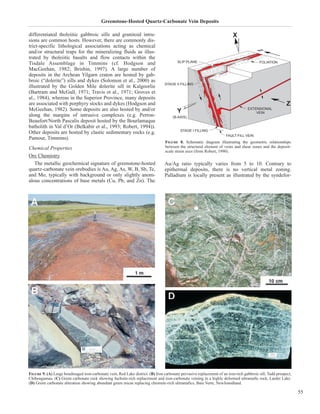
select group of 41 world-class deposits contains more than                                                  The average grade of greenstone-hosted quartz-carbonate
100 tonnes Au, including 11 giant deposits with more than                                                deposits is fairly consistent, ranging from 5 to 15 g/t Au,
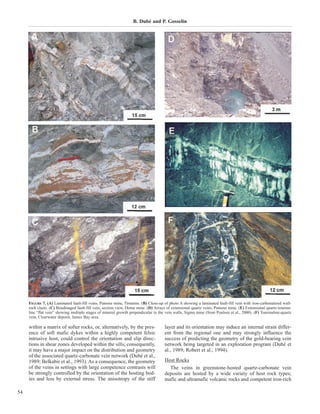
250 tonnes. In this group of world-class deposits, six are from                                          whereas the tonnage is highly variable and ranges from a few
the Abitibi greenstone belt of the Canadian Archean Superior                                             thousand tonnes to over 100 million tonnes of ore, although
Province (Fig. 3). The Superior Province is the largest and                                              more typically these deposits contain only a few million
best preserved Archean craton in terms of greenstone-hosted                                              tonnes of ore (Fig. 4).
gold endowment, followed by the Yilgarn craton of Australia.
                                                                                                                                                                                                                    51
B. Dubé and P. Gosselin


                                                                                                                         Casa Berardi


                                    Hollinger -
                                     McIntyre

                                                                                                         PDF
                                                 Pamour
                                               Dome                 Kirkland Kerr Horne
                                                                     Lake? Addison

                                                                                                                               LLCF
                                                                                                                     Doyon
                                                                                                                    Bousquet-LaRonde
                                                                                                                                  Malartic
                                                                                                                                  Sigma-Lamaque


                                                                                                                                                                          100 km

                Granitoid rock               Proterozoic cover           World-class greenstone-hosted       Other gold deposits
                                                                         quartz-carbonate vein deposits      of various types
                Mafic intrusion              Sedimentary rock            World-class gold-rich          LLCF Larder Lake - Cadillac
                                                                         volcanogenic massive-sulfides       Fault Zone
                Volcanic rock                Major fault                 Other smaller gold-rich VMS    PDF Pocupine - Destor Fault Zone

     FIGURE 3. Simplified geological map of the Abitibi greenstone belt showing the distribution of major fault zones and gold deposits. Modified from Poulsen
     et al. (2000). See Appendix 1 for deposit details.

     Comparison of Grade and Tonnage Characteristics with
     the Global Range
                                                                                                         35
        In Canada, this type of gold deposit is widely distributed
                                                                                                         30
     from the Paleozoic greenstone terranes of the Appalachian
                                                                                    Number of deposits


     Orogen on the east coast (e.g. Hammer Down and Deer Cove                                            25
     Newfoundland, Dubé et al., 1993; Gaboury et al., 1996),                                             20
     through the Archean greenstone belts of the Superior (Dome                                          15
     and Sigma-Lamaque) and Slave provinces (Con and Giant)                                              10
     in central Canada, to the oceanic terranes of the Cordillera
     (Bralorne-Pioneer).                                                                                  5

        The average gold grade of world-class Canadian deposits                                           0
                                                                                                                                                                                                               915
                                                                                                                         25
                                                                                                                              35
                                                                                                                                   45
                                                                                                                                        55
                                                                                                                                             65
                                                                                                                                                   75
                                                                                                                                                         85


                                                                                                                                                                    105


                                                                                                                                                                                 125
                                                                                                                                                                                       135
                                                                                                                                                                                             145
                                                                                                                                                                                                   155
                                                                                                                                                                                                         165
                                                                                                                    15


                                                                                                                                                              95
                                                                                                              0-5


                                                                                                                                                                          115


     is 10 g/t, which is slightly higher than the average for this
     type of deposit worldwide (7.6 g/t, Fig. 5). World-class                                                                                     Ore tonnage (Mt)
     deposits in Canada have on average lower tonnage (20.91 Mt                                          45
     of ore) than those worldwide (39.91 Mt). Perhaps this is in                                         40
     part because mining in Canada has traditionally taken place
                                                                                    Number of deposits


                                                                                                         35
     underground, whereas in other countries open pits have also                                         30
     been developed.                                                                                     25
                                                                                                         20
         Geological Characteristics of Greenstone-Hosted                                                 15
                 Quartz-Carbonate Vein Deposits                                                          10
     Physical Properties                                                                                 5
                                                                                                         0
     Mineralogy
                                                                                                                0-5           10        15          20             25           30           35          40
        The main gangue minerals in greenstone-hosted quartz-                                                                                     Ore grade (g/t)
     carbonate vein deposits are quartz and carbonate (calcite,                     FIGURE 4. Tonnage and grade repartition for gold deposits in the world con-
     dolomite, ankerite, and siderite), with variable amounts of                    taining at least 30 tonnes of Au in combined production and reserves.


52
Greenstone-Hosted Quartz-Carbonate Vein Deposits

              100


                                       Grass
                                       Valley
                                                     Kirkland Lake
                                                      Kolar
                                                  Bulyanhulu
              10                                          Hollinger-McIntyre
                                                KerrAddison
Grade (g/t)


                                                          Sigma-Lamaque
                                                          Dome

                                                                         GoldenMile


                                                                                  10
                                                                                      00
                                                                Alaska-Juneau


                                                                                       0
                                                                                           tA
               1


                                                                                             u
                                                                                  10
                                                                10
                                                10


                                                                                      00
                               1


                                                                     0
                                tA


                                                 tA


                                                                     tA


                                                                                       tA
                                   u


                                                   u


                                                                       u


                                                                                         u
              0.1
                0
                     0
                    0.1   1            10              100                 1000            10000
                                       Tonnage (Mt)
                              World 30t (70)                   7
                                                     Canada (128)

FIGURE 5. Tonnage versus grade relationship of Canadian and world Au
deposits containing at least 30 tonnes of Au in combined production and
reserves.

white micas, chlorite, tourmaline, and sometimes scheelite.
The sulphide minerals typically constitute less than 5 to 10%
of the volume of the orebodies. The main ore minerals are
native gold with, in decreasing amounts, pyrite, pyrrhotite,
and chalcopyrite and occur without any significant vertical
mineral zoning. Arsenopyrite commonly represents the main
sulphide in amphibolite-facies rocks (e.g. Con and Giant)
and in deposits hosted by clastic sediments. Trace amounts
of molybdenite and tellurides are also present in some
deposits, such as those hosted by syenite in Kirkland Lake
(Thompson et al., 1950; Fig. 6A, B).                                                               FIGURE 6. (A) Quartz-breccia vein, Main Break, Kirkland Lake. (B) High-
                                                                                                   grade quartz veinlets, hosted by syenite with visible gold, disseminated
Textures                                                                                           pyrite, and traces of tellurides, Main Break, Kirkland Lake.
   This type of gold deposit is characterized by moderately                                        Hodgson, 1993; Robert et al., 1994; Robert and Poulsen,
to steeply dipping, laminated fault-fill quartz-carbonate                                          2001). The laminated quartz-carbonate veins typically infill
veins (Fig. 7A, B, C) in brittle-ductile shear zones and faults,                                   the central part of, and are subparallel to slightly oblique to,
with or without fringing shallow-dipping extensional veins                                         the host structures (Hodgson, 1989; Robert et al., 1994;
and breccias (Fig. 7D, E). Quartz vein textures vary accord-                                       Robert and Poulsen, 2001) (Fig. 8). The shallow-dipping
ing to the nature of the host structure (extensional vs. com-                                      extensional veins are either confined within shear zones, in
pressional). Extensional veins typically display quartz and                                        which case they are relatively small and sigmoidal in shape,
carbonate fibres at a high angle to the vein walls and with                                        or they extend outside the shear zone and are planar and lat-
multiple stages of mineral growth (Fig. 7E), whereas the                                           erally much more extensive (Robert et al., 1994).
laminated veins are composed of massive, fine-grained
quartz. When present in laminated veins, fibres are subparal-                                         Stockworks and hydrothermal breccias may represent the
lel to the vein walls (Robert et al., 1994; Robert and Poulsen,                                    main mineralization styles when developed in competent
2001).                                                                                             units such as the granophyric facies of differentiated gab-
                                                                                                   broic sills (e.g. San Antonio deposit, Robert et al., 1994;
Dimensions                                                                                         Robert and Poulsen, 2001), especially when developed at
                                                                                                   shallower crustal levels. Ore-grade mineralization also
   Individual vein thickness varies from a few centimetres
                                                                                                   occurs as disseminated sulphides in altered (carbonatized)
up to 5 metres, and their length varies from 10 up to 1000 m.
                                                                                                   rocks along vein selvages. Due to the complexity of the geo-
The vertical extent of the orebodies is commonly greater
                                                                                                   logical and structural setting and the influence of strength
than 1 km and reaches 2.5 km in a few cases (e.g. the
                                                                                                   anisotropy and competency contrasts, the geometry of vein
Kirkland Lake deposit, Charlewood, 1964).
                                                                                                   networks varies from simple (e.g. Silidor deposit), to fairly
Morphology                                                                                         complex with multiple orientations of anastomosing and/or
                                                                                                   conjugate sets of veins, breccias, stockworks, and associated
   The gold-bearing shear zones and faults associated with                                         structures (Dubé et al., 1989; Hodgson, 1989, Belkabir et al.,
this deposit type are mainly compressional and they com-                                           1993; Robert et al., 1994; Robert and Poulsen, 2001). Layer
monly display a complex geometry with anastomosing                                                 anisotropy induced by stiff differentiated gabbroic sills
and/or conjugate arrays (Daigneault and Archambault, 1990;

                                                                                                                                                                              53
B. Dubé and P. Gosselin


     FIGURE 7. (A) Laminated fault-fill veins, Pamour mine, Timmins. (B) Close-up of photo A showing a laminated fault-fill vein with iron-carbonatized wall-
     rock clasts. (C) Boudinaged fault-fill vein, section view, Dome mine. (D) Arrays of extensional quartz veins, Pamour mine. (E) Extensional quartz-tourma-
     line “flat vein” showing multiple stages of mineral growth perpendicular to the vein walls, Sigma mine (from Poulsen et al., 2000). (F) Tourmaline-quartz
     vein, Clearwater deposit, James Bay area.

     within a matrix of softer rocks, or, alternatively, by the pres-               layer and its orientation may induce an internal strain differ-
     ence of soft mafic dykes within a highly competent felsic                      ent from the regional one and may strongly influence the
     intrusive host, could control the orientation and slip direc-                  success of predicting the geometry of the gold-bearing vein
     tions in shear zones developed within the sills; consequently,                 network being targeted in an exploration program (Dubé et
     it may have a major impact on the distribution and geometry                    al., 1989; Robert et al., 1994).
     of the associated quartz-carbonate vein network (Dubé et al.,
     1989; Belkabir et al., 1993). As a consequence, the geometry                   Host Rocks
     of the veins in settings with large competence contrasts will                    The veins in greenstone-hosted quartz-carbonate vein
     be strongly controlled by the orientation of the hosting bod-                  deposits are hosted by a wide variety of host rock types;
     ies and less by external stress. The anisotropy of the stiff                   mafic and ultramafic volcanic rocks and competent iron-rich

54
Greenstone-Hosted Quartz-Carbonate Vein Deposits

differentiated tholeiitic gabbroic sills and granitoid intru-                                                             X
sions are common hosts. However, there are commonly dis-
trict-specific lithological associations acting as chemical
and/or structural traps for the mineralizing fluids as illus-
trated by tholeiitic basalts and flow contacts within the
                                                                                        SLIP PLANE                                       FOLIATION
Tisdale Assemblage in Timmins (cf. Hodgson and
MacGeehan, 1982; Brisbin, 1997). A large number of
deposits in the Archean Yilgarn craton are hosted by gab-
broic (“dolerite”) sills and dykes (Solomon et al., 2000) as
                                                                                 STAGE II FILLING
illustrated by the Golden Mile dolerite sill in Kalgoorlie
(Bartram and McGall, 1971; Travis et al., 1971; Groves et
al., 1984), whereas in the Superior Province, many deposits
are associated with porphyry stocks and dykes (Hodgson and                                                                                                Z
McGeehan, 1982). Some deposits are also hosted by and/or                                Y                                         EXTENSIONAL
                                                                                                                                      VEIN
along the margins of intrusive complexes (e.g. Perron-                                (B-AXIS)
Beaufort/North Pascalis deposit hosted by the Bourlamaque
batholith in Val d’Or (Belkabir et al., 1993; Robert, 1994)).
                                                                                          STAGE I FILLING
Other deposits are hosted by clastic sedimentary rocks (e.g.
                                                                                                                     FAULT-FILL VEIN
Pamour, Timmins).
                                                                                 FIGURE 8. Schematic diagram illustrating the geometric relationships
Chemical Properties                                                              between the structural element of veins and shear zones and the deposit-
                                                                                 scale strain axes (from Robert, 1990).
Ore Chemistry
   The metallic geochemical signature of greenstone-hosted                       Au/Ag ratio typically varies from 5 to 10. Contrary to
quartz-carbonate vein orebodies is Au, Ag, As, W, B, Sb, Te,                     epithermal deposits, there is no vertical metal zoning.
and Mo, typically with background or only slightly anom-                         Palladium is locally present as illustrated by the syndefor-
alous concentrations of base metals (Cu, Pb, and Zn). The


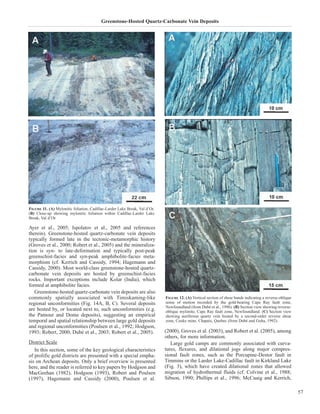
FIGURE 9. (A) Large boudinaged iron-carbonate vein, Red Lake district. (B) Iron carbonate pervasive replacement of an iron-rich gabbroic sill, Tadd prospect,
Chibougamau. (C) Green carbonate rock showing fuchsite-rich replacement and iron-carbonate veining in a highly deformed ultramafic rock, Larder Lake.
(D) Green carbonate alteration showing abundant green micas replacing chromite-rich ultramafics, Baie Verte, Newfoundland.

                                                                                                                                                                55
B. Dubé and P. Gosselin

                                                                                   Typically, the proximal alteration haloes are zoned and char-
                                                                                   acterized – in rocks at greenschist facies – by iron-carbona-
                                                                                   tization and sericitization, with sulphidation of the immedi-
                                                                                   ate vein selvages (mainly pyrite, less commonly arsenopy-
                                                                                   rite). Altered rocks show enrichments in CO2, K2O, and S,
                                                                                   and leaching of Na2O. Further away from the vein, the alter-
                                                                                   ation is characterized by various amounts of chlorite and cal-
                                                                                   cite, and locally magnetite (Phillips and Groves, 1984; Dubé
                                                                                   et al., 1987; Roberts, 1987). The dimensions of the alteration
                                                                                   haloes vary with the composition of the host rocks and may
                                                                                   envelope entire deposits hosted by mafic and ultramafic
                                                                                   rocks. Pervasive chromium- or vanadium-rich green micas
                                                                                   (fuchsite and roscoelite) and ankerite with zones of quartz-
                                                                                   carbonate stockworks are common in sheared ultramafic
                                                                                   rocks (Fig. 9C, D). Common hydrothermal alteration assem-
                                                                                   blages that are associated with gold mineralization in amphi-
                                                                                   bolite-facies rocks include biotite, amphibole, pyrite,
                                                                                   pyrrhotite, and arsenopyrite, and, at higher grades,
                                                                                   biotite/phlogopite, diopside, garnet, pyrrhotite and/or
                                                                                   arsenopyrite (cf. Mueller and Groves, 1991; Witt, 1991;
                                                                                   Hagemann and Cassidy, 2000; Ridley et al., 2000, and refer-
                                                                                   ences therein), with variable proportions of feldspar, calcite,
                                                                                   and clinozoisite (Fig. 10). The variations in alteration styles
                                                                                   have been interpreted as a direct reflection of the depth of
                                                                                   formation of the deposits (Colvine, 1989; Groves, 1993).
                                                                                   The alteration mineralogy of the deposits hosted by amphi-
                                                                                   bolite-facies rocks, in particular the presence of diopside,
                                                                                   biotite, K-feldspar, garnet, staurolite, andalusite, and actino-
                                                                                   lite, suggests that they share analogies with gold skarns,
                                                                                   especially when they (1) are hosted by sedimentary or mafic
                                                                                   volcanic rocks, (2) contain a calc-silicate alteration assem-
                                                                                   blage related to gold mineralization with an Au-As-Bi-Te
                                                                                   metallic signature, and (3) are associated with granodiorite-
                                                                                   diorite intrusions (cf. Meinert, 1998; Ray, 1998). Canadian
                                                                                   examples of deposits hosted in amphibolite-facies rocks
                                                                                   include the replacement-style Madsen deposit in Red Lake
                                                                                   (Dubé et al., 2000) and the quartz-tourmaline vein (Fig. 7F)
                                                                                   and replacement-style Eau Claire deposit in the James Bay
                                                                                   area (Cadieux, 2000; Tremblay, 2006).
                                                                                   Geological Properties
                                                                                   Continental Scale
                                                                                      Greenstone-hosted quartz-carbonate-vein deposits are
                                                                                   typically distributed along crustal-scale fault zones (cf.
                                                                                   Kerrich et al., 2000, and references therein) characterized by
     FIGURE 10. (A) Diopside vein in biotite-actinolite-microcline-rich gold-      several increments of strain (e.g. Cadillac-Larder Lake fault)
     bearing alteration, Madsen mine, Red Lake. (B) Auriferous metasomatic         (Figs. 3, 11A, B, 12A, B), and, consequently multiple gener-
     hydrothermal layering with actinolite-rich and biotite-microcline-rich        ations of steeply dipping foliations and folds resulting in a
     bands, Madsen mine, Red Lake. (C) Gold-rich No. 8 vein with visible gold
     in a quartz carbonate-actinolite-diopside-rich vein, Madsen mine, Red Lake.   complex deformational history. These crustal-scale fault
                                                                                   zones are the main hydrothermal pathways towards higher
     mation auriferous quartz or hematite-quartz veins hosted by                   crustal levels. However, the deposits are spatially and genet-
     Proterozoic iron formation in Brazil (Olivo et al., 1995).                    ically associated with second- and third-order compressional
                                                                                   reverse-oblique to oblique brittle-ductile high-angle shear
     Alteration Mineralogy and Chemistry                                           and high-strain zones (Fig. 12C), which are commonly
        At a district scale, greenstone-hosted quartz-carbonate                    located within 5 km of the first order fault and are best devel-
     vein deposits are associated with large-scale carbonate alter-                oped in its hanging wall (Robert, 1990). Brittle faults may
     ation (Fig. 9A, B) commonly distributed along major fault                     also be the main host to gold mineralization as illustrated by
     zones and associated subsidiary structures. At a deposit                      the Kirkland Lake Main Break, a brittle structure hosting the
     scale, the nature, distribution, and intensity of the wall-rock               giant Kirkland Lake deposit exploited by seven mines that
     alteration is controlled mainly by the composition and com-                   have collectively produced more than 760 metric tonnes of
     petence of the host rocks and their metamorphic grade.                        gold (Fig. 13) (Thomson, 1950; Kerrich and Watson, 1984;
56
Greenstone-Hosted Quartz-Carbonate Vein Deposits


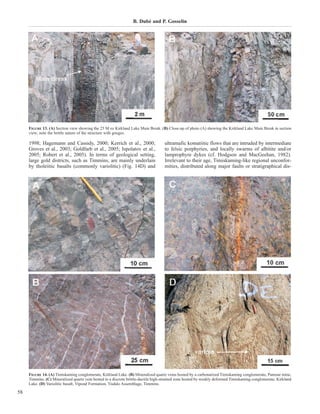
FIGURE 11. (A) Mylonitic foliation, Cadillac-Larder Lake Break, Val d’Or.
(B) Close-up showing mylonitic foliation within Cadillac-Larder Lake
Break, Val d’Or.

Ayer et al., 2005; Ispolatov et al., 2005 and references
therein). Greenstone-hosted quartz-carbonate vein deposits
typically formed late in the tectonic-metamorphic history
(Groves et al., 2000; Robert et al., 2005) and the mineraliza-
tion is syn- to late-deformation and typically post-peak
greenschist-facies and syn-peak amphibolite-facies meta-
morphism (cf. Kerrich and Cassidy, 1994; Hagemann and
Cassidy, 2000). Most world-class greenstone-hosted quartz-
carbonate vein deposits are hosted by greenschist-facies
rocks. Important exceptions include Kolar (India), which
formed at amphibolite facies.
   Greenstone-hosted quartz-carbonate vein deposits are also
commonly spatially associated with Timiskaming-like                         FIGURE 12. (A) Vertical section of shear bands indicating a reverse-oblique
regional unconformities (Fig. 14A, B, C). Several deposits                  sense of motion recorded by the gold-bearing Cape Ray fault zone,
                                                                            Newfoundland (from Dubé et al., 1996). (B) Section view showing reverse-
are hosted by, or located next to, such unconformities (e.g.                oblique mylonite, Cape Ray fault zone, Newfoundland. (C) Section view
the Pamour and Dome deposits), suggesting an empirical                      showing auriferous quartz vein hosted by a second-order reverse shear
temporal and spatial relationship between large gold deposits               zone, Cooke mine, Chapais, Quebec (from Dubé and Guha, 1992).
and regional unconformities (Poulsen et al., 1992; Hodgson,
1993; Robert, 2000; Dubé et al., 2003; Robert et al., 2005).                (2000), Groves et al. (2003), and Robert et al. (2005), among
                                                                            others, for more information.
District Scale                                                                 Large gold camps are commonly associated with curva-
   In this section, some of the key geological characteristics              tures, flexures, and dilational jogs along major compres-
of prolific gold districts are presented with a special empha-              sional fault zones, such as the Porcupine-Destor fault in
sis on Archean deposits. Only a brief overview is presented                 Timmins or the Larder Lake-Cadillac fault in Kirkland Lake
here, and the reader is referred to key papers by Hodgson and               (Fig. 3), which have created dilational zones that allowed
MacGeehan (1982), Hodgson (1993), Robert and Poulsen                        migration of hydrothermal fluids (cf. Colvine et al., 1988;
(1997), Hagemann and Cassidy (2000), Poulsen et al.                         Sibson, 1990; Phillips et al., 1996; McCuaig and Kerrich,

                                                                                                                                                          57
B. Dubé and P. Gosselin


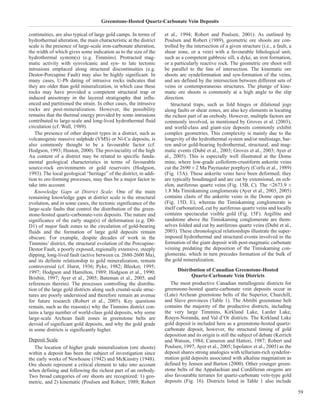
     FIGURE 13. (A) Section view showing the 25 M oz Kirkland Lake Main Break. (B) Close-up of photo (A) showing the Kirkland Lake Main Break in section
     view; note the brittle nature of the structure with gouges.

     1998; Hagemann and Cassidy, 2000; Kerrich et al., 2000;                        ultramafic komatiitic flows that are intruded by intermediate
     Groves et al., 2003; Goldfarb et al., 2005; Ispolatov et al.,                  to felsic porphyries, and locally swarms of albitite and/or
     2005; Robert et al., 2005). In terms of geological setting,                    lamprophyre dykes (cf. Hodgson and MacGeehan, 1982).
     large gold districts, such as Timmins, are mainly underlain                    Irrelevant to their age, Timiskaming-like regional unconfor-
     by tholeiitic basalts (commonly variolitic) (Fig. 14D) and                     mities, distributed along major faults or stratigraphical dis-


     FIGURE 14. (A) Timiskaming conglomerate, Kirkland Lake. (B) Mineralized quartz veins hosted by a carbonatized Timiskaming conglomerate, Pamour mine,
     Timmins. (C) Mineralized quartz vein hosted in a discrete brittle-ductile high-strained zone hosted by weakly deformed Timiskaming conglomerate, Kirkland
     Lake. (D) Variolitic basalt, Vipond Formation, Tisdale Assemblage, Timmins.

58
Greenstone-Hosted Quartz-Carbonate Vein Deposits

continuities, are also typical of large gold camps. In terms of    et al., 1994; Robert and Poulsen, 2001). As outlined by
hydrothermal alteration, the main characteristic at the district   Poulsen and Robert (1989), geometric ore shoots are con-
scale is the presence of large-scale iron-carbonate alteration,    trolled by the intersection of a given structure (i.e., a fault, a
the width of which gives some indication as to the size of the     shear zone, or a vein) with a favourable lithological unit,
hydrothermal system(s) (e.g. Timmins). Protracted mag-             such as a competent gabbroic sill, a dyke, an iron formation,
matic activity with synvolcanic and syn- to late tectonic          or a particularly reactive rock. The geometric ore shoot will
intrusions emplaced along structural discontinuities (e.g.         be parallel to the line of intersection. The kinematic ore
Destor-Porcupine Fault) may also be highly significant. In         shoots are syndeformation and syn-formation of the veins,
many cases, U-Pb dating of intrusive rocks indicates that          and are defined by the intersection between different sets of
they are older than gold mineralization, in which case these       veins or contemporaneous structures. The plunge of kine-
rocks may have provided a competent structural trap or             matic ore shoots is commonly at a high angle to the slip
induced anisotropy in the layered stratigraphy that influ-         direction.
enced and partitioned the strain. In other cases, the intrusive       Structural traps, such as fold hinges or dilational jogs
rocks are post-mineralization. However, the possibility            along faults or shear zones, are also key elements in locating
remains that the thermal energy provided by some intrusions        the richest part of an orebody. However, multiple factors are
contributed to large-scale and long-lived hydrothermal fluid       commonly involved, as mentioned by Groves et al. (2003),
circulation (cf. Wall, 1989).                                      and world-class and giant-size deposits commonly exhibit
   The presence of other deposit types in a district, such as      complex geometries. This complexity is mainly due to the
volcanogenic massive sulphide (VMS) or Ni-Cu deposits, is          longevity of the hydrothermal system and/or multistage, bar-
also commonly thought to be a favourable factor (cf.               ren and/or gold-bearing hydrothermal, structural, and mag-
Hodgson, 1993; Huston, 2000). The provinciality of the high        matic events (Dubé et al., 2003; Groves et al., 2003; Ayer et
Au content of a district may be related to specific funda-         al., 2005). This is especially well illustrated at the Dome
mental geological characteristics in terms of favourable           mine, where low-grade colloform-crustiform ankerite veins
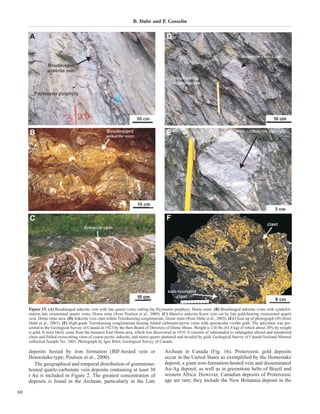
source-rock environments or gold reservoirs (Hodgson,              cut the 2690 ± 2 Ma Paymaster porphyry (Corfu et al., 1989)
1993). The local geological “heritage” of the district, in addi-   (Fig. 15A). These ankerite veins have been deformed; they
tion to ore-forming processes, may thus be a major factor to       are typically boudinaged and are cut by extensional, en ech-
take into account.                                                 elon, auriferous quartz veins (Fig. 15B, C). The <2673.9 ±
   Knowledge Gaps at District Scale: One of the main               1.8 Ma Timiskaming conglomerate (Ayer et al., 2003, 2005)
remaining knowledge gaps at district scale is the structural       contains clasts of the ankerite veins in the Dome open pit
evolution, and in some cases, the tectonic significance of the     (Fig. 15D, E), whereas the Timiskaming conglomerate is
large-scale faults that control the distribution of the green-     itself carbonatized, cut by auriferous quartz veins and locally
stone-hosted quartz-carbonate-vein deposits. The nature and        contains spectacular visible gold (Fig. 15F). Argillite and
significance of the early stage(s) of deformation (e.g. D0-        sandstone above the Timiskaming conglomerate are them-
D1) of major fault zones to the circulation of gold-bearing        selves folded and cut by auriferous quartz veins (Dubé et al.,
fluids and the formation of large gold deposits remain             2003). These chronological relationships illustrate the super-
obscure. For example, despite decades of work in the               imposed hydrothermal and structural events involved in the
Timmins’ district, the structural evolution of the Porcupine-      formation of the giant deposit with post-magmatic carbonate
Destor Fault, a poorly exposed, regionally extensive, steeply      veining predating the deposition of the Timiskaming con-
dipping, long-lived fault (active between ca. 2680-2600 Ma),       glomerate, which in turn precedes formation of the bulk of
and its definite relationship to gold mineralization, remain       the gold mineralization.
controversial (cf. Hurst, 1936; Pyke, 1982; Bleeker, 1995;
1997; Hodgson and Hamilton, 1989; Hodgson et al., 1990;                   Distribution of Canadian Greenstone-Hosted
Brisbin, 1997; Ayer et al., 2005; Bateman et al., 2005, and                     Quartz-Carbonate Vein Districts
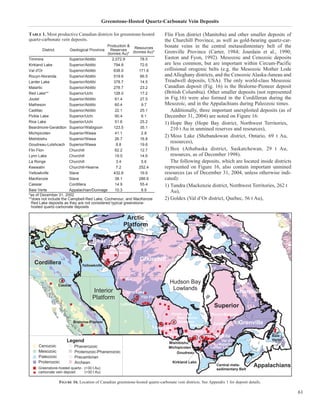
references therein). The processes controlling the distribu-          The most productive Canadian metallogenic districts for
tion of the large gold districts along such crustal-scale struc-   greenstone-hosted quartz-carbonate vein deposits occur in
tures are poorly understood and therefore remain an avenue         (Late) Archean greenstone belts of the Superior, Churchill,
for future research (Robert et al., 2005). Key questions           and Slave provinces (Table 1). The Abitibi greenstone belt
remain, such as the reason(s) why the Timmins district con-        contains the majority of the productive districts, including
tains a large number of world-class gold deposits, why some        the very large Timmins, Kirkland Lake, Larder Lake,
large-scale Archean fault zones in greenstone belts are            Rouyn-Noranda, and Val d’Or districts. The Kirkland Lake
devoid of significant gold deposits, and why the gold grade        gold deposit is included here as a greenstone-hosted quartz-
in some districts is significantly higher.                         carbonate deposit, however, the structural timing of gold
                                                                   deposition and its origin is still the subject of debate (Kerrich
Deposit Scale                                                      and Watson, 1984; Cameron and Hattori, 1987; Robert and
   The location of higher grade mineralization (ore shoots)        Poulsen, 1997; Ayer et al., 2005; Ispolatov et al., 2005) as the
within a deposit has been the subject of investigation since       deposit shares strong analogies with tellurium-rich syndefor-
the early works of Newhouse (1942) and McKinstry (1948).           mation gold deposits associated with alkaline magmatism as
Ore shoots represent a critical element to take into account       defined by Jensen and Barton (2000). Other younger green-
when defining and following the richest part of an orebody.        stone belts of the Appalachian and Cordilleran orogens are
Two broad categories of ore shoots are recognized: 1) geo-         also favourable terranes for quartz-carbonate vein-type gold
metric, and 2) kinematic (Poulsen and Robert, 1989; Robert         deposits (Fig. 16). Districts listed in Table 1 also include

                                                                                                                                        59
B. Dubé and P. Gosselin


     A                                                                                 D


     B                                                                                 E


     C                                                                                 F


     Figure 15. (A) Boudinaged ankerite vein with late quartz veins cutting the Paymaster porphyry, Dome mine. (B) Boudinaged ankerite veins with syndefor-
     mation late extensional quartz veins, Dome mine (from Poulsen et al., 2000). (C) Massive ankerite Kurst vein cut by late gold-bearing extensional quartz
     vein, Dome mine area. (D) Ankerite vein clast within Timiskaming conglomerate, Dome mine (from Dubé et al., 2003). (E) Close-up of photograph (D) (from
     Dubé et al., 2003). (F) High-grade Timiskaming conglomerate hosting folded carbonate-pyrite veins with spectacular visible gold. The specimen was pre-
     sented to the Geological Survey of Canada in 1923 by the then Board of Directors of Dome Mines. Weight is 136 lbs (61.8 kg) of which about 20% by weight
     is gold. It most likely came from the bonanza East Dome area, which was discovered in 1910. It consists of subrounded to subangular altered and nonaltered
     clasts and folded crosscutting veins of coarse pyrite, ankerite, and minor quartz shattered and invaded by gold. Geological Survey of Canada National Mineral
     collection Sample No. 1003. Photograph by Igor Bilot, Geological Survey of Canada.

     deposits hosted by iron formation (BIF-hosted vein or                            Archean in Canada (Fig. 16). Proterozoic gold deposits
     Homestake-type; Poulsen et al., 2000).                                           occur in the United States as exemplified by the Homestake
        The geographical and temporal distribution of greenstone-                     deposit, a giant iron-formation-hosted vein and disseminated
     hosted quartz-carbonate vein deposits containing at least 30                     Au-Ag deposit, as well as in greenstone belts of Brazil and
     t Au is included in Figure 2. The greatest concentration of                      western Africa. However, Canadian deposits of Proterozoic
     deposits is found in the Archean, particularly in the Late                       age are rare; they include the New Britannia deposit in the

60
Greenstone-Hosted Quartz-Carbonate Vein Deposits

TABLE 1. Most productive Canadian districts for greenstone-hosted              Flin Flon district (Manitoba) and other smaller deposits of
quartz-carbonate vein deposits.                                                the Churchill Province, as well as gold-bearing quartz-car-
                                            Production &
                                                            Resources          bonate veins in the central metasedimentary belt of the
       District         Geological Province   Reserves
                                            (tonnes Au)* (tonnes Au)*          Grenville Province (Carter, 1984; Jourdain et al., 1990;
Timmins                 Superior/Abitibi       2,072.9         78.5            Easton and Fyon, 1992). Mesozoic and Cenozoic deposits
Kirkland Lake           Superior/Abitibi        794.8          72.6            are less common, but are important within Circum-Pacific
Val d'Or                Superior/Abitibi        638.9         171.6            collisional orogenic belts (e.g. the Mesozoic Mother Lode
Rouyn-Noranda           Superior/Abitibi        519.6          66.5            and Alleghany districts, and the Cenozoic Alaska-Juneau and
Larder Lake             Superior/Abitibi        378.7          14.5            Treadwell deposits, USA). The only world-class Mesozoic
Malartic                Superior/Abitibi        278.7          23.2            Canadian deposit (Fig. 16) is the Bralorne-Pioneer deposit
Red Lake**              Superior/Uchi           128.0          17.2            (British Columbia). Other smaller deposits (not represented
Joutel                  Superior/Abitibi         61.4          27.5            in Fig.16) were also formed in the Cordilleran during the
Matheson                Superior/Abitibi         60.4           9.7            Mesozoic, and in the Appalachians during Paleozoic times.
Cadillac                Superior/Abitibi         22.1          25.1               Additionally, three important unexploited deposits (as of
Pickle Lake             Superior/Uchi            90.4           8.1            December 31, 2004) are noted on Figure 16:
Rice Lake               Superior/Uchi            51.6          25.2            1) Hope Bay (Hope Bay district, Northwest Territories,
Beardmore-Geraldton Superior/Wabigoon           123.5          35.1               210 t Au in unmined reserves and resources),
Michipicoten            Superior/Wawa            41.1           2.8
                                                                               2) Moss Lake (Shebandowan district, Ontario, 69 t Au,
Mishibishu              Superior/Wawa            26.7          16.8
Goudreau-Lolshcach Superior/Wawa                 8.8           19.6
                                                                                  resources),
Flin Flon               Churchill                62.2          12.7            3) Box (Athabaska district, Saskatchewan, 29 t Au,
Lynn Lake               Churchill                19.5          14.6               resources, as of December 1998).
La Ronge                Churchill                3.4            5.6               The following deposits, which are located inside districts
Keewatin                Churchill-Hearne          7.2         252.4            represented on Figure 16, also contain important unmined
Yellowknife             Slave                   432.8          16.6            resources (as of December 31, 2004, unless otherwise indi-
MacKenzie               Slave                    38.1         286.6            cated):
Cassiar                 Cordillera               14.9          55.4            1) Tundra (Mackenzie district, Northwest Territories, 262 t
Baie Verte              Appalachian/Dunnage      10.3           8.9               Au),
*as of December 31, 2002
**does not include the Campbell-Red Lake, Cochenour, and MacKenzie             2) Goldex (Val d’Or district, Quebec, 56 t Au),
 Red Lake deposits as they are not considered typical greenstone-
 hosted quartz-carbonate deposits

                                                        Arctic
                                                       Platform

                                                           Hope Bay
                                      Bear Slave
                                               Keewatin-
                                               MacKenzie
                                                                 Churchill
   Cordillera                   Yellowknife


                                                        Box
                                                                                  Hudson Bay
                  Cassiar
                                      Interior                                     Lowlands
                                                         Lynn Lake                                                      Churchill
                                      Platform                   Flin Flon
                                                      LaRonge
                                                                                                            Superior
                                                                                   Pickle Lake         Rouyn-Noranda
                                                                                      Beardmore-
                            Bralorne-Pioneer                                          Geraldton
                                                                                             Matheson   Cadillac     Grenville
                                                                          Rice Lake
                                                                                               Timmins
                                                                                  Moss Lake
                                                                                                             Abitibi                       Baie
                      Legend                                                                                    Val d'Or                   Verte
                                                                                  Mishibishu                  Malartic
     Cenozoic               Phanerozoic                                           Michipicoten            Larder Lake
     Mesozoic               Proterozoic-Phanerozoic                                   Goudreau
     Paleozoic              Precambrian
     Proterozoic            Archean                                                 Kirkland Lake
     Greenstone-hosted quartz- (>30 t Au)
                                                                                                              Central meta-        Appalachians
                                                                                                              sedimentary Belt
     carbonate vein deposit    (<30 t Au)

                  FIGURE 16. Location of Canadian greenstone-hosted quartz-carbonate vein districts. See Appendix 1 for deposit details.

                                                                                                                                                   61
B. Dubé and P. Gosselin

                                                                                   Consequently, once a deposit is appropriately classified,
                                                                                   exploration models are relatively well defined (cf. Hodgson,
                                                                                   1990, 1993; Groves et al., 2000, 2003). Since the early
                                                                                   1980s, several different genetic models have been proposed
                                                                                   to explain the formation of greenstone-hosted quartz-carbon-
                                                                                   ate vein deposits and this has resulted in significant contro-
                                                                                   versy. Some of this controversy is caused by the difficulty in
                                                                                   metamorphosed greenstone terranes to classify certain key
                                                                                   deposits, such as Hemlo (Lin, 2001; Muir, 2002; Davis and
                                                                                   Lin, 2003), due to the poor preservation of primary charac-
                                                                                   teristics largely obscured by post-mineralization deforma-
                                                                                   tion and metamorphism. Thus, adequate classification of
                                                                                   gold deposits is a key to formulating successful exploration
                                                                                   models (Poulsen et al., 2000). An excellent review of the
                                                                                   various proposed genetic models, and the pros and cons of
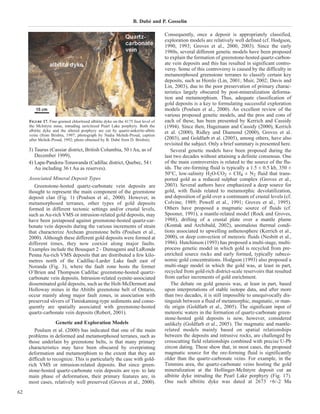
     FIGURE 17. Fine-grained chloritized albitite dyke on the 4175 foot level of   each of these, has been presented by Kerrich and Cassidy
     the McIntyre mine, intruding sericitized Pearl Lake porphyry. Both the        (1994). Since then, Hagemann and Cassidy (2000), Kerrich
     albitite dyke and the altered porphyry are cut by quartz-ankerite-albite      et al. (2000), Ridley and Diamond (2000), Groves et al.
     veins (from Brisbin, 1997; photograph by Nadia Melnik-Proud, caption
     after Melnik-Proud, 1992; photo obtained by B. Dubé from D. Brisbin).         (2003), and Goldfarb et al. (2005), among others, have also
                                                                                   revisited the subject. Only a brief summary is presented here.
     3) Taurus (Cassiar district, British Columbia, 50 t Au, as of                    Several genetic models have been proposed during the
        December 1999),                                                            last two decades without attaining a definite consensus. One
     4) Lapa-Pandora-Tonawanda (Cadillac district, Quebec, 54 t                    of the main controversies is related to the source of the flu-
        Au including 36 t Au as reserves).                                         ids. The ore-forming fluid is typically a 1.5 ± 0.5 kb, 350 ±
                                                                                   50°C, low-salinity H2O-CO2 ± CH4 ± N2 fluid that trans-
     Associated Mineral Deposit Types                                              ported gold as a reduced sulphur complex (Groves et al.,
        Greenstone-hosted quartz-carbonate vein deposits are                       2003). Several authors have emphasized a deep source for
     thought to represent the main component of the greenstone                     gold, with fluids related to metamorphic devolatilization,
     deposit clan (Fig. 1) (Poulsen et al., 2000). However, in                     and deposition of gold over a continuum of crustal levels (cf.
     metamorphosed terranes, other types of gold deposits                          Colvine, 1989; Powell et al., 1991; Groves et al., 1995).
     formed in different tectonic settings and/or crustal levels,                  Others have proposed a magmatic source of fluids (cf.
     such as Au-rich VMS or intrusion-related gold deposits, may                   Spooner, 1991), a mantle-related model (Rock and Groves,
     have been juxtaposed against greenstone-hosted quartz-car-                    1988), drifting of a crustal plate over a mantle plume
     bonate vein deposits during the various increments of strain                  (Kontak and Archibald, 2002), anomalous thermal condi-
     that characterize Archean greenstone belts (Poulsen et al.,                   tions associated to upwelling asthenosphere (Kerrich et al.,
     2000). Although these different gold deposits were formed at                  2000), or deep convection of meteoric fluids (Nesbitt et al.,
     different times, they now coexist along major faults.                         1986). Hutchinson (1993) has proposed a multi-stage, multi-
     Examples include the Bousquet 2 - Dumagami and LaRonde                        process genetic model in which gold is recycled from pre-
     Penna Au-rich VMS deposits that are distributed a few kilo-                   enriched source rocks and early formed, typically subeco-
     metres north of the Cadillac-Larder Lake fault east of                        nomic gold concentrations. Hodgson (1993) also proposed a
     Noranda (Fig. 3), where the fault zone hosts the former                       multi-stage model in which the gold was, at least in part,
     O’Brien and Thompson Cadillac greenstone-hosted quartz-                       recycled from gold-rich district-scale reservoirs that resulted
     carbonate vein deposits. Intrusion-related syenite-associated                 from earlier increments of gold enrichment.
     disseminated gold deposits, such as the Holt-McDermott and                       The debate on gold genesis was, at least in part, based
     Holloway mines in the Abitibi greenstone belt of Ontario,                     upon interpretations of stable isotope data, and after more
     occur mainly along major fault zones, in association with                     than two decades, it is still impossible to unequivocally dis-
     preserved slivers of Timiskaming-type sediments and conse-                    tinguish between a fluid of metamorphic, magmatic, or man-
     quently are spatially associated with greenstone-hosted                       tle origin (Goldfarb et al., 2005). The significant input of
     quartz-carbonate vein deposits (Robert, 2001).                                meteoric waters in the formation of quartz-carbonate green-
                                                                                   stone-hosted gold deposits is now, however, considered
                    Genetic and Exploration Models                                 unlikely (Goldfarb et al., 2005). The magmatic and mantle-
        Poulsen et al. (2000) has indicated that one of the main                   related models mainly based on spatial relationships
     problems in deformed and metamorphosed terranes, such as                      between the deposits and intrusive rocks, are challenged by
     those underlain by greenstone belts, is that many primary                     crosscutting field relationships combined with precise U-Pb
     characteristics may have been obscured by overprinting                        zircon dating. These show that, in most cases, the proposed
     deformation and metamorphism to the extent that they are                      magmatic source for the ore-forming fluid is significantly
     difficult to recognize. This is particularly the case with gold-              older than the quartz-carbonate veins. For example, in the
     rich VMS or intrusion-related deposits. But since green-                      Timmins area, the quartz-carbonate veins hosting the gold
     stone-hosted quartz-carbonate vein deposits are syn- to late                  mineralization at the Hollinger-McIntyre deposit cut an
     main phase of deformation, their primary features are, in                     albitite dyke intruding the Pearl Lake porphyry (Fig. 17).
     most cases, relatively well preserved (Groves et al., 2000).                  One such albitite dyke was dated at 2673 +6/-2 Ma

62
Greenstone-Hosted Quartz-Carbonate Vein Deposits

                                                                                          TURBIDITE-hosted
(Marmont and Corfu, 1989) and more recently at 2672.8 ±                                     VEIN
1.1 Ma (Ayer et al., 2005). Thus the albitite dyke is ca.15 Ma        WACKE-SHALE                    GREENSTONE-hosted
                                                                                                     VEIN
younger than the 2689 ± 1 Ma Pearl Lake porphyry and var-
ious porphyries in the regions ranging in age from 2691 to
                                                                                                                    3
2687 Ma (Corfu et al., 1989; Ayer et al., 2003). These            HOMESTAKE-
                                                                                                                                    BRITTLE
                                                                                                                                          -
                                                                  TYPE
chronological relationships rule out the possibility that the     SULPHIDE BODY
                                                                                                                                    DUCTILE
                                                                                                                                    ZONE
                                                                                                                          1
ore fluids could be related to known intrusions. An alterna-
tive to the magmatic fluid source model is one in which           VOLCANIC

intrusions have provided the thermal energy responsible, at
least in part, for fluid circulation (cf. Wall, 1989). The man-
tle-related model was mainly based on the close spatial rela-     IRON FORMATION                             SHEAR ZONE
tionship between lamprophyre dykes and gold deposits                                     GRANITOID

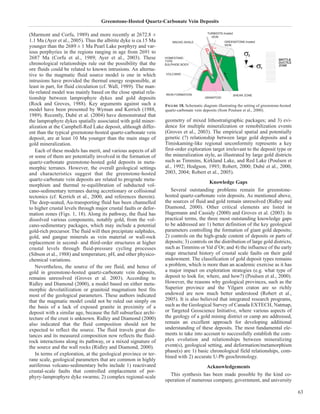
(Rock and Groves, 1988). Key arguments against such a             FIGURE 18. Schematic diagram illustrating the setting of greenstone-hosted
model have been presented by Wyman and Kerrich (1988,             quartz-carbonate vein deposits (from Poulsen et al., 2000).
1989). Recently, Dubé et al. (2004) have demonstrated that
the lamprophyre dykes spatially associated with gold miner-       geometry of mixed lithostratigraphic packages; and 3) evi-
alization at the Campbell-Red Lake deposit, although differ-      dence for multiple mineralization or remobilization events
ent than the typical greenstone-hosted quartz-carbonate vein      (Groves et al., 2003). The empirical spatial and potentially
deposit, are at least 10 Ma younger than the main stage of        genetic (?) relationship between large gold deposits and a
gold mineralization.                                              Timiskaming-like regional unconformity represents a key
   Each of these models has merit, and various aspects of all     first-order exploration target irrelevant to the deposit type or
or some of them are potentially involved in the formation of      the mineralization style, as illustrated by large gold districts
quartz-carbonate greenstone-hosted gold deposits in meta-         such as Timmins, Kirkland Lake, and Red Lake (Poulsen et
morphic terranes. However, the overall geological settings        al., 1992; Hodgson, 1993; Robert, 2000; Dubé et al., 2000,
and characteristics suggest that the greenstone-hosted            2003, 2004; Robert et al., 2005).
quartz-carbonate vein deposits are related to prograde meta-
                                                                                         Knowledge Gaps
morphism and thermal re-equilibration of subducted vol-
cano-sedimentary terranes during accretionary or collisional         Several outstanding problems remain for greenstone-
tectonics (cf. Kerrich et al., 2000, and references therein).     hosted quartz-carbonate vein deposits. As mentioned above,
The deep-seated, Au-transporting fluid has been channelled        the sources of fluid and gold remain unresolved (Ridley and
to higher crustal levels through major crustal faults or defor-   Diamond, 2000). Other critical elements are listed in
mation zones (Figs. 1, 18). Along its pathway, the fluid has      Hagemann and Cassidy (2000) and Groves et al. (2003). In
dissolved various components, notably gold, from the vol-         practical terms, the three most outstanding knowledge gaps
cano-sedimentary packages, which may include a potential          to be addressed are 1) better definition of the key geological
gold-rich precursor. The fluid will then precipitate sulphides,   parameters controlling the formation of giant gold deposits;
gold, and gangue minerals as vein material or wall-rock           2) controls on the high-grade content of deposits or parts of
replacement in second- and third-order structures at higher       deposits; 3) controls on the distribution of large gold districts,
crustal levels through fluid-pressure cycling processes           such as Timmins or Val d’Or; and 4) the influence of the early
(Sibson et al., 1988) and temperature, pH, and other physico-     stage structural history of crustal scale faults on their gold
chemical variations.                                              endowment. The classification of gold deposit types remains
   Nevertheless, the source of the ore fluid, and hence of        a problem, which is more than an academic exercise as it has
gold in greenstone-hosted quartz-carbonate vein deposits,         a major impact on exploration strategies (e.g. what type of
remains unresolved (Groves et al. 2003). According to             deposit to look for, where, and how?) (Poulsen et al., 2000).
Ridley and Diamond (2000), a model based on either meta-          However, the reasons why geological provinces, such as the
morphic devolatilization or granitoid magmatism best fits         Superior province and the Yilgarn craton are so richly
most of the geological parameters. These authors indicated        endowed are now much better understood (Robert et al.,
that the magmatic model could not be ruled out simply on          2005). It is also believed that integrated research programs,
the basis of a lack of exposed granite in proximity of a          such as the Geological Survey of Canada EXTECH, Natmap,
deposit with a similar age, because the full subsurface archi-    or Targeted Geoscience Initiative, where various aspects of
tecture of the crust is unknown. Ridley and Diamond (2000)        the geology of a gold mining district or camp are addressed,
also indicated that the fluid composition should not be           remain an excellent approach for developing additional
expected to reflect the source. The fluid travels great dis-      understanding of these deposits. The most fundamental ele-
tances and its measured composition now reflects the fluid-       ments to take into account to successfully establish the com-
rock interactions along its pathway, or a mixed signature of      plex evolution and relationships between mineralizing
the source and the wall rocks (Ridley and Diamond, 2000).         event(s), geological setting, and deformation/metamorphism
                                                                  phase(s) are 1) basic chronological field relationships, com-
   In terms of exploration, at the geological province or ter-
                                                                  bined with 2) accurate U-Pb geochronology.
rane scale, geological parameters that are common in highly
auriferous volcano-sedimentary belts include 1) reactivated                          Acknowledgements
crustal-scale faults that controlled emplacement of por-
phyry-lamprophyre dyke swarms; 2) complex regional-scale            This synthesis has been made possible by the kind co-
                                                                  operation of numerous company, government, and university

                                                                                                                                               63
B. Dubé and P. Gosselin

     geologists who shared their knowledge and who have                             Barrett, R.E., and Johnston, A.W., 1948, Central Patricia Mine, in Structural
     allowed surface and underground visits to many gold                                Geology of Canadian Ore Deposits - A Symposium: Canadian
                                                                                        Institutde of Mining and Metallurgy, Special Volume 1, p. 368-372.
     deposits. We benefited from numerous discussions with col-                     Barret, T.L., and Sherlock, R.L., 1996, Geology, lithogeochemistry and vol-
     leagues from the provincial surveys and from the Geological                        canic setting of the Eskay Creek Au-Ag-Cu-Zn deposit, Northwestern
     Survey of Canada. The first author would like to extend his                        British Columbia: Exploration and Mining Geology, v. 5, p. 339-368.
     deepest appreciation to F. Robert and H.K. Poulsen for con-                    Barron, K.M., Duke, N,A., and Hodder, R.W., 1989, Petrology of the
     structive suggestions, collaboration, and discussions on gold                      Springpole Lake alkalic volcanic complex, in Geoscience Research
                                                                                        Grant Program; Summary of Research 1988-1989: Ontario Geological
     deposits during the last twenty years. W. Goodfellow and I.                        Survey, Miscellaneous Paper 143, p. 133-145.
     Kjarsgaard are thanked for their editorial contribution.                       Bartram, G.D., and McCall, G.J.H., 1971, Wall-rock alteration associated
     Careful constructive reviews by R. Goldfarb, M. Gauthier,                          with auriferous lodes in the Golden Mile, Kalgoorlie, in Glover, J.E.,
     and S. Castonguay have led to substantial improvements.                            ed., Symposium on Archaean Rocks: Geological Society of Australia,
                                                                                        Special Publication 3, p. 191-199.
                                   References                                       Basnett, R., 1999, Seabee Mine, in Ashton, K.E., and Harper, C.T., eds.,
                                                                                        MINExpo '96 Symposium: Advances in Saskatchewan Geology and
     Akande, S.O., 1985, Coexisting precious metals, sulfosalts and sulfide min-        Mineral Exploration: Saskatchewan Geological Society, Special
         erals in the Ross gold mine, Holtyre, Ontario: Canadian Mineralogist,          Publication No. 14, p. 72-79.
         v. 23, p. 95-98.                                                           Bateman, R.J., Ayer, J.A., Dubé, B., and Hamilton, M.A., 2005, The
     Alldrick, D.J., 1983, The Mosquito Creek Mine, Cariboo Gold Belt (93H/4),          Timmins - Porcupine Gold Camp, Northern Ontario: The Anatomy of
         in Geological Fieldwork 1982: British Columbia Ministry of Energy,             an Archaean Greenstone and Its Gold Mineralization. Discover Abitibi
         Mines and Petroleum Resources, Paper 1983-1, p. 99-112.                        Initiative: Ontario Geological Survey, Open File Report 6158, 90 p.
     Ames, H.G., 1948, Perron mine, in Structural Geology of Canadian Ore           Beaudoin, G., Hubert, C., Trudel, P., and Perreault, G., 1987, Géologie du
         Deposits - A Symposium: Canadian Institute of Mining and Metallurgy,           projet Callahan, cantons de Vassan et de Dubuisson - District de Val-
         Special Volume 1, p. 893-898.                                                  d'Or: Ministère de l'Éenergie et des Ressources, Gouvernement du
     Ames, D.E., Franklin, J.M., and Froese, E., 1991, Zonation of hydrothermal         Québec, MB 87-48.
         alteration at the San Antonio gold mine, Bisset, Manitoba, Canada:         Belkabir, A., and Hubert, C., 1995, Geology and structure of a sulfide-rich
         Economic Geology, v. 86, p. 600-619.                                           gold deposit: an example from the Mouska gold mine, Bousquet dis-
     Anglin, C.D., and Franklin, J.M., 1985, Gold mineralization in the                 trict, Canada: Economic Geology, v. 90, p. 1064-1079.
         Beardmore-Geraldton area of northwestern Ontario: Structural consid-       Belkabir, A., Robert, F., Vu, L., and Hubert, C., 1993, The influence of dikes
         erations and the role of iron formation: Geological Survey of Canada,          on auriferous shear zone development within granitoid intrusions: The
         Current Research Paper 85-1B, p. 193-201.                                      Bourlamaque pluton, Val d'Or district, Abitibi greenstone belt:
     Anglin, C.D., Jonasson, I.R., and Franklin, J.M., 1996, Sm-Nd dating of            Canadian Journal of Earth Sciences, v. 30, p. 1924-1933.
         scheelite and tourmaline: Implications for the genesis of Archean gold     Bergmann, A., 1947, Development and ore possibilities of the area between
         deposits, Val d'Or, Canada: Economic Geology, v. 91, p. 1372-1382.             McKenzie Island and East Bay in the Red Lake mining district of
     Archambault, G., Guha, J., Tremblay, A., and Kanwar, R., 1984,                     Ontario: Precambrian, v. 20, p. 4-7.
         Implications of the geomechanical interpretation of the Copper Rand        Bevier, M.L., and Gebert, J.S., 1991, U-Pb geochronology of the Hope Bay
         deposit on the Dore Lake shear belt, in Guha, J., And Chown, E.H.,             - Elu Inlet area, Bathurst Block, northeastern Slave Structural Province,
         eds., Chibougamau - Stratigraphy and Mineralization: Proceedings of            Northwest Territories: Canadian Journal of Earth Sciences, v. 28,
         the Chibougamau Symposium and Field Trip: Canadian Institute of                p. 1925-1930.
         Mining, Special Volume 34, p. 300-318.                                     Blackburn, C.E., Johns, G.W., Ayer, J., and Davis, D.W., 1991, Wabigoon
     Armitage, A.E., Tella, S., and Miller, A.R., 1993, Iron-formation-hosted           Subprovince, Chapter 9, in Thurston, P.C., Williams, H.R., Sutcliffe,
         gold mineralization and its geological setting, Meliadine Lake area,           R.H., and Stott, G.M., eds., Geology of Ontario: Ontario Geological
         District of Keewatin, Northwest Territories: Geological Survey of              Survey, Special Volume 4, p. 303-381.
         Canada, Current Research 1993-C, p. 187-195.                               Blais, A., 1991, Copper Rand mine, in Guha, J., Chown, E.H., and
     Armitage, A.E., James, R.S., and Goff, S.P., 1996, Gold mineralization in          Daigneault, R., eds., Litho-tectonic Framework and Associated
         Archean banded iron formation, Third Portage Lake area, Northwest              Mineralization of the Eastern Extremity of the Abitibi Greenstone Belt
         Territories, Canada: Exploration and Mining Geology, v. 5, p. 1-15.            (8th Symposium of the International Association on the Genesis of Ore
     Armstrong, H.S., 1943, Gold ores of the Little Long Lac area, Ontario:             Deposits, Field Trip 3): Geological Survey of Canada, Open File 2158,
         Economic Geology, v. 38, p. 204-252.                                           p. 63-67.
     Ayer, J.A., Barr, E., Bleeker, W., Creaser, R.A., Hall, G., Ketchum, J.W.F.,   Blais, M., 1955, L'altération hydrothermale en bordure des filons aurifères
         Powers, D., Salier, B., Still, A., and Trowell, N.F., 2003, New                de la mine O'Brien, comté d'Abitibi-Est: Le Naturaliste Canadien,
         geochronological results from the Timmins area: Implications for the           v. 132, p. 77-98.
         timing of late-tectonic stratigraphy, magmatism and gold mineraliza-       Bleeker, W., 1995, Surface geology of the Porcupine camp, in Heather,
         tion: in Summary of Field work and Other Activities: Ontario                   K.B., ed., Precambrian '95 - Tectonics and Metallogeny of Archean
         Geological Survey, Open File Report 6120, p. 33-1 to 33-11.                    Crust in the Abitibi-Kapuskasing-Wawa Region, Field Trip Guidebook:
     Ayer, J.A., Thurston, P.C., Bateman, R., Dubé, B., Gibson, H.L., Hamilton,         Geological Survey of Canada, Open File Report 3141, p. 13-47.
         M.A., Hathway, B., Hocker, S.M., Houlé, M.G., Hudak, G., Ispolatov,        ––– 1997, Geology and mineral deposits of the Porcupine camp: Geological
         V.O., Lafrance, B., Lesher, C.M., MacDonald, P.J., Péloquin, A.S.,             Association of Canada, Field Trip Guide Book B6, 10-37 p.
         Piercey, S.J., Reed, L.E., and Thompson, P.H., 2005, Overview of           Boldy, J., Drouin, M., Hilgendorf, C., Davidson, D., Boniwell, J.B., and
         results from the greenstone architecture project: Discover Abitibi             Gingerich, J., 1984, Case history of a gold discovery, Eastmain River
         Initiative: Ontario Geological Survey, Open File Report 6154, 146 p.           area, Quebec, in Guha, J., and Chown, E.H., eds., Chibougamau -
     Backman, O.L., 1936, The geology of the Siscoe gold mine: Canadian                 Stratigraphy and Mineralization: Proceedings of the Chibougamau
         Mining Journal, v. 57, p. 467-475.                                             Symposium, Chibougamau, Quebec, Sept. 2-6, 1984, CIM Special
     Bacon, W.R., 1978, Lode gold deposits in Western Canada: Canadian                  Volume 34, p. 441-456.
         Institute of Mining and Metallurgy Bulletin, v. 71, p. 96-104.             Brisbin, D.I., 1997, Geological Setting of Gold Deposits in the Porcupine
     Barley, M.E., and Groves, D.I., 1992, Supercontinent cycles and the distri-        Gold Camp, Timmins, Ontario: Ph.D. thesis, Queen's University,
         bution of metal deposits through times: Geology, v. 20, p. 291-294.            Kingston, Ontario, 523 p.
     Barnett, E.S., Hutchinson, R.W., Adamcik, A., and Barnett, R., 1982,           Brisson, H., 1998, Caractéristiques, chronologie et typologie des minérali-
         Geology of the Agnico-Eagle deposit, Quebec, in Hutchinson, R.W.,              sations aurifères du la région du lac Shortt (Québec), sous-province
         Spence, C.D., and Franklin, J.M., eds., Precambrian Sulphide Deposits,         archéenne de l'Abitibi: Université du Québec à Chicoutimi, Ph.D. the-
         H.S. Robinson Memorial Volume: Geological Association of Canada,               sis, 277 p.
         Special Paper 25, p. 403-426.


64
Greenstone-Hosted Quartz-Carbonate Vein Deposits

Brodie Hicks, H., 1945, The geology of the Central Patricia mine, Ontario:     Champigny, N., and Sinclair, A.J., 1982, The Cinola gold deposit, Queen
    Precambrian, v. 18, p. 7-9.                                                    Charlotte Islands, British Columbia: in Hodder, R.W., and Petruk, W.,
Brown, D.A., 1987, Geological Setting of Volcanic-Hosted Silbak Premier            Geology of Canadian Gold Deposits: Canadian Institute of Mining and
    Mine, Northwestern British Columbia (104 A/4, B/1): M.Sc. thesis,              Metallurgy, Special Volume 24, p. 243 - 254
    University of British Columbia, Vancouver, British Columbia, 216 p.        Charlewood, G.H., 1964, Geology of Deep Developments on the Main Ore
Brown, R.A., 1948, O'Brien mine, in Structural Geology of Canadian Ore             Zone at Kirkland Lake: Ontario Department of Mines, Geological
    Deposits: A Symposium: Canadian Institute of Mining and Metallurgy,            Circular No. 11, 49 p.
    Special Volume 1, p. 809-816.                                              Chi, G., Dubé, B., and Williamson, K., 2002, Preliminary fluid-inclusion
Bruce, D.E., and Miller, J.H.L., 1990, Equity Silver mines; A success story,       microthermometry study of fluid evolution and temperature-pressure
    in Hollister, V.F., ed., Discoveries of Valuable Minerals and Precious         conditions in the Goldcorp High-Grade zone, Red Lake mine, Ontario,
    Metals Deposits Related to Intrusions and Faults: Society of Mining,           in Current Research 2002: Geological Survey of Canada, p. 1-12.
    Metalllurgy and Exploration Case Histories of Mineral Discoveries,         Childe, F., 1996, U-Pb geochronology and Nd and Pb isotopic characteris-
    v. 2, p. 144-161.                                                              tics of the Au-Ag-rich Eskay Creek VMS deposit, northwestern British
Bruce, E.L., and Samuel, W., 1937, Geology of the Little Long Lac Mine:            Columbia: Economic Geology, v. 91, p. 1209-1224.
    Economic Geology, v. 32, p. 318-334.                                       Church, B.N., 1985, Geology of the Mount Attwood-Phoenix area,
Buffam, S.W., and Allen, R.B., 1948, Chesterville mine, in Structural              Greenwood (82E/2): in Geological Fieldwork 1984: British Columbia
    Geology of Canadian Ore Deposits - A Symposium: Canadian Institute             Ministry of Energy, Mines and Resources, Paper 1985-2, p. 17-21.
    of Mining and Metallurgy, Special Volume 1, p. 662-671.                    Church, B.N., and Jones, L.D., 1997, Metallogeny of the Greenwood min-
Bullis, H.R., Pratico, W., and Webb, D.R., 1987, The Con Mine, in                  ing camp (082E02), British Columbia Ministry of Employment and
    Padgham, W.A., ed., Yellowknife Guide Book: A Guide to the Geology             Investment; Energy and Minerals Division, Online Report,
    of the Yellowknife Volcanic Belt and Its Bordering Rocks: Geological           http://www.em.gov.bc.ca/Mining/Geolsurv/Minfile/mapareas/greenwd.
    Associaton of Canada, Mineral Deposits Division, p. 175-181.                   htm, 20 p.
Bullis, H.R., Hureau, R.A., and Penner, B.D., 1994, Distribution of gold and   Coker, W.B., Fox, J.S., and Sopuck, V.J., 1982, Organic centre-lake sedi-
    sulfides at Lupin, Northwest Territories: Economic Geology, v. 89,             ments: Application in the geochemical exploration for gold in the
    p. 1217-1227.                                                                  Canadian Shield of Saskatchewan: in Hodder, R.W., and Petruk, W.,
Burrows, D.R., and Spooner, E.T.C., 1986, McIntyre Cu-Au deposit,                  Geology of Canadian Gold Deposits: Canadian Institute of Mining and
    Timmins, Ontario, Canada, in Macdonald, A.J., Downes, M., Pirie, J.,           Metallurgy, Special Volume 24, p. 267-280.
    and Chater, A.M., eds., Proceeding of Gold '86, An International           Colvine, A.C., 1989, An empirical model for the formation of Archean gold
    Symposium on the Geology of Gold: p. 23-39.                                    deposits: Products of final cratonization of the Superior Province,
Burrows, D.R., Spooner, E.T.C., Wood, P.C., and Jemielita, R.A., 1993,             Canada, in Keys, R.R., Ramsay, W.R.H., and Groves, D.I., eds., The
    Structural controls on formation of the Hollinger-McIntyre Au quartz           Geology of Gold Deposits: The Perspective in 1988: Economic
    vein system in the Hollinger Shear Zone, Timmins, Southern Abitibi             Geology, Monograph 6, p. 37-53.
    Greenstone Belt, Ontario: Economic Geology, v. 88, p. 1643-1663.           Colvine, A.C., Fyon, J.A., Heather, K.B., Marmont, S., Smith, P.M., and
Byrne, N.W., 1950, The Discovery Yellowknife gold mine, Giauque Lake,              Troop, D.G., 1988, Archean Lode Gold Deposits in Ontario: Ontario
    Yellowknife mining area, N.W.T.: Precambrian, v. 23, p. 8-12.                  Geological Survey, Miscellaneous Paper 139, 136 p.
Byron, M., 1994, Anomalous haloes of pathfinder elements for gold, Upper       Condie, K., 1998, Episodic continental growth and supercontinents; A man-
    Canada deposit, Kirkland Lake, Ontario: Exploration and Mining                 tle avalanche connection? Earth and Planetary Science Letters, v. 163,
    Geology, v. 3, p. 161-179.                                                     p. 97-108.
Cadieux, A.-M., 2000, Géologie du gîte aurifère Eau Claire, propriété          Coombe, W., Lewry, J.F., and Macdonald, R., 1986, Regional geological
    Clearwater, Baie James, Québec: M.Sc. thesis, Université Laval,                setting of gold in the La Ronge Domain, Saskatchewan, in Clark, L.A.,
    Québec, 242 p.                                                                 ed., Gold in the Western Shield: Canadian Institute of Mining and
                                                                                   Metallurgy, Special Volume 38, p. 26-56.
Callan, N.J., and Spooner, E.T.C., 1998, Repetitive hydraulic fracturing and
    shear zone inflation in an Archean granitoid-hosted, ribbon banded, Au-    Corfu, F., Krogh, T.E., Kwok, Y.Y., and Jensen, L.S., 1989, U-Pb zircon
    quartz vein system, Renabie area, Ontario, Canada: Ore Geology                 geochronology in the southwestern Abitibi greenstone belt, Superior
    Reviews, v. 12, p. 237-266.                                                    Province: Canadian Journal of Earth Sciences, v. 26, p. 1747-1763.
Cameron, E.M., and Hattori, K., 1987, Archean gold mineralization and oxi-     Cormie, J.M., 1936, Geology and ore deposits of the Central Patricia gold
    dized hydrothermal fluids: Economic Geology, v. 82, p. 1177-1191.              mine, Ontario: Economic Geology, v. 31, p. 93-103.
Cann, R.M., and Godwin, C.I., 1980, Geology and age of the Kemess por-         Couture, J.F., 1990, Carte géologique des gîtes métallifères des districts de
    phyry copper-molybdenum deposit, north-central British Columbia:               Rouyn-Noranda et de Val-d'Or (partie sud des feuillets SNRC 32C et
    Canadian Institute of Mining and Metallurgy Bulletin, v. 73, p. 94-99.         32D ouest): Ministère de l'Énergie et des Ressources du Québec,
                                                                                   #2109, DV-9011, scale 250000.
Carignan, J., and Gariépy, C., 1993, Pb isotope geochemistry of the Silidor
    and Launay gold deposits: Implications for the source of Archean Au in     Couture, J.F., and Guha, J., 1990, Relative timing of emplacement of an
    the Abitibi subprovince: Economic Geology, v. 88, p. 1722-1730.                Archean lode-gold deposit in an amphibolite terrane: The Eastmain
                                                                                   River deposit, northern Quebec: Canadian Journal of Earth Sciences,
Carrier, A., 1994, Évolution structurale et métallogénique du gisement
                                                                                   v. 27, p. 1621-1636.
    aurifère Silidor, Abitibi, Québec: M.Sc. thesis, University of Quebec at
    Montreal, Montreal, Quebec, 272 p.                                         Couture, J.F., and Pilote, P., 1993, The geology and alteration patterns of a
                                                                                   disseminated, shear zone-hosted mesothermal gold deposit: The
Carrier, A., Jébrak, M., Angelier, J., and Holyland, P., 2000, The Silidor
                                                                                   Francoeur 3 deposit, Rouyn-Noranda, Quebec: Economic Geology,
    deposit, Rouyn-Noranda district, Abitibi belt: Geology, structural evo-
                                                                                   v. 88, p. 1664-1684.
    lution and paleostress modeling of an Au quartz vein-type deposit in an
    Archean trondhjemite: Economic Geology, v. 95, p. 1049-1065.               Cyr, J.B., Pease, R.B., and Schroeter, T.G., 1984, Geology and mineraliza-
                                                                                   tion at Equity Silver mine: Economic Geology, v. 79, p. 947-968.
Carter, T.R., 1984, Metallogeny of the Grenville Province, Southeastern
    Ontario: Ontario Geological Survey, Open File Report 5515, 422 p.          Daigneault, R., and Allard, G.O., 1990, Le Complexe du lac Doré et son
                                                                                   environnement géologique, Région de Chibougamau - Sous-Province
Cattalani, S., Barrett, T.J., Maclean, W.H., Hoy, L., Hubert, C., and Fox,
                                                                                   de l'Abitibi: Ministère de l'Énergie et des Ressources, Québec, MM-89-
    J.S., 1993, Métallogénèse des gisements Horne et Quémont (région de
                                                                                   03, 275 p.
    Rouyn-Noranda): Ministère de l'Énergie et des Ressources, Québec, ET
    90-07, 121 p.                                                              Daigneault, R., and Archambault, G., 1990, Les grands couloirs de défor-
                                                                                   mation de la Sous-Province de l'Abitibi, in Rive, M., Verpaelst, P.,
Chabot, F., 1998, Minéralisation aurifère dans le pluton de Bourlamaque: la
                                                                                   Gagnon, Y., Lulin, J.M., Riverin, G., and Simard, A., eds., The
    mine Beaufor, Section 3A, in Pilote, P., Moorhead, J., and Mueller, W.,
                                                                                   Northwestern Quebec Polymetallic Belt: A Summary of 60 Years of
    eds., Développement d'un arc volcanique, la région de Val d'Or, cein-
                                                                                   Mining and Exploration: Canadian Institute of Mining and Metallurgy,
    ture de l'Abitibi - Volcanologie physique et évolution métallogénique:
                                                                                   Special Volume 43, p. 43-64.
    Geological Association of Canada, Mineralogical Association of
    Canada, Guidebook 1998 A2, p. 59-64.


                                                                                                                                                               65
B. Dubé and P. Gosselin

     Darling, R., Vu, L., Dussault, C., Waitzenegger, B., and Popov, V., 1986,           implications for exploration: North Atlantic Mineral Symposium, St.
         New gold target in Quebec; Geology of the Ferderber gold deposit, Val           John's, Newfoundland, May 27-30, 2001, p. 31-35.
         d'Or: Canadian Mining Journal, v. 107, p. 25-29.                           Dubé, B., Williamson, K., and Malo, M., 2001b, Preliminary report on the
     Davidson, S.C., and Banfield, A.F., 1944, Geology of the Beattie gold mine,         geology and controlling parameters of the Goldcorp Inc. High Grade
         Duparquet, Quebec: Economic Geology, v. 39, p. 535-556.                         zone, Red Lake mine, Ontario, in Current Research 2001: Geological
     Davis, D.W., and Lin, S., 2003, Unraveling the geologic history of the              Survey of Canada, p. 1-13.
         Hemlo Archean gold deposit, Superior Province, Canada; A U-Pb              ––– 2002, Geology of the Goldcorp Inc. High-Grade Zone, Red Lake Mine,
         geochronological study: Economic Geology, v. 98, p. 51-67.                      Ontario: An Update: Geological Survey of Canada, Current Research
     Davis, D.W., and Smith, P.M., 1991, Archean gold mineralization in the              2001-C26, 13 p.
         Wabigoon Subprovince, a product of crustal accretion: Evidence from        ––– 2003a, Gold Mineralization within the Red Lake Mine Trend: Example
         U-Pb geochronology in the Lake of the Woods area, Superior Province,            from the Cochenour-Willans Mine Area, Red Lake, Ontario, with New
         Canada: Journal of Geology, v. 99, p. 337-353.                                  Key Information from the Red Lake Mine and Potential Analogy with
     Davis, W.J., and Zaleski, E., 1998, Geochronological investigations of the          the Timmins Camp: Geological Survey of Canada, Current Research
         Woodburn Lake group, western Churchill Province, Northwest                      2003-C21, 15 p.
         Territories: preliminary results: in Radiogenic Age and Isotopic           Dubé, B., Mercier-Langevin, P., Lafrance, B., Hannington, M.D.,
         Studies, Report 11: Geological Survey of Canada, Current Research               Moorhead, J., Davis, D., Galley, A., and Pilote, P., 2003b, The Doyon-
         1998-F, p. 89-97.                                                               Bousquet-Laronde Archean Au-rich VMS gold camp: The example of
     Derry, D.R., Hopper, C.H., and Mcgowan, H.S., 1948, Matachewan                      the world-class LaRonde deposit, Abitibi, Quebec: CAnadian Institue
         Consolidated mine, in Structural Geology of Canadian Ore Deposits: A            of Mining and Metalurgy, Timmins, Extended Abstract, p. 3-10.
         Symposium: Canadian Institute of Mining and Metallurgy, Special            Dubé, B., Williamson, K., McNicoll, V., Malo, M., Skulski, T., Twomey, T.,
         Volume 1, p. 638-643.                                                           and Sanborn-Barrie, M., 2004, Timing of gold mineralization in the
     Diakow, L.J., and Metcalfe, P., 1997, Geology of the Swannell ranges in the         Red Lake gold camp, northwestern Ontario, Canada: New constraints
         vicinity of the Kemess copper-gold porphyry deposit, Attycelley Creek           from U-Pb geochronology at the Goldcorp high-grade zone, Red Lake
         (NTS94E/2), Toodoggone River map area: in Lefebure, D.V.,                       mine and at the Madsen Mine: Economic Geology, v. 99, p. 1611-1641.
         McMillan, W.J., and McArthur, J.G., eds., Geological Fieldwork 1996:       Dubé, P.L., Hubert, C., Brown, A.C., and Simard, J.-M., 1991, The Telbel
         British Columbia Ministry of Energy, Mines and Petroleum Resources,             orebody of the Agnico-Eagle mine in the Joutel area of the Abitibi
         Paper 1997-1, p. 101-115.                                                       greenstone belt, Quebec, Canada: A stratabound, gold-bearing massive
     Dion, C., and Maltais, G., 1998, La mine d'or Joe Mann, in Pilote, P., ed.,         siderite deposit with early diagenetic pyritization, in Ladeira, E.A., ed.,
         Géologie et métallogénie du district minier de Chapais-Chibougamau:             Brazil Gold '91: The Economics, Geology, Geochemistry and Genesis
         Ministère des Ressources Naturelles du Québec, DV 98-03, p. 125-131.            of Gold Deposits: Proceedings of a Symposium, Belo Horizonte, May
     Dougherty, E.Y., 1934, Mining geology of the Vipond gold mine, Porcupine            1991, Balkena, Rotterdam, p. 493-498.
         district, Ontario: Transactions of the Canadian Institute of Mining and    Durocher, M.E., 1983, The nature of hydrothermal alteration associated
         Metallurgy and of the Mining Society of Nova Scotia, v. 37, p. 260-284.         with the Madsen and Starratt-Olsen gold deposits, Red Lake area:
     Downes, M.J., Hodges, D.J., and Derweduwen, J., 1984, A free carbon- and            Ontario Geological Survey, Miscellaneous Paper 110, p. 111-140.
         carbonate-bearing alteration zone associated with the Hoyle Pond gold      Durocher, M.E., and Hugon, H., 1983, Structural geology and hydrothermal
         occurrence, Ontario, Canada, in Foster, R.P., ed., Gold '82: The                alteration in the Flat Lake-Howery Bay Deformation Zone, Red Lake
         Geology, Geochemistry and Genesis of Gold Deposits: Proceedings of              area, in Wood, J., White, O.L., Barlow, R.B., and Colvine, A.C., eds.,
         the International Symposium: Balkema, Rotterdam, p. 435-448.                    Summary of Field Work, 1982: Ministry of Natural Resources, Ontario
     Dubé, B., and Guha, J., 1989, Étude métallogénique (aurifère) du filon-             Geological Survey, Miscellaneous Paper 116, p. 216-219.
         couche de Bourbeau (région de Chibougamau): Ministère de l'Énergie         Dugas, F., 1963, Prospecting possibilities in the Belleterre area, Western
         et des Ressources du Québec, MM 87-03, 104 p.                                   Quebec: Canadian Mining Journal, v. 84, p. 85-89.
     ––– 1992, Relationship between NE trending regional faults and Archean         Easton, R.M., and Fyon, J.A., 1992, Metallogeny of the Grenville Province,
         mesothermal gold-copper mineralization: Cooke mine, Abitibi green-              in Thurston, P.C., Williams, H.R., Sutcliffe, R.H., and Stott, G.M., eds.,
         stone belt, Quebec, Canada: Economic Geology, v. 87, p. 1525-1540.              Geology of Ontario: Ontario Geological Survey, Special Volume 4,
     Dubé, B., Guha, J., and Rocheleau, M., 1987, Alteration patterns related to         p. 1217-1254.
         gold mineralization and their relation to CO2/H2O ratios: Mineralogy       Ettlinger, A.D., Meinert, L.D., and Ray, G.E., 1992, Gold skarn mineraliza-
         and Petrology, v. 37, p. 267-291.                                               tion and fluid evolution in the Nickel Plate deposit, British Columbia:
     Dubé, B., Poulsen K.H., and Guha, J., 1989, The effects of layer anisotropy         Economic Geology, v. 87, p. 1541-1565.
         on auriferous shear zones: The Norbeau mine, Quebec: Economic              Fahrni, K.C., 1966, Geological relations at Copper Mountain, Phoenix and
         Geology, v. 84, p. 871-878.                                                     Granisle mines, in Tectonic History and Mineral Deposits of the
     Dubé, B., Lauzière, K., and Poulsen, H.K., 1993, The Deer Cove deposit:             Western Cordillera: Canadian Institute of Mining and Metallurgy,
         An example of thrust-related breccia-vein type gold mineralization in           Special Volume 8, p. 315-320.
         the Baie Verte Peninsula, in Current Research: Newfoundland and            Ferguson, S.A., Buffman, B.S.W., Carter, O.F., Griffis, A.T., Holmes, T.C.,
         Labrador Geological Survey, Report 93-1D, p. 481.                               Hurst, M.E., Jones, W.A., Lane, H.C., and Longley, C.S., 1968,
     Dubé, B., Dunning, G.R., Lauziere, K., and Roddick, J.C., 1996, New                 Geology and Ore Deposits of Tisdale Township, District of Cochrane:
         insights into the Appalachian Orogen from geology and geochronology             Ontario Department of Mines, Geological Report 58, 117 p.
         along the Cape Ray fault zone, southwest Newfoundland: Geological          Ferguson, S.A., Groon, H.A., and Haynes, R., 1971, Gold Deposits of
         Society of America Bulletin, v. 108, p. 101-116.                                Ontario. Part 1: Districts of Algoma, Cochrane, Kenora, Rainy River,
     Dubé, B., Dunning, G.R., nd Lauzière, K., 1998a, Geology of the Hope                and Thunder Bay: Ontario Department of Mines and Northern Affairs,
         Brook Mine, Newfoundland, Canada: A preserved Late Proterozoic                  Ontario Division of Mines, Mineral Resources Circular 13, 315 p.
         high-sulfidation epithermal gold deposit and its implications for explo-   Fraser, R.J., 1993, The Lac Troilus Gold-Copper deposit, Northwestern
         ration: Economic Geology, v. 93, p. 405-436.                                    Quebec: A possible archean porphyry system: Economic Geology,
     Dubé, B., Lauzière, K., and Boisvert, 1998b, Lithological map and                   v. 88, p. 1685-1699.
         hydrothermal alteration map of the high-sulfidation Hope Brook gold        Fyles, J.T., 1984, Geological Setting of the Rossland Mining Camp: British
         deposit: Geological Survey of Canada, Open File 3606, scale 1:2500.             Columbia Ministry of Energy, Mines and Petroleum Resources,
     Dubé, B., Balmer, W., Sanborn-Barrie, M., Skulski, T., and Parker, J., 2000,        Bulletin 74, 61 p.
         A Preliminary Report on Amphibolite-Facies, Disseminated-                  Fyon, A., Breaks, T.W., Heather, K.B., Jackson, W.L., Muir, T.L., Stott,
         Replacement-Style Mineralization at the Madsen Gold Mine, Red                   G.M., and Thurston, P.C., 1992, Metallogeny of metallic mineral
         Lake, Ontario: Geological Survey of Canada, Current Research 2000-              deposits in the Superior Province of Ontario, Chapter 22 in Thurston,
         C17, 12 p.                                                                      P.C., Williams, H.R., Sutcliffe, R.H., and Stott, G.M., eds., Geology of
     Dubé, B., O'Brien, S., and Dunning, G.R., 2001a, Gold deposits in deformed          Ontario: Ministry of Northern Development and Mines, Special
         terranes: Examples of epithermal and quartz-carbonate shear-zone-               Volume No. 4, Part 2, p. 1091-1176.
         related gold systems in the Newfoundland Appalachians and their


66
Greenstone-Hosted Quartz-Carbonate Vein Deposits

Gaboury, D., and Daigneault, R., 1999, Evolution from sea floor-related to            gold deposits and significance for computer-based exploration tech-
     sulfide-rich quartz veint-type gold mineralization during deep subma-            niques with emphasis on the Yilgarn block, Western Australia: Ore
     rine volcanic construction: the Géant Dormant gld mine, Archean                  Geology Reviews, v. 17, p. 1-38.
     Abitibi belt, Canada: Economic Geology, v. 94, p. 3-22.                      Groves, D.J., 1993, The crustal continuum model for late Archean lode-gold
––– 2000, Flat vein formation in a transitional crustal setting by self-              deposits of the Yilgarn Block, Western Australia: Mineralium Deposita,
     induced fluid pressure quilibrium - An example from the Géant                    v. 28, p. 366-374.
     Dormant gold mine, Canada: Ore Geology Reviews, v. 17, p. 155-178.           Groves, D.J., Ridley, J.R., Bloem, E.J.M., Gebre-Mariam, M., Hronsky,
Gaboury, D., Daigneault, R., Tourigny, G., and Gobeil, C., 1996a, An                  J.M.A., Knight, J.T., McCuaig, T.C., McNaughton, N.J., and Ojala, J.,
     Archean volcanic-related gold-sulfide-quartz vein orebody: The Géant             1995, Lode-gold deposits of the Yilgarn Block: products of late-
     Dormant mine, Abitibi Subprovince, Québec, Canada: Exploration and               Archaean crustal-scale over-pressured hydrothermal systems, in
     Mining Geology, v. 5, p. 197-213.                                                Coward, R.P., and Ries, A.C., eds., Early Precambrian Processes:
Gaboury, D., Dubé, B., Laflèche, M., and Lauzière, K., 1996b, Geology of              Geological Society of London, Special Publication 95, p. 155-172.
     the mesothermal Hammer Down Gold Deposit, Newfoundland:                      Groves, D.J., Goldfarb, R.J., Gebre-Mariam, M., Hagemann, S.G., and
     Canadian Journal of Earth Sciences, v. 33, p. 335-350.                           Robert, F., 1998, Orogenic gold deposits: A proposed classification in
Gaboury, D., Daigneault, R., and Beaudoin, G., 2000, Volcanogenic-related             the context of their crustal distribution and relationships to other gold
     origin of sulfide-rich quartz veins: evidence from O and S isotopes at           deposit types: Ore Geology Reviews, v. 13, p. 7-27.
     the Géant Dormant gold mine, Abitibi belt, Canada: Mineralium                Gummer, P.K., 1986, Geology of the Seabee gold deposit, Tabbernor Lake
     Deposita, v. 35, p. 21-36.                                                       greenstone belt, Saskatchewan, in Clark, L.A., ed., Gold in the Western
Galley, A.G., Ames, D.E., and Franklin, J.M., 1989, Results of studies on             Shield: Canadian Institute of Mining and Metallurgy, Special Volume
     gold metallogeny of the Flin Flon belt, in Galley, A.G., Investigations          38, p. 272-284.
     by the Geological Survey of Canada in Manitoba and Saskatchewan              Hagemann, S.G., and Cassidy, K.F., 2000, Archean orogenic lode gold
     during the 1984 - 1989 Mineral Development Agreements: Geological                deposits, in Hagemann, S.G., and Brown, P.E., eds., Gold in 2000:
     Survey of Canada, Open File 2133, p. 25-32.                                      Society of Economic Geologists, Reviews in Economic Geology, v. 13,
Gaulin, H., and Trudel, P., 1990, Caractéristiques pétrographiques et                 p. 9-68.
     géochimiques de la minéralisation aurifère à la mine Elder, Abitibi,         Hall, R.S., and Rigg, D.M., 1986, Geology of the west anticline zone,
     Québec: Canadian Journal of Earth Sciences, v. 27, p. 1637-1650.                 Musselwhite prospect, Opapimiskan Lake, Ontario, Canada, in
Gauthier, N., Rocheleau, M., Kelly, D., and Gagnon, Y., 1990, Controls on             Macdonald, A.,J., Downes, M., Pirie, J., and Chater, A.M., eds.,
     the distribution of gold mineralization within the Cadillac tectonic             Proceeding of Gold '86, An International Symposium on the Geology
     zone, Rouyn-Beauchastel segment, Abitibi belt, Quebec, in Rive, M.,              of Gold: p. 124-136.
     Verpaelst, P., Gagnon, Y., Lulin, J.M., Riverin, G., and Simard, A., eds.,   Hannington, M.D., Poulsen, K.H., Thompson, J.F.H., and Sillitoe, R.H.,
     The Northwestern Quebec Polymetallic Belt: A Summary of 60 Years                 1999, Volcanogenic gold in the massive sulfide environment, Chapter
     of Mining and Exploration: Canadian Institute of Mining and                      14 in Barrie, C.T., and Hannington, M.D., Volcanic-Associated
     Metallurgy, Special Volume 43, p. 185-198.                                       Massive Sulfide Deposits: Processes and Examples in Modern and
Gill, J.E., and Byers, A.R., 1948, Surf Inlet and Pugsley mines, in Structural        Ancient Settings: Reviews in Economic Geology, v. 8, p. 319-350.
     Geology of Canadian Ore Deposits: A Symposium: Canadian Institute            Harding, W.D., 1936, Geology of the Birch-Springpole Lakes area: Ontario
     of Mining and Metallurgy, Special Volume 1, p. 99-104.                           Department of Mines; Annual Report 1936, v. 45, part 4, p. 1-33.
Goldfarb, R.J., Groves, D.I., and Gardoll, D., 2001, Orogenic gold and geo-       Hardy, R.V., 1993, A light stable isotope and fluid inclusion study of the
     logic time: A global synthesis: Ore Geology Reviews, v. 18, p. 1-75.             Sheep Creek gold camp, Salmo, British Columbia, in Programs with
Goldfarb, R.J., Baker, T., Dubé, B., Groves, D.I., Hart, C.J.R., Robert, F.,          Abstracts: Geological Association of Canada, Mineralogical
     and Gosselin, P., 2005, World distribution, productivity, character, and         Association of Canada Joint Annual Meeting, Edmonton, Alberta, p.
     genesis of gold deposits in metamorphic terranes, in Hedenquist, J.W.,           A40.
     Thompson, J.F.H., Goldfarb, R.J., and Richards, J.P., eds., Economic         Heather, K.B., 1991, Geological and structural setting of gold mineraliza-
     Geology One Hundredth Anniversary Volume: 1905 - 2005: Society of                tion, Renabie portion of the Missanabie-Renabie gold district, in Sage,
     Economic Geologists, p. 407-450.                                                 R.P., and Heather K.B., eds., The Structure, Stratigraphy and Mineral
Gordon, J.B., Lovel, H.L., and de Grijs, J., 1971, Gold Deposits of Ontario:          Deposits of the Wawa Area: Geological Association of Canada,
     Part 2, Districts of Muskoka, Nipissing, Parry Sound, Sudbury,                   Guidebook 1991 A6, p. 81-111.
     Timiskaming and Counties Southern Ontario: Ontario Ministry of               Hitchins, A.C., and Orssich, C.N., 1995, The Eagle zone gold-tungsten
     Natural Resources, Ontario Geological Survey, Mineral Deposits                   sheeted vein porphyry deposit and related mineralization, Dublin
     Circular 18, 253 p.                                                              Gulch, Yukon Territory, Section Gold (±Ag ±WO3 ±Cu) deposits asso-
Gosselin, P., and Dubé, B., 2005a, Gold Deposits of the World: Distribution,          ciated with porphyry-type systems, in Schroeter, T.G., ed., Porphyry
     Geological Parameters and Gold Content: Geological Survey of                     Deposits of the Northwestern Cordillera of North America: Canadian
     Canada, Open File 4895, 1 CD-ROM.                                                Institute of Mining, Metallurgy and Petroleum, Special Volume 46,
––– 2005b, Gold deposits of Canada: Distribution, geological parameters               p. 803-810.
     and gold content. Geological Survey of Canada, Open File 4896, 1 CD-         Hodgson, C.J., 1989, The structure of shear-related, vein-type gold deposits:
     ROM.                                                                             A review: Ore Geology Reviews, v. 4, p. 635-678.
Gray, M.D., and Hutchinson, R.W., 2001, New evidence for multiple peri-           ––– 1990, An overview of the geological characteristics of gold deposits in
     ods of gold emplacement in the Porcupine mining district, Timmins                the Abitibi Subprovince, in Ho, S.E., Robert, F., and Groves, D.I., eds.,
     area, Ontario, Canada: Economic Geology, v. 96, p. 453-475.                      Gold and Base Metal Mineralization in the Abitibi Subprovince,
Greig, C.U., Anderson, R.G., Daubeny, P.H., Bull, K.F., and Hinderman,                Canada, with Emphasis on the Quebec Segment: Geology Department
     T.K., 1994, Geology of the Cambria Icefield: Regional setting and Red            and University Extension, University of Western Australia, Perth,
     Mountain gold deposit, northwestern British Columbia: Geological                 Publication 24, p. 63-100.
     Survey of Canada, Current Research 1994-A, p. 45-56.                         ––– 1993, Mesothermal lode-gold deposits, in Kirkham, R.V., Sinclair,
Groves, D.I., Goldfarb, R.J., Robert, F., and Hart, C.J.R., 2003, Gold                W.D., Thorpe, R.I., and Duke, J.M., eds., Mineral Deposits Modelling:
     deposits in metamorphic belts: Overview of current understanding, out-           Geological Association of Canada, Special Paper 40, p. 635-678.
     standing problems, future research, and exploration significance:            Hodgson, C.J., and Hamilton, J.V., 1989, Gold mineralization in the Abitibi
     Economic Geology, v. 98, p. 1-29.                                                greenstone belt: end-stage results of Archean collisional tectonics? in
Groves, D.I., Phillips, G.N., Ho, S.E., Henderson, M.E., Clark, M.E., and             Keays, R.R., Ramsay, W.R.H., and Groves, D.I., eds., The Geology of
     Woad, G.M., 1984, Controls on distribution of Archean hydrothermal               Gold deposits; The Perspective in 1988: Economic Geology,
     gold deposits in Western Australia, in Foster, R.P., ed., Gold '82: The          Monograph 6, p. 86-100.
     Geology, Geochemistry and Genesis of Gold Deposits: Proceedings of           Hodgson, C.J., and MacGeehan, P.J., 1982, Geological characteristics of
     the International Symposium: Balkema, Rotterdam, p. 689-712.                     gold deposits in the Superior Province of the Canadian Shield, in
Groves, D.I., Goldfarb, R.J., Know-Robinson, C.M., Ojala, J., Gardoll, S.,            Hodder, R.W., and Petruks, W., eds., Geology of Canadian Gold
     Yun, G., and Holyland, P., 2000, Late-kinematic timing of orogenic               Deposits: Canadian Institute of Mining and Metallurgy, Special Volume
                                                                                      24, p. 211-229.

                                                                                                                                                                  67
B. Dubé and P. Gosselin

     Hodgson, C.J., Hamilton, J.V., and Piroshco, D.W., 1990, Structural setting      Kerrich, R., 1983, Geochemistry of Gold Deposits of the Abitibi Greenstone
          of gold deposits and the tectonic evolution of the Timmins-Kirkland             Belt: Canadian Institute of Mining and Metallurgy, Special Volume 27,
          Lake area, southwestern Abitibi greenstone belt, in Ho, S.E., Robert, F.,       75 p.
          and Groves, D.I., eds., Gold and Base Metal Mineralization in the           Kerrich, R., and Cassidy, K.F., 1994, Temporal relationships of lode gold
          Abitibi Subprovince, Canada, with Emphasis on the Quebec Segment:               mineralization to accretion, magmatism, metamorphism and deformation
          Geology Department and University Extension, University of Western              – Archean to present: A review: Ore Geology Reviews, v. 9, p. 263-310.
          Australia, Perth, Publication 24, p. 101-120.                               Kerrich, R., and Feng, R., 1992, Archean geodynamics and the Abitibi-
     Horwood, H.C., 1948, Howey and Hasaga mines in Structural Geology of                 Pontiac collision: Implications for advection of fluids at transpressive
          Canadian Ore Deposits: A Symposium: Canadian Institute of Mining                collisional boundaries and the origin of giant quartz vein systems: Earth
          and Metallurgy, Special Volume 1, p. 340-345.                                   Sciences Reviews, v. 32, p. 33-60.
     Horwood, H.C., and Pye, E.G., 1955, Geology of Ashmore Township:                 Kerrich, R., and Watson, G.P., 1984, The Macassa Mine Archean lode gold
          Annual report of the Department of Mines, v. 60, pt 5, Ontario                  deposit, Kirkland Lake, Ontario: geology, patterns of alteration, and
          Department of Mines, 105 p.                                                     hydrothermal regimes: Economic Geology, v. 79, p. 1104-1130.
     Höy, T., and Dunne, K.P.E., 2001, Metallogeny and Mineral Deposits of the        Kerrich, R., and Wyman, D.A., 1990, Geodynamic setting of mesothermal
          Nelson-Rossland Map-Area; Part II, The Early Jurassic Rossland                  gold deposits: An association with accretionary tectonic regimes:
          Group, Southeastern British Columbia: British Columbia Ministry of              Geology, v. 18, p. 882-885.
          Energy and Mines, Bulletin 109, 195 p.                                      Kerrich, R., Goldfarb, R., Groves, D., and Garwin, S., 2000, The geody-
     Hurst, M.E., 1936, Recent studies in the Porcupine area: Canadian Institute          namic of world-class gold deposits: characteristics, space-time distri-
          of Mining and Metallurgy, v. 39, p. 448-458.                                    bution and origins, in Hagemann, S.G., and Brown, P.E., eds., Gold in
     Huston, D.L., 2000, Gold in volcanic-hosted massive sulfide deposits:                2000: Society of Economic Geologists, Reviews in Economic Geology,
          Distribution, genesis and exploration, in Hagemann, S.G., and Brown,            v. 13, p. 501-551.
          P.E., eds., Gold in 2000: Society of Economic Geologists, Reviews in        Kerswill, J.A., 1993, Models for iron-formation-hosted gold deposits: in
          Economic Geology, v. 13, p. 401-426.                                            Kirkham, R.V., Sinclair, W.D., Thorpe, R.I., and Duke, J.M., eds.,
     Hutchison, R.W., 1993, A multi-stage, multi-process genetic hypothesis for           Mineral Deposit Modeling: Geological Association of Canada, Special
          greenstone-hosted gold lodes: Ore Geology Reviews, v. 7, p. 349-382.            Paper 40, p. 171-199.
     Isachsen, C.E., Bowring, S.A., and Padgham, W.A., 1991, U-Pb zircon              ––– 1996, Iron-formation-hosted stratabound gold, Chapter 15, in
          geochronology of the Yellowknife volcanic belt, N.W.T., Canada: New             Eckstrand, O.R., Sinclair, W.D., and Thorpe, R.I., eds., Geology of
          constraints of the timing and duration of greenstone belt magmatism:            Canadian Mineral Deposit Types: Geological Survey of Canada,
          Journal of Geology, v. 99, p. 55-67.                                            Geology of Canada, No. 8, p. 367-382.
     Ispolatov, V., Lafrance, B., Dubé, B., Hamilton, M., and Creaser, R., 2005,      King, J.E., Davis, W.J., Van Nostrand, T., and Relf, C., 1989, Archean to
          Geology, structure, and gold mineralization, Kirkland Lake and Larder           Proterozoic deformation and plutonism of the western Contwoyto Lake
          Lake areas (Gauthier and Teck townships): Discover Abitibi Initiative:          map area, central Slave Province, District of Mackenzie, N.W.T:
          Ontario Geological Survey, Open File Report 6159, 170 p.                        Geological Survey of Canada, Current Research, part C, Paper 89-1C,
     Issigonis, M.J., 1980, Occurrence of disseminated gold deposits in porphyries        M44-89/1C, 412 p.
          in Archean Abitibi belt, northwest Quebec, Canada: Transactions of the      Kinkel, A.R., 1948, Buffalo Ankerite mine, in Structural Geology of
          Institution of Mining and Metallurgy, v. 89, p. 157-158.                        Canadian Ore Deposits - A Symposium: Canadian Institute of Mining
     James, 1948, Siscoe mine, in Structural Geology of Canadian Ore Deposits:            and Metallurgy, Special Volume 1, p. 515-519.
          A Symposium: Canadian Institute of Mining and Metallurgy, Special           Kishida, A., and Kerrich, R., 1987, Hydrothermal alteration zoning and gold
          Volume 1, p. 876-882.                                                           concentration at the Kerr-Addison Archean lode gold deposit, Kirkland
     Jefferson, C.W., Lustwerk, R.L., and Lambert, M.B., 1992a, Stratigraphy,             Lake, Ontario: Economic Geology, v. 82, p. 649-690.
          facies changes and structure in auriferous, iron-rich, Archean sedimen-     Koulomzine, 1948, Consolidated Central Cadillac mine, in Structural
          tary sequences around the Back River volcanic complex, northeastern             Geology of Canadian Ore Deposits - A Symposium: Canadian Institute
          Slave province, NWT, in Richardson, D.G., and Irving, M., eds., Project         of Mining and Metallurgy, Special Volume 1, p. 816-821.
          Summaries: Canada-Northwest Territories Mineral Development                 Kontak, D.L., and Archibald, D.A., 2002, 40Ar/39Ar dating of hydrothermal
          Subsidiary Agreement 1987-1991: Geological Survey of Canada, Open               biotite from high-grade gold ore, Tangier gold deposit, Nova Scotia;
          File 2484, p. 185-188.                                                          Further evidence for 370 Ma gold metallogeny in the Meguma Terrane:
     Jefferson, C.W., Dufresne, R.A., Olson, R.A., and Rice, R., 1992b,                   Economic Geology, v. 97, p. 619-628.
          Stratigraphy and sedimentology of auriferous Archean iron formations        Kreczmer, M.J., and Deveaux, P.J., 1985, Exploration and geology of Tartan
          in the vicinity of George Lake, Eastern Slave Province, in Richardson,          Lake and Puffy Lake deposits, Flin Flon area, Manitoba, in Clark, L.A.,
          D.G., and Irving, M., eds., Project Summaries: Canada-Northwest                 ed., Gold in the Western Shield: Canadian Institute of Mining and
          Territories Mineral Development Subsidiary Agreement 1987-1991:                 Metallurgy, Special Volume 38, p. 359-360.
          Geological Survey of Canada, Open File 2484, p. 199-203.                    Krupka, K.M., Ohmoto, H., and Wickman, F.E., 1977, A new technique in
     Jenkins, C.L., Trudel, P., and Perreault, G., 1989, Progressive hydrothermal         neutron activation analysis of Na/K ratios of fluid inclusions and its
          alteration associated with gold mineralization of the Zone 1 intrusion of       application to the gold-quartz veins at the O'Brien mine, Quebec,
          the Callahan property, Val-d'Or region, Quebec: Canadian Journal of             Canada: Canadian Journal of Earth Sciences, v. 14, p. 2760-2770.
          Earth Sciences, v. 26, p. 2495-2506.                                        Kuhns, R.J., Sawkins, F.J., and Ito, E., 1994, Magmatism, metamorphism,
     Jenkins, C.L., Vincent, R., Garson, D.F., Robert, F., and Poulsen, K.J., 1997,       and deformation at Hemlo, Ontario, and the timing of Au-Mo mineral-
          Index-level Database for Lode Gold Deposits of the World: Geological            ization in the Golden Giant mine: Economic Geology, v. 89, p. 720-756.
          Survey of Canada, Open File 3490, CD-ROM.                                   Labine, R.J., 1991, Hoyle Pond Mine, in Fyon, J.A., and Green, A.H., eds.,
     Jenney, C.P., 1941, Geology of the Omega mine, Larder Lake, Ontario:                 Geology and Ore Deposits of the Timmins District, Ontario
          Economic Geology, v. 36, p. 424-447.                                            (Guidebook to Field Trip 6): Geological Survey of Canada, Open File
     Jensen, E.P., and Barton, M.D., 2000, Gold deposits related to alkaline mag-         2161, p. 114-123.
          matism, in Hagemann, S.G., and Brown, P.E., eds., Gold in 2000:             Lane, H.C., 1968, Preston East Dome Mine, in Ferguson, S.A., Buffam,
          Society of Economic Geologists, Reviews in Economic Geology, v. 13,             B.S.W., and Carter, O.F., eds., Geology and Ore Deposits of Tisdale
          p. 279-314.                                                                     Township: Ontario Geological Survey, Report 58, p. 143-151.
     Jourdain, V., Gauthier, M., and Guha, J., 1990, Métallogénie de l'or dans le     Lau, M.H.S., 1988, Structural geology of the vein system in the San Antonio
          sud-est de l'Ontario: Geological Survey of Canada, Open File 2287, 52 p.        gold mine Bissett, Manitoba, Canada: M.Sc. thesis, University of
     Kempthorne, R.H., 1957, Bevcon mine, in Structural Geology of Canadian               Manitoba, Winnipeg, Manitoba, 154 p.
          Ore Deposits: A Symposium: Canadian Institute of Mining and                 Laurus, K.A., and Fletcher, W.K., 1999, Gold distribution in glacial sedi-
          Metallurgy, Special Volume 2, p. 416-419.                                       ments and soils at Boston Property, Nunavut, Canada: Journal of
     Kerr, D.J., and Gibson, H.L., 1993, A comparison of the Horne volcanogenic           Geochemical Exploration, v. 67, p. 271-285.
          massive sulfide deposit and intracauldron deposits of the Mine              Leclair, 1992, The Ida Point gold showing, Hope Bay greenstone belt,
          sequence, Noranda, Quebec: Economic Geology, v. 88, p. 1419-1442.               Northwest Territories, in Richardson, D.G., and Irving, M., eds., Project

68
Greenstone-Hosted Quartz-Carbonate Vein Deposits

     Summaries; Canada-Northwest Territories Mineral Development                 ––– 1948, Powell Rouyn mine, in Structural Geology of Canadian Ore
     Subsidiary Agreement 1987-1991: Geological Survey of Canada, Open               Deposits - A Symposium: Canadian Institute of Mining and Metallurgy,
     File 2484, p. 61-63.                                                            Special Volume 1, p. 739-747.
Leitch, C.H.B., 1990, Bralorne: A Mesothermal, shield-type vein gold             Meinert, L.D., 1998, A review of skarns that contain gold, in Lentz, D.R.,
     deposit of Cretaceous age in southwestern British Columbia: Canadian            ed., Mineralized Intrusion-Related Skarn Systems: Mineralogical
     Institute of Mining and Metallurgy Bulletin, v. 83, p. 53-80.                   Association of Canada, Short Course, v. 26, p. 359-414.
Lennan, W.B., 1986, Ray Gulch tungsten skarn deposit, Dublin Gulch area,         Melling, D.R., Watkinson, D., Poulsen, K.H., Chorlton, L.B., and Hunter,
     central Yukon, in Morin, J.A., ed., Mineral deposits of Northern                1986, The Cameron Lake gold deposit, Northwestern Ontario, Canada:
     Cordillera, Proceedings of the Mineral Deposits of Northern Cordillera          Geological setting, structure, and alteration, in Macdonald, A.J.,
     Symposium, December 1983: Canadian Institute of Mining and                      Downes, M., Pirie, J., and Chater, A.M., eds., Proceeding of Gold '86,
     Metallurgy, Special Volume 37, p. 245-254.                                      An International Symposium on the Geology of Gold, p. 149-169.
Leroy, O.E., 1912, The Geology and Ore Deposits of Phoenix, Boundary             Melnik-Proud, N., 1992, The Geology and Ore Controls In and Around the
     District, British Columbia: Geological Survey of Canada, Memoir No.             McIntyre-Hollinger Complex, Timmins, Ontario: Ph.D. thesis, Queen’s
     21, 110 p.                                                                      University, Kingston, Ontario, 353 p.
Lewis, T.D., 1998, Musselwhite: An exploration success: Canadian Institute       Metcalfe, P., and Moors, J.G., 1993, Lithostratigraphy and mineralization of
     of Mining and Metallurgy Bulletin, v. 91, p. 51-55.                             the Bronson Corridor, Iskut River area, northwestern British Columbia:
Lin, S., 2001, Stratigraphic and structural setting of the Hemlo gold deposit,       Geological Association of Canada, Annual Meeting, Edmonton, AB,
     Ontario, Canada: Economic Geology, v. 96, p. 477-507.                           Abstracts 16, p. 70.
Longley, C.S., and Lazier, T.A., 1948, Paymaster Mine, in Structural             Méthot, Y., and Trudel, P., 1987, Géologie de la mine Marban, région de
     Geology of Canadian Ore Deposits - A Symposium: Canadian Institute              Malartic: Ministère de l'Éenergie et des Ressources, Gouvernement du
     of Mining and Metallurgy, Special Volume 1, p. 520-528.                         Québec, MB 87-53, 71 p.
Lustwerk, R.L., 1992, Geochemistry and petrography of iron formation and         Michibayashi, K., 1995, Two-phase syntectonic gold mineralization and
     other sedimentary rocks associated with the Back River volcanic and             barite remobilization within the main ore body of the Golden Giant
     sedimentary complex, NWT, in Richardson, D.G., and Irving, M., eds.,            mine, Hemlo, Ontario, Canada., Ore Geology Reviews, v. 10, p. 31-50.
     Project Summaries: Canada-Northwest Territories Mineral                     Mihalynuk, M.G., and Marriott, C.C., 1991, The Polaris-Taku deposit:
     Development Subsidiary Agreement 1987-199: Geological Survey of                 Geologic setting and recent mineral exploration results in Exploration
     Canada, Open File 2484, p. 189-192.                                             in British Columbia 1991: British Columbia Ministry of Energy, Mines
Macdonald, A.J., Lewis, P.D., Thompson, J.F.H., Nadaraju, G., Bartsch, R.,           and Petroleum Resources, p. 127-131.
     Bridge, D.J., Rhys, A., Roth, T., Kaip, A., Godwin, C.I., and Sinclair,     Miller, A.R., Balog, M.J., and Tella, S., 1995, Oxide iron-formation-hosted
     A.J., 1996, Metallogeny of an Early to Middle Jurassic arc, Iskut River         lode gold, Meliadine Trend, Rankin Inlet Group, Churchill Province,
     area, Northwestern British Columbia: Economic Geology, v. 91,                   Northwest Territories: Geological Survey of Canada, Current Research
     p. 1098-1114.                                                                   1995-C, p. 163-174.
Macdonald, J.M., 1982, The McLeod-Cockshutt and Hard Rock mines,                 Mills, J.W., 1950, Structural control of orebodies as illustrated by the use of
     Geraldton: Examples of an iron-formation related gold deposit, Section          vein contours at the O'Brien gold mine, Cadillac, Quebec: Economic
     Mineral Deposit Programs, in Wood, J., White, O.L., Barlow, R.B., and           Geology, v. 45, p. 786-807.
     Colvine, A.C., eds., Summary of Field Work, 1982: Ontario Geological        Morasse, S., Hodgson, C.J., Guha, J., and Coulombe, A., 1986, Preliminary
     Survey, Miscellaneous Paper 116, p. 188-191.                                    report on the geology of the Lac Shortt gold deposit, Demaraisville
Mcdonald, J.M., Duke, J.M., and Hauser, R.L., 1993, Geological setting of            area, Quebec, Canada, in Macdonald, A.J., Downes, M., Pirie, J., and
     the NERCO Con mine and the relationships of gold mineralization to              Chater, A.M., eds., Proceeding of Gold '86, An International
     metamorphism, Yellowknife, N.W.T.: Exploration and Mining                       Symposium on the Geology of Gold: p. 191-196.
     Geology, v. 2, p. 139-154.                                                  Morasse, S., Wasteneys, H.A., Cormier, M., Helmstaedt, H., and Mason, R.,
Magnan, M., and Blais, A., 1995, The Copper Rand Mine (Au-Cu-Ag),                    1995, A pre-2686 Ma intrusion-related gold deposit at the Kiena mine,
     Section Day 4: Porphyry and epithermal type mineralization in the               Val d'Or, Québec, southern Abitibi Subprovince: Economic Geology, v.
     Doré Lake Complex and the Roy Group, in Pilote, P., ed., Precambrian            90, p. 1310-1321.
     ‘95 - Metallogeny and Geologic Evolution of the Chibougamau Area -          Moritz, R.P., and Crocket, J.H., 1990, Mechanics of formation of the gold-
     from Porphyry Cu-Au-Mo to Mesothermal Lode Gold Deposits:                       bearing quartz-fuchsite vein at the Dome mine, Timmins area, Ontario:
     Geological Survey of Canada, Open File 3143, p. 87-94.                          Canadian Journal of Earth Sciences, v. 27, p. 1609-1620.
Marmont, S., 1986, The geological setting of the Detour Lake gold mine,          Morrow, H.F., 1949, The geology of Hard Rock gold mine's quartz stringer
     Ontario, Canada, in Macdonald, A.J., Downes, M., Pirie, J., and Chater,         ore zones: Precambrian, p. 11-39.
     A.M., eds., Proceeding of Gold '86, An International Symposium on the       Mortensen, J.K., 1993, U-Pb geochronology of the eastern Abitibi
     Geology of Gold: p. 81-96.                                                      Subprovince. Part 2: Noranda - Kirkland Lake area: Canadian Journal
Marmont, S., and Corfu, F., 1989, Timing of gold introduction in the Late            of Earth Sciences, v. 30, p. 29-41.
     Archean tectonic framework of the Canadian Shield: Evidence from U-         Mueller, A.G., and Groves, D.I., 1991, The classification of Western
     Pb zircon geochronology of the Abitibi subprovince, in Keays, R.R.,             Australia greenstone-hosted gold deposits according to wallrock-alter-
     Ramsay, W.R.H., and Groves, D.I., eds., The Geology of Gold                     ation mineral assemblages: Ore Geology Reviews, v. 6, p. 291-331.
     Deposits; The Perspective in 1988: Economic Geology, Monograph 6,
                                                                                 Muir, T.L., 1997, Hemlo Gold Deposit Area, Precambrian Geology: Ontario
     p. 101-111.
                                                                                     Geological Survey, Report 289, 219 p.
Marquis, P., Brown, A.C., Scherkus, E., Trudel, P., and Hoy, L.D., 1992,
                                                                                 ––– 2002, The Hemlo gold deposit, Ontario, Canada: Principal deposit char-
     Géologie de la mine Donald J. LaRonde (Abitibi): Ministère des
                                                                                     acteristics and constraints on mineralization: Ore Geology Reviews, v.
     Ressources Naturelles du Québec, ET 89-06, 106 p.
                                                                                     21, p. 1-66.
Mather, W.B., 1937, Geology and paragenesis of the gold ores of the Howey
                                                                                 Nesbitt, B.E., Murowchick, J.B., and Muehlenbachs, K., 1986, Dual origins
     mine, Red Lake, Ontario: Economic Geology, v. 32, p. 131-153.
                                                                                     of lode gold deposits in the Canadian Cordillera: Geology, v. 14, p. 506-
Mathews, W.H., 1953, Geology of the Sheep Creek Camp: British                        509.
     Columbia Department of Mines, Bulletin No. 31, 94 p.
                                                                                 Newhouse, W.H., 1942, Structural features associated with the ore deposits
Mckay, G.A., Cormie, A.M., and Coulson, C.J., 1948, Leitch mine, in                  described in this volume, in Newhouse, W.H., ed., Ore Deposits as
     Structural Geology of Canadian Ore Deposits - A Symposium: Canadian             Related to Structural Features: Princeton University Press, Princeton,
     Institute of Mining and Metallurgy, Special Volume 1, p. 385-389.               N.J., p. 9-53.
McLaren, D.C., 1946, The Omega gold mine: Canadian Mining Journal,               Olivo, G.R., and Williams-Jones, A.E., 2002, Genesis of the auriferous C
     v. 67, p. 941-950.                                                              quartz-tourmaline vein of the Siscoe mine, Val d'Ord district, Abitibi
––– 1947, Hasaga Gold Mines Limited: Canadian Mining Journal,                        subprovince, Canada: Structural, mineralogical and fluid inclusion con-
     v. 68, p. 168-174.                                                              straints: Economic Geology, v. 97, p. 929-947.
Mcmurchy, R.C., 1941, Geology of the Powell mine: Engineering and                Olivo, G.R., Gauthier, M., Bardoux, M., Leao de Sa, E., Fonseca, J.T.F., and
     Mining Journal, v. 142, p. 47.                                                  Carbonari, F., 1995, Palladium-bearing gold deposit hosted by

                                                                                                                                                                   69
B. Dubé and P. Gosselin

          Proterozoic Lake Superior-type iron-formation at Cauê iron mine,              Pressacco, R., ed., 1999, Special Project: Timmins Ore Deposit
          Itabira district, southern Sao Francisco craton, Brazil: Geologic and             Descriptions: Ontario Geological Survey, Open File 5985, 222 p.
          structural controls: Economic Geology, v. 90, p. 118-134.                     Proudlove, D.C., Hutchinson, R.W., and Rogers, D.S., 1989, Multiphase
     Ostry, G., and Halden, N.M., 1995, Geology of the Puffy Lake Au deposit,               Mineralization in Concordant and Discordant Gold Veins, Dome Mine,
          Sherridon district, Manitoba: Exploration and Mining Geology, v. 4,               South Porcupine, Ontario, Canada, in Keays, R.R., Ramsay, W.R.H.,
          p. 51-63.                                                                         and Groves, D.I., eds., The Geology of Gold Deposits: The Perspective
     Pan, Y., and Fleet, M.E., 1992, Calc-silicate alteration in the Hemlo gold             in 1988: Economic Geology Monograph 6, p. 112-12.
          deposit, Ontario: Mineral assemblages, P-T-X constraints and signifi-         Pyke, D.R., 1982, Geology of the Timmins Area, District of Cochrane:
          cance: Economic Geology, v. 87, p. 1104-1120.                                     Ontario Department of Mines, Geological Report, v. 219, 141 p.
     Penczak, R.S., and Mason, R., 1997, Metamorphosed Archean epithermal               Quirion, 1991, Geologie de la mine d'or Lac Shortt, in Guha, J., Chown,
          As-Au-Sb-Zn-(Hg) vein mineralization at the Campell Mine,                         E.H., and Daigneault R., eds., Litho-Tectonic Framework and
          Northwestern Ontario: Economic Geology, v. 92, p. 696-719.                        Associated Mineralization of the Eastern Extremity of the Abitibi
     ––– 1999, Characteristics and origin of Archean premetamorphic hydro-                  greenstone belt (Field Trip 3): Geological Survey of Canada, Open File
          thermal alteration at the Campbell gold mine, northwestern Ontario,               2158, p. 116-131.
          Canada: Economic Geology, v. 94, p. 507-528.                                  Ray, G.E., 1998, Skarns and skarn deposits in the Canadian Cordillera, in
     Phillips, G.N., and Groves, D.I., 1984, Fluid access and fluid-wall rock               Lefebure, D.V., ed., Metallogeny of Volcanic Arcs: British Columbia
          interaction in the genesis of the Archean gold-quartz vein deposit at             Geological Survey, Short Course Notes, Open File 1998-5, Section B,
          Hunt mine, Kambalda, Western Australia, in Foster, R.P., ed., Gold '82:           p. 45.
          The Geology, Geochemistry and Genesis of Gold Deposits: Proceeding            Ray, G.E., Shearer, J.T., and Niels, R.J.E., 1986, The geology and geo-
          of the Symposium Gold' 82, Balkema, Rotterdam, p. 389-416.                        chemistry of the Carolin gold deposit, southwestern British Columbia,
     Phillips, G.N., Groves, D.I., and Kerrich, R., 1996, Factors in the formation          Canada, in Macdonald, A.J., Downes, M., Pirie, J., and Chater, A.M.,
          of the giant Kalgoorlie gold deposit: Ore Geology Reviews, v. 10,                 eds., Proceeding of Gold '86, An International Symposium on the
          p. 295-317.                                                                       Geology of Gold: p. 470-487.
     Picard, S., 1990, Le gisement Silidor, in Rive, M., Verpaelst, P., Gagnon, Y.,     Ray, G.E., Dawson, G.L., and Webster, I.C.L., 1996, The stratigraphy of the
          Lulin, J.M., Riverin, G., and Simard, A., eds., The Northwestern                  Nicola Group in the Hedley district, British Columbia, and the chem-
          Quebec Polymetallic Belt: A Summary of 60 Years of Mining and                     istry of its intrusions and Au skarns: Canadian Journal of Earth
          Exploration: Canadian Institute of Mining and Metallurgy, Special                 Sciences, v. 33, p. 1105-1126.
          Volume 43, p. 175-183.                                                        Rebagliati, C.M., Bowen, B.K., Copeland, D.J., and Niosi, D.W.A., 1995,
     Pilote, P., and Guha, J., 1998, Part B - Metallogeny of the eastern extremity          Kemess South and Kemess North porphyry gold-copper deposits,
          of the Abitibi belt, in Pilote, P., Dion, C., and Morin, R., eds.,                northern British Columbia, Section Porphyry copper (±Au ±Mo)
          Metallogeny of the Chibougamau District: Geological Evolution and                 deposits of the calc-alkalic suite, in Schroeter, T.G., ed., Porphyry
          Development of Distinct Mineralized Systems Through Time:                         Deposits of the Northwestern Cordillera of North America: Canadian
          Geological Association of Canada, Mineralogical Association of                    Institute of Mining, Metallurgy and Petroleum, Special Volume 46,
          Canada, Guidebook 1998 B3, p. 29-40.                                              p. 377-396.
     Pilote, P., Guha, J., and Daigneault, R., 1990a, Contexte structural et            Richard, M., Hubert, C., Brown, A.C., and Sirois, R., 1990, The Pierre
          minéralisations aurifères des gîtes Casa-Berardi, Abitibi, Québec:                Beauchemin gold mine: A structurally controlled deposit within a sub-
          Canadian Journal of Earth Sciences, v. 27, p. 1672-1685.                          horizontal layered composite granitoid, in Rive, M., ed., The
     Pilote, P., Guha, J., Daigneault, R., Robert, F., Cloutier, J.Y., and Golightly,       Northwestern Quebec Polymetallic Belt: A Summary of 60 Years of
          J.P., 1990b, The Structural Evolution of the Casa-Berardi East Gold               Mining Exploration. Proceedings of the Rouyn-Noranda 1990
          Deposits, Casa-Berardi Township, Quebec,in Rive, M., Verpaelst, P.,               Symposium May 28 - June 1, 1990: Canadian Institute of Mining and
          Gagnon, Y., Lulin, J.M., Riverin, G., and Simard, A., eds., The                   Metallurgy, Special Volume 42, p. 211-219.
          Northwestern Quebec Polymetallic Belt: A Summary of 60 Years of               ––– 1991, The Pierre Beauchemin gold mine, in Tourigny, G., and Verpaelst,
          Mining and Exploration: Canadian Institute of Mining and Metallurgy,              P., eds., Control on Base Metal and Gold Mineralization, Bousquet-
          Special Volume 43, p. 337-348.                                                    Rouyn-Noranda Area: Society of Economic Geologists, Guidebook
     Poulsen, 1995, Disseminated and replacement gold, in Eckstrand, O.R.,                  v. 10, p. 98-106.
          Sinclair, W.D.T., and Thorpe, R.I., eds., Geology of Canadian Mineral         Richardson, D.J., and Ostry, G., 1996, Gold Deposits of Manitoba:
          Deposit Types: Geological Survey of Canada, Geology of Canada No.                 Manitoba Energy and Mines, Economic Geology Report ER86-1 (2nd
          8, p. 383-392.                                                                    edition), 114 p.
     ––– 1996, Carlin-type gold deposits and their potential occurrence in the          Ridler, J.R., 1970, Relationship of Mineralization to Volcanic Stratigraphy
          Canadian Cordillera, in Current Research 1996-A: Geological Survey                in the Kirkland-Larder Lakes Area, Ontario: Geological Association of
          of Canada, p. 1-9.                                                                Canada Proceedings, v. 21, p. 33-42.
     Poulsen, K.H., and Robert, F., 1989, Shear zones and gold: Practical exam-         Ridley, J.R., and Diamond, L.W., 2000, Fluid chemistry of orogenic lode
          ples from the southern Canadian Shield, in Bursnall, J.T., ed.,                   gold deposits and implications for genetic models, in Hagemann, S.G.,
          Mineralization and Shear Zones: Geological Association of Canada,                 and Brown, P.E., eds., Gold in 2000: Society of Economic Geologists,
          Short Course Notes 6, p. 239-266.                                                 Reviews in Economic Geology, v. 13, p. 141-162.
     Poulsen, K.H., Ames, D.E., Lau, M.H.S., and Brisbin, D.I., 1986,                   Ridley, J.R., Groves, D., I., and Knight, J.T., 2000, Gold deposits in amphi-
          Preliminary report on the structural setting of gold in the Rice Lake             bolite and granulite facies terranes of the Archean Yilgarn craton,
          area, Uch subprovince, southeastern Manitoba: Geological Survey of                Western Australia: Evidence and implications for synmetamorphic min-
          Canada, Current Research 1986, p. 213-221.                                        eralization, in Spry, P.G., Marshall, B., and Vokes, F.M., eds.,
     Poulsen, K.H., Card, K.D., and Franklin, J.M., 1992, Archean tectonic and              Metamorphosed and Metamorphogenic Ore Deposits: Society of
          metallogenic evolution of the Superior Province of the Canadian                   Economic Geologists, Reviews in Economic Geology, v. 11, p. 265-290.
          Shield: Precambrian Research, v. 58, p. 25-54.                                Robert, F., 1990, Structural setting and control of gold-quartz veins of the
     Poulsen, K.H., Mortensen, J.K., and Murphy, D.C., 1997, Styles of intru-               Val d'Or area, southeastern Abitibi subprovince, in Ho, S.E., Robert, F.,
          sion-related gold mineralization in the Dawson-Mayo area, Yukon                   and Groves, D.I., eds., Gold and Base-Metal Mineralization in the
          Territory, in Current Research 1997-A: Geological Survey of Canada,               Abitibi Subprovince, Canada, with Emphasis on the Quebec Segment:
          p. 1-10.                                                                          University of Western Australia, Short Course Notes, v. 24, p. 167-210.
     Poulsen, K.H., Robert, F., and Dubé, B., 2000, Geological Classification of        ––– 1994, Vein fields in gold districts: The example of Val d'Or, southeast-
          Canadian Gold Deposits: Geological Survey of Canada, Bulletin 540,                ern Abitibi subprovince, Quebec, in Canadian Shield: Geological
          106 p.                                                                            Survey of Canada, Current Research 1994-C, p. 295-302.
     Powell, R., Will, T.M., and Phillips, G.N., 1991, Metamorphism in Archean          ––– 1995, Quartz-carbonate vein gold, in Eckstrand, O.R., Sinclair, W.D.T.,
          greenstone belts: Calculated fluid compositions and implications for              and Thorpe, R.I., eds., Geology of Canadian Mineral Deposit Types:
          gold mineralization: Journal of Metamorphic Geology, v. 9, p. 141-150.            Geological Survey of Canada, Geology of Canada No. 8, p. 350-366.


70
Greenstone-Hosted Quartz-Carbonate Vein Deposits

––– 1997, A preliminary geological model for syenite-associated dissemi-               the Cochenour Willans Gold Mine, Red Lake, Ontario: M.Sc. thesis,
    nated gold deposits in the Abitibi belt, Ontario and Quebec: Geological            University of Toronto, Toronto, Ontario, 148 p.
    Survey of Canada, Current Research 1997, p. 201-210.                           Sanborn-Barrie, M., Skulski, T., and Parker, J., 2001, Three hundred million
––– 2000, World-class greenstone gold deposits and their exploration: 31st             years of tectonic history recorded by the Red Lake greenstone belt,
    International Geological Congress, Rio de Janeiro, Brasil, August,                 Ontario: Geological Survey of Canada, Current Research 2001, p. 1-14.
    2000, V. De Presentacionnes, CD-ROM, doc. SG304e, p. 4.                        Sansfaçon, R., and Hubert, C., 1990, The Malartic gold district, Abitibi
––– 2001, Syenite-associated disseminated gold deposits in the Abitibi-                greenstone belt, Quebec; geological setting, structure and timing of
    greenstone belt, Canada: Mineralium Deposita, v. 36, p. 503-516.                   gold emplacement at Malartic Gold Fields, Barnat, East-Malartic,
Robert, F., and Brown, A.C., 1986a, Archean gold-bearing quartz veins at               Canadian Malartic and Sladen mines, Section Val d'Or and Malartic
    the Sigma mine, Abitibi greenstone belt, Quebec. Part I: Economic                  mining camps, in Rive, M., Verpaelst, P., Gagnon, Y., Lulin, J.M.,
    Geology, v. 81, p. 578-592.                                                        Riverin, G., and Simard, A., eds., The Northwestern Quebec
––– 1986b, Archean gold-bearing quartz veins at the Sigma mine, Abitibi                Polymetallic Belt: A Summary of 60 Years of Mining and Exploration:
    greenstone belt, Quebec. Part II: Economic Geology, v. 81, p. 593-616.             Canadian Institute of Mining and Metallurgy, Special Volume 43,
                                                                                       p. 221-236.
Robert, F., and Poulsen, K.H., 1997, World-class Archaean gold deposits in
    Canada: An overview: Australian Journal of Earth Sciences, v. 44,              Sansfaçon, and Trudel, 1988, Géologie de la mine Malartic Gold Fields-
    p. 329-351.                                                                        Région de Malartic: Service Géologique du Nord-Ouest, Ministère de
                                                                                       l'Énergie et des Ressources, MB 88-24, 72 p.
––– 2001, Vein formation and deformation in greenstone gold deposits, in
    Richards, J.P., and Tosdal, R.M., eds., Structural Controls on Ore             Sauvé, P., 1985, Géologie de la mine Bevcon: Ministère de l'Énergie et des
    Genesis: Society of Economic Geologists, Reviews in Economic                       Ressources, service de la Géologie, MB 85-04.
    Geology, v. 14, p. 111-155.                                                    Sauvé‚ P., Imreh, L., and Trudel, P., 1993, Description des gîtes d'or de la
Robert, F., Poulsen, K.H., and Dubé, B., 1994, Structural analysis of lode             région de Val d'Or: Ministère des Ressources Naturelles du Québec,
    gold deposits in deformed terranes and its application: Geological                 MM 91-03, 178 p.
    Survey of Canada, Short course notes, Open File Report 2850, 140 p.            Savoie, A., Sauvé, P., Trudel, P., and Perrault, 1990, Geologie de la mine
Robert, F., Poulsen, K.H., Cassidy, K.F., and Hodgson, C.J., 2005, Gold                Doyon, Cadillac, Quebec, in Rive, M., Verpaelst, P., Gagnon, Y., Lulin,
    metallogeny of the Yilgarn and Superior cratons, in Goldfarb, R.J., and            J.M., Riverin, G., and Simard, A., eds., The Northwestern Quebec
    Richards, J.P., eds., Economic Geology One Hundredth Anniversary                   Polymetallic Belt: A Summary of 60 Years of Mining and Exploration:
    Volume: 1905 - 2005: Society of Economic Geologists, p. 1001-1033.                 Canadian Institute of Mining and Metallurgy, Special Volume 43,
                                                                                       p. 401-412.
Roberts, R.G., 1987, Archean lode gold deposits: Geoscience Canada, v. 14,
    p. 1-19.                                                                       Sawyer, E.W., and Barnes, S.-J., 1994, Thrusting, magmatic intraplating,
                                                                                       and metamorphic core complex development in the Archaean
Robertson, R., 2001, Hope Bay partners evaluate project's economics: The
                                                                                       Belleterre-Angliers Greenstone Belt, Superior Province, Quebec,
    Northern Miner, November 5, 2001, p. B1.
                                                                                       Canada: Precambrian Research, v. 68, p. 183-200.
Rock, N.M.S., and Groves, D.I., 1988, Can lamprophyres resolve the
                                                                                   Scales, M., 1997, Glimmer shines: Canadian Mining Journal, v. 118, p. 20-21.
    genetic controversy over mesothermal gold deposits? Geology, v. 16,
    p. 538-541.                                                                    Schmitt, H.R., Cameron, E.M., Hall, G.E.M., and Vaive, J., 1993,
                                                                                       Mobilization of gold into lake sediments from acid and alkaline miner-
Rogers, C., and Houle, J., 1999, Geological setting of the Kemess South Au-
                                                                                       alized environments in the southern Canadian Shield: Gold in lake sed-
    Cu porphyry deposit and local geology between Kemess Creek and
                                                                                       iments and natural waters: Journal of Geochemical Exploration, v. 48,
    Bicknell Lake (NTS 94E/2) in Geological Fieldwork, 1998: British
                                                                                       p. 329-358.
    Columbia Ministry of Energy, Mines and Petroleum Resources, Paper
    1999-1, p. 103-114.                                                            Schroeter, T.G., 1985, Muddy Lake prospect (104K/1W), in Geological
                                                                                       Fieldwork 1984: British Columbia Ministry of Energy, Mines and
Rogers, J.A., 1982, The geology and ore deposits of the No. 8 shaft area,
                                                                                       Petroleum Resources, Paper 1985-1, p. 352-358.
    Dome mine, in Hodder, R.W., and Petruck, W., eds., Geology of
    Canadian Gold Deposits: Canadian Institute of Mining and Metallurgy,           Schroeter, T.G., Lane, B., and Bray, A., 1992, Geologic setting and mineral-
    Special Volume 24, p. 161-168.                                                     ization of the Red Mountain mesothermal gold deposit, in Exploration
                                                                                       in British Columbia 1991: British Columbia Ministry of Energy, Mines
––– 1992, The Arthur W. White mine, Red Lake area, Ontario: Detailed
                                                                                       and Petroleum Resources, Paper 1992-1, p. 117-125.
    structural interpretation the key to successful grade control and explo-
    ration: Canadian Institute of Mining and Metallurgy Bulletin, v. 85,           Schultz, D.J., and Kerrich, R., 1991, Structural controls and geochemical
    p. 37-44.                                                                          character of the Seabee gold mine, Laonil Lake, Glennie Domain, in
                                                                                       Summary of Investigations 1991: Saskatchewan Geological Survey,
Roozendaal, Hawley, Siddle, and Webb, 1997, GMD Resource Corp;
                                                                                       Miscellaneous Report 91-4, p. 101-108.
    Rediscovering the Discovery mine, in Igboji, I.E., Goff, S.P., and
    Beales, P., Exploration Overview, 1996: Mining, Exploration and                Shelton, K.,L. Costello, C.S., and van Hees, E.H.P., 2000, Contrasting styles
    Geological Investigations: Department of Indian and Northern Affairs,              of Archaean greenstone gold deposition: Colomac gold mine, Canadian
    p. 3-3 3-32.                                                                       Northwest Territories: Journal of Geochemical Exploration, v. 69-70,
                                                                                       p. 303-307.
Ropchan, J.R., Luinstra, B., Fowler, A.D., Benn, K., Ayer, J., Berger, B.,
    Dahn, R., Labine, R., and Amelin, Y., 2002, Host-rock and structural           Sherlock, R.L., Alexander, R.B., March, R., Kellner, J., and Barclay, W.A.,
    controls on the nature and timing of gold mineralization at the                    2001, Geological Setting of the Meadowbank Iron-Formation-Hosted
    Holloway mine, Abitibi subprovince, Ontario: Economic Geology,                     Gold Deposits, Nunavut: Geological Survey of Canada, Current
    v. 97, p. 291-309.                                                                 Research 2001-C11, 16 p.
Roussy, J., 2003, Relations etnre la distribution de l'or, la structure, la com-   Sibbald, T.I.I., 1986, Bedrock geological mapping, Sulphide Lake area, in
    position des veines et de l'altération hydrothermale à la mine Beaufor,            Macdonald, R., and Sibbald, T.I.I., eds., Summary of Investigations,
    Val-d'Or, Abitibi, Québec: M.Sc. thesis, Université Laval, Quebec,                 1986: Saskatchewan Geological Survey, Miscellaneous Report 86-4,
    Canada, 316 p.                                                                     p. 63-64.
Rhys, D.A., 1996, The Snip and Johnny Mountain gold mines: Early                   Sibbick, S.J., Rebagliati, C.M., Copeland, D.J., and Lett, R.E., 1992, Soil
    Jurassic intrusive-related vein deposits, Iskut River area, northwestern           geochemistry of the Kemess South porphyry gold-copper deposit
    British Columbia: in Exploration in British Columbia 1995: British                 (94E/2E): in Grant, B., and Newell, J.M., eds., Geological Fieldwork
    Columbia Ministry of Employment and Investment, Geological Survey                  1991: British Columbia Ministry of Energy, Mines and Petroleum
    Branch, p. 163.                                                                    Resources, Paper 1992-1, p. 349-361.
Rhys, D.A., and Godwin, C.I., 1992, Preliminary structural interpretation of       Sibson, R.H., 1990, Faulting and fluid flow, in Nesbitt, B.E., ed., Short
    the Snip mine (104B/11), in Grant, B., and Newell, J.M., eds.,                     Course on Fluids in Tectonically Active Regimes of the Continental
    Geological Fieldwork 1991: British Columbia Ministry of Energy,                    Crust: Mineralogical Association of Canada, Short Course Handbook,
    Mines and Petroleum Resources, Paper 1992-1, p. 549-554.                           v. 18, p. 93-132.
Sanborn, M., 1987, The Role of Brittle-Ductile Shear in the Formation of           Sibson, R.H., Robert, F., and Poulsen, K.H., 1988, High-angle reverse
    Gold-bearing Quartz-Carbonate Veins in the West Carbonate Zone of                  faults, fluid-pressure cycling, and mesothermal gold-quartz deposits:
                                                                                       Geology, v. 16, p. 551-555.


                                                                                                                                                                   71
B. Dubé and P. Gosselin

     Simard, J.-M., and Genest, R., 1990, Géologie de la mine Agnico-Eagle,          Thomson, J.E., 1948, Omega mine, in Structural Geology of Canadian Ore
          Joutel (Québec), Section Matagami, Joutel, and Casa-Berardi mining             Deposits - A Symposium: Canadian Institute of Mining and Metallurgy,
          camps, in Rive, M., Verpaelst, P., Gagnon, Y., Lulin, J.M., Riverin, G.,       Special Volume 1, p. 658-662.
          and Simard, A., eds., The Northwestern Quebec Polymetallic Belt: A         ––– 1950, Geology of Teck Township and the Kenogami Lake Area,
          Summary of 60 Years of Mining and Exploration: Canadian Institute of           Kirkland Lake Gold Belt: Annual Report 1948, Ontario Department of
          Mining and Metallurgy, Special Volume 43, p. 373-382.                          Mines, p. 1-53.
     Sinclair, W.D., 1982, Gold deposits of the Matachewan area, Ontario, in         Thomson, J.E., Charlewood, G.H., Griffin, K., Hawley, J.E., Hopkins, H.,
          Hodder, R.W., and Petruck, W., eds., Geology of Canadian Gold                  MacIntosh, C.G., Orgizio, S.P., Perry, O.S., and Ward, W., 1950,
          Deposits: Canadian Institute of Mining and Metallurgy, Special Volume          Geology of the Main Ore Zone at Kirkland Lake: Annual Report 1948,
          24, p. 83-93.                                                                  Ontario Department of Mines, p. 54-196.
     Sinclair, W.D., Pilote, P., Kirkham, R.V., Robert, F., and Daigneault, R.,      Thrall, B., 1999, Heap leaching in extreme northern climates; overview of
          1994, A preliminary report of porphyry Cu-Mo-Au and shear-zone                 Brewery Creek mine, Yukon, Canada, in Udd, J.E., and Keen, A.J., eds.,
          hosted Cu-Au deposits in the Chibougamau area, Quebec: in Current              Mining in the Arctic: Proceedings of the 5th International Symposium:
          Research 1994-C: Geological Survey of Canada, p. 303-309.                      Yellowknife, Northwest Territories, 14-17 June 1998, p. 161-164.
     Smit, H., Sieb, M., and Swanson, C., 1996, The Dublin Gulch intrusive-          Tompkins, J.R., 1988, The Puffy Lake gold project, in Brawner, C.O., ed.,
          hosted gold deposit, in Lefebvre, D.V., ed., New Mineral Deposit               Gold mining ’88: Second International Conference on Gold Mining:
          Models of the Cordillera: Cordilleran Roundup Short Course, British            Society of Mining Engineers, p. 482-493.
          Columbia Geological Survey, Ministry of Energy, Mines and Petroleum        Tourigny, G., 1995, Structural setting and style of gold-bearing shear zones
          Resources, p. 157-158.                                                         in the Belleterre district, Témiscamingue, Québec: Exploration and
     Smith, P.M., 1986, Duport, a structurally controlled gold deposit in north-         Mining Geology, v. 4, p. 1-14.
          western Ontario, Canada: in Macdonald, A.J., Downes, M., Pirie, J.,        Tourigny, G., and Tremblay, A., 1997, Origin and incremental evolution of
          and Chater, A.M., eds., Proceeding of Gold '86, An International               brittle/ductile shear zones in granitic rocks: natural examples from the
          Symposium on the Geology of Gold: p. 197-212.                                  southern Abitibi Belt, Canada: Journal of Structural Geology, v. 19,
     Smith, J.P., Spooner, E.T.C. Broughton, D.W., and Ploeger, F.R., 1993,              p. 15-27.
          Archean Au-Ag-(W) quartz vein/disseminated mineralisation within           Tourigny, G., Hubert, C., Brown, A.C., Crépeau, R., Trudel, P., Hoy, L., and
          the Larder Lake-Cadillac Break, Kerr Addison-Chesterville system,              Kheang, L., 1992, Géologie de la mine Bousquet: Ministère des
          North East Ontario, Canada: Ontario Geoscience Research Grant                  Resources Naturelles du Québec, ET 89-09, 99 p.
          Program, Grant No. 364, Ontario Geological Survey, Open File Report
                                                                                     Tourigny, G., Doucet, D., and Bourget, A., 1993, Geology of the Bousquet
          5831, 310 p.
                                                                                         2 mine: An example of a deformed, gold-bearing polymetallic sulfide
     Solomon, M., Groves, D.I., and Jaques, A.L., 2000, The lode gold deposits           deposit: Economic Geology, v. 88, p. 1578-1597.
          of the Western Australian Shield, Chapter 5, in Solomon, M., and
                                                                                     Travis, G.A., Woodall, R., and Bartram, G.D., 1971, The geology of the
          Groves, D.I., eds., The Geology and Origin of Australia's Mineral
                                                                                         Kalgoorlie Goldfield, in Glover, J.E., ed., Symposium on Archean
          Deposits: Hobart: Centre for Ore Deposit Research, University of
                                                                                         Rocks: Geological Society of Australia, Special Publication 3, p. 175-
          Tasmania, Oxford Monographs on Geology and Geophysics, No. 24,
                                                                                         190.
          p. 54-84.
                                                                                     Tremblay, A., 2001, Postmineralization faults in the Beaufor gold deposit,
     Spooner, E.T.C., 1991, The magmatic model for the origin of Archean Au-
                                                                                         Abitibi greenstone belt, Canada: geometry, origin, and tectonic impli-
          quartz vein ore systems: Assessment of the evidence, in Ladeira, E.A.,
                                                                                         cations for the Val-d'Or mining district: Economic Geology, v. 96,
          ed., Brazil Gold '91: The Economics, Geology, Geochemistry and
                                                                                         p. 509-524.
          Genesis of Gold Deposits: Rotterdam, Brookfield, p. 313-318.
                                                                                     Tremblay, L.P., 1950, Northeast Part of Giauque Lake Map Area Northwest
     Stewart, P.W., 1992, The Origin of the Hope Brook Mine, Newfoundland: A
                                                                                         Territories: Geological Survey of Canada, Paper 50-18, 37 p.
          Shear Zone-Hosted Acid Sulphate Gold Deposit: Ph.D. thesis,
          University of Western Ontario, London, Ontario, 398 p.                     Tremblay, M., 2006, Minéralisation et déformation du gîte aurifère de la
                                                                                         zone Eau Claire, propriété Clearwater, Baie James: M.Sc. thesis,
     Stott, G.M., and Corfu, F., 1992, Uchi Subprovince, Chapter 6 in Thurston,
                                                                                         Université du Québec à Chicoutimi, Québec, 179 p.
          P.C., Williams, H.R., Sutcliffe, R.H., and Stott, G.M., eds., Geology of
          Ontario: Ontario Geological Survey, Special Volume 4, p. 145-236.          Trenholme, 1948, Belleterre mine, in Structural Geology of Canadian Ore
                                                                                         Deposits - A Symposium: Canadian Institute of Mining and Metallurgy,
     Studemeister, P.A., and Kilias, S., 1987, Alteration pattern and fluid inclu-
                                                                                         Special Volume 1, p. 796-803.
          sions of gold-bearing quartz veins in Archean trondhjemite near Wawa,
          Ontario, Canada: Economic Geology, v. 82, p. 429-439.                      Troop, D.G., 1985, Preliminary report on geology and metasomatism at the
                                                                                         Ross Mine and vicinity, District of Cochrane, in Wood, J., White, O.L.,
     Taylor, R.B., 1948, Delnite mine, in Structural Geology of Canadian Ore
                                                                                         Barlow R.B., and Colvine, A.C., eds., Summary of Field Work and
          Deposits - A Symposium: Canadian Institute of Mining and Metallurgy,
                                                                                         Other Activities 1985: Ontario Geological Survey, Miscellaneous
          Special Volume 1, p. 504-507.
                                                                                         Report 126, p. 320-325.
     Tella, S., Schau, M., Armitage, A.E., Seemayer, B.E., and Lemkow, D.,
                                                                                     ––– 1986, Multiple orebody types and vein morphologies, Ross mine, dis-
          1992, Precambrian geology and economic potential of the Meliadine
                                                                                         trict of Cochrane, in Thurston, P.C., White, O.L., Barlow, R.B., Cherry,
          Lake-Barbour Bay region, District of Keewatin, Northwest Territories,
                                                                                         M.E., and Colvine, A.C., eds., Summary of Field Work and Other
          in Current Research Part C: Geological Survey of Canada, Paper 92-
                                                                                         Activities, 1986: Ontario Geological Survey, Miscellaneous Report
          1C, p. 1-11.
                                                                                         132, p. 413-420.
     Teasdale, N., Brown, A.C., and Tourigny, G., 1996, Gîtologie de la mine
                                                                                     Trudel, P., 1985, Géologie de la mine Beaufor, région de Val d'Or: Ministère
          Bousquet 2: Ministère des Ressources Naturelles, Secteur des Mines,
                                                                                         de l'Énergie et des Ressources du Québec, MB 85-42, 33 p.
          Gouvernement du Québec, MB 96-37, 43 p.
                                                                                     Trudel, P., and Sauvé, P., 1992, Synthese des caracteristiques gitologiques
     Tessier, A.C., 1990 Structural evolution and host rock dilation during
                                                                                         des gisements d'or du district de Malartic: Ministere de l'Energie et
          emplacement of gold-quartz vein at the Perron deposit, Val d'Or
                                                                                         Ressources, Quebec, MM 98-04.
          Quebec: M.Sc. thesis, Queen's University, Kingston, Ontario, 242 p.
                                                                                     Trudel, P., Methot, and Perrault, G., 1989, Géochimie de la minéralisation
     Théberge, L., 1997, Géologie structurale et métallogénie de la mine Casa-
                                                                                         aurifère à la mine Eldrich, region de Rouyn-Noranda, Québec, Canada:
          Berardi Ouest, Abitibi, Québec: M.Sc. thesis, Université du Québec à
                                                                                         Journal of Geochemical Exploration, v. 32, p. 415-428.
          Montréal, 74 p.
                                                                                     Tully, D.W., 1963, The geology of the Upper Canada mine: Canadian
     Thiboutot, H., 1986, Eastmain River gold deposit, Quebec, in Macdonald,
                                                                                         Institute of Mining and Metallurgy Bulletin, v. 56, p. 24-34.
          A.,J., Downes, M., Pirie, J., and Chater, A.M., eds., Proceeding of Gold
          '86, An International Symposium on the Geology of Gold: p. 155-157.        Turek, A., Heather, K.B., Sage, R.P., and Van Schmus, W.R., 1996, U-Pb
                                                                                         zircon ages for the Missanabie-Renabie area and their relation to the
     Thompson, J.F.H., and Newberry, R.J., 2000, Gold deposits related to
                                                                                         rest of the Michipicoten greenstone belt, Superior Province, Ontario,
          reduced granitic intrusions, in Hagemann, S.G., and Brown, P.E., eds.,
                                                                                         Canada: Precambrian Research, v. 76, p. 191-211.
          Gold in 2000: Society of Economic Geologists, Reviews in Economic
          Geology, v. 13, p. 377-400.                                                Tyson, 1945, Report on gold belts in the Little Long Lac-Sturgeon River
                                                                                         district: Canadian Mining Journal, v. 66, p. 839-850.


72
Greenstone-Hosted Quartz-Carbonate Vein Deposits

Van Breemen, O., Jefferson, C.W., and Bursey, R.L., 1992, Precise 2683 Ma       Wiwchar, M.B., 1957, Consolidated Discovery Yellowknife Mine, in
    age of turbidite-hosted auriferous iron formations in the vicinity of           Structural Geology of Canadian Ore Deposits - A Symposium:
    George Lake, eastern Slave structural province, NWT., in Richardson,            Canadian Institutde of Mining and Metallurgy, Special Volume 2,
    D.G., and Irving, M., eds., Project Summaries: Canada-Northwest                 p. 201-209.
    Territories Mineral Development Subsidiary Agreement 1987-1991:             Wojdak, P.J., and Sinclair, A.J., 1984, Equity Silver silver-copper-gold
    Geological Survey of Canada, Open File 2484, p. 205-207.                        deposit: alteration and fluid inclusion studies: Economic Geology,
van Hees, E.H.P., 1979, Auriferous Ankerite Vein Genesis in the Aunor               v. 79, p. 969-990.
    Mine, Timmins, Ontario: M.Sc. thesis, University of Western Ontario,        Workman, A.W., 1986, Geology of the McDermott gold deposit, Kirkland
    London, Ontario, 138 p.                                                         Lake area, Northeastern Ontario, Canada: in Macdonald, A.J., Downes,
van Hees, E.H.P., Shelton,K., McMenamy, T., Ross, Jr., L., Cousens, B.,             M., Pirie, J., and Chater, A.M., eds., Proceeding of Gold '86, An
    Falck, H., Robb, N,m and Canam, T., 1999, Metasedimentary influence             International Symposium on the Geology of Gold: p. 184-190.
    on metavolcanics-rock-hosted greenstone gold deposits: Geochemistry         Wood, P.C., Burrows, D.R., Thomas, A.V., and Spooner, E.T.C., 1986, The
    of the Giant mine, Yellowknife, N.W.T.: Geology, v. 27, p. 71-74.               Hollinger-McIntyre Au-quartz vein system, Timmins, Ontario, Canada;
Vu, L., 1990, Geology of the Ferderber gold deposit and gold potential of           Geologic characteristics, fluid properties and light stable isotope geo-
    the Bourlamaque Batholith, Belmoral Mines Ltd., Val d'Or, Quebec, in            chemistry, in Macdonald, A.J., Downes, M., Pirie, J., and Chater, A.M.,
    Rive, M., Verpaelst, P., Gagnon, Y., Lulin, J.M., Riverin, G., and              eds., Proceeding of Gold '86, An International Symposium on the
    Simard, A., eds., The Northwestern Quebec Polymetallic Belt: A                  Geology of Gold: p. 56-80.
    Summary of 60 Years of Mining and Exploration: Canadian Institute of        Wyman, D., and Kerrich, R., 1988, Alkaline magmatism, major structures,
    Mining and Metallurgy, Special Volume 43, p. 237-244.                           and gold deposits: Implications for greenstone belt gold metallogeny:
––– 1991, Geology of the Belmoral (Ferderber) gold mine, Val d'Or,                  Economic Geology, v. 83, p. 454-461.
    Quebec, in Chartrand, F., ed., Geology and Gold, Rare Element, and          ––– 1989, Archean shoshonitic lamprophyres associated with Superior
    Base Metal Mineralization of the Val d'Or Area, Quebec: Society of              Province gold deposits: Distribution, tectonic setting, noble metal
    Economic Geologists, Guidebook 9, p. 37-44.                                     abundances, and significance for gold mineralization, in Keays, R.R.,
Vu, L., Darling, R., Beland, J., and Popov, V., 1987, Structure of the              Ramsay, W.R.H., and Groves, D.I., eds., The Geology of Gold
    Ferderber gold deposit, Belmoral Mines Ltd., Val d'Or, Quebec:                  Deposits: The Perspective in 1988: Economic Geology Monograph 6,
    Canadian Institute of Mining and Metallurgy Bulletin, v. 89, p. 68-77.          p. 651-657.
Walker, 1969, Gold-quartz veins of the Sheep Creek camp, British                Wyman, D., Kerrich, R., and Fryer, B.J., 1987, Gold mineralization overprint-
    Columbia, in Newhouse, W.H., ed., Ore Deposits as Related to                    ing iron formation at the Agnico-Eagle deposit, Quebec, Canada:
    Structural Features: United States National Research Council, p. 177-           Mineralogical, microstructural and geochemical evidence, in Macdonald,
    178.                                                                            A.J., Downes, M., Pirie, J., and Chater, A.M., eds., Proceeding of Gold
Wall, V.J., 1989, Fluids and Metamorphism: Ph.D. thesis, Monash                     '86, An International Symposium on the Geology of Gold: p. 108-123.
    University, Melbourne, Australia, 234 p.                                    Yeager, D.A., and Metcalfe, P., 1990, Geology of the Stonehouse gold deposit,
Walsh, J.F., Kesler, S.E., Duff, D., and Cloke, P.L., 1988, Fluid inclusion         Iskut River area, B.C., in Vancouver '90: Geological Association of
    geochemistry of high-grade, vein-hosted gold ore at the Pamour Mine,            Canada/Mineralogical Association of Canada Joint Annual Meeting,
    Porcupine Camp, Ontario: Economic Geology, v. 83, p. 1347-1367.                 Vancouver, British Columbia, Program with Abstracts 15, p. 143.
Webb, S.A., 1994, The Discovery mine, rediscovered, in Kusick, R., and          Young, M., and Helmstaedt, H.H., 2001, Tectonic Evolution of the Northern
    Goff, S.P., eds., Exploration Overview 1994; Northwest Territories;             Pickle Lake Greenstone Belt, Northwestern Superior Province, Ontario:
    mining, exploration and geological investigations: Northern Affairs             Geological Survey of Canada, Current Research 2001-C20, 22 p.
    Program, Northwest Territories Geology Division, p. 64-65.                  Yule, A., Mckenzie, C., and Zentilli, M., 1990, Hope Brook: A new
Williams, H.R., Stott, G.M., Heather, K.B., Muir, T.L., and Sage, R.P., 1992,       Appalachian gold deposit in Newfoundland, Canada, and the significance
    Wawa Subprovince, Chapter 12, in Thurston, P.C., Williams, H.R.,                of hydrothermally altered mafic dikes: Chronique de la Recherche
    Sutcliffe, R.H., and Stott, G.M., eds., Geology of Ontario: Ontario             Miniere, v. 498, p. 29-42.
    Geological Survey, Special Volume 4, p. 485-539.                            Zaleski, E., L'Heureux, R., Duke, N., Wilkinson, L., and Davis, W.J., 1999,
Wilson, M.E., and Lee, A.C., 1948, Senator-Rouyn mine, in Structural                Komatiitic and felsic volcanic rocks overlain by quartzite, Woodburn
    Geology of Canadian Ore Deposits - A Symposium: Canadian                        Lake group, Meadowbank River area, western Churchill Province,
    Institutde of Mining and Metallurgy, Special Volume 1, p. 735-739.              Northwest Territories (Nunavut): Geological Survey of Canada, Current
Wilson, M.E., and Mcquarry, W.R., 1948, Stadacona mine, in Structural               Research 1999-C, p. 9-18.
    Geology of Canadian Ore Deposits - A Symposium: Canadian                    Ziehlke, D.V., 1983, The Nor-Acme gold deposit, Manitoba: Canadian
    Institutde of Mining and Metallurgy, Special Volume 1, p. 776-782.              Institute of Mining and Metallurgy Bulletin, v. 76, p. 80.
Witt, W.K., 1991, Regional metamorphic controls on alteration associated        Zweng, P.L., Mortensen, J.K., and Dalrymple, G.B., 1993, Thermochronology
    with gold mineralization in the Eastern Goldfields province, Western            of the Camflo gold deposit, Malartic, Quebec: Implications for mag-
    Australia: Implications for the timing and origin of Archean lode-gold          matic underplating and the formation of gold-bearing quartz veins:
    deposits: Geology, v. 19, p. 982-985.                                           Economic Geology, v. 88, p. 1700-1721.


                                                                                                                                                                73

GREENSTONE-HOSTED QUARTZ-CARBONATE VEIN DEPOSITS

  • 1.
    GREENSTONE-HOSTED QUARTZ-CARBONATE VEINDEPOSITS BENOÎT DUBÉ AND PATRICE GOSSELIN Geological Survey of Canada, 490 de la Couronne, Quebec, Quebec G1K 9A9 Corresponding author’s email: bdube@nrcan-rncan.gc.ca Abstract Greenstone-hosted quartz-carbonate vein deposits typically occur in deformed greenstone belts of all ages, espe- cially those with variolitic tholeiitic basalts and ultramafic komatiitic flows intruded by intermediate to felsic porphyry intrusions, and sometimes with swarms of albitite or lamprophyre dyke. They are distributed along major compressional to transtensional crustal-scale fault zones in deformed greenstone terranes commonly marking the convergent margins between major lithological boundaries, such as volcano-plutonic and sedimentary domains. The large greenstone- hosted quartz-carbonate vein deposits are commonly spatially associated with fluvio-alluvial conglomerate (e.g. Timiskaming conglomerate) distributed along major crustal fault zones (e.g. Destor Porcupine Fault). This association suggests an empirical time and space relationship between large-scale deposits and regional unconformities. These types of deposits are most abundant and significant, in terms of total gold content, in Archean terranes. However, a significant number of world-class deposits are also found in Proterozoic and Paleozoic terranes. In Canada, they represent the main source of gold and are mainly located in the Archean greenstone belts of the Superior and Slave provinces. They also occur in the Paleozoic greenstone terranes of the Appalachian orogen and in the oceanic terranes of the Cordillera. The greenstone-hosted quartz-carbonate vein deposits correspond to structurally controlled complex epigenetic deposits characterized by simple to complex networks of gold-bearing, laminated quartz-carbonate fault-fill veins. These veins are hosted by moderately to steeply dipping, compressional brittle-ductile shear zones and faults with locally associated shallow-dipping extensional veins and hydrothermal breccias. The deposits are hosted by greenschist to locally amphibolite-facies metamorphic rocks of dominantly mafic composition and formed at intermediate depth (5- 10 km). The mineralization is syn- to late-deformation and typically post-peak greenschist -facies or syn-peak amphi- bolite-facies metamorphism. They are typically associated with iron-carbonate alteration. Gold is largely confined to the quartz-carbonate vein network but may also be present in significant amounts within iron-rich sulphidized wall-rock selvages or within silicified and arsenopyrite-rich replacement zones. There is a general consensus that the greenstone-hosted quartz-carbonate vein deposits are related to metamorphic fluids from accretionary processes and generated by prograde metamorphism and thermal re-equilibration of subducted volcano-sedimentary terranes. The deep-seated, Au-transporting metamorphic fluid has been channelled to higher crustal levels through major crustal faults or deformation zones. Along its pathway, the fluid has dissolved various com- ponents - notably gold - from the volcano-sedimentary packages, including a potential gold-rich precursor. The fluid then precipitated as vein material or wall-rock replacement in second and third order structures at higher crustal levels through fluid-pressure cycling processes and temperature, pH and other physico-chemical variations. Résumé Les gîtes de filoniens à veines de quartz-carbonates dans des roches vertes reposent généralement au sein de cein- tures de roches vertes de tout âge, mais tout particulièrement dans celles qui présentent des basaltes tholéiitiques à tex- ture variolaire et des coulées ultramafiques komatiitiques dans lesquels se sont mis en place des intrusions porphyriques de composition intermédiaire à felsique et, parfois, des essaims de dykes d’albitite ou de lamprophyre. Ces gîtes sont répartis le long d’importantes zones de failles d’échelle crustale formées dans un régime allant de la compression à la transtension, au sein de terrains de roches vertes déformés, où elles coïncident habituellement avec d’importantes lim- ites lithologiques qui témoignent d’une marge convergence, comme celles qui séparent des domaines sédimentaires de domaines volcano-plutoniques. Les plus gros gisements du genre sont souvent associés, sur le plan spatial, à des con- glomérats fluvio-alluvionnaires (p. ex. le conglomérat de Timiskaming) répartis le long d’importantes zones de failles d’échelle crustale (p. ex. la faille de Destor-Porcupine). Cette association suppose un lien empirique aussi bien temporel que spatial entre les gros gisements et les discordances régionales. Les gîtes de ce type sont plus abondants et importants, quant au contenu total en or, dans les terrains archéens. Cependant, de nombreux gisements de calibre mondial reposent aussi dans des terrains protérozoïques et paléozoïques. Au Canada, ils constituent la principale source d’or et sont concentrés dans les ceintures de roches vertes archéennes des provinces du lac Supérieur et des Esclaves, mais on en a aussi découvert dans le terrains de roches vertes paléo- zoïque de l’orogène des Appalaches et dans les terrains océaniques de la Cordillère. Ces gîtes constituent des minéralisations épigénétiques à contrôle structural complexe caractérisées par des réseaux simples à complexes de filons de quartz carbonates laminés porteurs d’or produits par le remplissage de failles. Ces filons sont logés dans des failles et des zones de cisaillement à comportement fragile-ductile formées en régime com- pressif, qui présentent un pendage moyen à fort, auxquels sont associés, par endroits, des brèches hydrothermales et des veines d’extension à faible pendage. Les gîtes, qui se sont formés à des profondeurs intermédiaires (de 5 à 10 km), sont encaissés dans des roches métamorphiques, de composition principalement mafique, du faciès des schistes verts et, par endroits, du faciès des amphibolites. La mise en place de la minéralisation est contemporaine des phases intermédiaires et tardives de la déformation et s’est déroulée après l’atteinte des conditions maximales du métamorphisme au faciès des schistes verts ou lors de l’atteinte des conditions maximales du métamorphisme au faciès des amphibolites. La minéralisation est généralement associée à une altération à carbonates de fer. L’or est en grande partie piégé dans un réseau de filons de quartz-carbonates, mais il est aussi présent en quantités importantes dans les épontes de roches encaissantes sulfurées riches en fer ou de zones des remplacement silicifiées et riches en arsénopyrite. Dubé, B., and Gosselin, P., 2007, Greenstone-hosted quartz-carbonate vein deposits, in Goodfellow, W.D., ed., Mineral Deposits of Canada: A Synthesis of Major Deposit-Types, District Metallogeny, the Evolution of Geological Provinces, and Exploration Methods: Geological Association of Canada, Mineral Deposits Division, Special Publication No. 5, p. 49-73.
  • 2.
    B. Dubé andP. Gosselin On croit que l’existence des gîtes de filons de quartz-carbonates dans des roches vertes est liée à celle de fluides métamorphiques issus de processus d’accrétion, et qu’ils sont le produit d’un métamorphisme prograde et d’une remise en équilibre thermique de terrains volcano-sédimentaires subductés. Les fluides métamorphiques de grande profondeur qui ont transporté l’or se sont élevés dans la croûte en empruntant d’importantes failles ou zones de déformation d’échelle crustale. Le long de leur parcours, ils ont dissous divers éléments, dont l’or, dans les assemblages volcano- sédimentaires, qui pouvaient comprendre un précurseur riche en or. Les fluides ont ensuite précipité sous forme de veines ou ont remplacé les roches encaissantes dans des structures de deuxième et de troisième ordres, à des niveaux crustaux supérieurs, selon une succession de cycles liés à des variations de la pression hydrostatique, de la température, du pH et d’autres paramètres physico-chimiques. Definition EPITHERMAL CLAN Simplified Definition ADVANCED ARGILLIC HOTSPRING Greenstone-hosted quartz-car- km HIGH-SULPHIDATION sea level bonate vein deposits occur as 0 LOW SULFIDATION Rhyolite dome PALEOPLACER quartz and quartz-carbonate veins, AU-RICH MASSIVE SULPHIDE ARGILLIC with valuable amounts of gold and (mainly from Hannington et al., 1999) silver, in faults and shear zones 1 STOCKWORK- SERICITE BRECCIA-PIPE AU DISSEMINATED located within deformed terranes AU Carbonate of ancient to recent greenstone Permeable rocks belts commonly metamorphosed Unit CARLIN TYPE at greenschist facies. GREENSTONE VEIN PORPHYRY AND SLATE BELT CLANS AU AU MANTO Scientific Definition 5 Dyke AU SKARN TURBIDITE-HOSTED Stock Vein Greenstone-hosted quartz-car- VEIN bonate vein deposits are a subtype BIF-HOSTED VEIN Wacke-shale INTRUSION-RELATED CLAN (mainly from Sillitoe and Bonham, 1990) of lode gold deposits (Poulsen et Volcanic al., 2000) (Fig. 1). They are also 10 GREENSTONE-HOSTED known as mesothermal, orogenic QUARTZ-CARBONATE VEIN DEPOSITS (mesozonal and hypozonal - the near surface orogenic epizonal Iron formation Shear zone Au-Sb-Hg deposits described by Granitoid Groves et al. (1998) are not FIGURE 1. Inferred crustal levels of gold deposition showing the different types of gold deposits and the included in this synthesis), lode inferred deposit clan (from Dubé et al., 2001; modified from Poulsen et al., 2000). gold, shear-zone-related quartz- carbonate or gold-only deposits (Hodgson and MacGeehan, ically post-peak greenschist-facies or syn-peak amphibolite- 1982; Roberts, 1987; Colvine, 1989; Kerrich and Wyman, facies metamorphism. They are formed from low salinity, 1990; Robert, 1990; Kerrich and Feng, 1992; Hodgson, H2O-CO2-rich hydrothermal fluids with typically anomalous 1993; Kerrich and Cassidy, 1994; Robert, 1995; Groves et concentrations of CH4, N2, K, and S. Gold is mainly con- al., 1998; Hagemann and Cassidy, 2000; Kerrich et al., 2000; fined to the quartz-carbonate vein networks but may also be Poulsen et al., 2000; Goldfarb et al., 2001; Robert and present in significant amounts within iron-rich sulphidized Poulsen, 2001; Groves et al., 2003; Goldfarb et al., 2005; wall rock. Greenstone-hosted quartz-carbonate vein deposits Robert et al., 2005). The focus of the following text is mainly are distributed along major compressional to transpressional on Canadian examples and particularly those deposits found crustal-scale fault zones in deformed greenstone terranes of in the Abitibi Archean greenstone belt. For a complete global all ages, but are more abundant and significant, in terms of perspective, readers are referred to the above list of selected total gold content, in Archean terranes. However, a signifi- key references. cant number of world-class deposits (>100 t Au) are also Greenstone-hosted quartz-carbonate vein deposits are found in Proterozoic and Paleozoic terranes. International structurally controlled, complex epigenetic deposits that are examples of this subtype of gold deposits include Mt. hosted in deformed and metamorphosed terranes. They con- Charlotte, Norseman, and Victory (Australia), Bulyanhulu sist of simple to complex networks of gold-bearing, lami- (Tanzania), and Kolar (India) (Fig. 2). Canadian examples nated quartz-carbonate fault-fill veins in moderately to include Sigma-Lamaque (Québec), Dome and Pamour steeply dipping, compressional brittle-ductile shear zones (Ontario), Giant and Con (Northwest Territories), San and faults, with locally associated extensional veins and Antonio (Manitoba), Hammer Down (Newfoundland), and hydrothermal breccias. They are dominantly hosted by mafic Bralorne-Pioneer (British Columbia). Detailed characteris- metamorphic rocks of greenschist to locally lower amphibo- tics and references are found in the text below. The reader lite facies and formed at intermediate depths (5-10 km). may refer to Appendix 1 for a list of geographical, geologi- Greenstone-hosted quartz-carbonate vein deposits are typi- cal, and economical characteristics of Canadian gold cally associated with iron-carbonate alteration. The relative deposits with more than 250 000 oz Au in combined produc- timing of mineralization is syn- to late-deformation and typ- tion and reserves (data from Gosselin and Dubé, 2005b). 50
  • 3.
    Greenstone-Hosted Quartz-Carbonate VeinDeposits New Brittannia Berezovskoe Discovery Kochkar Stepnyak Darasun Yellowknife Svetlinskoe Karalveem Olimpiada Duolanasayi Alaska-Juneau Casa Berardi Aksu Daugyztau Treadwell Chibougamau Bralorne-Pioneer Val d'Or Zun-Holba San Antonio Timmins Qiyiqiu No. 1 Alleghany District Grass Valley District Kirkland Lake ? Mother Lode System Akbakay Paishanlou Larder Lake Baguamiao Renabie Shanggong La Herradura Amesmessa Woxi Wenyu Hetai Zarmitan Erjia El Callao Kolar Hutti Yatela Gross Rosebel Morila Omai Lega Dembi Syama Bulyanhulu Poura Bibiani Shamva Obuasi Mazoe Fazenda Brasileiro Plutonic Cam & Motor Dalny Bronzewing Morro do Ouro Golden Valley Lancefield Morro Velho Lonely Meekatharra Passagem de Mariana Navachab Day Dawn Gympie Blanket Fairview Morning Star / Evening Star Granny Smith Globe and Phoenix New Consort Sheba Sons of Gwalia Golden Mile Mount Charlotte Sunrise Dam - Cleo Royal New Celebration Norseman Victory-Defiance Legend Cenozoic Paleozoic Archean Precambrian Greenstone-hosted quartz-carbonate Mesozoic Proterozoic Phanerozoic Proterozoic-Phanerozoic vein deposit FIGURE 2. World distribution of greenstone-hosted quartz-carbonate vein deposits containing at least 30 tonnes of Au. Economic Characteristics of Greenstone-Hosted The temporal and geographic distribution of greenstone- Quartz-Carbonate Vein Deposits hosted quartz-carbonate vein deposits is shown on Figure 2. Summary of Economic Characteristics Greenstone-hosted quartz-carbonate vein deposits occur in greenstone terranes of all ages. Although they are present in The total world production and reserves of gold, including Paleozoic to Tertiary terranes, they are mainly concentrated the Witwatersrand paleoplacer deposits, stands at more than in Precambrian terranes, and particularly in those of late 126 420 metric tonnes Au (Gosselin and Dubé, 2005a). World Archean age. In Canada, all the world-class deposits but one production and reserves for the greenstone-hosted quartz-car- (Bralorne-Pioneer) are of late Archean age. Their concentra- bonate vein deposit subtype is 15 920 metric tonnes Au tion in the Archean is thought to be related to 1) continental (Gosselin and Dubé, 2005a), which is equivalent to 13% of growth and the related higher number of large-scale colli- the total world production and puts them in second place for sions between continental fragments (and/or arc complex), world productivity behind paleoplacers. Total Canadian pro- and 2) the associated development of major faults and large- duction and reserves, at 9 280 metric tonnes Au, represent 7% scale hydrothermal fluid flow during the supercontinent cycle of the world total. However, Canadian production and and mantle plume activity (cf. Barley and Groves, 1992; reserves for the greenstone-hosted quartz-carbonate vein sub- Condie, 1998; Kerrich et al., 2000; Goldfarb et al., 2001). type are 5 510 metric tonnes, which constitutes 35% of the world production for this deposit subtype, and 59% of the Grade and Tonnage Characteristics total Canadian production and reserves of gold. The Superior Greenstone-hosted quartz-carbonate vein deposits are sec- province contains 86% (4 760 metric tonnes) of Canadian ond on total tonnage of gold only to the Witwatersrand paleo- gold production and reserves for greenstone-hosted quartz- placers of South Africa. The largest greenstone-hosted quartz- carbonate vein deposits (Gosselin and Dubé, 2005a,b). The carbonate vein deposit in terms of total gold content is the Abitibi sub-province is the main source and represents 81% Golden Mile complex in Kalgoorlie, Australia, with more than (4 470 metric tonnes) of the total Canadian gold. 1800 tonnes Au (Gosselin and Dubé, 2005a). The Hollinger- There are 103 known greenstone-hosted quartz-carbonate McIntyre deposit in Timmins, Ontario, is the second largest vein deposits world-wide containing at least 30 tonnes (~1 M deposit of such type ever found with 987 tonnes Au (Gosselin oz) Au (production and reserves), including 31 Canadian and Dubé, 2005a). In contrast to the Golden Mile complex, deposits, whereas 33 other deposits in Canada, and several open pit mining of the Hollinger-McIntyre deposit is now hundred worldwide, contain more than 7.5 tonnes (~250 000 impossible due to housing, which leaves a significant part of oz) but less than 30 tonnes (Gosselin and Dubé, 2005b). A the total gold content of the deposit inaccessible. select group of 41 world-class deposits contains more than The average grade of greenstone-hosted quartz-carbonate 100 tonnes Au, including 11 giant deposits with more than deposits is fairly consistent, ranging from 5 to 15 g/t Au, 250 tonnes. In this group of world-class deposits, six are from whereas the tonnage is highly variable and ranges from a few the Abitibi greenstone belt of the Canadian Archean Superior thousand tonnes to over 100 million tonnes of ore, although Province (Fig. 3). The Superior Province is the largest and more typically these deposits contain only a few million best preserved Archean craton in terms of greenstone-hosted tonnes of ore (Fig. 4). gold endowment, followed by the Yilgarn craton of Australia. 51
  • 4.
    B. Dubé andP. Gosselin Casa Berardi Hollinger - McIntyre PDF Pamour Dome Kirkland Kerr Horne Lake? Addison LLCF Doyon Bousquet-LaRonde Malartic Sigma-Lamaque 100 km Granitoid rock Proterozoic cover World-class greenstone-hosted Other gold deposits quartz-carbonate vein deposits of various types Mafic intrusion Sedimentary rock World-class gold-rich LLCF Larder Lake - Cadillac volcanogenic massive-sulfides Fault Zone Volcanic rock Major fault Other smaller gold-rich VMS PDF Pocupine - Destor Fault Zone FIGURE 3. Simplified geological map of the Abitibi greenstone belt showing the distribution of major fault zones and gold deposits. Modified from Poulsen et al. (2000). See Appendix 1 for deposit details. Comparison of Grade and Tonnage Characteristics with the Global Range 35 In Canada, this type of gold deposit is widely distributed 30 from the Paleozoic greenstone terranes of the Appalachian Number of deposits Orogen on the east coast (e.g. Hammer Down and Deer Cove 25 Newfoundland, Dubé et al., 1993; Gaboury et al., 1996), 20 through the Archean greenstone belts of the Superior (Dome 15 and Sigma-Lamaque) and Slave provinces (Con and Giant) 10 in central Canada, to the oceanic terranes of the Cordillera (Bralorne-Pioneer). 5 The average gold grade of world-class Canadian deposits 0 915 25 35 45 55 65 75 85 105 125 135 145 155 165 15 95 0-5 115 is 10 g/t, which is slightly higher than the average for this type of deposit worldwide (7.6 g/t, Fig. 5). World-class Ore tonnage (Mt) deposits in Canada have on average lower tonnage (20.91 Mt 45 of ore) than those worldwide (39.91 Mt). Perhaps this is in 40 part because mining in Canada has traditionally taken place Number of deposits 35 underground, whereas in other countries open pits have also 30 been developed. 25 20 Geological Characteristics of Greenstone-Hosted 15 Quartz-Carbonate Vein Deposits 10 Physical Properties 5 0 Mineralogy 0-5 10 15 20 25 30 35 40 The main gangue minerals in greenstone-hosted quartz- Ore grade (g/t) carbonate vein deposits are quartz and carbonate (calcite, FIGURE 4. Tonnage and grade repartition for gold deposits in the world con- dolomite, ankerite, and siderite), with variable amounts of taining at least 30 tonnes of Au in combined production and reserves. 52
  • 5.
    Greenstone-Hosted Quartz-Carbonate VeinDeposits 100 Grass Valley Kirkland Lake Kolar Bulyanhulu 10 Hollinger-McIntyre KerrAddison Grade (g/t) Sigma-Lamaque Dome GoldenMile 10 00 Alaska-Juneau 0 tA 1 u 10 10 10 00 1 0 tA tA tA tA u u u u 0.1 0 0 0.1 1 10 100 1000 10000 Tonnage (Mt) World 30t (70) 7 Canada (128) FIGURE 5. Tonnage versus grade relationship of Canadian and world Au deposits containing at least 30 tonnes of Au in combined production and reserves. white micas, chlorite, tourmaline, and sometimes scheelite. The sulphide minerals typically constitute less than 5 to 10% of the volume of the orebodies. The main ore minerals are native gold with, in decreasing amounts, pyrite, pyrrhotite, and chalcopyrite and occur without any significant vertical mineral zoning. Arsenopyrite commonly represents the main sulphide in amphibolite-facies rocks (e.g. Con and Giant) and in deposits hosted by clastic sediments. Trace amounts of molybdenite and tellurides are also present in some deposits, such as those hosted by syenite in Kirkland Lake (Thompson et al., 1950; Fig. 6A, B). FIGURE 6. (A) Quartz-breccia vein, Main Break, Kirkland Lake. (B) High- grade quartz veinlets, hosted by syenite with visible gold, disseminated Textures pyrite, and traces of tellurides, Main Break, Kirkland Lake. This type of gold deposit is characterized by moderately Hodgson, 1993; Robert et al., 1994; Robert and Poulsen, to steeply dipping, laminated fault-fill quartz-carbonate 2001). The laminated quartz-carbonate veins typically infill veins (Fig. 7A, B, C) in brittle-ductile shear zones and faults, the central part of, and are subparallel to slightly oblique to, with or without fringing shallow-dipping extensional veins the host structures (Hodgson, 1989; Robert et al., 1994; and breccias (Fig. 7D, E). Quartz vein textures vary accord- Robert and Poulsen, 2001) (Fig. 8). The shallow-dipping ing to the nature of the host structure (extensional vs. com- extensional veins are either confined within shear zones, in pressional). Extensional veins typically display quartz and which case they are relatively small and sigmoidal in shape, carbonate fibres at a high angle to the vein walls and with or they extend outside the shear zone and are planar and lat- multiple stages of mineral growth (Fig. 7E), whereas the erally much more extensive (Robert et al., 1994). laminated veins are composed of massive, fine-grained quartz. When present in laminated veins, fibres are subparal- Stockworks and hydrothermal breccias may represent the lel to the vein walls (Robert et al., 1994; Robert and Poulsen, main mineralization styles when developed in competent 2001). units such as the granophyric facies of differentiated gab- broic sills (e.g. San Antonio deposit, Robert et al., 1994; Dimensions Robert and Poulsen, 2001), especially when developed at shallower crustal levels. Ore-grade mineralization also Individual vein thickness varies from a few centimetres occurs as disseminated sulphides in altered (carbonatized) up to 5 metres, and their length varies from 10 up to 1000 m. rocks along vein selvages. Due to the complexity of the geo- The vertical extent of the orebodies is commonly greater logical and structural setting and the influence of strength than 1 km and reaches 2.5 km in a few cases (e.g. the anisotropy and competency contrasts, the geometry of vein Kirkland Lake deposit, Charlewood, 1964). networks varies from simple (e.g. Silidor deposit), to fairly Morphology complex with multiple orientations of anastomosing and/or conjugate sets of veins, breccias, stockworks, and associated The gold-bearing shear zones and faults associated with structures (Dubé et al., 1989; Hodgson, 1989, Belkabir et al., this deposit type are mainly compressional and they com- 1993; Robert et al., 1994; Robert and Poulsen, 2001). Layer monly display a complex geometry with anastomosing anisotropy induced by stiff differentiated gabbroic sills and/or conjugate arrays (Daigneault and Archambault, 1990; 53
  • 6.
    B. Dubé andP. Gosselin FIGURE 7. (A) Laminated fault-fill veins, Pamour mine, Timmins. (B) Close-up of photo A showing a laminated fault-fill vein with iron-carbonatized wall- rock clasts. (C) Boudinaged fault-fill vein, section view, Dome mine. (D) Arrays of extensional quartz veins, Pamour mine. (E) Extensional quartz-tourma- line “flat vein” showing multiple stages of mineral growth perpendicular to the vein walls, Sigma mine (from Poulsen et al., 2000). (F) Tourmaline-quartz vein, Clearwater deposit, James Bay area. within a matrix of softer rocks, or, alternatively, by the pres- layer and its orientation may induce an internal strain differ- ence of soft mafic dykes within a highly competent felsic ent from the regional one and may strongly influence the intrusive host, could control the orientation and slip direc- success of predicting the geometry of the gold-bearing vein tions in shear zones developed within the sills; consequently, network being targeted in an exploration program (Dubé et it may have a major impact on the distribution and geometry al., 1989; Robert et al., 1994). of the associated quartz-carbonate vein network (Dubé et al., 1989; Belkabir et al., 1993). As a consequence, the geometry Host Rocks of the veins in settings with large competence contrasts will The veins in greenstone-hosted quartz-carbonate vein be strongly controlled by the orientation of the hosting bod- deposits are hosted by a wide variety of host rock types; ies and less by external stress. The anisotropy of the stiff mafic and ultramafic volcanic rocks and competent iron-rich 54
  • 7.
    Greenstone-Hosted Quartz-Carbonate VeinDeposits differentiated tholeiitic gabbroic sills and granitoid intru- X sions are common hosts. However, there are commonly dis- trict-specific lithological associations acting as chemical and/or structural traps for the mineralizing fluids as illus- trated by tholeiitic basalts and flow contacts within the SLIP PLANE FOLIATION Tisdale Assemblage in Timmins (cf. Hodgson and MacGeehan, 1982; Brisbin, 1997). A large number of deposits in the Archean Yilgarn craton are hosted by gab- broic (“dolerite”) sills and dykes (Solomon et al., 2000) as STAGE II FILLING illustrated by the Golden Mile dolerite sill in Kalgoorlie (Bartram and McGall, 1971; Travis et al., 1971; Groves et al., 1984), whereas in the Superior Province, many deposits are associated with porphyry stocks and dykes (Hodgson and Z McGeehan, 1982). Some deposits are also hosted by and/or Y EXTENSIONAL VEIN along the margins of intrusive complexes (e.g. Perron- (B-AXIS) Beaufort/North Pascalis deposit hosted by the Bourlamaque batholith in Val d’Or (Belkabir et al., 1993; Robert, 1994)). STAGE I FILLING Other deposits are hosted by clastic sedimentary rocks (e.g. FAULT-FILL VEIN Pamour, Timmins). FIGURE 8. Schematic diagram illustrating the geometric relationships Chemical Properties between the structural element of veins and shear zones and the deposit- scale strain axes (from Robert, 1990). Ore Chemistry The metallic geochemical signature of greenstone-hosted Au/Ag ratio typically varies from 5 to 10. Contrary to quartz-carbonate vein orebodies is Au, Ag, As, W, B, Sb, Te, epithermal deposits, there is no vertical metal zoning. and Mo, typically with background or only slightly anom- Palladium is locally present as illustrated by the syndefor- alous concentrations of base metals (Cu, Pb, and Zn). The FIGURE 9. (A) Large boudinaged iron-carbonate vein, Red Lake district. (B) Iron carbonate pervasive replacement of an iron-rich gabbroic sill, Tadd prospect, Chibougamau. (C) Green carbonate rock showing fuchsite-rich replacement and iron-carbonate veining in a highly deformed ultramafic rock, Larder Lake. (D) Green carbonate alteration showing abundant green micas replacing chromite-rich ultramafics, Baie Verte, Newfoundland. 55
  • 8.
    B. Dubé andP. Gosselin Typically, the proximal alteration haloes are zoned and char- acterized – in rocks at greenschist facies – by iron-carbona- tization and sericitization, with sulphidation of the immedi- ate vein selvages (mainly pyrite, less commonly arsenopy- rite). Altered rocks show enrichments in CO2, K2O, and S, and leaching of Na2O. Further away from the vein, the alter- ation is characterized by various amounts of chlorite and cal- cite, and locally magnetite (Phillips and Groves, 1984; Dubé et al., 1987; Roberts, 1987). The dimensions of the alteration haloes vary with the composition of the host rocks and may envelope entire deposits hosted by mafic and ultramafic rocks. Pervasive chromium- or vanadium-rich green micas (fuchsite and roscoelite) and ankerite with zones of quartz- carbonate stockworks are common in sheared ultramafic rocks (Fig. 9C, D). Common hydrothermal alteration assem- blages that are associated with gold mineralization in amphi- bolite-facies rocks include biotite, amphibole, pyrite, pyrrhotite, and arsenopyrite, and, at higher grades, biotite/phlogopite, diopside, garnet, pyrrhotite and/or arsenopyrite (cf. Mueller and Groves, 1991; Witt, 1991; Hagemann and Cassidy, 2000; Ridley et al., 2000, and refer- ences therein), with variable proportions of feldspar, calcite, and clinozoisite (Fig. 10). The variations in alteration styles have been interpreted as a direct reflection of the depth of formation of the deposits (Colvine, 1989; Groves, 1993). The alteration mineralogy of the deposits hosted by amphi- bolite-facies rocks, in particular the presence of diopside, biotite, K-feldspar, garnet, staurolite, andalusite, and actino- lite, suggests that they share analogies with gold skarns, especially when they (1) are hosted by sedimentary or mafic volcanic rocks, (2) contain a calc-silicate alteration assem- blage related to gold mineralization with an Au-As-Bi-Te metallic signature, and (3) are associated with granodiorite- diorite intrusions (cf. Meinert, 1998; Ray, 1998). Canadian examples of deposits hosted in amphibolite-facies rocks include the replacement-style Madsen deposit in Red Lake (Dubé et al., 2000) and the quartz-tourmaline vein (Fig. 7F) and replacement-style Eau Claire deposit in the James Bay area (Cadieux, 2000; Tremblay, 2006). Geological Properties Continental Scale Greenstone-hosted quartz-carbonate-vein deposits are typically distributed along crustal-scale fault zones (cf. Kerrich et al., 2000, and references therein) characterized by FIGURE 10. (A) Diopside vein in biotite-actinolite-microcline-rich gold- several increments of strain (e.g. Cadillac-Larder Lake fault) bearing alteration, Madsen mine, Red Lake. (B) Auriferous metasomatic (Figs. 3, 11A, B, 12A, B), and, consequently multiple gener- hydrothermal layering with actinolite-rich and biotite-microcline-rich ations of steeply dipping foliations and folds resulting in a bands, Madsen mine, Red Lake. (C) Gold-rich No. 8 vein with visible gold in a quartz carbonate-actinolite-diopside-rich vein, Madsen mine, Red Lake. complex deformational history. These crustal-scale fault zones are the main hydrothermal pathways towards higher mation auriferous quartz or hematite-quartz veins hosted by crustal levels. However, the deposits are spatially and genet- Proterozoic iron formation in Brazil (Olivo et al., 1995). ically associated with second- and third-order compressional reverse-oblique to oblique brittle-ductile high-angle shear Alteration Mineralogy and Chemistry and high-strain zones (Fig. 12C), which are commonly At a district scale, greenstone-hosted quartz-carbonate located within 5 km of the first order fault and are best devel- vein deposits are associated with large-scale carbonate alter- oped in its hanging wall (Robert, 1990). Brittle faults may ation (Fig. 9A, B) commonly distributed along major fault also be the main host to gold mineralization as illustrated by zones and associated subsidiary structures. At a deposit the Kirkland Lake Main Break, a brittle structure hosting the scale, the nature, distribution, and intensity of the wall-rock giant Kirkland Lake deposit exploited by seven mines that alteration is controlled mainly by the composition and com- have collectively produced more than 760 metric tonnes of petence of the host rocks and their metamorphic grade. gold (Fig. 13) (Thomson, 1950; Kerrich and Watson, 1984; 56
  • 9.
    Greenstone-Hosted Quartz-Carbonate VeinDeposits FIGURE 11. (A) Mylonitic foliation, Cadillac-Larder Lake Break, Val d’Or. (B) Close-up showing mylonitic foliation within Cadillac-Larder Lake Break, Val d’Or. Ayer et al., 2005; Ispolatov et al., 2005 and references therein). Greenstone-hosted quartz-carbonate vein deposits typically formed late in the tectonic-metamorphic history (Groves et al., 2000; Robert et al., 2005) and the mineraliza- tion is syn- to late-deformation and typically post-peak greenschist-facies and syn-peak amphibolite-facies meta- morphism (cf. Kerrich and Cassidy, 1994; Hagemann and Cassidy, 2000). Most world-class greenstone-hosted quartz- carbonate vein deposits are hosted by greenschist-facies rocks. Important exceptions include Kolar (India), which formed at amphibolite facies. Greenstone-hosted quartz-carbonate vein deposits are also commonly spatially associated with Timiskaming-like FIGURE 12. (A) Vertical section of shear bands indicating a reverse-oblique regional unconformities (Fig. 14A, B, C). Several deposits sense of motion recorded by the gold-bearing Cape Ray fault zone, Newfoundland (from Dubé et al., 1996). (B) Section view showing reverse- are hosted by, or located next to, such unconformities (e.g. oblique mylonite, Cape Ray fault zone, Newfoundland. (C) Section view the Pamour and Dome deposits), suggesting an empirical showing auriferous quartz vein hosted by a second-order reverse shear temporal and spatial relationship between large gold deposits zone, Cooke mine, Chapais, Quebec (from Dubé and Guha, 1992). and regional unconformities (Poulsen et al., 1992; Hodgson, 1993; Robert, 2000; Dubé et al., 2003; Robert et al., 2005). (2000), Groves et al. (2003), and Robert et al. (2005), among others, for more information. District Scale Large gold camps are commonly associated with curva- In this section, some of the key geological characteristics tures, flexures, and dilational jogs along major compres- of prolific gold districts are presented with a special empha- sional fault zones, such as the Porcupine-Destor fault in sis on Archean deposits. Only a brief overview is presented Timmins or the Larder Lake-Cadillac fault in Kirkland Lake here, and the reader is referred to key papers by Hodgson and (Fig. 3), which have created dilational zones that allowed MacGeehan (1982), Hodgson (1993), Robert and Poulsen migration of hydrothermal fluids (cf. Colvine et al., 1988; (1997), Hagemann and Cassidy (2000), Poulsen et al. Sibson, 1990; Phillips et al., 1996; McCuaig and Kerrich, 57
  • 10.
    B. Dubé andP. Gosselin FIGURE 13. (A) Section view showing the 25 M oz Kirkland Lake Main Break. (B) Close-up of photo (A) showing the Kirkland Lake Main Break in section view; note the brittle nature of the structure with gouges. 1998; Hagemann and Cassidy, 2000; Kerrich et al., 2000; ultramafic komatiitic flows that are intruded by intermediate Groves et al., 2003; Goldfarb et al., 2005; Ispolatov et al., to felsic porphyries, and locally swarms of albitite and/or 2005; Robert et al., 2005). In terms of geological setting, lamprophyre dykes (cf. Hodgson and MacGeehan, 1982). large gold districts, such as Timmins, are mainly underlain Irrelevant to their age, Timiskaming-like regional unconfor- by tholeiitic basalts (commonly variolitic) (Fig. 14D) and mities, distributed along major faults or stratigraphical dis- FIGURE 14. (A) Timiskaming conglomerate, Kirkland Lake. (B) Mineralized quartz veins hosted by a carbonatized Timiskaming conglomerate, Pamour mine, Timmins. (C) Mineralized quartz vein hosted in a discrete brittle-ductile high-strained zone hosted by weakly deformed Timiskaming conglomerate, Kirkland Lake. (D) Variolitic basalt, Vipond Formation, Tisdale Assemblage, Timmins. 58
  • 11.
    Greenstone-Hosted Quartz-Carbonate VeinDeposits continuities, are also typical of large gold camps. In terms of et al., 1994; Robert and Poulsen, 2001). As outlined by hydrothermal alteration, the main characteristic at the district Poulsen and Robert (1989), geometric ore shoots are con- scale is the presence of large-scale iron-carbonate alteration, trolled by the intersection of a given structure (i.e., a fault, a the width of which gives some indication as to the size of the shear zone, or a vein) with a favourable lithological unit, hydrothermal system(s) (e.g. Timmins). Protracted mag- such as a competent gabbroic sill, a dyke, an iron formation, matic activity with synvolcanic and syn- to late tectonic or a particularly reactive rock. The geometric ore shoot will intrusions emplaced along structural discontinuities (e.g. be parallel to the line of intersection. The kinematic ore Destor-Porcupine Fault) may also be highly significant. In shoots are syndeformation and syn-formation of the veins, many cases, U-Pb dating of intrusive rocks indicates that and are defined by the intersection between different sets of they are older than gold mineralization, in which case these veins or contemporaneous structures. The plunge of kine- rocks may have provided a competent structural trap or matic ore shoots is commonly at a high angle to the slip induced anisotropy in the layered stratigraphy that influ- direction. enced and partitioned the strain. In other cases, the intrusive Structural traps, such as fold hinges or dilational jogs rocks are post-mineralization. However, the possibility along faults or shear zones, are also key elements in locating remains that the thermal energy provided by some intrusions the richest part of an orebody. However, multiple factors are contributed to large-scale and long-lived hydrothermal fluid commonly involved, as mentioned by Groves et al. (2003), circulation (cf. Wall, 1989). and world-class and giant-size deposits commonly exhibit The presence of other deposit types in a district, such as complex geometries. This complexity is mainly due to the volcanogenic massive sulphide (VMS) or Ni-Cu deposits, is longevity of the hydrothermal system and/or multistage, bar- also commonly thought to be a favourable factor (cf. ren and/or gold-bearing hydrothermal, structural, and mag- Hodgson, 1993; Huston, 2000). The provinciality of the high matic events (Dubé et al., 2003; Groves et al., 2003; Ayer et Au content of a district may be related to specific funda- al., 2005). This is especially well illustrated at the Dome mental geological characteristics in terms of favourable mine, where low-grade colloform-crustiform ankerite veins source-rock environments or gold reservoirs (Hodgson, cut the 2690 ± 2 Ma Paymaster porphyry (Corfu et al., 1989) 1993). The local geological “heritage” of the district, in addi- (Fig. 15A). These ankerite veins have been deformed; they tion to ore-forming processes, may thus be a major factor to are typically boudinaged and are cut by extensional, en ech- take into account. elon, auriferous quartz veins (Fig. 15B, C). The <2673.9 ± Knowledge Gaps at District Scale: One of the main 1.8 Ma Timiskaming conglomerate (Ayer et al., 2003, 2005) remaining knowledge gaps at district scale is the structural contains clasts of the ankerite veins in the Dome open pit evolution, and in some cases, the tectonic significance of the (Fig. 15D, E), whereas the Timiskaming conglomerate is large-scale faults that control the distribution of the green- itself carbonatized, cut by auriferous quartz veins and locally stone-hosted quartz-carbonate-vein deposits. The nature and contains spectacular visible gold (Fig. 15F). Argillite and significance of the early stage(s) of deformation (e.g. D0- sandstone above the Timiskaming conglomerate are them- D1) of major fault zones to the circulation of gold-bearing selves folded and cut by auriferous quartz veins (Dubé et al., fluids and the formation of large gold deposits remain 2003). These chronological relationships illustrate the super- obscure. For example, despite decades of work in the imposed hydrothermal and structural events involved in the Timmins’ district, the structural evolution of the Porcupine- formation of the giant deposit with post-magmatic carbonate Destor Fault, a poorly exposed, regionally extensive, steeply veining predating the deposition of the Timiskaming con- dipping, long-lived fault (active between ca. 2680-2600 Ma), glomerate, which in turn precedes formation of the bulk of and its definite relationship to gold mineralization, remain the gold mineralization. controversial (cf. Hurst, 1936; Pyke, 1982; Bleeker, 1995; 1997; Hodgson and Hamilton, 1989; Hodgson et al., 1990; Distribution of Canadian Greenstone-Hosted Brisbin, 1997; Ayer et al., 2005; Bateman et al., 2005, and Quartz-Carbonate Vein Districts references therein). The processes controlling the distribu- The most productive Canadian metallogenic districts for tion of the large gold districts along such crustal-scale struc- greenstone-hosted quartz-carbonate vein deposits occur in tures are poorly understood and therefore remain an avenue (Late) Archean greenstone belts of the Superior, Churchill, for future research (Robert et al., 2005). Key questions and Slave provinces (Table 1). The Abitibi greenstone belt remain, such as the reason(s) why the Timmins district con- contains the majority of the productive districts, including tains a large number of world-class gold deposits, why some the very large Timmins, Kirkland Lake, Larder Lake, large-scale Archean fault zones in greenstone belts are Rouyn-Noranda, and Val d’Or districts. The Kirkland Lake devoid of significant gold deposits, and why the gold grade gold deposit is included here as a greenstone-hosted quartz- in some districts is significantly higher. carbonate deposit, however, the structural timing of gold deposition and its origin is still the subject of debate (Kerrich Deposit Scale and Watson, 1984; Cameron and Hattori, 1987; Robert and The location of higher grade mineralization (ore shoots) Poulsen, 1997; Ayer et al., 2005; Ispolatov et al., 2005) as the within a deposit has been the subject of investigation since deposit shares strong analogies with tellurium-rich syndefor- the early works of Newhouse (1942) and McKinstry (1948). mation gold deposits associated with alkaline magmatism as Ore shoots represent a critical element to take into account defined by Jensen and Barton (2000). Other younger green- when defining and following the richest part of an orebody. stone belts of the Appalachian and Cordilleran orogens are Two broad categories of ore shoots are recognized: 1) geo- also favourable terranes for quartz-carbonate vein-type gold metric, and 2) kinematic (Poulsen and Robert, 1989; Robert deposits (Fig. 16). Districts listed in Table 1 also include 59
  • 12.
    B. Dubé andP. Gosselin A D B E C F Figure 15. (A) Boudinaged ankerite vein with late quartz veins cutting the Paymaster porphyry, Dome mine. (B) Boudinaged ankerite veins with syndefor- mation late extensional quartz veins, Dome mine (from Poulsen et al., 2000). (C) Massive ankerite Kurst vein cut by late gold-bearing extensional quartz vein, Dome mine area. (D) Ankerite vein clast within Timiskaming conglomerate, Dome mine (from Dubé et al., 2003). (E) Close-up of photograph (D) (from Dubé et al., 2003). (F) High-grade Timiskaming conglomerate hosting folded carbonate-pyrite veins with spectacular visible gold. The specimen was pre- sented to the Geological Survey of Canada in 1923 by the then Board of Directors of Dome Mines. Weight is 136 lbs (61.8 kg) of which about 20% by weight is gold. It most likely came from the bonanza East Dome area, which was discovered in 1910. It consists of subrounded to subangular altered and nonaltered clasts and folded crosscutting veins of coarse pyrite, ankerite, and minor quartz shattered and invaded by gold. Geological Survey of Canada National Mineral collection Sample No. 1003. Photograph by Igor Bilot, Geological Survey of Canada. deposits hosted by iron formation (BIF-hosted vein or Archean in Canada (Fig. 16). Proterozoic gold deposits Homestake-type; Poulsen et al., 2000). occur in the United States as exemplified by the Homestake The geographical and temporal distribution of greenstone- deposit, a giant iron-formation-hosted vein and disseminated hosted quartz-carbonate vein deposits containing at least 30 Au-Ag deposit, as well as in greenstone belts of Brazil and t Au is included in Figure 2. The greatest concentration of western Africa. However, Canadian deposits of Proterozoic deposits is found in the Archean, particularly in the Late age are rare; they include the New Britannia deposit in the 60
  • 13.
    Greenstone-Hosted Quartz-Carbonate VeinDeposits TABLE 1. Most productive Canadian districts for greenstone-hosted Flin Flon district (Manitoba) and other smaller deposits of quartz-carbonate vein deposits. the Churchill Province, as well as gold-bearing quartz-car- Production & Resources bonate veins in the central metasedimentary belt of the District Geological Province Reserves (tonnes Au)* (tonnes Au)* Grenville Province (Carter, 1984; Jourdain et al., 1990; Timmins Superior/Abitibi 2,072.9 78.5 Easton and Fyon, 1992). Mesozoic and Cenozoic deposits Kirkland Lake Superior/Abitibi 794.8 72.6 are less common, but are important within Circum-Pacific Val d'Or Superior/Abitibi 638.9 171.6 collisional orogenic belts (e.g. the Mesozoic Mother Lode Rouyn-Noranda Superior/Abitibi 519.6 66.5 and Alleghany districts, and the Cenozoic Alaska-Juneau and Larder Lake Superior/Abitibi 378.7 14.5 Treadwell deposits, USA). The only world-class Mesozoic Malartic Superior/Abitibi 278.7 23.2 Canadian deposit (Fig. 16) is the Bralorne-Pioneer deposit Red Lake** Superior/Uchi 128.0 17.2 (British Columbia). Other smaller deposits (not represented Joutel Superior/Abitibi 61.4 27.5 in Fig.16) were also formed in the Cordilleran during the Matheson Superior/Abitibi 60.4 9.7 Mesozoic, and in the Appalachians during Paleozoic times. Cadillac Superior/Abitibi 22.1 25.1 Additionally, three important unexploited deposits (as of Pickle Lake Superior/Uchi 90.4 8.1 December 31, 2004) are noted on Figure 16: Rice Lake Superior/Uchi 51.6 25.2 1) Hope Bay (Hope Bay district, Northwest Territories, Beardmore-Geraldton Superior/Wabigoon 123.5 35.1 210 t Au in unmined reserves and resources), Michipicoten Superior/Wawa 41.1 2.8 2) Moss Lake (Shebandowan district, Ontario, 69 t Au, Mishibishu Superior/Wawa 26.7 16.8 Goudreau-Lolshcach Superior/Wawa 8.8 19.6 resources), Flin Flon Churchill 62.2 12.7 3) Box (Athabaska district, Saskatchewan, 29 t Au, Lynn Lake Churchill 19.5 14.6 resources, as of December 1998). La Ronge Churchill 3.4 5.6 The following deposits, which are located inside districts Keewatin Churchill-Hearne 7.2 252.4 represented on Figure 16, also contain important unmined Yellowknife Slave 432.8 16.6 resources (as of December 31, 2004, unless otherwise indi- MacKenzie Slave 38.1 286.6 cated): Cassiar Cordillera 14.9 55.4 1) Tundra (Mackenzie district, Northwest Territories, 262 t Baie Verte Appalachian/Dunnage 10.3 8.9 Au), *as of December 31, 2002 **does not include the Campbell-Red Lake, Cochenour, and MacKenzie 2) Goldex (Val d’Or district, Quebec, 56 t Au), Red Lake deposits as they are not considered typical greenstone- hosted quartz-carbonate deposits Arctic Platform Hope Bay Bear Slave Keewatin- MacKenzie Churchill Cordillera Yellowknife Box Hudson Bay Cassiar Interior Lowlands Lynn Lake Churchill Platform Flin Flon LaRonge Superior Pickle Lake Rouyn-Noranda Beardmore- Bralorne-Pioneer Geraldton Matheson Cadillac Grenville Rice Lake Timmins Moss Lake Abitibi Baie Legend Val d'Or Verte Mishibishu Malartic Cenozoic Phanerozoic Michipicoten Larder Lake Mesozoic Proterozoic-Phanerozoic Goudreau Paleozoic Precambrian Proterozoic Archean Kirkland Lake Greenstone-hosted quartz- (>30 t Au) Central meta- Appalachians sedimentary Belt carbonate vein deposit (<30 t Au) FIGURE 16. Location of Canadian greenstone-hosted quartz-carbonate vein districts. See Appendix 1 for deposit details. 61
  • 14.
    B. Dubé andP. Gosselin Consequently, once a deposit is appropriately classified, exploration models are relatively well defined (cf. Hodgson, 1990, 1993; Groves et al., 2000, 2003). Since the early 1980s, several different genetic models have been proposed to explain the formation of greenstone-hosted quartz-carbon- ate vein deposits and this has resulted in significant contro- versy. Some of this controversy is caused by the difficulty in metamorphosed greenstone terranes to classify certain key deposits, such as Hemlo (Lin, 2001; Muir, 2002; Davis and Lin, 2003), due to the poor preservation of primary charac- teristics largely obscured by post-mineralization deforma- tion and metamorphism. Thus, adequate classification of gold deposits is a key to formulating successful exploration models (Poulsen et al., 2000). An excellent review of the various proposed genetic models, and the pros and cons of FIGURE 17. Fine-grained chloritized albitite dyke on the 4175 foot level of each of these, has been presented by Kerrich and Cassidy the McIntyre mine, intruding sericitized Pearl Lake porphyry. Both the (1994). Since then, Hagemann and Cassidy (2000), Kerrich albitite dyke and the altered porphyry are cut by quartz-ankerite-albite et al. (2000), Ridley and Diamond (2000), Groves et al. veins (from Brisbin, 1997; photograph by Nadia Melnik-Proud, caption after Melnik-Proud, 1992; photo obtained by B. Dubé from D. Brisbin). (2003), and Goldfarb et al. (2005), among others, have also revisited the subject. Only a brief summary is presented here. 3) Taurus (Cassiar district, British Columbia, 50 t Au, as of Several genetic models have been proposed during the December 1999), last two decades without attaining a definite consensus. One 4) Lapa-Pandora-Tonawanda (Cadillac district, Quebec, 54 t of the main controversies is related to the source of the flu- Au including 36 t Au as reserves). ids. The ore-forming fluid is typically a 1.5 ± 0.5 kb, 350 ± 50°C, low-salinity H2O-CO2 ± CH4 ± N2 fluid that trans- Associated Mineral Deposit Types ported gold as a reduced sulphur complex (Groves et al., Greenstone-hosted quartz-carbonate vein deposits are 2003). Several authors have emphasized a deep source for thought to represent the main component of the greenstone gold, with fluids related to metamorphic devolatilization, deposit clan (Fig. 1) (Poulsen et al., 2000). However, in and deposition of gold over a continuum of crustal levels (cf. metamorphosed terranes, other types of gold deposits Colvine, 1989; Powell et al., 1991; Groves et al., 1995). formed in different tectonic settings and/or crustal levels, Others have proposed a magmatic source of fluids (cf. such as Au-rich VMS or intrusion-related gold deposits, may Spooner, 1991), a mantle-related model (Rock and Groves, have been juxtaposed against greenstone-hosted quartz-car- 1988), drifting of a crustal plate over a mantle plume bonate vein deposits during the various increments of strain (Kontak and Archibald, 2002), anomalous thermal condi- that characterize Archean greenstone belts (Poulsen et al., tions associated to upwelling asthenosphere (Kerrich et al., 2000). Although these different gold deposits were formed at 2000), or deep convection of meteoric fluids (Nesbitt et al., different times, they now coexist along major faults. 1986). Hutchinson (1993) has proposed a multi-stage, multi- Examples include the Bousquet 2 - Dumagami and LaRonde process genetic model in which gold is recycled from pre- Penna Au-rich VMS deposits that are distributed a few kilo- enriched source rocks and early formed, typically subeco- metres north of the Cadillac-Larder Lake fault east of nomic gold concentrations. Hodgson (1993) also proposed a Noranda (Fig. 3), where the fault zone hosts the former multi-stage model in which the gold was, at least in part, O’Brien and Thompson Cadillac greenstone-hosted quartz- recycled from gold-rich district-scale reservoirs that resulted carbonate vein deposits. Intrusion-related syenite-associated from earlier increments of gold enrichment. disseminated gold deposits, such as the Holt-McDermott and The debate on gold genesis was, at least in part, based Holloway mines in the Abitibi greenstone belt of Ontario, upon interpretations of stable isotope data, and after more occur mainly along major fault zones, in association with than two decades, it is still impossible to unequivocally dis- preserved slivers of Timiskaming-type sediments and conse- tinguish between a fluid of metamorphic, magmatic, or man- quently are spatially associated with greenstone-hosted tle origin (Goldfarb et al., 2005). The significant input of quartz-carbonate vein deposits (Robert, 2001). meteoric waters in the formation of quartz-carbonate green- stone-hosted gold deposits is now, however, considered Genetic and Exploration Models unlikely (Goldfarb et al., 2005). The magmatic and mantle- Poulsen et al. (2000) has indicated that one of the main related models mainly based on spatial relationships problems in deformed and metamorphosed terranes, such as between the deposits and intrusive rocks, are challenged by those underlain by greenstone belts, is that many primary crosscutting field relationships combined with precise U-Pb characteristics may have been obscured by overprinting zircon dating. These show that, in most cases, the proposed deformation and metamorphism to the extent that they are magmatic source for the ore-forming fluid is significantly difficult to recognize. This is particularly the case with gold- older than the quartz-carbonate veins. For example, in the rich VMS or intrusion-related deposits. But since green- Timmins area, the quartz-carbonate veins hosting the gold stone-hosted quartz-carbonate vein deposits are syn- to late mineralization at the Hollinger-McIntyre deposit cut an main phase of deformation, their primary features are, in albitite dyke intruding the Pearl Lake porphyry (Fig. 17). most cases, relatively well preserved (Groves et al., 2000). One such albitite dyke was dated at 2673 +6/-2 Ma 62
  • 15.
    Greenstone-Hosted Quartz-Carbonate VeinDeposits TURBIDITE-hosted (Marmont and Corfu, 1989) and more recently at 2672.8 ± VEIN 1.1 Ma (Ayer et al., 2005). Thus the albitite dyke is ca.15 Ma WACKE-SHALE GREENSTONE-hosted VEIN younger than the 2689 ± 1 Ma Pearl Lake porphyry and var- ious porphyries in the regions ranging in age from 2691 to 3 2687 Ma (Corfu et al., 1989; Ayer et al., 2003). These HOMESTAKE- BRITTLE - TYPE chronological relationships rule out the possibility that the SULPHIDE BODY DUCTILE ZONE 1 ore fluids could be related to known intrusions. An alterna- tive to the magmatic fluid source model is one in which VOLCANIC intrusions have provided the thermal energy responsible, at least in part, for fluid circulation (cf. Wall, 1989). The man- tle-related model was mainly based on the close spatial rela- IRON FORMATION SHEAR ZONE tionship between lamprophyre dykes and gold deposits GRANITOID (Rock and Groves, 1988). Key arguments against such a FIGURE 18. Schematic diagram illustrating the setting of greenstone-hosted model have been presented by Wyman and Kerrich (1988, quartz-carbonate vein deposits (from Poulsen et al., 2000). 1989). Recently, Dubé et al. (2004) have demonstrated that the lamprophyre dykes spatially associated with gold miner- geometry of mixed lithostratigraphic packages; and 3) evi- alization at the Campbell-Red Lake deposit, although differ- dence for multiple mineralization or remobilization events ent than the typical greenstone-hosted quartz-carbonate vein (Groves et al., 2003). The empirical spatial and potentially deposit, are at least 10 Ma younger than the main stage of genetic (?) relationship between large gold deposits and a gold mineralization. Timiskaming-like regional unconformity represents a key Each of these models has merit, and various aspects of all first-order exploration target irrelevant to the deposit type or or some of them are potentially involved in the formation of the mineralization style, as illustrated by large gold districts quartz-carbonate greenstone-hosted gold deposits in meta- such as Timmins, Kirkland Lake, and Red Lake (Poulsen et morphic terranes. However, the overall geological settings al., 1992; Hodgson, 1993; Robert, 2000; Dubé et al., 2000, and characteristics suggest that the greenstone-hosted 2003, 2004; Robert et al., 2005). quartz-carbonate vein deposits are related to prograde meta- Knowledge Gaps morphism and thermal re-equilibration of subducted vol- cano-sedimentary terranes during accretionary or collisional Several outstanding problems remain for greenstone- tectonics (cf. Kerrich et al., 2000, and references therein). hosted quartz-carbonate vein deposits. As mentioned above, The deep-seated, Au-transporting fluid has been channelled the sources of fluid and gold remain unresolved (Ridley and to higher crustal levels through major crustal faults or defor- Diamond, 2000). Other critical elements are listed in mation zones (Figs. 1, 18). Along its pathway, the fluid has Hagemann and Cassidy (2000) and Groves et al. (2003). In dissolved various components, notably gold, from the vol- practical terms, the three most outstanding knowledge gaps cano-sedimentary packages, which may include a potential to be addressed are 1) better definition of the key geological gold-rich precursor. The fluid will then precipitate sulphides, parameters controlling the formation of giant gold deposits; gold, and gangue minerals as vein material or wall-rock 2) controls on the high-grade content of deposits or parts of replacement in second- and third-order structures at higher deposits; 3) controls on the distribution of large gold districts, crustal levels through fluid-pressure cycling processes such as Timmins or Val d’Or; and 4) the influence of the early (Sibson et al., 1988) and temperature, pH, and other physico- stage structural history of crustal scale faults on their gold chemical variations. endowment. The classification of gold deposit types remains Nevertheless, the source of the ore fluid, and hence of a problem, which is more than an academic exercise as it has gold in greenstone-hosted quartz-carbonate vein deposits, a major impact on exploration strategies (e.g. what type of remains unresolved (Groves et al. 2003). According to deposit to look for, where, and how?) (Poulsen et al., 2000). Ridley and Diamond (2000), a model based on either meta- However, the reasons why geological provinces, such as the morphic devolatilization or granitoid magmatism best fits Superior province and the Yilgarn craton are so richly most of the geological parameters. These authors indicated endowed are now much better understood (Robert et al., that the magmatic model could not be ruled out simply on 2005). It is also believed that integrated research programs, the basis of a lack of exposed granite in proximity of a such as the Geological Survey of Canada EXTECH, Natmap, deposit with a similar age, because the full subsurface archi- or Targeted Geoscience Initiative, where various aspects of tecture of the crust is unknown. Ridley and Diamond (2000) the geology of a gold mining district or camp are addressed, also indicated that the fluid composition should not be remain an excellent approach for developing additional expected to reflect the source. The fluid travels great dis- understanding of these deposits. The most fundamental ele- tances and its measured composition now reflects the fluid- ments to take into account to successfully establish the com- rock interactions along its pathway, or a mixed signature of plex evolution and relationships between mineralizing the source and the wall rocks (Ridley and Diamond, 2000). event(s), geological setting, and deformation/metamorphism phase(s) are 1) basic chronological field relationships, com- In terms of exploration, at the geological province or ter- bined with 2) accurate U-Pb geochronology. rane scale, geological parameters that are common in highly auriferous volcano-sedimentary belts include 1) reactivated Acknowledgements crustal-scale faults that controlled emplacement of por- phyry-lamprophyre dyke swarms; 2) complex regional-scale This synthesis has been made possible by the kind co- operation of numerous company, government, and university 63
  • 16.
    B. Dubé andP. Gosselin geologists who shared their knowledge and who have Barrett, R.E., and Johnston, A.W., 1948, Central Patricia Mine, in Structural allowed surface and underground visits to many gold Geology of Canadian Ore Deposits - A Symposium: Canadian Institutde of Mining and Metallurgy, Special Volume 1, p. 368-372. deposits. We benefited from numerous discussions with col- Barret, T.L., and Sherlock, R.L., 1996, Geology, lithogeochemistry and vol- leagues from the provincial surveys and from the Geological canic setting of the Eskay Creek Au-Ag-Cu-Zn deposit, Northwestern Survey of Canada. The first author would like to extend his British Columbia: Exploration and Mining Geology, v. 5, p. 339-368. deepest appreciation to F. Robert and H.K. Poulsen for con- Barron, K.M., Duke, N,A., and Hodder, R.W., 1989, Petrology of the structive suggestions, collaboration, and discussions on gold Springpole Lake alkalic volcanic complex, in Geoscience Research Grant Program; Summary of Research 1988-1989: Ontario Geological deposits during the last twenty years. W. Goodfellow and I. Survey, Miscellaneous Paper 143, p. 133-145. Kjarsgaard are thanked for their editorial contribution. Bartram, G.D., and McCall, G.J.H., 1971, Wall-rock alteration associated Careful constructive reviews by R. Goldfarb, M. Gauthier, with auriferous lodes in the Golden Mile, Kalgoorlie, in Glover, J.E., and S. Castonguay have led to substantial improvements. ed., Symposium on Archaean Rocks: Geological Society of Australia, Special Publication 3, p. 191-199. References Basnett, R., 1999, Seabee Mine, in Ashton, K.E., and Harper, C.T., eds., MINExpo '96 Symposium: Advances in Saskatchewan Geology and Akande, S.O., 1985, Coexisting precious metals, sulfosalts and sulfide min- Mineral Exploration: Saskatchewan Geological Society, Special erals in the Ross gold mine, Holtyre, Ontario: Canadian Mineralogist, Publication No. 14, p. 72-79. v. 23, p. 95-98. Bateman, R.J., Ayer, J.A., Dubé, B., and Hamilton, M.A., 2005, The Alldrick, D.J., 1983, The Mosquito Creek Mine, Cariboo Gold Belt (93H/4), Timmins - Porcupine Gold Camp, Northern Ontario: The Anatomy of in Geological Fieldwork 1982: British Columbia Ministry of Energy, an Archaean Greenstone and Its Gold Mineralization. Discover Abitibi Mines and Petroleum Resources, Paper 1983-1, p. 99-112. Initiative: Ontario Geological Survey, Open File Report 6158, 90 p. Ames, H.G., 1948, Perron mine, in Structural Geology of Canadian Ore Beaudoin, G., Hubert, C., Trudel, P., and Perreault, G., 1987, Géologie du Deposits - A Symposium: Canadian Institute of Mining and Metallurgy, projet Callahan, cantons de Vassan et de Dubuisson - District de Val- Special Volume 1, p. 893-898. d'Or: Ministère de l'Éenergie et des Ressources, Gouvernement du Ames, D.E., Franklin, J.M., and Froese, E., 1991, Zonation of hydrothermal Québec, MB 87-48. alteration at the San Antonio gold mine, Bisset, Manitoba, Canada: Belkabir, A., and Hubert, C., 1995, Geology and structure of a sulfide-rich Economic Geology, v. 86, p. 600-619. gold deposit: an example from the Mouska gold mine, Bousquet dis- Anglin, C.D., and Franklin, J.M., 1985, Gold mineralization in the trict, Canada: Economic Geology, v. 90, p. 1064-1079. Beardmore-Geraldton area of northwestern Ontario: Structural consid- Belkabir, A., Robert, F., Vu, L., and Hubert, C., 1993, The influence of dikes erations and the role of iron formation: Geological Survey of Canada, on auriferous shear zone development within granitoid intrusions: The Current Research Paper 85-1B, p. 193-201. Bourlamaque pluton, Val d'Or district, Abitibi greenstone belt: Anglin, C.D., Jonasson, I.R., and Franklin, J.M., 1996, Sm-Nd dating of Canadian Journal of Earth Sciences, v. 30, p. 1924-1933. scheelite and tourmaline: Implications for the genesis of Archean gold Bergmann, A., 1947, Development and ore possibilities of the area between deposits, Val d'Or, Canada: Economic Geology, v. 91, p. 1372-1382. McKenzie Island and East Bay in the Red Lake mining district of Archambault, G., Guha, J., Tremblay, A., and Kanwar, R., 1984, Ontario: Precambrian, v. 20, p. 4-7. Implications of the geomechanical interpretation of the Copper Rand Bevier, M.L., and Gebert, J.S., 1991, U-Pb geochronology of the Hope Bay deposit on the Dore Lake shear belt, in Guha, J., And Chown, E.H., - Elu Inlet area, Bathurst Block, northeastern Slave Structural Province, eds., Chibougamau - Stratigraphy and Mineralization: Proceedings of Northwest Territories: Canadian Journal of Earth Sciences, v. 28, the Chibougamau Symposium and Field Trip: Canadian Institute of p. 1925-1930. Mining, Special Volume 34, p. 300-318. Blackburn, C.E., Johns, G.W., Ayer, J., and Davis, D.W., 1991, Wabigoon Armitage, A.E., Tella, S., and Miller, A.R., 1993, Iron-formation-hosted Subprovince, Chapter 9, in Thurston, P.C., Williams, H.R., Sutcliffe, gold mineralization and its geological setting, Meliadine Lake area, R.H., and Stott, G.M., eds., Geology of Ontario: Ontario Geological District of Keewatin, Northwest Territories: Geological Survey of Survey, Special Volume 4, p. 303-381. Canada, Current Research 1993-C, p. 187-195. Blais, A., 1991, Copper Rand mine, in Guha, J., Chown, E.H., and Armitage, A.E., James, R.S., and Goff, S.P., 1996, Gold mineralization in Daigneault, R., eds., Litho-tectonic Framework and Associated Archean banded iron formation, Third Portage Lake area, Northwest Mineralization of the Eastern Extremity of the Abitibi Greenstone Belt Territories, Canada: Exploration and Mining Geology, v. 5, p. 1-15. (8th Symposium of the International Association on the Genesis of Ore Armstrong, H.S., 1943, Gold ores of the Little Long Lac area, Ontario: Deposits, Field Trip 3): Geological Survey of Canada, Open File 2158, Economic Geology, v. 38, p. 204-252. p. 63-67. Ayer, J.A., Barr, E., Bleeker, W., Creaser, R.A., Hall, G., Ketchum, J.W.F., Blais, M., 1955, L'altération hydrothermale en bordure des filons aurifères Powers, D., Salier, B., Still, A., and Trowell, N.F., 2003, New de la mine O'Brien, comté d'Abitibi-Est: Le Naturaliste Canadien, geochronological results from the Timmins area: Implications for the v. 132, p. 77-98. timing of late-tectonic stratigraphy, magmatism and gold mineraliza- Bleeker, W., 1995, Surface geology of the Porcupine camp, in Heather, tion: in Summary of Field work and Other Activities: Ontario K.B., ed., Precambrian '95 - Tectonics and Metallogeny of Archean Geological Survey, Open File Report 6120, p. 33-1 to 33-11. Crust in the Abitibi-Kapuskasing-Wawa Region, Field Trip Guidebook: Ayer, J.A., Thurston, P.C., Bateman, R., Dubé, B., Gibson, H.L., Hamilton, Geological Survey of Canada, Open File Report 3141, p. 13-47. M.A., Hathway, B., Hocker, S.M., Houlé, M.G., Hudak, G., Ispolatov, ––– 1997, Geology and mineral deposits of the Porcupine camp: Geological V.O., Lafrance, B., Lesher, C.M., MacDonald, P.J., Péloquin, A.S., Association of Canada, Field Trip Guide Book B6, 10-37 p. Piercey, S.J., Reed, L.E., and Thompson, P.H., 2005, Overview of Boldy, J., Drouin, M., Hilgendorf, C., Davidson, D., Boniwell, J.B., and results from the greenstone architecture project: Discover Abitibi Gingerich, J., 1984, Case history of a gold discovery, Eastmain River Initiative: Ontario Geological Survey, Open File Report 6154, 146 p. area, Quebec, in Guha, J., and Chown, E.H., eds., Chibougamau - Backman, O.L., 1936, The geology of the Siscoe gold mine: Canadian Stratigraphy and Mineralization: Proceedings of the Chibougamau Mining Journal, v. 57, p. 467-475. Symposium, Chibougamau, Quebec, Sept. 2-6, 1984, CIM Special Bacon, W.R., 1978, Lode gold deposits in Western Canada: Canadian Volume 34, p. 441-456. Institute of Mining and Metallurgy Bulletin, v. 71, p. 96-104. Brisbin, D.I., 1997, Geological Setting of Gold Deposits in the Porcupine Barley, M.E., and Groves, D.I., 1992, Supercontinent cycles and the distri- Gold Camp, Timmins, Ontario: Ph.D. thesis, Queen's University, bution of metal deposits through times: Geology, v. 20, p. 291-294. Kingston, Ontario, 523 p. Barnett, E.S., Hutchinson, R.W., Adamcik, A., and Barnett, R., 1982, Brisson, H., 1998, Caractéristiques, chronologie et typologie des minérali- Geology of the Agnico-Eagle deposit, Quebec, in Hutchinson, R.W., sations aurifères du la région du lac Shortt (Québec), sous-province Spence, C.D., and Franklin, J.M., eds., Precambrian Sulphide Deposits, archéenne de l'Abitibi: Université du Québec à Chicoutimi, Ph.D. the- H.S. Robinson Memorial Volume: Geological Association of Canada, sis, 277 p. Special Paper 25, p. 403-426. 64
  • 17.
    Greenstone-Hosted Quartz-Carbonate VeinDeposits Brodie Hicks, H., 1945, The geology of the Central Patricia mine, Ontario: Champigny, N., and Sinclair, A.J., 1982, The Cinola gold deposit, Queen Precambrian, v. 18, p. 7-9. Charlotte Islands, British Columbia: in Hodder, R.W., and Petruk, W., Brown, D.A., 1987, Geological Setting of Volcanic-Hosted Silbak Premier Geology of Canadian Gold Deposits: Canadian Institute of Mining and Mine, Northwestern British Columbia (104 A/4, B/1): M.Sc. thesis, Metallurgy, Special Volume 24, p. 243 - 254 University of British Columbia, Vancouver, British Columbia, 216 p. Charlewood, G.H., 1964, Geology of Deep Developments on the Main Ore Brown, R.A., 1948, O'Brien mine, in Structural Geology of Canadian Ore Zone at Kirkland Lake: Ontario Department of Mines, Geological Deposits: A Symposium: Canadian Institute of Mining and Metallurgy, Circular No. 11, 49 p. Special Volume 1, p. 809-816. Chi, G., Dubé, B., and Williamson, K., 2002, Preliminary fluid-inclusion Bruce, D.E., and Miller, J.H.L., 1990, Equity Silver mines; A success story, microthermometry study of fluid evolution and temperature-pressure in Hollister, V.F., ed., Discoveries of Valuable Minerals and Precious conditions in the Goldcorp High-Grade zone, Red Lake mine, Ontario, Metals Deposits Related to Intrusions and Faults: Society of Mining, in Current Research 2002: Geological Survey of Canada, p. 1-12. Metalllurgy and Exploration Case Histories of Mineral Discoveries, Childe, F., 1996, U-Pb geochronology and Nd and Pb isotopic characteris- v. 2, p. 144-161. tics of the Au-Ag-rich Eskay Creek VMS deposit, northwestern British Bruce, E.L., and Samuel, W., 1937, Geology of the Little Long Lac Mine: Columbia: Economic Geology, v. 91, p. 1209-1224. Economic Geology, v. 32, p. 318-334. Church, B.N., 1985, Geology of the Mount Attwood-Phoenix area, Buffam, S.W., and Allen, R.B., 1948, Chesterville mine, in Structural Greenwood (82E/2): in Geological Fieldwork 1984: British Columbia Geology of Canadian Ore Deposits - A Symposium: Canadian Institute Ministry of Energy, Mines and Resources, Paper 1985-2, p. 17-21. of Mining and Metallurgy, Special Volume 1, p. 662-671. Church, B.N., and Jones, L.D., 1997, Metallogeny of the Greenwood min- Bullis, H.R., Pratico, W., and Webb, D.R., 1987, The Con Mine, in ing camp (082E02), British Columbia Ministry of Employment and Padgham, W.A., ed., Yellowknife Guide Book: A Guide to the Geology Investment; Energy and Minerals Division, Online Report, of the Yellowknife Volcanic Belt and Its Bordering Rocks: Geological http://www.em.gov.bc.ca/Mining/Geolsurv/Minfile/mapareas/greenwd. Associaton of Canada, Mineral Deposits Division, p. 175-181. htm, 20 p. Bullis, H.R., Hureau, R.A., and Penner, B.D., 1994, Distribution of gold and Coker, W.B., Fox, J.S., and Sopuck, V.J., 1982, Organic centre-lake sedi- sulfides at Lupin, Northwest Territories: Economic Geology, v. 89, ments: Application in the geochemical exploration for gold in the p. 1217-1227. Canadian Shield of Saskatchewan: in Hodder, R.W., and Petruk, W., Burrows, D.R., and Spooner, E.T.C., 1986, McIntyre Cu-Au deposit, Geology of Canadian Gold Deposits: Canadian Institute of Mining and Timmins, Ontario, Canada, in Macdonald, A.J., Downes, M., Pirie, J., Metallurgy, Special Volume 24, p. 267-280. and Chater, A.M., eds., Proceeding of Gold '86, An International Colvine, A.C., 1989, An empirical model for the formation of Archean gold Symposium on the Geology of Gold: p. 23-39. deposits: Products of final cratonization of the Superior Province, Burrows, D.R., Spooner, E.T.C., Wood, P.C., and Jemielita, R.A., 1993, Canada, in Keys, R.R., Ramsay, W.R.H., and Groves, D.I., eds., The Structural controls on formation of the Hollinger-McIntyre Au quartz Geology of Gold Deposits: The Perspective in 1988: Economic vein system in the Hollinger Shear Zone, Timmins, Southern Abitibi Geology, Monograph 6, p. 37-53. Greenstone Belt, Ontario: Economic Geology, v. 88, p. 1643-1663. Colvine, A.C., Fyon, J.A., Heather, K.B., Marmont, S., Smith, P.M., and Byrne, N.W., 1950, The Discovery Yellowknife gold mine, Giauque Lake, Troop, D.G., 1988, Archean Lode Gold Deposits in Ontario: Ontario Yellowknife mining area, N.W.T.: Precambrian, v. 23, p. 8-12. Geological Survey, Miscellaneous Paper 139, 136 p. Byron, M., 1994, Anomalous haloes of pathfinder elements for gold, Upper Condie, K., 1998, Episodic continental growth and supercontinents; A man- Canada deposit, Kirkland Lake, Ontario: Exploration and Mining tle avalanche connection? Earth and Planetary Science Letters, v. 163, Geology, v. 3, p. 161-179. p. 97-108. Cadieux, A.-M., 2000, Géologie du gîte aurifère Eau Claire, propriété Coombe, W., Lewry, J.F., and Macdonald, R., 1986, Regional geological Clearwater, Baie James, Québec: M.Sc. thesis, Université Laval, setting of gold in the La Ronge Domain, Saskatchewan, in Clark, L.A., Québec, 242 p. ed., Gold in the Western Shield: Canadian Institute of Mining and Metallurgy, Special Volume 38, p. 26-56. Callan, N.J., and Spooner, E.T.C., 1998, Repetitive hydraulic fracturing and shear zone inflation in an Archean granitoid-hosted, ribbon banded, Au- Corfu, F., Krogh, T.E., Kwok, Y.Y., and Jensen, L.S., 1989, U-Pb zircon quartz vein system, Renabie area, Ontario, Canada: Ore Geology geochronology in the southwestern Abitibi greenstone belt, Superior Reviews, v. 12, p. 237-266. Province: Canadian Journal of Earth Sciences, v. 26, p. 1747-1763. Cameron, E.M., and Hattori, K., 1987, Archean gold mineralization and oxi- Cormie, J.M., 1936, Geology and ore deposits of the Central Patricia gold dized hydrothermal fluids: Economic Geology, v. 82, p. 1177-1191. mine, Ontario: Economic Geology, v. 31, p. 93-103. Cann, R.M., and Godwin, C.I., 1980, Geology and age of the Kemess por- Couture, J.F., 1990, Carte géologique des gîtes métallifères des districts de phyry copper-molybdenum deposit, north-central British Columbia: Rouyn-Noranda et de Val-d'Or (partie sud des feuillets SNRC 32C et Canadian Institute of Mining and Metallurgy Bulletin, v. 73, p. 94-99. 32D ouest): Ministère de l'Énergie et des Ressources du Québec, #2109, DV-9011, scale 250000. Carignan, J., and Gariépy, C., 1993, Pb isotope geochemistry of the Silidor and Launay gold deposits: Implications for the source of Archean Au in Couture, J.F., and Guha, J., 1990, Relative timing of emplacement of an the Abitibi subprovince: Economic Geology, v. 88, p. 1722-1730. Archean lode-gold deposit in an amphibolite terrane: The Eastmain River deposit, northern Quebec: Canadian Journal of Earth Sciences, Carrier, A., 1994, Évolution structurale et métallogénique du gisement v. 27, p. 1621-1636. aurifère Silidor, Abitibi, Québec: M.Sc. thesis, University of Quebec at Montreal, Montreal, Quebec, 272 p. Couture, J.F., and Pilote, P., 1993, The geology and alteration patterns of a disseminated, shear zone-hosted mesothermal gold deposit: The Carrier, A., Jébrak, M., Angelier, J., and Holyland, P., 2000, The Silidor Francoeur 3 deposit, Rouyn-Noranda, Quebec: Economic Geology, deposit, Rouyn-Noranda district, Abitibi belt: Geology, structural evo- v. 88, p. 1664-1684. lution and paleostress modeling of an Au quartz vein-type deposit in an Archean trondhjemite: Economic Geology, v. 95, p. 1049-1065. Cyr, J.B., Pease, R.B., and Schroeter, T.G., 1984, Geology and mineraliza- tion at Equity Silver mine: Economic Geology, v. 79, p. 947-968. Carter, T.R., 1984, Metallogeny of the Grenville Province, Southeastern Ontario: Ontario Geological Survey, Open File Report 5515, 422 p. Daigneault, R., and Allard, G.O., 1990, Le Complexe du lac Doré et son environnement géologique, Région de Chibougamau - Sous-Province Cattalani, S., Barrett, T.J., Maclean, W.H., Hoy, L., Hubert, C., and Fox, de l'Abitibi: Ministère de l'Énergie et des Ressources, Québec, MM-89- J.S., 1993, Métallogénèse des gisements Horne et Quémont (région de 03, 275 p. Rouyn-Noranda): Ministère de l'Énergie et des Ressources, Québec, ET 90-07, 121 p. Daigneault, R., and Archambault, G., 1990, Les grands couloirs de défor- mation de la Sous-Province de l'Abitibi, in Rive, M., Verpaelst, P., Chabot, F., 1998, Minéralisation aurifère dans le pluton de Bourlamaque: la Gagnon, Y., Lulin, J.M., Riverin, G., and Simard, A., eds., The mine Beaufor, Section 3A, in Pilote, P., Moorhead, J., and Mueller, W., Northwestern Quebec Polymetallic Belt: A Summary of 60 Years of eds., Développement d'un arc volcanique, la région de Val d'Or, cein- Mining and Exploration: Canadian Institute of Mining and Metallurgy, ture de l'Abitibi - Volcanologie physique et évolution métallogénique: Special Volume 43, p. 43-64. Geological Association of Canada, Mineralogical Association of Canada, Guidebook 1998 A2, p. 59-64. 65
  • 18.
    B. Dubé andP. Gosselin Darling, R., Vu, L., Dussault, C., Waitzenegger, B., and Popov, V., 1986, implications for exploration: North Atlantic Mineral Symposium, St. New gold target in Quebec; Geology of the Ferderber gold deposit, Val John's, Newfoundland, May 27-30, 2001, p. 31-35. d'Or: Canadian Mining Journal, v. 107, p. 25-29. Dubé, B., Williamson, K., and Malo, M., 2001b, Preliminary report on the Davidson, S.C., and Banfield, A.F., 1944, Geology of the Beattie gold mine, geology and controlling parameters of the Goldcorp Inc. High Grade Duparquet, Quebec: Economic Geology, v. 39, p. 535-556. zone, Red Lake mine, Ontario, in Current Research 2001: Geological Davis, D.W., and Lin, S., 2003, Unraveling the geologic history of the Survey of Canada, p. 1-13. Hemlo Archean gold deposit, Superior Province, Canada; A U-Pb ––– 2002, Geology of the Goldcorp Inc. High-Grade Zone, Red Lake Mine, geochronological study: Economic Geology, v. 98, p. 51-67. Ontario: An Update: Geological Survey of Canada, Current Research Davis, D.W., and Smith, P.M., 1991, Archean gold mineralization in the 2001-C26, 13 p. Wabigoon Subprovince, a product of crustal accretion: Evidence from ––– 2003a, Gold Mineralization within the Red Lake Mine Trend: Example U-Pb geochronology in the Lake of the Woods area, Superior Province, from the Cochenour-Willans Mine Area, Red Lake, Ontario, with New Canada: Journal of Geology, v. 99, p. 337-353. Key Information from the Red Lake Mine and Potential Analogy with Davis, W.J., and Zaleski, E., 1998, Geochronological investigations of the the Timmins Camp: Geological Survey of Canada, Current Research Woodburn Lake group, western Churchill Province, Northwest 2003-C21, 15 p. Territories: preliminary results: in Radiogenic Age and Isotopic Dubé, B., Mercier-Langevin, P., Lafrance, B., Hannington, M.D., Studies, Report 11: Geological Survey of Canada, Current Research Moorhead, J., Davis, D., Galley, A., and Pilote, P., 2003b, The Doyon- 1998-F, p. 89-97. Bousquet-Laronde Archean Au-rich VMS gold camp: The example of Derry, D.R., Hopper, C.H., and Mcgowan, H.S., 1948, Matachewan the world-class LaRonde deposit, Abitibi, Quebec: CAnadian Institue Consolidated mine, in Structural Geology of Canadian Ore Deposits: A of Mining and Metalurgy, Timmins, Extended Abstract, p. 3-10. Symposium: Canadian Institute of Mining and Metallurgy, Special Dubé, B., Williamson, K., McNicoll, V., Malo, M., Skulski, T., Twomey, T., Volume 1, p. 638-643. and Sanborn-Barrie, M., 2004, Timing of gold mineralization in the Diakow, L.J., and Metcalfe, P., 1997, Geology of the Swannell ranges in the Red Lake gold camp, northwestern Ontario, Canada: New constraints vicinity of the Kemess copper-gold porphyry deposit, Attycelley Creek from U-Pb geochronology at the Goldcorp high-grade zone, Red Lake (NTS94E/2), Toodoggone River map area: in Lefebure, D.V., mine and at the Madsen Mine: Economic Geology, v. 99, p. 1611-1641. McMillan, W.J., and McArthur, J.G., eds., Geological Fieldwork 1996: Dubé, P.L., Hubert, C., Brown, A.C., and Simard, J.-M., 1991, The Telbel British Columbia Ministry of Energy, Mines and Petroleum Resources, orebody of the Agnico-Eagle mine in the Joutel area of the Abitibi Paper 1997-1, p. 101-115. greenstone belt, Quebec, Canada: A stratabound, gold-bearing massive Dion, C., and Maltais, G., 1998, La mine d'or Joe Mann, in Pilote, P., ed., siderite deposit with early diagenetic pyritization, in Ladeira, E.A., ed., Géologie et métallogénie du district minier de Chapais-Chibougamau: Brazil Gold '91: The Economics, Geology, Geochemistry and Genesis Ministère des Ressources Naturelles du Québec, DV 98-03, p. 125-131. of Gold Deposits: Proceedings of a Symposium, Belo Horizonte, May Dougherty, E.Y., 1934, Mining geology of the Vipond gold mine, Porcupine 1991, Balkena, Rotterdam, p. 493-498. district, Ontario: Transactions of the Canadian Institute of Mining and Durocher, M.E., 1983, The nature of hydrothermal alteration associated Metallurgy and of the Mining Society of Nova Scotia, v. 37, p. 260-284. with the Madsen and Starratt-Olsen gold deposits, Red Lake area: Downes, M.J., Hodges, D.J., and Derweduwen, J., 1984, A free carbon- and Ontario Geological Survey, Miscellaneous Paper 110, p. 111-140. carbonate-bearing alteration zone associated with the Hoyle Pond gold Durocher, M.E., and Hugon, H., 1983, Structural geology and hydrothermal occurrence, Ontario, Canada, in Foster, R.P., ed., Gold '82: The alteration in the Flat Lake-Howery Bay Deformation Zone, Red Lake Geology, Geochemistry and Genesis of Gold Deposits: Proceedings of area, in Wood, J., White, O.L., Barlow, R.B., and Colvine, A.C., eds., the International Symposium: Balkema, Rotterdam, p. 435-448. Summary of Field Work, 1982: Ministry of Natural Resources, Ontario Dubé, B., and Guha, J., 1989, Étude métallogénique (aurifère) du filon- Geological Survey, Miscellaneous Paper 116, p. 216-219. couche de Bourbeau (région de Chibougamau): Ministère de l'Énergie Dugas, F., 1963, Prospecting possibilities in the Belleterre area, Western et des Ressources du Québec, MM 87-03, 104 p. Quebec: Canadian Mining Journal, v. 84, p. 85-89. ––– 1992, Relationship between NE trending regional faults and Archean Easton, R.M., and Fyon, J.A., 1992, Metallogeny of the Grenville Province, mesothermal gold-copper mineralization: Cooke mine, Abitibi green- in Thurston, P.C., Williams, H.R., Sutcliffe, R.H., and Stott, G.M., eds., stone belt, Quebec, Canada: Economic Geology, v. 87, p. 1525-1540. Geology of Ontario: Ontario Geological Survey, Special Volume 4, Dubé, B., Guha, J., and Rocheleau, M., 1987, Alteration patterns related to p. 1217-1254. gold mineralization and their relation to CO2/H2O ratios: Mineralogy Ettlinger, A.D., Meinert, L.D., and Ray, G.E., 1992, Gold skarn mineraliza- and Petrology, v. 37, p. 267-291. tion and fluid evolution in the Nickel Plate deposit, British Columbia: Dubé, B., Poulsen K.H., and Guha, J., 1989, The effects of layer anisotropy Economic Geology, v. 87, p. 1541-1565. on auriferous shear zones: The Norbeau mine, Quebec: Economic Fahrni, K.C., 1966, Geological relations at Copper Mountain, Phoenix and Geology, v. 84, p. 871-878. Granisle mines, in Tectonic History and Mineral Deposits of the Dubé, B., Lauzière, K., and Poulsen, H.K., 1993, The Deer Cove deposit: Western Cordillera: Canadian Institute of Mining and Metallurgy, An example of thrust-related breccia-vein type gold mineralization in Special Volume 8, p. 315-320. the Baie Verte Peninsula, in Current Research: Newfoundland and Ferguson, S.A., Buffman, B.S.W., Carter, O.F., Griffis, A.T., Holmes, T.C., Labrador Geological Survey, Report 93-1D, p. 481. Hurst, M.E., Jones, W.A., Lane, H.C., and Longley, C.S., 1968, Dubé, B., Dunning, G.R., Lauziere, K., and Roddick, J.C., 1996, New Geology and Ore Deposits of Tisdale Township, District of Cochrane: insights into the Appalachian Orogen from geology and geochronology Ontario Department of Mines, Geological Report 58, 117 p. along the Cape Ray fault zone, southwest Newfoundland: Geological Ferguson, S.A., Groon, H.A., and Haynes, R., 1971, Gold Deposits of Society of America Bulletin, v. 108, p. 101-116. Ontario. Part 1: Districts of Algoma, Cochrane, Kenora, Rainy River, Dubé, B., Dunning, G.R., nd Lauzière, K., 1998a, Geology of the Hope and Thunder Bay: Ontario Department of Mines and Northern Affairs, Brook Mine, Newfoundland, Canada: A preserved Late Proterozoic Ontario Division of Mines, Mineral Resources Circular 13, 315 p. high-sulfidation epithermal gold deposit and its implications for explo- Fraser, R.J., 1993, The Lac Troilus Gold-Copper deposit, Northwestern ration: Economic Geology, v. 93, p. 405-436. Quebec: A possible archean porphyry system: Economic Geology, Dubé, B., Lauzière, K., and Boisvert, 1998b, Lithological map and v. 88, p. 1685-1699. hydrothermal alteration map of the high-sulfidation Hope Brook gold Fyles, J.T., 1984, Geological Setting of the Rossland Mining Camp: British deposit: Geological Survey of Canada, Open File 3606, scale 1:2500. Columbia Ministry of Energy, Mines and Petroleum Resources, Dubé, B., Balmer, W., Sanborn-Barrie, M., Skulski, T., and Parker, J., 2000, Bulletin 74, 61 p. A Preliminary Report on Amphibolite-Facies, Disseminated- Fyon, A., Breaks, T.W., Heather, K.B., Jackson, W.L., Muir, T.L., Stott, Replacement-Style Mineralization at the Madsen Gold Mine, Red G.M., and Thurston, P.C., 1992, Metallogeny of metallic mineral Lake, Ontario: Geological Survey of Canada, Current Research 2000- deposits in the Superior Province of Ontario, Chapter 22 in Thurston, C17, 12 p. P.C., Williams, H.R., Sutcliffe, R.H., and Stott, G.M., eds., Geology of Dubé, B., O'Brien, S., and Dunning, G.R., 2001a, Gold deposits in deformed Ontario: Ministry of Northern Development and Mines, Special terranes: Examples of epithermal and quartz-carbonate shear-zone- Volume No. 4, Part 2, p. 1091-1176. related gold systems in the Newfoundland Appalachians and their 66
  • 19.
    Greenstone-Hosted Quartz-Carbonate VeinDeposits Gaboury, D., and Daigneault, R., 1999, Evolution from sea floor-related to gold deposits and significance for computer-based exploration tech- sulfide-rich quartz veint-type gold mineralization during deep subma- niques with emphasis on the Yilgarn block, Western Australia: Ore rine volcanic construction: the Géant Dormant gld mine, Archean Geology Reviews, v. 17, p. 1-38. Abitibi belt, Canada: Economic Geology, v. 94, p. 3-22. Groves, D.J., 1993, The crustal continuum model for late Archean lode-gold ––– 2000, Flat vein formation in a transitional crustal setting by self- deposits of the Yilgarn Block, Western Australia: Mineralium Deposita, induced fluid pressure quilibrium - An example from the Géant v. 28, p. 366-374. Dormant gold mine, Canada: Ore Geology Reviews, v. 17, p. 155-178. Groves, D.J., Ridley, J.R., Bloem, E.J.M., Gebre-Mariam, M., Hronsky, Gaboury, D., Daigneault, R., Tourigny, G., and Gobeil, C., 1996a, An J.M.A., Knight, J.T., McCuaig, T.C., McNaughton, N.J., and Ojala, J., Archean volcanic-related gold-sulfide-quartz vein orebody: The Géant 1995, Lode-gold deposits of the Yilgarn Block: products of late- Dormant mine, Abitibi Subprovince, Québec, Canada: Exploration and Archaean crustal-scale over-pressured hydrothermal systems, in Mining Geology, v. 5, p. 197-213. Coward, R.P., and Ries, A.C., eds., Early Precambrian Processes: Gaboury, D., Dubé, B., Laflèche, M., and Lauzière, K., 1996b, Geology of Geological Society of London, Special Publication 95, p. 155-172. the mesothermal Hammer Down Gold Deposit, Newfoundland: Groves, D.J., Goldfarb, R.J., Gebre-Mariam, M., Hagemann, S.G., and Canadian Journal of Earth Sciences, v. 33, p. 335-350. Robert, F., 1998, Orogenic gold deposits: A proposed classification in Gaboury, D., Daigneault, R., and Beaudoin, G., 2000, Volcanogenic-related the context of their crustal distribution and relationships to other gold origin of sulfide-rich quartz veins: evidence from O and S isotopes at deposit types: Ore Geology Reviews, v. 13, p. 7-27. the Géant Dormant gold mine, Abitibi belt, Canada: Mineralium Gummer, P.K., 1986, Geology of the Seabee gold deposit, Tabbernor Lake Deposita, v. 35, p. 21-36. greenstone belt, Saskatchewan, in Clark, L.A., ed., Gold in the Western Galley, A.G., Ames, D.E., and Franklin, J.M., 1989, Results of studies on Shield: Canadian Institute of Mining and Metallurgy, Special Volume gold metallogeny of the Flin Flon belt, in Galley, A.G., Investigations 38, p. 272-284. by the Geological Survey of Canada in Manitoba and Saskatchewan Hagemann, S.G., and Cassidy, K.F., 2000, Archean orogenic lode gold during the 1984 - 1989 Mineral Development Agreements: Geological deposits, in Hagemann, S.G., and Brown, P.E., eds., Gold in 2000: Survey of Canada, Open File 2133, p. 25-32. Society of Economic Geologists, Reviews in Economic Geology, v. 13, Gaulin, H., and Trudel, P., 1990, Caractéristiques pétrographiques et p. 9-68. géochimiques de la minéralisation aurifère à la mine Elder, Abitibi, Hall, R.S., and Rigg, D.M., 1986, Geology of the west anticline zone, Québec: Canadian Journal of Earth Sciences, v. 27, p. 1637-1650. Musselwhite prospect, Opapimiskan Lake, Ontario, Canada, in Gauthier, N., Rocheleau, M., Kelly, D., and Gagnon, Y., 1990, Controls on Macdonald, A.,J., Downes, M., Pirie, J., and Chater, A.M., eds., the distribution of gold mineralization within the Cadillac tectonic Proceeding of Gold '86, An International Symposium on the Geology zone, Rouyn-Beauchastel segment, Abitibi belt, Quebec, in Rive, M., of Gold: p. 124-136. Verpaelst, P., Gagnon, Y., Lulin, J.M., Riverin, G., and Simard, A., eds., Hannington, M.D., Poulsen, K.H., Thompson, J.F.H., and Sillitoe, R.H., The Northwestern Quebec Polymetallic Belt: A Summary of 60 Years 1999, Volcanogenic gold in the massive sulfide environment, Chapter of Mining and Exploration: Canadian Institute of Mining and 14 in Barrie, C.T., and Hannington, M.D., Volcanic-Associated Metallurgy, Special Volume 43, p. 185-198. Massive Sulfide Deposits: Processes and Examples in Modern and Gill, J.E., and Byers, A.R., 1948, Surf Inlet and Pugsley mines, in Structural Ancient Settings: Reviews in Economic Geology, v. 8, p. 319-350. Geology of Canadian Ore Deposits: A Symposium: Canadian Institute Harding, W.D., 1936, Geology of the Birch-Springpole Lakes area: Ontario of Mining and Metallurgy, Special Volume 1, p. 99-104. Department of Mines; Annual Report 1936, v. 45, part 4, p. 1-33. Goldfarb, R.J., Groves, D.I., and Gardoll, D., 2001, Orogenic gold and geo- Hardy, R.V., 1993, A light stable isotope and fluid inclusion study of the logic time: A global synthesis: Ore Geology Reviews, v. 18, p. 1-75. Sheep Creek gold camp, Salmo, British Columbia, in Programs with Goldfarb, R.J., Baker, T., Dubé, B., Groves, D.I., Hart, C.J.R., Robert, F., Abstracts: Geological Association of Canada, Mineralogical and Gosselin, P., 2005, World distribution, productivity, character, and Association of Canada Joint Annual Meeting, Edmonton, Alberta, p. genesis of gold deposits in metamorphic terranes, in Hedenquist, J.W., A40. Thompson, J.F.H., Goldfarb, R.J., and Richards, J.P., eds., Economic Heather, K.B., 1991, Geological and structural setting of gold mineraliza- Geology One Hundredth Anniversary Volume: 1905 - 2005: Society of tion, Renabie portion of the Missanabie-Renabie gold district, in Sage, Economic Geologists, p. 407-450. R.P., and Heather K.B., eds., The Structure, Stratigraphy and Mineral Gordon, J.B., Lovel, H.L., and de Grijs, J., 1971, Gold Deposits of Ontario: Deposits of the Wawa Area: Geological Association of Canada, Part 2, Districts of Muskoka, Nipissing, Parry Sound, Sudbury, Guidebook 1991 A6, p. 81-111. Timiskaming and Counties Southern Ontario: Ontario Ministry of Hitchins, A.C., and Orssich, C.N., 1995, The Eagle zone gold-tungsten Natural Resources, Ontario Geological Survey, Mineral Deposits sheeted vein porphyry deposit and related mineralization, Dublin Circular 18, 253 p. Gulch, Yukon Territory, Section Gold (±Ag ±WO3 ±Cu) deposits asso- Gosselin, P., and Dubé, B., 2005a, Gold Deposits of the World: Distribution, ciated with porphyry-type systems, in Schroeter, T.G., ed., Porphyry Geological Parameters and Gold Content: Geological Survey of Deposits of the Northwestern Cordillera of North America: Canadian Canada, Open File 4895, 1 CD-ROM. Institute of Mining, Metallurgy and Petroleum, Special Volume 46, ––– 2005b, Gold deposits of Canada: Distribution, geological parameters p. 803-810. and gold content. Geological Survey of Canada, Open File 4896, 1 CD- Hodgson, C.J., 1989, The structure of shear-related, vein-type gold deposits: ROM. A review: Ore Geology Reviews, v. 4, p. 635-678. Gray, M.D., and Hutchinson, R.W., 2001, New evidence for multiple peri- ––– 1990, An overview of the geological characteristics of gold deposits in ods of gold emplacement in the Porcupine mining district, Timmins the Abitibi Subprovince, in Ho, S.E., Robert, F., and Groves, D.I., eds., area, Ontario, Canada: Economic Geology, v. 96, p. 453-475. Gold and Base Metal Mineralization in the Abitibi Subprovince, Greig, C.U., Anderson, R.G., Daubeny, P.H., Bull, K.F., and Hinderman, Canada, with Emphasis on the Quebec Segment: Geology Department T.K., 1994, Geology of the Cambria Icefield: Regional setting and Red and University Extension, University of Western Australia, Perth, Mountain gold deposit, northwestern British Columbia: Geological Publication 24, p. 63-100. Survey of Canada, Current Research 1994-A, p. 45-56. ––– 1993, Mesothermal lode-gold deposits, in Kirkham, R.V., Sinclair, Groves, D.I., Goldfarb, R.J., Robert, F., and Hart, C.J.R., 2003, Gold W.D., Thorpe, R.I., and Duke, J.M., eds., Mineral Deposits Modelling: deposits in metamorphic belts: Overview of current understanding, out- Geological Association of Canada, Special Paper 40, p. 635-678. standing problems, future research, and exploration significance: Hodgson, C.J., and Hamilton, J.V., 1989, Gold mineralization in the Abitibi Economic Geology, v. 98, p. 1-29. greenstone belt: end-stage results of Archean collisional tectonics? in Groves, D.I., Phillips, G.N., Ho, S.E., Henderson, M.E., Clark, M.E., and Keays, R.R., Ramsay, W.R.H., and Groves, D.I., eds., The Geology of Woad, G.M., 1984, Controls on distribution of Archean hydrothermal Gold deposits; The Perspective in 1988: Economic Geology, gold deposits in Western Australia, in Foster, R.P., ed., Gold '82: The Monograph 6, p. 86-100. Geology, Geochemistry and Genesis of Gold Deposits: Proceedings of Hodgson, C.J., and MacGeehan, P.J., 1982, Geological characteristics of the International Symposium: Balkema, Rotterdam, p. 689-712. gold deposits in the Superior Province of the Canadian Shield, in Groves, D.I., Goldfarb, R.J., Know-Robinson, C.M., Ojala, J., Gardoll, S., Hodder, R.W., and Petruks, W., eds., Geology of Canadian Gold Yun, G., and Holyland, P., 2000, Late-kinematic timing of orogenic Deposits: Canadian Institute of Mining and Metallurgy, Special Volume 24, p. 211-229. 67
  • 20.
    B. Dubé andP. Gosselin Hodgson, C.J., Hamilton, J.V., and Piroshco, D.W., 1990, Structural setting Kerrich, R., 1983, Geochemistry of Gold Deposits of the Abitibi Greenstone of gold deposits and the tectonic evolution of the Timmins-Kirkland Belt: Canadian Institute of Mining and Metallurgy, Special Volume 27, Lake area, southwestern Abitibi greenstone belt, in Ho, S.E., Robert, F., 75 p. and Groves, D.I., eds., Gold and Base Metal Mineralization in the Kerrich, R., and Cassidy, K.F., 1994, Temporal relationships of lode gold Abitibi Subprovince, Canada, with Emphasis on the Quebec Segment: mineralization to accretion, magmatism, metamorphism and deformation Geology Department and University Extension, University of Western – Archean to present: A review: Ore Geology Reviews, v. 9, p. 263-310. Australia, Perth, Publication 24, p. 101-120. Kerrich, R., and Feng, R., 1992, Archean geodynamics and the Abitibi- Horwood, H.C., 1948, Howey and Hasaga mines in Structural Geology of Pontiac collision: Implications for advection of fluids at transpressive Canadian Ore Deposits: A Symposium: Canadian Institute of Mining collisional boundaries and the origin of giant quartz vein systems: Earth and Metallurgy, Special Volume 1, p. 340-345. Sciences Reviews, v. 32, p. 33-60. Horwood, H.C., and Pye, E.G., 1955, Geology of Ashmore Township: Kerrich, R., and Watson, G.P., 1984, The Macassa Mine Archean lode gold Annual report of the Department of Mines, v. 60, pt 5, Ontario deposit, Kirkland Lake, Ontario: geology, patterns of alteration, and Department of Mines, 105 p. hydrothermal regimes: Economic Geology, v. 79, p. 1104-1130. Höy, T., and Dunne, K.P.E., 2001, Metallogeny and Mineral Deposits of the Kerrich, R., and Wyman, D.A., 1990, Geodynamic setting of mesothermal Nelson-Rossland Map-Area; Part II, The Early Jurassic Rossland gold deposits: An association with accretionary tectonic regimes: Group, Southeastern British Columbia: British Columbia Ministry of Geology, v. 18, p. 882-885. Energy and Mines, Bulletin 109, 195 p. Kerrich, R., Goldfarb, R., Groves, D., and Garwin, S., 2000, The geody- Hurst, M.E., 1936, Recent studies in the Porcupine area: Canadian Institute namic of world-class gold deposits: characteristics, space-time distri- of Mining and Metallurgy, v. 39, p. 448-458. bution and origins, in Hagemann, S.G., and Brown, P.E., eds., Gold in Huston, D.L., 2000, Gold in volcanic-hosted massive sulfide deposits: 2000: Society of Economic Geologists, Reviews in Economic Geology, Distribution, genesis and exploration, in Hagemann, S.G., and Brown, v. 13, p. 501-551. P.E., eds., Gold in 2000: Society of Economic Geologists, Reviews in Kerswill, J.A., 1993, Models for iron-formation-hosted gold deposits: in Economic Geology, v. 13, p. 401-426. Kirkham, R.V., Sinclair, W.D., Thorpe, R.I., and Duke, J.M., eds., Hutchison, R.W., 1993, A multi-stage, multi-process genetic hypothesis for Mineral Deposit Modeling: Geological Association of Canada, Special greenstone-hosted gold lodes: Ore Geology Reviews, v. 7, p. 349-382. Paper 40, p. 171-199. Isachsen, C.E., Bowring, S.A., and Padgham, W.A., 1991, U-Pb zircon ––– 1996, Iron-formation-hosted stratabound gold, Chapter 15, in geochronology of the Yellowknife volcanic belt, N.W.T., Canada: New Eckstrand, O.R., Sinclair, W.D., and Thorpe, R.I., eds., Geology of constraints of the timing and duration of greenstone belt magmatism: Canadian Mineral Deposit Types: Geological Survey of Canada, Journal of Geology, v. 99, p. 55-67. Geology of Canada, No. 8, p. 367-382. Ispolatov, V., Lafrance, B., Dubé, B., Hamilton, M., and Creaser, R., 2005, King, J.E., Davis, W.J., Van Nostrand, T., and Relf, C., 1989, Archean to Geology, structure, and gold mineralization, Kirkland Lake and Larder Proterozoic deformation and plutonism of the western Contwoyto Lake Lake areas (Gauthier and Teck townships): Discover Abitibi Initiative: map area, central Slave Province, District of Mackenzie, N.W.T: Ontario Geological Survey, Open File Report 6159, 170 p. Geological Survey of Canada, Current Research, part C, Paper 89-1C, Issigonis, M.J., 1980, Occurrence of disseminated gold deposits in porphyries M44-89/1C, 412 p. in Archean Abitibi belt, northwest Quebec, Canada: Transactions of the Kinkel, A.R., 1948, Buffalo Ankerite mine, in Structural Geology of Institution of Mining and Metallurgy, v. 89, p. 157-158. Canadian Ore Deposits - A Symposium: Canadian Institute of Mining James, 1948, Siscoe mine, in Structural Geology of Canadian Ore Deposits: and Metallurgy, Special Volume 1, p. 515-519. A Symposium: Canadian Institute of Mining and Metallurgy, Special Kishida, A., and Kerrich, R., 1987, Hydrothermal alteration zoning and gold Volume 1, p. 876-882. concentration at the Kerr-Addison Archean lode gold deposit, Kirkland Jefferson, C.W., Lustwerk, R.L., and Lambert, M.B., 1992a, Stratigraphy, Lake, Ontario: Economic Geology, v. 82, p. 649-690. facies changes and structure in auriferous, iron-rich, Archean sedimen- Koulomzine, 1948, Consolidated Central Cadillac mine, in Structural tary sequences around the Back River volcanic complex, northeastern Geology of Canadian Ore Deposits - A Symposium: Canadian Institute Slave province, NWT, in Richardson, D.G., and Irving, M., eds., Project of Mining and Metallurgy, Special Volume 1, p. 816-821. Summaries: Canada-Northwest Territories Mineral Development Kontak, D.L., and Archibald, D.A., 2002, 40Ar/39Ar dating of hydrothermal Subsidiary Agreement 1987-1991: Geological Survey of Canada, Open biotite from high-grade gold ore, Tangier gold deposit, Nova Scotia; File 2484, p. 185-188. Further evidence for 370 Ma gold metallogeny in the Meguma Terrane: Jefferson, C.W., Dufresne, R.A., Olson, R.A., and Rice, R., 1992b, Economic Geology, v. 97, p. 619-628. Stratigraphy and sedimentology of auriferous Archean iron formations Kreczmer, M.J., and Deveaux, P.J., 1985, Exploration and geology of Tartan in the vicinity of George Lake, Eastern Slave Province, in Richardson, Lake and Puffy Lake deposits, Flin Flon area, Manitoba, in Clark, L.A., D.G., and Irving, M., eds., Project Summaries: Canada-Northwest ed., Gold in the Western Shield: Canadian Institute of Mining and Territories Mineral Development Subsidiary Agreement 1987-1991: Metallurgy, Special Volume 38, p. 359-360. Geological Survey of Canada, Open File 2484, p. 199-203. Krupka, K.M., Ohmoto, H., and Wickman, F.E., 1977, A new technique in Jenkins, C.L., Trudel, P., and Perreault, G., 1989, Progressive hydrothermal neutron activation analysis of Na/K ratios of fluid inclusions and its alteration associated with gold mineralization of the Zone 1 intrusion of application to the gold-quartz veins at the O'Brien mine, Quebec, the Callahan property, Val-d'Or region, Quebec: Canadian Journal of Canada: Canadian Journal of Earth Sciences, v. 14, p. 2760-2770. Earth Sciences, v. 26, p. 2495-2506. Kuhns, R.J., Sawkins, F.J., and Ito, E., 1994, Magmatism, metamorphism, Jenkins, C.L., Vincent, R., Garson, D.F., Robert, F., and Poulsen, K.J., 1997, and deformation at Hemlo, Ontario, and the timing of Au-Mo mineral- Index-level Database for Lode Gold Deposits of the World: Geological ization in the Golden Giant mine: Economic Geology, v. 89, p. 720-756. Survey of Canada, Open File 3490, CD-ROM. Labine, R.J., 1991, Hoyle Pond Mine, in Fyon, J.A., and Green, A.H., eds., Jenney, C.P., 1941, Geology of the Omega mine, Larder Lake, Ontario: Geology and Ore Deposits of the Timmins District, Ontario Economic Geology, v. 36, p. 424-447. (Guidebook to Field Trip 6): Geological Survey of Canada, Open File Jensen, E.P., and Barton, M.D., 2000, Gold deposits related to alkaline mag- 2161, p. 114-123. matism, in Hagemann, S.G., and Brown, P.E., eds., Gold in 2000: Lane, H.C., 1968, Preston East Dome Mine, in Ferguson, S.A., Buffam, Society of Economic Geologists, Reviews in Economic Geology, v. 13, B.S.W., and Carter, O.F., eds., Geology and Ore Deposits of Tisdale p. 279-314. Township: Ontario Geological Survey, Report 58, p. 143-151. Jourdain, V., Gauthier, M., and Guha, J., 1990, Métallogénie de l'or dans le Lau, M.H.S., 1988, Structural geology of the vein system in the San Antonio sud-est de l'Ontario: Geological Survey of Canada, Open File 2287, 52 p. gold mine Bissett, Manitoba, Canada: M.Sc. thesis, University of Kempthorne, R.H., 1957, Bevcon mine, in Structural Geology of Canadian Manitoba, Winnipeg, Manitoba, 154 p. Ore Deposits: A Symposium: Canadian Institute of Mining and Laurus, K.A., and Fletcher, W.K., 1999, Gold distribution in glacial sedi- Metallurgy, Special Volume 2, p. 416-419. ments and soils at Boston Property, Nunavut, Canada: Journal of Kerr, D.J., and Gibson, H.L., 1993, A comparison of the Horne volcanogenic Geochemical Exploration, v. 67, p. 271-285. massive sulfide deposit and intracauldron deposits of the Mine Leclair, 1992, The Ida Point gold showing, Hope Bay greenstone belt, sequence, Noranda, Quebec: Economic Geology, v. 88, p. 1419-1442. Northwest Territories, in Richardson, D.G., and Irving, M., eds., Project 68
  • 21.
    Greenstone-Hosted Quartz-Carbonate VeinDeposits Summaries; Canada-Northwest Territories Mineral Development ––– 1948, Powell Rouyn mine, in Structural Geology of Canadian Ore Subsidiary Agreement 1987-1991: Geological Survey of Canada, Open Deposits - A Symposium: Canadian Institute of Mining and Metallurgy, File 2484, p. 61-63. Special Volume 1, p. 739-747. Leitch, C.H.B., 1990, Bralorne: A Mesothermal, shield-type vein gold Meinert, L.D., 1998, A review of skarns that contain gold, in Lentz, D.R., deposit of Cretaceous age in southwestern British Columbia: Canadian ed., Mineralized Intrusion-Related Skarn Systems: Mineralogical Institute of Mining and Metallurgy Bulletin, v. 83, p. 53-80. Association of Canada, Short Course, v. 26, p. 359-414. Lennan, W.B., 1986, Ray Gulch tungsten skarn deposit, Dublin Gulch area, Melling, D.R., Watkinson, D., Poulsen, K.H., Chorlton, L.B., and Hunter, central Yukon, in Morin, J.A., ed., Mineral deposits of Northern 1986, The Cameron Lake gold deposit, Northwestern Ontario, Canada: Cordillera, Proceedings of the Mineral Deposits of Northern Cordillera Geological setting, structure, and alteration, in Macdonald, A.J., Symposium, December 1983: Canadian Institute of Mining and Downes, M., Pirie, J., and Chater, A.M., eds., Proceeding of Gold '86, Metallurgy, Special Volume 37, p. 245-254. An International Symposium on the Geology of Gold, p. 149-169. Leroy, O.E., 1912, The Geology and Ore Deposits of Phoenix, Boundary Melnik-Proud, N., 1992, The Geology and Ore Controls In and Around the District, British Columbia: Geological Survey of Canada, Memoir No. McIntyre-Hollinger Complex, Timmins, Ontario: Ph.D. thesis, Queen’s 21, 110 p. University, Kingston, Ontario, 353 p. Lewis, T.D., 1998, Musselwhite: An exploration success: Canadian Institute Metcalfe, P., and Moors, J.G., 1993, Lithostratigraphy and mineralization of of Mining and Metallurgy Bulletin, v. 91, p. 51-55. the Bronson Corridor, Iskut River area, northwestern British Columbia: Lin, S., 2001, Stratigraphic and structural setting of the Hemlo gold deposit, Geological Association of Canada, Annual Meeting, Edmonton, AB, Ontario, Canada: Economic Geology, v. 96, p. 477-507. Abstracts 16, p. 70. Longley, C.S., and Lazier, T.A., 1948, Paymaster Mine, in Structural Méthot, Y., and Trudel, P., 1987, Géologie de la mine Marban, région de Geology of Canadian Ore Deposits - A Symposium: Canadian Institute Malartic: Ministère de l'Éenergie et des Ressources, Gouvernement du of Mining and Metallurgy, Special Volume 1, p. 520-528. Québec, MB 87-53, 71 p. Lustwerk, R.L., 1992, Geochemistry and petrography of iron formation and Michibayashi, K., 1995, Two-phase syntectonic gold mineralization and other sedimentary rocks associated with the Back River volcanic and barite remobilization within the main ore body of the Golden Giant sedimentary complex, NWT, in Richardson, D.G., and Irving, M., eds., mine, Hemlo, Ontario, Canada., Ore Geology Reviews, v. 10, p. 31-50. Project Summaries: Canada-Northwest Territories Mineral Mihalynuk, M.G., and Marriott, C.C., 1991, The Polaris-Taku deposit: Development Subsidiary Agreement 1987-199: Geological Survey of Geologic setting and recent mineral exploration results in Exploration Canada, Open File 2484, p. 189-192. in British Columbia 1991: British Columbia Ministry of Energy, Mines Macdonald, A.J., Lewis, P.D., Thompson, J.F.H., Nadaraju, G., Bartsch, R., and Petroleum Resources, p. 127-131. Bridge, D.J., Rhys, A., Roth, T., Kaip, A., Godwin, C.I., and Sinclair, Miller, A.R., Balog, M.J., and Tella, S., 1995, Oxide iron-formation-hosted A.J., 1996, Metallogeny of an Early to Middle Jurassic arc, Iskut River lode gold, Meliadine Trend, Rankin Inlet Group, Churchill Province, area, Northwestern British Columbia: Economic Geology, v. 91, Northwest Territories: Geological Survey of Canada, Current Research p. 1098-1114. 1995-C, p. 163-174. Macdonald, J.M., 1982, The McLeod-Cockshutt and Hard Rock mines, Mills, J.W., 1950, Structural control of orebodies as illustrated by the use of Geraldton: Examples of an iron-formation related gold deposit, Section vein contours at the O'Brien gold mine, Cadillac, Quebec: Economic Mineral Deposit Programs, in Wood, J., White, O.L., Barlow, R.B., and Geology, v. 45, p. 786-807. Colvine, A.C., eds., Summary of Field Work, 1982: Ontario Geological Morasse, S., Hodgson, C.J., Guha, J., and Coulombe, A., 1986, Preliminary Survey, Miscellaneous Paper 116, p. 188-191. report on the geology of the Lac Shortt gold deposit, Demaraisville Mcdonald, J.M., Duke, J.M., and Hauser, R.L., 1993, Geological setting of area, Quebec, Canada, in Macdonald, A.J., Downes, M., Pirie, J., and the NERCO Con mine and the relationships of gold mineralization to Chater, A.M., eds., Proceeding of Gold '86, An International metamorphism, Yellowknife, N.W.T.: Exploration and Mining Symposium on the Geology of Gold: p. 191-196. Geology, v. 2, p. 139-154. Morasse, S., Wasteneys, H.A., Cormier, M., Helmstaedt, H., and Mason, R., Magnan, M., and Blais, A., 1995, The Copper Rand Mine (Au-Cu-Ag), 1995, A pre-2686 Ma intrusion-related gold deposit at the Kiena mine, Section Day 4: Porphyry and epithermal type mineralization in the Val d'Or, Québec, southern Abitibi Subprovince: Economic Geology, v. Doré Lake Complex and the Roy Group, in Pilote, P., ed., Precambrian 90, p. 1310-1321. ‘95 - Metallogeny and Geologic Evolution of the Chibougamau Area - Moritz, R.P., and Crocket, J.H., 1990, Mechanics of formation of the gold- from Porphyry Cu-Au-Mo to Mesothermal Lode Gold Deposits: bearing quartz-fuchsite vein at the Dome mine, Timmins area, Ontario: Geological Survey of Canada, Open File 3143, p. 87-94. Canadian Journal of Earth Sciences, v. 27, p. 1609-1620. Marmont, S., 1986, The geological setting of the Detour Lake gold mine, Morrow, H.F., 1949, The geology of Hard Rock gold mine's quartz stringer Ontario, Canada, in Macdonald, A.J., Downes, M., Pirie, J., and Chater, ore zones: Precambrian, p. 11-39. A.M., eds., Proceeding of Gold '86, An International Symposium on the Mortensen, J.K., 1993, U-Pb geochronology of the eastern Abitibi Geology of Gold: p. 81-96. Subprovince. Part 2: Noranda - Kirkland Lake area: Canadian Journal Marmont, S., and Corfu, F., 1989, Timing of gold introduction in the Late of Earth Sciences, v. 30, p. 29-41. Archean tectonic framework of the Canadian Shield: Evidence from U- Mueller, A.G., and Groves, D.I., 1991, The classification of Western Pb zircon geochronology of the Abitibi subprovince, in Keays, R.R., Australia greenstone-hosted gold deposits according to wallrock-alter- Ramsay, W.R.H., and Groves, D.I., eds., The Geology of Gold ation mineral assemblages: Ore Geology Reviews, v. 6, p. 291-331. Deposits; The Perspective in 1988: Economic Geology, Monograph 6, Muir, T.L., 1997, Hemlo Gold Deposit Area, Precambrian Geology: Ontario p. 101-111. Geological Survey, Report 289, 219 p. Marquis, P., Brown, A.C., Scherkus, E., Trudel, P., and Hoy, L.D., 1992, ––– 2002, The Hemlo gold deposit, Ontario, Canada: Principal deposit char- Géologie de la mine Donald J. LaRonde (Abitibi): Ministère des acteristics and constraints on mineralization: Ore Geology Reviews, v. Ressources Naturelles du Québec, ET 89-06, 106 p. 21, p. 1-66. Mather, W.B., 1937, Geology and paragenesis of the gold ores of the Howey Nesbitt, B.E., Murowchick, J.B., and Muehlenbachs, K., 1986, Dual origins mine, Red Lake, Ontario: Economic Geology, v. 32, p. 131-153. of lode gold deposits in the Canadian Cordillera: Geology, v. 14, p. 506- Mathews, W.H., 1953, Geology of the Sheep Creek Camp: British 509. Columbia Department of Mines, Bulletin No. 31, 94 p. Newhouse, W.H., 1942, Structural features associated with the ore deposits Mckay, G.A., Cormie, A.M., and Coulson, C.J., 1948, Leitch mine, in described in this volume, in Newhouse, W.H., ed., Ore Deposits as Structural Geology of Canadian Ore Deposits - A Symposium: Canadian Related to Structural Features: Princeton University Press, Princeton, Institute of Mining and Metallurgy, Special Volume 1, p. 385-389. N.J., p. 9-53. McLaren, D.C., 1946, The Omega gold mine: Canadian Mining Journal, Olivo, G.R., and Williams-Jones, A.E., 2002, Genesis of the auriferous C v. 67, p. 941-950. quartz-tourmaline vein of the Siscoe mine, Val d'Ord district, Abitibi ––– 1947, Hasaga Gold Mines Limited: Canadian Mining Journal, subprovince, Canada: Structural, mineralogical and fluid inclusion con- v. 68, p. 168-174. straints: Economic Geology, v. 97, p. 929-947. Mcmurchy, R.C., 1941, Geology of the Powell mine: Engineering and Olivo, G.R., Gauthier, M., Bardoux, M., Leao de Sa, E., Fonseca, J.T.F., and Mining Journal, v. 142, p. 47. Carbonari, F., 1995, Palladium-bearing gold deposit hosted by 69
  • 22.
    B. Dubé andP. Gosselin Proterozoic Lake Superior-type iron-formation at Cauê iron mine, Pressacco, R., ed., 1999, Special Project: Timmins Ore Deposit Itabira district, southern Sao Francisco craton, Brazil: Geologic and Descriptions: Ontario Geological Survey, Open File 5985, 222 p. structural controls: Economic Geology, v. 90, p. 118-134. Proudlove, D.C., Hutchinson, R.W., and Rogers, D.S., 1989, Multiphase Ostry, G., and Halden, N.M., 1995, Geology of the Puffy Lake Au deposit, Mineralization in Concordant and Discordant Gold Veins, Dome Mine, Sherridon district, Manitoba: Exploration and Mining Geology, v. 4, South Porcupine, Ontario, Canada, in Keays, R.R., Ramsay, W.R.H., p. 51-63. and Groves, D.I., eds., The Geology of Gold Deposits: The Perspective Pan, Y., and Fleet, M.E., 1992, Calc-silicate alteration in the Hemlo gold in 1988: Economic Geology Monograph 6, p. 112-12. deposit, Ontario: Mineral assemblages, P-T-X constraints and signifi- Pyke, D.R., 1982, Geology of the Timmins Area, District of Cochrane: cance: Economic Geology, v. 87, p. 1104-1120. Ontario Department of Mines, Geological Report, v. 219, 141 p. Penczak, R.S., and Mason, R., 1997, Metamorphosed Archean epithermal Quirion, 1991, Geologie de la mine d'or Lac Shortt, in Guha, J., Chown, As-Au-Sb-Zn-(Hg) vein mineralization at the Campell Mine, E.H., and Daigneault R., eds., Litho-Tectonic Framework and Northwestern Ontario: Economic Geology, v. 92, p. 696-719. Associated Mineralization of the Eastern Extremity of the Abitibi ––– 1999, Characteristics and origin of Archean premetamorphic hydro- greenstone belt (Field Trip 3): Geological Survey of Canada, Open File thermal alteration at the Campbell gold mine, northwestern Ontario, 2158, p. 116-131. Canada: Economic Geology, v. 94, p. 507-528. Ray, G.E., 1998, Skarns and skarn deposits in the Canadian Cordillera, in Phillips, G.N., and Groves, D.I., 1984, Fluid access and fluid-wall rock Lefebure, D.V., ed., Metallogeny of Volcanic Arcs: British Columbia interaction in the genesis of the Archean gold-quartz vein deposit at Geological Survey, Short Course Notes, Open File 1998-5, Section B, Hunt mine, Kambalda, Western Australia, in Foster, R.P., ed., Gold '82: p. 45. The Geology, Geochemistry and Genesis of Gold Deposits: Proceeding Ray, G.E., Shearer, J.T., and Niels, R.J.E., 1986, The geology and geo- of the Symposium Gold' 82, Balkema, Rotterdam, p. 389-416. chemistry of the Carolin gold deposit, southwestern British Columbia, Phillips, G.N., Groves, D.I., and Kerrich, R., 1996, Factors in the formation Canada, in Macdonald, A.J., Downes, M., Pirie, J., and Chater, A.M., of the giant Kalgoorlie gold deposit: Ore Geology Reviews, v. 10, eds., Proceeding of Gold '86, An International Symposium on the p. 295-317. Geology of Gold: p. 470-487. Picard, S., 1990, Le gisement Silidor, in Rive, M., Verpaelst, P., Gagnon, Y., Ray, G.E., Dawson, G.L., and Webster, I.C.L., 1996, The stratigraphy of the Lulin, J.M., Riverin, G., and Simard, A., eds., The Northwestern Nicola Group in the Hedley district, British Columbia, and the chem- Quebec Polymetallic Belt: A Summary of 60 Years of Mining and istry of its intrusions and Au skarns: Canadian Journal of Earth Exploration: Canadian Institute of Mining and Metallurgy, Special Sciences, v. 33, p. 1105-1126. Volume 43, p. 175-183. Rebagliati, C.M., Bowen, B.K., Copeland, D.J., and Niosi, D.W.A., 1995, Pilote, P., and Guha, J., 1998, Part B - Metallogeny of the eastern extremity Kemess South and Kemess North porphyry gold-copper deposits, of the Abitibi belt, in Pilote, P., Dion, C., and Morin, R., eds., northern British Columbia, Section Porphyry copper (±Au ±Mo) Metallogeny of the Chibougamau District: Geological Evolution and deposits of the calc-alkalic suite, in Schroeter, T.G., ed., Porphyry Development of Distinct Mineralized Systems Through Time: Deposits of the Northwestern Cordillera of North America: Canadian Geological Association of Canada, Mineralogical Association of Institute of Mining, Metallurgy and Petroleum, Special Volume 46, Canada, Guidebook 1998 B3, p. 29-40. p. 377-396. Pilote, P., Guha, J., and Daigneault, R., 1990a, Contexte structural et Richard, M., Hubert, C., Brown, A.C., and Sirois, R., 1990, The Pierre minéralisations aurifères des gîtes Casa-Berardi, Abitibi, Québec: Beauchemin gold mine: A structurally controlled deposit within a sub- Canadian Journal of Earth Sciences, v. 27, p. 1672-1685. horizontal layered composite granitoid, in Rive, M., ed., The Pilote, P., Guha, J., Daigneault, R., Robert, F., Cloutier, J.Y., and Golightly, Northwestern Quebec Polymetallic Belt: A Summary of 60 Years of J.P., 1990b, The Structural Evolution of the Casa-Berardi East Gold Mining Exploration. Proceedings of the Rouyn-Noranda 1990 Deposits, Casa-Berardi Township, Quebec,in Rive, M., Verpaelst, P., Symposium May 28 - June 1, 1990: Canadian Institute of Mining and Gagnon, Y., Lulin, J.M., Riverin, G., and Simard, A., eds., The Metallurgy, Special Volume 42, p. 211-219. Northwestern Quebec Polymetallic Belt: A Summary of 60 Years of ––– 1991, The Pierre Beauchemin gold mine, in Tourigny, G., and Verpaelst, Mining and Exploration: Canadian Institute of Mining and Metallurgy, P., eds., Control on Base Metal and Gold Mineralization, Bousquet- Special Volume 43, p. 337-348. Rouyn-Noranda Area: Society of Economic Geologists, Guidebook Poulsen, 1995, Disseminated and replacement gold, in Eckstrand, O.R., v. 10, p. 98-106. Sinclair, W.D.T., and Thorpe, R.I., eds., Geology of Canadian Mineral Richardson, D.J., and Ostry, G., 1996, Gold Deposits of Manitoba: Deposit Types: Geological Survey of Canada, Geology of Canada No. Manitoba Energy and Mines, Economic Geology Report ER86-1 (2nd 8, p. 383-392. edition), 114 p. ––– 1996, Carlin-type gold deposits and their potential occurrence in the Ridler, J.R., 1970, Relationship of Mineralization to Volcanic Stratigraphy Canadian Cordillera, in Current Research 1996-A: Geological Survey in the Kirkland-Larder Lakes Area, Ontario: Geological Association of of Canada, p. 1-9. Canada Proceedings, v. 21, p. 33-42. Poulsen, K.H., and Robert, F., 1989, Shear zones and gold: Practical exam- Ridley, J.R., and Diamond, L.W., 2000, Fluid chemistry of orogenic lode ples from the southern Canadian Shield, in Bursnall, J.T., ed., gold deposits and implications for genetic models, in Hagemann, S.G., Mineralization and Shear Zones: Geological Association of Canada, and Brown, P.E., eds., Gold in 2000: Society of Economic Geologists, Short Course Notes 6, p. 239-266. Reviews in Economic Geology, v. 13, p. 141-162. Poulsen, K.H., Ames, D.E., Lau, M.H.S., and Brisbin, D.I., 1986, Ridley, J.R., Groves, D., I., and Knight, J.T., 2000, Gold deposits in amphi- Preliminary report on the structural setting of gold in the Rice Lake bolite and granulite facies terranes of the Archean Yilgarn craton, area, Uch subprovince, southeastern Manitoba: Geological Survey of Western Australia: Evidence and implications for synmetamorphic min- Canada, Current Research 1986, p. 213-221. eralization, in Spry, P.G., Marshall, B., and Vokes, F.M., eds., Poulsen, K.H., Card, K.D., and Franklin, J.M., 1992, Archean tectonic and Metamorphosed and Metamorphogenic Ore Deposits: Society of metallogenic evolution of the Superior Province of the Canadian Economic Geologists, Reviews in Economic Geology, v. 11, p. 265-290. Shield: Precambrian Research, v. 58, p. 25-54. Robert, F., 1990, Structural setting and control of gold-quartz veins of the Poulsen, K.H., Mortensen, J.K., and Murphy, D.C., 1997, Styles of intru- Val d'Or area, southeastern Abitibi subprovince, in Ho, S.E., Robert, F., sion-related gold mineralization in the Dawson-Mayo area, Yukon and Groves, D.I., eds., Gold and Base-Metal Mineralization in the Territory, in Current Research 1997-A: Geological Survey of Canada, Abitibi Subprovince, Canada, with Emphasis on the Quebec Segment: p. 1-10. University of Western Australia, Short Course Notes, v. 24, p. 167-210. Poulsen, K.H., Robert, F., and Dubé, B., 2000, Geological Classification of ––– 1994, Vein fields in gold districts: The example of Val d'Or, southeast- Canadian Gold Deposits: Geological Survey of Canada, Bulletin 540, ern Abitibi subprovince, Quebec, in Canadian Shield: Geological 106 p. Survey of Canada, Current Research 1994-C, p. 295-302. Powell, R., Will, T.M., and Phillips, G.N., 1991, Metamorphism in Archean ––– 1995, Quartz-carbonate vein gold, in Eckstrand, O.R., Sinclair, W.D.T., greenstone belts: Calculated fluid compositions and implications for and Thorpe, R.I., eds., Geology of Canadian Mineral Deposit Types: gold mineralization: Journal of Metamorphic Geology, v. 9, p. 141-150. Geological Survey of Canada, Geology of Canada No. 8, p. 350-366. 70
  • 23.
    Greenstone-Hosted Quartz-Carbonate VeinDeposits ––– 1997, A preliminary geological model for syenite-associated dissemi- the Cochenour Willans Gold Mine, Red Lake, Ontario: M.Sc. thesis, nated gold deposits in the Abitibi belt, Ontario and Quebec: Geological University of Toronto, Toronto, Ontario, 148 p. Survey of Canada, Current Research 1997, p. 201-210. Sanborn-Barrie, M., Skulski, T., and Parker, J., 2001, Three hundred million ––– 2000, World-class greenstone gold deposits and their exploration: 31st years of tectonic history recorded by the Red Lake greenstone belt, International Geological Congress, Rio de Janeiro, Brasil, August, Ontario: Geological Survey of Canada, Current Research 2001, p. 1-14. 2000, V. De Presentacionnes, CD-ROM, doc. SG304e, p. 4. Sansfaçon, R., and Hubert, C., 1990, The Malartic gold district, Abitibi ––– 2001, Syenite-associated disseminated gold deposits in the Abitibi- greenstone belt, Quebec; geological setting, structure and timing of greenstone belt, Canada: Mineralium Deposita, v. 36, p. 503-516. gold emplacement at Malartic Gold Fields, Barnat, East-Malartic, Robert, F., and Brown, A.C., 1986a, Archean gold-bearing quartz veins at Canadian Malartic and Sladen mines, Section Val d'Or and Malartic the Sigma mine, Abitibi greenstone belt, Quebec. Part I: Economic mining camps, in Rive, M., Verpaelst, P., Gagnon, Y., Lulin, J.M., Geology, v. 81, p. 578-592. Riverin, G., and Simard, A., eds., The Northwestern Quebec ––– 1986b, Archean gold-bearing quartz veins at the Sigma mine, Abitibi Polymetallic Belt: A Summary of 60 Years of Mining and Exploration: greenstone belt, Quebec. Part II: Economic Geology, v. 81, p. 593-616. Canadian Institute of Mining and Metallurgy, Special Volume 43, p. 221-236. Robert, F., and Poulsen, K.H., 1997, World-class Archaean gold deposits in Canada: An overview: Australian Journal of Earth Sciences, v. 44, Sansfaçon, and Trudel, 1988, Géologie de la mine Malartic Gold Fields- p. 329-351. Région de Malartic: Service Géologique du Nord-Ouest, Ministère de l'Énergie et des Ressources, MB 88-24, 72 p. ––– 2001, Vein formation and deformation in greenstone gold deposits, in Richards, J.P., and Tosdal, R.M., eds., Structural Controls on Ore Sauvé, P., 1985, Géologie de la mine Bevcon: Ministère de l'Énergie et des Genesis: Society of Economic Geologists, Reviews in Economic Ressources, service de la Géologie, MB 85-04. Geology, v. 14, p. 111-155. Sauvé‚ P., Imreh, L., and Trudel, P., 1993, Description des gîtes d'or de la Robert, F., Poulsen, K.H., and Dubé, B., 1994, Structural analysis of lode région de Val d'Or: Ministère des Ressources Naturelles du Québec, gold deposits in deformed terranes and its application: Geological MM 91-03, 178 p. Survey of Canada, Short course notes, Open File Report 2850, 140 p. Savoie, A., Sauvé, P., Trudel, P., and Perrault, 1990, Geologie de la mine Robert, F., Poulsen, K.H., Cassidy, K.F., and Hodgson, C.J., 2005, Gold Doyon, Cadillac, Quebec, in Rive, M., Verpaelst, P., Gagnon, Y., Lulin, metallogeny of the Yilgarn and Superior cratons, in Goldfarb, R.J., and J.M., Riverin, G., and Simard, A., eds., The Northwestern Quebec Richards, J.P., eds., Economic Geology One Hundredth Anniversary Polymetallic Belt: A Summary of 60 Years of Mining and Exploration: Volume: 1905 - 2005: Society of Economic Geologists, p. 1001-1033. Canadian Institute of Mining and Metallurgy, Special Volume 43, p. 401-412. Roberts, R.G., 1987, Archean lode gold deposits: Geoscience Canada, v. 14, p. 1-19. Sawyer, E.W., and Barnes, S.-J., 1994, Thrusting, magmatic intraplating, and metamorphic core complex development in the Archaean Robertson, R., 2001, Hope Bay partners evaluate project's economics: The Belleterre-Angliers Greenstone Belt, Superior Province, Quebec, Northern Miner, November 5, 2001, p. B1. Canada: Precambrian Research, v. 68, p. 183-200. Rock, N.M.S., and Groves, D.I., 1988, Can lamprophyres resolve the Scales, M., 1997, Glimmer shines: Canadian Mining Journal, v. 118, p. 20-21. genetic controversy over mesothermal gold deposits? Geology, v. 16, p. 538-541. Schmitt, H.R., Cameron, E.M., Hall, G.E.M., and Vaive, J., 1993, Mobilization of gold into lake sediments from acid and alkaline miner- Rogers, C., and Houle, J., 1999, Geological setting of the Kemess South Au- alized environments in the southern Canadian Shield: Gold in lake sed- Cu porphyry deposit and local geology between Kemess Creek and iments and natural waters: Journal of Geochemical Exploration, v. 48, Bicknell Lake (NTS 94E/2) in Geological Fieldwork, 1998: British p. 329-358. Columbia Ministry of Energy, Mines and Petroleum Resources, Paper 1999-1, p. 103-114. Schroeter, T.G., 1985, Muddy Lake prospect (104K/1W), in Geological Fieldwork 1984: British Columbia Ministry of Energy, Mines and Rogers, J.A., 1982, The geology and ore deposits of the No. 8 shaft area, Petroleum Resources, Paper 1985-1, p. 352-358. Dome mine, in Hodder, R.W., and Petruck, W., eds., Geology of Canadian Gold Deposits: Canadian Institute of Mining and Metallurgy, Schroeter, T.G., Lane, B., and Bray, A., 1992, Geologic setting and mineral- Special Volume 24, p. 161-168. ization of the Red Mountain mesothermal gold deposit, in Exploration in British Columbia 1991: British Columbia Ministry of Energy, Mines ––– 1992, The Arthur W. White mine, Red Lake area, Ontario: Detailed and Petroleum Resources, Paper 1992-1, p. 117-125. structural interpretation the key to successful grade control and explo- ration: Canadian Institute of Mining and Metallurgy Bulletin, v. 85, Schultz, D.J., and Kerrich, R., 1991, Structural controls and geochemical p. 37-44. character of the Seabee gold mine, Laonil Lake, Glennie Domain, in Summary of Investigations 1991: Saskatchewan Geological Survey, Roozendaal, Hawley, Siddle, and Webb, 1997, GMD Resource Corp; Miscellaneous Report 91-4, p. 101-108. Rediscovering the Discovery mine, in Igboji, I.E., Goff, S.P., and Beales, P., Exploration Overview, 1996: Mining, Exploration and Shelton, K.,L. Costello, C.S., and van Hees, E.H.P., 2000, Contrasting styles Geological Investigations: Department of Indian and Northern Affairs, of Archaean greenstone gold deposition: Colomac gold mine, Canadian p. 3-3 3-32. Northwest Territories: Journal of Geochemical Exploration, v. 69-70, p. 303-307. Ropchan, J.R., Luinstra, B., Fowler, A.D., Benn, K., Ayer, J., Berger, B., Dahn, R., Labine, R., and Amelin, Y., 2002, Host-rock and structural Sherlock, R.L., Alexander, R.B., March, R., Kellner, J., and Barclay, W.A., controls on the nature and timing of gold mineralization at the 2001, Geological Setting of the Meadowbank Iron-Formation-Hosted Holloway mine, Abitibi subprovince, Ontario: Economic Geology, Gold Deposits, Nunavut: Geological Survey of Canada, Current v. 97, p. 291-309. Research 2001-C11, 16 p. Roussy, J., 2003, Relations etnre la distribution de l'or, la structure, la com- Sibbald, T.I.I., 1986, Bedrock geological mapping, Sulphide Lake area, in position des veines et de l'altération hydrothermale à la mine Beaufor, Macdonald, R., and Sibbald, T.I.I., eds., Summary of Investigations, Val-d'Or, Abitibi, Québec: M.Sc. thesis, Université Laval, Quebec, 1986: Saskatchewan Geological Survey, Miscellaneous Report 86-4, Canada, 316 p. p. 63-64. Rhys, D.A., 1996, The Snip and Johnny Mountain gold mines: Early Sibbick, S.J., Rebagliati, C.M., Copeland, D.J., and Lett, R.E., 1992, Soil Jurassic intrusive-related vein deposits, Iskut River area, northwestern geochemistry of the Kemess South porphyry gold-copper deposit British Columbia: in Exploration in British Columbia 1995: British (94E/2E): in Grant, B., and Newell, J.M., eds., Geological Fieldwork Columbia Ministry of Employment and Investment, Geological Survey 1991: British Columbia Ministry of Energy, Mines and Petroleum Branch, p. 163. Resources, Paper 1992-1, p. 349-361. Rhys, D.A., and Godwin, C.I., 1992, Preliminary structural interpretation of Sibson, R.H., 1990, Faulting and fluid flow, in Nesbitt, B.E., ed., Short the Snip mine (104B/11), in Grant, B., and Newell, J.M., eds., Course on Fluids in Tectonically Active Regimes of the Continental Geological Fieldwork 1991: British Columbia Ministry of Energy, Crust: Mineralogical Association of Canada, Short Course Handbook, Mines and Petroleum Resources, Paper 1992-1, p. 549-554. v. 18, p. 93-132. Sanborn, M., 1987, The Role of Brittle-Ductile Shear in the Formation of Sibson, R.H., Robert, F., and Poulsen, K.H., 1988, High-angle reverse Gold-bearing Quartz-Carbonate Veins in the West Carbonate Zone of faults, fluid-pressure cycling, and mesothermal gold-quartz deposits: Geology, v. 16, p. 551-555. 71
  • 24.
    B. Dubé andP. Gosselin Simard, J.-M., and Genest, R., 1990, Géologie de la mine Agnico-Eagle, Thomson, J.E., 1948, Omega mine, in Structural Geology of Canadian Ore Joutel (Québec), Section Matagami, Joutel, and Casa-Berardi mining Deposits - A Symposium: Canadian Institute of Mining and Metallurgy, camps, in Rive, M., Verpaelst, P., Gagnon, Y., Lulin, J.M., Riverin, G., Special Volume 1, p. 658-662. and Simard, A., eds., The Northwestern Quebec Polymetallic Belt: A ––– 1950, Geology of Teck Township and the Kenogami Lake Area, Summary of 60 Years of Mining and Exploration: Canadian Institute of Kirkland Lake Gold Belt: Annual Report 1948, Ontario Department of Mining and Metallurgy, Special Volume 43, p. 373-382. Mines, p. 1-53. Sinclair, W.D., 1982, Gold deposits of the Matachewan area, Ontario, in Thomson, J.E., Charlewood, G.H., Griffin, K., Hawley, J.E., Hopkins, H., Hodder, R.W., and Petruck, W., eds., Geology of Canadian Gold MacIntosh, C.G., Orgizio, S.P., Perry, O.S., and Ward, W., 1950, Deposits: Canadian Institute of Mining and Metallurgy, Special Volume Geology of the Main Ore Zone at Kirkland Lake: Annual Report 1948, 24, p. 83-93. Ontario Department of Mines, p. 54-196. Sinclair, W.D., Pilote, P., Kirkham, R.V., Robert, F., and Daigneault, R., Thrall, B., 1999, Heap leaching in extreme northern climates; overview of 1994, A preliminary report of porphyry Cu-Mo-Au and shear-zone Brewery Creek mine, Yukon, Canada, in Udd, J.E., and Keen, A.J., eds., hosted Cu-Au deposits in the Chibougamau area, Quebec: in Current Mining in the Arctic: Proceedings of the 5th International Symposium: Research 1994-C: Geological Survey of Canada, p. 303-309. Yellowknife, Northwest Territories, 14-17 June 1998, p. 161-164. Smit, H., Sieb, M., and Swanson, C., 1996, The Dublin Gulch intrusive- Tompkins, J.R., 1988, The Puffy Lake gold project, in Brawner, C.O., ed., hosted gold deposit, in Lefebvre, D.V., ed., New Mineral Deposit Gold mining ’88: Second International Conference on Gold Mining: Models of the Cordillera: Cordilleran Roundup Short Course, British Society of Mining Engineers, p. 482-493. Columbia Geological Survey, Ministry of Energy, Mines and Petroleum Tourigny, G., 1995, Structural setting and style of gold-bearing shear zones Resources, p. 157-158. in the Belleterre district, Témiscamingue, Québec: Exploration and Smith, P.M., 1986, Duport, a structurally controlled gold deposit in north- Mining Geology, v. 4, p. 1-14. western Ontario, Canada: in Macdonald, A.J., Downes, M., Pirie, J., Tourigny, G., and Tremblay, A., 1997, Origin and incremental evolution of and Chater, A.M., eds., Proceeding of Gold '86, An International brittle/ductile shear zones in granitic rocks: natural examples from the Symposium on the Geology of Gold: p. 197-212. southern Abitibi Belt, Canada: Journal of Structural Geology, v. 19, Smith, J.P., Spooner, E.T.C. Broughton, D.W., and Ploeger, F.R., 1993, p. 15-27. Archean Au-Ag-(W) quartz vein/disseminated mineralisation within Tourigny, G., Hubert, C., Brown, A.C., Crépeau, R., Trudel, P., Hoy, L., and the Larder Lake-Cadillac Break, Kerr Addison-Chesterville system, Kheang, L., 1992, Géologie de la mine Bousquet: Ministère des North East Ontario, Canada: Ontario Geoscience Research Grant Resources Naturelles du Québec, ET 89-09, 99 p. Program, Grant No. 364, Ontario Geological Survey, Open File Report Tourigny, G., Doucet, D., and Bourget, A., 1993, Geology of the Bousquet 5831, 310 p. 2 mine: An example of a deformed, gold-bearing polymetallic sulfide Solomon, M., Groves, D.I., and Jaques, A.L., 2000, The lode gold deposits deposit: Economic Geology, v. 88, p. 1578-1597. of the Western Australian Shield, Chapter 5, in Solomon, M., and Travis, G.A., Woodall, R., and Bartram, G.D., 1971, The geology of the Groves, D.I., eds., The Geology and Origin of Australia's Mineral Kalgoorlie Goldfield, in Glover, J.E., ed., Symposium on Archean Deposits: Hobart: Centre for Ore Deposit Research, University of Rocks: Geological Society of Australia, Special Publication 3, p. 175- Tasmania, Oxford Monographs on Geology and Geophysics, No. 24, 190. p. 54-84. Tremblay, A., 2001, Postmineralization faults in the Beaufor gold deposit, Spooner, E.T.C., 1991, The magmatic model for the origin of Archean Au- Abitibi greenstone belt, Canada: geometry, origin, and tectonic impli- quartz vein ore systems: Assessment of the evidence, in Ladeira, E.A., cations for the Val-d'Or mining district: Economic Geology, v. 96, ed., Brazil Gold '91: The Economics, Geology, Geochemistry and p. 509-524. Genesis of Gold Deposits: Rotterdam, Brookfield, p. 313-318. Tremblay, L.P., 1950, Northeast Part of Giauque Lake Map Area Northwest Stewart, P.W., 1992, The Origin of the Hope Brook Mine, Newfoundland: A Territories: Geological Survey of Canada, Paper 50-18, 37 p. Shear Zone-Hosted Acid Sulphate Gold Deposit: Ph.D. thesis, University of Western Ontario, London, Ontario, 398 p. Tremblay, M., 2006, Minéralisation et déformation du gîte aurifère de la zone Eau Claire, propriété Clearwater, Baie James: M.Sc. thesis, Stott, G.M., and Corfu, F., 1992, Uchi Subprovince, Chapter 6 in Thurston, Université du Québec à Chicoutimi, Québec, 179 p. P.C., Williams, H.R., Sutcliffe, R.H., and Stott, G.M., eds., Geology of Ontario: Ontario Geological Survey, Special Volume 4, p. 145-236. Trenholme, 1948, Belleterre mine, in Structural Geology of Canadian Ore Deposits - A Symposium: Canadian Institute of Mining and Metallurgy, Studemeister, P.A., and Kilias, S., 1987, Alteration pattern and fluid inclu- Special Volume 1, p. 796-803. sions of gold-bearing quartz veins in Archean trondhjemite near Wawa, Ontario, Canada: Economic Geology, v. 82, p. 429-439. Troop, D.G., 1985, Preliminary report on geology and metasomatism at the Ross Mine and vicinity, District of Cochrane, in Wood, J., White, O.L., Taylor, R.B., 1948, Delnite mine, in Structural Geology of Canadian Ore Barlow R.B., and Colvine, A.C., eds., Summary of Field Work and Deposits - A Symposium: Canadian Institute of Mining and Metallurgy, Other Activities 1985: Ontario Geological Survey, Miscellaneous Special Volume 1, p. 504-507. Report 126, p. 320-325. Tella, S., Schau, M., Armitage, A.E., Seemayer, B.E., and Lemkow, D., ––– 1986, Multiple orebody types and vein morphologies, Ross mine, dis- 1992, Precambrian geology and economic potential of the Meliadine trict of Cochrane, in Thurston, P.C., White, O.L., Barlow, R.B., Cherry, Lake-Barbour Bay region, District of Keewatin, Northwest Territories, M.E., and Colvine, A.C., eds., Summary of Field Work and Other in Current Research Part C: Geological Survey of Canada, Paper 92- Activities, 1986: Ontario Geological Survey, Miscellaneous Report 1C, p. 1-11. 132, p. 413-420. Teasdale, N., Brown, A.C., and Tourigny, G., 1996, Gîtologie de la mine Trudel, P., 1985, Géologie de la mine Beaufor, région de Val d'Or: Ministère Bousquet 2: Ministère des Ressources Naturelles, Secteur des Mines, de l'Énergie et des Ressources du Québec, MB 85-42, 33 p. Gouvernement du Québec, MB 96-37, 43 p. Trudel, P., and Sauvé, P., 1992, Synthese des caracteristiques gitologiques Tessier, A.C., 1990 Structural evolution and host rock dilation during des gisements d'or du district de Malartic: Ministere de l'Energie et emplacement of gold-quartz vein at the Perron deposit, Val d'Or Ressources, Quebec, MM 98-04. Quebec: M.Sc. thesis, Queen's University, Kingston, Ontario, 242 p. Trudel, P., Methot, and Perrault, G., 1989, Géochimie de la minéralisation Théberge, L., 1997, Géologie structurale et métallogénie de la mine Casa- aurifère à la mine Eldrich, region de Rouyn-Noranda, Québec, Canada: Berardi Ouest, Abitibi, Québec: M.Sc. thesis, Université du Québec à Journal of Geochemical Exploration, v. 32, p. 415-428. Montréal, 74 p. Tully, D.W., 1963, The geology of the Upper Canada mine: Canadian Thiboutot, H., 1986, Eastmain River gold deposit, Quebec, in Macdonald, Institute of Mining and Metallurgy Bulletin, v. 56, p. 24-34. A.,J., Downes, M., Pirie, J., and Chater, A.M., eds., Proceeding of Gold '86, An International Symposium on the Geology of Gold: p. 155-157. Turek, A., Heather, K.B., Sage, R.P., and Van Schmus, W.R., 1996, U-Pb zircon ages for the Missanabie-Renabie area and their relation to the Thompson, J.F.H., and Newberry, R.J., 2000, Gold deposits related to rest of the Michipicoten greenstone belt, Superior Province, Ontario, reduced granitic intrusions, in Hagemann, S.G., and Brown, P.E., eds., Canada: Precambrian Research, v. 76, p. 191-211. Gold in 2000: Society of Economic Geologists, Reviews in Economic Geology, v. 13, p. 377-400. Tyson, 1945, Report on gold belts in the Little Long Lac-Sturgeon River district: Canadian Mining Journal, v. 66, p. 839-850. 72
  • 25.
    Greenstone-Hosted Quartz-Carbonate VeinDeposits Van Breemen, O., Jefferson, C.W., and Bursey, R.L., 1992, Precise 2683 Ma Wiwchar, M.B., 1957, Consolidated Discovery Yellowknife Mine, in age of turbidite-hosted auriferous iron formations in the vicinity of Structural Geology of Canadian Ore Deposits - A Symposium: George Lake, eastern Slave structural province, NWT., in Richardson, Canadian Institutde of Mining and Metallurgy, Special Volume 2, D.G., and Irving, M., eds., Project Summaries: Canada-Northwest p. 201-209. Territories Mineral Development Subsidiary Agreement 1987-1991: Wojdak, P.J., and Sinclair, A.J., 1984, Equity Silver silver-copper-gold Geological Survey of Canada, Open File 2484, p. 205-207. deposit: alteration and fluid inclusion studies: Economic Geology, van Hees, E.H.P., 1979, Auriferous Ankerite Vein Genesis in the Aunor v. 79, p. 969-990. Mine, Timmins, Ontario: M.Sc. thesis, University of Western Ontario, Workman, A.W., 1986, Geology of the McDermott gold deposit, Kirkland London, Ontario, 138 p. Lake area, Northeastern Ontario, Canada: in Macdonald, A.J., Downes, van Hees, E.H.P., Shelton,K., McMenamy, T., Ross, Jr., L., Cousens, B., M., Pirie, J., and Chater, A.M., eds., Proceeding of Gold '86, An Falck, H., Robb, N,m and Canam, T., 1999, Metasedimentary influence International Symposium on the Geology of Gold: p. 184-190. on metavolcanics-rock-hosted greenstone gold deposits: Geochemistry Wood, P.C., Burrows, D.R., Thomas, A.V., and Spooner, E.T.C., 1986, The of the Giant mine, Yellowknife, N.W.T.: Geology, v. 27, p. 71-74. Hollinger-McIntyre Au-quartz vein system, Timmins, Ontario, Canada; Vu, L., 1990, Geology of the Ferderber gold deposit and gold potential of Geologic characteristics, fluid properties and light stable isotope geo- the Bourlamaque Batholith, Belmoral Mines Ltd., Val d'Or, Quebec, in chemistry, in Macdonald, A.J., Downes, M., Pirie, J., and Chater, A.M., Rive, M., Verpaelst, P., Gagnon, Y., Lulin, J.M., Riverin, G., and eds., Proceeding of Gold '86, An International Symposium on the Simard, A., eds., The Northwestern Quebec Polymetallic Belt: A Geology of Gold: p. 56-80. Summary of 60 Years of Mining and Exploration: Canadian Institute of Wyman, D., and Kerrich, R., 1988, Alkaline magmatism, major structures, Mining and Metallurgy, Special Volume 43, p. 237-244. and gold deposits: Implications for greenstone belt gold metallogeny: ––– 1991, Geology of the Belmoral (Ferderber) gold mine, Val d'Or, Economic Geology, v. 83, p. 454-461. Quebec, in Chartrand, F., ed., Geology and Gold, Rare Element, and ––– 1989, Archean shoshonitic lamprophyres associated with Superior Base Metal Mineralization of the Val d'Or Area, Quebec: Society of Province gold deposits: Distribution, tectonic setting, noble metal Economic Geologists, Guidebook 9, p. 37-44. abundances, and significance for gold mineralization, in Keays, R.R., Vu, L., Darling, R., Beland, J., and Popov, V., 1987, Structure of the Ramsay, W.R.H., and Groves, D.I., eds., The Geology of Gold Ferderber gold deposit, Belmoral Mines Ltd., Val d'Or, Quebec: Deposits: The Perspective in 1988: Economic Geology Monograph 6, Canadian Institute of Mining and Metallurgy Bulletin, v. 89, p. 68-77. p. 651-657. Walker, 1969, Gold-quartz veins of the Sheep Creek camp, British Wyman, D., Kerrich, R., and Fryer, B.J., 1987, Gold mineralization overprint- Columbia, in Newhouse, W.H., ed., Ore Deposits as Related to ing iron formation at the Agnico-Eagle deposit, Quebec, Canada: Structural Features: United States National Research Council, p. 177- Mineralogical, microstructural and geochemical evidence, in Macdonald, 178. A.J., Downes, M., Pirie, J., and Chater, A.M., eds., Proceeding of Gold Wall, V.J., 1989, Fluids and Metamorphism: Ph.D. thesis, Monash '86, An International Symposium on the Geology of Gold: p. 108-123. University, Melbourne, Australia, 234 p. Yeager, D.A., and Metcalfe, P., 1990, Geology of the Stonehouse gold deposit, Walsh, J.F., Kesler, S.E., Duff, D., and Cloke, P.L., 1988, Fluid inclusion Iskut River area, B.C., in Vancouver '90: Geological Association of geochemistry of high-grade, vein-hosted gold ore at the Pamour Mine, Canada/Mineralogical Association of Canada Joint Annual Meeting, Porcupine Camp, Ontario: Economic Geology, v. 83, p. 1347-1367. Vancouver, British Columbia, Program with Abstracts 15, p. 143. Webb, S.A., 1994, The Discovery mine, rediscovered, in Kusick, R., and Young, M., and Helmstaedt, H.H., 2001, Tectonic Evolution of the Northern Goff, S.P., eds., Exploration Overview 1994; Northwest Territories; Pickle Lake Greenstone Belt, Northwestern Superior Province, Ontario: mining, exploration and geological investigations: Northern Affairs Geological Survey of Canada, Current Research 2001-C20, 22 p. Program, Northwest Territories Geology Division, p. 64-65. Yule, A., Mckenzie, C., and Zentilli, M., 1990, Hope Brook: A new Williams, H.R., Stott, G.M., Heather, K.B., Muir, T.L., and Sage, R.P., 1992, Appalachian gold deposit in Newfoundland, Canada, and the significance Wawa Subprovince, Chapter 12, in Thurston, P.C., Williams, H.R., of hydrothermally altered mafic dikes: Chronique de la Recherche Sutcliffe, R.H., and Stott, G.M., eds., Geology of Ontario: Ontario Miniere, v. 498, p. 29-42. Geological Survey, Special Volume 4, p. 485-539. Zaleski, E., L'Heureux, R., Duke, N., Wilkinson, L., and Davis, W.J., 1999, Wilson, M.E., and Lee, A.C., 1948, Senator-Rouyn mine, in Structural Komatiitic and felsic volcanic rocks overlain by quartzite, Woodburn Geology of Canadian Ore Deposits - A Symposium: Canadian Lake group, Meadowbank River area, western Churchill Province, Institutde of Mining and Metallurgy, Special Volume 1, p. 735-739. Northwest Territories (Nunavut): Geological Survey of Canada, Current Wilson, M.E., and Mcquarry, W.R., 1948, Stadacona mine, in Structural Research 1999-C, p. 9-18. Geology of Canadian Ore Deposits - A Symposium: Canadian Ziehlke, D.V., 1983, The Nor-Acme gold deposit, Manitoba: Canadian Institutde of Mining and Metallurgy, Special Volume 1, p. 776-782. Institute of Mining and Metallurgy Bulletin, v. 76, p. 80. Witt, W.K., 1991, Regional metamorphic controls on alteration associated Zweng, P.L., Mortensen, J.K., and Dalrymple, G.B., 1993, Thermochronology with gold mineralization in the Eastern Goldfields province, Western of the Camflo gold deposit, Malartic, Quebec: Implications for mag- Australia: Implications for the timing and origin of Archean lode-gold matic underplating and the formation of gold-bearing quartz veins: deposits: Geology, v. 19, p. 982-985. Economic Geology, v. 88, p. 1700-1721. 73