Shri Shivaji Education Society Amravati’s
J.D.Patil Sangludkar Mahavidyalaya,
Daryapur.
Metallurgy
Rahul G sawarkar
Contents
Introduction
Steps in Metallurgy
Crushing and Pulverization
Ore Dressing or concentration of ore
Calcination
Roasting
Smelting
Refining
References
Introduction
Mineral
A "naturally occurring substance containing an element in free state”.
Or
A compound with “definite chemical composition and structure."
What is Metallurgy ?
An art and science of getting the metal in pure state economically from ore.
Steps in Metallurgy
4
Crushing and Pulverization.
Ore Dressing or Concentration.
Calcination.
Roasting.
Smelting.
Refining.
Crushing and pulverization
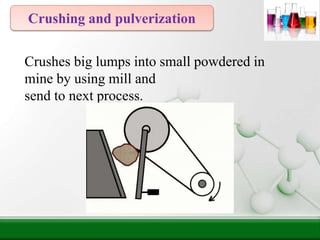
Crushes big lumps into small powdered in
mine by using mill and
send to next process.
Ore Dressing or Concentration
Removal of gangue from powdered ore is known as
ore dressing or concentration of ore.
The purified ore is known as concentrate.
Following are the methods for concentration of ore.
Gravity Separation
Froth Floatation
Electromagnetic separation
Gravity Separation
Principle
Gravity separation process is especially suitable for heavy ‘oxide’.
Process
This process is useful when the density ratio of ore and gangue is
more than 1.25, i.e. metallic part should be 1.25 (or more) times heavier
than gangue.
In this method the powdered ore is subjected to a stream of flowing
water so that lighter gangue particles are flown away leaving behind the
heavy metallic particles.
Principle:
Surface tension plays an important role in this method.
This method is usually employed for concentration of
sulphide ores.
Froath Flotation Process
Electro-Magnetic Separation
Principle:
Separation for magnetic impurities from non magnetic ore particles
(or vice-versa).
Calcination
What is Calcination ?
Heating an ore in absence of air below its melting point.
Calcination is usually done to carbonate ores.
It convert carbonates into oxide,
ZnCO3 ZnO + CO2
ii) Impurities evaporate on heating.
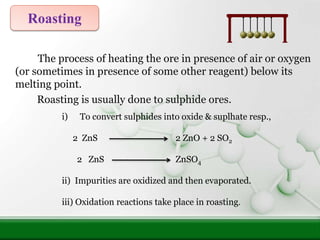
Roasting
The process of heating the ore in presence of air or oxygen
(or sometimes in presence of some other reagent) below its
melting point.
Roasting is usually done to sulphide ores.
i) To convert sulphides into oxide & suplhate resp.,
2 ZnS 2 ZnO + 2 SO2
2 ZnS ZnSO4
ii) Impurities are oxidized and then evaporated.
iii) Oxidation reactions take place in roasting.
 The roasted ore or calcined ore is heated to high
temperature along with reducing agent(generally coal or coke)
and another substance called as flux (generally lime CaO).
 The reducing agent converts the ore into molten metal,
while the flux removes the last traces of gangue in the form of
fusible mass, called slag (which floats on the molten metal)
and is removed separately.
Smelting
Fe2O3 + 3 C Δ 2 Fe + 3 CO
Ore Reducing Metal
agent (Molten)
SiO2 + CaO Δ CaSiO3
Impurity Flux slag
(Gangue) (Molten)
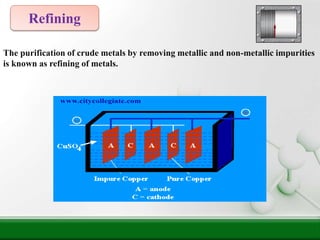
The purification of crude metals by removing metallic and non-metallic impurities
is known as refining of metals.
Refining
Metallurgy.pptx

Metallurgy.pptx

  • 1.
    Shri Shivaji EducationSociety Amravati’s J.D.Patil Sangludkar Mahavidyalaya, Daryapur. Metallurgy Rahul G sawarkar
  • 2.
    Contents Introduction Steps in Metallurgy Crushingand Pulverization Ore Dressing or concentration of ore Calcination Roasting Smelting Refining References
  • 3.
    Introduction Mineral A "naturally occurringsubstance containing an element in free state”. Or A compound with “definite chemical composition and structure." What is Metallurgy ? An art and science of getting the metal in pure state economically from ore.
  • 4.
    Steps in Metallurgy 4 Crushingand Pulverization. Ore Dressing or Concentration. Calcination. Roasting. Smelting. Refining.
  • 5.
    Crushing and pulverization Crushesbig lumps into small powdered in mine by using mill and send to next process.
  • 6.
    Ore Dressing orConcentration Removal of gangue from powdered ore is known as ore dressing or concentration of ore. The purified ore is known as concentrate. Following are the methods for concentration of ore. Gravity Separation Froth Floatation Electromagnetic separation
  • 7.
    Gravity Separation Principle Gravity separationprocess is especially suitable for heavy ‘oxide’. Process This process is useful when the density ratio of ore and gangue is more than 1.25, i.e. metallic part should be 1.25 (or more) times heavier than gangue. In this method the powdered ore is subjected to a stream of flowing water so that lighter gangue particles are flown away leaving behind the heavy metallic particles.
  • 8.
    Principle: Surface tension playsan important role in this method. This method is usually employed for concentration of sulphide ores. Froath Flotation Process
  • 9.
    Electro-Magnetic Separation Principle: Separation formagnetic impurities from non magnetic ore particles (or vice-versa).
  • 10.
    Calcination What is Calcination? Heating an ore in absence of air below its melting point. Calcination is usually done to carbonate ores. It convert carbonates into oxide, ZnCO3 ZnO + CO2 ii) Impurities evaporate on heating.
  • 11.
    Roasting The process ofheating the ore in presence of air or oxygen (or sometimes in presence of some other reagent) below its melting point. Roasting is usually done to sulphide ores. i) To convert sulphides into oxide & suplhate resp., 2 ZnS 2 ZnO + 2 SO2 2 ZnS ZnSO4 ii) Impurities are oxidized and then evaporated. iii) Oxidation reactions take place in roasting.
  • 12.
     The roastedore or calcined ore is heated to high temperature along with reducing agent(generally coal or coke) and another substance called as flux (generally lime CaO).  The reducing agent converts the ore into molten metal, while the flux removes the last traces of gangue in the form of fusible mass, called slag (which floats on the molten metal) and is removed separately. Smelting
  • 13.
    Fe2O3 + 3C Δ 2 Fe + 3 CO Ore Reducing Metal agent (Molten) SiO2 + CaO Δ CaSiO3 Impurity Flux slag (Gangue) (Molten)
  • 14.
    The purification ofcrude metals by removing metallic and non-metallic impurities is known as refining of metals. Refining