Mind Maps
by
Dr. Pramila Kudva
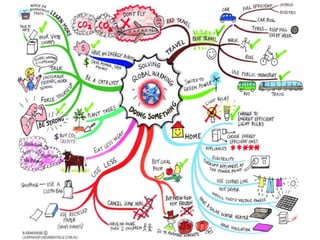
A Mind map is often created
around a single word or text,
placed in the center, to which
associated ideas, words and
concepts are added.
Invented by- TONY BUZAN
Buzan popularized the idea of mental literacy and a
thinking technique called mind mapping, inspired by
techniques used by Leonardo da Vinci, Albert Einstein, and
Joseph D. Novak's "concept mapping" techniques.
Characteristics
of mind maps
They tend to be more
flexible and personal
than concept maps.
Are used to dissect
the map’s central
topic or concept in
multiple ways.
May contain images
and colour which
makes them more
visually stimulating.
Usefulness
of mind
maps
Meaningful learning occurs when the links between concepts are
recognized, and when new information is integrated into an
existing knowledge base.
They are ‘active’ revision which can make it more interesting and
more effective for many.
They promote in-depth learning.
They help to organize the learning.
They show how the mind is organizing information.
They make recall easier.
They are good for complex topics with many smaller topic areas.
Why Mind Maps?
1. They are ‘active’ revision can make it more
interesting & more effective for many.
2. They promote in depth learning = understanding
3. They help to organise your learning.
4. Shows how your mind is organising information.
5. They make recall easier.
6. Good for complex topics with many smaller topic
areas.
7. Good for essay planning.
Guidelines
for Mind
Maps
1 of 2
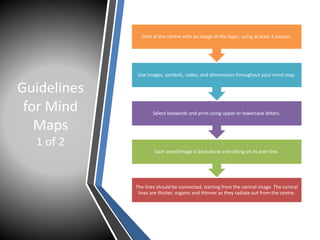
The lines should be connected, starting from the central image. The central
lines are thicker, organic and thinner as they radiate out from the centre.
Each word/image is best alone and sitting on its own line.
Select keywords and print using upper or lowercase letters.
Use images, symbols, codes, and dimensions throughout your mind map.
Start at the centre with an image of the topic, using at least 3 colours.
Guidelines for Mind Maps 2 of 2
Make the lines the same length
as the word/image they support
1.Use multiple colours throughout
the mind map, for visual stimulation
and also to encode or group.
1.Develop your own personal
style of mind mapping.
1.Use emphasis and show
associations in your mind map.
Limitations of Mind Maps
1. Not so effective for basic factual learning
2. Work best when you already know something
about the subject
3. Difficult to operate for certain subjects?
4. Not a substitute for practising exam questions
5. Ought not to be the only form of revision used
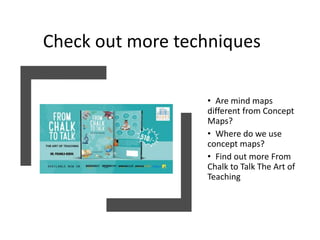
Check out more techniques
• Are mind maps
different from Concept
Maps?
• Where do we use
concept maps?
• Find out more From
Chalk to Talk The Art of
Teaching

Mind maps

  • 1.
  • 2.
    A Mind mapis often created around a single word or text, placed in the center, to which associated ideas, words and concepts are added. Invented by- TONY BUZAN
  • 3.
    Buzan popularized theidea of mental literacy and a thinking technique called mind mapping, inspired by techniques used by Leonardo da Vinci, Albert Einstein, and Joseph D. Novak's "concept mapping" techniques.
  • 4.
    Characteristics of mind maps Theytend to be more flexible and personal than concept maps. Are used to dissect the map’s central topic or concept in multiple ways. May contain images and colour which makes them more visually stimulating.
  • 5.
    Usefulness of mind maps Meaningful learningoccurs when the links between concepts are recognized, and when new information is integrated into an existing knowledge base. They are ‘active’ revision which can make it more interesting and more effective for many. They promote in-depth learning. They help to organize the learning. They show how the mind is organizing information. They make recall easier. They are good for complex topics with many smaller topic areas.
  • 6.
    Why Mind Maps? 1.They are ‘active’ revision can make it more interesting & more effective for many. 2. They promote in depth learning = understanding 3. They help to organise your learning. 4. Shows how your mind is organising information. 5. They make recall easier. 6. Good for complex topics with many smaller topic areas. 7. Good for essay planning.
  • 7.
    Guidelines for Mind Maps 1 of2 The lines should be connected, starting from the central image. The central lines are thicker, organic and thinner as they radiate out from the centre. Each word/image is best alone and sitting on its own line. Select keywords and print using upper or lowercase letters. Use images, symbols, codes, and dimensions throughout your mind map. Start at the centre with an image of the topic, using at least 3 colours.
  • 8.
    Guidelines for MindMaps 2 of 2 Make the lines the same length as the word/image they support 1.Use multiple colours throughout the mind map, for visual stimulation and also to encode or group. 1.Develop your own personal style of mind mapping. 1.Use emphasis and show associations in your mind map.
  • 10.
    Limitations of MindMaps 1. Not so effective for basic factual learning 2. Work best when you already know something about the subject 3. Difficult to operate for certain subjects? 4. Not a substitute for practising exam questions 5. Ought not to be the only form of revision used
  • 11.
    Check out moretechniques • Are mind maps different from Concept Maps? • Where do we use concept maps? • Find out more From Chalk to Talk The Art of Teaching

Editor's Notes

  • #7 Meaningful learning occurs when we recognize the links between concepts, and when we integrate new information into an existing knowledge base.