Presented By:
Akshay Ramani
PhD
DAIRY CHEMISTRY
Milk Fat Replacers: Carbohydrate based
PRESENTATION OVERVIEW
 Fat: A Good Things In Moderation
 Why Eat A Lower Fat Diet?
 Fat replacer: Terminology
 Types
 Use of fat replacers in various food
 Future trends
Fat: A Good Things In Moderation
Most concentrated source of energy in diets
(9 kcal/g of fat).
Large molecules consisting multiple fatty acid
esters.
Occur naturally in most foods.
Necessary for absorption of fat soluble
vitamins (A, D, E & K).
Provide mouth-feel, texture and taste to
Why Eat A Lower Fat Diet ?
 Too much dietary fat linked to higher risk
of chronic diseases
Heart diseases: Specially saturated fat
Heart Failure
Stroke
Some cancers
Colorectal cancer
Prostate cancer
Obesity
Hypertension
Diabetes/ Insulin resistance
Fat Replacers - Terminology
Fat Substitute
 Compound designed to replace fats on a weight by weight basis.
Fat Mimetic
 Compound that reproduces physical and sensory attributes associated with
fats.
Fat Analogs
 Compounds with many of the characteristics of fat but have an altered
digestibility and altered nutritional value.
Fat extenders
 Compound that optimize functionality of fat, thus allowing a decrease in the
usual amount of fat in the products.
What are Fat Replacers ?
 Fat replacers are any substances that are able to emulate the
physical and sensory properties of fats in foods or food preparation,
without any calories or at a reduced level of calories.
 They are
- Old ingredients used in new ways
- Most are made from familiar ingredients
- Some are combination of basic ingredients
Types of Fat Replacers
Carbohydrate-based
Protein-based
Synthetic Fat-based
(Ognean et al., 2006)
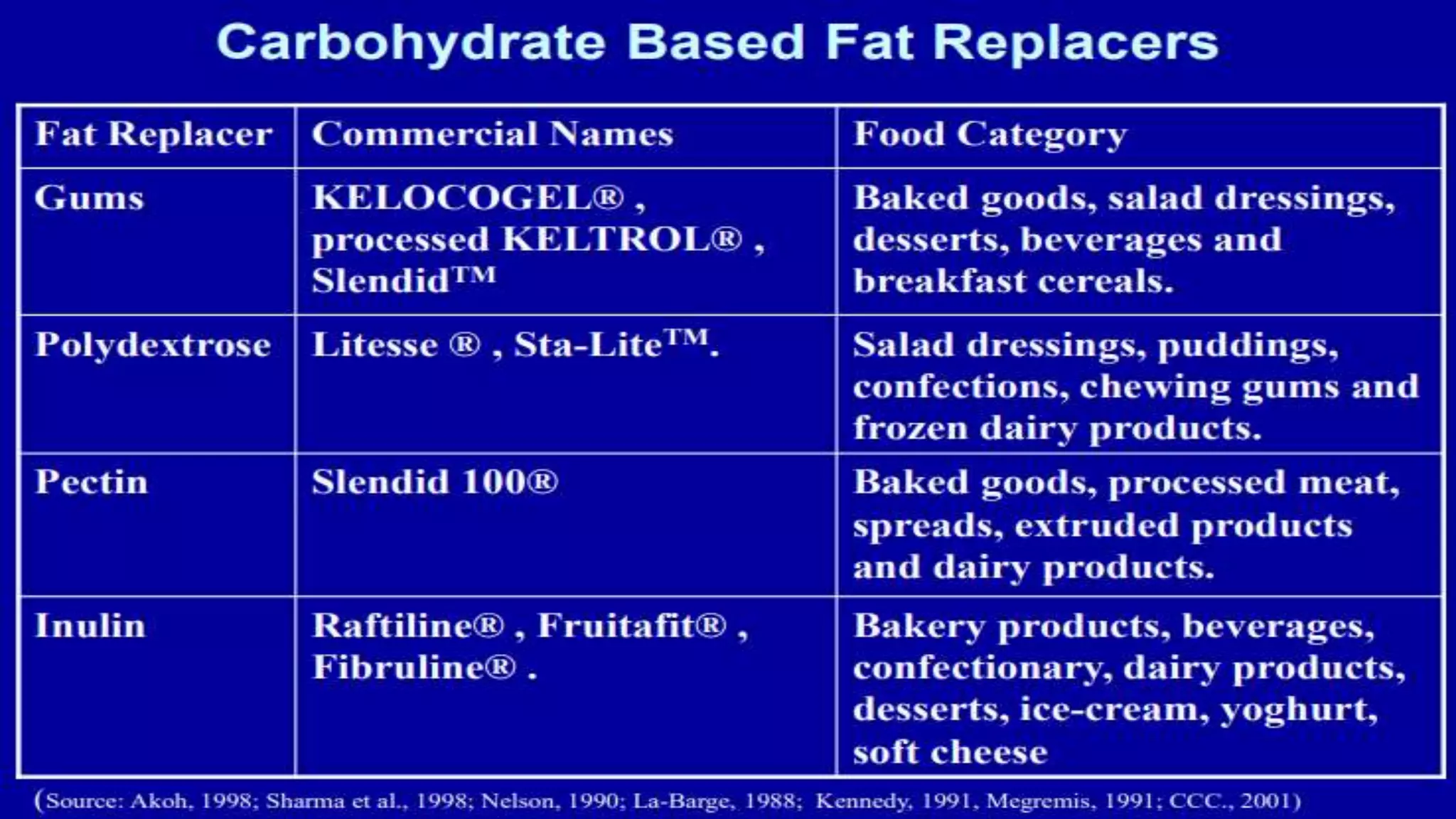
Carbohydrate Based fat replacers
Starch – derived fat mimetics:
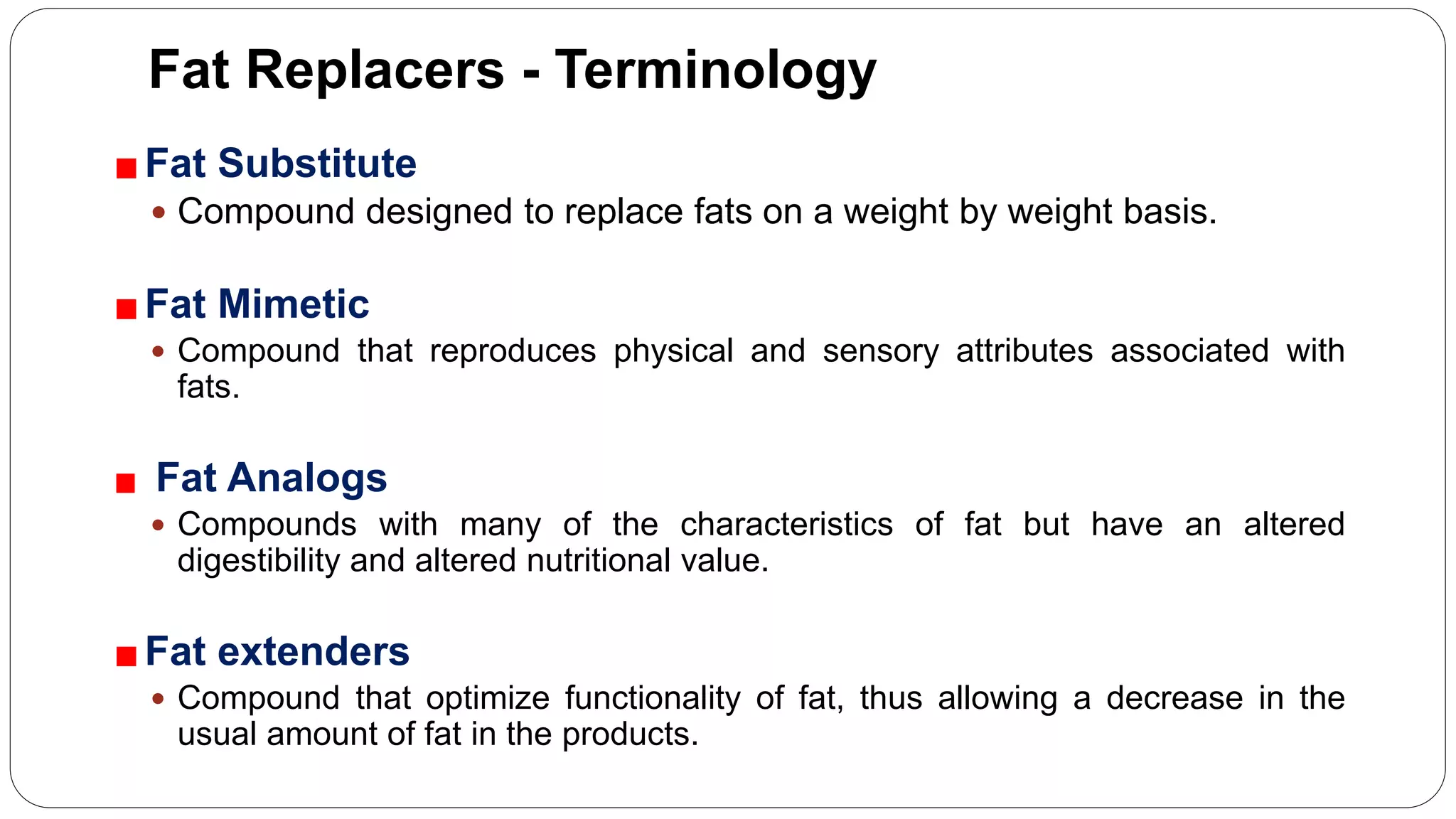
Maltodextrin
Modified Starches
Oatrim
Z-trim
Fiber based fat mimetics
Microcrystalline cellulose
Methylcellulose gums
Pectin
Hydrocolloid gums
Polydextrose
Fruit and fruit purees
Maltodextrins
Maltodextrins are products of the partial hydrolysis of
starch by enzymes or acids, and are α-D-glucans with a
low degree of polymerization.
Non sweet.
Produced by partial hydrolysis of starch (corn, potato, oat,
rice, wheat, tapioca) .
Uses: table spreads, margarine, imitation sour cream,
salad dressings, baked goods, frostings, fillings ,sauces,
processed meat, frozen desserts .
Application of Maltodextrin
It replaces fat and some sugar to give calorie reduced
frozen desserts with the usage level of 1.5% (Hannigan,
1981; Adapa et al., 2000).
In frozen desserts, maltodextrin added at a level of 9-13%
which replaces butterfat and enables calorie reduction by
45%.
In spreadable foods like table spreads, meat pates,
frostings
and cheese-cake when fat is lowered the continuous oil
phase
Nutritional & Toxicological Aspects of Maltodextrin.
Pre-prepared gels, consisting of one part maltodextrin and
three parts water, have only 1 kcal/gm, which is only 1/9 of
the caloric value of fats and oils.
FDA has given maltodextrins a GRAS status for use as a
direct human food ingredient.
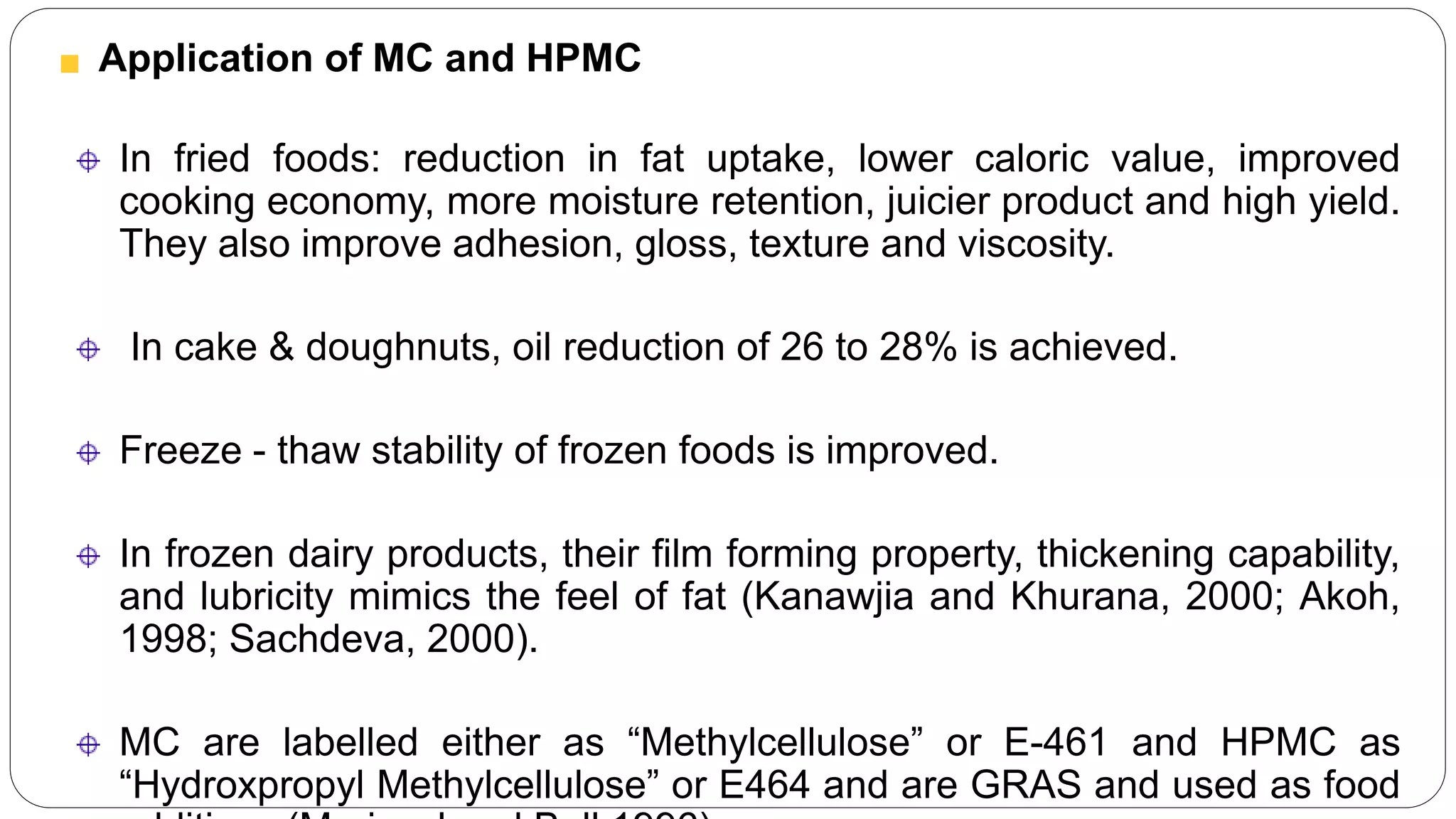
Oatrim
Also known as α-Trim™.
Energy produces 1-4 kcal/g.
Made by partial enzymatic hydolysis of oat starch.
Used for baked goods, fillings and frostings, frozen
desserts, dairy beverages, cheese, salad dressings,
processes meats and confections (Owusu-apenten,
2005).
Z-trim
Insoluble fiber from oat, soybean, pea and rice hulls or
from corn or wheat bran.
Increasing the fiber content of food
Used with baked goods, burgers, cheese, ice-cream and
yoghurt.
Despite its heat stability, Z-trim is not considered suitable
for frying (Owusu-apenten, 2005).
Microcrystalline cellulose:
It is colloidal products based on co-processing
microcrystalline cellulose with sodium carboxymethyl
cellulose.
Uses: Salad dressings, bakery products, dairy
products, ice-cream and frozen desserts, cheese
spreads and processed meats.
The standard usage levels range from 0.4 to 3.0%.
In most food systems, microcrystalline cellulose is used
as part of an overall fat-mimetic system, which often
includes soluble hydrocolloid starch, fat flavours and
Methylcellulose gums :
Such as methylcellulose (MC) and hydroxy propyl methyl cellulose:
used for more than 40 years.
MC and HPMC helps entrain air in food stuffs to improve structure,
stabilize air or carbon dioxide bubbles to reduce volume loss and
enhance moisture retention.
Uses: fried foods, liquid foods, baked products, frozen dairy products
and low-fat whipped toppings.
The main benefit from using MC and HPMC in fried food products is
the reduction in fat uptake achievable during the frying step. This
Application of MC and HPMC
In fried foods: reduction in fat uptake, lower caloric value, improved
cooking economy, more moisture retention, juicier product and high yield.
They also improve adhesion, gloss, texture and viscosity.
In cake & doughnuts, oil reduction of 26 to 28% is achieved.
Freeze - thaw stability of frozen foods is improved.
In frozen dairy products, their film forming property, thickening capability,
and lubricity mimics the feel of fat (Kanawjia and Khurana, 2000; Akoh,
1998; Sachdeva, 2000).
MC are labelled either as “Methylcellulose” or E-461 and HPMC as
“Hydroxpropyl Methylcellulose” or E464 and are GRAS and used as food
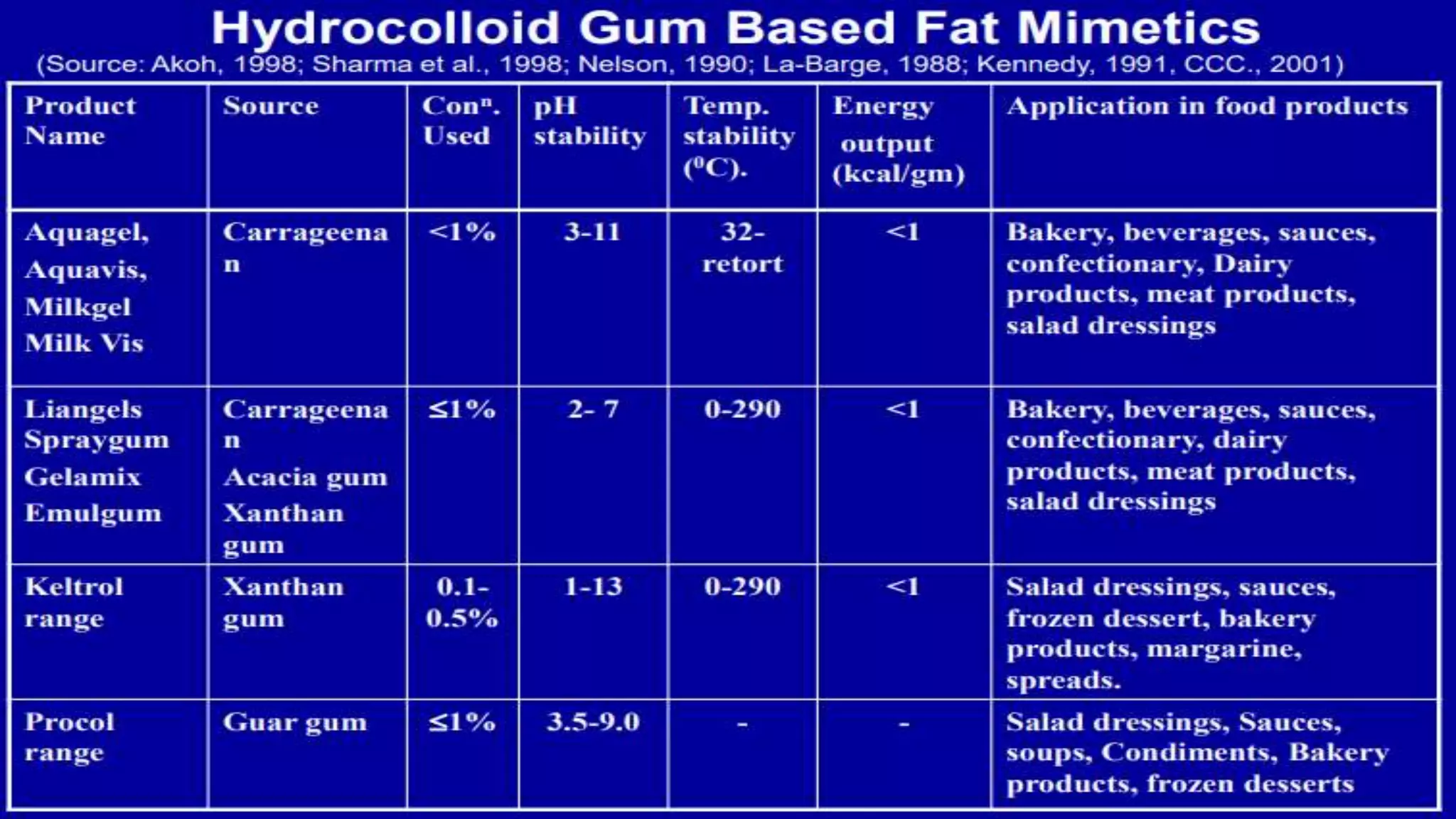
Hydrocolloid gums
Gums are referred to as hydrophilic colloids or hydrocolloids
which are long chain, high-molecular weight polymers that
dissolve or disperse in water, and are considered non nutritive.
They may also be produced by the chemical modification of
polysaccharides or from microbial fermentation (Giese, 1996).
Used as bulking agents and emulsifiers.
Applications of hydrocolloid gums In Low-fat Foods
As a stabilizer in low-fat ice-creams, dressings, sauces and
mayonnaises.
In soft cheese type products to prevent syneresis.
In low-fat bakery products to give softness and moistness.
Used at 0.1 to 0.4% levels and give <1 Kcal/gm.
Polydextrose
Randomly-bonded polymer of glucose, sorbitol, and citric
or phosphoric acid
Available in liquid or powdered and acidic or neutralized
forms.
It is a low-calorie bulking agent which can replace all or
part of the sugars and some of the fats in foods.
Used as a humectants, texturizer, thickeners and
stabilizer.
Nutritional and Toxicological Aspects of
Polydextrose
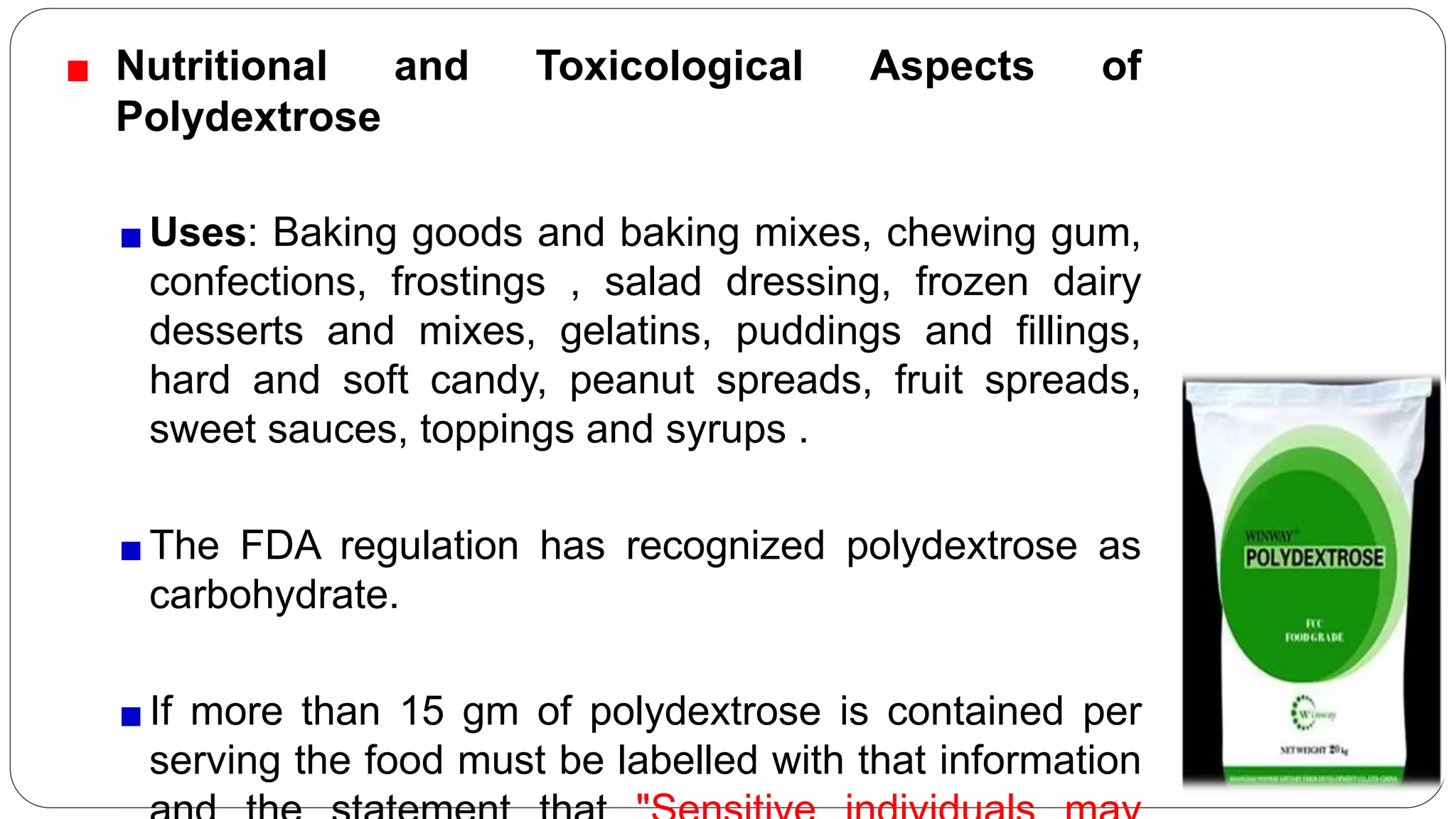
Uses: Baking goods and baking mixes, chewing gum,
confections, frostings , salad dressing, frozen dairy
desserts and mixes, gelatins, puddings and fillings,
hard and soft candy, peanut spreads, fruit spreads,
sweet sauces, toppings and syrups .
The FDA regulation has recognized polydextrose as
carbohydrate.
If more than 15 gm of polydextrose is contained per
serving the food must be labelled with that information
Pectin:
Hydrocolloid consisting of partial methyl esters of
polygalacturonic acid.
Cell wall polysaccharides extracted from apple pomace,
citrus peel, sugar beet pulp, sunflowers heads.
The fat replacer is "pectin" or "fruit pectin" and in the U.S is
affirmed GRAS.
The E.U has adopted pectin as a food additive under the
designation of E440
Uses: mainly in sauces.
Fruit and fruit purees
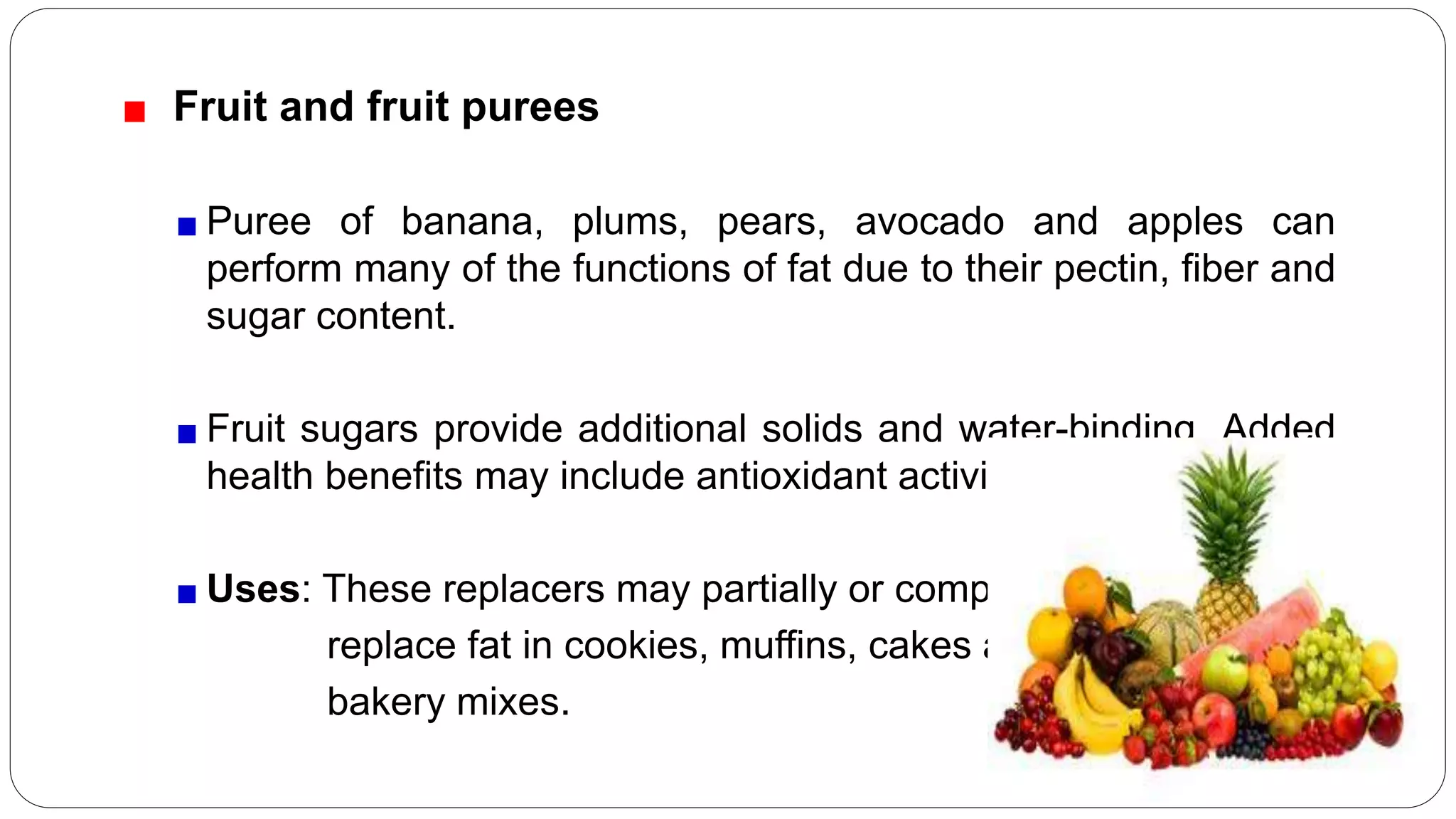
Puree of banana, plums, pears, avocado and apples can
perform many of the functions of fat due to their pectin, fiber and
sugar content.
Fruit sugars provide additional solids and water-binding. Added
health benefits may include antioxidant activity.
Uses: These replacers may partially or completely
replace fat in cookies, muffins, cakes and other
bakery mixes.
Mechanism for Fat Replacement with
Carbohydrates
No single ingredient is commercially is
available to replace fat in all foods.
Conclusion:
Carbohydrate fat replacers usually have low
calorie density and provide gelling,
thickening, stabilizing, and other texture-
modifying properties.
THANK YOU

Milk fat replacers carbohydrate based

  • 1.
    Presented By: Akshay Ramani PhD DAIRYCHEMISTRY Milk Fat Replacers: Carbohydrate based
  • 2.
    PRESENTATION OVERVIEW  Fat:A Good Things In Moderation  Why Eat A Lower Fat Diet?  Fat replacer: Terminology  Types  Use of fat replacers in various food  Future trends
  • 3.
    Fat: A GoodThings In Moderation Most concentrated source of energy in diets (9 kcal/g of fat). Large molecules consisting multiple fatty acid esters. Occur naturally in most foods. Necessary for absorption of fat soluble vitamins (A, D, E & K). Provide mouth-feel, texture and taste to
  • 4.
    Why Eat ALower Fat Diet ?  Too much dietary fat linked to higher risk of chronic diseases Heart diseases: Specially saturated fat Heart Failure Stroke Some cancers Colorectal cancer Prostate cancer Obesity Hypertension Diabetes/ Insulin resistance
  • 5.
    Fat Replacers -Terminology Fat Substitute  Compound designed to replace fats on a weight by weight basis. Fat Mimetic  Compound that reproduces physical and sensory attributes associated with fats. Fat Analogs  Compounds with many of the characteristics of fat but have an altered digestibility and altered nutritional value. Fat extenders  Compound that optimize functionality of fat, thus allowing a decrease in the usual amount of fat in the products.
  • 6.
    What are FatReplacers ?  Fat replacers are any substances that are able to emulate the physical and sensory properties of fats in foods or food preparation, without any calories or at a reduced level of calories.  They are - Old ingredients used in new ways - Most are made from familiar ingredients - Some are combination of basic ingredients
  • 7.
    Types of FatReplacers Carbohydrate-based Protein-based Synthetic Fat-based (Ognean et al., 2006)
  • 8.
    Carbohydrate Based fatreplacers Starch – derived fat mimetics: Maltodextrin Modified Starches Oatrim Z-trim Fiber based fat mimetics Microcrystalline cellulose Methylcellulose gums Pectin Hydrocolloid gums Polydextrose Fruit and fruit purees
  • 9.
    Maltodextrins Maltodextrins are productsof the partial hydrolysis of starch by enzymes or acids, and are α-D-glucans with a low degree of polymerization. Non sweet. Produced by partial hydrolysis of starch (corn, potato, oat, rice, wheat, tapioca) . Uses: table spreads, margarine, imitation sour cream, salad dressings, baked goods, frostings, fillings ,sauces, processed meat, frozen desserts .
  • 10.
    Application of Maltodextrin Itreplaces fat and some sugar to give calorie reduced frozen desserts with the usage level of 1.5% (Hannigan, 1981; Adapa et al., 2000). In frozen desserts, maltodextrin added at a level of 9-13% which replaces butterfat and enables calorie reduction by 45%. In spreadable foods like table spreads, meat pates, frostings and cheese-cake when fat is lowered the continuous oil phase
  • 11.
    Nutritional & ToxicologicalAspects of Maltodextrin. Pre-prepared gels, consisting of one part maltodextrin and three parts water, have only 1 kcal/gm, which is only 1/9 of the caloric value of fats and oils. FDA has given maltodextrins a GRAS status for use as a direct human food ingredient.
  • 12.
    Oatrim Also known asα-Trim™. Energy produces 1-4 kcal/g. Made by partial enzymatic hydolysis of oat starch. Used for baked goods, fillings and frostings, frozen desserts, dairy beverages, cheese, salad dressings, processes meats and confections (Owusu-apenten, 2005).
  • 13.
    Z-trim Insoluble fiber fromoat, soybean, pea and rice hulls or from corn or wheat bran. Increasing the fiber content of food Used with baked goods, burgers, cheese, ice-cream and yoghurt. Despite its heat stability, Z-trim is not considered suitable for frying (Owusu-apenten, 2005).
  • 14.
    Microcrystalline cellulose: It iscolloidal products based on co-processing microcrystalline cellulose with sodium carboxymethyl cellulose. Uses: Salad dressings, bakery products, dairy products, ice-cream and frozen desserts, cheese spreads and processed meats. The standard usage levels range from 0.4 to 3.0%. In most food systems, microcrystalline cellulose is used as part of an overall fat-mimetic system, which often includes soluble hydrocolloid starch, fat flavours and
  • 15.
    Methylcellulose gums : Suchas methylcellulose (MC) and hydroxy propyl methyl cellulose: used for more than 40 years. MC and HPMC helps entrain air in food stuffs to improve structure, stabilize air or carbon dioxide bubbles to reduce volume loss and enhance moisture retention. Uses: fried foods, liquid foods, baked products, frozen dairy products and low-fat whipped toppings. The main benefit from using MC and HPMC in fried food products is the reduction in fat uptake achievable during the frying step. This
  • 16.
    Application of MCand HPMC In fried foods: reduction in fat uptake, lower caloric value, improved cooking economy, more moisture retention, juicier product and high yield. They also improve adhesion, gloss, texture and viscosity. In cake & doughnuts, oil reduction of 26 to 28% is achieved. Freeze - thaw stability of frozen foods is improved. In frozen dairy products, their film forming property, thickening capability, and lubricity mimics the feel of fat (Kanawjia and Khurana, 2000; Akoh, 1998; Sachdeva, 2000). MC are labelled either as “Methylcellulose” or E-461 and HPMC as “Hydroxpropyl Methylcellulose” or E464 and are GRAS and used as food
  • 17.
    Hydrocolloid gums Gums arereferred to as hydrophilic colloids or hydrocolloids which are long chain, high-molecular weight polymers that dissolve or disperse in water, and are considered non nutritive. They may also be produced by the chemical modification of polysaccharides or from microbial fermentation (Giese, 1996). Used as bulking agents and emulsifiers.
  • 20.
    Applications of hydrocolloidgums In Low-fat Foods As a stabilizer in low-fat ice-creams, dressings, sauces and mayonnaises. In soft cheese type products to prevent syneresis. In low-fat bakery products to give softness and moistness. Used at 0.1 to 0.4% levels and give <1 Kcal/gm.
  • 21.
    Polydextrose Randomly-bonded polymer ofglucose, sorbitol, and citric or phosphoric acid Available in liquid or powdered and acidic or neutralized forms. It is a low-calorie bulking agent which can replace all or part of the sugars and some of the fats in foods. Used as a humectants, texturizer, thickeners and stabilizer.
  • 23.
    Nutritional and ToxicologicalAspects of Polydextrose Uses: Baking goods and baking mixes, chewing gum, confections, frostings , salad dressing, frozen dairy desserts and mixes, gelatins, puddings and fillings, hard and soft candy, peanut spreads, fruit spreads, sweet sauces, toppings and syrups . The FDA regulation has recognized polydextrose as carbohydrate. If more than 15 gm of polydextrose is contained per serving the food must be labelled with that information
  • 24.
    Pectin: Hydrocolloid consisting ofpartial methyl esters of polygalacturonic acid. Cell wall polysaccharides extracted from apple pomace, citrus peel, sugar beet pulp, sunflowers heads. The fat replacer is "pectin" or "fruit pectin" and in the U.S is affirmed GRAS. The E.U has adopted pectin as a food additive under the designation of E440 Uses: mainly in sauces.
  • 25.
    Fruit and fruitpurees Puree of banana, plums, pears, avocado and apples can perform many of the functions of fat due to their pectin, fiber and sugar content. Fruit sugars provide additional solids and water-binding. Added health benefits may include antioxidant activity. Uses: These replacers may partially or completely replace fat in cookies, muffins, cakes and other bakery mixes.
  • 26.
    Mechanism for FatReplacement with Carbohydrates
  • 29.
    No single ingredientis commercially is available to replace fat in all foods. Conclusion: Carbohydrate fat replacers usually have low calorie density and provide gelling, thickening, stabilizing, and other texture- modifying properties.
  • 30.