Differentiated Instruction Grades 6-12Patricia HuttonLA consultantCMSCE at Rutgerstikap@aol.com908-757-27511
Session OverviewWhat Is Differentiation?Differentiation StrategiesDifferentiation PracticeTips for Implementing Differentiated InstructionResources2
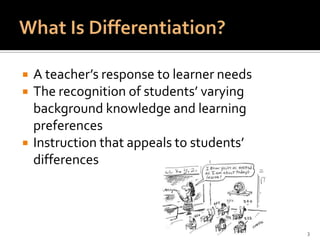
What Is Differentiation?A teacher’s response to learner needsThe recognition of students’ varying background knowledge and learning preferencesInstruction that appeals to students’ differences3
4Why differentiate ?Because not all children learn in the same way.
Because NCLB requires all children to be proficient.
Because research demonstrates effectiveness.
Because meeting a student’s needs maximizes growth.
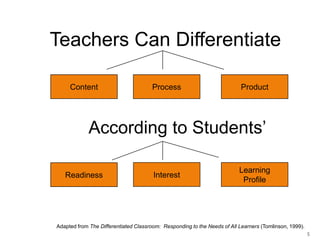
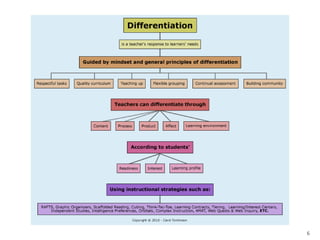
Because of diverse student populations. (ELL, disabilities, and cultural backgrounds) 5Teachers Can DifferentiateContentProcessProductAccording to Students’InterestLearningProfileReadinessAdapted from The Differentiated Classroom:  Responding to the Needs of All Learners (Tomlinson, 1999).
6
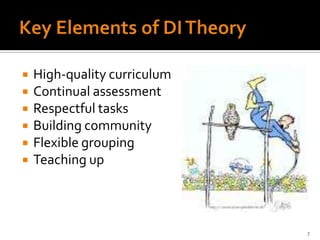
Key Elements of DI TheoryHigh-quality curriculumContinual assessmentRespectful tasksBuilding communityFlexible groupingTeaching up7
ReflectionHow are traditional classrooms and differentiated classrooms alike? How are they different?8?
Comparing Traditional and Differentiated ClassroomsConsideration of student differencesFrench 1-Use of assessmentEnglishUse of student interest and learning stylePhysical educationMiddle school science9
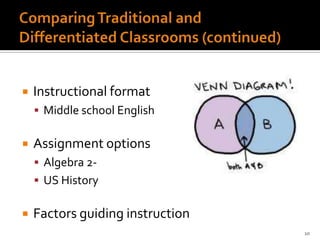
Comparing Traditional and Differentiated Classrooms (continued)Instructional formatMiddle school EnglishAssignment optionsAlgebra 2-US HistoryFactors guiding instruction10
11What are you already doing to differentiate instruction in your classroom?Discussion Question
Because………. When you differentiate you must:Know exactly where students are before you know how to take them someplace newOrganize resourcesPrepare for varying degrees of depthSupportModify your strategy as you goRecognize there are different ways to reach the same destination12
Differentiation StrategiesAll strategies are aligned with instructional goals and objectives.Specific strategy selection based on Focus of instructionFocus of differentiation	13
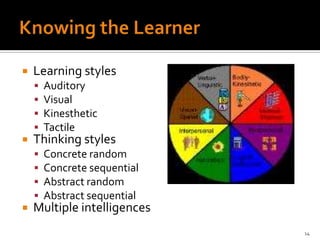
Knowing the LearnerLearning stylesAuditoryVisualKinestheticTactileThinking stylesConcrete randomConcrete sequentialAbstract randomAbstract sequentialMultiple intelligences14
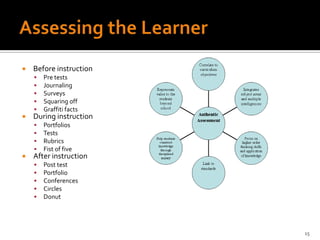
Assessing the LearnerBefore instructionPre testsJournalingSurveysSquaring offGraffiti factsDuring instructionPortfoliosTestsRubricsFist of fiveAfter instructionPost testPortfolioConferencesCirclesDonut15
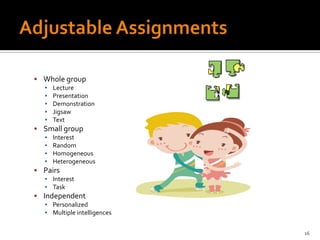
Adjustable AssignmentsWhole groupLecturePresentationDemonstrationJigsawTextSmall groupInterestRandomHomogeneousHeterogeneousPairsInterestTaskIndependentPersonalizedMultiple intelligences16
Differentiation Strategies Compacting- Steps for compactingIndependent Study- Sample independent projectsInterest Centers or Interest GroupsFlexible Grouping- Types of groups17
Strategies That Support Interest-Based StudiesStudying concepts and principles through the lens of interestStudent choice of tasksIndependent StudyI-SearchesOrbitalsMentorshipsGroup InvestigationsInterest GroupsJigsawLiterature CirclesWebQuestsStudent-selected audiences18
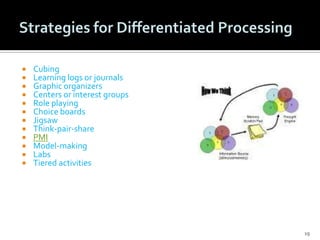
Strategies for Differentiated ProcessingCubingLearning logs or journalsGraphic organizersCenters or interest groupsRole playingChoice boardsJigsawThink-pair-sharePMI Model-makingLabs Tiered activities19
Strategies ContinuedComplex instruction- 10th grade EnglishSmall groupsOpen-endedAmbiguousIntegrate reading and writingUse multiple intelligences and multimedia20
Orbital studies- grade 6Addresses similarities and differencesIndependent investigations that orbit around curriculumStudents choose topicsStudents develop research question and plan, method of presentation, and criteria for assessment21
Entry points- Grade 7 Social StudiesAddress differing multiple intelligence profiles5 entry pointsNarrationalLogical-quantitativeFoundationalAestheticExperiential22
Examples of Differentiation StrategiesChoice Boards- PersuasionPhotosynthesisTechnologyTiered Activities- Causes of the Civil WarPhotojournalism 10-12Learning Contracts- Samples23
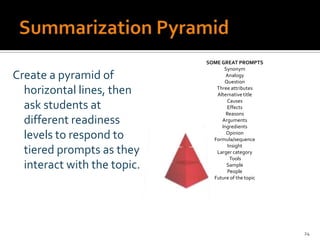
Summarization PyramidSOME GREAT PROMPTSSynonymAnalogyQuestionThree attributesAlternative titleCausesEffectsReasonsArgumentsIngredientsOpinionFormula/sequenceInsightLarger category  ToolsSamplePeopleFuture of the topicCreate a pyramid of horizontal lines, then ask students at different readiness levels to respond to tiered prompts as they interact with the topic.  24
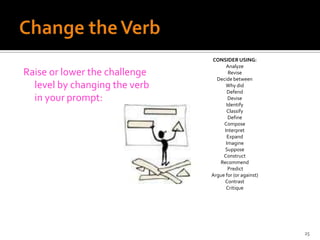
Change the VerbRaise or lower the challenge level by changing the verb in your prompt:CONSIDER USING:AnalyzeReviseDecide betweenWhy didDefendDeviseIdentifyClassifyDefineComposeInterpretExpandImagineSupposeConstructRecommend Predict Argue for (or against)ContrastCritique25
Using Technology in Differentiated InstructionIt's a Wild Ride- project based learningtech matrix-  identify appropriate toolsbackpack it- Make pages with to-do lists, notes, files, and images 	word 2 word- dictionaries in multiple languagespodcastsNational Geographic webcamsUnited Streaming videosVirtual Field tripsHandhelds26
Technology for Student Productswww.blogger.comhttp://pbwiki.com/	www.voicethread.comhttp://www.storycenter.org/Bio CubeAcrostic poemsCharacter trading cards27
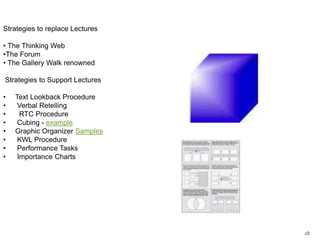
28Strategies to replace Lectures The Thinking Web
The Forum
 The Gallery Walk renowned  Strategies to Support LecturesText Lookback Procedure
 Verbal Retelling
  RTC Procedure
Cubing - example
Graphic Organizer Samples
 KWL Procedure
 Performance Tasks
 Importance Charts Big Question Teaching Frame lessons and units as questions, issues or problems -more challenging and interesting -narrows the topicOpen-ended questions stimulate thought, encourage creative thinking and diverse responses -authentic learning and investigation. Examples of big questions: •  What makes a poem memorable? •  What are the unsolved mysteries of the pyramids? •  What does it mean to be an ethical scientist? 29
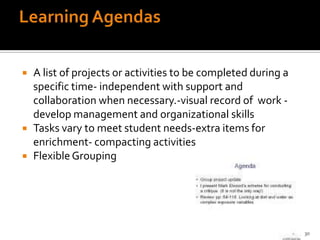
Learning Agendas A list of projects or activities to be completed during a specific time- independent with support and collaboration when necessary.-visual record of  work - develop management and organizational skillsTasks vary to meet student needs-extra items for enrichment- compacting activities Flexible Grouping 30
Centers or Stations Flexible grouping -work with individual students or small groupsFocus on important learning goals, use materials that support individual students' growth; use activities addressing a range of reading levels, learning profiles, and student interests; and provide clear directions Student-led or teacher-led. In a secondary  math classroom, learners might rotate through five stations: •  working with the teacher to learn about probability •  solving probability problems from the textbook •  generating a list of real-world applications for probability •  working on new computer program with a small group •  completing a review worksheet from the last unit 31
32Diner Menu – PhotosynthesisAppetizer (Everyone Shares)Write the chemical equation for photosynthesis.Entrée (Select One)Draw a picture that shows what happens during photosynthesis.
Write two paragraphs about what happens during photosynthesis.
Create a rap that explains what happens during photosynthesis.Side Dishes (Select at Least Two) Define respiration, in writing.
Compare photosynthesis to respiration using a Venn Diagram.
Write a journal entry from the point of view of a green plant.
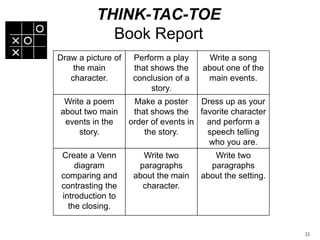
With a partner, create and perform a skit that shows the differences between photosynthesis and respiration.Dessert (Optional)Create a test to assess the teacher’s knowledge of photosynthesis.33THINK-TAC-TOEBook Report
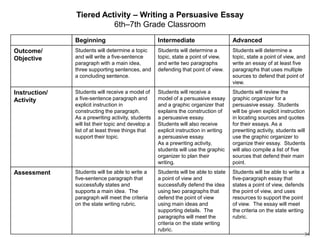
34Tiered Activity – Writing a Persuasive Essay6th–7th Grade Classroom
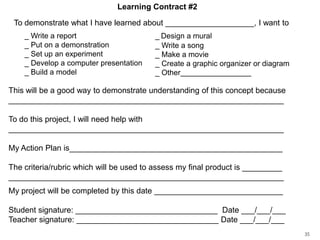
35LearningContract #2To demonstrate what I have learned about ____________________, I want to_ Write a report_ Put on a demonstration_ Set up an experiment_ Develop a computer presentation_ Build a model_Design a mural_ Write a song_ Make a movie_ Create a graphic organizer or diagram_ OtherThis will be a good way to demonstrate understanding of this concept because______________________________________________________________To do this project, I will need help with______________________________________________________________My Action Plan is________________________________________________The criteria/rubric which will be used to assess my final product is _______________________________________________________________________My project will be completed by this date _____________________________Student signature: ________________________________  Date ___/___/___Teacher signature: ________________________________ Date ___/___/___
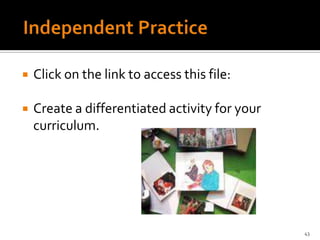
Differentiation PracticeDifferentiation Scenario36
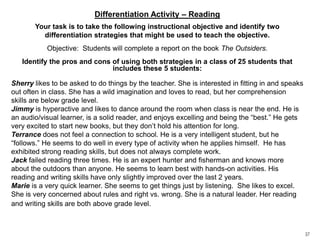
37Differentiation Activity – ReadingYour task is to take the following instructional objective and identify two differentiation strategies that might be used to teach the objective.Objective:  Students will complete a report on the bookThe Outsiders.Identify the pros and cons of using both strategies in a class of 25 students that includes these 5 students:Sherry likes to be asked to do things by the teacher. She is interested in fitting in and speaks out often in class. She has a wild imagination and loves to read, but her comprehension skills are below grade level.Jimmy is hyperactive and likes to dance around the room when class is near the end. He is an audio/visual learner, is a solid reader, and enjoys excelling and being the “best.” He gets very excited to start new books, but they don’t hold his attention for long.Terrance does not feel a connection to school. He is a very intelligent student, but he “follows.” He seems to do well in every type of activity when he applies himself.  He has exhibited strong reading skills, but does not always complete work.Jack failed reading three times. He is an expert hunter and fisherman and knows more about the outdoors than anyone. He seems to learn best with hands-on activities. His reading and writing skills have only slightly improved over the last 2 years.Marie is a very quick learner. She seems to get things just by listening.  She likes to excel.  She is very concerned about rules and right vs. wrong. She is a natural leader. Her reading and writing skills are both above grade level.
Assessment in the Differentiated ClassroomOngoingInstruction-dependentStudent-dependentInformative for continuedinstruction38
Assessment ToolsStudent Progress- monitoring toolsEngrade-online gradebook	39
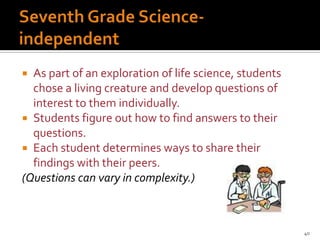
Seventh Grade Science-independentAs part of an exploration of life science, students chose a living creature and develop questions of interest to them individually.Students figure out how to find answers to their questions.Each student determines ways to share their findings with their peers.(Questions can vary in complexity.)40
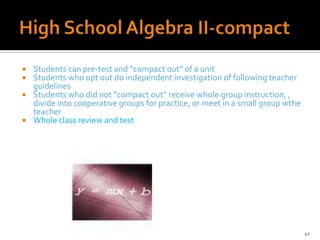
High School Algebra II-compactStudents can pre-test and “compact out” of a unitStudents who opt out do independent investigation of following teacher guidelinesStudents who did not “compact out” receive whole group instruction, , divide into cooperative groups for practice, or meet in a small group wthe teacherWhole class review and test41
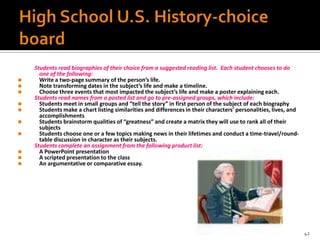
High School U.S. History-choice boardStudents read biographies of their choice from a suggested reading list.  Each student chooses to do one of the following:Write a two-page summary of the person’s life.
Note transforming dates in the subject’s life and make a timeline.

Differentiated instruction6 12

  • 1.
    Differentiated Instruction Grades6-12Patricia HuttonLA consultantCMSCE at Rutgerstikap@aol.com908-757-27511
  • 2.
    Session OverviewWhat IsDifferentiation?Differentiation StrategiesDifferentiation PracticeTips for Implementing Differentiated InstructionResources2
  • 3.
    What Is Differentiation?Ateacher’s response to learner needsThe recognition of students’ varying background knowledge and learning preferencesInstruction that appeals to students’ differences3
  • 4.
    4Why differentiate ?Becausenot all children learn in the same way.
  • 5.
    Because NCLB requiresall children to be proficient.
  • 6.
  • 7.
    Because meeting astudent’s needs maximizes growth.
  • 8.
    Because of diversestudent populations. (ELL, disabilities, and cultural backgrounds) 5Teachers Can DifferentiateContentProcessProductAccording to Students’InterestLearningProfileReadinessAdapted from The Differentiated Classroom: Responding to the Needs of All Learners (Tomlinson, 1999).
  • 9.
  • 10.
    Key Elements ofDI TheoryHigh-quality curriculumContinual assessmentRespectful tasksBuilding communityFlexible groupingTeaching up7
  • 11.
    ReflectionHow are traditionalclassrooms and differentiated classrooms alike? How are they different?8?
  • 12.
    Comparing Traditional andDifferentiated ClassroomsConsideration of student differencesFrench 1-Use of assessmentEnglishUse of student interest and learning stylePhysical educationMiddle school science9
  • 13.
    Comparing Traditional andDifferentiated Classrooms (continued)Instructional formatMiddle school EnglishAssignment optionsAlgebra 2-US HistoryFactors guiding instruction10
  • 14.
    11What are youalready doing to differentiate instruction in your classroom?Discussion Question
  • 15.
    Because………. When youdifferentiate you must:Know exactly where students are before you know how to take them someplace newOrganize resourcesPrepare for varying degrees of depthSupportModify your strategy as you goRecognize there are different ways to reach the same destination12
  • 16.
    Differentiation StrategiesAll strategiesare aligned with instructional goals and objectives.Specific strategy selection based on Focus of instructionFocus of differentiation 13
  • 17.
    Knowing the LearnerLearningstylesAuditoryVisualKinestheticTactileThinking stylesConcrete randomConcrete sequentialAbstract randomAbstract sequentialMultiple intelligences14
  • 18.
    Assessing the LearnerBeforeinstructionPre testsJournalingSurveysSquaring offGraffiti factsDuring instructionPortfoliosTestsRubricsFist of fiveAfter instructionPost testPortfolioConferencesCirclesDonut15
  • 19.
    Adjustable AssignmentsWhole groupLecturePresentationDemonstrationJigsawTextSmallgroupInterestRandomHomogeneousHeterogeneousPairsInterestTaskIndependentPersonalizedMultiple intelligences16
  • 20.
    Differentiation Strategies Compacting-Steps for compactingIndependent Study- Sample independent projectsInterest Centers or Interest GroupsFlexible Grouping- Types of groups17
  • 21.
    Strategies That SupportInterest-Based StudiesStudying concepts and principles through the lens of interestStudent choice of tasksIndependent StudyI-SearchesOrbitalsMentorshipsGroup InvestigationsInterest GroupsJigsawLiterature CirclesWebQuestsStudent-selected audiences18
  • 22.
    Strategies for DifferentiatedProcessingCubingLearning logs or journalsGraphic organizersCenters or interest groupsRole playingChoice boardsJigsawThink-pair-sharePMI Model-makingLabs Tiered activities19
  • 23.
    Strategies ContinuedComplex instruction-10th grade EnglishSmall groupsOpen-endedAmbiguousIntegrate reading and writingUse multiple intelligences and multimedia20
  • 24.
    Orbital studies- grade6Addresses similarities and differencesIndependent investigations that orbit around curriculumStudents choose topicsStudents develop research question and plan, method of presentation, and criteria for assessment21
  • 25.
    Entry points- Grade7 Social StudiesAddress differing multiple intelligence profiles5 entry pointsNarrationalLogical-quantitativeFoundationalAestheticExperiential22
  • 26.
    Examples of DifferentiationStrategiesChoice Boards- PersuasionPhotosynthesisTechnologyTiered Activities- Causes of the Civil WarPhotojournalism 10-12Learning Contracts- Samples23
  • 27.
    Summarization PyramidSOME GREATPROMPTSSynonymAnalogyQuestionThree attributesAlternative titleCausesEffectsReasonsArgumentsIngredientsOpinionFormula/sequenceInsightLarger category ToolsSamplePeopleFuture of the topicCreate a pyramid of horizontal lines, then ask students at different readiness levels to respond to tiered prompts as they interact with the topic. 24
  • 28.
    Change the VerbRaiseor lower the challenge level by changing the verb in your prompt:CONSIDER USING:AnalyzeReviseDecide betweenWhy didDefendDeviseIdentifyClassifyDefineComposeInterpretExpandImagineSupposeConstructRecommend Predict Argue for (or against)ContrastCritique25
  • 29.
    Using Technology inDifferentiated InstructionIt's a Wild Ride- project based learningtech matrix- identify appropriate toolsbackpack it- Make pages with to-do lists, notes, files, and images word 2 word- dictionaries in multiple languagespodcastsNational Geographic webcamsUnited Streaming videosVirtual Field tripsHandhelds26
  • 30.
    Technology for StudentProductswww.blogger.comhttp://pbwiki.com/ www.voicethread.comhttp://www.storycenter.org/Bio CubeAcrostic poemsCharacter trading cards27
  • 31.
    28Strategies to replaceLectures The Thinking Web
  • 32.
  • 33.
    The GalleryWalk renowned Strategies to Support LecturesText Lookback Procedure
  • 34.
  • 35.
    RTCProcedure
  • 36.
  • 37.
  • 38.
  • 39.
  • 40.
    Importance ChartsBig Question Teaching Frame lessons and units as questions, issues or problems -more challenging and interesting -narrows the topicOpen-ended questions stimulate thought, encourage creative thinking and diverse responses -authentic learning and investigation. Examples of big questions: •  What makes a poem memorable? •  What are the unsolved mysteries of the pyramids? •  What does it mean to be an ethical scientist? 29
  • 41.
    Learning Agendas Alist of projects or activities to be completed during a specific time- independent with support and collaboration when necessary.-visual record of work - develop management and organizational skillsTasks vary to meet student needs-extra items for enrichment- compacting activities Flexible Grouping 30
  • 42.
    Centers or StationsFlexible grouping -work with individual students or small groupsFocus on important learning goals, use materials that support individual students' growth; use activities addressing a range of reading levels, learning profiles, and student interests; and provide clear directions Student-led or teacher-led. In a secondary math classroom, learners might rotate through five stations: •  working with the teacher to learn about probability •  solving probability problems from the textbook •  generating a list of real-world applications for probability •  working on new computer program with a small group •  completing a review worksheet from the last unit 31
  • 43.
    32Diner Menu –PhotosynthesisAppetizer (Everyone Shares)Write the chemical equation for photosynthesis.Entrée (Select One)Draw a picture that shows what happens during photosynthesis.
  • 44.
    Write two paragraphsabout what happens during photosynthesis.
  • 45.
    Create a rapthat explains what happens during photosynthesis.Side Dishes (Select at Least Two) Define respiration, in writing.
  • 46.
    Compare photosynthesis torespiration using a Venn Diagram.
  • 47.
    Write a journalentry from the point of view of a green plant.
  • 48.
    With a partner,create and perform a skit that shows the differences between photosynthesis and respiration.Dessert (Optional)Create a test to assess the teacher’s knowledge of photosynthesis.33THINK-TAC-TOEBook Report
  • 49.
    34Tiered Activity –Writing a Persuasive Essay6th–7th Grade Classroom
  • 50.
    35LearningContract #2To demonstratewhat I have learned about ____________________, I want to_ Write a report_ Put on a demonstration_ Set up an experiment_ Develop a computer presentation_ Build a model_Design a mural_ Write a song_ Make a movie_ Create a graphic organizer or diagram_ OtherThis will be a good way to demonstrate understanding of this concept because______________________________________________________________To do this project, I will need help with______________________________________________________________My Action Plan is________________________________________________The criteria/rubric which will be used to assess my final product is _______________________________________________________________________My project will be completed by this date _____________________________Student signature: ________________________________ Date ___/___/___Teacher signature: ________________________________ Date ___/___/___
  • 51.
  • 52.
    37Differentiation Activity –ReadingYour task is to take the following instructional objective and identify two differentiation strategies that might be used to teach the objective.Objective: Students will complete a report on the bookThe Outsiders.Identify the pros and cons of using both strategies in a class of 25 students that includes these 5 students:Sherry likes to be asked to do things by the teacher. She is interested in fitting in and speaks out often in class. She has a wild imagination and loves to read, but her comprehension skills are below grade level.Jimmy is hyperactive and likes to dance around the room when class is near the end. He is an audio/visual learner, is a solid reader, and enjoys excelling and being the “best.” He gets very excited to start new books, but they don’t hold his attention for long.Terrance does not feel a connection to school. He is a very intelligent student, but he “follows.” He seems to do well in every type of activity when he applies himself. He has exhibited strong reading skills, but does not always complete work.Jack failed reading three times. He is an expert hunter and fisherman and knows more about the outdoors than anyone. He seems to learn best with hands-on activities. His reading and writing skills have only slightly improved over the last 2 years.Marie is a very quick learner. She seems to get things just by listening. She likes to excel. She is very concerned about rules and right vs. wrong. She is a natural leader. Her reading and writing skills are both above grade level.
  • 53.
    Assessment in theDifferentiated ClassroomOngoingInstruction-dependentStudent-dependentInformative for continuedinstruction38
  • 54.
    Assessment ToolsStudent Progress-monitoring toolsEngrade-online gradebook 39
  • 55.
    Seventh Grade Science-independentAspart of an exploration of life science, students chose a living creature and develop questions of interest to them individually.Students figure out how to find answers to their questions.Each student determines ways to share their findings with their peers.(Questions can vary in complexity.)40
  • 56.
    High School AlgebraII-compactStudents can pre-test and “compact out” of a unitStudents who opt out do independent investigation of following teacher guidelinesStudents who did not “compact out” receive whole group instruction, , divide into cooperative groups for practice, or meet in a small group wthe teacherWhole class review and test41
  • 57.
    High School U.S.History-choice boardStudents read biographies of their choice from a suggested reading list. Each student chooses to do one of the following:Write a two-page summary of the person’s life.
  • 58.
    Note transforming datesin the subject’s life and make a timeline.