Collaborative Approach In Special
Education
Presented By
Ahmed Bilal
F2019189041
ahmed.bilal.jaswall@gmail.com
Facebook.com/ahmedbilal
Twiter.com/ahmedbilaljaswal
Agenda
Introduction
01
Legislative Mandats for
Collaboration
02
Co-teaching
03
Evolving Approaches
of Collaboration
04
Collaboration Model
05
Factors Impacting
Collaboration
06
Obstacles to
Collaboration
07
References
08
Introduction
01
What is collaboration?
• In special education, the term "collaboration" refers to a team teaching approach. In addition to the
regular classroom teacher and the special education teacher, a collaborative team may also
include speech, occupational, and/or physical therapists.
What is collaborative learning?
• Collaborative learning is an educational approach to teaching and learning that involves groups of
students working together to solve a problem, complete a task, or create a product. According to
Gerlach, "Collaborative learning is based on the idea that learning is a naturally social act in which
the participants talk among themselves (Gerlach, 1994). It is through the talk that learning occurs."
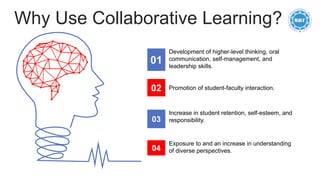
Why Use Collaborative Learning?
Development of higher-level thinking, oral
communication, self-management, and
leadership skills.
01
Promotion of student-faculty interaction.
02
Increase in student retention, self-esteem, and
responsibility.
03
Exposure to and an increase in understanding
of diverse perspectives.
04
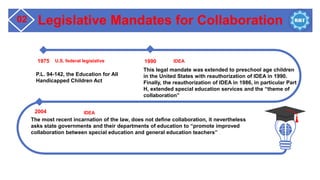
Legislative Mandates for Collaboration
1975 U.S. federal legislative
P.L. 94-142, the Education for All
Handicapped Children Act
1990 IDEA
This legal mandate was extended to preschool age children
in the United States with reauthorization of IDEA in 1990.
Finally, the reauthorization of IDEA in 1986, in particular Part
H, extended special education services and the “theme of
collaboration”
2004 IDEA
The most recent incarnation of the law, does not define collaboration, it nevertheless
asks state governments and their departments of education to “promote improved
collaboration between special education and general education teachers” .
02
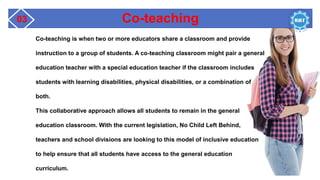
Co-teaching
03
Co-teaching is when two or more educators share a classroom and provide
instruction to a group of students. A co-teaching classroom might pair a general
education teacher with a special education teacher if the classroom includes
students with learning disabilities, physical disabilities, or a combination of
both.
This collaborative approach allows all students to remain in the general
education classroom. With the current legislation, No Child Left Behind,
teachers and school divisions are looking to this model of inclusive education
to help ensure that all students have access to the general education
curriculum.
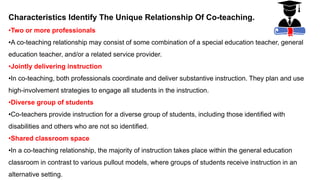
Characteristics Identify The Unique Relationship Of Co-teaching.
•Two or more professionals
•A co-teaching relationship may consist of some combination of a special education teacher, general
education teacher, and/or a related service provider.
•Jointly delivering instruction
•In co-teaching, both professionals coordinate and deliver substantive instruction. They plan and use
high-involvement strategies to engage all students in the instruction.
•Diverse group of students
•Co-teachers provide instruction for a diverse group of students, including those identified with
disabilities and others who are not so identified.
•Shared classroom space
•In a co-teaching relationship, the majority of instruction takes place within the general education
classroom in contrast to various pullout models, where groups of students receive instruction in an
alternative setting.
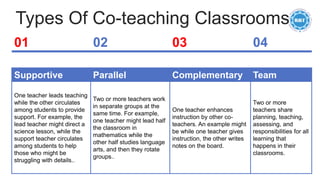
Types Of Co-teaching Classrooms
01 02 03 04
Supportive Parallel Complementary Team
One teacher leads teaching
while the other circulates
among students to provide
support. For example, the
lead teacher might direct a
science lesson, while the
support teacher circulates
among students to help
those who might be
struggling with details..
Two or more teachers work
in separate groups at the
same time. For example,
one teacher might lead half
the classroom in
mathematics while the
other half studies language
arts, and then they rotate
groups..
One teacher enhances
instruction by other co-
teachers. An example might
be while one teacher gives
instruction, the other writes
notes on the board.
Two or more
teachers share
planning, teaching,
assessing, and
responsibilities for all
learning that
happens in their
classrooms.
Evolving Approaches of Collaboration
04
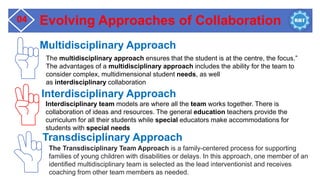
Multidisciplinary Approach
Interdisciplinary Approach
Transdisciplinary Approach
The multidisciplinary approach ensures that the student is at the centre, the focus.”
The advantages of a multidisciplinary approach includes the ability for the team to
consider complex, multidimensional student needs, as well
as interdisciplinary collaboration
Interdisciplinary team models are where all the team works together. There is
collaboration of ideas and resources. The general education teachers provide the
curriculum for all their students while special educators make accommodations for
students with special needs
The Transdisciplinary Team Approach is a family-centered process for supporting
families of young children with disabilities or delays. In this approach, one member of an
identified multidisciplinary team is selected as the lead interventionist and receives
coaching from other team members as needed.
Collaboration Model
05
The Lead Teacher Collaboration Model
In classrooms with a lead teacher, often the regular classroom teacher delivers
the instruction in the subject area. The special education teacher is an observer
who works with children after instruction to provide specially designed
instruction, ensure understanding, and to provide adaptations and modifications.
The Learning Centers Collaboration Model
The learning center collaboration approach is particularly appropriate for
younger students, for whom center-based education is more typical.
Pull-Out Collaboration Model
In some settings, rather than having special education teachers or therapists "push
into" general education classrooms, students are "pulled out" for services. In such
situations, students might leave the classroom for therapies or particular subjects,
and then return to the general education classroom.
Factors Impacting Collaboration
06
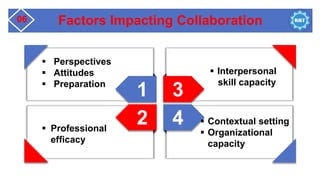
1 3
2 4
 Perspectives
 Attitudes
 Preparation
 Professional
efficacy
 Interpersonal
skill capacity
 Contextual setting
 Organizational
capacity
Obstacles to Collaboration
07
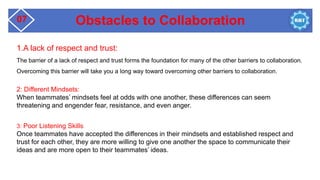
1.A lack of respect and trust
2.Different mindsets
3.Poor listening skills
4.Knowledge deficits
5.A lack of alignment around goals
6.Internal competitiveness
7.Information hoarding
8.Organizational silos
9.Physical separation
Obstacles to Collaboration
07
1.A lack of respect and trust:
The barrier of a lack of respect and trust forms the foundation for many of the other barriers to collaboration.
Overcoming this barrier will take you a long way toward overcoming other barriers to collaboration.
2: Different Mindsets:
When teammates’ mindsets feel at odds with one another, these differences can seem
threatening and engender fear, resistance, and even anger.
3: Poor Listening Skills
Once teammates have accepted the differences in their mindsets and established respect and
trust for each other, they are more willing to give one another the space to communicate their
ideas and are more open to their teammates’ ideas.
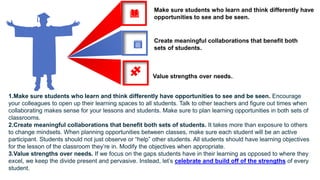
Make sure students who learn and think differently have
opportunities to see and be seen.
Create meaningful collaborations that benefit both
sets of students.
Value strengths over needs..
1.Make sure students who learn and think differently have opportunities to see and be seen. Encourage
your colleagues to open up their learning spaces to all students. Talk to other teachers and figure out times when
collaborating makes sense for your lessons and students. Make sure to plan learning opportunities in both sets of
classrooms.
2.Create meaningful collaborations that benefit both sets of students. It takes more than exposure to others
to change mindsets. When planning opportunities between classes, make sure each student will be an active
participant. Students should not just observe or “help” other students. All students should have learning objectives
for the lesson of the classroom they’re in. Modify the objectives when appropriate.
3.Value strengths over needs. If we focus on the gaps students have in their learning as opposed to where they
excel, we keep the divide present and pervasive. Instead, let’s celebrate and build off of the strengths of every
student.
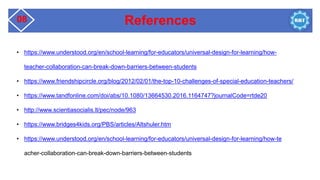
References
08
• https://www.understood.org/en/school-learning/for-educators/universal-design-for-learning/how-
teacher-collaboration-can-break-down-barriers-between-students
• https://www.friendshipcircle.org/blog/2012/02/01/the-top-10-challenges-of-special-education-teachers/
• https://www.tandfonline.com/doi/abs/10.1080/13664530.2016.1164747?journalCode=rtde20
• http://www.scientiasocialis.lt/pec/node/963
• https://www.bridges4kids.org/PBS/articles/Altshuler.htm
• https://www.understood.org/en/school-learning/for-educators/universal-design-for-learning/how-te
acher-collaboration-can-break-down-barriers-between-students
THANK YOU

Collaborative approaches in special education

  • 1.
    Collaborative Approach InSpecial Education
  • 2.
  • 3.
    Agenda Introduction 01 Legislative Mandats for Collaboration 02 Co-teaching 03 EvolvingApproaches of Collaboration 04 Collaboration Model 05 Factors Impacting Collaboration 06 Obstacles to Collaboration 07 References 08
  • 4.
    Introduction 01 What is collaboration? •In special education, the term "collaboration" refers to a team teaching approach. In addition to the regular classroom teacher and the special education teacher, a collaborative team may also include speech, occupational, and/or physical therapists. What is collaborative learning? • Collaborative learning is an educational approach to teaching and learning that involves groups of students working together to solve a problem, complete a task, or create a product. According to Gerlach, "Collaborative learning is based on the idea that learning is a naturally social act in which the participants talk among themselves (Gerlach, 1994). It is through the talk that learning occurs."
  • 5.
    Why Use CollaborativeLearning? Development of higher-level thinking, oral communication, self-management, and leadership skills. 01 Promotion of student-faculty interaction. 02 Increase in student retention, self-esteem, and responsibility. 03 Exposure to and an increase in understanding of diverse perspectives. 04
  • 6.
    Legislative Mandates forCollaboration 1975 U.S. federal legislative P.L. 94-142, the Education for All Handicapped Children Act 1990 IDEA This legal mandate was extended to preschool age children in the United States with reauthorization of IDEA in 1990. Finally, the reauthorization of IDEA in 1986, in particular Part H, extended special education services and the “theme of collaboration” 2004 IDEA The most recent incarnation of the law, does not define collaboration, it nevertheless asks state governments and their departments of education to “promote improved collaboration between special education and general education teachers” . 02
  • 7.
    Co-teaching 03 Co-teaching is whentwo or more educators share a classroom and provide instruction to a group of students. A co-teaching classroom might pair a general education teacher with a special education teacher if the classroom includes students with learning disabilities, physical disabilities, or a combination of both. This collaborative approach allows all students to remain in the general education classroom. With the current legislation, No Child Left Behind, teachers and school divisions are looking to this model of inclusive education to help ensure that all students have access to the general education curriculum.
  • 8.
    Characteristics Identify TheUnique Relationship Of Co-teaching. •Two or more professionals •A co-teaching relationship may consist of some combination of a special education teacher, general education teacher, and/or a related service provider. •Jointly delivering instruction •In co-teaching, both professionals coordinate and deliver substantive instruction. They plan and use high-involvement strategies to engage all students in the instruction. •Diverse group of students •Co-teachers provide instruction for a diverse group of students, including those identified with disabilities and others who are not so identified. •Shared classroom space •In a co-teaching relationship, the majority of instruction takes place within the general education classroom in contrast to various pullout models, where groups of students receive instruction in an alternative setting.
  • 9.
    Types Of Co-teachingClassrooms 01 02 03 04 Supportive Parallel Complementary Team One teacher leads teaching while the other circulates among students to provide support. For example, the lead teacher might direct a science lesson, while the support teacher circulates among students to help those who might be struggling with details.. Two or more teachers work in separate groups at the same time. For example, one teacher might lead half the classroom in mathematics while the other half studies language arts, and then they rotate groups.. One teacher enhances instruction by other co- teachers. An example might be while one teacher gives instruction, the other writes notes on the board. Two or more teachers share planning, teaching, assessing, and responsibilities for all learning that happens in their classrooms.
  • 10.
    Evolving Approaches ofCollaboration 04 Multidisciplinary Approach Interdisciplinary Approach Transdisciplinary Approach The multidisciplinary approach ensures that the student is at the centre, the focus.” The advantages of a multidisciplinary approach includes the ability for the team to consider complex, multidimensional student needs, as well as interdisciplinary collaboration Interdisciplinary team models are where all the team works together. There is collaboration of ideas and resources. The general education teachers provide the curriculum for all their students while special educators make accommodations for students with special needs The Transdisciplinary Team Approach is a family-centered process for supporting families of young children with disabilities or delays. In this approach, one member of an identified multidisciplinary team is selected as the lead interventionist and receives coaching from other team members as needed.
  • 11.
    Collaboration Model 05 The LeadTeacher Collaboration Model In classrooms with a lead teacher, often the regular classroom teacher delivers the instruction in the subject area. The special education teacher is an observer who works with children after instruction to provide specially designed instruction, ensure understanding, and to provide adaptations and modifications. The Learning Centers Collaboration Model The learning center collaboration approach is particularly appropriate for younger students, for whom center-based education is more typical. Pull-Out Collaboration Model In some settings, rather than having special education teachers or therapists "push into" general education classrooms, students are "pulled out" for services. In such situations, students might leave the classroom for therapies or particular subjects, and then return to the general education classroom.
  • 12.
    Factors Impacting Collaboration 06 13 2 4  Perspectives  Attitudes  Preparation  Professional efficacy  Interpersonal skill capacity  Contextual setting  Organizational capacity
  • 13.
    Obstacles to Collaboration 07 1.Alack of respect and trust 2.Different mindsets 3.Poor listening skills 4.Knowledge deficits 5.A lack of alignment around goals 6.Internal competitiveness 7.Information hoarding 8.Organizational silos 9.Physical separation
  • 14.
    Obstacles to Collaboration 07 1.Alack of respect and trust: The barrier of a lack of respect and trust forms the foundation for many of the other barriers to collaboration. Overcoming this barrier will take you a long way toward overcoming other barriers to collaboration. 2: Different Mindsets: When teammates’ mindsets feel at odds with one another, these differences can seem threatening and engender fear, resistance, and even anger. 3: Poor Listening Skills Once teammates have accepted the differences in their mindsets and established respect and trust for each other, they are more willing to give one another the space to communicate their ideas and are more open to their teammates’ ideas.
  • 16.
    Make sure studentswho learn and think differently have opportunities to see and be seen. Create meaningful collaborations that benefit both sets of students. Value strengths over needs.. 1.Make sure students who learn and think differently have opportunities to see and be seen. Encourage your colleagues to open up their learning spaces to all students. Talk to other teachers and figure out times when collaborating makes sense for your lessons and students. Make sure to plan learning opportunities in both sets of classrooms. 2.Create meaningful collaborations that benefit both sets of students. It takes more than exposure to others to change mindsets. When planning opportunities between classes, make sure each student will be an active participant. Students should not just observe or “help” other students. All students should have learning objectives for the lesson of the classroom they’re in. Modify the objectives when appropriate. 3.Value strengths over needs. If we focus on the gaps students have in their learning as opposed to where they excel, we keep the divide present and pervasive. Instead, let’s celebrate and build off of the strengths of every student.
  • 18.
    References 08 • https://www.understood.org/en/school-learning/for-educators/universal-design-for-learning/how- teacher-collaboration-can-break-down-barriers-between-students • https://www.friendshipcircle.org/blog/2012/02/01/the-top-10-challenges-of-special-education-teachers/ •https://www.tandfonline.com/doi/abs/10.1080/13664530.2016.1164747?journalCode=rtde20 • http://www.scientiasocialis.lt/pec/node/963 • https://www.bridges4kids.org/PBS/articles/Altshuler.htm • https://www.understood.org/en/school-learning/for-educators/universal-design-for-learning/how-te acher-collaboration-can-break-down-barriers-between-students
  • 19.