







MONTHS
PRESENTED BY:
• Khadizatul Kobra Nahin
• Md.Hasnain Ahmed
• Rafiul Alam
• Tahmim Rahman
• Ashok Kumar Singha
• Aminul Islam Amin
• Akib Mostafa Chowdhury
• Arnab Mazumder
TOPICS:
• What is month?
• Types of month.
• History of month.
• Relationship between month and season.
• Importance of month.
MONTHS
The term ‘month’ comes from middle English ‘moneth’ which comes from old
English ‘monath’.
It is akin to German Old High German manod meaning ‘month’ and Old English
Mona meaning ‘moon’.
It actually refers to the various moon's phases used as the measure of time.
SIMPLE DEFINITION OF MONTH
• any one of the 12 parts into which the year is divided
• a period of time that lasts about four weeks or 30 days
• a long period of time that is less than a year
HOW WE DEFINE MONTH?
• A month is a unit of time, used with calendars, which is approximately as long
as a natural period related to the motion of the Moon
• a measure of time corresponding nearly to the period of the moon's
revolution and amounting to approximately 4 weeks or 30 days or 1⁄12 of a
year.
TYPES OF MONTHS
The following types of months are first recognized in Babylonian lunar astronomy.
• The Sidereal Month
• The Synodic Month
• The Tropical Month
• The Anomalistic Month
• The Draconic Month
SIDEREAL MONTH
• time for one revolution of Moon around Earth.
• It is about 27.32166 days (27 days, 7 hours, 43 minutes, 11.6 seconds).
SYNODIC MONTH
• time between one full Moon and the next (or one new Moon and the next).
• The mean length of the synodic month is 29.53059 days (29 days, 12 hours, 44
minutes, 2.8 seconds).
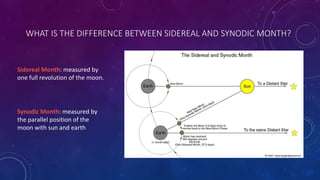
THE SIDEREAL AND SYNODIC MONTHS
WHAT IS THE DIFFERENCE BETWEEN SIDEREAL AND SYNODIC MONTH?
Sidereal Month: measured by
one full revolution of the moon.
Synodic Month: measured by
the parallel position of the
moon with sun and earth
TROPICAL MONTH
• It is the average time for the Moon to pass twice
through the same equinox point of the sky.
• Average period of the revolution of the moon about
the earth with the respect to the vernal or spring
equinox.
• It is 27.32158 days, very slightly shorter than the
sidereal month (27.32166) days.
ANOMALISTIC MONTH
• An anomalistic month is the average time,
the Moon takes to go from perigee to
perigee (the point in the Moon's orbit when
it is closest to Earth).
 apogee: the point in the Moon’s orbit when
it is furthest to Earth.
• An anomalistic month is about 27.55455
days on average.
DRACONIC MONTH
• To understand about that month first we have an clear
idea about nodal point.
• An orbital node is one of the two points where an orbit
crosses a plane of reference to which it is inclined.
• The ascending node, when the moon’s path crosses the
ecliptic into the north
• The descending node, when the moon’s path crosses
the ecliptic into the south
• The angle between two orbit is about 5.3 degree
• The draconic month or nodal month is the period in
which the Moon returns to the same node of its orbit or
the average interval between two successive transits of
the moon through the same node.
• Its duration is about 27.21222 days on average
SUMMARY OF DIFFERENT TYPES OF MONTHS
A HISTORY OF THE 12 MONTHS
• The original Roman year had 10 named months Martius, Aprilis, Maius, Junius, Quintilis,
Sextilis, September, October, November, December.
• Probably there were two unnamed months in the dead of winter when not much happened
in agriculture.
• Numa Pompilius, the second king of Rome circa 700 BC, added the two months Januarius
"January" and Februarius "February".
• The King also moved the beginning of the year from Marius to Januarius and changed the
number of days in several months to be odd, a lucky number.
THE TWELVE MONTHS
We get twelve months in Gregorian Calendar which is used in modern calender.
THE TWELVE MONTHS
• January : It comes from the Latin Januarius, meaning ‘of Janus’. Janus,
who is often shown with two faces pointed in opposite directions
(hence Janus-faced) is the Roman god of gates and doorways.
- It is the starting month of the year.
- This month contains 31 days .
• February: It is ultimately based on Latin februarius, from februa. In case
that’s not helped things become clearer, februa was the name of a
purification feast held on the 15th of this month.
-It contains 28 days.
-After every 4 years the month contains 29 days.That is called Leap Year.
THE TWELVE MONTHS
• March: The name comes from the Latin word ‘Martius’ meaning of ‘Mars’.
It was a time when any ongoing battles would be resumed. It seems
appropriate that the month was named after Mars, the Roman god of war.
- It was the first month of the Roman calendar.
- It always contained 31 days.
• April: Three theories exist regarding the origin of April's name. Some say
April got its name from the Latin word meaning “second" since April was
the second month on the ancient calendar. Others claim it comes from
“aperire," a Latin word meaning “to open," because it represents the
opening of buds and flowers in spring. Still others think April was named
after the goddess Aphrodite.
THE TWELVE MONTHS
• May: May was named after Maia, an earth goddess of growing
plants. Maia (in Greek mythology) was daughter of Atlas and
mother of Hermes.
• June: The fourth month was named in honor of Juno. However,
the name might also come from iuniores (young men; juniors).
-June was also once sometimes known as midsummer month.
THE TWELVE MONTHS
• July: The first month in the calendar named after a
real person, July was named in honor of Julius
Caesar after his death in 44 BC, July being the
month of his birth.
• August: Augustus Caesar clarified and completed
the calendar reform of Julius Caesar. In the process,
he also renamed this month after himself.
Previously, August was called “Sextillia," which was
Latin for “sixth."
THE TWELVE MONTHS
• September: The name comes from septem, Latin for
“seven”. September had 30 days, until Numa when it had 29
days, until Julius when it became 30 days long.
• October: October's name comes from octo, Latin for
“eight”. October has always had 31 days.
THE TWELVE MONTHS
• November: Novembris had 30 days, until Numa when it had 29 days, until
Julius when it became 30 days long. November's name comes from novem,
Latin for “nine.“
• December: December's name come from decem, Latin for “ten.“
-It is the last month of a year.
BANGLA MONTH
• The names of the twelve months of the Bengali calendar are based on the names of the নক্ষত্র nokkhotro
(lunar mansions). These names were derived from the Surya Siddhanta, an ancient Indian book on
Astronomy. The calendar originally introduced by Akbar in the year 1584 AD, each day of the month had
a different name, but this was cumbersome, and his grandson Shah Jahan changed this to a 7-day week
as in the Gregorian calendar, with the week also starting on a Sunday.
BANGLA MONTHS
• বৈশাখ Boishakh after the star, বৈশাখা Bishakha april-may
• বযৈষ্ঠ Joishţho after the star, জ্যৈষ্ঠা Jeshţha may- june
• আষাঢ় Ashaŗh after the star, উত্তরাষাঢ়া Uttorashaŗha june- july
• শ্রাৈণ Srabon after the star, শ্রৈণা Srobona july-august
• ভাদ্র Bhadro after the star, পূৈবভাদ্রপদ Purbobhadropôd august- september
• আবিন Ashshin after the star, অবিনী Ôshshini September- october
• কাবতব ক Kartik after the star, কৃ বত্তকা Krittika October- november
• অগ্রহায়ণ Ôgrohaeon after the star, মৃগবশরা Mrigoshira November-december
• জ্পৌষ Poush after the star, পুষৈা Pushsha December-january
• মাঘ Magh after the star মঘা Môgha January-february
• ফাল্গুন Falgun after the star, উত্তরফাল্গুনী Uttorfalguni February-march
• বৈত্র Choitro after the star, বৈত্রা Chitra march-april
RELATIONSHIP BETWEEN MONTH AND SEASON
• The reason why months are larger and smaller than another is because when the earth
revolves around the sun some parts are closer to the sun than others that's why we get
seasons.
RELATIONSHIP BETWEEN MONTH AND SEASON
June 21:
-Summer Solstice
-Longest day, shortest night
-Sun is directly over the Tropic of Cancer.
September 23:
-Fall Autumnal equinox
-Equal day and night
-Sun is directly over the equator
RELATIONSHIP BETWEEN MONTH AND SEASON
December 21:
- Winter Solstice
-Shortest day, longest night
-Sun is directly over the Tropic of Capricorn.
March21:
-Spring (vernal) Equinox
-Sun is directly over the Equator
-Equal day and night
RELATIONSHIP BETWEEN MONTH AND SEASON
IMPORTANCE OF MONTHS
• Without Months, the whole time system crumples since holds most of every
bit and piece.
• Months divided the year into 12 categories which helps to calculate easily.
• Particular months given the clear idea of season .Example: In Bnangladesh
December, January, February are the winter season.
THANK YOU

Month

  • 1.
  • 2.
    PRESENTED BY: • KhadizatulKobra Nahin • Md.Hasnain Ahmed • Rafiul Alam • Tahmim Rahman • Ashok Kumar Singha • Aminul Islam Amin • Akib Mostafa Chowdhury • Arnab Mazumder
  • 3.
    TOPICS: • What ismonth? • Types of month. • History of month. • Relationship between month and season. • Importance of month.
  • 4.
    MONTHS The term ‘month’comes from middle English ‘moneth’ which comes from old English ‘monath’. It is akin to German Old High German manod meaning ‘month’ and Old English Mona meaning ‘moon’. It actually refers to the various moon's phases used as the measure of time.
  • 5.
    SIMPLE DEFINITION OFMONTH • any one of the 12 parts into which the year is divided • a period of time that lasts about four weeks or 30 days • a long period of time that is less than a year
  • 6.
    HOW WE DEFINEMONTH? • A month is a unit of time, used with calendars, which is approximately as long as a natural period related to the motion of the Moon • a measure of time corresponding nearly to the period of the moon's revolution and amounting to approximately 4 weeks or 30 days or 1⁄12 of a year.
  • 7.
    TYPES OF MONTHS Thefollowing types of months are first recognized in Babylonian lunar astronomy. • The Sidereal Month • The Synodic Month • The Tropical Month • The Anomalistic Month • The Draconic Month
  • 8.
    SIDEREAL MONTH • timefor one revolution of Moon around Earth. • It is about 27.32166 days (27 days, 7 hours, 43 minutes, 11.6 seconds).
  • 9.
    SYNODIC MONTH • timebetween one full Moon and the next (or one new Moon and the next). • The mean length of the synodic month is 29.53059 days (29 days, 12 hours, 44 minutes, 2.8 seconds).
  • 10.
    THE SIDEREAL ANDSYNODIC MONTHS
  • 11.
    WHAT IS THEDIFFERENCE BETWEEN SIDEREAL AND SYNODIC MONTH? Sidereal Month: measured by one full revolution of the moon. Synodic Month: measured by the parallel position of the moon with sun and earth
  • 12.
    TROPICAL MONTH • Itis the average time for the Moon to pass twice through the same equinox point of the sky. • Average period of the revolution of the moon about the earth with the respect to the vernal or spring equinox. • It is 27.32158 days, very slightly shorter than the sidereal month (27.32166) days.
  • 13.
    ANOMALISTIC MONTH • Ananomalistic month is the average time, the Moon takes to go from perigee to perigee (the point in the Moon's orbit when it is closest to Earth).  apogee: the point in the Moon’s orbit when it is furthest to Earth. • An anomalistic month is about 27.55455 days on average.
  • 14.
    DRACONIC MONTH • Tounderstand about that month first we have an clear idea about nodal point. • An orbital node is one of the two points where an orbit crosses a plane of reference to which it is inclined. • The ascending node, when the moon’s path crosses the ecliptic into the north • The descending node, when the moon’s path crosses the ecliptic into the south • The angle between two orbit is about 5.3 degree • The draconic month or nodal month is the period in which the Moon returns to the same node of its orbit or the average interval between two successive transits of the moon through the same node. • Its duration is about 27.21222 days on average
  • 15.
    SUMMARY OF DIFFERENTTYPES OF MONTHS
  • 16.
    A HISTORY OFTHE 12 MONTHS • The original Roman year had 10 named months Martius, Aprilis, Maius, Junius, Quintilis, Sextilis, September, October, November, December. • Probably there were two unnamed months in the dead of winter when not much happened in agriculture. • Numa Pompilius, the second king of Rome circa 700 BC, added the two months Januarius "January" and Februarius "February". • The King also moved the beginning of the year from Marius to Januarius and changed the number of days in several months to be odd, a lucky number.
  • 17.
    THE TWELVE MONTHS Weget twelve months in Gregorian Calendar which is used in modern calender.
  • 18.
    THE TWELVE MONTHS •January : It comes from the Latin Januarius, meaning ‘of Janus’. Janus, who is often shown with two faces pointed in opposite directions (hence Janus-faced) is the Roman god of gates and doorways. - It is the starting month of the year. - This month contains 31 days . • February: It is ultimately based on Latin februarius, from februa. In case that’s not helped things become clearer, februa was the name of a purification feast held on the 15th of this month. -It contains 28 days. -After every 4 years the month contains 29 days.That is called Leap Year.
  • 19.
    THE TWELVE MONTHS •March: The name comes from the Latin word ‘Martius’ meaning of ‘Mars’. It was a time when any ongoing battles would be resumed. It seems appropriate that the month was named after Mars, the Roman god of war. - It was the first month of the Roman calendar. - It always contained 31 days. • April: Three theories exist regarding the origin of April's name. Some say April got its name from the Latin word meaning “second" since April was the second month on the ancient calendar. Others claim it comes from “aperire," a Latin word meaning “to open," because it represents the opening of buds and flowers in spring. Still others think April was named after the goddess Aphrodite.
  • 20.
    THE TWELVE MONTHS •May: May was named after Maia, an earth goddess of growing plants. Maia (in Greek mythology) was daughter of Atlas and mother of Hermes. • June: The fourth month was named in honor of Juno. However, the name might also come from iuniores (young men; juniors). -June was also once sometimes known as midsummer month.
  • 21.
    THE TWELVE MONTHS •July: The first month in the calendar named after a real person, July was named in honor of Julius Caesar after his death in 44 BC, July being the month of his birth. • August: Augustus Caesar clarified and completed the calendar reform of Julius Caesar. In the process, he also renamed this month after himself. Previously, August was called “Sextillia," which was Latin for “sixth."
  • 22.
    THE TWELVE MONTHS •September: The name comes from septem, Latin for “seven”. September had 30 days, until Numa when it had 29 days, until Julius when it became 30 days long. • October: October's name comes from octo, Latin for “eight”. October has always had 31 days.
  • 23.
    THE TWELVE MONTHS •November: Novembris had 30 days, until Numa when it had 29 days, until Julius when it became 30 days long. November's name comes from novem, Latin for “nine.“ • December: December's name come from decem, Latin for “ten.“ -It is the last month of a year.
  • 24.
    BANGLA MONTH • Thenames of the twelve months of the Bengali calendar are based on the names of the নক্ষত্র nokkhotro (lunar mansions). These names were derived from the Surya Siddhanta, an ancient Indian book on Astronomy. The calendar originally introduced by Akbar in the year 1584 AD, each day of the month had a different name, but this was cumbersome, and his grandson Shah Jahan changed this to a 7-day week as in the Gregorian calendar, with the week also starting on a Sunday.
  • 25.
    BANGLA MONTHS • বৈশাখBoishakh after the star, বৈশাখা Bishakha april-may • বযৈষ্ঠ Joishţho after the star, জ্যৈষ্ঠা Jeshţha may- june • আষাঢ় Ashaŗh after the star, উত্তরাষাঢ়া Uttorashaŗha june- july • শ্রাৈণ Srabon after the star, শ্রৈণা Srobona july-august • ভাদ্র Bhadro after the star, পূৈবভাদ্রপদ Purbobhadropôd august- september • আবিন Ashshin after the star, অবিনী Ôshshini September- october • কাবতব ক Kartik after the star, কৃ বত্তকা Krittika October- november • অগ্রহায়ণ Ôgrohaeon after the star, মৃগবশরা Mrigoshira November-december • জ্পৌষ Poush after the star, পুষৈা Pushsha December-january • মাঘ Magh after the star মঘা Môgha January-february • ফাল্গুন Falgun after the star, উত্তরফাল্গুনী Uttorfalguni February-march • বৈত্র Choitro after the star, বৈত্রা Chitra march-april
  • 26.
    RELATIONSHIP BETWEEN MONTHAND SEASON • The reason why months are larger and smaller than another is because when the earth revolves around the sun some parts are closer to the sun than others that's why we get seasons.
  • 27.
    RELATIONSHIP BETWEEN MONTHAND SEASON June 21: -Summer Solstice -Longest day, shortest night -Sun is directly over the Tropic of Cancer. September 23: -Fall Autumnal equinox -Equal day and night -Sun is directly over the equator
  • 28.
    RELATIONSHIP BETWEEN MONTHAND SEASON December 21: - Winter Solstice -Shortest day, longest night -Sun is directly over the Tropic of Capricorn. March21: -Spring (vernal) Equinox -Sun is directly over the Equator -Equal day and night
  • 29.
  • 30.
    IMPORTANCE OF MONTHS •Without Months, the whole time system crumples since holds most of every bit and piece. • Months divided the year into 12 categories which helps to calculate easily. • Particular months given the clear idea of season .Example: In Bnangladesh December, January, February are the winter season.
  • 31.