Study on Temperature Control Model
of the Focal Cooling Human Physiological System
Graduate School of Medicine Yamaguchi University
Kenyu UEHARA
May/20/2015
Outline
1. Background
2. Purpose of this study
3. Study method
4. Result and Discussion
5. Conclusion
Introduction of this research
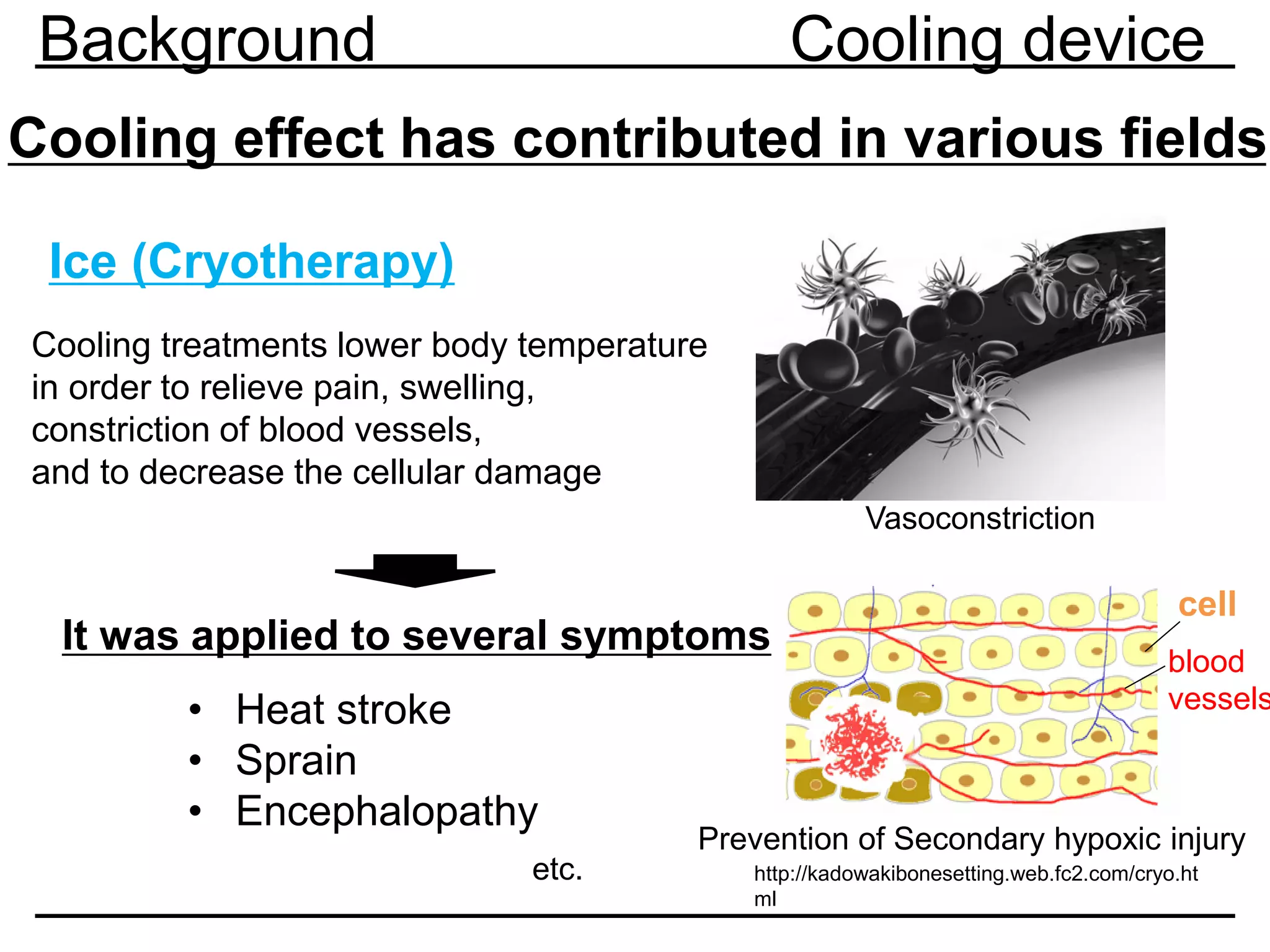
Cooling effect has contributed in various fields
Ice (Cryotherapy)
Cooling treatments lower body temperature
in order to relieve pain, swelling,
constriction of blood vessels,
and to decrease the cellular damage
http://kadowakibonesetting.web.fc2.com/cryo.ht
ml
Vasoconstriction
Prevention of Secondary hypoxic injury
• Heat stroke
• Sprain
• Encephalopathy
It was applied to several symptoms
etc.
Background Cooling device
cell
blood
vessels
Background Cooling device
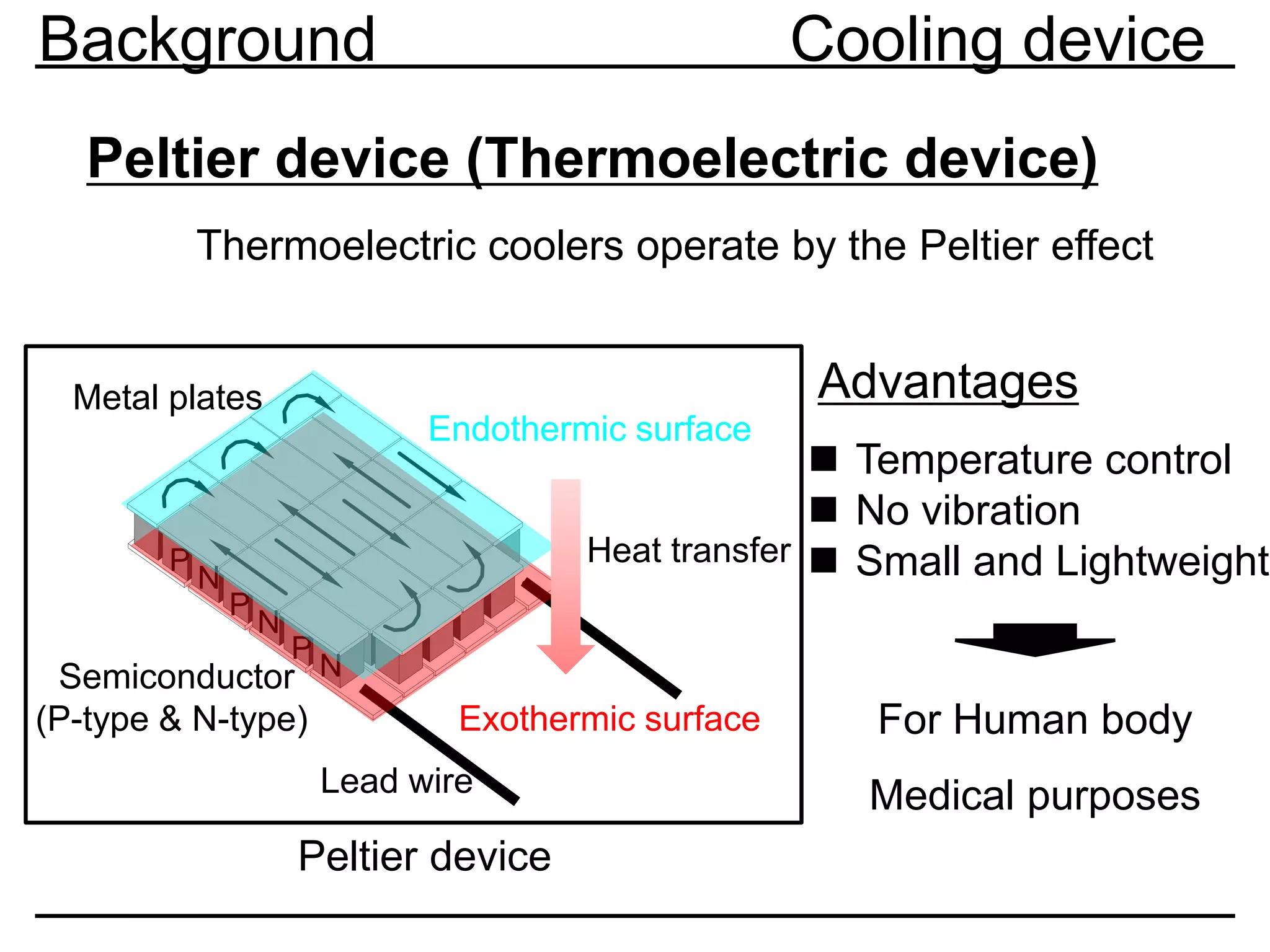
Peltier device (Thermoelectric device)
P
N
P
N
P
N
Semiconductor
(P-type & N-type)
Metal plates
Endothermic surface
Exothermic surface
Heat transfer
Peltier device
Lead wire
Thermoelectric coolers operate by the Peltier effect
Advantages
◼ Temperature control
◼ No vibration
◼ Small and Lightweight
For Human body
Medical purposes
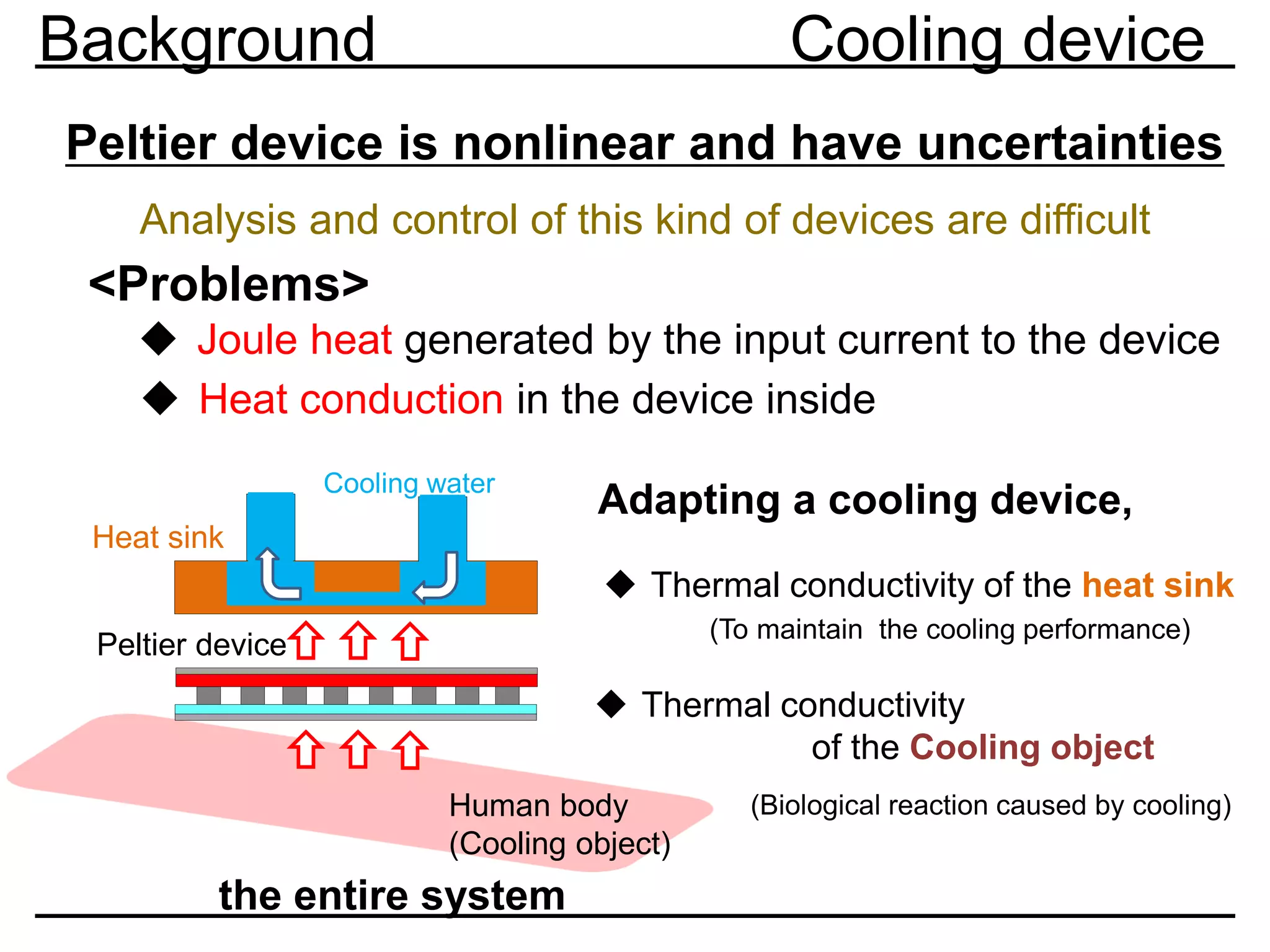
Peltier device is nonlinear and have uncertainties
Analysis and control of this kind of devices are difficult
◆ Joule heat generated by the input current to the device
◆ Heat conduction in the device inside
<Problems>
Adapting a cooling device,
◆ Thermal conductivity of the heat sink
(To maintain the cooling performance)
◆ Thermal conductivity
of the Cooling object
(Biological reaction caused by cooling)
Heat sink
Peltier device
Cooling water
Human body
(Cooling object)
the entire system
Background Cooling device
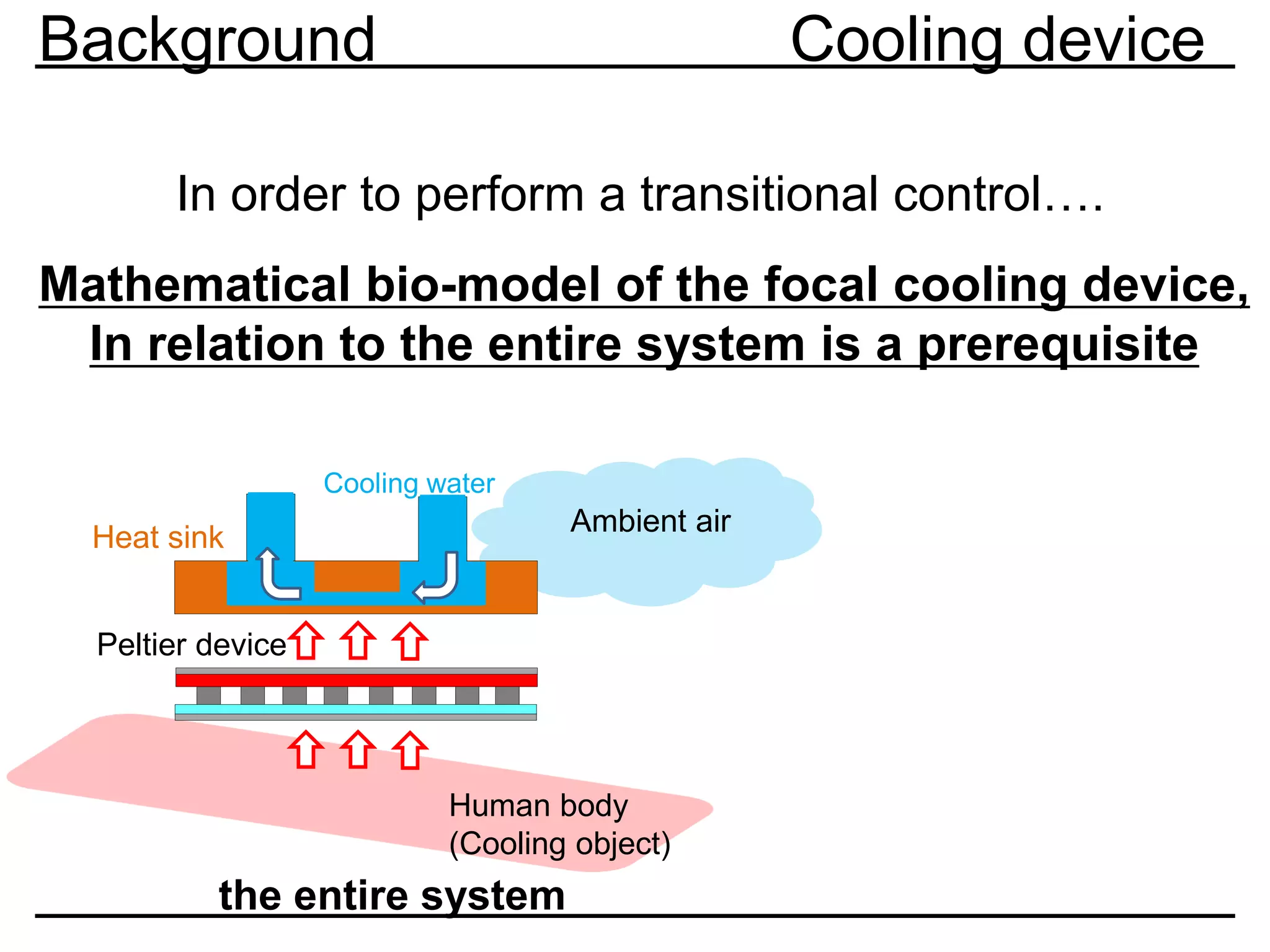
Mathematical bio-model of the focal cooling device,
In relation to the entire system is a prerequisite
In order to perform a transitional control….
Ambient air
Heat sink
Peltier device
Cooling water
Human body
(Cooling object)
the entire system
Background Cooling device
Previous research Modeling
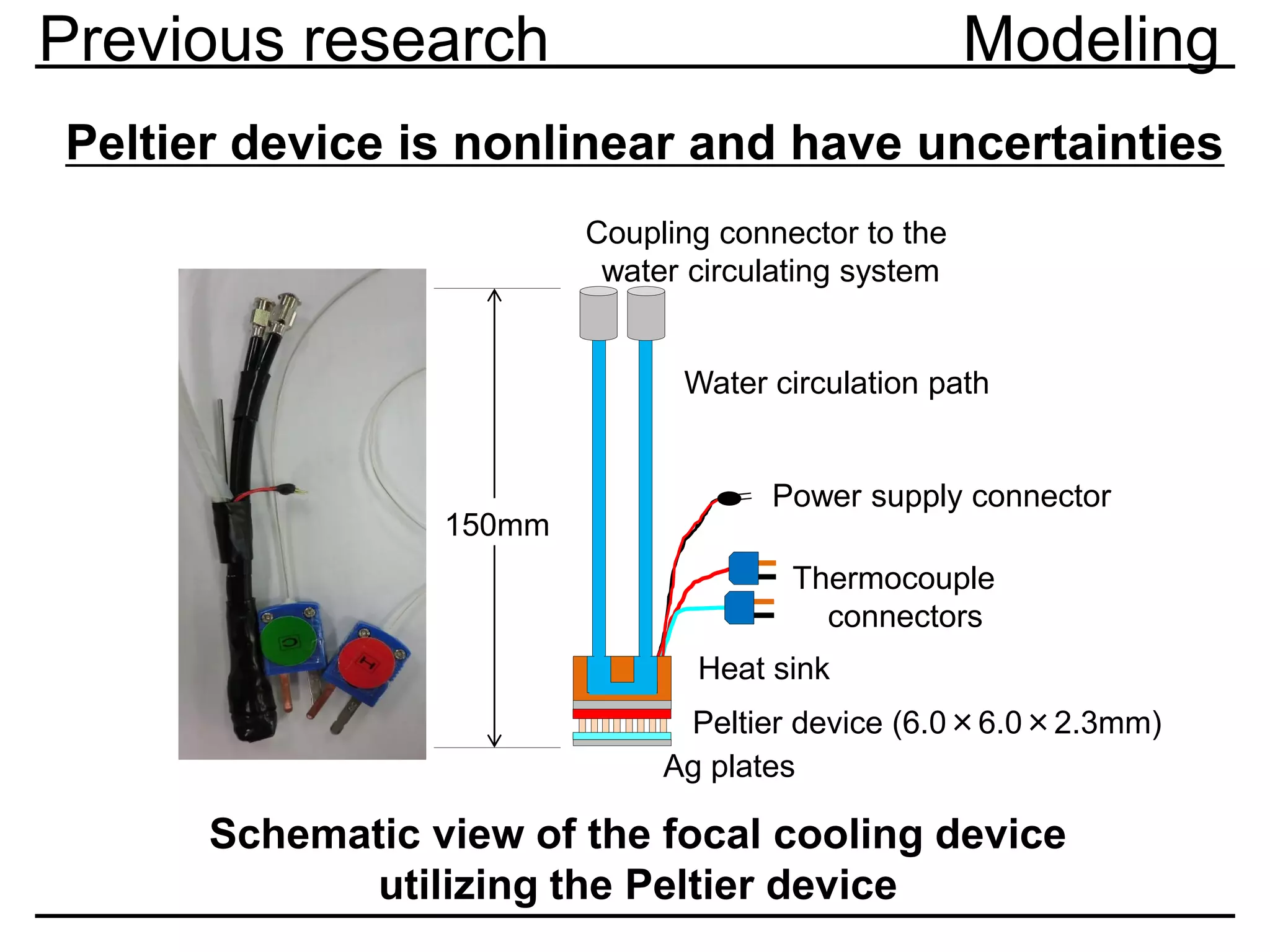
Thermocouple
connectors
Heat sink
Peltier device (6.0×6.0×2.3mm)
Ag plates
Water circulation path
Power supply connector
Coupling connector to the
water circulating system
150mm
Schematic view of the focal cooling device
utilizing the Peltier device
Peltier device is nonlinear and have uncertainties
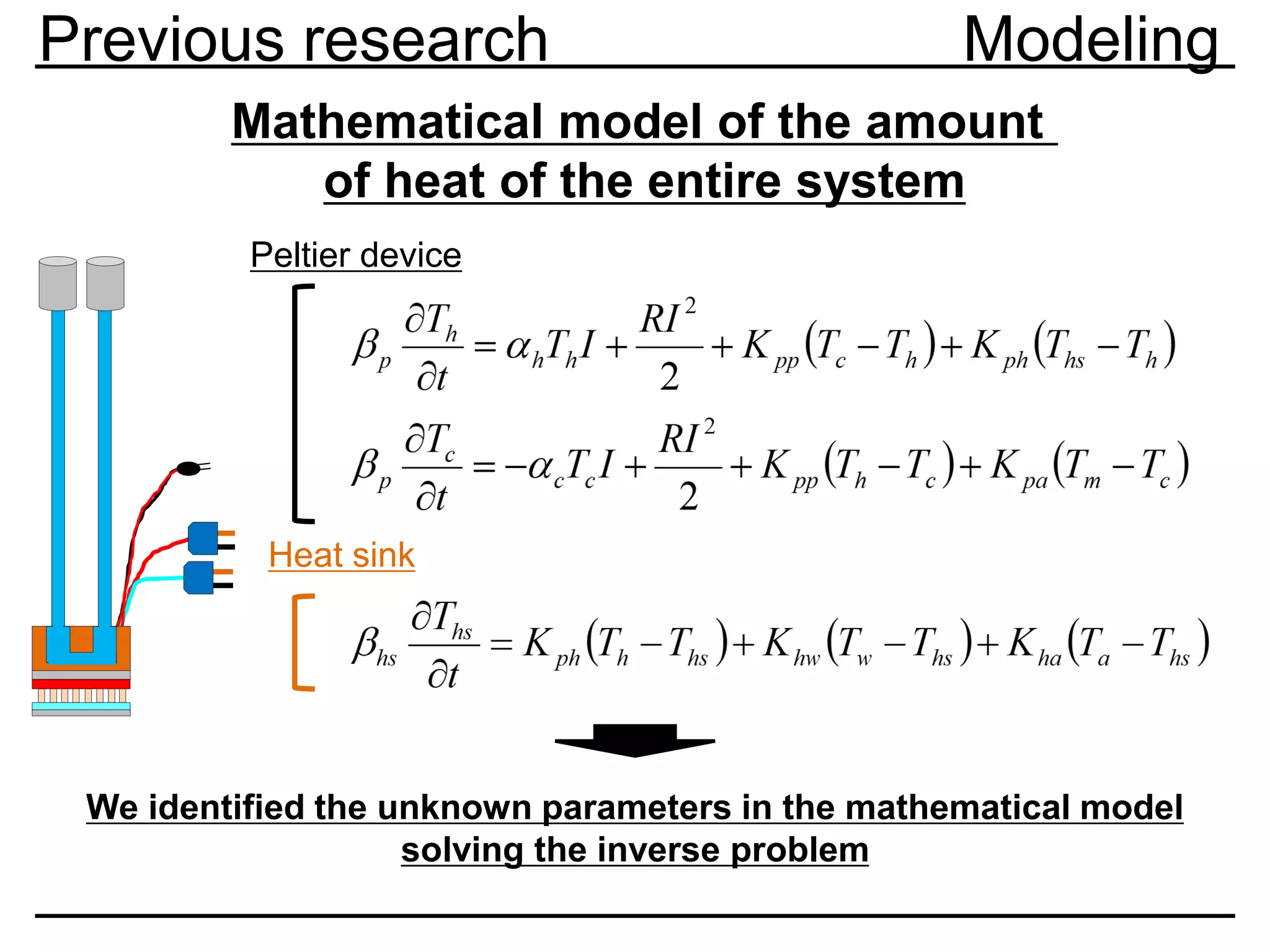
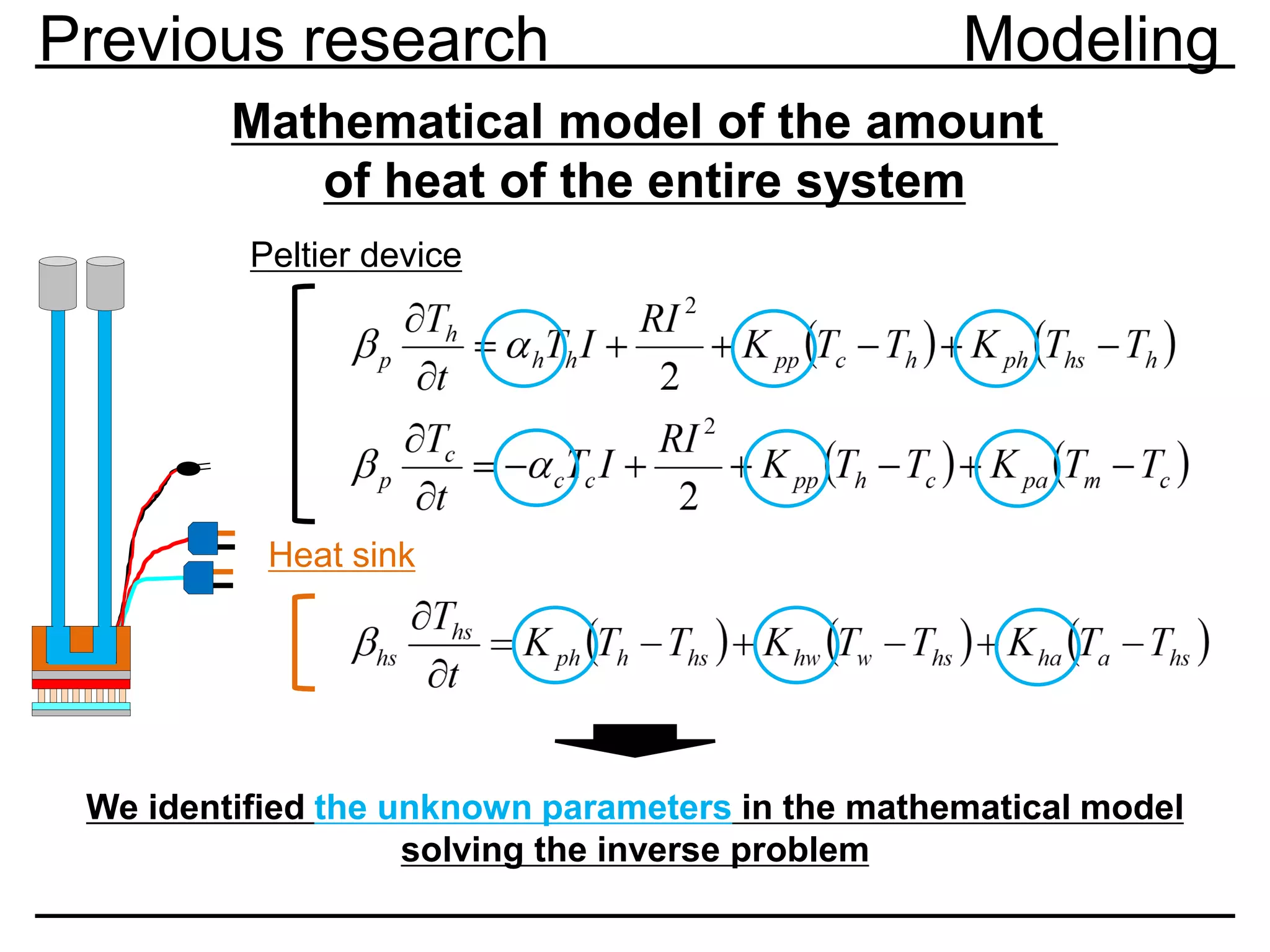
Mathematical model of the amount
of heat of the entire system
Peltier device
Heat sink
Previous research Modeling
We identified the unknown parameters in the mathematical model
solving the inverse problem
Mathematical model of the amount
of heat of the entire system
Peltier device
Heat sink
Previous research Modeling
We identified the unknown parameters in the mathematical model
solving the inverse problem
In order to minimize the difference
Previous research Modeling
0.0 0.2 0.4 0.6 0.8 1.0 1.2
0.0
0.2
0.4
0.6
0.8
1.0
1.2
1.4
1.6
1.8
2.0
MeanError[%/point]
Input voltage [V]
The relative difference per-point error of the
experimental and simulation value vs. input voltage
1.16 % / point
Average error
Error function
℃
s
Texp.
Tsim.
0 10 20 30 40 50
15
20
25
30
35
40
45
Exp.
Sim.
Temperature[
o
C]
Time [s]
Previous research Modeling
Comparison of the experimental and simulation
results in case of proportional gain Kp is 0.5
Result of the validation of the mathematical model
Proportional control [V]
The relative Error
of the controlled side
1 %/point (0.2~0.3 ℃)
Mathematical model can simulate
Experimental result in the error range
of the parameter identification
Previous research Modeling
Comparison of the experimental and simulation
results in case of proportional gain Kp is 0.5
Result of the validation of the mathematical model
Using a temperature control based on ONLY Proportional action
Error in the temperature
of the controlled side
0.2~0.3 ℃
Mathematical model can simulate
Experimental based on the P-control
0 10 20 30 40 50
15
20
25
30
35
40
45
Exp.
Sim.
Temperature[
o
C]
Time [s]
Controlled temperature reaches
a balance away from the target
Previous research Modeling
Comparison of the experimental and simulation
results in case of proportional gain Kp is 0.5
Using a temperature control based on ONLY Proportional action
Error in the temperature
of the controlled side
0.2~0.3 ℃
Mathematical model can simulate
Experimental based on the P-control
0 10 20 30 40 50
15
20
25
30
35
40
45
Exp.
Sim.
Temperature[
o
C]
Time [s]
Controlled temperature reaches
a balance away from the target
General temperature control.
⚫ To eliminate the steady-state error
⚫ To improve the stability of the system
In order to adapt to a living body,
accuracy of the cooling temperature is an important factor
PI,PD, or PID control
P : Proportional action
I : Integral action
D : Derivative action
Is used as needed in the temperature control
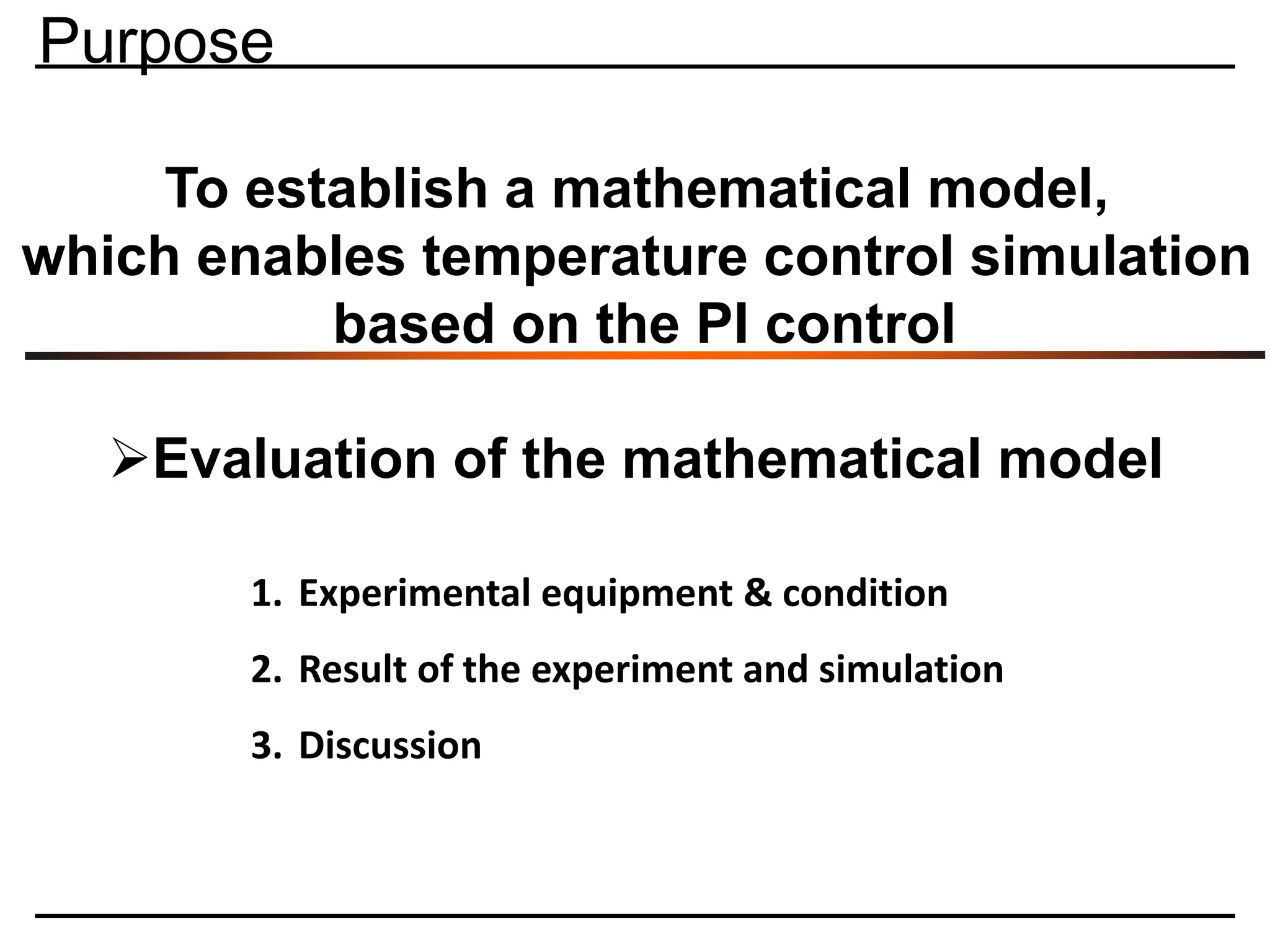
To establish a mathematical model,
which enables temperature control simulation
based on the PI control
➢Evaluation of the mathematical model
1. Experimental equipment & condition
2. Result of the experiment and simulation
3. Discussion
Purpose
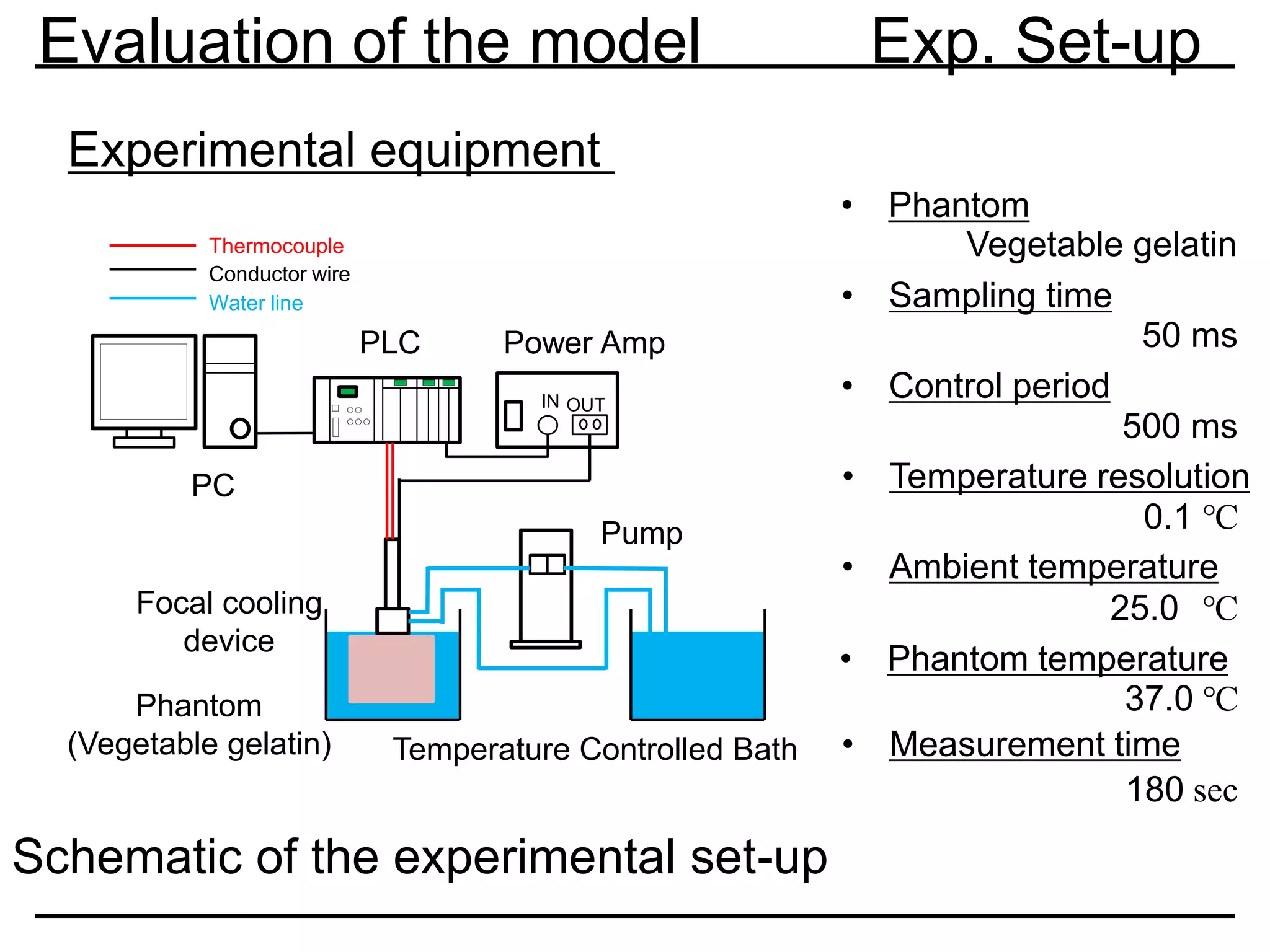
Evaluation of the model Exp. Set-up
Thermocouple
Conductor wire
Water line
IN OUT
Temperature Controlled Bath
Pump
PLC
PC
Power Amp
Phantom
(Vegetable gelatin)
Focal cooling
device
Schematic of the experimental set-up
• Phantom
Vegetable gelatin
• Sampling time
50 ms
• Control period
500 ms
• Temperature resolution
0.1 ℃
• Ambient temperature
25.0 ℃
• Phantom temperature
37.0 ℃
• Measurement time
180 sec
Experimental equipment
PI control
[V]
Input voltage
25
32 ~ 33
Time [s]
Temperature [℃]
Cooling start Cooling end
10 50
Heat side
Cool side
controlled
Evaluation of the model Exp.& Sim.
Proportional gain Integral gainControl error
(0.5) 15.0
30.0
50.0
Condition of the experiment and simulation
0 10 20 30 40 50
15
20
25
30
35
40
45
Exp.
Sim.
Temperature[
o
C]
Time [s]
An example of result in case of proportional
gain is 0.5 and integral gain is 15.0
Ki Controlled side Both sides
15.0 0.66 1.92
30.0 0.24 1.23
50.0 0.45 1.48
Relative error per-point of the results [%/point]
The average error in the parameter
identification is 1.16%/point
The relative error in the both sides is nearly equal
to the time of the parameter identification
It is to be sufficiently possible simulated in the error
range at the time of the parameter identification
Evaluation Result & discussion
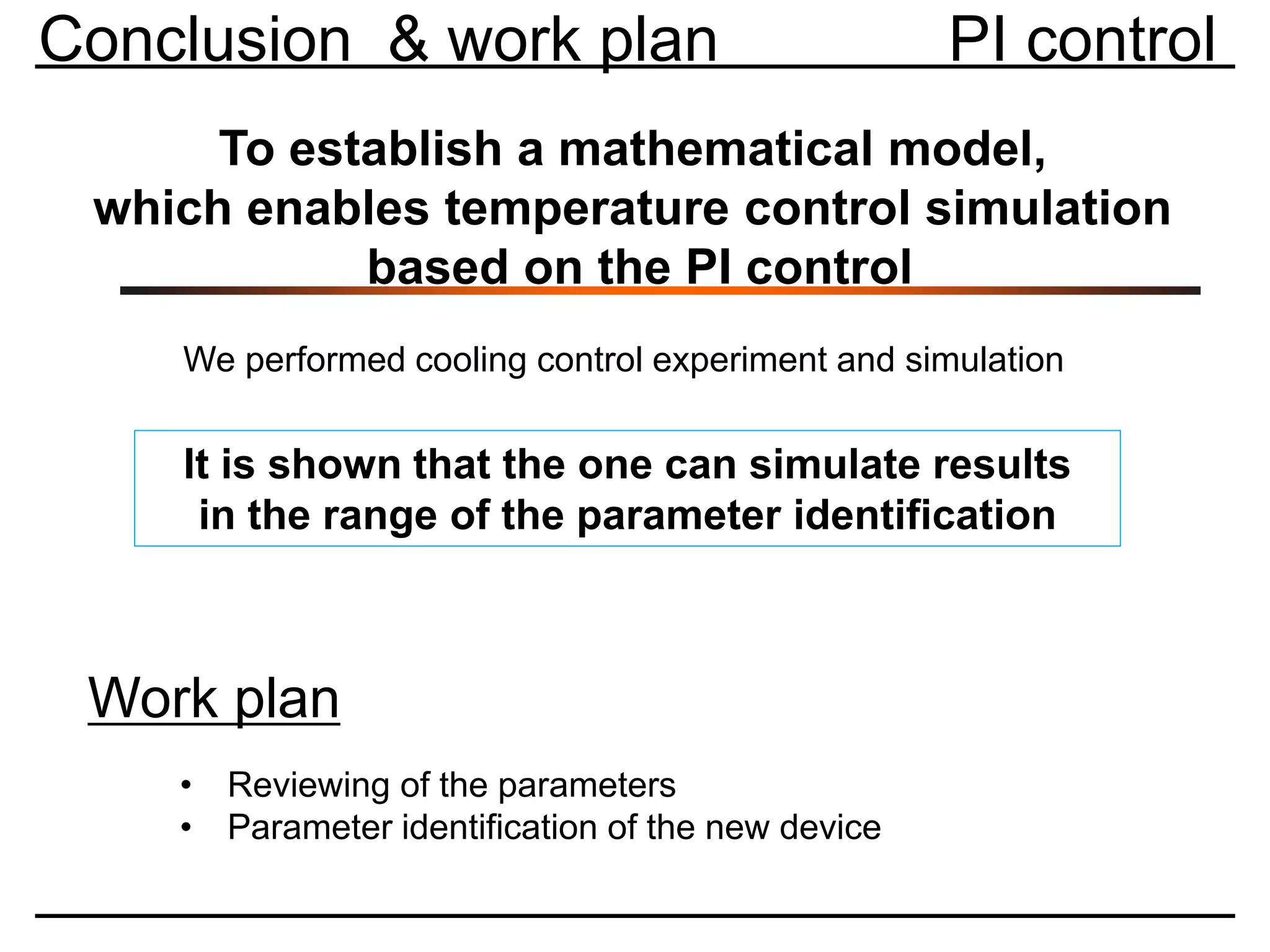
Conclusion & work plan PI control
It is shown that the one can simulate results
in the range of the parameter identification
To establish a mathematical model,
which enables temperature control simulation
based on the PI control
We performed cooling control experiment and simulation
Work plan
• Reviewing of the parameters
• Parameter identification of the new device

Study on temperature control model of a focal cooling human physiological system

  • 1.
    Study on TemperatureControl Model of the Focal Cooling Human Physiological System Graduate School of Medicine Yamaguchi University Kenyu UEHARA May/20/2015
  • 2.
    Outline 1. Background 2. Purposeof this study 3. Study method 4. Result and Discussion 5. Conclusion Introduction of this research
  • 3.
    Cooling effect hascontributed in various fields Ice (Cryotherapy) Cooling treatments lower body temperature in order to relieve pain, swelling, constriction of blood vessels, and to decrease the cellular damage http://kadowakibonesetting.web.fc2.com/cryo.ht ml Vasoconstriction Prevention of Secondary hypoxic injury • Heat stroke • Sprain • Encephalopathy It was applied to several symptoms etc. Background Cooling device cell blood vessels
  • 4.
    Background Cooling device Peltierdevice (Thermoelectric device) P N P N P N Semiconductor (P-type & N-type) Metal plates Endothermic surface Exothermic surface Heat transfer Peltier device Lead wire Thermoelectric coolers operate by the Peltier effect Advantages ◼ Temperature control ◼ No vibration ◼ Small and Lightweight For Human body Medical purposes
  • 5.
    Peltier device isnonlinear and have uncertainties Analysis and control of this kind of devices are difficult ◆ Joule heat generated by the input current to the device ◆ Heat conduction in the device inside <Problems> Adapting a cooling device, ◆ Thermal conductivity of the heat sink (To maintain the cooling performance) ◆ Thermal conductivity of the Cooling object (Biological reaction caused by cooling) Heat sink Peltier device Cooling water Human body (Cooling object) the entire system Background Cooling device
  • 6.
    Mathematical bio-model ofthe focal cooling device, In relation to the entire system is a prerequisite In order to perform a transitional control…. Ambient air Heat sink Peltier device Cooling water Human body (Cooling object) the entire system Background Cooling device
  • 7.
    Previous research Modeling Thermocouple connectors Heatsink Peltier device (6.0×6.0×2.3mm) Ag plates Water circulation path Power supply connector Coupling connector to the water circulating system 150mm Schematic view of the focal cooling device utilizing the Peltier device Peltier device is nonlinear and have uncertainties
  • 8.
    Mathematical model ofthe amount of heat of the entire system Peltier device Heat sink Previous research Modeling We identified the unknown parameters in the mathematical model solving the inverse problem
  • 9.
    Mathematical model ofthe amount of heat of the entire system Peltier device Heat sink Previous research Modeling We identified the unknown parameters in the mathematical model solving the inverse problem
  • 10.
    In order tominimize the difference Previous research Modeling 0.0 0.2 0.4 0.6 0.8 1.0 1.2 0.0 0.2 0.4 0.6 0.8 1.0 1.2 1.4 1.6 1.8 2.0 MeanError[%/point] Input voltage [V] The relative difference per-point error of the experimental and simulation value vs. input voltage 1.16 % / point Average error Error function ℃ s Texp. Tsim.
  • 11.
    0 10 2030 40 50 15 20 25 30 35 40 45 Exp. Sim. Temperature[ o C] Time [s] Previous research Modeling Comparison of the experimental and simulation results in case of proportional gain Kp is 0.5 Result of the validation of the mathematical model Proportional control [V] The relative Error of the controlled side 1 %/point (0.2~0.3 ℃) Mathematical model can simulate Experimental result in the error range of the parameter identification
  • 12.
    Previous research Modeling Comparisonof the experimental and simulation results in case of proportional gain Kp is 0.5 Result of the validation of the mathematical model Using a temperature control based on ONLY Proportional action Error in the temperature of the controlled side 0.2~0.3 ℃ Mathematical model can simulate Experimental based on the P-control 0 10 20 30 40 50 15 20 25 30 35 40 45 Exp. Sim. Temperature[ o C] Time [s] Controlled temperature reaches a balance away from the target
  • 13.
    Previous research Modeling Comparisonof the experimental and simulation results in case of proportional gain Kp is 0.5 Using a temperature control based on ONLY Proportional action Error in the temperature of the controlled side 0.2~0.3 ℃ Mathematical model can simulate Experimental based on the P-control 0 10 20 30 40 50 15 20 25 30 35 40 45 Exp. Sim. Temperature[ o C] Time [s] Controlled temperature reaches a balance away from the target General temperature control. ⚫ To eliminate the steady-state error ⚫ To improve the stability of the system In order to adapt to a living body, accuracy of the cooling temperature is an important factor PI,PD, or PID control P : Proportional action I : Integral action D : Derivative action Is used as needed in the temperature control
  • 14.
    To establish amathematical model, which enables temperature control simulation based on the PI control ➢Evaluation of the mathematical model 1. Experimental equipment & condition 2. Result of the experiment and simulation 3. Discussion Purpose
  • 15.
    Evaluation of themodel Exp. Set-up Thermocouple Conductor wire Water line IN OUT Temperature Controlled Bath Pump PLC PC Power Amp Phantom (Vegetable gelatin) Focal cooling device Schematic of the experimental set-up • Phantom Vegetable gelatin • Sampling time 50 ms • Control period 500 ms • Temperature resolution 0.1 ℃ • Ambient temperature 25.0 ℃ • Phantom temperature 37.0 ℃ • Measurement time 180 sec Experimental equipment
  • 16.
    PI control [V] Input voltage 25 32~ 33 Time [s] Temperature [℃] Cooling start Cooling end 10 50 Heat side Cool side controlled Evaluation of the model Exp.& Sim. Proportional gain Integral gainControl error (0.5) 15.0 30.0 50.0 Condition of the experiment and simulation
  • 17.
    0 10 2030 40 50 15 20 25 30 35 40 45 Exp. Sim. Temperature[ o C] Time [s] An example of result in case of proportional gain is 0.5 and integral gain is 15.0 Ki Controlled side Both sides 15.0 0.66 1.92 30.0 0.24 1.23 50.0 0.45 1.48 Relative error per-point of the results [%/point] The average error in the parameter identification is 1.16%/point The relative error in the both sides is nearly equal to the time of the parameter identification It is to be sufficiently possible simulated in the error range at the time of the parameter identification Evaluation Result & discussion
  • 18.
    Conclusion & workplan PI control It is shown that the one can simulate results in the range of the parameter identification To establish a mathematical model, which enables temperature control simulation based on the PI control We performed cooling control experiment and simulation Work plan • Reviewing of the parameters • Parameter identification of the new device