Applied Medical Engineering Science, Graduate School of Medicine
Internal Mechanical Engineering Congress & Exposition 2016
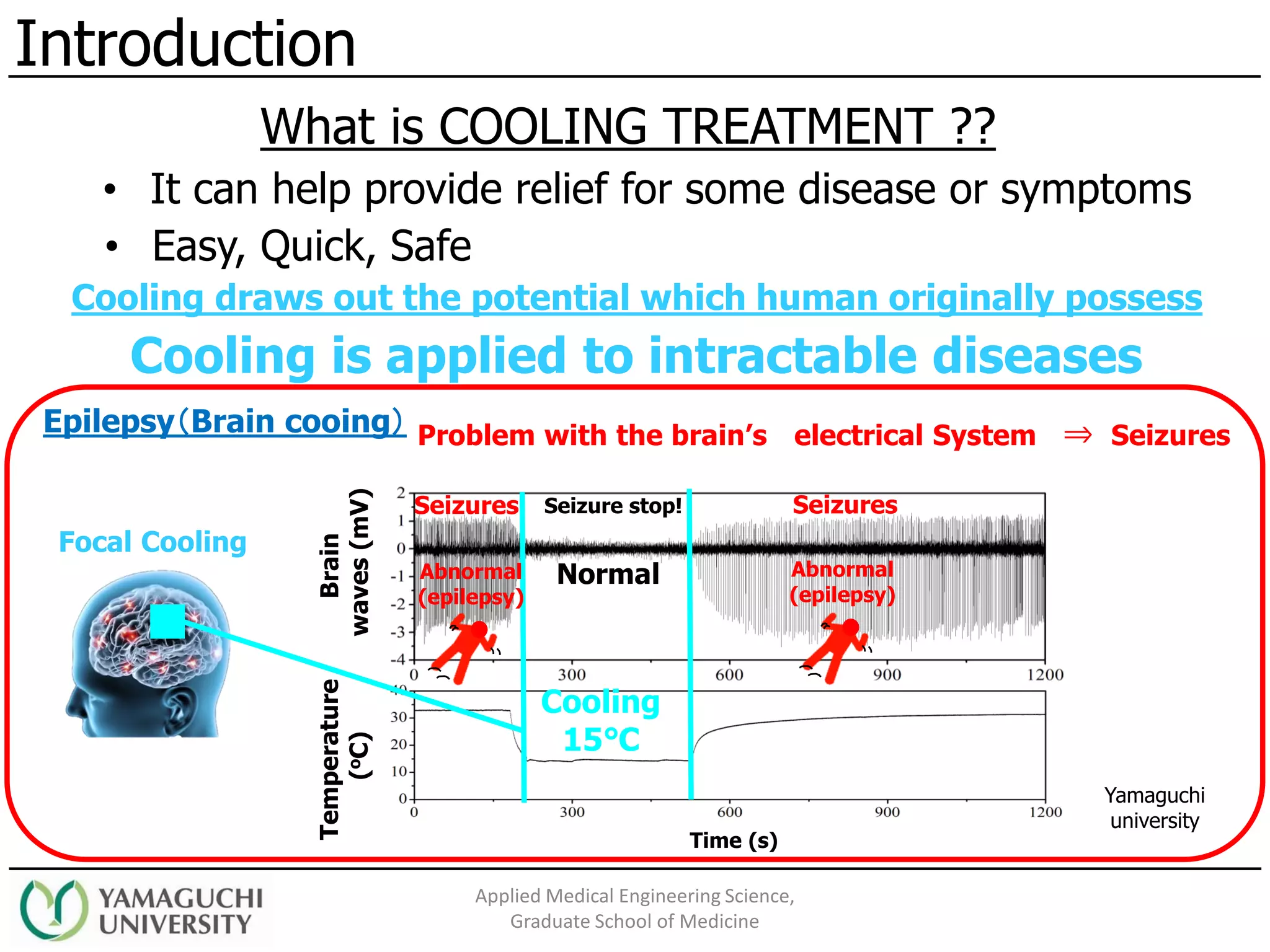
2016.11.17
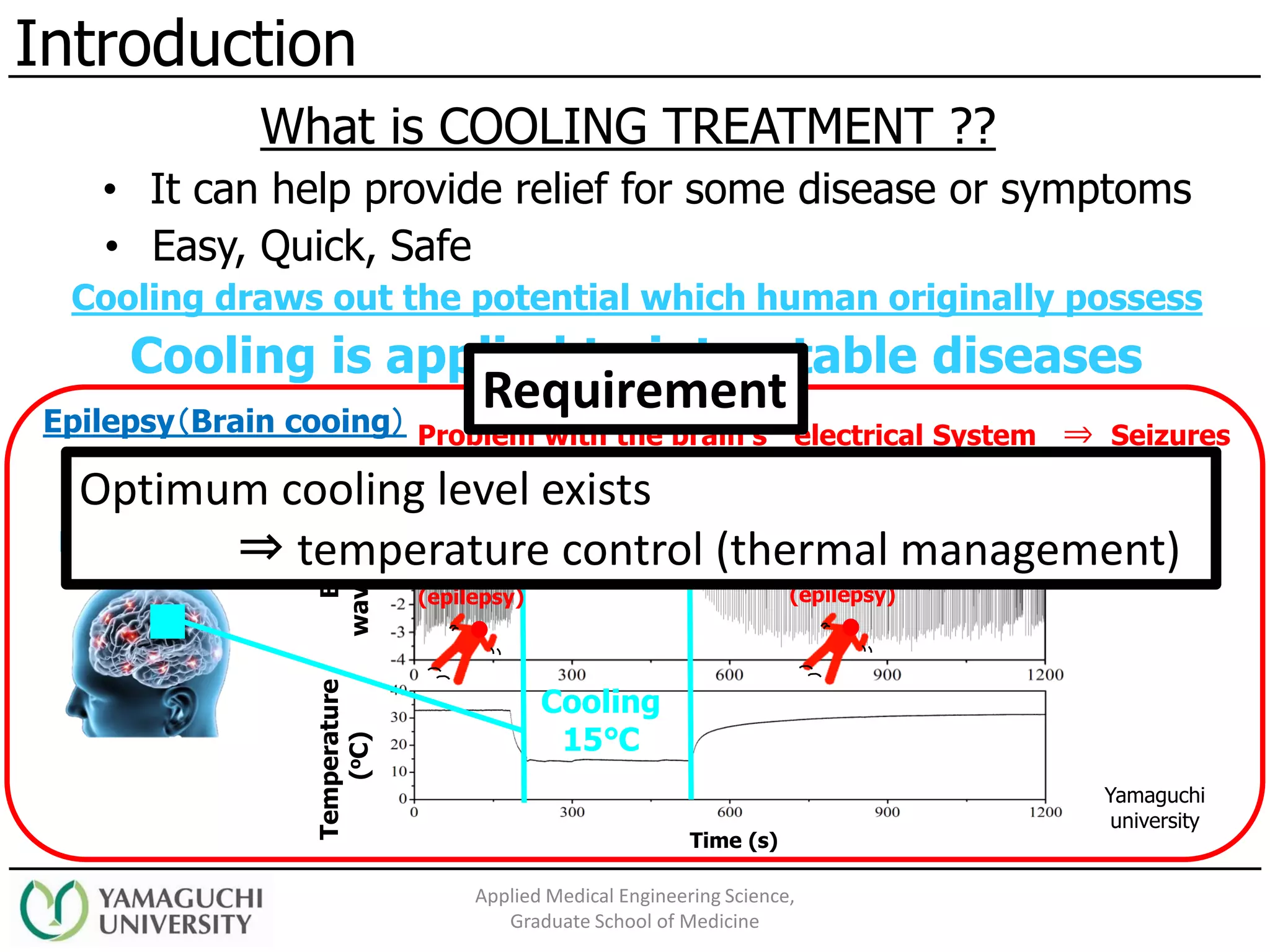
Study on Model Parameters of Focal Cooling Device
Using a Peltier Element for a Living Body
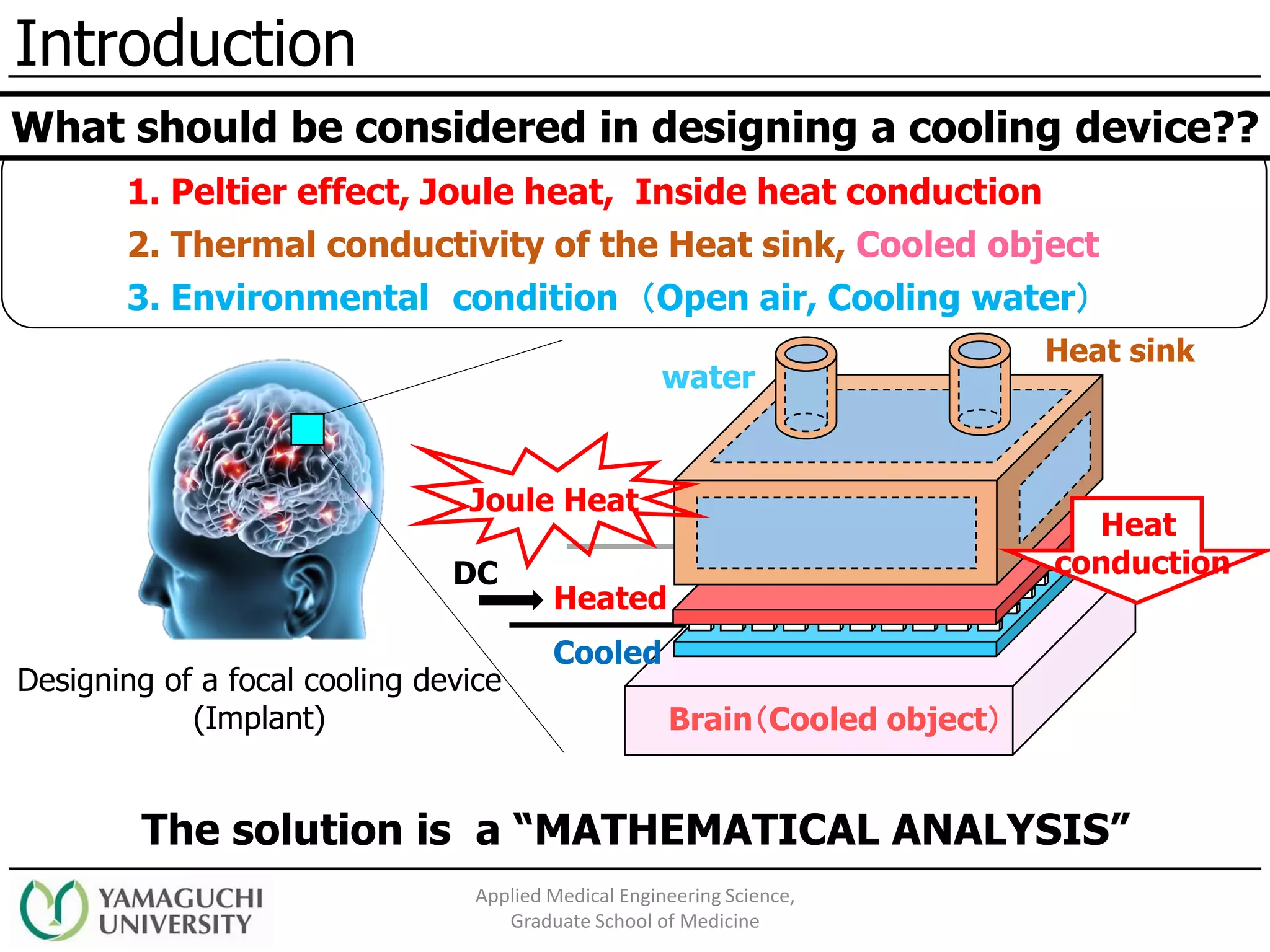
○Kenyu UEHARA∗1 Kentaro MIYAGO∗2 Koji MORI∗2 Takashi SAITO∗2
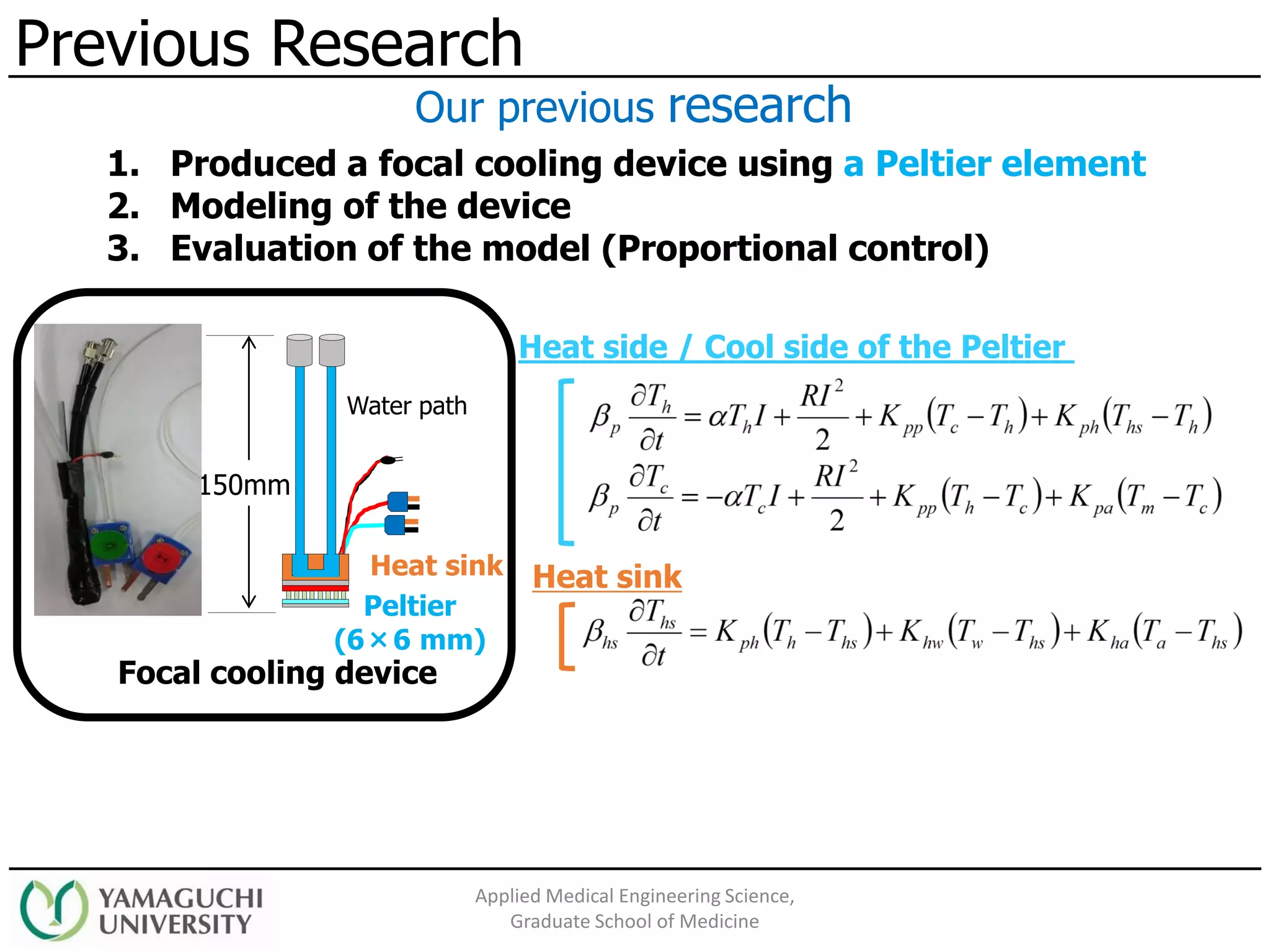
∗1Graduate school of Medicine, Yamaguchi University, in JAPAN
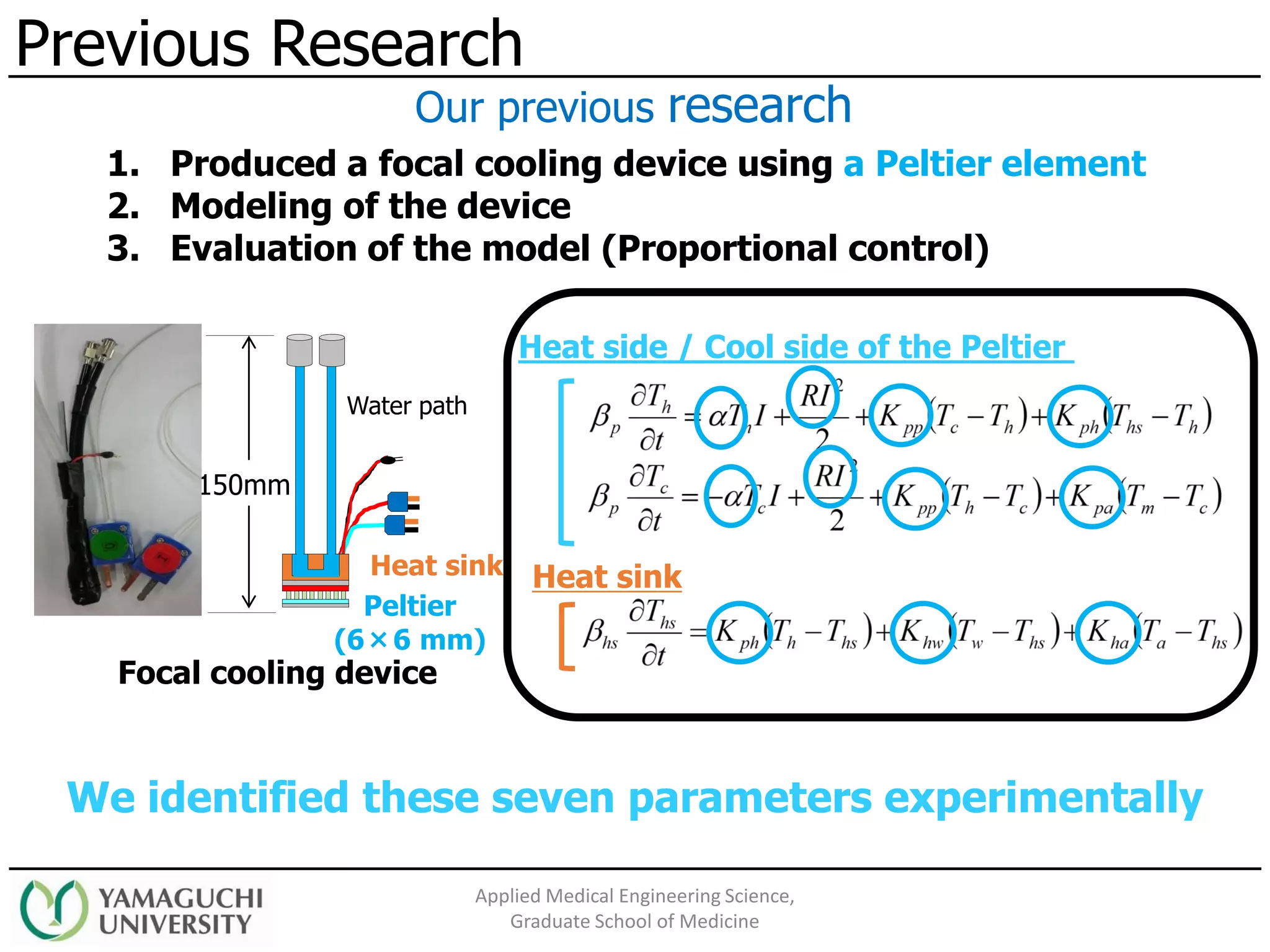
∗2Graduate school of Science and Technology for Innovation, Yamaguchi University , in JAPAN
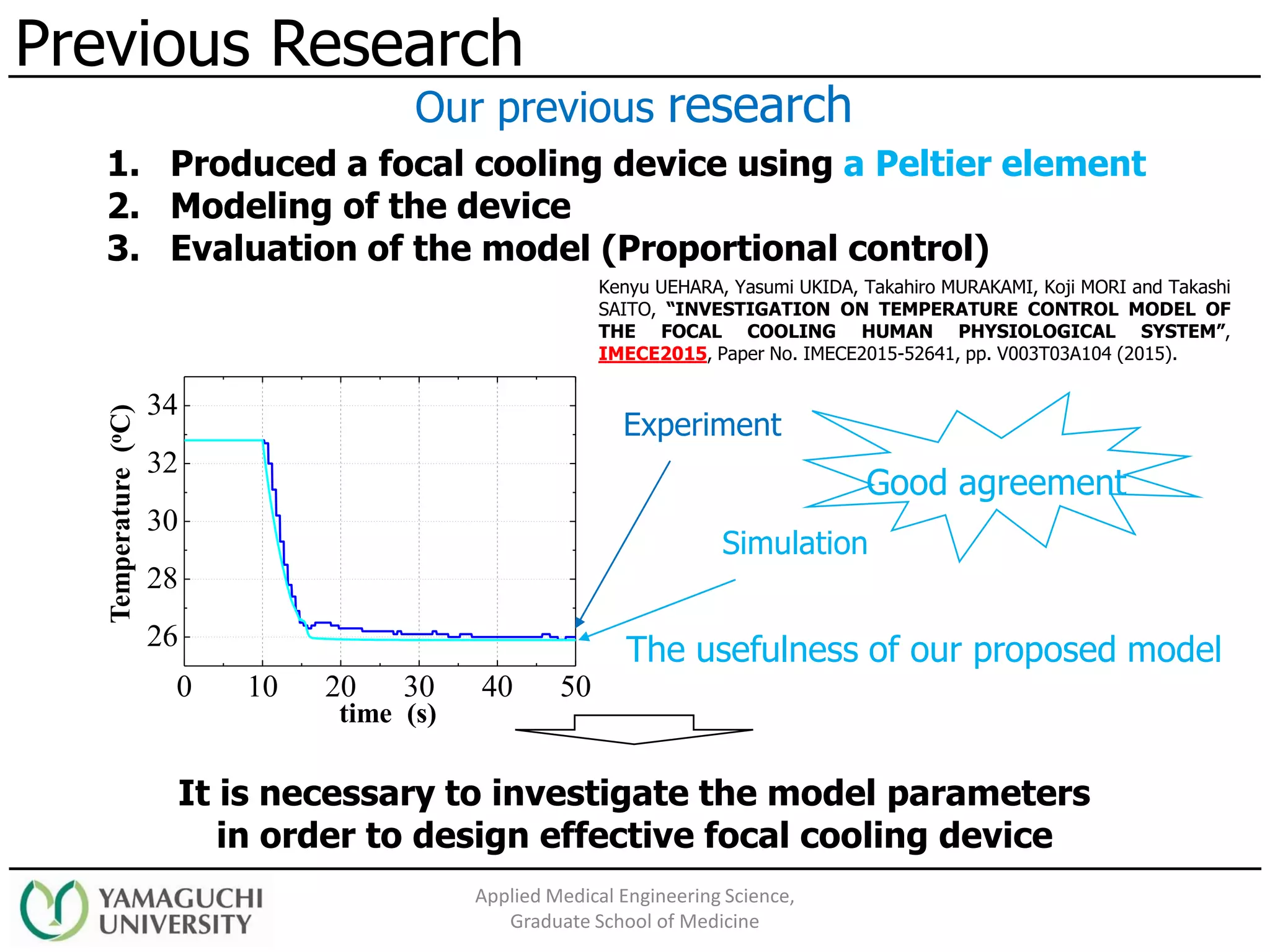
Brain
waves(mV)
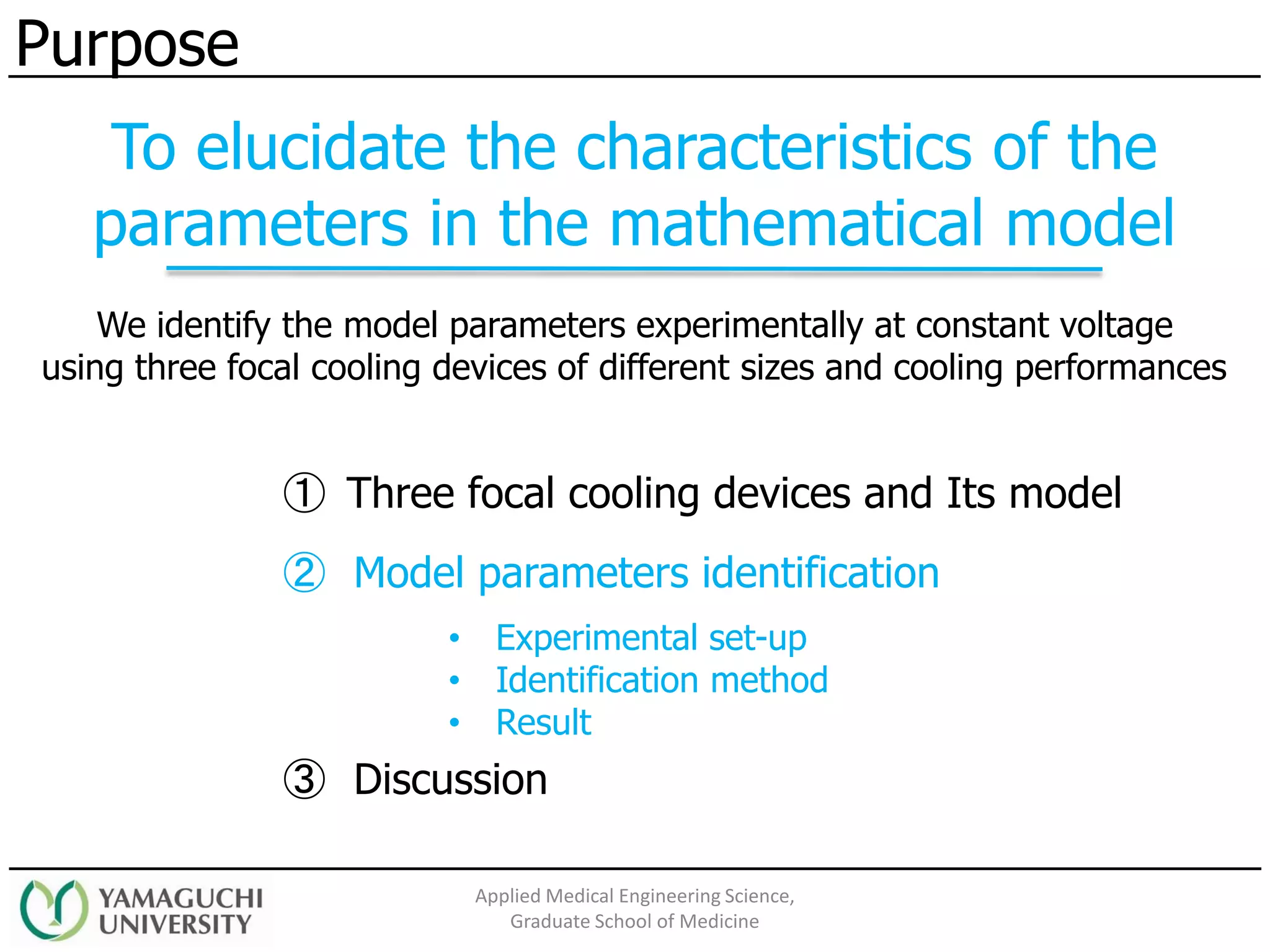
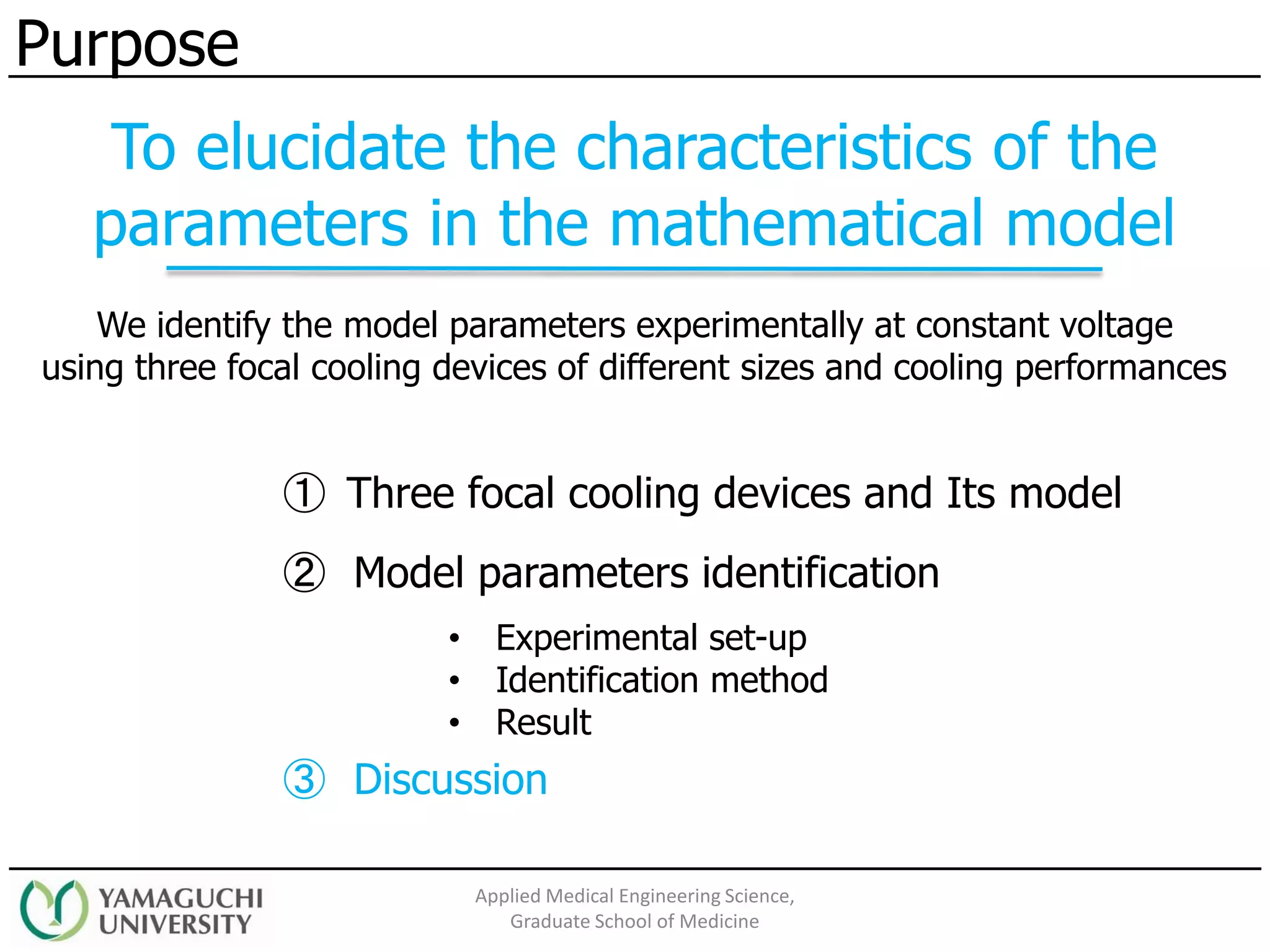
Temperature
(oC)
Time (s)
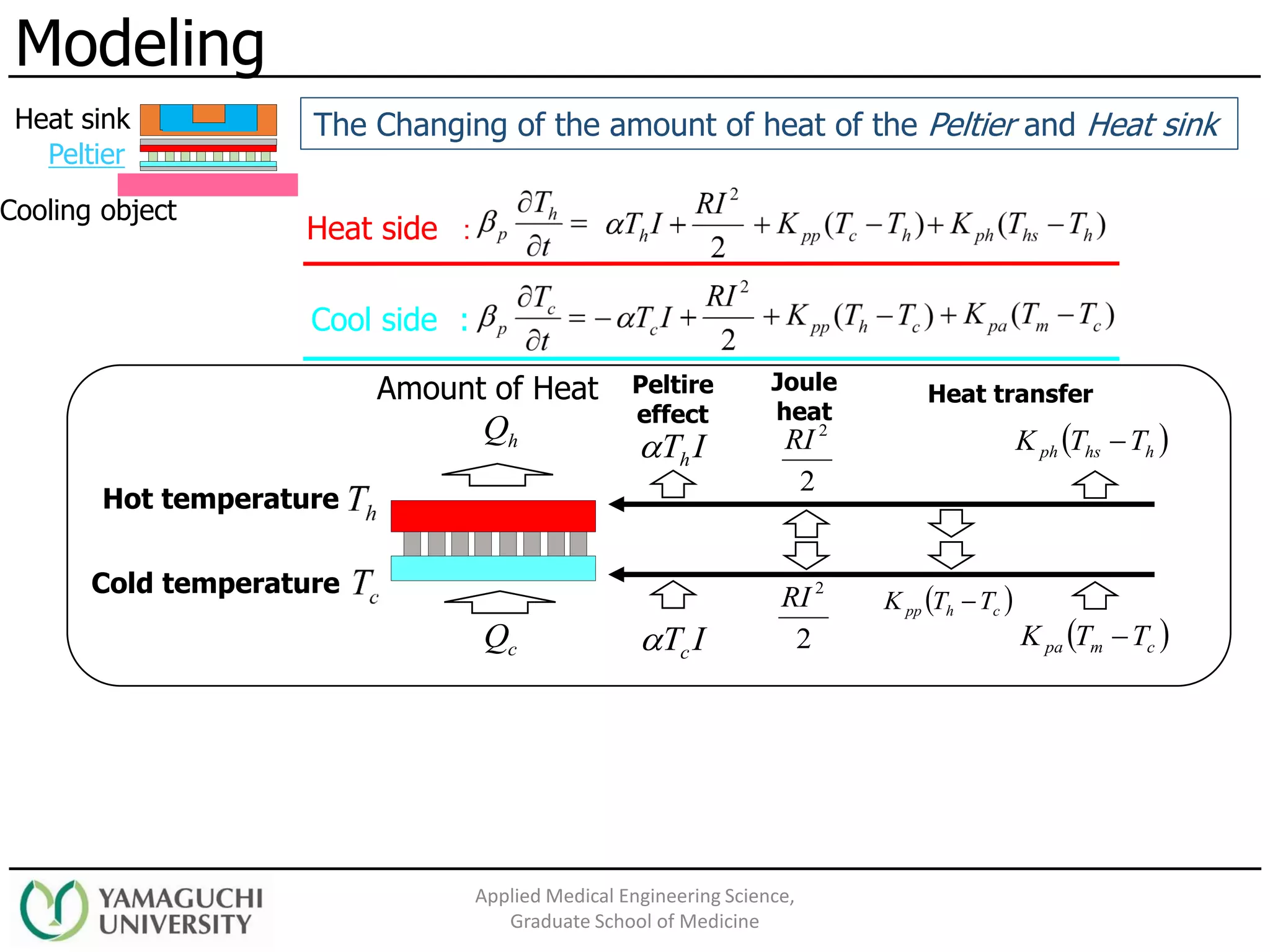
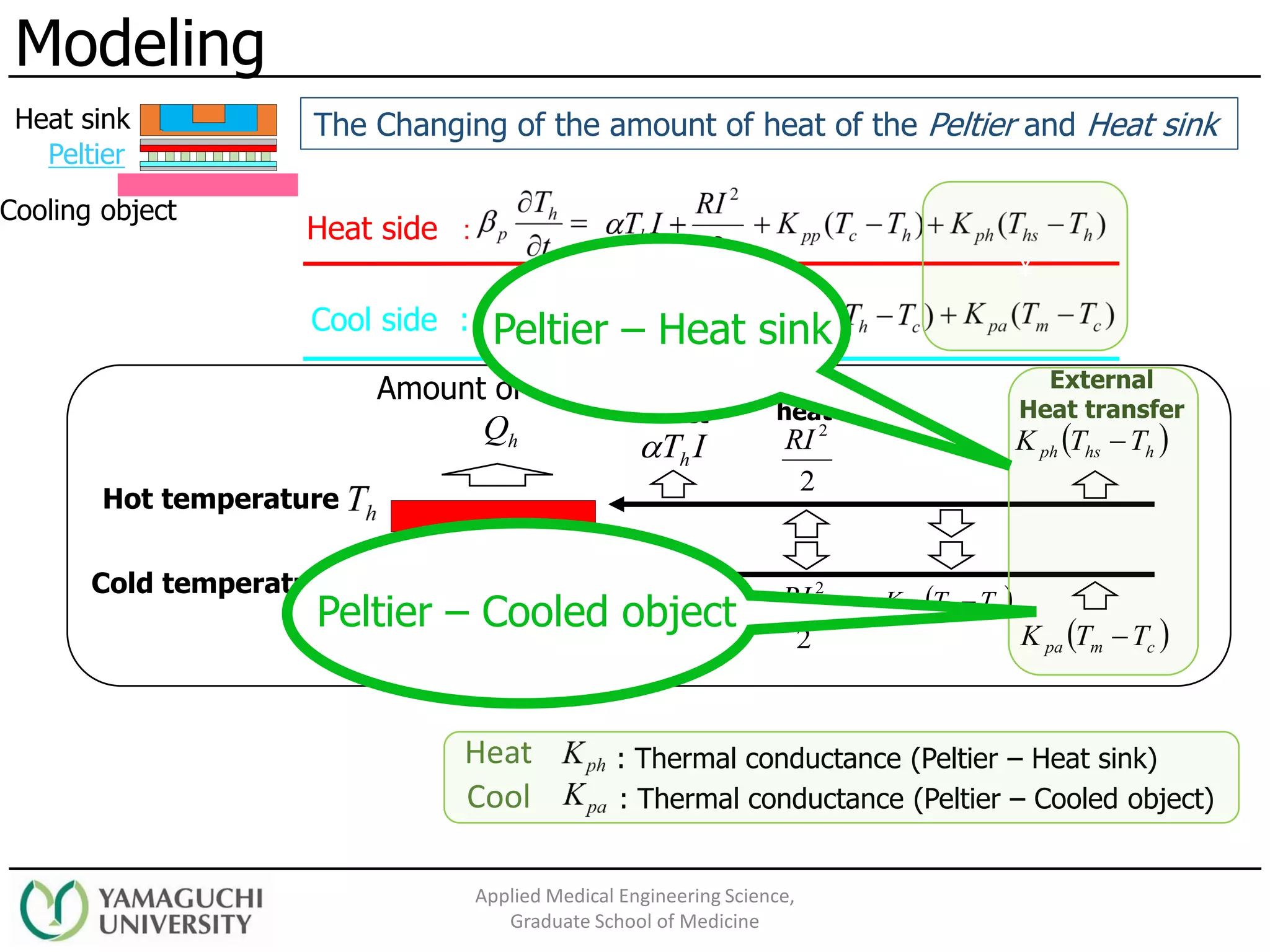
Cooling
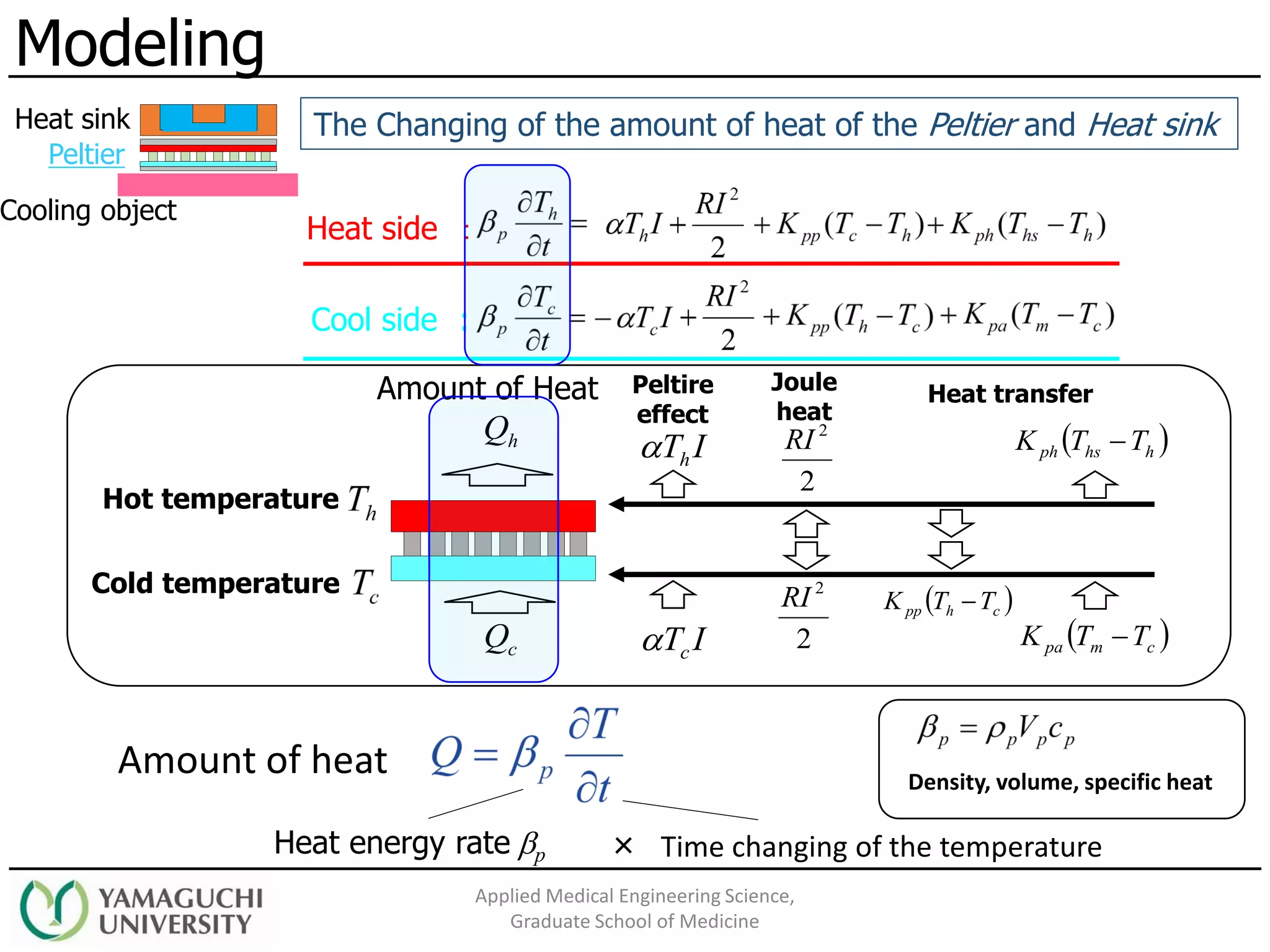
15℃
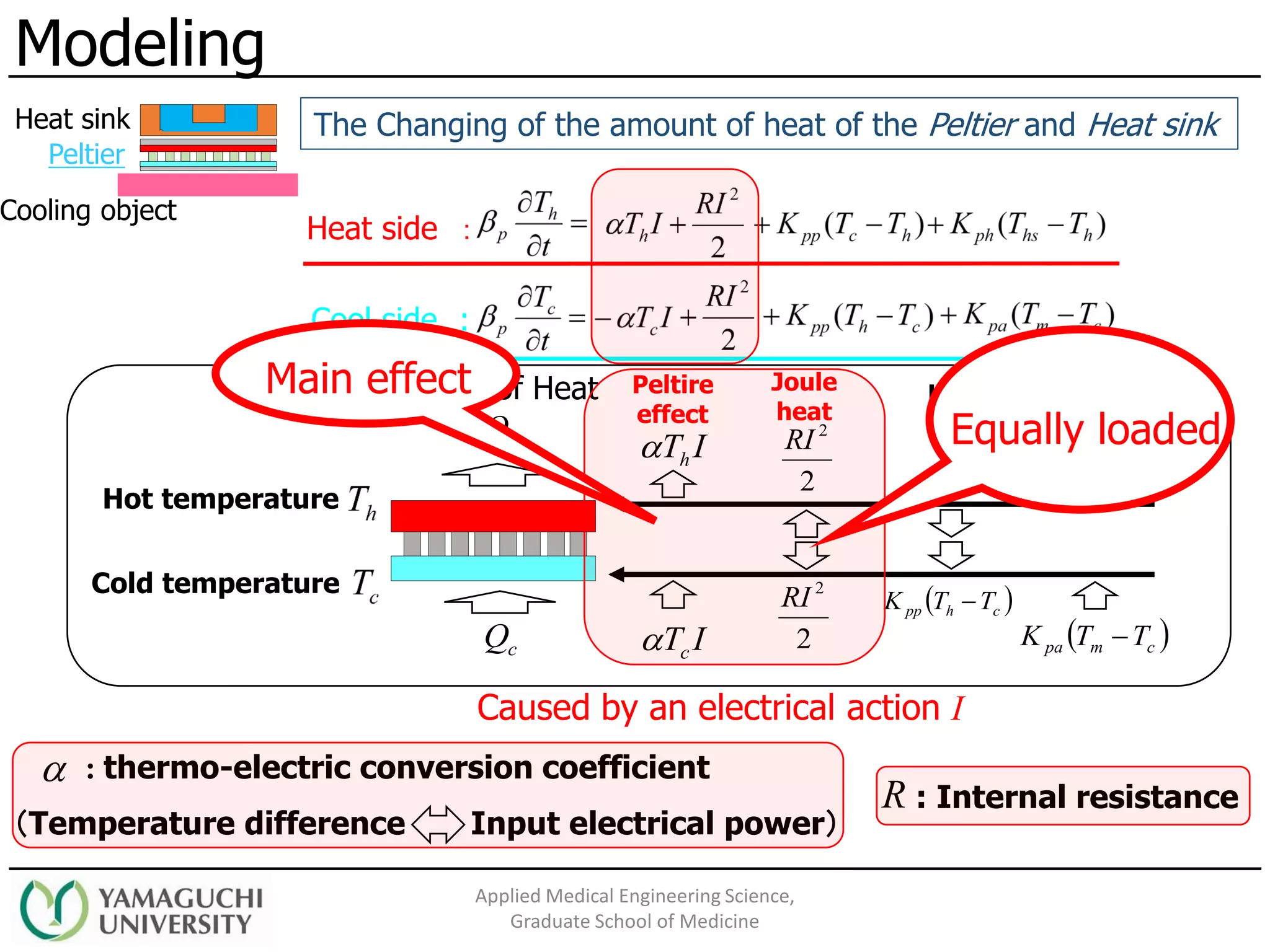
NormalAbnormal
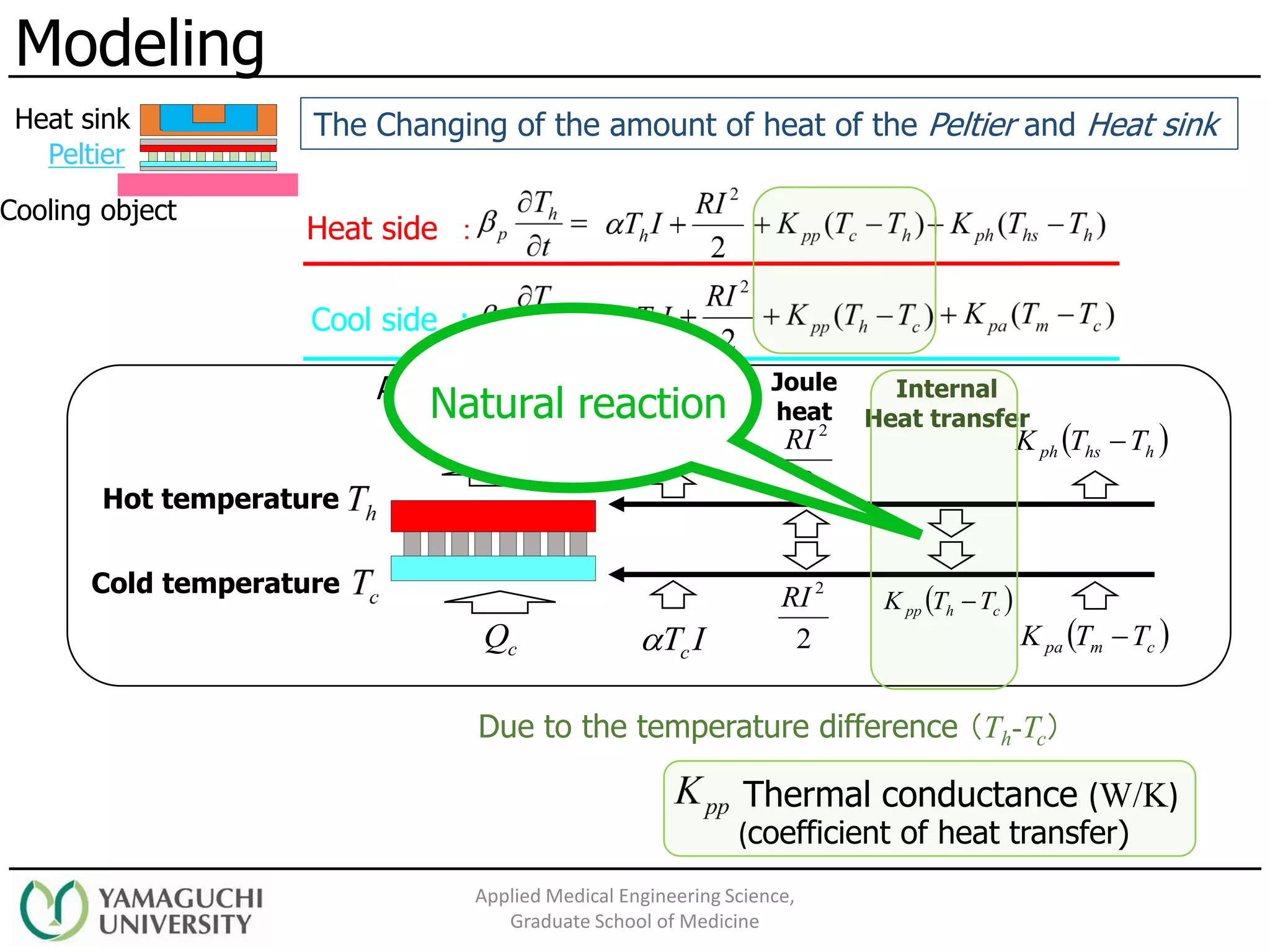
(epilepsy)
Abnormal
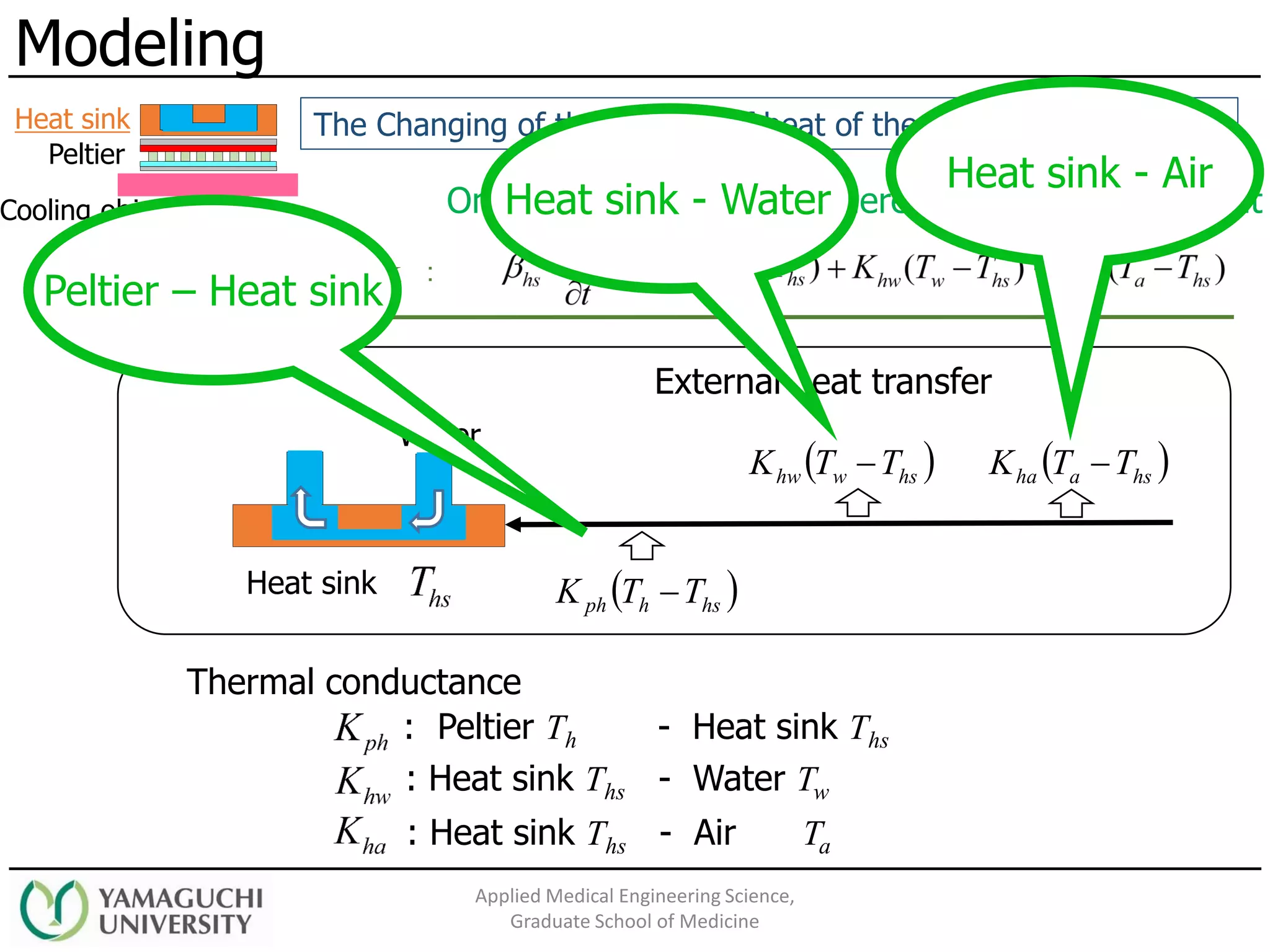
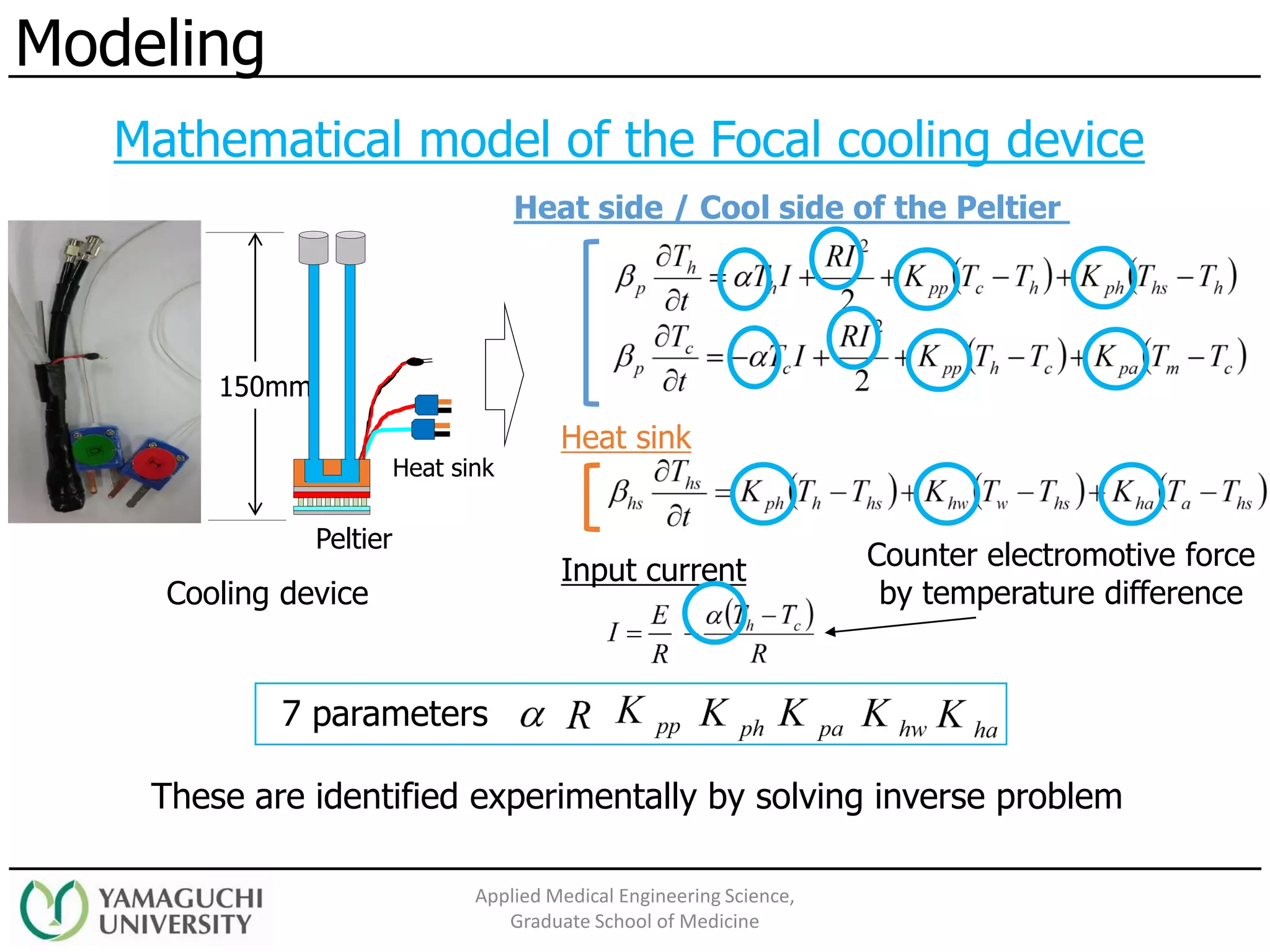
(epilepsy)
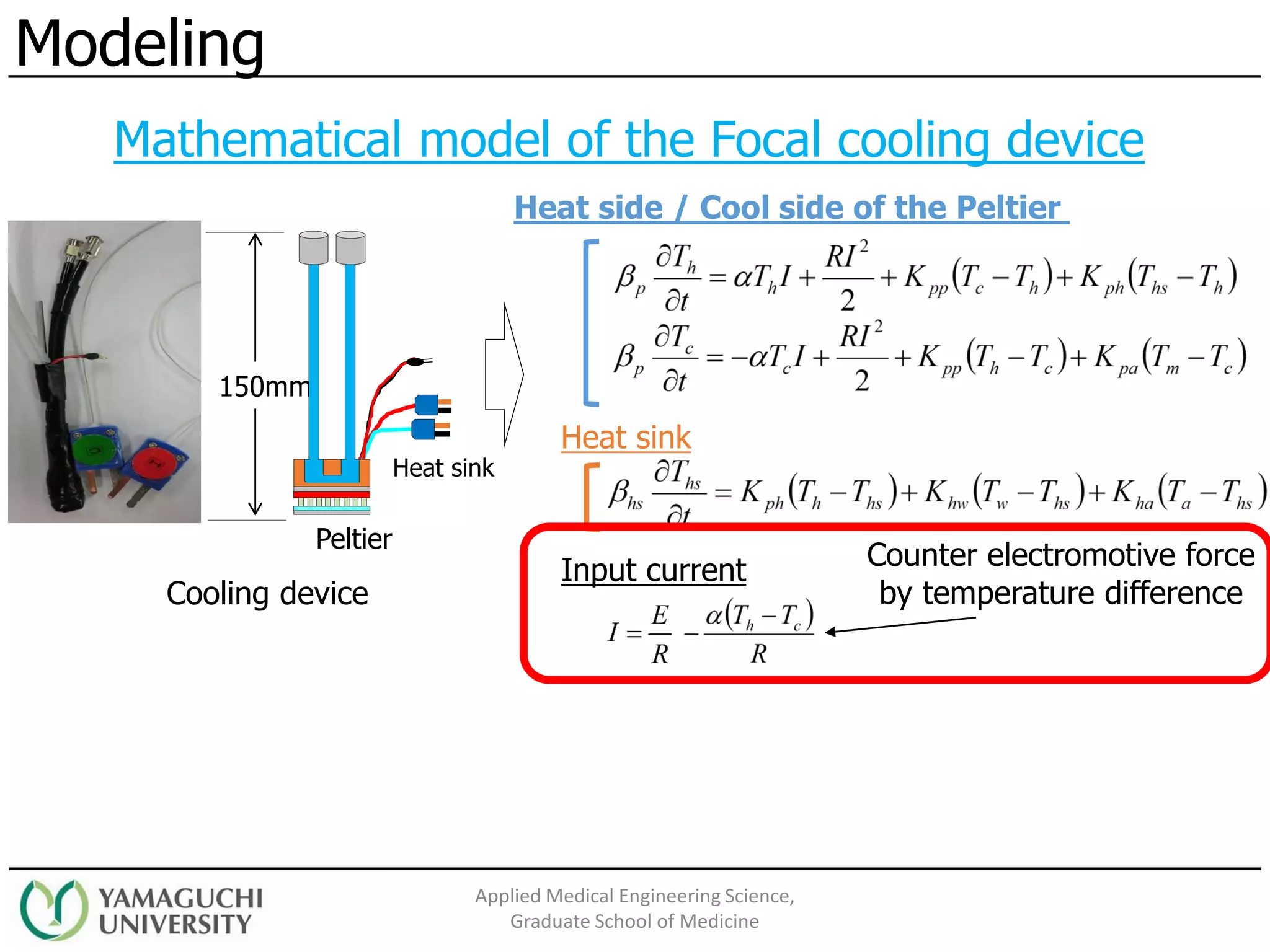
Seizure stop!Seizures Seizures
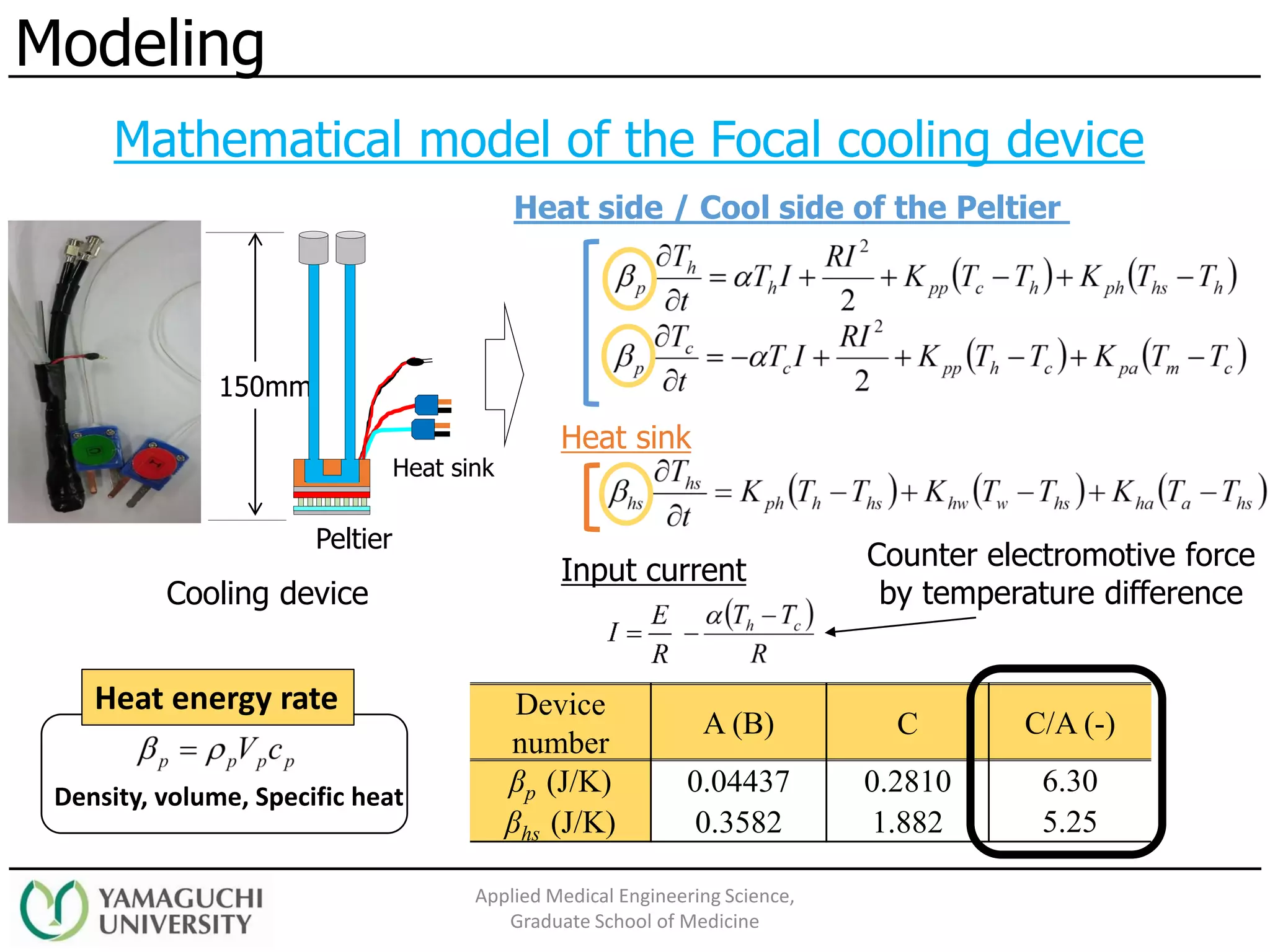
Introduction
Applied Medical Engineering Science,
Graduate School of Medicine
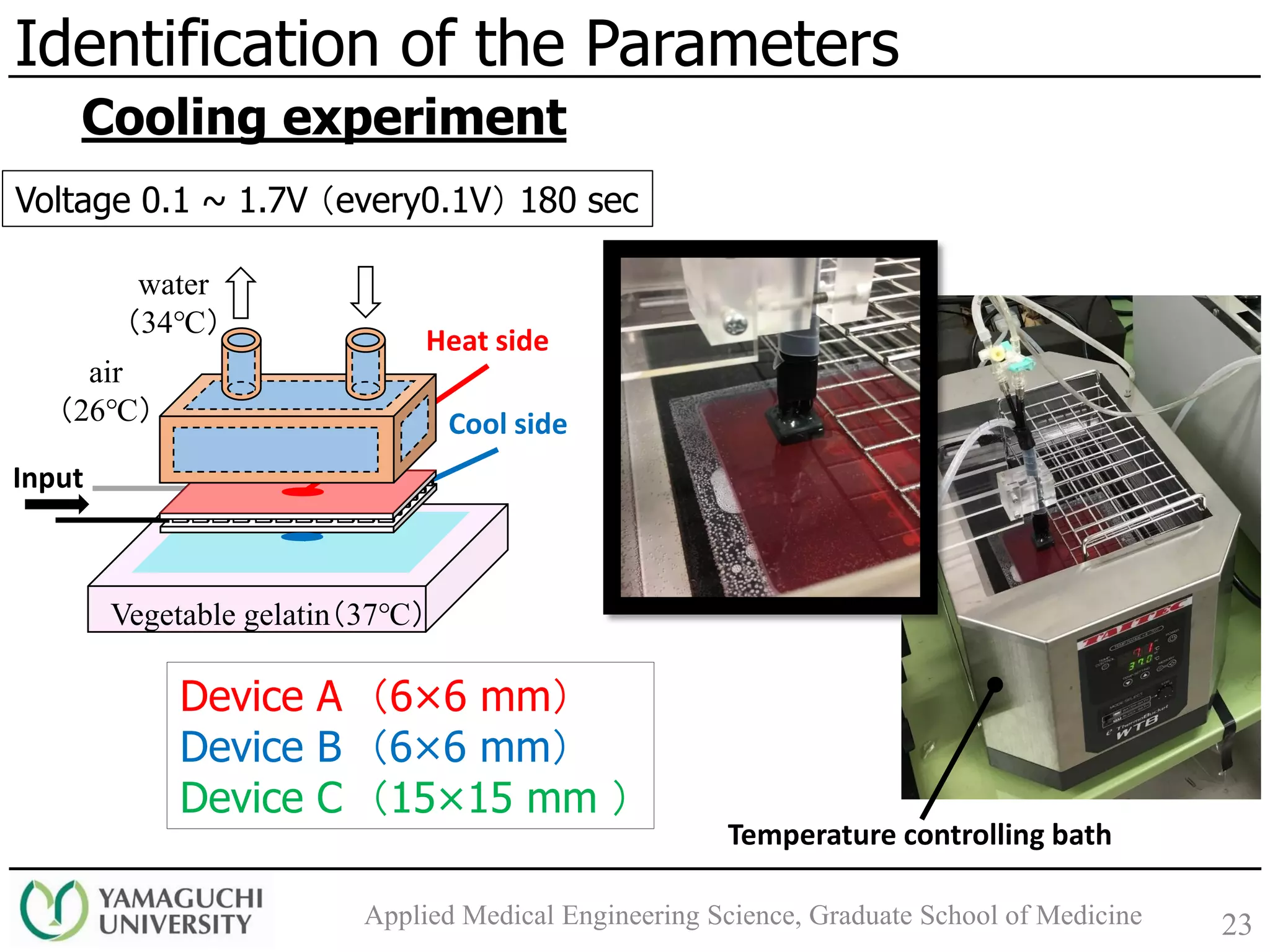
What is COOLING TREATMENT ??
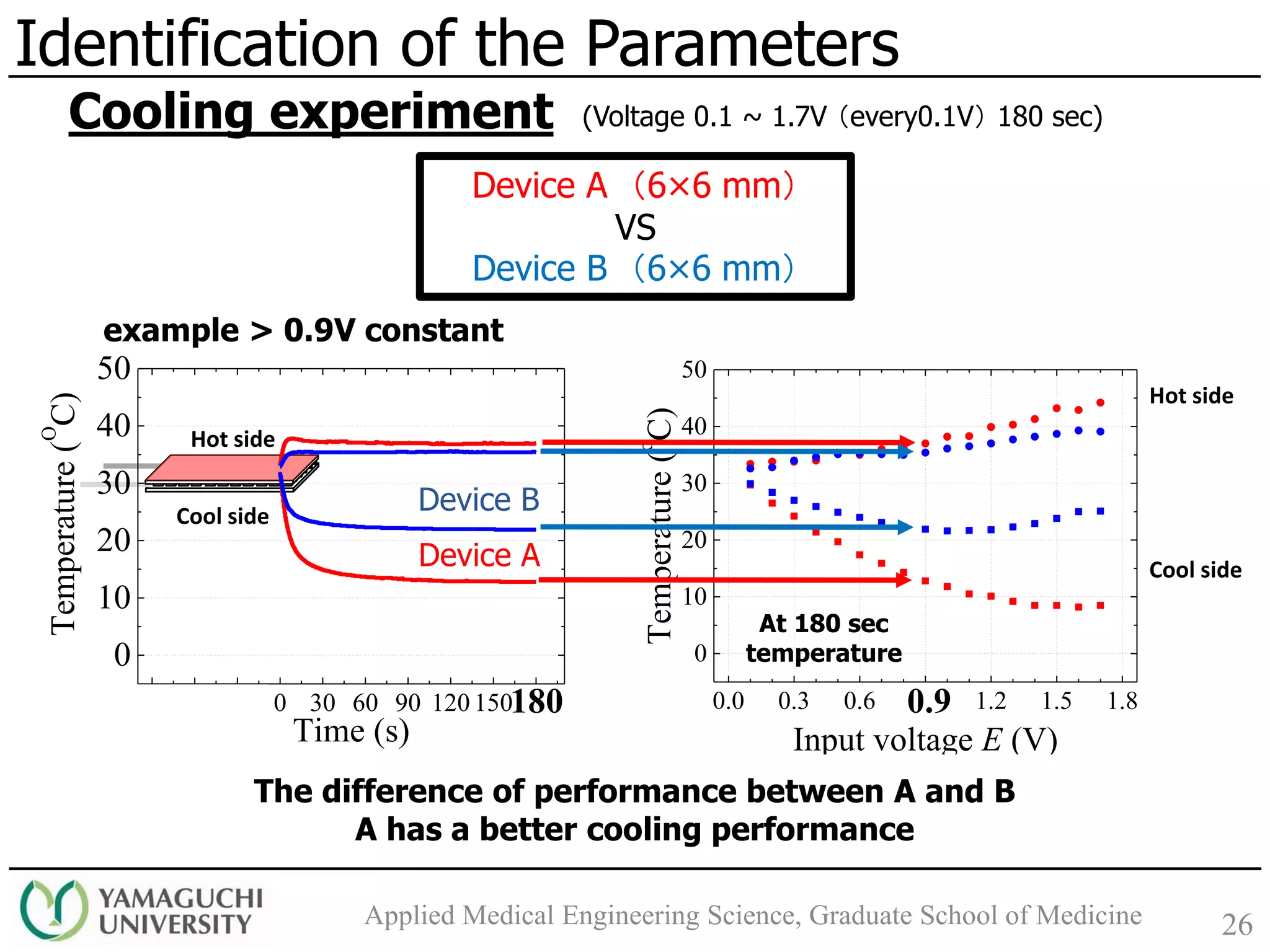
• It can help provide relief for some disease or symptoms
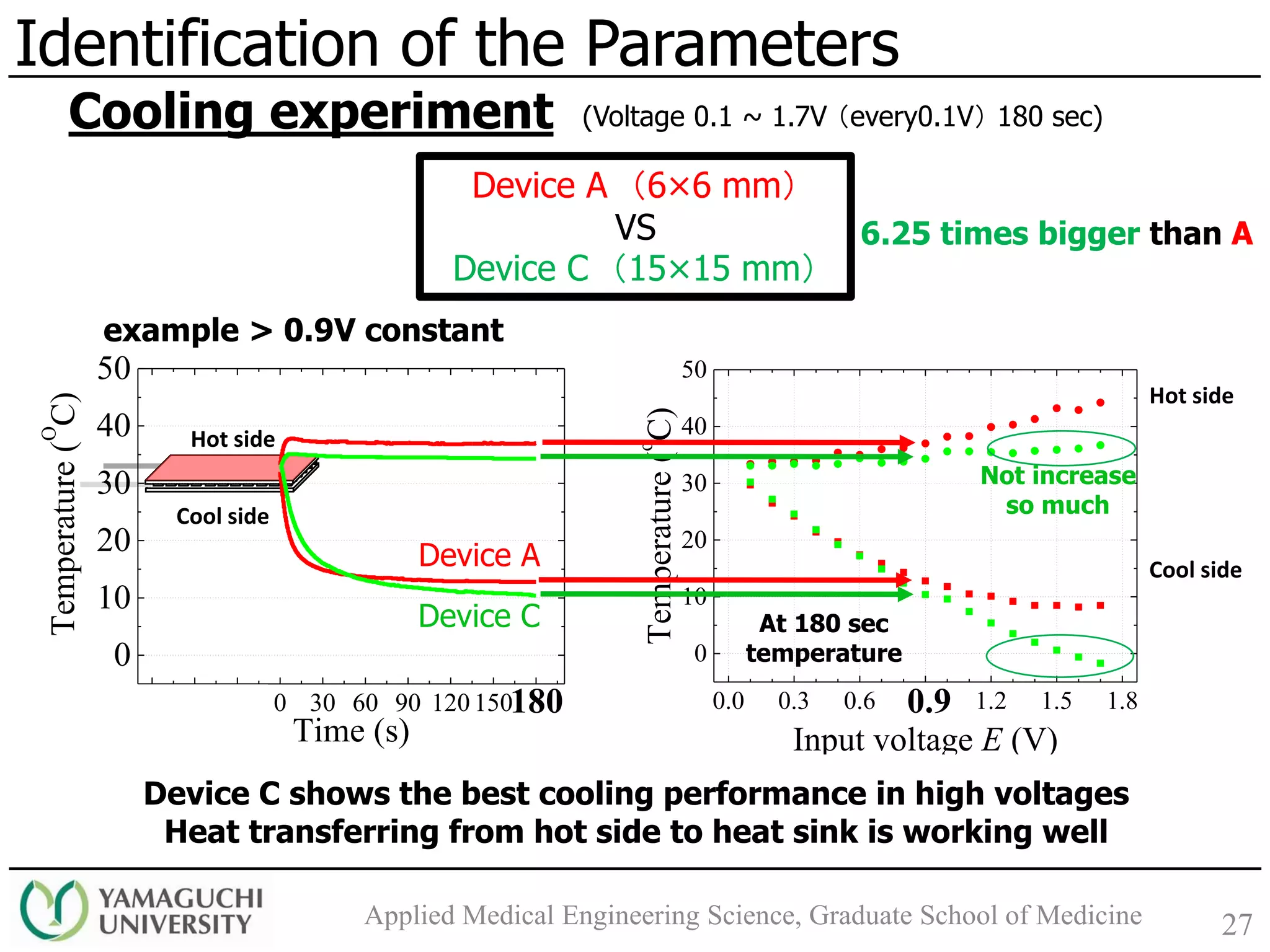
• Easy, Quick, Safe
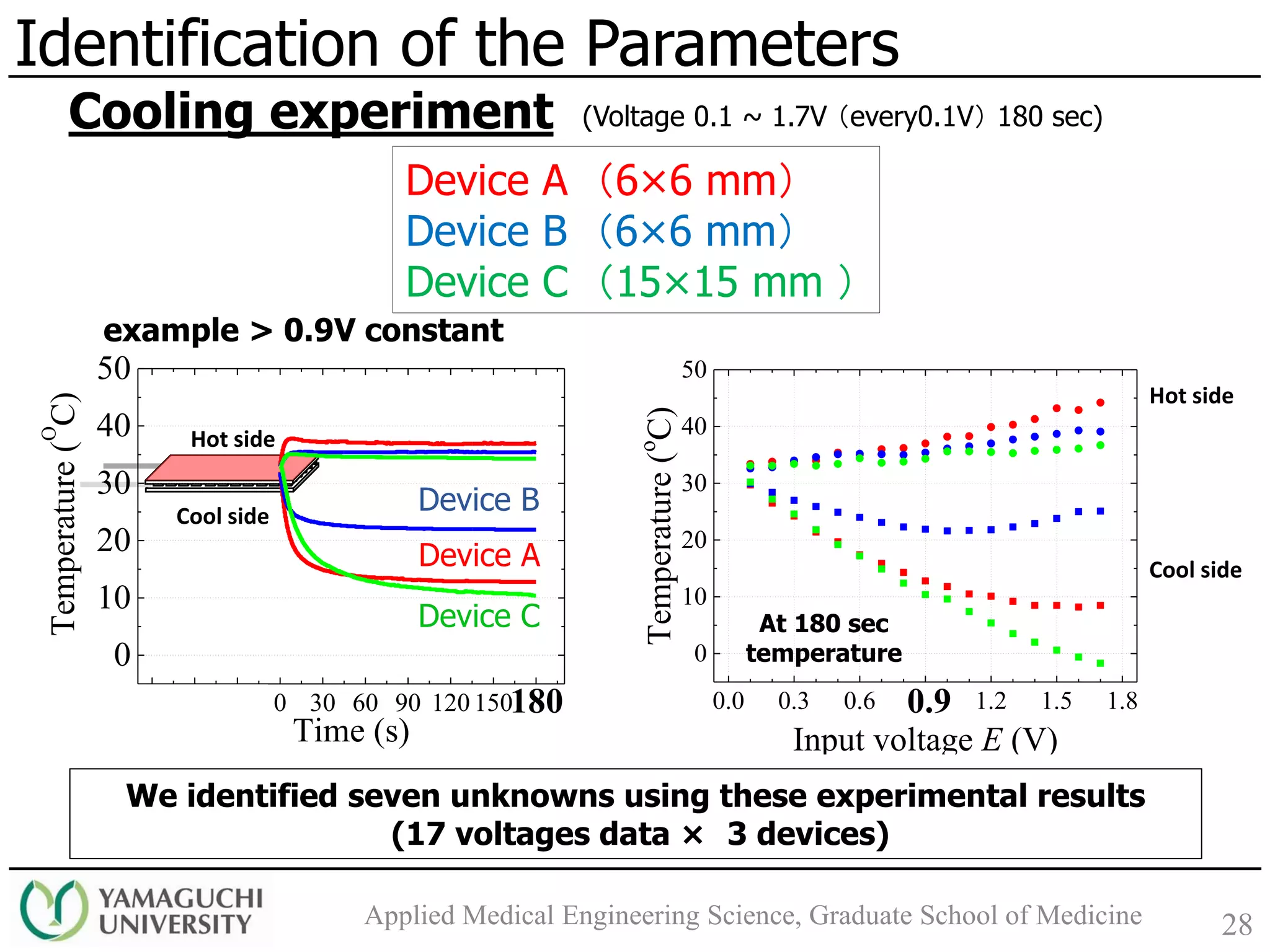
Epilepsy(Brain cooing) Problem with the brain’s electrical System ⇒ Seizures
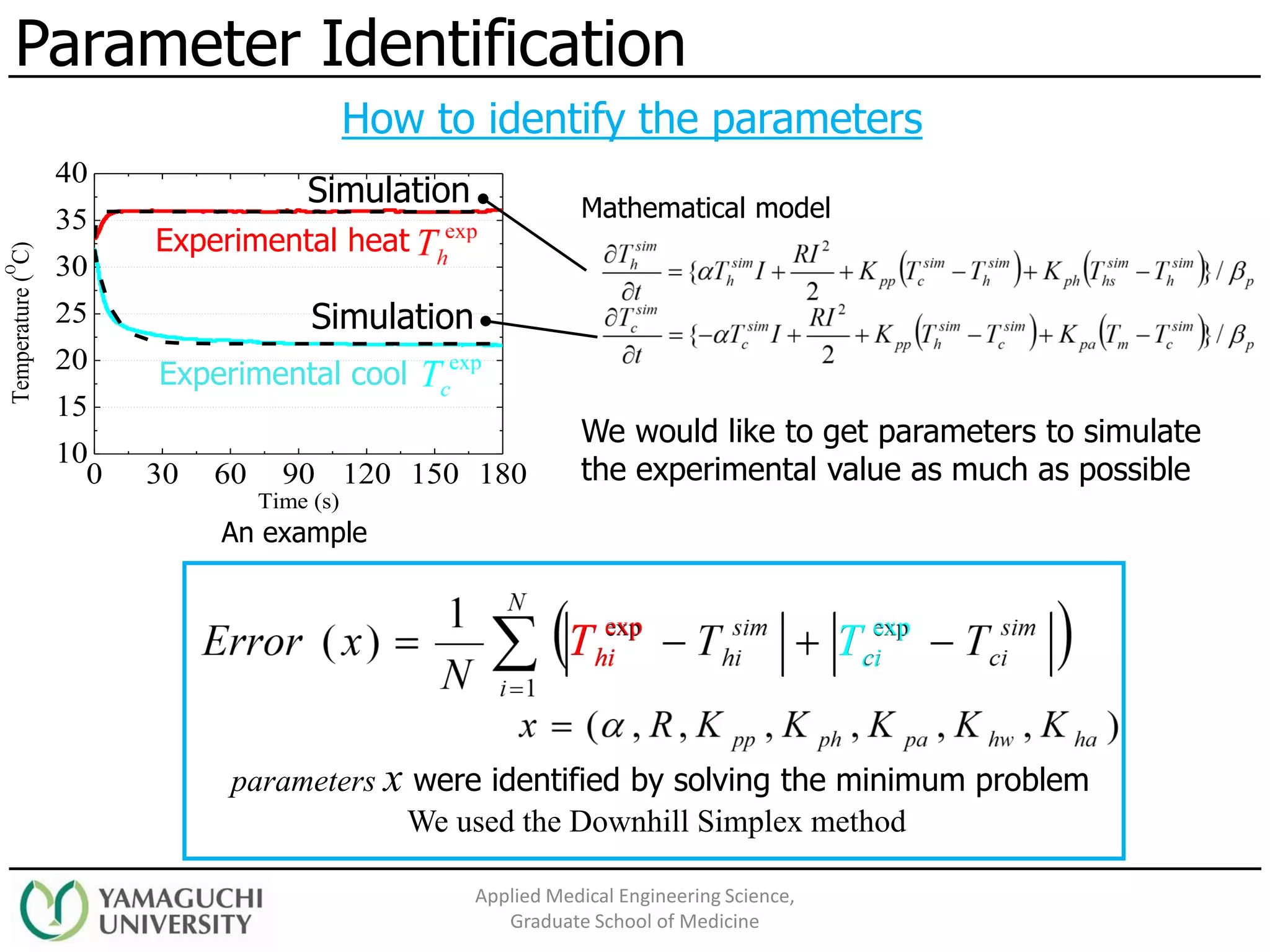
Focal Cooling
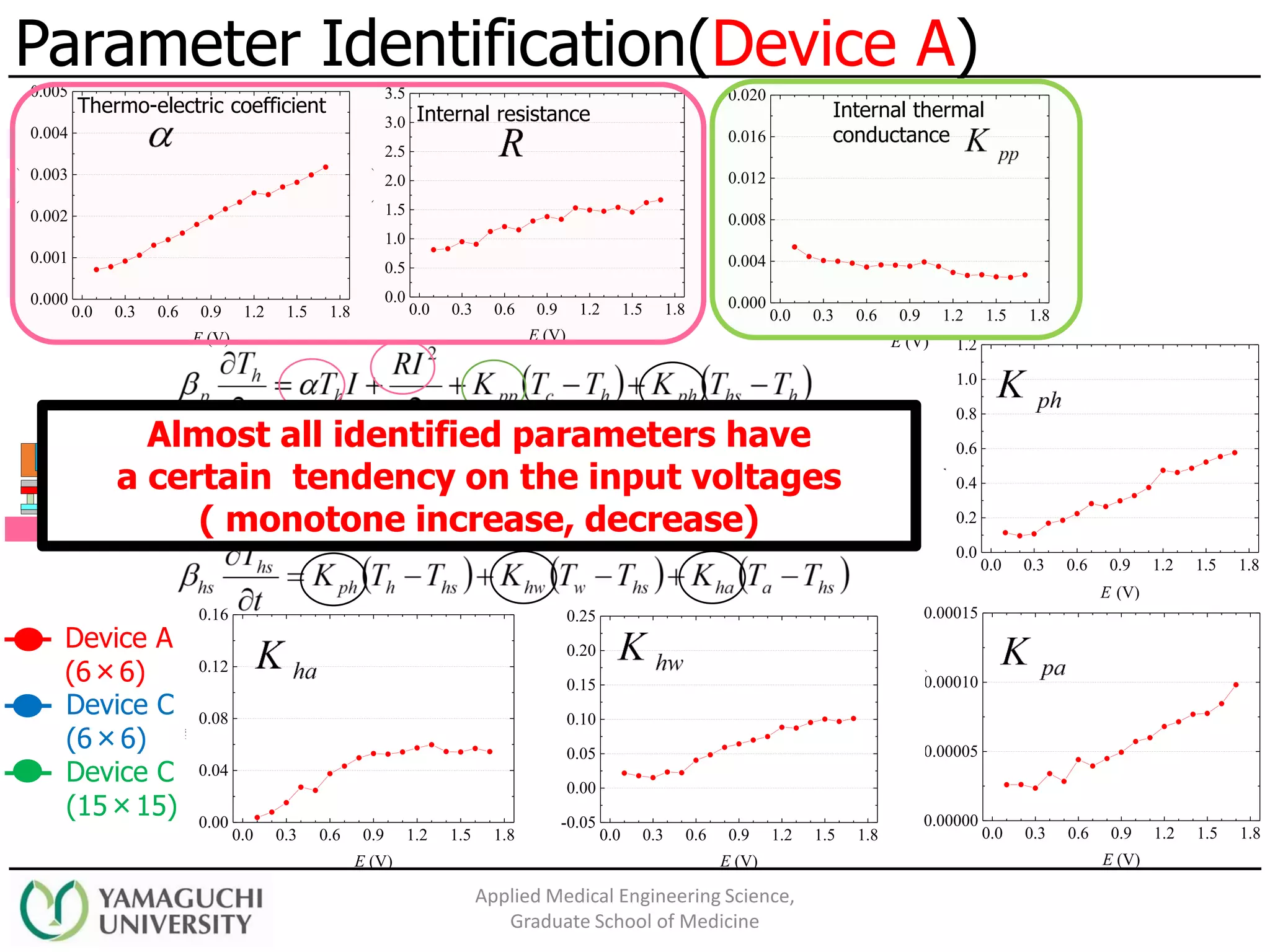
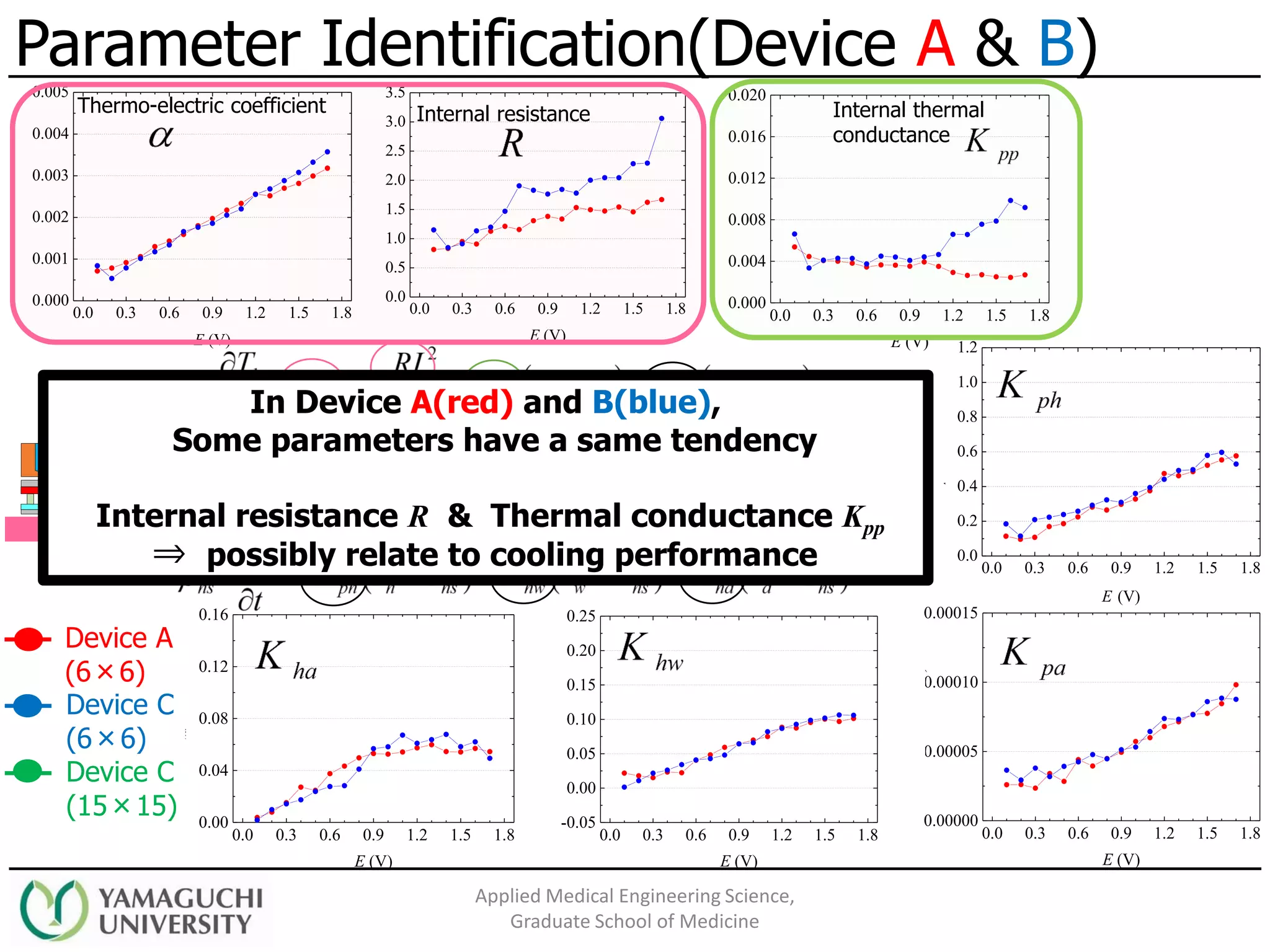
Yamaguchi
university
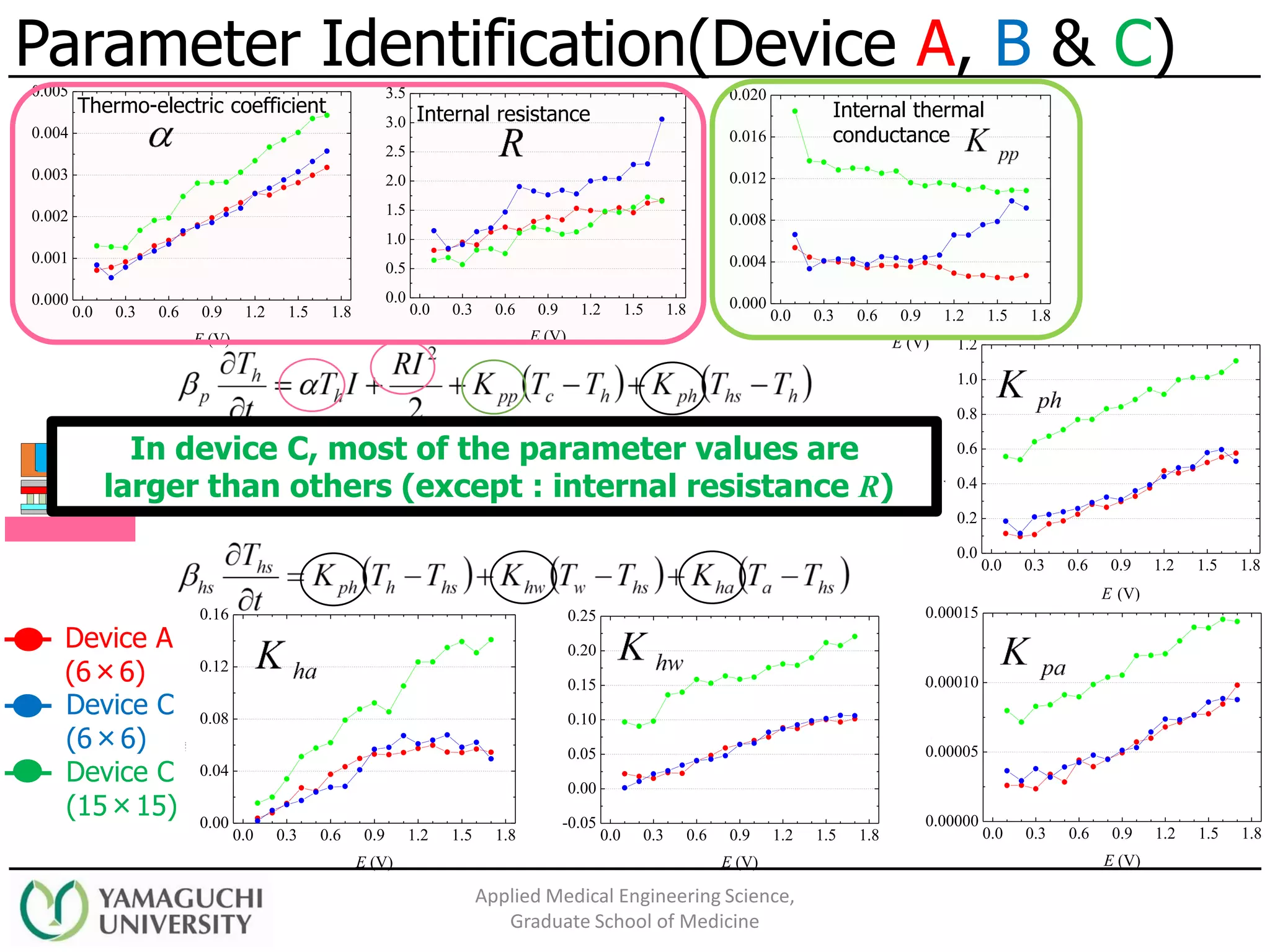
Cooling is applied to intractable diseases
Cooling draws out the potential which human originally possess
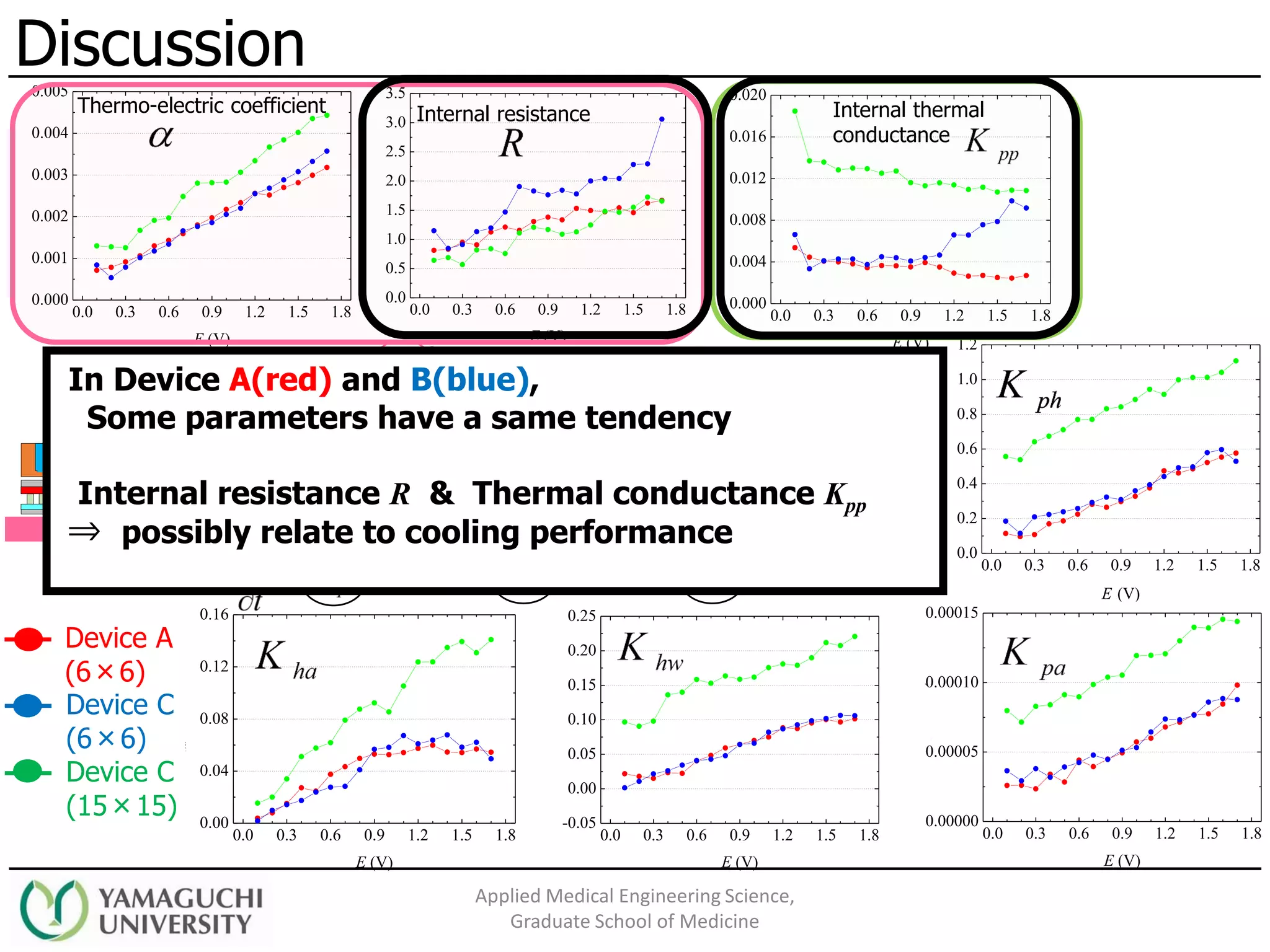
Brain
waves(mV)
Temperature
(oC)
Time (s)
Cooling
15℃
NormalAbnormal
(epilepsy)
Abnormal
(epilepsy)
Seizure stop!Seizures Seizures
Introduction
Applied Medical Engineering Science,
Graduate School of Medicine
What is COOLING TREATMENT ??
• It can help provide relief for some disease or symptoms
• Easy, Quick, Safe
Epilepsy(Brain cooing) Problem with the brain’s electrical System ⇒ Seizures
Focal Cooling
Yamaguchi
university
Cooling is applied to intractable diseases
Cooling draws out the potential which human originally possess
Requirement
Optimum cooling level exists
⇒ temperature control (thermal management)
Two semiconductors
(N-type & P-type)
Introduction
Applied Medical Engineering Science,
Graduate School of Medicine
What is a PELTIER ELEMENT ??
P
N
P
N
P
N
Metal plate
cooled
Heated
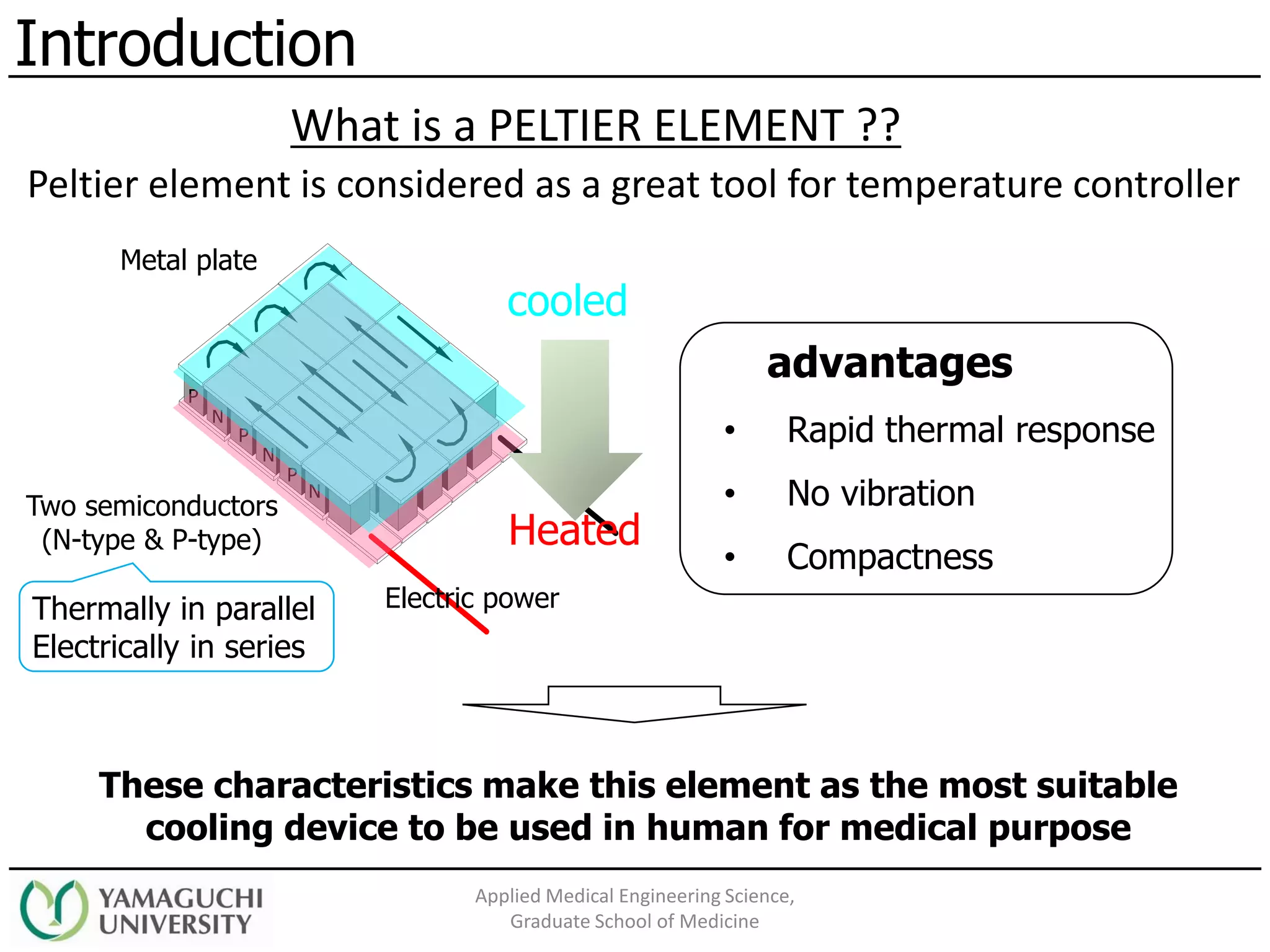
Peltier element is considered as a great tool for temperature controller
Electric powerThermally in parallel
Electrically in series
• Rapid thermal response
• No vibration
• Compactness
advantages
These characteristics make this element as the most suitable
cooling device to be used in human for medical purpose
Introduction
Applied Medical Engineering Science,
Graduate School of Medicine
DC
Heated
Cooled
water
Heat sink
Brain(Cooled object)
Designing of a focal cooling device
(Implant)
1. Peltier effect, Joule heat, Inside heat conduction
2. Thermal conductivity of the Heat sink, Cooled object
3. Environmental condition (Open air, Cooling water)
The solution is a “MATHEMATICAL ANALYSIS”
What should be considered in designing a cooling device??
Joule Heat
Heat
conduction
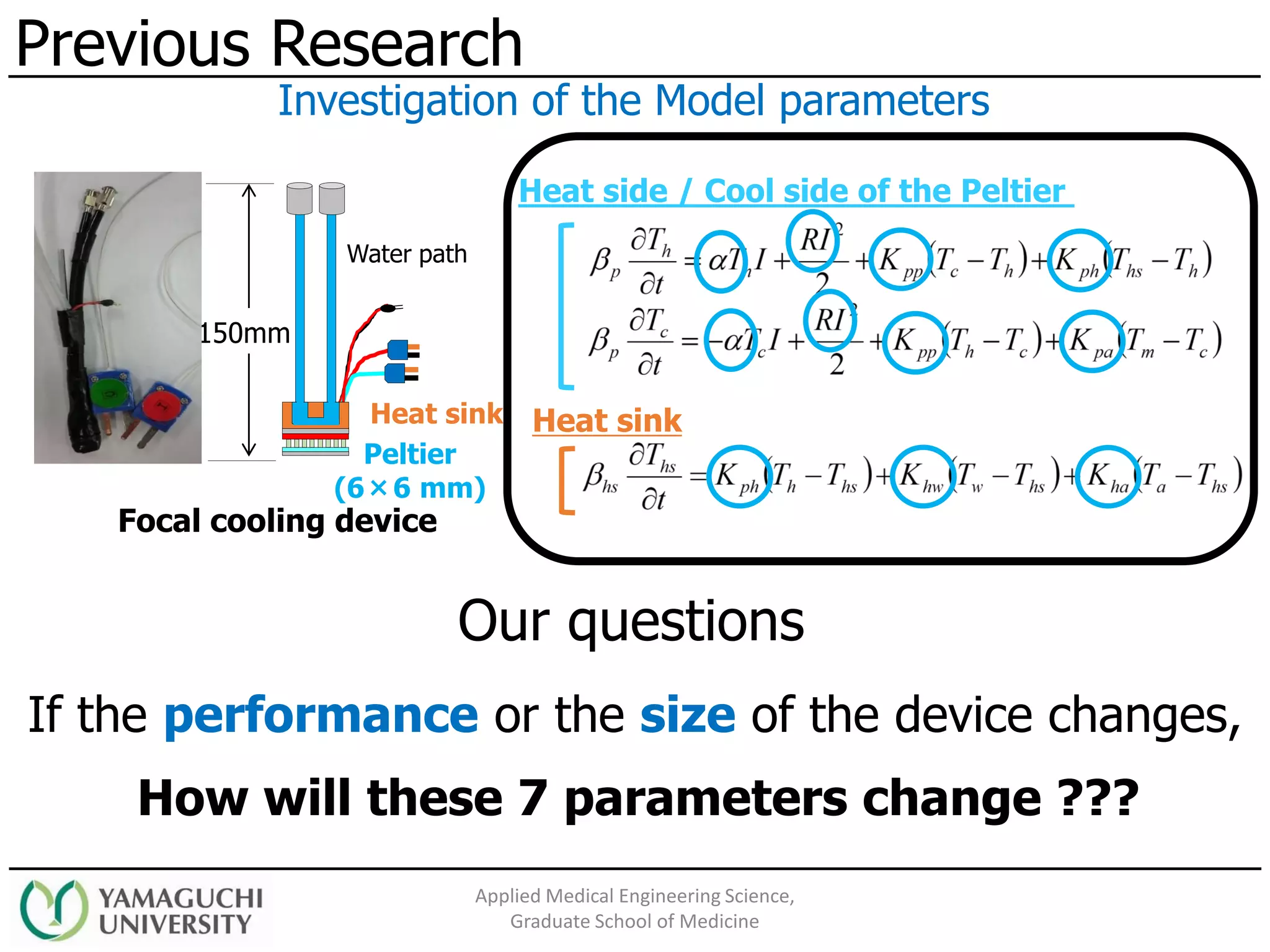
Previous Research
Applied Medical Engineering Science,
Graduate School of Medicine
1. Produced a focal cooling device using a Peltier element
2. Modeling of the device
3. Evaluation of the model (Proportional control)
Our previous research
Heat sink
Peltier
(6×6 mm)
150mm
Water path
Focal cooling device
Heat side / Cool side of the Peltier
Heat sink
Previous Research
Applied Medical Engineering Science,
Graduate School of Medicine
1. Produced a focal cooling device using a Peltier element
2. Modeling of the device
3. Evaluation of the model (Proportional control)
Our previous research
Heat sink
Peltier
(6×6 mm)
150mm
Water path
Focal cooling device
Heat side / Cool side of the Peltier
Heat sink
We identified these seven parameters experimentally
Previous Research
Applied Medical Engineering Science,
Graduate School of Medicine
The usefulness of our proposed model
Kenyu UEHARA, Yasumi UKIDA, Takahiro MURAKAMI, Koji MORI and Takashi
SAITO, “INVESTIGATION ON TEMPERATURE CONTROL MODEL OF
THE FOCAL COOLING HUMAN PHYSIOLOGICAL SYSTEM”,
IMECE2015, Paper No. IMECE2015-52641, pp. V003T03A104 (2015).
time (s)
0 10 20 30 40 50
26
28
30
32
34
Temperature(
O
C)
Simulation
Experiment
Temperature(oC)
It is necessary to investigate the model parameters
in order to design effective focal cooling device
1. Produced a focal cooling device using a Peltier element
2. Modeling of the device
3. Evaluation of the model (Proportional control)
Our previous research
Good agreement
Previous Research
Applied Medical Engineering Science,
Graduate School of Medicine
Investigation of the Model parameters
Heat side / Cool side of the Peltier
Heat sinkHeat sink
Peltier
(6×6 mm)
150mm
Water path
Focal cooling device
Our questions
If the performance or the size of the device changes,
How will these 7 parameters change ???
We identify the model parameters experimentally at constant voltage
using three focal cooling devices of different sizes and cooling performances
② Model parameters identification
③ Discussion
• Experimental set-up
• Identification method
• Result
Purpose
To elucidate the characteristics of the
parameters in the mathematical model
Applied Medical Engineering Science,
Graduate School of Medicine
① Three focal cooling devices and Its model
② Model parameters identification
③ Discussion
• Experimental set-up
• Identification method
• Result
Purpose
Applied Medical Engineering Science,
Graduate School of Medicine
We identify the model parameters experimentally at constant voltage
using three focal cooling devices of different sizes and cooling performances
To elucidate the characteristics of the
parameters in the mathematical model
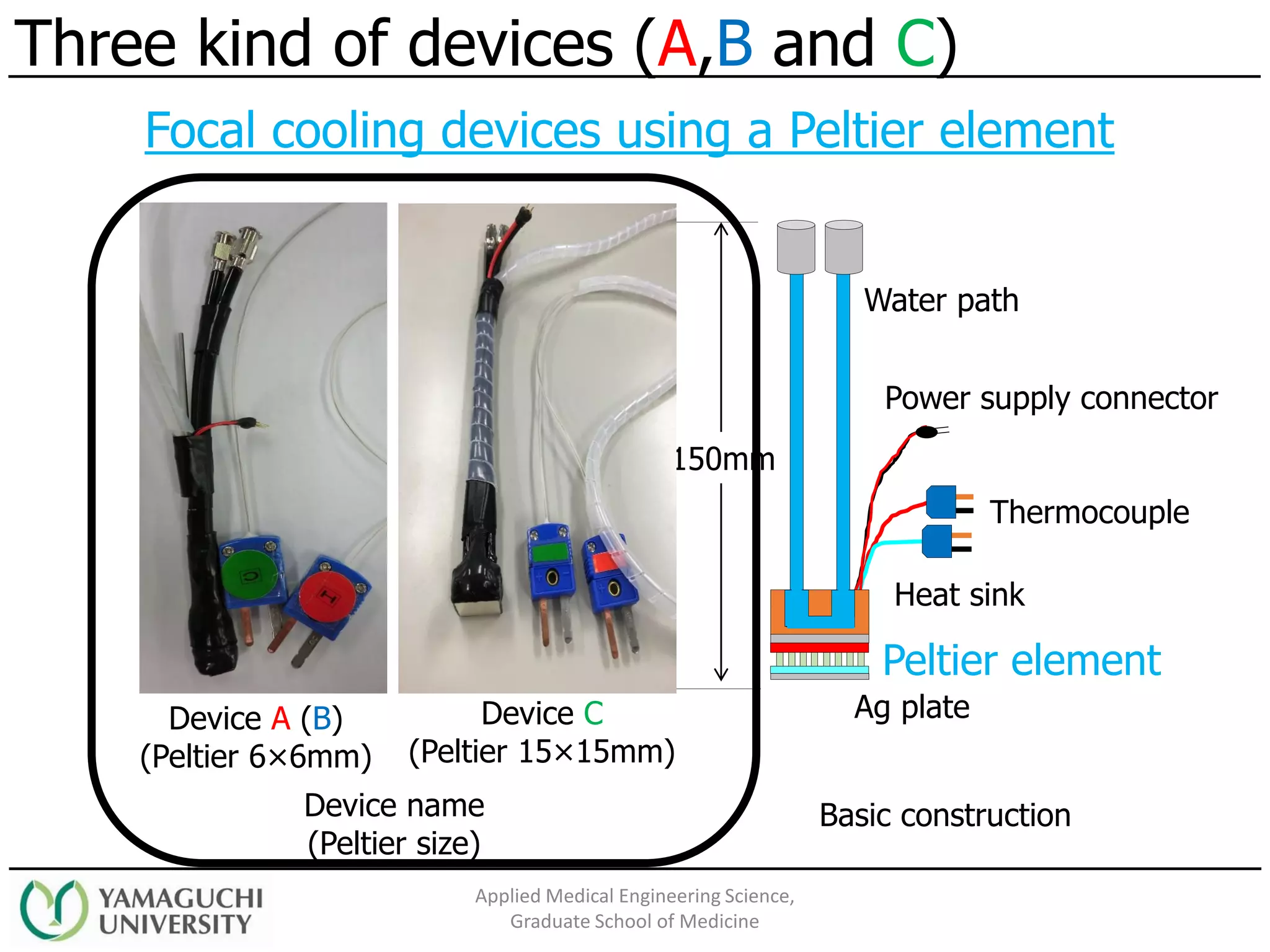
Thermocouple
Heat sink
Peltier element
Ag plate
Water path
Power supply connector
150mm
Device name
(Peltier size)
Basic construction
Focal cooling devices using a Peltier element
Device A (B)
(Peltier 6×6mm)
Device C
(Peltier 15×15mm)
Applied Medical Engineering Science,
Graduate School of Medicine
Three kind of devices (A,B and C)
Heat side :
Cool side :
Modeling
Applied Medical Engineering Science,
Graduate School of Medicine
Cooling object
Peltier
Heat sink
ITh
ITc 2
2
RI
2
2
RI
( )chpp TTK −
( )hhsph TTK −
( )cmpa TTK −
Peltire
effect
Joule
heat
Heat transfer
Hot temperature
Cold temperature
cQ
hQ
Amount of Heat
The Changing of the amount of heat of the Peltier and Heat sink
Heat side :
Cool side :
Modeling
Applied Medical Engineering Science,
Graduate School of Medicine
Cooling object
Peltier
Heat sink
ITh
ITc 2
2
RI
2
2
RI
( )chpp TTK −
( )hhsph TTK −
( )cmpa TTK −
Peltire
effect
Joule
heat
Heat transfer
Hot temperature
Cold temperature
Amount of heat
Heat energy rate bp × Time changing of the temperature
Density, volume, specific heat
cQ
hQ
Amount of Heat
The Changing of the amount of heat of the Peltier and Heat sink
Heat side :
Cool side :
Modeling
Applied Medical Engineering Science,
Graduate School of Medicine
Cooling object
Peltier
Heat sink
ITh
ITc 2
2
RI
2
2
RI
( )chpp TTK −
( )hhsph TTK −
( )cmpa TTK −
Peltire
effect
Joule
heat
Heat transfer
Hot temperature
Cold temperature
cQ
hQ
Amount of Heat
Caused by an electrical action I
 : thermo-electric conversion coefficient
(Temperature difference Input electrical power)
: Internal resistanceR
The Changing of the amount of heat of the Peltier and Heat sink
Equally loaded
Main effect
Heat side :
Cool side :
Modeling
Applied Medical Engineering Science,
Graduate School of Medicine
Cooling object
Peltier
Heat sink
ITh
ITc 2
2
RI
2
2
RI
( )chpp TTK −
( )hhsph TTK −
( )cmpa TTK −
Peltire
effect
Joule
heat
Internal
Heat transfer
Hot temperature
Cold temperature
cQ
hQ
Amount of Heat
Due to the temperature difference (Th-Tc)
Thermal conductance (W/K)
(coefficient of heat transfer)
The Changing of the amount of heat of the Peltier and Heat sink
Natural reaction
Heat side :
Cool side :
Modeling
Applied Medical Engineering Science,
Graduate School of Medicine
Cooling object
Peltier
Heat sink
ITh
ITc 2
2
RI
2
2
RI
( )chpp TTK −
( )hhsph TTK −
( )cmpa TTK −
Peltire
effect
Joule
heat
External
Heat transfer
Hot temperature
Cold temperature
cQ
hQ
Amount of Heat
¥
Heat
Cool
: Thermal conductance (Peltier – Heat sink)
: Thermal conductance (Peltier – Cooled object)
The Changing of the amount of heat of the Peltier and Heat sink
Peltier – Heat sink
Peltier – Cooled object
Modeling
Applied Medical Engineering Science,
Graduate School of Medicine
Heat sink :
( )hshph TTK −
( )hswhw TTK − ( )hsaha TTK −
Heat sink
Water
External heat transfer
: Peltier Th - Heat sink Ths
Thermal conductance
Only heat transfer since there is no effect by currentCooling object
Peltier
Heat sink The Changing of the amount of heat of the Peltier and Heat sink
: Heat sink Ths - Water Tw
: Heat sink Ths - Air Ta
Peltier – Heat sink
Heat sink - Water
Heat sink - Air
Heat sink
Peltier
150mm
Heat side / Cool side of the Peltier
Heat sink
Input current
Mathematical model of the Focal cooling device
Cooling device
Modeling
Applied Medical Engineering Science,
Graduate School of Medicine
Counter electromotive force
by temperature difference
Heat sink
Peltier
150mm
Heat side / Cool side of the Peltier
Heat sink
Input current
Mathematical model of the Focal cooling device
Cooling device
Modeling
Applied Medical Engineering Science,
Graduate School of Medicine
Device
number
A (B) C C/A (-)
βp (J/K) 0.04437 0.2810 6.30
βhs (J/K) 0.3582 1.882 5.25
Heat energy rate
Density, volume, Specific heat
Counter electromotive force
by temperature difference
Heat sink
Peltier
150mm
Heat side / Cool side of the Peltier
Heat sink
Input current
Mathematical model of the Focal cooling device
Cooling device
Modeling
Applied Medical Engineering Science,
Graduate School of Medicine
7 parameters
These are identified experimentally by solving inverse problem
Counter electromotive force
by temperature difference
② Model parameters identification
③ Discussion
• Experimental set-up
• Identification method
• Result
Purpose
Applied Medical Engineering Science,
Graduate School of Medicine
① Three focal cooling devices and Its model
We identify the model parameters experimentally at constant voltage
using three focal cooling devices of different sizes and cooling performances
To elucidate the characteristics of the
parameters in the mathematical model
23
Identification of the Parameters
Applied Medical Engineering Science, Graduate School of Medicine
Cooling experiment
Voltage 0.1 ~ 1.7V (every0.1V) 180 sec
Input
Heat side
Cool side
Vegetable gelatin(37℃)
water
(34℃)
air
(26℃)
Device A (6×6 mm)
Device B (6×6 mm)
Device C (15×15 mm )
Temperature controlling bath
-90 -60 -30 0 30 60 90 120 150 180
0
10
20
30
40
50
Temperature(
O
C)
Time (s)
0.0 0.3 0.6 0.9 1.2 1.5 1.8
0
10
20
30
40
50
Temperature(
o
C)
Input voltage E (V)
26
Identification of the Parameters
Applied Medical Engineering Science, Graduate School of Medicine
Cooling experiment (Voltage 0.1 ~ 1.7V (every0.1V) 180 sec)
Device A (6×6 mm)
VS
Device B (6×6 mm)
example > 0.9V constant
Device A
Device B
At 180 sec
temperature
Hot side
Cool side
Hot side
Cool side
0.9180
The difference of performance between A and B
A has a better cooling performance
-90 -60 -30 0 30 60 90 120 150 180
0
10
20
30
40
50
Temperature(
O
C)
Time (s)
0.0 0.3 0.6 0.9 1.2 1.5 1.8
0
10
20
30
40
50
Temperature(
o
C)
Input voltage E (V)
27
Identification of the Parameters
Applied Medical Engineering Science, Graduate School of Medicine
Cooling experiment (Voltage 0.1 ~ 1.7V (every0.1V) 180 sec)
Device A (6×6 mm)
VS
Device C (15×15 mm)
example > 0.9V constant
Device A
Device C At 180 sec
temperature
Hot side
Cool side
Hot side
Cool side
0.9180
6.25 times bigger than A
Device C shows the best cooling performance in high voltages
Heat transferring from hot side to heat sink is working well
Not increase
so much
-90 -60 -30 0 30 60 90 120 150 180
0
10
20
30
40
50
Temperature(
O
C)
Time (s)
0.0 0.3 0.6 0.9 1.2 1.5 1.8
0
10
20
30
40
50
Temperature(o
C)
Input voltage E (V)
28
Identification of the Parameters
Applied Medical Engineering Science, Graduate School of Medicine
Cooling experiment (Voltage 0.1 ~ 1.7V (every0.1V) 180 sec)
example > 0.9V constant
Device A
Device B
At 180 sec
temperature
Hot side
Cool side
Hot side
Cool side
0.9180
Device A (6×6 mm)
Device B (6×6 mm)
Device C (15×15 mm )
Device C
We identified seven unknowns using these experimental results
(17 voltages data × 3 devices)
0 30 60 90 120 150 180
10
15
20
25
30
35
40
Temperature(
O
C)
Time (s)
Experimental heat
Experimental cool
Parameter Identification
Simulation
How to identify the parameters
parameters x were identified by solving the minimum problem
We used the Downhill Simplex method
Applied Medical Engineering Science,
Graduate School of Medicine
Simulation
Mathematical model
An example
We would like to get parameters to simulate
the experimental value as much as possible
Parameter Identification(Device A)
Applied Medical Engineering Science,
Graduate School of Medicine
0.0 0.3 0.6 0.9 1.2 1.5 1.8
0.000
0.001
0.002
0.003
0.004
0.005
(V/K)
E (V)
0.0 0.3 0.6 0.9 1.2 1.5 1.8
0.0
0.5
1.0
1.5
2.0
2.5
3.0
3.5
R(V/A)
E (V)
0.0 0.3 0.6 0.9 1.2 1.5 1.8
0.000
0.004
0.008
0.012
0.016
0.020
Kpp(W/K)
E (V)
0.0 0.3 0.6 0.9 1.2 1.5 1.8
0.0
0.2
0.4
0.6
0.8
1.0
1.2
Kph(W/K)
E (V)
0.0 0.3 0.6 0.9 1.2 1.5 1.8
0.00000
0.00005
0.00010
0.00015
Kpa(W/K)
E (V)
0.0 0.3 0.6 0.9 1.2 1.5 1.8
-0.05
0.00
0.05
0.10
0.15
0.20
0.25
Khw(W/K)
E (V)
0.0 0.3 0.6 0.9 1.2 1.5 1.8
0.00
0.04
0.08
0.12
0.16
Kha(W/K)
E (V)
Device A
(6×6)
Device C
(6×6)
Device C
(15×15)
Thermo-electric coefficient Internal resistance Internal thermal
conductance
Almost all identified parameters have
a certain tendency on the input voltages
( monotone increase, decrease)
Parameter Identification(Device A & B)
Applied Medical Engineering Science,
Graduate School of Medicine
0.0 0.3 0.6 0.9 1.2 1.5 1.8
0.000
0.001
0.002
0.003
0.004
0.005
(V/K)
E (V)
0.0 0.3 0.6 0.9 1.2 1.5 1.8
0.0
0.5
1.0
1.5
2.0
2.5
3.0
3.5
R(V/A)
E (V)
0.0 0.3 0.6 0.9 1.2 1.5 1.8
0.000
0.004
0.008
0.012
0.016
0.020
Kpp
(W/K)
E (V)
0.0 0.3 0.6 0.9 1.2 1.5 1.8
0.0
0.2
0.4
0.6
0.8
1.0
1.2
Kph
(W/K)
E (V)
0.0 0.3 0.6 0.9 1.2 1.5 1.8
0.00000
0.00005
0.00010
0.00015
Kpa(W/K)
E (V)
0.0 0.3 0.6 0.9 1.2 1.5 1.8
-0.05
0.00
0.05
0.10
0.15
0.20
0.25
Khw(W/K)
E (V)
0.0 0.3 0.6 0.9 1.2 1.5 1.8
0.00
0.04
0.08
0.12
0.16
Kha(W/K)
E (V)
Thermo-electric coefficient Internal resistance Internal thermal
conductance
In Device A(red) and B(blue),
Some parameters have a same tendency
Internal resistance R & Thermal conductance Kpp
⇒ possibly relate to cooling performance
Device A
(6×6)
Device C
(6×6)
Device C
(15×15)
Parameter Identification(Device A, B & C)
Applied Medical Engineering Science,
Graduate School of Medicine
0.0 0.3 0.6 0.9 1.2 1.5 1.8
0.000
0.001
0.002
0.003
0.004
0.005
(V/K)
E (V)
0.0 0.3 0.6 0.9 1.2 1.5 1.8
0.0
0.5
1.0
1.5
2.0
2.5
3.0
3.5
R(V/A)
E (V)
0.0 0.3 0.6 0.9 1.2 1.5 1.8
0.000
0.004
0.008
0.012
0.016
0.020
Kpp
(W/K)
E (V)
0.0 0.3 0.6 0.9 1.2 1.5 1.8
0.0
0.2
0.4
0.6
0.8
1.0
1.2
Kph
(W/K)
E (V)
0.0 0.3 0.6 0.9 1.2 1.5 1.8
0.00000
0.00005
0.00010
0.00015
Kpa
(W/K)
E (V)
0.0 0.3 0.6 0.9 1.2 1.5 1.8
-0.05
0.00
0.05
0.10
0.15
0.20
0.25
Khw
(W/K)
E (V)
0.0 0.3 0.6 0.9 1.2 1.5 1.8
0.00
0.04
0.08
0.12
0.16
Kha
(W/K)
E (V)
Thermo-electric coefficient Internal resistance Internal thermal
conductance
In device C, most of the parameter values are
larger than others (except : internal resistance R)
Device A
(6×6)
Device C
(6×6)
Device C
(15×15)
② Model parameters identification
③ Discussion
• Experimental set-up
• Identification method
• Result
Purpose
Applied Medical Engineering Science,
Graduate School of Medicine
① Three focal cooling devices and Its model
We identify the model parameters experimentally at constant voltage
using three focal cooling devices of different sizes and cooling performances
To elucidate the characteristics of the
parameters in the mathematical model
0.0 0.3 0.6 0.9 1.2 1.5 1.8
0.0
0.5
1.0
1.5
2.0
2.5
3.0
3.5
R(V/A)
E (V)
0.0 0.3 0.6 0.9 1.2 1.5 1.8
0.000
0.004
0.008
0.012
0.016
0.020
Kpp
(W/K)
E (V)
0.0 0.3 0.6 0.9 1.2 1.5 1.8
0.000
0.001
0.002
0.003
0.004
0.005
(V/K)
E (V)
Applied Medical Engineering Science,
Graduate School of Medicine
0.0 0.3 0.6 0.9 1.2 1.5 1.8
0.0
0.2
0.4
0.6
0.8
1.0
1.2
Kph
(W/K)
E (V)
0.0 0.3 0.6 0.9 1.2 1.5 1.8
0.00000
0.00005
0.00010
0.00015
Kpa
(W/K)
E (V)
0.0 0.3 0.6 0.9 1.2 1.5 1.8
-0.05
0.00
0.05
0.10
0.15
0.20
0.25
Khw
(W/K)
E (V)
0.0 0.3 0.6 0.9 1.2 1.5 1.8
0.00
0.04
0.08
0.12
0.16
Kha
(W/K)
E (V)
を検討
In Device A(red) and B(blue),
Some parameters have a same tendency
Internal resistance R & Thermal conductance Kpp
⇒ possibly relate to cooling performance
Discussion
Thermo-electric coefficient Internal resistance Internal thermal
conductance
Device A
(6×6)
Device C
(6×6)
Device C
(15×15)
Applied Medical Engineering Science,
Graduate School of Medicine
0.0 0.3 0.6 0.9 1.2 1.5 1.8
0.0
0.5
1.0
1.5
2.0
2.5
3.0
3.5
R(V/A)
E (V)
0.0 0.3 0.6 0.9 1.2 1.5 1.8
0.000
0.004
0.008
0.012
0.016
0.020
Kpp
(W/K)
E (V)
Discussion
0.0 0.3 0.6 0.9 1.2 1.5 1.8
0
10
20
30
40
50
Device A
Device B
Device C
Temperature(
o
C)
Input voltage E (V)
Heat cool
Hot side
Cool side
Equilibrium temperature of
both side of Peltier vs. input voltage
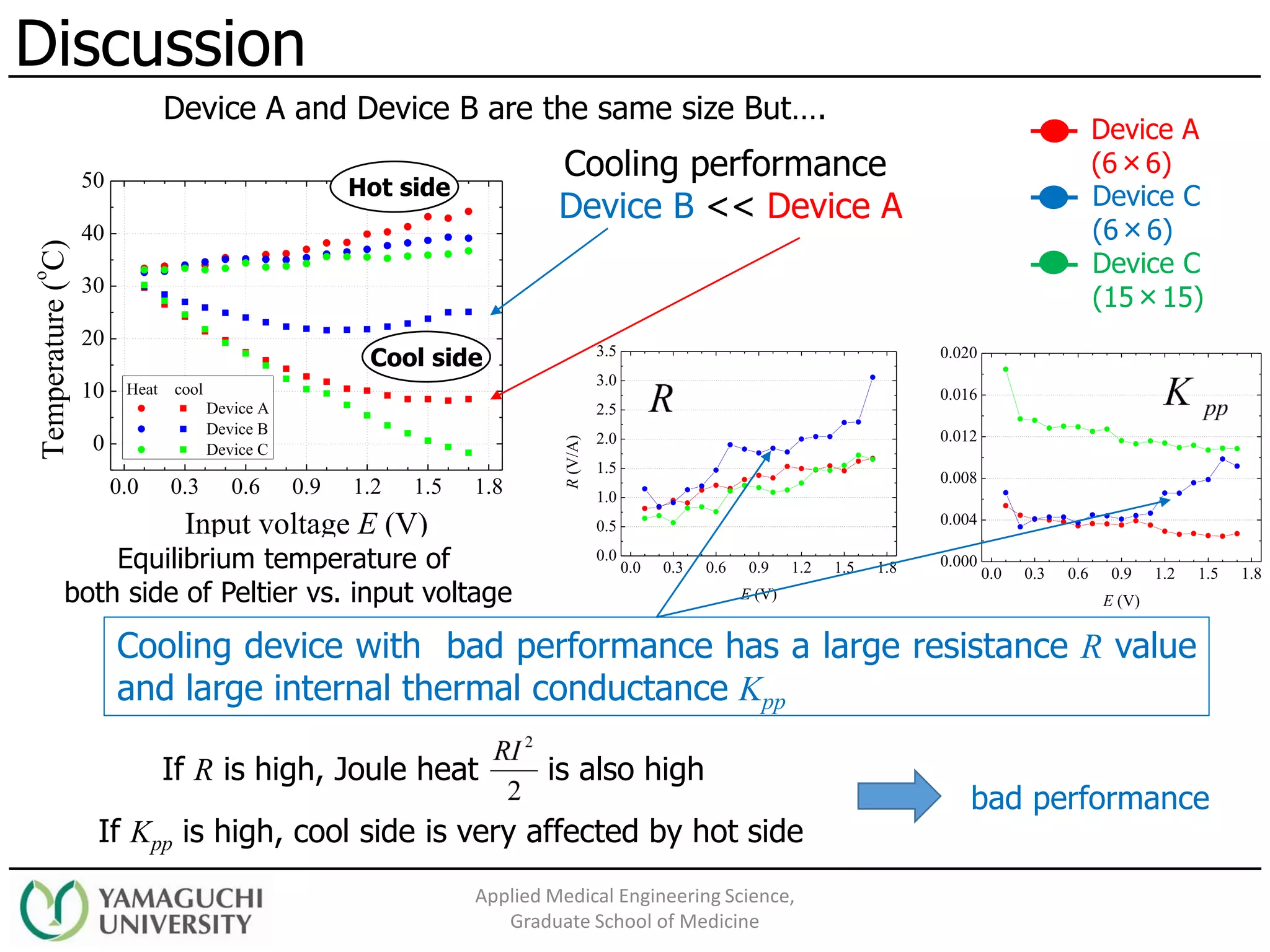
Cooling performance
Device B << Device A
Device A and Device B are the same size But….
Cooling device with bad performance has a large resistance R value
and large internal thermal conductance Kpp
If R is high, Joule heat is also high
If Kpp is high, cool side is very affected by hot side
bad performance
Device A
(6×6)
Device C
(6×6)
Device C
(15×15)
Applied Medical Engineering Science,
Graduate School of Medicine
0.0 0.3 0.6 0.9 1.2 1.5 1.8
0.0
0.2
0.4
0.6
0.8
1.0
1.2
Kph
(W/K)
E (V)
0.0 0.3 0.6 0.9 1.2 1.5 1.8
0.00000
0.00005
0.00010
0.00015
Kpa
(W/K)
E (V)
0.0 0.3 0.6 0.9 1.2 1.5 1.8
-0.05
0.00
0.05
0.10
0.15
0.20
0.25
Khw
(W/K)
E (V)
0.0 0.3 0.6 0.9 1.2 1.5 1.8
0.00
0.04
0.08
0.12
0.16
Kha
(W/K)
E (V)
を検討
Device A(6×6 mm)
Device C (15×15 mm)
Investigation of the Device size
Discussion
0.0 0.3 0.6 0.9 1.2 1.5 1.8
0.000
0.001
0.002
0.003
0.004
0.005
(V/K)
E (V)
0.0 0.3 0.6 0.9 1.2 1.5 1.8
0.0
0.5
1.0
1.5
2.0
2.5
3.0
3.5
R(V/A)
E (V)
0.0 0.3 0.6 0.9 1.2 1.5 1.8
0.000
0.004
0.008
0.012
0.016
0.020
Kpp
(W/K)
E (V)
Thermo-electric coefficient Internal resistance Internal thermal
conductance
Device A
(6×6)
Device C
(6×6)
Device C
(15×15)
Applied Medical Engineering Science,
Graduate School of Medicine
Parameters
Discussion
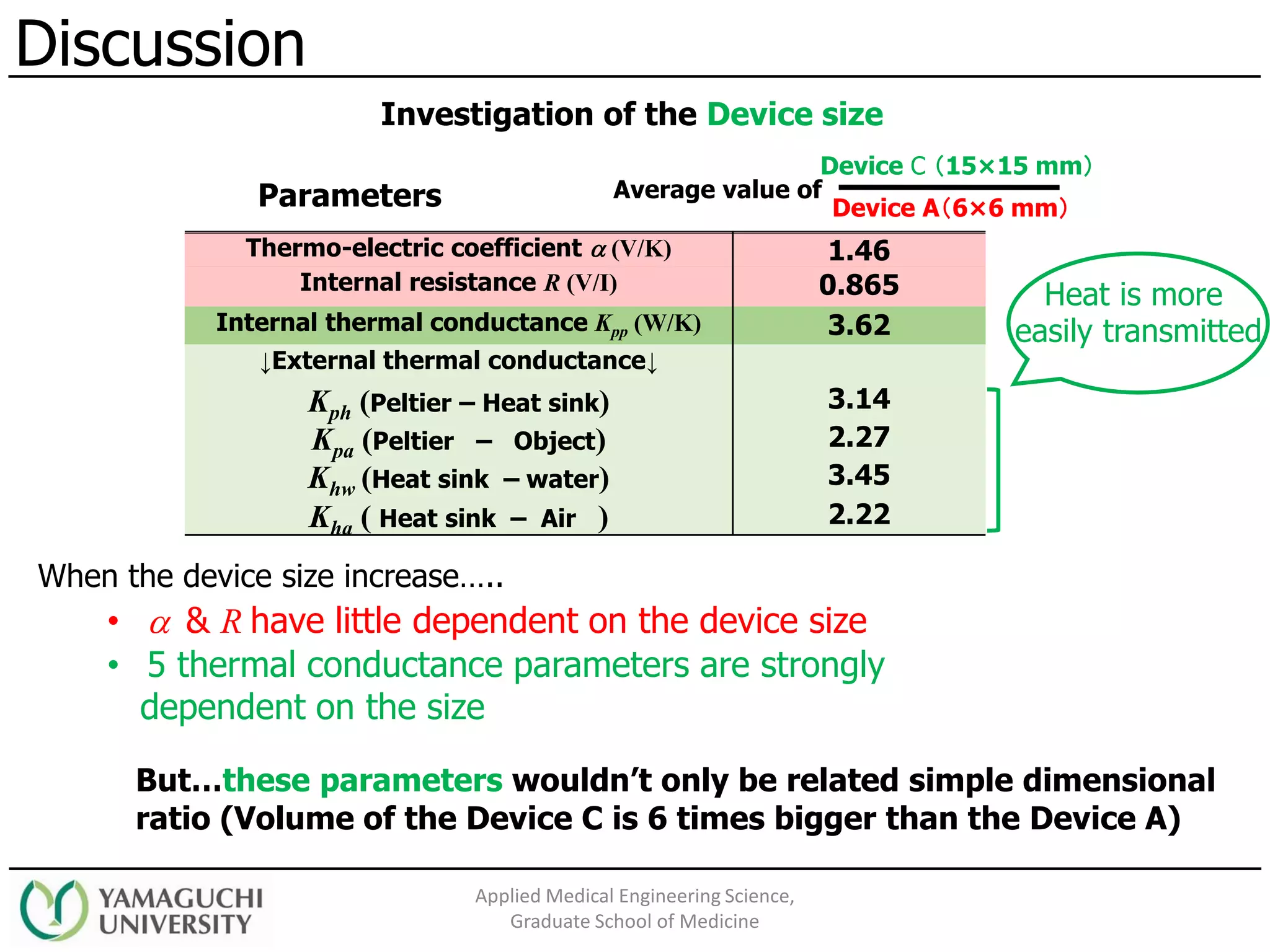
Thermo-electric coefficient  (V/K) 1.46
Internal resistance R (V/I) 0.865
Internal thermal conductance Kpp (W/K) 3.62
↓External thermal conductance↓
Kph (Peltier – Heat sink) 3.14
Kpa (Peltier – Object) 2.27
Khw (Heat sink – water) 3.45
Kha ( Heat sink – Air ) 2.22
Device A(6×6 mm)
Device C (15×15 mm)
Average value of
•  & R have little dependent on the device size
• 5 thermal conductance parameters are strongly
dependent on the size
When the device size increase…..
Investigation of the Device size
Heat is more
easily transmitted
But…these parameters wouldn’t only be related simple dimensional
ratio (Volume of the Device C is 6 times bigger than the Device A)
Applied Medical Engineering Science,
Graduate School of Medicine
Parameters
Discussion
Thermo-electric coefficient  (V/K) 1.46
Internal resistance R (V/I) 0.865
Internal thermal conductance Kpp (W/K) 3.62
↓External thermal conductance↓
Kph (Peltier – Heat sink) 3.14
Kpa (Peltier – Object) 2.27
Khw (Heat sink – water) 3.45
Kha ( Heat sink – Air ) 2.22
Device A(6×6 mm)
Device B (15×15 mm)
Average value of
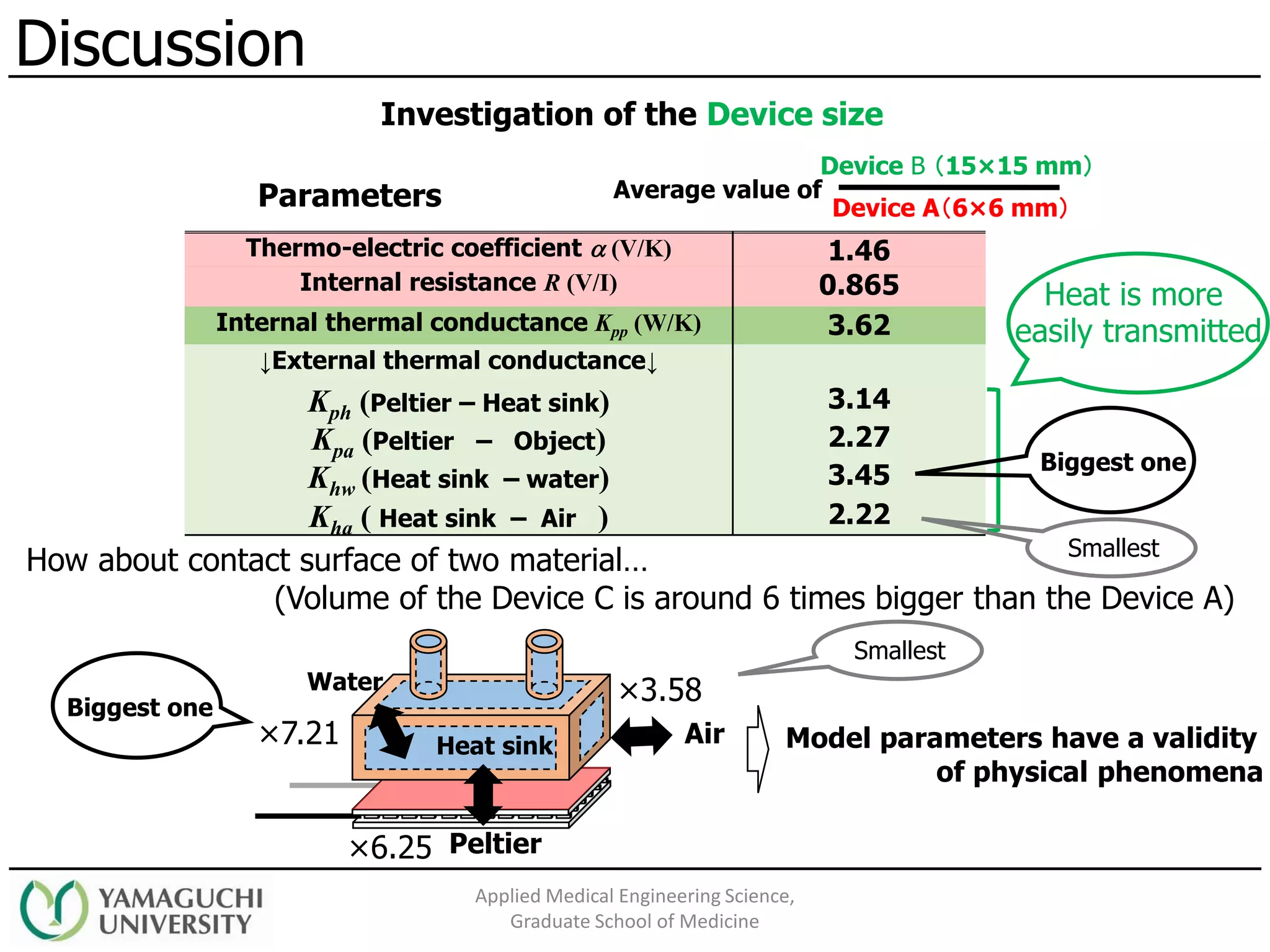
How about contact surface of two material…
(Volume of the Device C is around 6 times bigger than the Device A)
Investigation of the Device size
Heat is more
easily transmitted
×3.58
Air
×6.25 Peltier
Heat sink
Water
×7.21
Biggest one
Biggest one
Model parameters have a validity
of physical phenomena
Smallest
Smallest
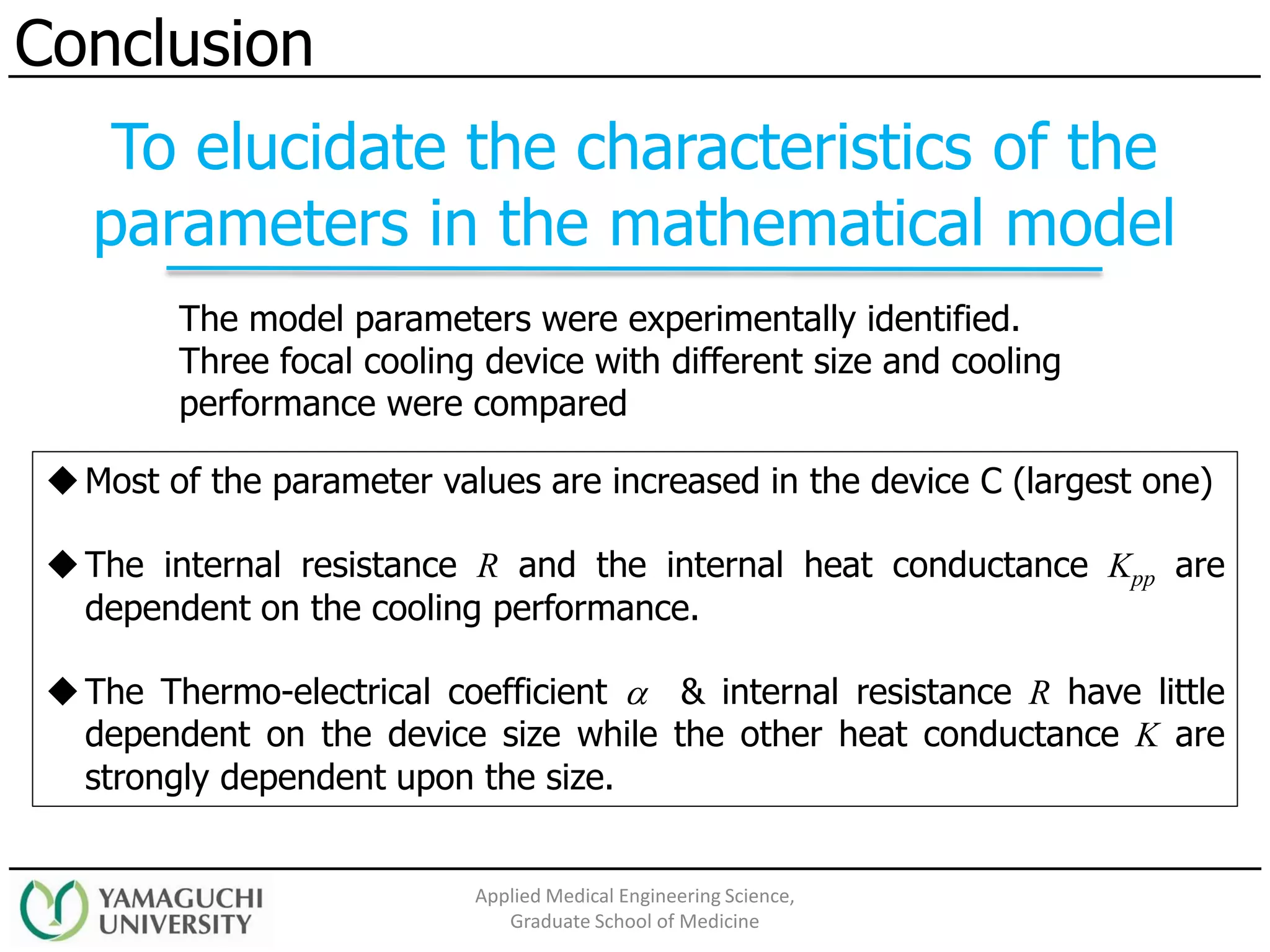
The model parameters were experimentally identified.
Three focal cooling device with different size and cooling
performance were compared
Conclusion
Applied Medical Engineering Science,
Graduate School of Medicine
◆Most of the parameter values are increased in the device C (largest one)
◆The internal resistance R and the internal heat conductance Kpp are
dependent on the cooling performance.
◆The Thermo-electrical coefficient  & internal resistance R have little
dependent on the device size while the other heat conductance K are
strongly dependent upon the size.
To elucidate the characteristics of the
parameters in the mathematical model

Study on model parameters of focal cooling device using a Peltier element for a living body

  • 1.
    Applied Medical EngineeringScience, Graduate School of Medicine Internal Mechanical Engineering Congress & Exposition 2016 2016.11.17 Study on Model Parameters of Focal Cooling Device Using a Peltier Element for a Living Body ○Kenyu UEHARA∗1 Kentaro MIYAGO∗2 Koji MORI∗2 Takashi SAITO∗2 ∗1Graduate school of Medicine, Yamaguchi University, in JAPAN ∗2Graduate school of Science and Technology for Innovation, Yamaguchi University , in JAPAN
  • 2.
    Brain waves(mV) Temperature (oC) Time (s) Cooling 15℃ NormalAbnormal (epilepsy) Abnormal (epilepsy) Seizure stop!SeizuresSeizures Introduction Applied Medical Engineering Science, Graduate School of Medicine What is COOLING TREATMENT ?? • It can help provide relief for some disease or symptoms • Easy, Quick, Safe Epilepsy(Brain cooing) Problem with the brain’s electrical System ⇒ Seizures Focal Cooling Yamaguchi university Cooling is applied to intractable diseases Cooling draws out the potential which human originally possess
  • 3.
    Brain waves(mV) Temperature (oC) Time (s) Cooling 15℃ NormalAbnormal (epilepsy) Abnormal (epilepsy) Seizure stop!SeizuresSeizures Introduction Applied Medical Engineering Science, Graduate School of Medicine What is COOLING TREATMENT ?? • It can help provide relief for some disease or symptoms • Easy, Quick, Safe Epilepsy(Brain cooing) Problem with the brain’s electrical System ⇒ Seizures Focal Cooling Yamaguchi university Cooling is applied to intractable diseases Cooling draws out the potential which human originally possess Requirement Optimum cooling level exists ⇒ temperature control (thermal management)
  • 4.
    Two semiconductors (N-type &P-type) Introduction Applied Medical Engineering Science, Graduate School of Medicine What is a PELTIER ELEMENT ?? P N P N P N Metal plate cooled Heated Peltier element is considered as a great tool for temperature controller Electric powerThermally in parallel Electrically in series • Rapid thermal response • No vibration • Compactness advantages These characteristics make this element as the most suitable cooling device to be used in human for medical purpose
  • 5.
    Introduction Applied Medical EngineeringScience, Graduate School of Medicine DC Heated Cooled water Heat sink Brain(Cooled object) Designing of a focal cooling device (Implant) 1. Peltier effect, Joule heat, Inside heat conduction 2. Thermal conductivity of the Heat sink, Cooled object 3. Environmental condition (Open air, Cooling water) The solution is a “MATHEMATICAL ANALYSIS” What should be considered in designing a cooling device?? Joule Heat Heat conduction
  • 6.
    Previous Research Applied MedicalEngineering Science, Graduate School of Medicine 1. Produced a focal cooling device using a Peltier element 2. Modeling of the device 3. Evaluation of the model (Proportional control) Our previous research Heat sink Peltier (6×6 mm) 150mm Water path Focal cooling device Heat side / Cool side of the Peltier Heat sink
  • 7.
    Previous Research Applied MedicalEngineering Science, Graduate School of Medicine 1. Produced a focal cooling device using a Peltier element 2. Modeling of the device 3. Evaluation of the model (Proportional control) Our previous research Heat sink Peltier (6×6 mm) 150mm Water path Focal cooling device Heat side / Cool side of the Peltier Heat sink We identified these seven parameters experimentally
  • 8.
    Previous Research Applied MedicalEngineering Science, Graduate School of Medicine The usefulness of our proposed model Kenyu UEHARA, Yasumi UKIDA, Takahiro MURAKAMI, Koji MORI and Takashi SAITO, “INVESTIGATION ON TEMPERATURE CONTROL MODEL OF THE FOCAL COOLING HUMAN PHYSIOLOGICAL SYSTEM”, IMECE2015, Paper No. IMECE2015-52641, pp. V003T03A104 (2015). time (s) 0 10 20 30 40 50 26 28 30 32 34 Temperature( O C) Simulation Experiment Temperature(oC) It is necessary to investigate the model parameters in order to design effective focal cooling device 1. Produced a focal cooling device using a Peltier element 2. Modeling of the device 3. Evaluation of the model (Proportional control) Our previous research Good agreement
  • 9.
    Previous Research Applied MedicalEngineering Science, Graduate School of Medicine Investigation of the Model parameters Heat side / Cool side of the Peltier Heat sinkHeat sink Peltier (6×6 mm) 150mm Water path Focal cooling device Our questions If the performance or the size of the device changes, How will these 7 parameters change ???
  • 10.
    We identify themodel parameters experimentally at constant voltage using three focal cooling devices of different sizes and cooling performances ② Model parameters identification ③ Discussion • Experimental set-up • Identification method • Result Purpose To elucidate the characteristics of the parameters in the mathematical model Applied Medical Engineering Science, Graduate School of Medicine ① Three focal cooling devices and Its model
  • 11.
    ① Three focalcooling devices and Its model ② Model parameters identification ③ Discussion • Experimental set-up • Identification method • Result Purpose Applied Medical Engineering Science, Graduate School of Medicine We identify the model parameters experimentally at constant voltage using three focal cooling devices of different sizes and cooling performances To elucidate the characteristics of the parameters in the mathematical model
  • 12.
    Thermocouple Heat sink Peltier element Agplate Water path Power supply connector 150mm Device name (Peltier size) Basic construction Focal cooling devices using a Peltier element Device A (B) (Peltier 6×6mm) Device C (Peltier 15×15mm) Applied Medical Engineering Science, Graduate School of Medicine Three kind of devices (A,B and C)
  • 13.
    Heat side : Coolside : Modeling Applied Medical Engineering Science, Graduate School of Medicine Cooling object Peltier Heat sink ITh ITc 2 2 RI 2 2 RI ( )chpp TTK − ( )hhsph TTK − ( )cmpa TTK − Peltire effect Joule heat Heat transfer Hot temperature Cold temperature cQ hQ Amount of Heat The Changing of the amount of heat of the Peltier and Heat sink
  • 14.
    Heat side : Coolside : Modeling Applied Medical Engineering Science, Graduate School of Medicine Cooling object Peltier Heat sink ITh ITc 2 2 RI 2 2 RI ( )chpp TTK − ( )hhsph TTK − ( )cmpa TTK − Peltire effect Joule heat Heat transfer Hot temperature Cold temperature Amount of heat Heat energy rate bp × Time changing of the temperature Density, volume, specific heat cQ hQ Amount of Heat The Changing of the amount of heat of the Peltier and Heat sink
  • 15.
    Heat side : Coolside : Modeling Applied Medical Engineering Science, Graduate School of Medicine Cooling object Peltier Heat sink ITh ITc 2 2 RI 2 2 RI ( )chpp TTK − ( )hhsph TTK − ( )cmpa TTK − Peltire effect Joule heat Heat transfer Hot temperature Cold temperature cQ hQ Amount of Heat Caused by an electrical action I  : thermo-electric conversion coefficient (Temperature difference Input electrical power) : Internal resistanceR The Changing of the amount of heat of the Peltier and Heat sink Equally loaded Main effect
  • 16.
    Heat side : Coolside : Modeling Applied Medical Engineering Science, Graduate School of Medicine Cooling object Peltier Heat sink ITh ITc 2 2 RI 2 2 RI ( )chpp TTK − ( )hhsph TTK − ( )cmpa TTK − Peltire effect Joule heat Internal Heat transfer Hot temperature Cold temperature cQ hQ Amount of Heat Due to the temperature difference (Th-Tc) Thermal conductance (W/K) (coefficient of heat transfer) The Changing of the amount of heat of the Peltier and Heat sink Natural reaction
  • 17.
    Heat side : Coolside : Modeling Applied Medical Engineering Science, Graduate School of Medicine Cooling object Peltier Heat sink ITh ITc 2 2 RI 2 2 RI ( )chpp TTK − ( )hhsph TTK − ( )cmpa TTK − Peltire effect Joule heat External Heat transfer Hot temperature Cold temperature cQ hQ Amount of Heat ¥ Heat Cool : Thermal conductance (Peltier – Heat sink) : Thermal conductance (Peltier – Cooled object) The Changing of the amount of heat of the Peltier and Heat sink Peltier – Heat sink Peltier – Cooled object
  • 18.
    Modeling Applied Medical EngineeringScience, Graduate School of Medicine Heat sink : ( )hshph TTK − ( )hswhw TTK − ( )hsaha TTK − Heat sink Water External heat transfer : Peltier Th - Heat sink Ths Thermal conductance Only heat transfer since there is no effect by currentCooling object Peltier Heat sink The Changing of the amount of heat of the Peltier and Heat sink : Heat sink Ths - Water Tw : Heat sink Ths - Air Ta Peltier – Heat sink Heat sink - Water Heat sink - Air
  • 19.
    Heat sink Peltier 150mm Heat side/ Cool side of the Peltier Heat sink Input current Mathematical model of the Focal cooling device Cooling device Modeling Applied Medical Engineering Science, Graduate School of Medicine Counter electromotive force by temperature difference
  • 20.
    Heat sink Peltier 150mm Heat side/ Cool side of the Peltier Heat sink Input current Mathematical model of the Focal cooling device Cooling device Modeling Applied Medical Engineering Science, Graduate School of Medicine Device number A (B) C C/A (-) βp (J/K) 0.04437 0.2810 6.30 βhs (J/K) 0.3582 1.882 5.25 Heat energy rate Density, volume, Specific heat Counter electromotive force by temperature difference
  • 21.
    Heat sink Peltier 150mm Heat side/ Cool side of the Peltier Heat sink Input current Mathematical model of the Focal cooling device Cooling device Modeling Applied Medical Engineering Science, Graduate School of Medicine 7 parameters These are identified experimentally by solving inverse problem Counter electromotive force by temperature difference
  • 22.
    ② Model parametersidentification ③ Discussion • Experimental set-up • Identification method • Result Purpose Applied Medical Engineering Science, Graduate School of Medicine ① Three focal cooling devices and Its model We identify the model parameters experimentally at constant voltage using three focal cooling devices of different sizes and cooling performances To elucidate the characteristics of the parameters in the mathematical model
  • 23.
    23 Identification of theParameters Applied Medical Engineering Science, Graduate School of Medicine Cooling experiment Voltage 0.1 ~ 1.7V (every0.1V) 180 sec Input Heat side Cool side Vegetable gelatin(37℃) water (34℃) air (26℃) Device A (6×6 mm) Device B (6×6 mm) Device C (15×15 mm ) Temperature controlling bath
  • 24.
    -90 -60 -300 30 60 90 120 150 180 0 10 20 30 40 50 Temperature( O C) Time (s) 0.0 0.3 0.6 0.9 1.2 1.5 1.8 0 10 20 30 40 50 Temperature( o C) Input voltage E (V) 26 Identification of the Parameters Applied Medical Engineering Science, Graduate School of Medicine Cooling experiment (Voltage 0.1 ~ 1.7V (every0.1V) 180 sec) Device A (6×6 mm) VS Device B (6×6 mm) example > 0.9V constant Device A Device B At 180 sec temperature Hot side Cool side Hot side Cool side 0.9180 The difference of performance between A and B A has a better cooling performance
  • 25.
    -90 -60 -300 30 60 90 120 150 180 0 10 20 30 40 50 Temperature( O C) Time (s) 0.0 0.3 0.6 0.9 1.2 1.5 1.8 0 10 20 30 40 50 Temperature( o C) Input voltage E (V) 27 Identification of the Parameters Applied Medical Engineering Science, Graduate School of Medicine Cooling experiment (Voltage 0.1 ~ 1.7V (every0.1V) 180 sec) Device A (6×6 mm) VS Device C (15×15 mm) example > 0.9V constant Device A Device C At 180 sec temperature Hot side Cool side Hot side Cool side 0.9180 6.25 times bigger than A Device C shows the best cooling performance in high voltages Heat transferring from hot side to heat sink is working well Not increase so much
  • 26.
    -90 -60 -300 30 60 90 120 150 180 0 10 20 30 40 50 Temperature( O C) Time (s) 0.0 0.3 0.6 0.9 1.2 1.5 1.8 0 10 20 30 40 50 Temperature(o C) Input voltage E (V) 28 Identification of the Parameters Applied Medical Engineering Science, Graduate School of Medicine Cooling experiment (Voltage 0.1 ~ 1.7V (every0.1V) 180 sec) example > 0.9V constant Device A Device B At 180 sec temperature Hot side Cool side Hot side Cool side 0.9180 Device A (6×6 mm) Device B (6×6 mm) Device C (15×15 mm ) Device C We identified seven unknowns using these experimental results (17 voltages data × 3 devices)
  • 27.
    0 30 6090 120 150 180 10 15 20 25 30 35 40 Temperature( O C) Time (s) Experimental heat Experimental cool Parameter Identification Simulation How to identify the parameters parameters x were identified by solving the minimum problem We used the Downhill Simplex method Applied Medical Engineering Science, Graduate School of Medicine Simulation Mathematical model An example We would like to get parameters to simulate the experimental value as much as possible
  • 28.
    Parameter Identification(Device A) AppliedMedical Engineering Science, Graduate School of Medicine 0.0 0.3 0.6 0.9 1.2 1.5 1.8 0.000 0.001 0.002 0.003 0.004 0.005 (V/K) E (V) 0.0 0.3 0.6 0.9 1.2 1.5 1.8 0.0 0.5 1.0 1.5 2.0 2.5 3.0 3.5 R(V/A) E (V) 0.0 0.3 0.6 0.9 1.2 1.5 1.8 0.000 0.004 0.008 0.012 0.016 0.020 Kpp(W/K) E (V) 0.0 0.3 0.6 0.9 1.2 1.5 1.8 0.0 0.2 0.4 0.6 0.8 1.0 1.2 Kph(W/K) E (V) 0.0 0.3 0.6 0.9 1.2 1.5 1.8 0.00000 0.00005 0.00010 0.00015 Kpa(W/K) E (V) 0.0 0.3 0.6 0.9 1.2 1.5 1.8 -0.05 0.00 0.05 0.10 0.15 0.20 0.25 Khw(W/K) E (V) 0.0 0.3 0.6 0.9 1.2 1.5 1.8 0.00 0.04 0.08 0.12 0.16 Kha(W/K) E (V) Device A (6×6) Device C (6×6) Device C (15×15) Thermo-electric coefficient Internal resistance Internal thermal conductance Almost all identified parameters have a certain tendency on the input voltages ( monotone increase, decrease)
  • 29.
    Parameter Identification(Device A& B) Applied Medical Engineering Science, Graduate School of Medicine 0.0 0.3 0.6 0.9 1.2 1.5 1.8 0.000 0.001 0.002 0.003 0.004 0.005 (V/K) E (V) 0.0 0.3 0.6 0.9 1.2 1.5 1.8 0.0 0.5 1.0 1.5 2.0 2.5 3.0 3.5 R(V/A) E (V) 0.0 0.3 0.6 0.9 1.2 1.5 1.8 0.000 0.004 0.008 0.012 0.016 0.020 Kpp (W/K) E (V) 0.0 0.3 0.6 0.9 1.2 1.5 1.8 0.0 0.2 0.4 0.6 0.8 1.0 1.2 Kph (W/K) E (V) 0.0 0.3 0.6 0.9 1.2 1.5 1.8 0.00000 0.00005 0.00010 0.00015 Kpa(W/K) E (V) 0.0 0.3 0.6 0.9 1.2 1.5 1.8 -0.05 0.00 0.05 0.10 0.15 0.20 0.25 Khw(W/K) E (V) 0.0 0.3 0.6 0.9 1.2 1.5 1.8 0.00 0.04 0.08 0.12 0.16 Kha(W/K) E (V) Thermo-electric coefficient Internal resistance Internal thermal conductance In Device A(red) and B(blue), Some parameters have a same tendency Internal resistance R & Thermal conductance Kpp ⇒ possibly relate to cooling performance Device A (6×6) Device C (6×6) Device C (15×15)
  • 30.
    Parameter Identification(Device A,B & C) Applied Medical Engineering Science, Graduate School of Medicine 0.0 0.3 0.6 0.9 1.2 1.5 1.8 0.000 0.001 0.002 0.003 0.004 0.005 (V/K) E (V) 0.0 0.3 0.6 0.9 1.2 1.5 1.8 0.0 0.5 1.0 1.5 2.0 2.5 3.0 3.5 R(V/A) E (V) 0.0 0.3 0.6 0.9 1.2 1.5 1.8 0.000 0.004 0.008 0.012 0.016 0.020 Kpp (W/K) E (V) 0.0 0.3 0.6 0.9 1.2 1.5 1.8 0.0 0.2 0.4 0.6 0.8 1.0 1.2 Kph (W/K) E (V) 0.0 0.3 0.6 0.9 1.2 1.5 1.8 0.00000 0.00005 0.00010 0.00015 Kpa (W/K) E (V) 0.0 0.3 0.6 0.9 1.2 1.5 1.8 -0.05 0.00 0.05 0.10 0.15 0.20 0.25 Khw (W/K) E (V) 0.0 0.3 0.6 0.9 1.2 1.5 1.8 0.00 0.04 0.08 0.12 0.16 Kha (W/K) E (V) Thermo-electric coefficient Internal resistance Internal thermal conductance In device C, most of the parameter values are larger than others (except : internal resistance R) Device A (6×6) Device C (6×6) Device C (15×15)
  • 31.
    ② Model parametersidentification ③ Discussion • Experimental set-up • Identification method • Result Purpose Applied Medical Engineering Science, Graduate School of Medicine ① Three focal cooling devices and Its model We identify the model parameters experimentally at constant voltage using three focal cooling devices of different sizes and cooling performances To elucidate the characteristics of the parameters in the mathematical model
  • 32.
    0.0 0.3 0.60.9 1.2 1.5 1.8 0.0 0.5 1.0 1.5 2.0 2.5 3.0 3.5 R(V/A) E (V) 0.0 0.3 0.6 0.9 1.2 1.5 1.8 0.000 0.004 0.008 0.012 0.016 0.020 Kpp (W/K) E (V) 0.0 0.3 0.6 0.9 1.2 1.5 1.8 0.000 0.001 0.002 0.003 0.004 0.005 (V/K) E (V) Applied Medical Engineering Science, Graduate School of Medicine 0.0 0.3 0.6 0.9 1.2 1.5 1.8 0.0 0.2 0.4 0.6 0.8 1.0 1.2 Kph (W/K) E (V) 0.0 0.3 0.6 0.9 1.2 1.5 1.8 0.00000 0.00005 0.00010 0.00015 Kpa (W/K) E (V) 0.0 0.3 0.6 0.9 1.2 1.5 1.8 -0.05 0.00 0.05 0.10 0.15 0.20 0.25 Khw (W/K) E (V) 0.0 0.3 0.6 0.9 1.2 1.5 1.8 0.00 0.04 0.08 0.12 0.16 Kha (W/K) E (V) を検討 In Device A(red) and B(blue), Some parameters have a same tendency Internal resistance R & Thermal conductance Kpp ⇒ possibly relate to cooling performance Discussion Thermo-electric coefficient Internal resistance Internal thermal conductance Device A (6×6) Device C (6×6) Device C (15×15)
  • 33.
    Applied Medical EngineeringScience, Graduate School of Medicine 0.0 0.3 0.6 0.9 1.2 1.5 1.8 0.0 0.5 1.0 1.5 2.0 2.5 3.0 3.5 R(V/A) E (V) 0.0 0.3 0.6 0.9 1.2 1.5 1.8 0.000 0.004 0.008 0.012 0.016 0.020 Kpp (W/K) E (V) Discussion 0.0 0.3 0.6 0.9 1.2 1.5 1.8 0 10 20 30 40 50 Device A Device B Device C Temperature( o C) Input voltage E (V) Heat cool Hot side Cool side Equilibrium temperature of both side of Peltier vs. input voltage Cooling performance Device B << Device A Device A and Device B are the same size But…. Cooling device with bad performance has a large resistance R value and large internal thermal conductance Kpp If R is high, Joule heat is also high If Kpp is high, cool side is very affected by hot side bad performance Device A (6×6) Device C (6×6) Device C (15×15)
  • 34.
    Applied Medical EngineeringScience, Graduate School of Medicine 0.0 0.3 0.6 0.9 1.2 1.5 1.8 0.0 0.2 0.4 0.6 0.8 1.0 1.2 Kph (W/K) E (V) 0.0 0.3 0.6 0.9 1.2 1.5 1.8 0.00000 0.00005 0.00010 0.00015 Kpa (W/K) E (V) 0.0 0.3 0.6 0.9 1.2 1.5 1.8 -0.05 0.00 0.05 0.10 0.15 0.20 0.25 Khw (W/K) E (V) 0.0 0.3 0.6 0.9 1.2 1.5 1.8 0.00 0.04 0.08 0.12 0.16 Kha (W/K) E (V) を検討 Device A(6×6 mm) Device C (15×15 mm) Investigation of the Device size Discussion 0.0 0.3 0.6 0.9 1.2 1.5 1.8 0.000 0.001 0.002 0.003 0.004 0.005 (V/K) E (V) 0.0 0.3 0.6 0.9 1.2 1.5 1.8 0.0 0.5 1.0 1.5 2.0 2.5 3.0 3.5 R(V/A) E (V) 0.0 0.3 0.6 0.9 1.2 1.5 1.8 0.000 0.004 0.008 0.012 0.016 0.020 Kpp (W/K) E (V) Thermo-electric coefficient Internal resistance Internal thermal conductance Device A (6×6) Device C (6×6) Device C (15×15)
  • 35.
    Applied Medical EngineeringScience, Graduate School of Medicine Parameters Discussion Thermo-electric coefficient  (V/K) 1.46 Internal resistance R (V/I) 0.865 Internal thermal conductance Kpp (W/K) 3.62 ↓External thermal conductance↓ Kph (Peltier – Heat sink) 3.14 Kpa (Peltier – Object) 2.27 Khw (Heat sink – water) 3.45 Kha ( Heat sink – Air ) 2.22 Device A(6×6 mm) Device C (15×15 mm) Average value of •  & R have little dependent on the device size • 5 thermal conductance parameters are strongly dependent on the size When the device size increase….. Investigation of the Device size Heat is more easily transmitted But…these parameters wouldn’t only be related simple dimensional ratio (Volume of the Device C is 6 times bigger than the Device A)
  • 36.
    Applied Medical EngineeringScience, Graduate School of Medicine Parameters Discussion Thermo-electric coefficient  (V/K) 1.46 Internal resistance R (V/I) 0.865 Internal thermal conductance Kpp (W/K) 3.62 ↓External thermal conductance↓ Kph (Peltier – Heat sink) 3.14 Kpa (Peltier – Object) 2.27 Khw (Heat sink – water) 3.45 Kha ( Heat sink – Air ) 2.22 Device A(6×6 mm) Device B (15×15 mm) Average value of How about contact surface of two material… (Volume of the Device C is around 6 times bigger than the Device A) Investigation of the Device size Heat is more easily transmitted ×3.58 Air ×6.25 Peltier Heat sink Water ×7.21 Biggest one Biggest one Model parameters have a validity of physical phenomena Smallest Smallest
  • 37.
    The model parameterswere experimentally identified. Three focal cooling device with different size and cooling performance were compared Conclusion Applied Medical Engineering Science, Graduate School of Medicine ◆Most of the parameter values are increased in the device C (largest one) ◆The internal resistance R and the internal heat conductance Kpp are dependent on the cooling performance. ◆The Thermo-electrical coefficient  & internal resistance R have little dependent on the device size while the other heat conductance K are strongly dependent upon the size. To elucidate the characteristics of the parameters in the mathematical model