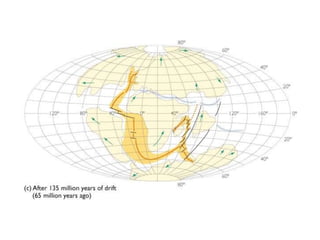
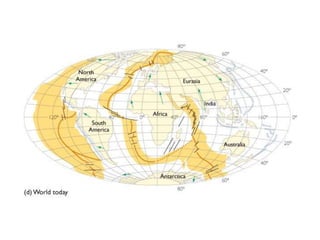
Mid-Oceanic Ridges & Sea
Floor Spreading
TYPES OF PLATE MOVEMENT
• The ways that plates interact depend on
their relative motion and whether oceanic
or continental crust is at the edge of the
lithospheric plate.
• Plates move away from, toward, or slide
past each other.
• Geologists call these divergent,
convergent, and transform plate
boundaries.
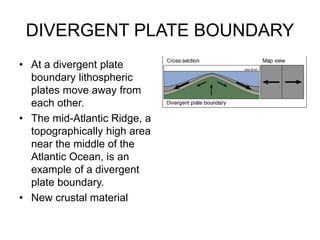
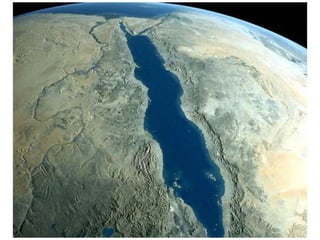
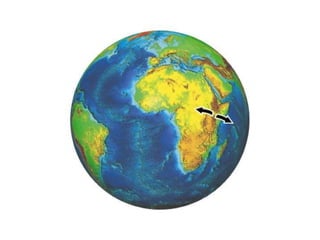
DIVERGENT PLATE BOUNDARY
• At a divergent plate
boundary lithospheric
plates move away from
each other.
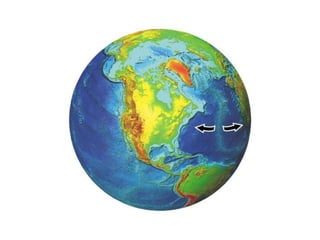
• The mid-Atlantic Ridge, a
topographically high area
near the middle of the
Atlantic Ocean, is an
example of a divergent
plate boundary.
• New crustal material
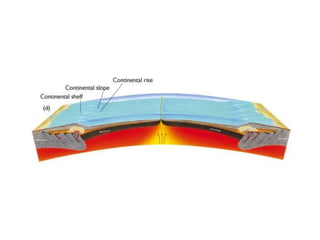
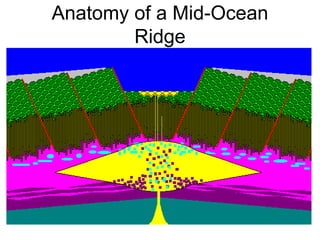
Anatomy of a Mid-Ocean
Ridge
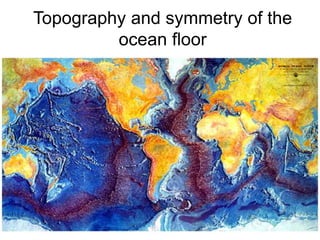
Topography and symmetry of the
ocean floor
ANDES
• The Andes Mountain Range spans the entire
length of South America, along the western
coast. This close-up shows that coast, which
represents the western terrestrial edge of
the South American Plate. The leading edge
of the Nazca Plate is subducting below the
South American Plate at a plate boundary
known as a subduction zone. During this
subduction some Nazca crust is scraped off
along base of the Andes, adding height to
the entire range.
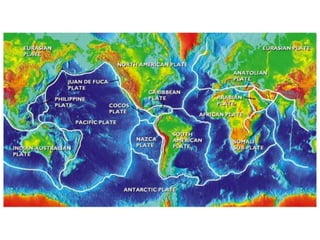
• The East Pacific Rise [the ridge to the left] is
part of the global network of mid-ocean
ridges that girdle the planet. As the sea-floor
spreads on either side of this ridge, the
Nazca Plate moves easterly while the
Pacific Plate moves westerly. The
Galapagos Islands, off the northwestern
coast of South America, are the result of a
"Hot Spot" that exists over a mid-ocean
ridge.
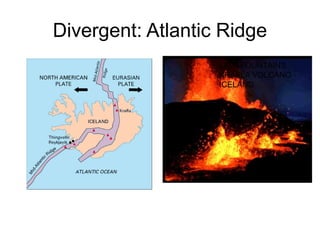
Divergent: Atlantic Ridge
LAVA FOUNTAINS
KRAFLA VOLCANO
ICELAND
Sea-floor spreading
• Mid-ocean ridges long recognized, but
magnetic structure only known since
WWII (anti-submarine technology)
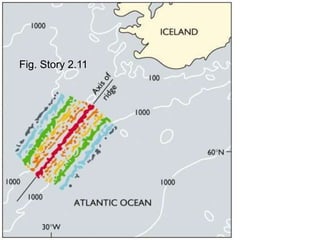
• Symmetric distribution of magnetic
stripes and age of ocean crust was the
key clue
• Demonstrated youth of ocean basins
and continual formation of crust
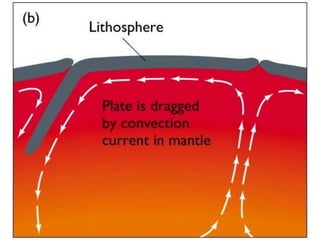
• Mechanisms related to mantle
convection
Fig. Story 2.11
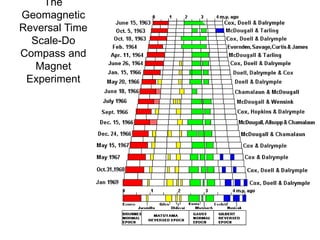
The
Geomagnetic
Reversal Time
Scale-Do
Compass and
Magnet
Experiment
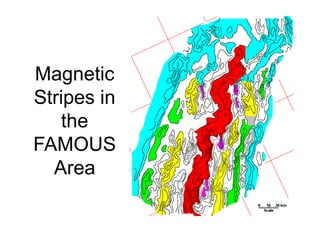
Magnetic
Stripes in
the
FAMOUS
Area
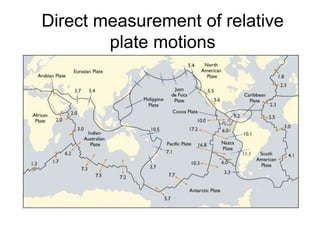
Direct measurement of relative
plate motions
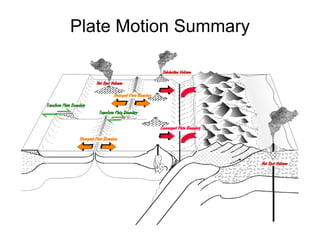
Plate Motion Summary
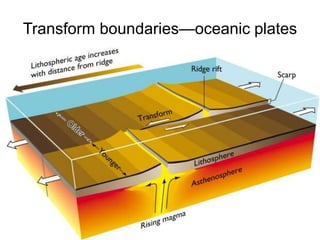
Transform boundaries—oceanic plates
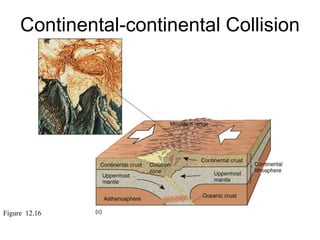
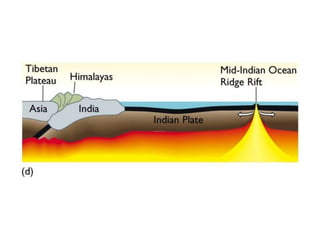
Continental-continental Collision
Figure 12.16
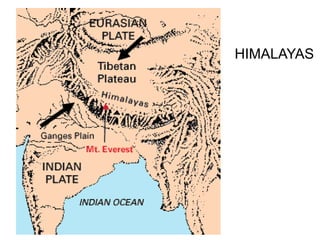
HIMALAYAS
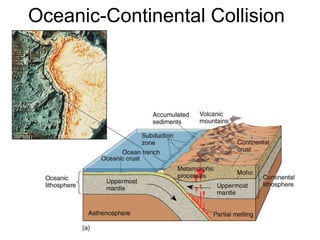
Oceanic-Continental Collision
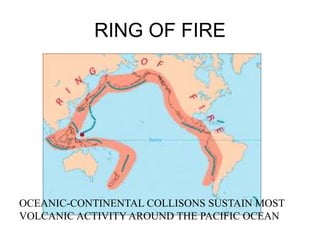
RING OF FIRE
OCEANIC-CONTINENTAL COLLISONS SUSTAIN MOST
VOLCANIC ACTIVITY AROUND THE PACIFIC OCEAN
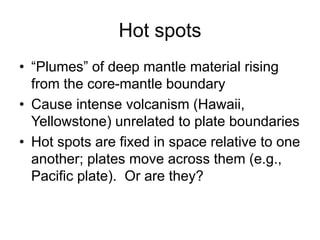
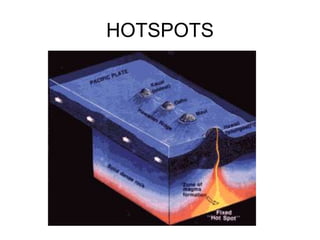
Hot spots
• “Plumes” of deep mantle material rising
from the core-mantle boundary
• Cause intense volcanism (Hawaii,
Yellowstone) unrelated to plate boundaries
• Hot spots are fixed in space relative to one
another; plates move across them (e.g.,
Pacific plate). Or are they?
HOTSPOTS
Geology plus three   Plate Tectonics.ppt

Geology plus three Plate Tectonics.ppt

  • 1.
    Mid-Oceanic Ridges &Sea Floor Spreading
  • 2.
    TYPES OF PLATEMOVEMENT • The ways that plates interact depend on their relative motion and whether oceanic or continental crust is at the edge of the lithospheric plate. • Plates move away from, toward, or slide past each other. • Geologists call these divergent, convergent, and transform plate boundaries.
  • 3.
    DIVERGENT PLATE BOUNDARY •At a divergent plate boundary lithospheric plates move away from each other. • The mid-Atlantic Ridge, a topographically high area near the middle of the Atlantic Ocean, is an example of a divergent plate boundary. • New crustal material
  • 5.
    Anatomy of aMid-Ocean Ridge
  • 6.
    Topography and symmetryof the ocean floor
  • 7.
    ANDES • The AndesMountain Range spans the entire length of South America, along the western coast. This close-up shows that coast, which represents the western terrestrial edge of the South American Plate. The leading edge of the Nazca Plate is subducting below the South American Plate at a plate boundary known as a subduction zone. During this subduction some Nazca crust is scraped off along base of the Andes, adding height to the entire range. • The East Pacific Rise [the ridge to the left] is part of the global network of mid-ocean ridges that girdle the planet. As the sea-floor spreads on either side of this ridge, the Nazca Plate moves easterly while the Pacific Plate moves westerly. The Galapagos Islands, off the northwestern coast of South America, are the result of a "Hot Spot" that exists over a mid-ocean ridge.
  • 9.
    Divergent: Atlantic Ridge LAVAFOUNTAINS KRAFLA VOLCANO ICELAND
  • 10.
    Sea-floor spreading • Mid-oceanridges long recognized, but magnetic structure only known since WWII (anti-submarine technology) • Symmetric distribution of magnetic stripes and age of ocean crust was the key clue • Demonstrated youth of ocean basins and continual formation of crust • Mechanisms related to mantle convection
  • 11.
  • 12.
  • 13.
  • 16.
    Direct measurement ofrelative plate motions
  • 17.
  • 18.
  • 19.
  • 20.
  • 22.
  • 23.
    RING OF FIRE OCEANIC-CONTINENTALCOLLISONS SUSTAIN MOST VOLCANIC ACTIVITY AROUND THE PACIFIC OCEAN
  • 36.
    Hot spots • “Plumes”of deep mantle material rising from the core-mantle boundary • Cause intense volcanism (Hawaii, Yellowstone) unrelated to plate boundaries • Hot spots are fixed in space relative to one another; plates move across them (e.g., Pacific plate). Or are they?
  • 37.