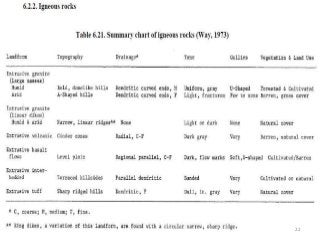
Unit -2
Interpretation of Rock types and
Landforms
1
Landforms
In the process of analyzing aerial photographs
the first and perhaps the most important step is to
identify the landform.
landform?
2
The landform may consist of hills, valleys,
plains, terraces, beaches, dunes, and other
topographic features largely created by the forces
of erosion.
3
Within a given area there usually will be found two types
of landforms :
Destructional and Constructional.
The hills of high ground are being worn down by erosion,
while the flood plains of streams are built up by
deposition of the material eroded from the upland.
For the best results from photo-interpretation, particularly
in areas where the interpreter’s experience is limited,
sufficient photo-coverage should be available to include
both constructional and destructional features.
This is especially true where the survey is expected to
include the location of gravel and sand deposits, since
they are most often found within areas of constructional
landforms.
4
https://en.wikipedia.org/wiki/List_of_landforms
5
Identifying the landform commonly identifies the
natural process that formed it, and commonly limits
the type of soils or soil characteristics that can be
expected.
6
7
8
LITHOLOGIC INTERPRETATION
Lithological interpretation refers to the recognition of rock types
from photogeological data alone, rather than from
photogeological data supported by local field experience. A
combination of geomorphological and structural analysis must be
undertaken.
Each outcrop seen on the stereomodel must be considered on its
local and regional geological environment, and the final
lithological interpretation must not be made until the other studies
are completed.
9
The photographic appearance of a particular rock type
may be quite variable, depending especially on the
climate and the amount of relief.
It is not possible to establish a set of criteria for the
recognition of rock types that would be applicable to all
areas.
However, certain lithologic information can be obtained
by using certain photocharacteristics of different rocks.
10
The following procedure may be used in lithologic interpretation:
1. Determine the climatic environment (e.g. desert, arid, semi-
arid, humid, temperate, tropical),
2. Determine the type of erosional environment (e.g. active, very
active, inactive),
3. Recognize and mark the bedding traces of the sediments or
metasediments,
4. Recognize and mark the areas of outcrop that do not have any
bedding (these may be intrusions, or horizontally bedded
sediments),
5. Recognize and mark the areas of superficial cover that do not
indicate bedding,
6. Re-study the bedding traces determined at (3) around fold
noses and determine the approximate position of the axial traces,
7. Study the lineaments to determine whether they represent
faults, dykes, joints, or combinations of these.
11
To differentiate different lithologies, the following observations
should be made on aerial photographs:
1. The photographic tone of the rock mass in relation to the neighboring
rocks,
2. The resistance to erosion of the rock mass in relation to the
neighboring rocks,
3. The boundary of whole rock mass,
4. The topographical expression of whole rock mass,
5. The boundaries of the individual outcrops,
6. The gully analysis,
7. The joint pattern,
8. The fault pattern,
9. The drainage pattern,
10. The vegetation cover,
11. The bedding or the relic bedding lineaments,
12. The foliation lineaments,
13. The regional geological environment.
12
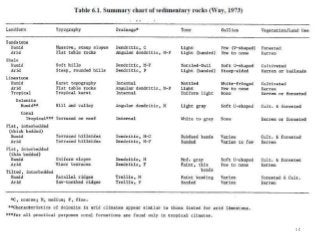
Sedimentary rocks- Consolidated sediments
The most prominent feature of sedimentary rocks is bedding.
As a result of differential erosion of sedimentary rocks, beds
appear as banded patterns on aerial photographs.
Banding due to vegetation or soil differences expressed by
topographic tone can also be used to recognize and mark the
beds in absence of topographic expressions.
Bedding may be most prominent in the mature stage of
geomorphic cycle. However, bedding may be masked in the
case of massive sedimentary rocks, such as certain sandstones,
and these appear as uniform masses and similar to some
igneous and metamorphic rocks.
In massive limestones sinkhole develop.
13
14
15
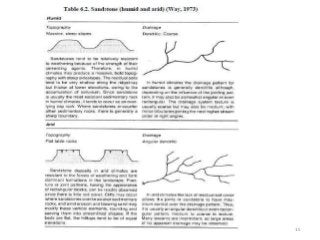
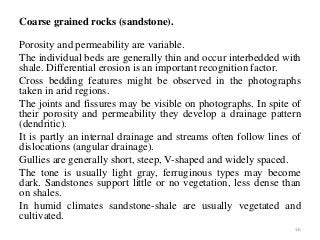
Coarse grained rocks (sandstone).
Porosity and permeability are variable.
The individual beds are generally thin and occur interbedded with
shale. Differential erosion is an important recognition factor.
Cross bedding features might be observed in the photographs
taken in arid regions.
The joints and fissures may be visible on photographs. In spite of
their porosity and permeability they develop a drainage pattern
(dendritic).
It is partly an internal drainage and streams often follow lines of
dislocations (angular drainage).
Gullies are generally short, steep, V-shaped and widely spaced.
The tone is usually light gray, ferruginous types may become
dark. Sandstones support little or no vegetation, less dense than
on shales.
In humid climates sandstone-shale are usually vegetated and
cultivated.
16
17
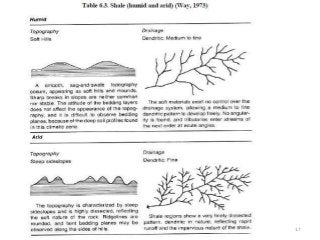
Shale and similar fine grained sedimentary
rocks.
Shales are the most common and wide spread sediments.
They exhibit dark tones, a fine-textured drainage, and relatively closely
and regularly spaced joints.
Dark tone of shales is due to absorbed water (but it is impervious to it).
As a result of very poor permeability no internal drainage develops on
shales (or unconsolidated equivalents, clays).
Erosion is intense, typical drainage pattern is closely spaced tree-like
(dendritic), and when steepsloped and silty, is dendritic-parallel.
Gullies in shales are long, more open with more gentle gradient
than in sandy beds.
In most places shales are interbedded with more or less sandy beds or
sandstone.
Sand content influences the drainage pattern. Strike controlled
subsequent pattern may form. Faulting can rarely be observed in shales,
because the fissure is soon closed and joined together by clay.
18
Very coarse grained rocks (conglomerate and breccia).
These seldom show a great degree of permeability.
Permeability depends on the grade of cementation and
the type of solubility of the matrix.
They are usually lenticular and almost always
associated with sandstones. It is difficult to separate
conglomerates from sandstones on the basis of drainage
since they differ from sandstones only in the size of
fragments.
In deserts the surface of beds are disintegrated to gravel
deposits giving a rough surface and darker tone (shadow
effect). Cataclastic breccias and conglomerates occur in
crushed zones.
19
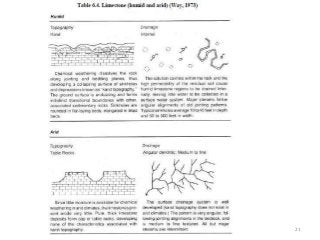
Limestones have light tones with dissolution forms like rills,
channels, trenches and sinkholes.
Dolomite is less soluble than limestone.
Different types of limestones have sinkholes different size
and distribution.
Fractures are broadened by solution. The drainage is internal.
Marls are light in tone, have drainage patterns similar to shales
depending on their clay content.
In tropical regions they support dense forest vegetation
20
21
22
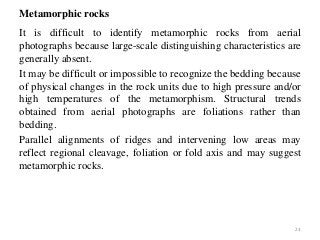
Metamorphic rocks
It is difficult to identify metamorphic rocks from aerial
photographs because large-scale distinguishing characteristics are
generally absent.
It may be difficult or impossible to recognize the bedding because
of physical changes in the rock units due to high pressure and/or
high temperatures of the metamorphism. Structural trends
obtained from aerial photographs are foliations rather than
bedding.
Parallel alignments of ridges and intervening low areas may
reflect regional cleavage, foliation or fold axis and may suggest
metamorphic rocks.
23
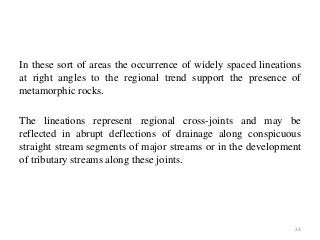
In these sort of areas the occurrence of widely spaced lineations
at right angles to the regional trend support the presence of
metamorphic rocks.
The lineations represent regional cross-joints and may be
reflected in abrupt deflections of drainage along conspicuous
straight stream segments of major streams or in the development
of tributary streams along these joints.
24
25
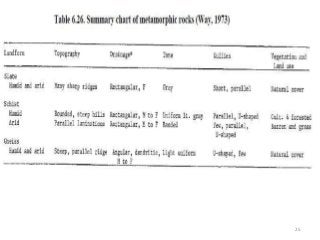
Schists are metamorphic rocks with highly foliated
structures.
Not much resistant to weathering and erosion.
They develop landforms similar to the original rocks they
are derived from.
Because they have been repeatedly folded and fractured
they are usually in steep attitudes and
folded into undulating lamellations.
Drainage in uniform schists is dendritic, close-spaced in
phyllites and widely spaced in quartzite schist.
Fault control is prominent.
In humid climates schists tend to form rounded crests as a
result of intense weathering
26
Slates have rugged topography and have very
characteristic drainage, angular and most often
rectangular. The hills are rounded, the slopes are very
steep. Tone is usually dark.
Gneiss is a massive foliated rock of granitic character
with high erosion resistance.
Orthogneiss is derived from granite and morphologically
similar to it in appearance and landform, showing rounded
forms.
Paragneisses derived from sediments show sharp crested
parallel ridges when they are derived from massive
sandstone; smooth and irregular in case of
metamorphosed shales, tuffs, lavas or marls.
The tone varies widely depending on the composition.
27
28
29
30
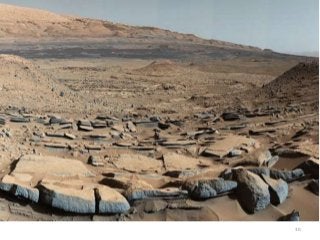
• This photograph, taken by NASA's Mars Rover
Curiosity in 2015, shows sedimentary rocks of
the Kimberley Formation in Gale Crater. The
crater contains thick deposits of finely
laminated mudstone that represent fine-
grained sediments deposited in a standing
body of water that persisted for a long period
of time - long enough to allow sediments to
accumulate to significant thickness.
• Image by NASA
31

Unit 2 landforms

  • 1.
    Unit -2 Interpretation ofRock types and Landforms 1
  • 2.
    Landforms In the processof analyzing aerial photographs the first and perhaps the most important step is to identify the landform. landform? 2
  • 3.
    The landform mayconsist of hills, valleys, plains, terraces, beaches, dunes, and other topographic features largely created by the forces of erosion. 3
  • 4.
    Within a givenarea there usually will be found two types of landforms : Destructional and Constructional. The hills of high ground are being worn down by erosion, while the flood plains of streams are built up by deposition of the material eroded from the upland. For the best results from photo-interpretation, particularly in areas where the interpreter’s experience is limited, sufficient photo-coverage should be available to include both constructional and destructional features. This is especially true where the survey is expected to include the location of gravel and sand deposits, since they are most often found within areas of constructional landforms. 4
  • 5.
  • 6.
    Identifying the landformcommonly identifies the natural process that formed it, and commonly limits the type of soils or soil characteristics that can be expected. 6
  • 7.
  • 8.
  • 9.
    LITHOLOGIC INTERPRETATION Lithological interpretationrefers to the recognition of rock types from photogeological data alone, rather than from photogeological data supported by local field experience. A combination of geomorphological and structural analysis must be undertaken. Each outcrop seen on the stereomodel must be considered on its local and regional geological environment, and the final lithological interpretation must not be made until the other studies are completed. 9
  • 10.
    The photographic appearanceof a particular rock type may be quite variable, depending especially on the climate and the amount of relief. It is not possible to establish a set of criteria for the recognition of rock types that would be applicable to all areas. However, certain lithologic information can be obtained by using certain photocharacteristics of different rocks. 10
  • 11.
    The following proceduremay be used in lithologic interpretation: 1. Determine the climatic environment (e.g. desert, arid, semi- arid, humid, temperate, tropical), 2. Determine the type of erosional environment (e.g. active, very active, inactive), 3. Recognize and mark the bedding traces of the sediments or metasediments, 4. Recognize and mark the areas of outcrop that do not have any bedding (these may be intrusions, or horizontally bedded sediments), 5. Recognize and mark the areas of superficial cover that do not indicate bedding, 6. Re-study the bedding traces determined at (3) around fold noses and determine the approximate position of the axial traces, 7. Study the lineaments to determine whether they represent faults, dykes, joints, or combinations of these. 11
  • 12.
    To differentiate differentlithologies, the following observations should be made on aerial photographs: 1. The photographic tone of the rock mass in relation to the neighboring rocks, 2. The resistance to erosion of the rock mass in relation to the neighboring rocks, 3. The boundary of whole rock mass, 4. The topographical expression of whole rock mass, 5. The boundaries of the individual outcrops, 6. The gully analysis, 7. The joint pattern, 8. The fault pattern, 9. The drainage pattern, 10. The vegetation cover, 11. The bedding or the relic bedding lineaments, 12. The foliation lineaments, 13. The regional geological environment. 12
  • 13.
    Sedimentary rocks- Consolidatedsediments The most prominent feature of sedimentary rocks is bedding. As a result of differential erosion of sedimentary rocks, beds appear as banded patterns on aerial photographs. Banding due to vegetation or soil differences expressed by topographic tone can also be used to recognize and mark the beds in absence of topographic expressions. Bedding may be most prominent in the mature stage of geomorphic cycle. However, bedding may be masked in the case of massive sedimentary rocks, such as certain sandstones, and these appear as uniform masses and similar to some igneous and metamorphic rocks. In massive limestones sinkhole develop. 13
  • 14.
  • 15.
  • 16.
    Coarse grained rocks(sandstone). Porosity and permeability are variable. The individual beds are generally thin and occur interbedded with shale. Differential erosion is an important recognition factor. Cross bedding features might be observed in the photographs taken in arid regions. The joints and fissures may be visible on photographs. In spite of their porosity and permeability they develop a drainage pattern (dendritic). It is partly an internal drainage and streams often follow lines of dislocations (angular drainage). Gullies are generally short, steep, V-shaped and widely spaced. The tone is usually light gray, ferruginous types may become dark. Sandstones support little or no vegetation, less dense than on shales. In humid climates sandstone-shale are usually vegetated and cultivated. 16
  • 17.
  • 18.
    Shale and similarfine grained sedimentary rocks. Shales are the most common and wide spread sediments. They exhibit dark tones, a fine-textured drainage, and relatively closely and regularly spaced joints. Dark tone of shales is due to absorbed water (but it is impervious to it). As a result of very poor permeability no internal drainage develops on shales (or unconsolidated equivalents, clays). Erosion is intense, typical drainage pattern is closely spaced tree-like (dendritic), and when steepsloped and silty, is dendritic-parallel. Gullies in shales are long, more open with more gentle gradient than in sandy beds. In most places shales are interbedded with more or less sandy beds or sandstone. Sand content influences the drainage pattern. Strike controlled subsequent pattern may form. Faulting can rarely be observed in shales, because the fissure is soon closed and joined together by clay. 18
  • 19.
    Very coarse grainedrocks (conglomerate and breccia). These seldom show a great degree of permeability. Permeability depends on the grade of cementation and the type of solubility of the matrix. They are usually lenticular and almost always associated with sandstones. It is difficult to separate conglomerates from sandstones on the basis of drainage since they differ from sandstones only in the size of fragments. In deserts the surface of beds are disintegrated to gravel deposits giving a rough surface and darker tone (shadow effect). Cataclastic breccias and conglomerates occur in crushed zones. 19
  • 20.
    Limestones have lighttones with dissolution forms like rills, channels, trenches and sinkholes. Dolomite is less soluble than limestone. Different types of limestones have sinkholes different size and distribution. Fractures are broadened by solution. The drainage is internal. Marls are light in tone, have drainage patterns similar to shales depending on their clay content. In tropical regions they support dense forest vegetation 20
  • 21.
  • 22.
  • 23.
    Metamorphic rocks It isdifficult to identify metamorphic rocks from aerial photographs because large-scale distinguishing characteristics are generally absent. It may be difficult or impossible to recognize the bedding because of physical changes in the rock units due to high pressure and/or high temperatures of the metamorphism. Structural trends obtained from aerial photographs are foliations rather than bedding. Parallel alignments of ridges and intervening low areas may reflect regional cleavage, foliation or fold axis and may suggest metamorphic rocks. 23
  • 24.
    In these sortof areas the occurrence of widely spaced lineations at right angles to the regional trend support the presence of metamorphic rocks. The lineations represent regional cross-joints and may be reflected in abrupt deflections of drainage along conspicuous straight stream segments of major streams or in the development of tributary streams along these joints. 24
  • 25.
  • 26.
    Schists are metamorphicrocks with highly foliated structures. Not much resistant to weathering and erosion. They develop landforms similar to the original rocks they are derived from. Because they have been repeatedly folded and fractured they are usually in steep attitudes and folded into undulating lamellations. Drainage in uniform schists is dendritic, close-spaced in phyllites and widely spaced in quartzite schist. Fault control is prominent. In humid climates schists tend to form rounded crests as a result of intense weathering 26
  • 27.
    Slates have ruggedtopography and have very characteristic drainage, angular and most often rectangular. The hills are rounded, the slopes are very steep. Tone is usually dark. Gneiss is a massive foliated rock of granitic character with high erosion resistance. Orthogneiss is derived from granite and morphologically similar to it in appearance and landform, showing rounded forms. Paragneisses derived from sediments show sharp crested parallel ridges when they are derived from massive sandstone; smooth and irregular in case of metamorphosed shales, tuffs, lavas or marls. The tone varies widely depending on the composition. 27
  • 28.
  • 29.
  • 30.
  • 31.
    • This photograph,taken by NASA's Mars Rover Curiosity in 2015, shows sedimentary rocks of the Kimberley Formation in Gale Crater. The crater contains thick deposits of finely laminated mudstone that represent fine- grained sediments deposited in a standing body of water that persisted for a long period of time - long enough to allow sediments to accumulate to significant thickness. • Image by NASA 31