Keynote


Luc Van de Velde             Arlindo Alves
Director                     Technical Evangelist
Developer & platform group   Developer & platform group
Microsoft BeLux              Microsoft BeLux
@lucfields                   @aralves
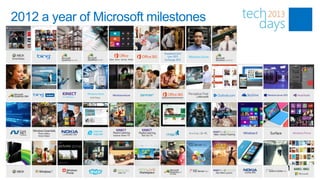
2012 a year of Microsoft milestones
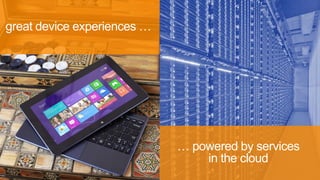
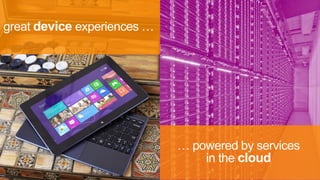
great device experiences …


                             … powered by services
                                 in the cloud
•
•
•
•
•
•
•
•
Demo


Arlindo Alves
Technical Evangelist
Microsoft BeLux
@aralves
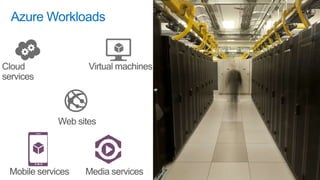
Azure Workloads
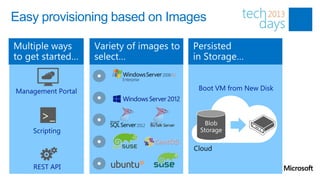
Easy provisioning based on Images


     >_
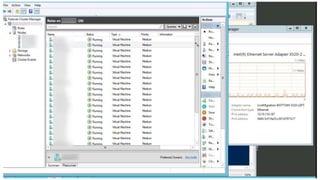
Demo
Deploying Virtual Machine

Nick Trogh
Technology Evangelist
Microsoft BeLux
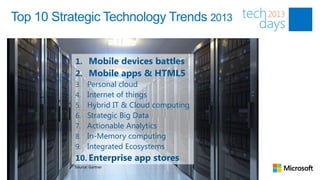
Top 10 Strategic Technology Trends 2013


           1. Mobile devices battles
           2. Mobile apps & HTML5
           3. Personal cloud
           4. Internet of things
           5. Hybrid IT & Cloud computing
           6. Strategic Big Data
           7. Actionable Analytics
           8. In-Memory computing
           9. Integrated Ecosystems
           10. Enterprise app stores
           Source: Gartner
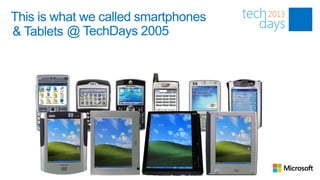
This is what we called smartphones
& Tablets @ TechDays 2005
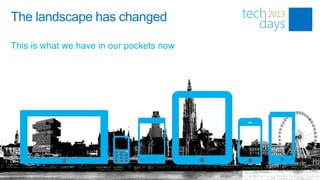
The landscape has changed

This is what we have in our pockets now
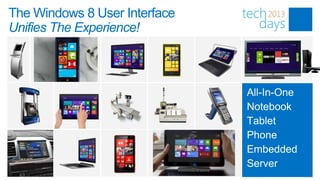
The Windows 8 User Interface Devices…
Powering World’s Computing
Unifies The Experience!
Demo
Windows 8 & Devices

Arlindo Alves
Technology Evangelist
Microsoft BeLux
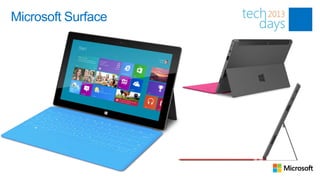
Microsoft Surface
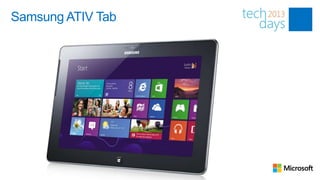
Samsung ATIV Tab
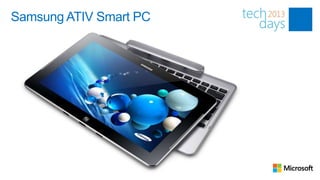
Samsung ATIV Smart PC
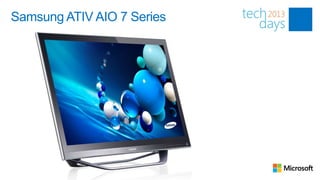
Samsung ATIV AIO 7 Series
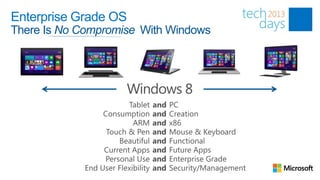
Enterprise Grade OS
There Is No Compromise With Windows
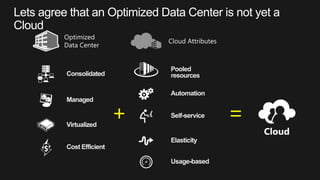
Lets agree that an Optimized Data Center is not yet a
Cloud


                   +                      =
Automation     Continuity
                     Pooled         Integration &
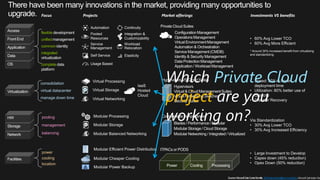
                     Resources      Customizability                  • 60% Avg Lower TCO
                     Service        Workload                         • 60% Avg More Efficient
                     Management     Relocation
                                                                     * Around 30% increased benefit from virtualizing
                     Self Service   Elasticity                       and standardizing


                     Usage Based


consolidation
                                                                Private Cloud
                                                                     • Speed: 50X or lower
                                                                       deployment time


                                                      project
virtual datacenter                                                   • Utilization: 80% better use of
                                                                       capacity
manage down time
                                                                     • Disaster Recovery


pooling
                                                                     Via Standardization
management                                                           • 30% Avg Lower TCO
                                                                     • 30% Avg Increased Efficiency
balancing


power                                                                • Large Investment to Develop
cooling                                                              • Capex down (45% reduction)
location                                                             • Opex Down (50% reduction)


                                                                               2010Microsoft Spotlight onCost Study, Microsoft Optimization Ben
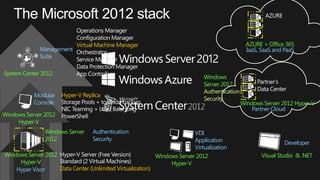
Virtual Machine Manager                                              AZURE + Office 365
              Management                                                                         IaaS, SaaS and PaaS
              Suite

System Center 2012
                                                                               Windows
                                                                               Server 2012
                                                                               Authentication
           Modular    Hyper-V Replica
                                                                               Security
           Console                                                                              Windows Server 2012 Hyper-V
                                                                                                    Partner Cloud
Windows Server 2012
     Hyper-V
                Windows Server     Authentication                          VDI
                2012               Security                                Application                          Developer
                                                                           Virtualization
Windows Server 2012                                          Windows Server 2012                       Visual Studio & .NET
     Hyper-V                                                      Hyper-V
    Hyper Visor     Data Center (Unlimited Virtualization)
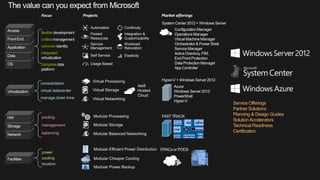
Automation     Continuity
                     Pooled         Integration &
                     Resources      Customizability
                     Service        Workload
                     Management     Relocation
                     Self Service   Elasticity

                     Usage Based


consolidation
virtual datacenter
manage down time
                                                      Service Offerings
                                                      Partner Solutions
                                                      Planning & Design Guides
pooling
                                                      Solution Accelerators
management                                            Technical Readiness
balancing                                             Certification


power
cooling
location
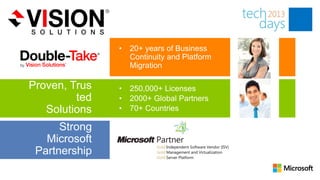
•   20+ years of Business
                   Continuity and Platform
                   Migration

Proven, Trus   •   250,000+ Licenses
         ted   •   2000+ Global Partners
   Solutions   •   70+ Countries

      Strong
   Microsoft
 Partnership
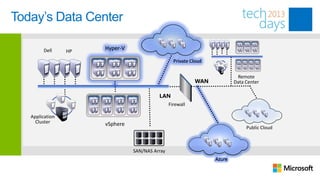
Today’s Data Center

        Dell     HP
                      Hyper-V

                                                  Private Cloud


                                                                           Remote
                                                           WAN            Data Center

                                          LAN
                                                Firewall

   Application
     Cluster          vSphere
                                                                               Public Cloud


                                SAN/NAS Array
                                                                  Azure
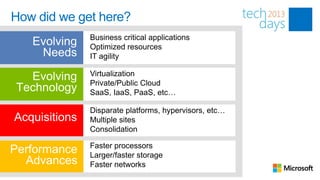
How did we get here?
             Business critical applications
             Optimized resources
             IT agility

             Virtualization
             Private/Public Cloud
             SaaS, IaaS, PaaS, etc…

             Disparate platforms, hypervisors, etc…
             Multiple sites
             Consolidation

             Faster processors
             Larger/faster storage
             Faster networks
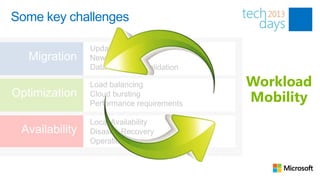
Some key challenges

            Updated hardware
            New platform
            Data center consolidation

            Load balancing              Workload
            Cloud bursting
            Performance requirements
                                        Mobility
            Local Availability
            Disaster Recovery PP
            Operational recovery
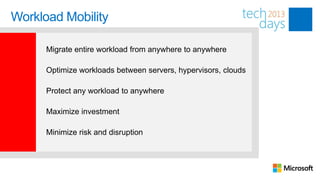
Workload Mobility

      Migrate entire workload from anywhere to anywhere

      Optimize workloads between servers, hypervisors, clouds

      Protect any workload to anywhere

      Maximize investment

      Minimize risk and disruption
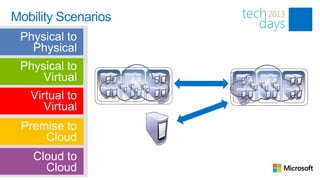
Mobility Scenarios
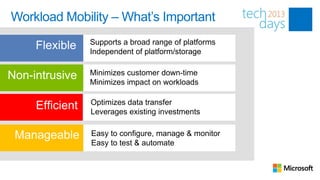
Workload Mobility – What’s Important
             Supports a broad range of platforms
             Independent of platform/storage

             Minimizes customer down-time
             Minimizes impact on workloads

              Optimizes data transfer
              Leverages existing investments

              Easy to configure, manage & monitor
              Easy to test & automate
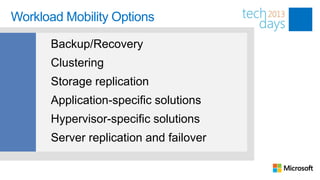
Workload Mobility Options

      Backup/Recovery
      Clustering
      Storage replication
      Application-specific solutions
      Hypervisor-specific solutions
      Server replication and failover
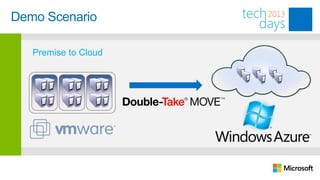
Demo Scenario

   Premise to Cloud
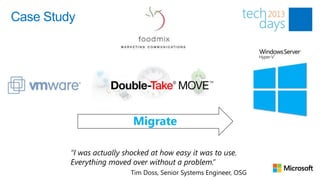
Case Study


                           Migrate

         “I was actually shocked at how easy it was to use.
         Everything moved over without a problem.”
                           Tim Doss, Senior Systems Engineer, OSG
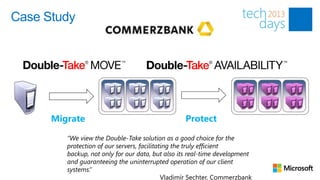
Case Study


      Migrate                                     Protect

         “We view the Double-Take solution as a good choice for the
         protection of our servers, facilitating the truly efficient
         backup, not only for our data, but also its real-time development
         and guaranteeing the uninterrupted operation of our client
         systems.”
                                             Vladimír Sechter, Commerzbank
Workload Mobility

       Adapt to change

       Optimize resources

       Keep workloads available
www.visionsolutions.com

Come visit our booth
 Register to win a Surface Tablet!
great device experiences …


                             … powered by services
                                 in the cloud
Microsoft TechDays 2013 - IT Pro Keynote

Microsoft TechDays 2013 - IT Pro Keynote

  • 1.
    Keynote Luc Van deVelde Arlindo Alves Director Technical Evangelist Developer & platform group Developer & platform group Microsoft BeLux Microsoft BeLux @lucfields @aralves
  • 2.
    2012 a yearof Microsoft milestones
  • 4.
    great device experiences… … powered by services in the cloud
  • 6.
  • 7.
  • 9.
  • 11.
  • 12.
  • 13.
    Demo Deploying Virtual Machine NickTrogh Technology Evangelist Microsoft BeLux
  • 14.
    Top 10 StrategicTechnology Trends 2013 1. Mobile devices battles 2. Mobile apps & HTML5 3. Personal cloud 4. Internet of things 5. Hybrid IT & Cloud computing 6. Strategic Big Data 7. Actionable Analytics 8. In-Memory computing 9. Integrated Ecosystems 10. Enterprise app stores Source: Gartner
  • 15.
    This is whatwe called smartphones & Tablets @ TechDays 2005
  • 16.
    The landscape haschanged This is what we have in our pockets now
  • 17.
    The Windows 8User Interface Devices… Powering World’s Computing Unifies The Experience!
  • 18.
    Demo Windows 8 &Devices Arlindo Alves Technology Evangelist Microsoft BeLux
  • 19.
  • 20.
  • 21.
  • 22.
  • 23.
    Enterprise Grade OS ThereIs No Compromise With Windows
  • 26.
    Lets agree thatan Optimized Data Center is not yet a Cloud + =
  • 27.
    Automation Continuity Pooled Integration & Resources Customizability • 60% Avg Lower TCO Service Workload • 60% Avg More Efficient Management Relocation * Around 30% increased benefit from virtualizing Self Service Elasticity and standardizing Usage Based consolidation Private Cloud • Speed: 50X or lower deployment time project virtual datacenter • Utilization: 80% better use of capacity manage down time • Disaster Recovery pooling Via Standardization management • 30% Avg Lower TCO • 30% Avg Increased Efficiency balancing power • Large Investment to Develop cooling • Capex down (45% reduction) location • Opex Down (50% reduction) 2010Microsoft Spotlight onCost Study, Microsoft Optimization Ben
  • 28.
    Virtual Machine Manager AZURE + Office 365 Management IaaS, SaaS and PaaS Suite System Center 2012 Windows Server 2012 Authentication Modular Hyper-V Replica Security Console Windows Server 2012 Hyper-V Partner Cloud Windows Server 2012 Hyper-V Windows Server Authentication VDI 2012 Security Application Developer Virtualization Windows Server 2012 Windows Server 2012 Visual Studio & .NET Hyper-V Hyper-V Hyper Visor Data Center (Unlimited Virtualization)
  • 29.
    Automation Continuity Pooled Integration & Resources Customizability Service Workload Management Relocation Self Service Elasticity Usage Based consolidation virtual datacenter manage down time Service Offerings Partner Solutions Planning & Design Guides pooling Solution Accelerators management Technical Readiness balancing Certification power cooling location
  • 31.
    20+ years of Business Continuity and Platform Migration Proven, Trus • 250,000+ Licenses ted • 2000+ Global Partners Solutions • 70+ Countries Strong Microsoft Partnership
  • 32.
    Today’s Data Center Dell HP Hyper-V Private Cloud Remote WAN Data Center LAN Firewall Application Cluster vSphere Public Cloud SAN/NAS Array Azure
  • 33.
    How did weget here? Business critical applications Optimized resources IT agility Virtualization Private/Public Cloud SaaS, IaaS, PaaS, etc… Disparate platforms, hypervisors, etc… Multiple sites Consolidation Faster processors Larger/faster storage Faster networks
  • 34.
    Some key challenges Updated hardware New platform Data center consolidation Load balancing Workload Cloud bursting Performance requirements Mobility Local Availability Disaster Recovery PP Operational recovery
  • 35.
    Workload Mobility Migrate entire workload from anywhere to anywhere Optimize workloads between servers, hypervisors, clouds Protect any workload to anywhere Maximize investment Minimize risk and disruption
  • 36.
  • 37.
    Workload Mobility –What’s Important Supports a broad range of platforms Independent of platform/storage Minimizes customer down-time Minimizes impact on workloads Optimizes data transfer Leverages existing investments Easy to configure, manage & monitor Easy to test & automate
  • 38.
    Workload Mobility Options Backup/Recovery Clustering Storage replication Application-specific solutions Hypervisor-specific solutions Server replication and failover
  • 40.
    Demo Scenario Premise to Cloud
  • 42.
    Case Study Migrate “I was actually shocked at how easy it was to use. Everything moved over without a problem.” Tim Doss, Senior Systems Engineer, OSG
  • 43.
    Case Study Migrate Protect “We view the Double-Take solution as a good choice for the protection of our servers, facilitating the truly efficient backup, not only for our data, but also its real-time development and guaranteeing the uninterrupted operation of our client systems.” Vladimír Sechter, Commerzbank
  • 44.
    Workload Mobility Adapt to change Optimize resources Keep workloads available
  • 45.
    www.visionsolutions.com Come visit ourbooth Register to win a Surface Tablet!
  • 46.
    great device experiences… … powered by services in the cloud

Editor's Notes

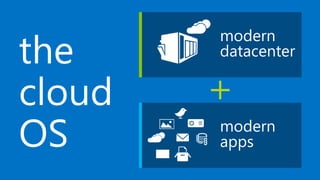
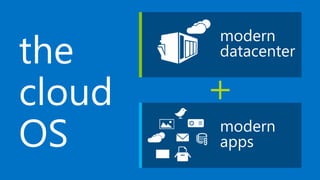
  • #5 Today’s industry transformation is both driving and being driven by several key trends that are all built on rapidly increasing capabilities in virtualized servers, the cost of storage, and networking advancements: We see four big most observable trends. You can see them on the outer ring. First is around the emergence of new types of apps. Apps that are much more inherently social (like, follow, share as verbs), that use open APIs, and new app frameworks. These apps have a notion of intelligence built right in (e.g. auto complete in every search bar). Second is the notion of data explosion – both in structured and unstructured data from a growing world of sources (sensors, social media). IDC says digital data will grow 44x over the next decade – this creates huge challenges for managing & processing all that data, but also creates great opportunities for insights.Third key trend is Consumerization of IT, which speaks to the proliferation of devices that users bring to work and expect IT to support. It’s estimated that in 2015, the number of connected devices will be twice the number of people on the planet. Users expect their apps to be available on these devices w/seamless experiences. But,security and compliance needs can’t be sacrificed to meet these expectations. And of course there’s tremendous interest in the economic benefits of cloud computing. Underneath all these four trends, the core dynamic that is fueling all these developments is ever-increasing access and availability of computing power, declining cost of storage and faster networks. These core building blocks are fundamentally evolving at a rapid rate, which in turn are enabling these four trends as outcomes. This is a profound and foundational development, and certainly points to the beginning of a new era in IT. This new era in IT requires a comprehensive and holistic approach to truly realize the potential of transformations that come with it. Much like the transitions before us from mainframes to minis, and then from minis to client/server, the transformation ahead will be fueled by a redefinition of the Operating System. Microsoft believe that the confluence of profound changes in compute, storage, and network mean that the role of OS must be redefined to move from managing individual server as the unit of compute to managing datacenter as a whole and to enable the next generation of applications and services. We are redefiningthe server operating system to create the modern platform with the assets for the modern datacenter and modern applications – we call it the Cloud OS.(click to unveil Cloud OS on next slide)
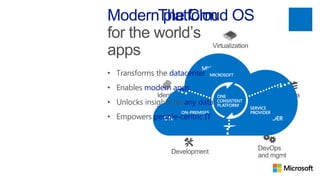
  • #6 Meet the Cloud OS – THE modern platform for the world’s applications – a broad spectrum of applications – from future and modern apps required to keep pace with your competitors to legacy apps critical to your business today.Microsoft is uniquely positioned to deliver the Cloud OS, given the breadth and strength of our assets. I’ll spend more time on these four Cloud OS dimensions a bit later… let’s take a moment to set some context for you.
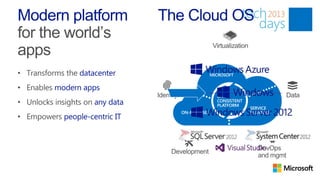
  • #7 The Cloud OS builds on Microsoft’s heritage in operating systems & democratizing technology, and delivers a modern platform that: transforms the datacenterenables modern appsunlocks insights on any dataempowers people-centric ITAt Microsoft, we have been learning by delivering global scale services from our datacenters what is required from this new era of IT, and we have taken these learnings, together with the trends and technology innovations, and built them into our core products to deliver the modern platform, which we call the Cloud OS.Our unique engineering experience is at the heart of the Cloud OS and the heart of our products. We engineer from the Cloud Up which means every customer benefits from those learnings.Customers need a modern platform to take advantage of these trends across their application portfolio:Transforms the Datacenter: The unit of compute has changed from single server to the datacenter. Customers need an infrastructure which provides a generational leap in agility, delivering a highly elastic and scalable infrastructure with always on, always up services across a set of shared resources with more automated management and self-service provisioning.Enable Modern Apps: Today’s apps need to interact and exchange data with other app – apps built on multiple platforms and languages; they need to integrate social data or foster social connections among users; and they need to live on-premises or off-premises and be delivered out to multiple devices. Modern apps evolve and thus, fast time to solution and lifecycle management is critical.Unlocks Insights on Any Data: To better compete, customers need to tap into growing data volumes, especially with unstructured data, or “Big Data”, to ask new questions and discover new data sources which they can combine with existing data for new insights. Customers need to deliver data to more users with the right IT oversight to help users make faster, better business decisions. Empowers People-Centric IT: With the proliferation and range of new devices, today’s users expect to be productive wherever they choose, on whatever device they choose, and IT needs to easily manage these devices and securely deliver apps and data in an extended, mobile environment.  Microsoft’s Cloud OS uniquely delivers on customer needs across these scenarios. The Cloud OS is a consistent platform with a common set of technologies you can use to develop and manage applications for all environments using the same skills, knowledge and experience:Agile development Platform: Use the tools you know build the apps you need, new modern apps and traditional apps, wherever they need to run to get to your customers or users. Those tools may be Visual Studio and .NET or open source technologies and languages, such REST, JSON, PHP, Java.Unified Dev-ops & Management: Use System Center as single pane of glass for all apps coupled with Visual Studio as common platform to build once, deploy anywhere with integration to manage apps across their lifecycles for quick time to solution and easy troubleshooting/management.Common identity: Implement Active Directory as a powerful asset across environments to help you extend your enterprise to the cloud with internet scale security using a single identity and/or securely extend apps and data to devices.Integrated virtualization: Microsoft is engineered for cloud from the metal up with virtualization built as an integrated element of the OS, not layered on the OS with no need for additional add-ons.Complete data platform: Microsoft delivers comprehensive technologies to manage petabytes of data in the cloud to millions of transactions for your most mission-critical applications to billions of rows in the hands of end users for predictive and adhoc analytics in IT-managed offerings. Microsoft uniquely delivers the Cloud OS as a consistent and comprehensive set of capabilities across your datacenter, ours or someone else’s to support the world’s apps and data anywhere.The Cloud OS is delivered via our leading enterprise server, cloud and data platform technologies: Windows Server, which is at the heart of the Cloud OS and delivers on the promises of a modern data center; it works with Windows Azure to bring you the economics, agility and innovation of cloud both on your premises and off. Windows Azure, which is an open cloud platform that enables you to quickly build, deploy and manage applications across a global network of Microsoft-managed datacenters. With Windows Azure and the next releases of Windows Server and System Center, there is no better platform for connecting to data and services across on-premises and public.SQL Server 2012, which helps organizations unlock breakthrough insights across the organization and quickly build solutions to extend data across on-premises and public cloud, backed by mission critical confidence. And Visual Studio 2012, which is a comprehensive family of products for every organization, team and individual developer that wants to modernize or create exciting apps to run on-premises or in the cloud.
  • #8 Microsoft uniquely delivers the Cloud OS as a consistent and comprehensive set of capabilities across your datacenter, ours or someone else’s to support the world’s apps and data anywhere.Introducing Windows Server 2012: Windows Server 2012 is at the heart of the Cloud OS and delivers on the promises of a modern data center to bring you the economics, agility and innovation of cloud both on your premises and off. We’ve seen hundreds of thousands of downloads of the pre-release versions, thousands of engineers worked on this product – and we couldn’t be more proud to share it with you.Let’s take a closer look at how Windows Server 2012 can deliver value to your organization – whether you are building your own cloud on-premises, plan to offer cloud services, or want to securely connect between on-premises and off-premises cloud services.So what comprises Microsoft’s Cloud OS? What is powering this?At the heart of the Cloud OS is Windows<CLICK>Windows Azure is our public cloud service, and comes with a rich set of services including SQL database services. Windows Server 2012 is at the core of the Cloud OS for customers on-premises datacenters and service providers. To deliver on the full capabilities of the Cloud OS, you also need SQL Server and Windows Azure Data Services, System Center and Visual Studio.Collectively the Cloud OS is designed to work together to deliver a consistent and modern platform for apps and data.
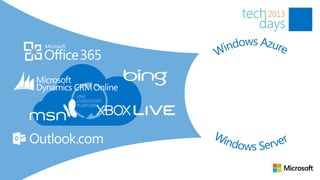
  • #9 Cloud OS is deeply informed by first-hand experience in running some of the largest Internet-scale services in the world. Given the unprecedented nature of the transformation… the notion of first-hand experience and on-going learning becomes crucial. With any platform, it’s the feedback cycle from the apps that drive the platform. Currently, Microsoft handles 5.5 billion+ Bing queries a month worldwide, manages & powers 350 million active Hotmail accounts and serves 40 million Xbox live users. This is just sample of the 200+ services that we run for hundreds of millions of customers, globally 24 by 7.In fact, Bing began running major components on Windows Server 2012 even before it was officially launched. Windows Server 2012 effectively was built from the cloud up – with all of our learnings wrapped into this core engine of the Cloud OS.We consume hundreds of petabytes of data from those services for rich analytics to improve customer experience and revenues, and we’ve built solutions to manage those high data volumes. Running these services has taught us - and is teaching us in real time - what it takes to architect, build and run applications and services at cloud scale. This kind of first-hand feedback cycle gives us a tremendous advantage in delivering great value to customers in the Cloud OS. We are taking all this learning back into platform, to the engines of the Cloud OS – Windows Server and Windows Azure, and beyond to SQL Server, System Center and Visual Studio, which when combined, deliver our modern platform (Cloud OS).*Note: Data updated near close of FY12
  • #12 Continuous feedback loop between what we use in production and what we implement in our productsOur consumer business matters more than ever to our enterprise business – consumers are calling the shots now, re-shaping the adoption curves for tech in the enterprise to reflect their personal tastes and not IT inertia and slownessWe learn a lot from it … implement that learning into our products, all while maintaining an enterprise-grade feature set that matters more to IT today than ever beforeOnly Microsoft plays in both these areas, and now that the line separating the two is gone forever, we’re in a great position to take advantage
  • #33 Let’s talk a little more about the “Real Datacenter” in today’s environments. We often see a broad range of physical, virtual and cloud resources in use in most environments. You start with some physical servers…often hosting business critical or legacy applications that aren’t well suited to clustering or virtualization. Add on top of that various application clusters to provide a level of availability for specific applications. Of course, we all have virtual resources in our datacenter, though it’s not uncommon for multiple hypervisors to be in use. According to ESG, over 65% of companies report that they have more than one hypervisor in use. And that trend will continue to grow with the adoption of Windows Server 2012. In terms of storage, you likely have a combination of direct-attached, NAS and SAN devices, utilizing various storage protocols. Next you have your private cloud implementation to help provide flexible, cost-effective resources to your internal customers on a self-service basis. Beyond your site, you may be using public cloud resources, whether in the form of Software as a Service, or as compute or storage infrastructure. And finally, you have your remote datacenter for disaster recovery purposes. Everyone has one of those, right??? Now, multiply these resources for each remote site you support. Pretty complicated, and rarely homogenous.
  • #34 So, how did we get here? First and foremost, business needs have changed. Demanding SLAs, dramatic growth of compute and storage requirements, management requirements, HA and DR requirements, are just a few drivers of change. Business priorities are also always evolving. Today, more and more businesses are demanding agile IT to keep up with the pace of innovation. Of course, there have been tremendous advances in technology, and you have leveraged these to make your business be more efficient. Mergers and acquisitions lead to an even broader mix of applications, servers and other technologies. Finally, there have also been dramatic improvements in existing technology – higher processor density, faster processors, larger and faster storage, etc… As your business needs grow, you have to take advantage of the improved technology. The end result is that we’re all facing a challenging task of managing and protecting a really broad range of technologies. I think we can all agree that the pace of change will not decrease, and that IT will continue to be on the hook to optimize
  • #35 So, how did we get here? First and foremost, business needs have changed. Demanding SLAs, dramatic growth of compute and storage requirements, management requirements, HA and DR requirements, are just a few drivers of change. Business priorities are also always evolving. Today, more and more businesses are demanding agile IT to keep up with the pace of innovation. Of course, there have been tremendous advances in technology, and you have leveraged these to make your business be more efficient. Mergers and acquisitions lead to an even broader mix of applications, servers and other technologies. Finally, there have also been dramatic improvements in existing technology – higher processor density, faster processors, larger and faster storage, etc… As your business needs grow, you have to take advantage of the improved technology. The end result is that we’re all facing a challenging task of managing and protecting a really broad range of technologies. I think we can all agree that the pace of change will not decrease, and that IT will continue to be on the hook to optimize
  • #36 So what is workload mobility? Workload mobility allows you move your workloads wherever you want them so you can optimize their performance, cost or availability. One of the drivers of virtualization adoption has been workload mobility – virtual server workloads can be moved to another host pretty easily. Features like Hyper-V Replica and Live Migration can be used to move between Hyper-V hosts. However, we already know that most environments are not homogeneous. So true workload mobility goes beyond virtual workloads. It allows you to migrate workloads between various platforms and technologies. That includes physical servers, virtual hosts, different hypervisors, private and public clouds. Workload mobility also allows you to protect these workloads both locally and remotely, to insure availability. Note that this means protection from both planned and unplanned outtages. Workload mobility allows you to maximize your investment and adapt to change, by moving workloads to the most optimal location or platform. And finally, workload mobility helps you mitigate risk and user disruption. With the ability to easily move workloads on demand, you’ve reduced your reliance on a single technology.
  • #37 Let’s look at some of the scenarios that true workload mobility should provide. There’s the traditional physical to physical configuration, but also physical to virtual for migration or protection purposes. Note that the arrows go both ways here. While the obvious trend is towards P2V, what happens if a workload really doesn’t behave or perform well in a virtualized environment? You need to be able to “get it back” to an optimal configuration. Virtual to virtual mobility is more common in the industry, though it’s also important to consider cross-hypervisor mobility. Premise to cloud mobility is something that you will hear Microsoft talk about this week – they are making some great strides towards making this boundary as transparent as possible for virtualized workloads. The other important consideration here – as with P2V – is how do you get your workloads back on premise after a disaster. And Cloud to Cloud is important for risk mitigation and availability.
  • #38 So what things are most important when considering workload mobility for our dynamic and heterogeneous environments? First, we need to be able to support a broad range of platforms. We’ve seen that these environments are generally in flux, and we are continually optimizing how and where things are running to meet business needs. An ideal solution operates independently of the underlying platform or storage. Second, workload mobility has to be unobtrusive. User downtime should be minimized when a workload is being moved, and there should be minimal impact on production workloads during normal business. This is true of both planned and un-planned mobility. Next, when data has to be transferred (which is often the case), it should be done in an efficient way to limit bandwidth requirements. This is especially important when moving workloads between sites, and when considering growing storage requirements. Finally, things have to be easy. This is especially critical for disaster recovery scenarios. It’s one thing to manage disparate or complex tools on a calm Tuesday afternoon when all is well. It’s another when you are in the middle of trying to get an entire datacenter back on-line. A complex recovery process generally leads to errors and increased downtime. Note that the ability to test and automate your solution easily is also critical in preventing surprises when you are in the middle of a disaster.
  • #39 The are a number of options for workload mobility, and you need to understand the pros and cons of each to determine which is a best fit for your environment. These solutions are generally tailored to specific platforms or scenarios, and may not apply to all of your workloads.
  • #40 So let’s see an example of workload mobility in action. Let’s look at a quick demo where we’ll migrate a virtual machine running in vSphere to Azure. To do this migration, we’re going to use Double-Take Move.
  • #43 True workload mobility will give you the ability to adapt to change, which we know is inevitable.It will also dramatically lower the risk of moving workloads around as a result of this change, enabling you to continually optimize your resources.And true workload mobility will help you keep your critical business resources up and running for your customers.
  • #44 I’d like to invite you to stop by the Vision Solutions booth to see our workload mobility solutions, and while you’re at it register to win one of two Surface tablets we’ll be giving away. Thank you for your time today, and have a great week at Microsoft TechDays.