1
MICROBIOME IN HEALTH AND DISEASES
Outline
• Introduction
• The Human Microbiome
• The Human Microbiome in Health
• The Human Microbiome in Diseases
• Microbiota in Therapy
• The Human Microbiome Project
• Conclusion
• Recommendation
• References
2
Introduction
• A microbiota is defined as the community of
microorganisms living in a specific environment and a
microbiome is the entire collection of all the genomic
elements of a specific microbiota (Icaza-Chávez, 2014)
• The bacteria, archaea, fungi, and viruses that populate
every facet of our external and internal surfaces compose
what is known as the human microbiome (Netto & Kaul,
2019)
• Humans are colonized at birth by microorganisms that
eventually make up the human microbiome
3
The Human Microbiome
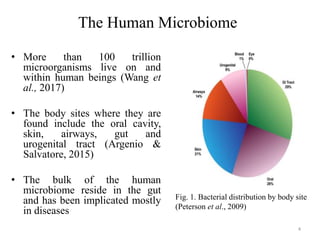
• More than 100 trillion
microorganisms live on and
within human beings (Wang et
al., 2017)
• The body sites where they are
found include the oral cavity,
skin, airways, gut and
urogenital tract (Argenio &
Salvatore, 2015)
• The bulk of the human
microbiome reside in the gut
and has been implicated mostly
in diseases
4
Fig. 1. Bacterial distribution by body site
(Peterson et al., 2009)
The Gut Microbiome
5
• Sequencing techniques such as 16s rRNA sequencing and
shotgun metagenomics have been used to characterize and
identify bacterial species in the gut microbiota
• The most abundant have been found to be of the phylum
Firmicutes, Bacteroidetes, Actinobacteria and Proteobacteria
while Fusobacteria, Cyanobacteria and Verrucomicrobia are
usually less represented (Argenio & Salvatore, 2015)
• Interactions between the host and microbiota as well as
between members of the microbiota help determine a normal
symbiotic gut microbiota
The Gut microbiome in Health
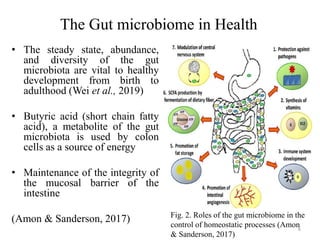
• The steady state, abundance,
and diversity of the gut
microbiota are vital to healthy
development from birth to
adulthood (Wei et al., 2019)
• Butyric acid (short chain fatty
acid), a metabolite of the gut
microbiota is used by colon
cells as a source of energy
• Maintenance of the integrity of
the mucosal barrier of the
intestine
(Amon & Sanderson, 2017) Fig. 2. Roles of the gut microbiome in the
control of homeostatic processes (Amon
& Sanderson, 2017)
6
The Gut microbiome in Health Cont’d
• The gut microbiota has also been linked
availability of tryptophan (an amino acid) in the
body
• This tryptophan is a precursor for the
neurotransmitter Serotonin
• This neurotransmitter plays important role in
mood, anxiety and happiness
(Dehhaghi et al., 2019)
7
The Gut Microbiome in Diseases
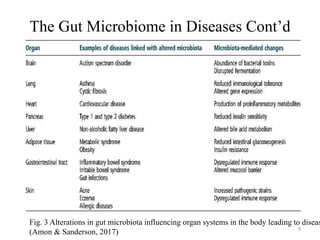
• Studies have shown that diseases linked to the microbiome
occur due to alterations in the constituent of the microbiome
which is known as “Dysbiosis” (Netto & Kaul, 2019)
• Factors such as diet and antibiotics have been found to cause
dysbiosis (Amon & Sanderson, 2017)
• Gut dysbiosis either predisposes an individual to a certain
disease or aids in the pathophysiology of the disease
• A study carried out in murine model showed that germ free
mice had abnormal body development, atrophy in intestinal
walls, low weight organs and an underdeveloped immune
system (Jia & Rajani, 2017)
8
The Gut Microbiome in Diseases Cont’d
9
Fig. 3 Alterations in gut microbiota influencing organ systems in the body leading to diseas
(Amon & Sanderson, 2017)
Case study: Inflammatory Bowel Disease (IBD)
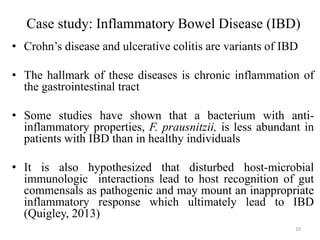
• Crohn’s disease and ulcerative colitis are variants of IBD
• The hallmark of these diseases is chronic inflammation of
the gastrointestinal tract
• Some studies have shown that a bacterium with anti-
inflammatory properties, F. prausnitzii, is less abundant in
patients with IBD than in healthy individuals
• It is also hypothesized that disturbed host-microbial
immunologic interactions lead to host recognition of gut
commensals as pathogenic and may mount an inappropriate
inflammatory response which ultimately lead to IBD
(Quigley, 2013)
10
Microbiota in Therapy
• Probiotics
Live microorganisms such as gram +ve
Lactobacillus spp. and Bifidobacterium spp.
taken in to benefit host health
• Prebiotics
A prebiotic is defined as “a selectively
fermented ingredient that allows specific
changes, both in the composition and/or activity
in the gastrointestinal microbiota that confers
benefits upon host well-being and health” (Netto
11
Microbiota in Therapy Cont’d.
• Synbiotics refers to a
combination of probiotics
and prebiotics
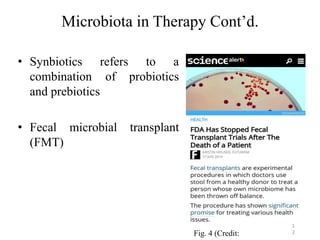
• Fecal microbial transplant
(FMT)
1
2
Fig. 4 (Credit:
The Human Microbiome Project (HMP)
• It is an initiative launched in 2008 and sponsored
by the National Human Genome Research Institute
(NHGRI), a part of the National Institutes of
Health (NIH)
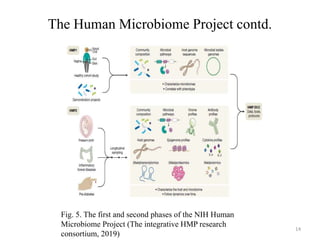
• It has been carried out over ten years and two
phases to provide resources, methods, and
discoveries that link interactions between humans
and their microbiomes to health-related outcomes
(The integrative HMP research consortium, 2019)
13
The Human Microbiome Project contd.
14
Fig. 5. The first and second phases of the NIH Human
Microbiome Project (The integrative HMP research
consortium, 2019)
The Human Microbiome Project Cont’d.
• Some key findings from HMP 1 include:
 The microbiome varies among individuals
 Diet, environment, host genetics, and early microbial
exposure affect the diversity of the microbiome
 There is niche specialization of the microbiota both
within and among individuals
 Estimation of about 81-99% of the genera, enzyme
families and community configuration occupied by the
healthy microbiome
15
The African Collaborative Centre for
Microbiome and Genomics Research
(ACCME)
16
Conclusion
• Several studies have shown the importance of the
human microbiome in maintaining health and also in
diseases.
However, questions such as
 What are the specific microbial-host interactions that
bring about the disease outcomes
 How the microbiome affect a person’s response to
medications
 How can these findings be used in clinical settings for
diagnosis
17
Recommendations
• Research which will help elucidate the specific
mechanism of action of the microbiomes in
disease outcome need to be carried out
• A Human Microbiome Project initiative needs to
be conducted in African countries in order to
relate the human microbiome in these regions to
diseases of public health impact there such as
Malaria
18
References
• Amon, P., & Sanderson, I. (2017). What is the microbiome? Archives of Disease
in Childhood: Education and Practice Edition, 102(5), 258–261.
https://doi.org/10.1136/archdischild-2016-311643
• Argenio, V. D., & Salvatore, F. (2015). Clinica Chimica Acta The role of the gut
microbiome in the healthy adult status. Clinica Chimica Acta, 451, 97–102.
• Dehhaghi, M., Kazemi, H., Panahi, S., & Guillemin, G. J. (2019).
Microorganisms , Tryptophan Metabolism , and Kynurenine Pathway : A
Complex Interconnected Loop Influencing Human Health Status. International
Journal of Tryptophan Research, 12, 1–10.
https://doi.org/10.1177/1178646919852996
• Icaza-Chávez, M. E. (2014). Gut microbiota in health and disease ଝ. Integrative
Medicine Research, 78(4), 240–248.
https://doi.org/10.1016/j.rgmxen.2014.02.009
• Jia, W., & Rajani, C. (2017). Gut Microbial Metabolism in Health and Disease. In
Nutrition in the Prevention and Treatment of Disease (Fourth Edition).
https://doi.org/10.1016/B978-0-12-802928-2.00038-2
• Ley, R. E. (2010). Obesity and the human microbiome. Current Opinion in
Gastroenterology, 26(1), 5–11. https://doi.org/10.1097/MOG.0b013e328333d751
19
References
• Quigley, E. M. M. (2013). Gut bacteria in health and disease. Gastroenterology and

Hepatology, 9(9), 560–569.
• Sekirov, I., Russell, S. L., Antunes, L. C. M., & Finlay, B. B. (2010). Gut Microbiota in
Health and Disease Gut Microbiota in Health and Disease. Physiol Rev, 90, 859–904.
https://doi.org/10.1152/physrev.00045.2009
• The integrative HMP research consortium. (2019). The Integrative Human Microbiome
Project. Perspective, 569, 641–648. https://doi.org/10.1038/s41586-019-1238-8
• Valles-colomer, M., Falony, G., Darzi, Y., Tigchelaar, E. F., Wang, J., Tito, R. Y., …
Raes, J. (2019). microbiota in quality of life and depression. Nature Microbiology.
https://doi.org/10.1038/s41564-018-0337-x
• Wang, B., Yao, M., Lv, L., Ling, Z., & Li, L. (2017). The Human Microbiota in Health
and Disease. Engineering, 3, 71–82.
• Wei, M. Y., Shi, S., Liang, C., Meng, Q. C., Hua, J., Zhang, Y. Y., … Yu, X. J. (2019).
The microbiota and microbiome in pancreatic cancer: More influential than expected.
Molecular Cancer, 18(1), 1–15. https://doi.org/10.1186/s12943-019-1008-0
• https://www.sciencealert.com/fda-stops-fecal-transplant-trials-after-one-led-to-fatal-
infection
• https://www.fda.gov/news-events/fda-brief/fda-brief-fda-warns-about-potential-risk-
serious-infections-caused-multi-drug-resistant-organisms
• www.h3accme.com
20
21
Thank you for
listening!

microbiomes.pptx

  • 1.
  • 2.
    Outline • Introduction • TheHuman Microbiome • The Human Microbiome in Health • The Human Microbiome in Diseases • Microbiota in Therapy • The Human Microbiome Project • Conclusion • Recommendation • References 2
  • 3.
    Introduction • A microbiotais defined as the community of microorganisms living in a specific environment and a microbiome is the entire collection of all the genomic elements of a specific microbiota (Icaza-Chávez, 2014) • The bacteria, archaea, fungi, and viruses that populate every facet of our external and internal surfaces compose what is known as the human microbiome (Netto & Kaul, 2019) • Humans are colonized at birth by microorganisms that eventually make up the human microbiome 3
  • 4.
    The Human Microbiome •More than 100 trillion microorganisms live on and within human beings (Wang et al., 2017) • The body sites where they are found include the oral cavity, skin, airways, gut and urogenital tract (Argenio & Salvatore, 2015) • The bulk of the human microbiome reside in the gut and has been implicated mostly in diseases 4 Fig. 1. Bacterial distribution by body site (Peterson et al., 2009)
  • 5.
    The Gut Microbiome 5 •Sequencing techniques such as 16s rRNA sequencing and shotgun metagenomics have been used to characterize and identify bacterial species in the gut microbiota • The most abundant have been found to be of the phylum Firmicutes, Bacteroidetes, Actinobacteria and Proteobacteria while Fusobacteria, Cyanobacteria and Verrucomicrobia are usually less represented (Argenio & Salvatore, 2015) • Interactions between the host and microbiota as well as between members of the microbiota help determine a normal symbiotic gut microbiota
  • 6.
    The Gut microbiomein Health • The steady state, abundance, and diversity of the gut microbiota are vital to healthy development from birth to adulthood (Wei et al., 2019) • Butyric acid (short chain fatty acid), a metabolite of the gut microbiota is used by colon cells as a source of energy • Maintenance of the integrity of the mucosal barrier of the intestine (Amon & Sanderson, 2017) Fig. 2. Roles of the gut microbiome in the control of homeostatic processes (Amon & Sanderson, 2017) 6
  • 7.
    The Gut microbiomein Health Cont’d • The gut microbiota has also been linked availability of tryptophan (an amino acid) in the body • This tryptophan is a precursor for the neurotransmitter Serotonin • This neurotransmitter plays important role in mood, anxiety and happiness (Dehhaghi et al., 2019) 7
  • 8.
    The Gut Microbiomein Diseases • Studies have shown that diseases linked to the microbiome occur due to alterations in the constituent of the microbiome which is known as “Dysbiosis” (Netto & Kaul, 2019) • Factors such as diet and antibiotics have been found to cause dysbiosis (Amon & Sanderson, 2017) • Gut dysbiosis either predisposes an individual to a certain disease or aids in the pathophysiology of the disease • A study carried out in murine model showed that germ free mice had abnormal body development, atrophy in intestinal walls, low weight organs and an underdeveloped immune system (Jia & Rajani, 2017) 8
  • 9.
    The Gut Microbiomein Diseases Cont’d 9 Fig. 3 Alterations in gut microbiota influencing organ systems in the body leading to diseas (Amon & Sanderson, 2017)
  • 10.
    Case study: InflammatoryBowel Disease (IBD) • Crohn’s disease and ulcerative colitis are variants of IBD • The hallmark of these diseases is chronic inflammation of the gastrointestinal tract • Some studies have shown that a bacterium with anti- inflammatory properties, F. prausnitzii, is less abundant in patients with IBD than in healthy individuals • It is also hypothesized that disturbed host-microbial immunologic interactions lead to host recognition of gut commensals as pathogenic and may mount an inappropriate inflammatory response which ultimately lead to IBD (Quigley, 2013) 10
  • 11.
    Microbiota in Therapy •Probiotics Live microorganisms such as gram +ve Lactobacillus spp. and Bifidobacterium spp. taken in to benefit host health • Prebiotics A prebiotic is defined as “a selectively fermented ingredient that allows specific changes, both in the composition and/or activity in the gastrointestinal microbiota that confers benefits upon host well-being and health” (Netto 11
  • 12.
    Microbiota in TherapyCont’d. • Synbiotics refers to a combination of probiotics and prebiotics • Fecal microbial transplant (FMT) 1 2 Fig. 4 (Credit:
  • 13.
    The Human MicrobiomeProject (HMP) • It is an initiative launched in 2008 and sponsored by the National Human Genome Research Institute (NHGRI), a part of the National Institutes of Health (NIH) • It has been carried out over ten years and two phases to provide resources, methods, and discoveries that link interactions between humans and their microbiomes to health-related outcomes (The integrative HMP research consortium, 2019) 13
  • 14.
    The Human MicrobiomeProject contd. 14 Fig. 5. The first and second phases of the NIH Human Microbiome Project (The integrative HMP research consortium, 2019)
  • 15.
    The Human MicrobiomeProject Cont’d. • Some key findings from HMP 1 include:  The microbiome varies among individuals  Diet, environment, host genetics, and early microbial exposure affect the diversity of the microbiome  There is niche specialization of the microbiota both within and among individuals  Estimation of about 81-99% of the genera, enzyme families and community configuration occupied by the healthy microbiome 15
  • 16.
    The African CollaborativeCentre for Microbiome and Genomics Research (ACCME) 16
  • 17.
    Conclusion • Several studieshave shown the importance of the human microbiome in maintaining health and also in diseases. However, questions such as  What are the specific microbial-host interactions that bring about the disease outcomes  How the microbiome affect a person’s response to medications  How can these findings be used in clinical settings for diagnosis 17
  • 18.
    Recommendations • Research whichwill help elucidate the specific mechanism of action of the microbiomes in disease outcome need to be carried out • A Human Microbiome Project initiative needs to be conducted in African countries in order to relate the human microbiome in these regions to diseases of public health impact there such as Malaria 18
  • 19.
    References • Amon, P.,& Sanderson, I. (2017). What is the microbiome? Archives of Disease in Childhood: Education and Practice Edition, 102(5), 258–261. https://doi.org/10.1136/archdischild-2016-311643 • Argenio, V. D., & Salvatore, F. (2015). Clinica Chimica Acta The role of the gut microbiome in the healthy adult status. Clinica Chimica Acta, 451, 97–102. • Dehhaghi, M., Kazemi, H., Panahi, S., & Guillemin, G. J. (2019). Microorganisms , Tryptophan Metabolism , and Kynurenine Pathway : A Complex Interconnected Loop Influencing Human Health Status. International Journal of Tryptophan Research, 12, 1–10. https://doi.org/10.1177/1178646919852996 • Icaza-Chávez, M. E. (2014). Gut microbiota in health and disease ଝ. Integrative Medicine Research, 78(4), 240–248. https://doi.org/10.1016/j.rgmxen.2014.02.009 • Jia, W., & Rajani, C. (2017). Gut Microbial Metabolism in Health and Disease. In Nutrition in the Prevention and Treatment of Disease (Fourth Edition). https://doi.org/10.1016/B978-0-12-802928-2.00038-2 • Ley, R. E. (2010). Obesity and the human microbiome. Current Opinion in Gastroenterology, 26(1), 5–11. https://doi.org/10.1097/MOG.0b013e328333d751 19
  • 20.
    References • Quigley, E.M. M. (2013). Gut bacteria in health and disease. Gastroenterology and Hepatology, 9(9), 560–569. • Sekirov, I., Russell, S. L., Antunes, L. C. M., & Finlay, B. B. (2010). Gut Microbiota in Health and Disease Gut Microbiota in Health and Disease. Physiol Rev, 90, 859–904. https://doi.org/10.1152/physrev.00045.2009 • The integrative HMP research consortium. (2019). The Integrative Human Microbiome Project. Perspective, 569, 641–648. https://doi.org/10.1038/s41586-019-1238-8 • Valles-colomer, M., Falony, G., Darzi, Y., Tigchelaar, E. F., Wang, J., Tito, R. Y., … Raes, J. (2019). microbiota in quality of life and depression. Nature Microbiology. https://doi.org/10.1038/s41564-018-0337-x • Wang, B., Yao, M., Lv, L., Ling, Z., & Li, L. (2017). The Human Microbiota in Health and Disease. Engineering, 3, 71–82. • Wei, M. Y., Shi, S., Liang, C., Meng, Q. C., Hua, J., Zhang, Y. Y., … Yu, X. J. (2019). The microbiota and microbiome in pancreatic cancer: More influential than expected. Molecular Cancer, 18(1), 1–15. https://doi.org/10.1186/s12943-019-1008-0 • https://www.sciencealert.com/fda-stops-fecal-transplant-trials-after-one-led-to-fatal- infection • https://www.fda.gov/news-events/fda-brief/fda-brief-fda-warns-about-potential-risk- serious-infections-caused-multi-drug-resistant-organisms • www.h3accme.com 20
  • 21.

Editor's Notes

  • #9 Alterations in the gut microbiota through the use of antibiotics in neonates has been shown to have a positive correlation with increased risk of intestinal intussusception It has been thought that systemic complications as a result of widespread infection arise in critically ill patients is due to migration of gut microbiota out of the colon due impaired epithelial function
  • #11 It is speculated that inflammatory response to gut microbiota may be due to recognition of epitope of particular bacteria or molecular mimicry- mediated autoimmunity (Sekirov et al., 2010) Pathological overgrowth of Clostridrium difficile in antibiotic treated gastrointestinal tract leads to antibiotic associated diarrhea Necrotizing enterocolitis in premature infants