Microbiology
Getting Started
Early Milestones
in Microbiology
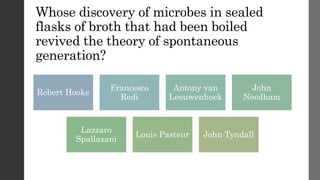
Whose discovery of microbes in sealed
flasks of broth that had been boiled
revived the theory of spontaneous
generation?
Robert Hooke
Francesco
Redi
Antony van
Leeuwenhoek
John
Needham
Lazzaro
Spallazani
Louis Pasteur John Tyndall
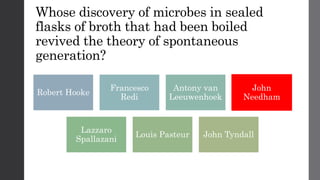
Whose discovery of microbes in sealed
flasks of broth that had been boiled
revived the theory of spontaneous
generation?
Robert Hooke
Francesco
Redi
Antony van
Leeuwenhoek
John
Needham
Lazzaro
Spallazani
Louis Pasteur John Tyndall
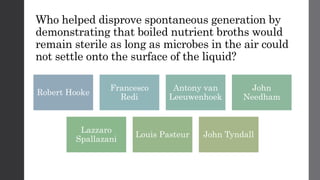
Who helped disprove spontaneous generation by
demonstrating that boiled nutrient broths would
remain sterile as long as microbes in the air could
not settle onto the surface of the liquid?
Robert Hooke
Francesco
Redi
Antony van
Leeuwenhoek
John
Needham
Lazzaro
Spallazani
Louis Pasteur John Tyndall
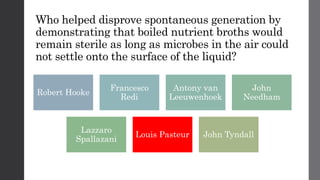
Who helped disprove spontaneous generation by
demonstrating that boiled nutrient broths would
remain sterile as long as microbes in the air could
not settle onto the surface of the liquid?
Robert Hooke
Francesco
Redi
Antony van
Leeuwenhoek
John
Needham
Lazzaro
Spallazani
Louis Pasteur John Tyndall
Whose experiments using boiling as a method of
sterilizing broths lead him to suggest that some
microbes exist in two forms, one that is
susceptible to heat and one that is not?
Robert Hooke
Francesco
Redi
Antony van
Leeuwenhoek
John
Needham
Lazzaro
Spallazani
Louis Pasteur John Tyndall
Whose experiments using boiling as a method of
sterilizing broths lead him to suggest that some
microbes exist in two forms, one that is
susceptible to heat and one that is not?
Robert Hooke
Francesco
Redi
Antony van
Leeuwenhoek
John
Needham
Lazzaro
Spallazani
Louis Pasteur John Tyndall
This researcher sealed boiled nutrient broths in
glass flasks in two ways, with corks and with
fused-necks, showing that only broths exposed to
air after boiling contained microbes.
Robert Hooke
Francesco
Redi
Antony van
Leeuwenhoek
John
Needham
Lazzaro
Spallazani
Louis Pasteur John Tyndall
This researcher sealed boiled nutrient broths in
glass flasks in two ways, with corks and with
fused-necks, showing that only broths exposed to
air after boiling contained microbes.
Robert Hooke
Francesco
Redi
Antony van
Leeuwenhoek
John
Needham
Lazzaro
Spallazani
Louis Pasteur John Tyndall
Who viewed and described the actions
of microbial “animalcules” using a
homemade microscope?
Robert Hooke
Francesco
Redi
Antony van
Leeuwenhoek
John
Needham
Lazzaro
Spallazani
Louis Pasteur John Tyndall
Who viewed and described the actions
of microbial “animalcules” using a
homemade microscope?
Robert Hooke
Francesco
Redi
Antony van
Leeuwenhoek
John
Needham
Lazzaro
Spallazani
Louis Pasteur John Tyndall
Whose early challenge to spontaneous
generation involved covering rotting meat
with gauze, preventing flies from landing
and depositing eggs?
Robert Hooke
Francesco
Redi
Antony van
Leeuwenhoek
John
Needham
Lazzaro
Spallazani
Louis Pasteur John Tyndall
Whose early challenge to spontaneous
generation involved covering rotting meat
with gauze, preventing flies from landing
and depositing eggs?
Robert Hooke
Francesco
Redi
Antony van
Leeuwenhoek
John
Needham
Lazzaro
Spallazani
Louis Pasteur John Tyndall
Who described the “microbial
mushroom” of bread mold using a
homemade microscope?
Robert Hooke
Francesco
Redi
Antony van
Leeuwenhoek
John
Needham
Lazzaro
Spallazani
Louis Pasteur John Tyndall
Who described the “microbial
mushroom” of bread mold using a
homemade microscope?
Robert Hooke
Francesco
Redi
Antony van
Leeuwenhoek
John
Needham
Lazzaro
Spallazani
Louis Pasteur John Tyndall
Who
invented a
method of
using heat
to sterilize
food that is
still in use
today?
Oliver Wendell Holmes & Ignaz
Semmelweiss
Joseph Lister
Louis Pasteur
Robert Koch
Antony van Leeuwenhoek
Who
invented a
method of
using heat
to sterilize
food that is
still in use
today?
Oliver Wendell Holmes & Ignaz
Semmelweiss
Joseph Lister
Louis Pasteur
Robert Koch
Antony van Leeuwenhoek
Who
pioneered
the use of
sterile
surgical
techniques?
Oliver Wendell Holmes & Ignaz
Semmelweiss
Joseph Lister
Louis Pasteur
Robert Koch
Antony van Leeuwenhoek
Who
pioneered
the use of
sterile
surgical
techniques?
Oliver Wendell Holmes & Ignaz
Semmelweiss
Joseph Lister
Louis Pasteur
Robert Koch
Antony van Leeuwenhoek
Who made
over 250
microscopes,
including
some that
were capable
of magnifying
specimens to
300 times
normal size?
Oliver Wendell Holmes & Ignaz
Semmelweiss
Joseph Lister
Louis Pasteur
Robert Koch
Antony van Leeuwenhoek
Who made
over 250
microscopes,
including
some that
were capable
of magnifying
specimens to
300 times
normal size?
Oliver Wendell Holmes & Ignaz
Semmelweiss
Joseph Lister
Louis Pasteur
Robert Koch
Antony van Leeuwenhoek
Who created
a logarithm
for
determining
the
pathogenicity
of an
organism and
the disease
resulting
from
infection?
Oliver Wendell Holmes & Ignaz
Semmelweiss
Joseph Lister
Louis Pasteur
Robert Koch
Antony van Leeuwenhoek
Who created
a logarithm
for
determining
the
pathogenicity
of an
organism and
the disease
resulting
from
infection?
Oliver Wendell Holmes & Ignaz
Semmelweiss
Joseph Lister
Louis Pasteur
Robert Koch
Antony van Leeuwenhoek
Who is
credited with
stressing the
importance of
handwashing
in clinical
settings?
Oliver Wendell Holmes & Ignaz
Semmelweiss
Joseph Lister
Louis Pasteur
Robert Koch
Antony van Leeuwenhoek
Who is
credited with
stressing the
importance of
handwashing
in clinical
settings?
Oliver Wendell Holmes & Ignaz
Semmelweiss
Joseph Lister
Louis Pasteur
Robert Koch
Antony van Leeuwenhoek
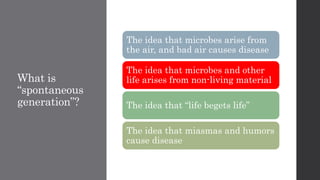
What is
“spontaneous
generation”?
The idea that microbes arise from
the air, and bad air causes disease
The idea that microbes and other
life arises from non-living material
The idea that “life begets life”
The idea that miasmas and humors
cause disease
What is
“spontaneous
generation”?
The idea that microbes arise from
the air, and bad air causes disease
The idea that microbes and other
life arises from non-living material
The idea that “life begets life”
The idea that miasmas and humors
cause disease
Microbiology Basics
This involves placing a sample on or into
a container of sterile medium containing
appropriate nutrients and chemical
reagents:
Inoculation Incubation Isolation Inspection Identification
This involves placing a sample on or into
a container of sterile medium containing
appropriate nutrients and chemical
reagents:
Inoculation Incubation Isolation Inspection Identification
This involves the use of staining
processes and microscopy to observe
the characteristics of a sample:
Inoculation Incubation Isolation Inspection Identification
This involves the use of staining
processes and microscopy to observe
the characteristics of a sample:
Inoculation Incubation Isolation Inspection Identification
This process may include genetic
analysis, immunological or biochemical
testing to determine which microbes are
present in a sample:
Inoculation Incubation Isolation Inspection Identification
This process may include genetic
analysis, immunological or biochemical
testing to determine which microbes are
present in a sample:
Inoculation Incubation Isolation Inspection Identification
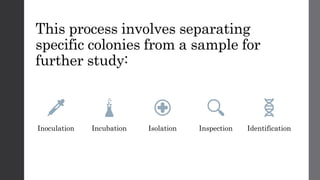
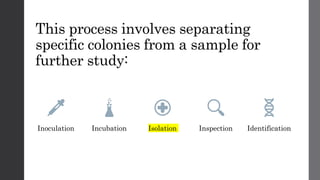
This process involves separating
specific colonies from a sample for
further study:
Inoculation Incubation Isolation Inspection Identification
This process involves separating
specific colonies from a sample for
further study:
Inoculation Incubation Isolation Inspection Identification
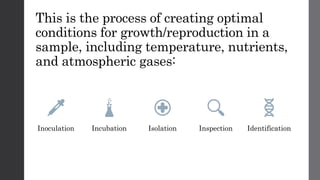
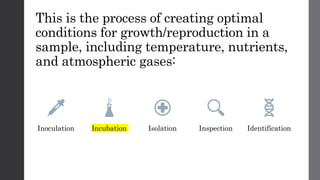
This is the process of creating optimal
conditions for growth/reproduction in a
sample, including temperature, nutrients,
and atmospheric gases:
Inoculation Incubation Isolation Inspection Identification
This is the process of creating optimal
conditions for growth/reproduction in a
sample, including temperature, nutrients,
and atmospheric gases:
Inoculation Incubation Isolation Inspection Identification
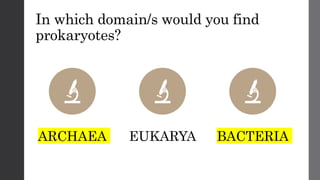
In which domain/s would you find
prokaryotes?
ARCHAEA EUKARYA BACTERIA
In which domain/s would you find
prokaryotes?
ARCHAEA EUKARYA BACTERIA
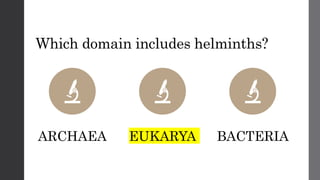
Which domain includes helminths?
ARCHAEA EUKARYA BACTERIA
Which domain includes helminths?
ARCHAEA EUKARYA BACTERIA
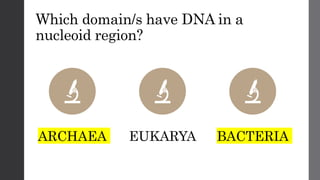
Which domain/s have DNA in a
nucleoid region?
ARCHAEA EUKARYA BACTERIA
Which domain/s have DNA in a
nucleoid region?
ARCHAEA EUKARYA BACTERIA
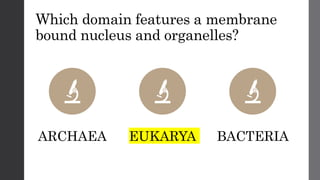
Which domain features a membrane
bound nucleus and organelles?
ARCHAEA EUKARYA BACTERIA
Which domain features a membrane
bound nucleus and organelles?
ARCHAEA EUKARYA BACTERIA
In which domain would you classify an
organism with a peptidoglycan cell wall?
ARCHAEA EUKARYA BACTERIA
In which domain would you classify an
organism with a peptidoglycan cell wall?
ARCHAEA EUKARYA BACTERIA
Which domain/s have 70s ribosomes?
ARCHAEA EUKARYA BACTERIA
Which domain/s have 70s ribosomes?
ARCHAEA EUKARYA BACTERIA
Which domain/s have circular DNA?
ARCHAEA EUKARYA BACTERIA
Which domain/s have circular DNA?
ARCHAEA EUKARYA BACTERIA
In which domain would you place
fungi?
ARCHAEA EUKARYA BACTERIA
In which domain would you place
fungi?
ARCHAEA EUKARYA BACTERIA
In which domain would you place
algae?
ARCHAEA EUKARYA BACTERIA
In which domain would you place
algae?
ARCHAEA EUKARYA BACTERIA
In which domain would you place
algae?
ARCHAEA EUKARYA BACTERIA
In which domain would you place
protozoans?
ARCHAEA EUKARYA BACTERIA
In which domain would you place
protozoans?
ARCHAEA EUKARYA BACTERIA
Which of the following statements is in
correct order from largest to smallest?
• Viruses, bacteria, eukaryotic cells, helminth
• Bacteria, viruses, helminth, eukaryotic cells
• Eukaryotic cells, helminth, viruses, bacteria
• Helminth, eukaryotic cells, bacteria, viruses
Which of the following statements is in
correct order from largest to smallest?
• Viruses, bacteria, eukaryotic cells, helminth
• Bacteria, viruses, helminth, eukaryotic cells
• Eukaryotic cells, helminth, viruses, bacteria
• Helminth, eukaryotic cells, bacteria, viruses
Staining
A ____ dye has a _____ charge, causing it to
_____ charged particles in the cell envelope.
• Basic, positive, bind to
• Acidic, negative, bind to
• Basic, positive, repel
• Acidic, positive, repel
A ____ dye has a _____ charge, causing it to
_____ charged particles in the cell envelope.
• Basic, positive, bind to
• Acidic, negative, bind to
• Basic, positive, repel
• Acidic, positive, repel
A ____ dye has a ____ charge, which is ______ by
charged particles in the cell envelope.
• Basic, positive, repelled
• Basic, negative, bound
• Acidic, negative, repelled
• Acidic, negative, bound
A ____ dye has a ____ charge, which is ______ by
charged particles in the cell envelope.
• Basic, positive, repelled
• Basic, negative, bound
• Acidic, negative, repelled
• Acidic, negative, bound
A positive stain colors the ____, and a
negative stain creates a _____.
• Background, cell
• Cell, silhouette
• Cell, contrast
• Envelope, colored sample
A positive stain colors the ____, and a
negative stain creates a _____.
• Background, cell
• Cell, silhouette
• Cell, contrast
• Envelope, colored sample
Which statement lists the reagents of
the Gram stain in the correct order?
• Gram’s iodine, alcohol, safranin,
crystal violet
• Safranin, alcohol, crystal violet,
iodine
• Crystal violet, alcohol, Gram’s iodine,
safranin
• Crystal violet, Gram’s iodine, alcohol,
safranin
Which statement lists the reagents of
the Gram stain in the correct order?
• Gram’s iodine, alcohol, safranin,
crystal violet
• Safranin, alcohol, crystal violet,
iodine
• Crystal violet, alcohol, Gram’s iodine,
safranin
• Crystal violet, Gram’s iodine, alcohol,
safranin
How does Gram staining differentiate
between Gram positive and Gram
negative bacteria?
• Gram negative bacteria turns blue, as the crystal violet is trapped by the
thick peptidoglycan cell wall, but is washed out of the thin Gram-positive
cell wall, which is permeable to the red safranin added in the last step
• Gram positive bacteria turns blue, as the crystal violet is trapped by the
thick peptidoglycan cell wall, but is washed out of the thin Gram-negative
cell wall, which is permeable to the red safranin added in the last step
• Gram positive bacteria is colorized in the Gram stain, but Gram negative
bacteria is not colorized
• Gram negative bacteria cannot be identified by the Gram stain, because it
has a waxy, impervious cell wall
How does Gram staining differentiate
between Gram positive and Gram
negative bacteria?
• Gram negative bacteria turns blue, as the crystal violet is trapped by the
thick peptidoglycan cell wall, but is washed out of the thin Gram-positive
cell wall, which is permeable to the red safranin added in the last step
• Gram positive bacteria turns blue, as the crystal violet is trapped by the
thick peptidoglycan cell wall, but is washed out of the thin Gram-negative
cell wall, which is permeable to the red safranin added in the last step
• Gram positive bacteria is colorized in the Gram stain, but Gram negative
bacteria is not colorized
• Gram negative bacteria cannot be identified by the Gram stain, because it
has a waxy, impervious cell wall
Which of the following can lead to
erroneous or inconclusive results in a
Gram stain?
• Overlong application of decolorizing agent washing crystal violet out of
Gram-positive bacteria
• Old bacterial samples (greater than 24 hours old) that are unable to take up
enough dye to yield conclusive results
• Under-colorizing the sample, so the bacteria are unable to take up the
crystal violet or safranin
• More than one but not all of these
• All of these may lead to inconclusive or incorrect results
Which of the following can lead to
erroneous or inconclusive results in a
Gram stain?
• Overlong application of decolorizing agent washing crystal violet out of
Gram-positive bacteria
• Old bacterial samples (greater than 24 hours old) that are unable to take up
enough dye to yield conclusive results
• Under-colorizing the sample, so the bacteria are unable to take up the
crystal violet or safranin
• More than one but not all of these
• All of these may lead to inconclusive or incorrect results
Why must Mycobacterium be
detected with an acid fast stain, and
not a simple stain or a Gram stain?
• Mycobacterium can be detected with a Gram stain using an augmented
procedure
• Mycobacterium does not have a peptidoglycan cell wall, so it will not bind
crystal violet or safranin
• Mycobacterium has high levels of mycolic acids in the cell wall, making it
impervious to most staining techniques
• Mycobacterium is a sporulating bacteria that can only be detected with an
endospore stain
Why must Mycobacterium be
detected with an acid fast stain, and
not a simple stain or a Gram stain?
• Mycobacterium can be detected with a Gram stain using an augmented
procedure
• Mycobacterium does not have a peptidoglycan cell wall, so it will not bind
crystal violet or safranin
• Mycobacterium has high levels of mycolic acids in the cell wall, making it
impervious to most staining techniques
• Mycobacterium is a sporulating bacteria that can only be detected with an
endospore stain
Which statement lists the steps of the
acid-fast stain in the correct order?
• Methylene blue is applied to sample, excess stain is rinsed away, sample is
decolorized with acid-alcohol, carbol-fuchsin stain is applied to sample
• Carbol-fuchsin stain is applied to sample, excess stain is rinsed away,
sample is decolorized with acid-alcohol, methylene blue is applied to sample.
• Carbol-fuchsin stain is applied to sample, sample is decolorized with acid-
alcohol, methylene blue is applied to sample, excess stain is rinsed away
• Methylene blue is applied to sample, excess stain is rinsed away, carbol-
fuchsin stain is applied to sample, sample is decolorized with acid-alcohol
Which statement lists the steps of the
acid-fast stain in the correct order?
• Methylene blue is applied to sample, excess stain is rinsed away, sample is
decolorized with acid-alcohol, carbol-fuchsin stain is applied to sample
• Carbol-fuchsin stain is applied to sample, excess stain is rinsed away,
sample is decolorized with acid-alcohol, methylene blue is applied to sample.
• Carbol-fuchsin stain is applied to sample, sample is decolorized with acid-
alcohol, methylene blue is applied to sample, excess stain is rinsed away
• Methylene blue is applied to sample, excess stain is rinsed away, carbol-
fuchsin stain is applied to sample, sample is decolorized with acid-alcohol
In the acid-fast stain, acid-fast organisms
appear ____ and other cells appear ____.
Pink,
colorless
1
Blue,
colorless
2
Blue, pink
3
Pink, blue
4
In the acid-fast stain, acid-fast organisms
appear ____ and other cells appear ____.
Pink,
colorless
1
Blue,
colorless
2
Blue, pink
3
Pink, blue
4
Microbial Pathogens
This bacterium causes a lung disease that can
be dormant for years:
Mycobacterium tuberculosis
Bacillus anthracis
Clostridium tetani
Clostridium perfringens
Escheria coli
This bacterium causes a lung disease that can
be dormant for years:
Mycobacterium tuberculosis
Bacillus anthracis
Clostridium tetani
Clostridium perfringens
Escheria coli
This sporulating bacterium causes a disease that is
linked to livestock and leather production:
Mycobacterium tuberculosis
Bacillus anthracis
Clostridium tetani
Clostridium perfringens
Escheria coli
This sporulating bacterium causes a disease that is
linked to livestock and leather production:
Mycobacterium tuberculosis
Bacillus anthracis
Clostridium tetani
Clostridium perfringens
Escheria coli
This bacterium causes leprosy:
Mycobacterium tuberculosis
Bacillus anthracis
Clostridium tetani
Clostridium perfringens
Escheria coli
This bacterium causes leprosy:
Mycobacterium tuberculosis
Bacillus anthracis
Clostridium tetani
Clostridium perfringens
Escheria coli
This bacterium has both harmless and highly
toxic strains:
Mycobacterium tuberculosis
Bacillus anthracis
Clostridium tetani
Clostridium perfringens
Escheria coli
This bacterium has both harmless and highly
toxic strains:
Mycobacterium tuberculosis
Bacillus anthracis
Clostridium tetani
Clostridium perfringens
Escheria coli
This bacterium causes a disease characterized by
sustained contractions of the skeletal muscles:
Mycobacterium tuberculosis
Bacillus anthracis
Clostridium tetani
Clostridium perfringens
Escheria coli
This bacterium causes a disease characterized by
sustained contractions of the skeletal muscles:
Mycobacterium tuberculosis
Bacillus anthracis
Clostridium tetani
Clostridium perfringens
Escheria coli
Microbial
Structure & Function
Which of the following statements
about flagella are true?
• Eukaryotic flagella are 10x thicker than bacterial flagella
• Bacteria, Archaea, and Eukarya have bacterial flagellum, archaellum, and
eukaryotic flagellum, respectively
• Bacterial flagella can be arranged singly or in groups, at one end, both ends,
or randomly around the cell perimeter
• Flagellated propulsion occurs in a series of runs and tumbles
• All of these statements are true
Which of the following statements
about flagella are true?
• Eukaryotic flagella are 10x thicker than bacterial flagella
• Bacteria, Archaea, and Eukarya have bacterial flagellum, archaellum, and
eukaryotic flagellum, respectively
• Bacterial flagella can be arranged singly or in groups, at one end, both ends,
or randomly around the cell perimeter
• Flagellated propulsion occurs in a series of runs and tumbles
• All of these statements are true
In this arrangement, flagella are clumped into
small bunches emerging from the same site:
Monotrichous
Lophotrichous
Amphitrichous
Peritrichous
In this arrangement, flagella are clumped into
small bunches emerging from the same site:
Monotrichous
Lophotrichous
Amphitrichous
Peritrichous
In this arrangement, a single flagellum
extends from one end of the cell:
Monotrichous
Lophotrichous
Amphitrichous
Peritrichous
In this arrangement, a single flagellum
extends from one end of the cell:
Monotrichous
Lophotrichous
Amphitrichous
Peritrichous
In this arrangement, two flagella extend from
opposite ends, or poles, of a cell:
Monotrichous
Lophotrichous
Amphitrichous
Peritrichous
In this arrangement, two flagella extend from
opposite ends, or poles, of a cell:
Monotrichous
Lophotrichous
Amphitrichous
Peritrichous
In this arrangement, flagella are scattered
randomly around the surface of the cell:
Monotrichous
Lophotrichous
Amphitrichous
Peritrichous
In this arrangement, flagella are scattered
randomly around the surface of the cell:
Monotrichous
Lophotrichous
Amphitrichous
Peritrichous
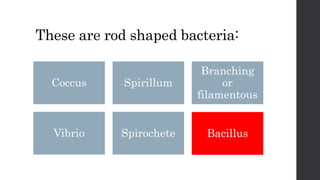
These are rod shaped bacteria:
Coccus Spirillum
Branching
or
filamentous
Vibrio Spirochete Bacillus
These are rod shaped bacteria:
Coccus Spirillum
Branching
or
filamentous
Vibrio Spirochete Bacillus
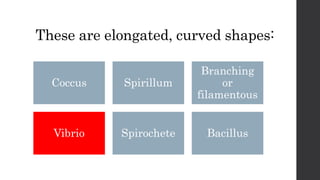
These are elongated, curved shapes:
Coccus Spirillum
Branching
or
filamentous
Vibrio Spirochete Bacillus
These are elongated, curved shapes:
Coccus Spirillum
Branching
or
filamentous
Vibrio Spirochete Bacillus
These are spiral or curved shapes:
Coccus Spirillum
Branching
or
filamentous
Vibrio Spirochete Bacillus
These are spiral or curved shapes:
Coccus Spirillum
Branching
or
filamentous
Vibrio Spirochete Bacillus
These are spherical bacteria:
Coccus Spirillum
Branching
or
filamentous
Vibrio Spirochete Bacillus
These are spherical bacteria:
Coccus Spirillum
Branching
or
filamentous
Vibrio Spirochete Bacillus
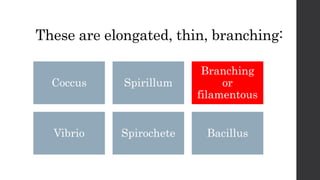
These are elongated, thin, branching:
Coccus Spirillum
Branching
or
filamentous
Vibrio Spirochete Bacillus
These are elongated, thin, branching:
Coccus Spirillum
Branching
or
filamentous
Vibrio Spirochete Bacillus
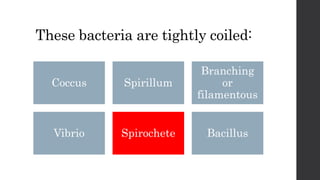
These bacteria are tightly coiled:
Coccus Spirillum
Branching
or
filamentous
Vibrio Spirochete Bacillus
These bacteria are tightly coiled:
Coccus Spirillum
Branching
or
filamentous
Vibrio Spirochete Bacillus
These appendages are found only in
eukaryotes:
Fimbriae
PiliCilia
Flagellum
These appendages are found only in
eukaryotes:
Fimbriae
Pili
Cilia
Flagellum
These short, thin pili are used by Gram-
negative bacteria to attach to epithelial
tissues in the mucous membranes:
Fimbriae
PiliCilia
Flagellum
These short, thin pili are used by Gram-
negative bacteria to attach to epithelial
tissues in the mucous membranes:
Fimbriae
PiliCilia
Flagellum
This appendage can be spun
counterclockwise to generate forward
propulsion:
Fimbriae
PiliCilia
Flagellum
This appendage can be spun
counterclockwise to generate forward
propulsion:
Fimbriae
PiliCilia
Flagellum
These structures are a means of
attachment and gene transfer during
conjugation:
Fimbriae
PiliCilia
Flagellum
These structures are a means of
attachment and gene transfer during
conjugation:
Fimbriae
Pili
Cilia
Flagellum
The Gram positive bacteria is characterized by a _____
layer of peptidoglycan in the cell wall, and the presence of
_____.
Thin, lipopolysaccharides
Thin, porins
Thick, tetrapeptides
Thick, teichoic acids
The Gram positive bacteria is characterized by a _____
layer of peptidoglycan in the cell wall, and the presence of
_____.
Thin, lipopolysaccharides
Thin, porins
Thick, tetrapeptides
Thick, teichoic acids
The Gram negative bacteria is characterized by a _____
layer of peptidoglycan in the cell wall, and the presence of
_____.
Thin, lipopolysaccharides
Thin, porins
Thick, tetrapeptides
Thick, teichoic acids
The Gram negative bacteria is characterized by a _____
layer of peptidoglycan in the cell wall, and the presence of
_____.
Thin, lipopolysaccharides
Thin, porins
Thick, tetrapeptides
Thick, teichoic acids
This structural feature of the Gram-
negative cell wall is an endotoxin,
making infections by these bacteria
severe:
• Periplasm
• Teichoic acids
• Peptidoglycan
• Lipopolysaccharide
This structural feature of the Gram-
negative cell wall is an endotoxin,
making infections by these bacteria
severe:
• Periplasm
• Teichoic acids
• Peptidoglycan
• Lipopolysaccharide
Which statement places the layers off the
Gram negative bacterial cell envelope in the
correct order from superficial to deep?
Microbes and Disease
Most microorganisms are beneficial,
or at least not harmful, to humans:
True False
Most microorganisms are beneficial,
or at least not harmful, to humans:
True False
Which of the following are industrial
uses for microbes?
• Fermenting yogurt, cheese, beer & wine
• Producing insulin for human use
• “Bioremediation” to break down pollutants like PCBs and oil spills
• Synthesis of plastics, cellulose, biofuels
• Synthesis of antibiotics and amino acids
• All of these
Which of the following are industrial
uses for microbes?
• Fermenting yogurt, cheese, beer & wine
• Producing insulin for human use
• “Bioremediation” to break down pollutants like PCBs and oil spills
• Synthesis of plastics, cellulose, biofuels
• Synthesis of antibiotics and amino acids
• All of these
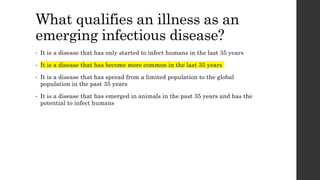
What qualifies an illness as an
emerging infectious disease?
• It is a disease that has only started to infect humans in the last 35 years
• It is a disease that has become more common in the last 35 years
• It is a disease that has spread from a limited population to the global
population in the past 35 years
• It is a disease that has emerged in animals in the past 35 years and has the
potential to infect humans
What qualifies an illness as an
emerging infectious disease?
• It is a disease that has only started to infect humans in the last 35 years
• It is a disease that has become more common in the last 35 years
• It is a disease that has spread from a limited population to the global
population in the past 35 years
• It is a disease that has emerged in animals in the past 35 years and has the
potential to infect humans
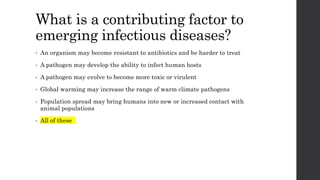
What is a contributing factor to
emerging infectious diseases?
• An organism may become resistant to antibiotics and be harder to treat
• A pathogen may develop the ability to infect human hosts
• A pathogen may evolve to become more toxic or virulent
• Global warming may increase the range of warm climate pathogens
• Population spread may bring humans into new or increased contact with
animal populations
• All of these
What is a contributing factor to
emerging infectious diseases?
• An organism may become resistant to antibiotics and be harder to treat
• A pathogen may develop the ability to infect human hosts
• A pathogen may evolve to become more toxic or virulent
• Global warming may increase the range of warm climate pathogens
• Population spread may bring humans into new or increased contact with
animal populations
• All of these
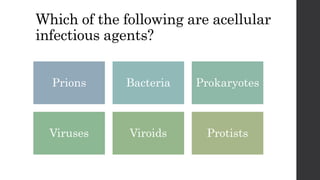
Which of the following are acellular
infectious agents?
Prions Bacteria Prokaryotes
Viruses Viroids Protists
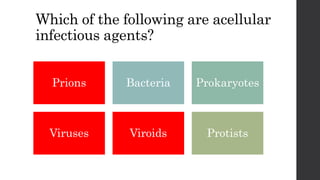
Which of the following are acellular
infectious agents?
Prions Bacteria Prokaryotes
Viruses Viroids Protists

Microbiology

  • 1.
  • 2.
  • 3.
    Whose discovery ofmicrobes in sealed flasks of broth that had been boiled revived the theory of spontaneous generation? Robert Hooke Francesco Redi Antony van Leeuwenhoek John Needham Lazzaro Spallazani Louis Pasteur John Tyndall
  • 4.
    Whose discovery ofmicrobes in sealed flasks of broth that had been boiled revived the theory of spontaneous generation? Robert Hooke Francesco Redi Antony van Leeuwenhoek John Needham Lazzaro Spallazani Louis Pasteur John Tyndall
  • 5.
    Who helped disprovespontaneous generation by demonstrating that boiled nutrient broths would remain sterile as long as microbes in the air could not settle onto the surface of the liquid? Robert Hooke Francesco Redi Antony van Leeuwenhoek John Needham Lazzaro Spallazani Louis Pasteur John Tyndall
  • 6.
    Who helped disprovespontaneous generation by demonstrating that boiled nutrient broths would remain sterile as long as microbes in the air could not settle onto the surface of the liquid? Robert Hooke Francesco Redi Antony van Leeuwenhoek John Needham Lazzaro Spallazani Louis Pasteur John Tyndall
  • 7.
    Whose experiments usingboiling as a method of sterilizing broths lead him to suggest that some microbes exist in two forms, one that is susceptible to heat and one that is not? Robert Hooke Francesco Redi Antony van Leeuwenhoek John Needham Lazzaro Spallazani Louis Pasteur John Tyndall
  • 8.
    Whose experiments usingboiling as a method of sterilizing broths lead him to suggest that some microbes exist in two forms, one that is susceptible to heat and one that is not? Robert Hooke Francesco Redi Antony van Leeuwenhoek John Needham Lazzaro Spallazani Louis Pasteur John Tyndall
  • 9.
    This researcher sealedboiled nutrient broths in glass flasks in two ways, with corks and with fused-necks, showing that only broths exposed to air after boiling contained microbes. Robert Hooke Francesco Redi Antony van Leeuwenhoek John Needham Lazzaro Spallazani Louis Pasteur John Tyndall
  • 10.
    This researcher sealedboiled nutrient broths in glass flasks in two ways, with corks and with fused-necks, showing that only broths exposed to air after boiling contained microbes. Robert Hooke Francesco Redi Antony van Leeuwenhoek John Needham Lazzaro Spallazani Louis Pasteur John Tyndall
  • 11.
    Who viewed anddescribed the actions of microbial “animalcules” using a homemade microscope? Robert Hooke Francesco Redi Antony van Leeuwenhoek John Needham Lazzaro Spallazani Louis Pasteur John Tyndall
  • 12.
    Who viewed anddescribed the actions of microbial “animalcules” using a homemade microscope? Robert Hooke Francesco Redi Antony van Leeuwenhoek John Needham Lazzaro Spallazani Louis Pasteur John Tyndall
  • 13.
    Whose early challengeto spontaneous generation involved covering rotting meat with gauze, preventing flies from landing and depositing eggs? Robert Hooke Francesco Redi Antony van Leeuwenhoek John Needham Lazzaro Spallazani Louis Pasteur John Tyndall
  • 14.
    Whose early challengeto spontaneous generation involved covering rotting meat with gauze, preventing flies from landing and depositing eggs? Robert Hooke Francesco Redi Antony van Leeuwenhoek John Needham Lazzaro Spallazani Louis Pasteur John Tyndall
  • 15.
    Who described the“microbial mushroom” of bread mold using a homemade microscope? Robert Hooke Francesco Redi Antony van Leeuwenhoek John Needham Lazzaro Spallazani Louis Pasteur John Tyndall
  • 16.
    Who described the“microbial mushroom” of bread mold using a homemade microscope? Robert Hooke Francesco Redi Antony van Leeuwenhoek John Needham Lazzaro Spallazani Louis Pasteur John Tyndall
  • 17.
    Who invented a method of usingheat to sterilize food that is still in use today? Oliver Wendell Holmes & Ignaz Semmelweiss Joseph Lister Louis Pasteur Robert Koch Antony van Leeuwenhoek
  • 18.
    Who invented a method of usingheat to sterilize food that is still in use today? Oliver Wendell Holmes & Ignaz Semmelweiss Joseph Lister Louis Pasteur Robert Koch Antony van Leeuwenhoek
  • 19.
    Who pioneered the use of sterile surgical techniques? OliverWendell Holmes & Ignaz Semmelweiss Joseph Lister Louis Pasteur Robert Koch Antony van Leeuwenhoek
  • 20.
    Who pioneered the use of sterile surgical techniques? OliverWendell Holmes & Ignaz Semmelweiss Joseph Lister Louis Pasteur Robert Koch Antony van Leeuwenhoek
  • 21.
    Who made over 250 microscopes, including somethat were capable of magnifying specimens to 300 times normal size? Oliver Wendell Holmes & Ignaz Semmelweiss Joseph Lister Louis Pasteur Robert Koch Antony van Leeuwenhoek
  • 22.
    Who made over 250 microscopes, including somethat were capable of magnifying specimens to 300 times normal size? Oliver Wendell Holmes & Ignaz Semmelweiss Joseph Lister Louis Pasteur Robert Koch Antony van Leeuwenhoek
  • 23.
    Who created a logarithm for determining the pathogenicity ofan organism and the disease resulting from infection? Oliver Wendell Holmes & Ignaz Semmelweiss Joseph Lister Louis Pasteur Robert Koch Antony van Leeuwenhoek
  • 24.
    Who created a logarithm for determining the pathogenicity ofan organism and the disease resulting from infection? Oliver Wendell Holmes & Ignaz Semmelweiss Joseph Lister Louis Pasteur Robert Koch Antony van Leeuwenhoek
  • 25.
    Who is credited with stressingthe importance of handwashing in clinical settings? Oliver Wendell Holmes & Ignaz Semmelweiss Joseph Lister Louis Pasteur Robert Koch Antony van Leeuwenhoek
  • 26.
    Who is credited with stressingthe importance of handwashing in clinical settings? Oliver Wendell Holmes & Ignaz Semmelweiss Joseph Lister Louis Pasteur Robert Koch Antony van Leeuwenhoek
  • 27.
    What is “spontaneous generation”? The ideathat microbes arise from the air, and bad air causes disease The idea that microbes and other life arises from non-living material The idea that “life begets life” The idea that miasmas and humors cause disease
  • 28.
    What is “spontaneous generation”? The ideathat microbes arise from the air, and bad air causes disease The idea that microbes and other life arises from non-living material The idea that “life begets life” The idea that miasmas and humors cause disease
  • 29.
  • 30.
    This involves placinga sample on or into a container of sterile medium containing appropriate nutrients and chemical reagents: Inoculation Incubation Isolation Inspection Identification
  • 31.
    This involves placinga sample on or into a container of sterile medium containing appropriate nutrients and chemical reagents: Inoculation Incubation Isolation Inspection Identification
  • 32.
    This involves theuse of staining processes and microscopy to observe the characteristics of a sample: Inoculation Incubation Isolation Inspection Identification
  • 33.
    This involves theuse of staining processes and microscopy to observe the characteristics of a sample: Inoculation Incubation Isolation Inspection Identification
  • 34.
    This process mayinclude genetic analysis, immunological or biochemical testing to determine which microbes are present in a sample: Inoculation Incubation Isolation Inspection Identification
  • 35.
    This process mayinclude genetic analysis, immunological or biochemical testing to determine which microbes are present in a sample: Inoculation Incubation Isolation Inspection Identification
  • 36.
    This process involvesseparating specific colonies from a sample for further study: Inoculation Incubation Isolation Inspection Identification
  • 37.
    This process involvesseparating specific colonies from a sample for further study: Inoculation Incubation Isolation Inspection Identification
  • 38.
    This is theprocess of creating optimal conditions for growth/reproduction in a sample, including temperature, nutrients, and atmospheric gases: Inoculation Incubation Isolation Inspection Identification
  • 39.
    This is theprocess of creating optimal conditions for growth/reproduction in a sample, including temperature, nutrients, and atmospheric gases: Inoculation Incubation Isolation Inspection Identification
  • 40.
    In which domain/swould you find prokaryotes? ARCHAEA EUKARYA BACTERIA
  • 41.
    In which domain/swould you find prokaryotes? ARCHAEA EUKARYA BACTERIA
  • 42.
    Which domain includeshelminths? ARCHAEA EUKARYA BACTERIA
  • 43.
    Which domain includeshelminths? ARCHAEA EUKARYA BACTERIA
  • 44.
    Which domain/s haveDNA in a nucleoid region? ARCHAEA EUKARYA BACTERIA
  • 45.
    Which domain/s haveDNA in a nucleoid region? ARCHAEA EUKARYA BACTERIA
  • 46.
    Which domain featuresa membrane bound nucleus and organelles? ARCHAEA EUKARYA BACTERIA
  • 47.
    Which domain featuresa membrane bound nucleus and organelles? ARCHAEA EUKARYA BACTERIA
  • 48.
    In which domainwould you classify an organism with a peptidoglycan cell wall? ARCHAEA EUKARYA BACTERIA
  • 49.
    In which domainwould you classify an organism with a peptidoglycan cell wall? ARCHAEA EUKARYA BACTERIA
  • 50.
    Which domain/s have70s ribosomes? ARCHAEA EUKARYA BACTERIA
  • 51.
    Which domain/s have70s ribosomes? ARCHAEA EUKARYA BACTERIA
  • 52.
    Which domain/s havecircular DNA? ARCHAEA EUKARYA BACTERIA
  • 53.
    Which domain/s havecircular DNA? ARCHAEA EUKARYA BACTERIA
  • 54.
    In which domainwould you place fungi? ARCHAEA EUKARYA BACTERIA
  • 55.
    In which domainwould you place fungi? ARCHAEA EUKARYA BACTERIA
  • 56.
    In which domainwould you place algae? ARCHAEA EUKARYA BACTERIA
  • 57.
    In which domainwould you place algae? ARCHAEA EUKARYA BACTERIA
  • 58.
    In which domainwould you place algae? ARCHAEA EUKARYA BACTERIA
  • 59.
    In which domainwould you place protozoans? ARCHAEA EUKARYA BACTERIA
  • 60.
    In which domainwould you place protozoans? ARCHAEA EUKARYA BACTERIA
  • 61.
    Which of thefollowing statements is in correct order from largest to smallest? • Viruses, bacteria, eukaryotic cells, helminth • Bacteria, viruses, helminth, eukaryotic cells • Eukaryotic cells, helminth, viruses, bacteria • Helminth, eukaryotic cells, bacteria, viruses
  • 62.
    Which of thefollowing statements is in correct order from largest to smallest? • Viruses, bacteria, eukaryotic cells, helminth • Bacteria, viruses, helminth, eukaryotic cells • Eukaryotic cells, helminth, viruses, bacteria • Helminth, eukaryotic cells, bacteria, viruses
  • 63.
  • 64.
    A ____ dyehas a _____ charge, causing it to _____ charged particles in the cell envelope. • Basic, positive, bind to • Acidic, negative, bind to • Basic, positive, repel • Acidic, positive, repel
  • 65.
    A ____ dyehas a _____ charge, causing it to _____ charged particles in the cell envelope. • Basic, positive, bind to • Acidic, negative, bind to • Basic, positive, repel • Acidic, positive, repel
  • 66.
    A ____ dyehas a ____ charge, which is ______ by charged particles in the cell envelope. • Basic, positive, repelled • Basic, negative, bound • Acidic, negative, repelled • Acidic, negative, bound
  • 67.
    A ____ dyehas a ____ charge, which is ______ by charged particles in the cell envelope. • Basic, positive, repelled • Basic, negative, bound • Acidic, negative, repelled • Acidic, negative, bound
  • 68.
    A positive staincolors the ____, and a negative stain creates a _____. • Background, cell • Cell, silhouette • Cell, contrast • Envelope, colored sample
  • 69.
    A positive staincolors the ____, and a negative stain creates a _____. • Background, cell • Cell, silhouette • Cell, contrast • Envelope, colored sample
  • 70.
    Which statement liststhe reagents of the Gram stain in the correct order? • Gram’s iodine, alcohol, safranin, crystal violet • Safranin, alcohol, crystal violet, iodine • Crystal violet, alcohol, Gram’s iodine, safranin • Crystal violet, Gram’s iodine, alcohol, safranin
  • 71.
    Which statement liststhe reagents of the Gram stain in the correct order? • Gram’s iodine, alcohol, safranin, crystal violet • Safranin, alcohol, crystal violet, iodine • Crystal violet, alcohol, Gram’s iodine, safranin • Crystal violet, Gram’s iodine, alcohol, safranin
  • 72.
    How does Gramstaining differentiate between Gram positive and Gram negative bacteria? • Gram negative bacteria turns blue, as the crystal violet is trapped by the thick peptidoglycan cell wall, but is washed out of the thin Gram-positive cell wall, which is permeable to the red safranin added in the last step • Gram positive bacteria turns blue, as the crystal violet is trapped by the thick peptidoglycan cell wall, but is washed out of the thin Gram-negative cell wall, which is permeable to the red safranin added in the last step • Gram positive bacteria is colorized in the Gram stain, but Gram negative bacteria is not colorized • Gram negative bacteria cannot be identified by the Gram stain, because it has a waxy, impervious cell wall
  • 73.
    How does Gramstaining differentiate between Gram positive and Gram negative bacteria? • Gram negative bacteria turns blue, as the crystal violet is trapped by the thick peptidoglycan cell wall, but is washed out of the thin Gram-positive cell wall, which is permeable to the red safranin added in the last step • Gram positive bacteria turns blue, as the crystal violet is trapped by the thick peptidoglycan cell wall, but is washed out of the thin Gram-negative cell wall, which is permeable to the red safranin added in the last step • Gram positive bacteria is colorized in the Gram stain, but Gram negative bacteria is not colorized • Gram negative bacteria cannot be identified by the Gram stain, because it has a waxy, impervious cell wall
  • 74.
    Which of thefollowing can lead to erroneous or inconclusive results in a Gram stain? • Overlong application of decolorizing agent washing crystal violet out of Gram-positive bacteria • Old bacterial samples (greater than 24 hours old) that are unable to take up enough dye to yield conclusive results • Under-colorizing the sample, so the bacteria are unable to take up the crystal violet or safranin • More than one but not all of these • All of these may lead to inconclusive or incorrect results
  • 75.
    Which of thefollowing can lead to erroneous or inconclusive results in a Gram stain? • Overlong application of decolorizing agent washing crystal violet out of Gram-positive bacteria • Old bacterial samples (greater than 24 hours old) that are unable to take up enough dye to yield conclusive results • Under-colorizing the sample, so the bacteria are unable to take up the crystal violet or safranin • More than one but not all of these • All of these may lead to inconclusive or incorrect results
  • 76.
    Why must Mycobacteriumbe detected with an acid fast stain, and not a simple stain or a Gram stain? • Mycobacterium can be detected with a Gram stain using an augmented procedure • Mycobacterium does not have a peptidoglycan cell wall, so it will not bind crystal violet or safranin • Mycobacterium has high levels of mycolic acids in the cell wall, making it impervious to most staining techniques • Mycobacterium is a sporulating bacteria that can only be detected with an endospore stain
  • 77.
    Why must Mycobacteriumbe detected with an acid fast stain, and not a simple stain or a Gram stain? • Mycobacterium can be detected with a Gram stain using an augmented procedure • Mycobacterium does not have a peptidoglycan cell wall, so it will not bind crystal violet or safranin • Mycobacterium has high levels of mycolic acids in the cell wall, making it impervious to most staining techniques • Mycobacterium is a sporulating bacteria that can only be detected with an endospore stain
  • 78.
    Which statement liststhe steps of the acid-fast stain in the correct order? • Methylene blue is applied to sample, excess stain is rinsed away, sample is decolorized with acid-alcohol, carbol-fuchsin stain is applied to sample • Carbol-fuchsin stain is applied to sample, excess stain is rinsed away, sample is decolorized with acid-alcohol, methylene blue is applied to sample. • Carbol-fuchsin stain is applied to sample, sample is decolorized with acid- alcohol, methylene blue is applied to sample, excess stain is rinsed away • Methylene blue is applied to sample, excess stain is rinsed away, carbol- fuchsin stain is applied to sample, sample is decolorized with acid-alcohol
  • 79.
    Which statement liststhe steps of the acid-fast stain in the correct order? • Methylene blue is applied to sample, excess stain is rinsed away, sample is decolorized with acid-alcohol, carbol-fuchsin stain is applied to sample • Carbol-fuchsin stain is applied to sample, excess stain is rinsed away, sample is decolorized with acid-alcohol, methylene blue is applied to sample. • Carbol-fuchsin stain is applied to sample, sample is decolorized with acid- alcohol, methylene blue is applied to sample, excess stain is rinsed away • Methylene blue is applied to sample, excess stain is rinsed away, carbol- fuchsin stain is applied to sample, sample is decolorized with acid-alcohol
  • 80.
    In the acid-faststain, acid-fast organisms appear ____ and other cells appear ____. Pink, colorless 1 Blue, colorless 2 Blue, pink 3 Pink, blue 4
  • 81.
    In the acid-faststain, acid-fast organisms appear ____ and other cells appear ____. Pink, colorless 1 Blue, colorless 2 Blue, pink 3 Pink, blue 4
  • 82.
  • 83.
    This bacterium causesa lung disease that can be dormant for years: Mycobacterium tuberculosis Bacillus anthracis Clostridium tetani Clostridium perfringens Escheria coli
  • 84.
    This bacterium causesa lung disease that can be dormant for years: Mycobacterium tuberculosis Bacillus anthracis Clostridium tetani Clostridium perfringens Escheria coli
  • 85.
    This sporulating bacteriumcauses a disease that is linked to livestock and leather production: Mycobacterium tuberculosis Bacillus anthracis Clostridium tetani Clostridium perfringens Escheria coli
  • 86.
    This sporulating bacteriumcauses a disease that is linked to livestock and leather production: Mycobacterium tuberculosis Bacillus anthracis Clostridium tetani Clostridium perfringens Escheria coli
  • 87.
    This bacterium causesleprosy: Mycobacterium tuberculosis Bacillus anthracis Clostridium tetani Clostridium perfringens Escheria coli
  • 88.
    This bacterium causesleprosy: Mycobacterium tuberculosis Bacillus anthracis Clostridium tetani Clostridium perfringens Escheria coli
  • 89.
    This bacterium hasboth harmless and highly toxic strains: Mycobacterium tuberculosis Bacillus anthracis Clostridium tetani Clostridium perfringens Escheria coli
  • 90.
    This bacterium hasboth harmless and highly toxic strains: Mycobacterium tuberculosis Bacillus anthracis Clostridium tetani Clostridium perfringens Escheria coli
  • 91.
    This bacterium causesa disease characterized by sustained contractions of the skeletal muscles: Mycobacterium tuberculosis Bacillus anthracis Clostridium tetani Clostridium perfringens Escheria coli
  • 92.
    This bacterium causesa disease characterized by sustained contractions of the skeletal muscles: Mycobacterium tuberculosis Bacillus anthracis Clostridium tetani Clostridium perfringens Escheria coli
  • 93.
  • 94.
    Which of thefollowing statements about flagella are true? • Eukaryotic flagella are 10x thicker than bacterial flagella • Bacteria, Archaea, and Eukarya have bacterial flagellum, archaellum, and eukaryotic flagellum, respectively • Bacterial flagella can be arranged singly or in groups, at one end, both ends, or randomly around the cell perimeter • Flagellated propulsion occurs in a series of runs and tumbles • All of these statements are true
  • 95.
    Which of thefollowing statements about flagella are true? • Eukaryotic flagella are 10x thicker than bacterial flagella • Bacteria, Archaea, and Eukarya have bacterial flagellum, archaellum, and eukaryotic flagellum, respectively • Bacterial flagella can be arranged singly or in groups, at one end, both ends, or randomly around the cell perimeter • Flagellated propulsion occurs in a series of runs and tumbles • All of these statements are true
  • 96.
    In this arrangement,flagella are clumped into small bunches emerging from the same site: Monotrichous Lophotrichous Amphitrichous Peritrichous
  • 97.
    In this arrangement,flagella are clumped into small bunches emerging from the same site: Monotrichous Lophotrichous Amphitrichous Peritrichous
  • 98.
    In this arrangement,a single flagellum extends from one end of the cell: Monotrichous Lophotrichous Amphitrichous Peritrichous
  • 99.
    In this arrangement,a single flagellum extends from one end of the cell: Monotrichous Lophotrichous Amphitrichous Peritrichous
  • 100.
    In this arrangement,two flagella extend from opposite ends, or poles, of a cell: Monotrichous Lophotrichous Amphitrichous Peritrichous
  • 101.
    In this arrangement,two flagella extend from opposite ends, or poles, of a cell: Monotrichous Lophotrichous Amphitrichous Peritrichous
  • 102.
    In this arrangement,flagella are scattered randomly around the surface of the cell: Monotrichous Lophotrichous Amphitrichous Peritrichous
  • 103.
    In this arrangement,flagella are scattered randomly around the surface of the cell: Monotrichous Lophotrichous Amphitrichous Peritrichous
  • 104.
    These are rodshaped bacteria: Coccus Spirillum Branching or filamentous Vibrio Spirochete Bacillus
  • 105.
    These are rodshaped bacteria: Coccus Spirillum Branching or filamentous Vibrio Spirochete Bacillus
  • 106.
    These are elongated,curved shapes: Coccus Spirillum Branching or filamentous Vibrio Spirochete Bacillus
  • 107.
    These are elongated,curved shapes: Coccus Spirillum Branching or filamentous Vibrio Spirochete Bacillus
  • 108.
    These are spiralor curved shapes: Coccus Spirillum Branching or filamentous Vibrio Spirochete Bacillus
  • 109.
    These are spiralor curved shapes: Coccus Spirillum Branching or filamentous Vibrio Spirochete Bacillus
  • 110.
    These are sphericalbacteria: Coccus Spirillum Branching or filamentous Vibrio Spirochete Bacillus
  • 111.
    These are sphericalbacteria: Coccus Spirillum Branching or filamentous Vibrio Spirochete Bacillus
  • 112.
    These are elongated,thin, branching: Coccus Spirillum Branching or filamentous Vibrio Spirochete Bacillus
  • 113.
    These are elongated,thin, branching: Coccus Spirillum Branching or filamentous Vibrio Spirochete Bacillus
  • 114.
    These bacteria aretightly coiled: Coccus Spirillum Branching or filamentous Vibrio Spirochete Bacillus
  • 115.
    These bacteria aretightly coiled: Coccus Spirillum Branching or filamentous Vibrio Spirochete Bacillus
  • 116.
    These appendages arefound only in eukaryotes: Fimbriae PiliCilia Flagellum
  • 117.
    These appendages arefound only in eukaryotes: Fimbriae Pili Cilia Flagellum
  • 118.
    These short, thinpili are used by Gram- negative bacteria to attach to epithelial tissues in the mucous membranes: Fimbriae PiliCilia Flagellum
  • 119.
    These short, thinpili are used by Gram- negative bacteria to attach to epithelial tissues in the mucous membranes: Fimbriae PiliCilia Flagellum
  • 120.
    This appendage canbe spun counterclockwise to generate forward propulsion: Fimbriae PiliCilia Flagellum
  • 121.
    This appendage canbe spun counterclockwise to generate forward propulsion: Fimbriae PiliCilia Flagellum
  • 122.
    These structures area means of attachment and gene transfer during conjugation: Fimbriae PiliCilia Flagellum
  • 123.
    These structures area means of attachment and gene transfer during conjugation: Fimbriae Pili Cilia Flagellum
  • 124.
    The Gram positivebacteria is characterized by a _____ layer of peptidoglycan in the cell wall, and the presence of _____. Thin, lipopolysaccharides Thin, porins Thick, tetrapeptides Thick, teichoic acids
  • 125.
    The Gram positivebacteria is characterized by a _____ layer of peptidoglycan in the cell wall, and the presence of _____. Thin, lipopolysaccharides Thin, porins Thick, tetrapeptides Thick, teichoic acids
  • 126.
    The Gram negativebacteria is characterized by a _____ layer of peptidoglycan in the cell wall, and the presence of _____. Thin, lipopolysaccharides Thin, porins Thick, tetrapeptides Thick, teichoic acids
  • 127.
    The Gram negativebacteria is characterized by a _____ layer of peptidoglycan in the cell wall, and the presence of _____. Thin, lipopolysaccharides Thin, porins Thick, tetrapeptides Thick, teichoic acids
  • 128.
    This structural featureof the Gram- negative cell wall is an endotoxin, making infections by these bacteria severe: • Periplasm • Teichoic acids • Peptidoglycan • Lipopolysaccharide
  • 129.
    This structural featureof the Gram- negative cell wall is an endotoxin, making infections by these bacteria severe: • Periplasm • Teichoic acids • Peptidoglycan • Lipopolysaccharide
  • 130.
    Which statement placesthe layers off the Gram negative bacterial cell envelope in the correct order from superficial to deep?
  • 131.
  • 132.
    Most microorganisms arebeneficial, or at least not harmful, to humans: True False
  • 133.
    Most microorganisms arebeneficial, or at least not harmful, to humans: True False
  • 134.
    Which of thefollowing are industrial uses for microbes? • Fermenting yogurt, cheese, beer & wine • Producing insulin for human use • “Bioremediation” to break down pollutants like PCBs and oil spills • Synthesis of plastics, cellulose, biofuels • Synthesis of antibiotics and amino acids • All of these
  • 135.
    Which of thefollowing are industrial uses for microbes? • Fermenting yogurt, cheese, beer & wine • Producing insulin for human use • “Bioremediation” to break down pollutants like PCBs and oil spills • Synthesis of plastics, cellulose, biofuels • Synthesis of antibiotics and amino acids • All of these
  • 136.
    What qualifies anillness as an emerging infectious disease? • It is a disease that has only started to infect humans in the last 35 years • It is a disease that has become more common in the last 35 years • It is a disease that has spread from a limited population to the global population in the past 35 years • It is a disease that has emerged in animals in the past 35 years and has the potential to infect humans
  • 137.
    What qualifies anillness as an emerging infectious disease? • It is a disease that has only started to infect humans in the last 35 years • It is a disease that has become more common in the last 35 years • It is a disease that has spread from a limited population to the global population in the past 35 years • It is a disease that has emerged in animals in the past 35 years and has the potential to infect humans
  • 138.
    What is acontributing factor to emerging infectious diseases? • An organism may become resistant to antibiotics and be harder to treat • A pathogen may develop the ability to infect human hosts • A pathogen may evolve to become more toxic or virulent • Global warming may increase the range of warm climate pathogens • Population spread may bring humans into new or increased contact with animal populations • All of these
  • 139.
    What is acontributing factor to emerging infectious diseases? • An organism may become resistant to antibiotics and be harder to treat • A pathogen may develop the ability to infect human hosts • A pathogen may evolve to become more toxic or virulent • Global warming may increase the range of warm climate pathogens • Population spread may bring humans into new or increased contact with animal populations • All of these
  • 140.
    Which of thefollowing are acellular infectious agents? Prions Bacteria Prokaryotes Viruses Viroids Protists

  • 141.
    Which of thefollowing are acellular infectious agents? Prions Bacteria Prokaryotes Viruses Viroids Protists