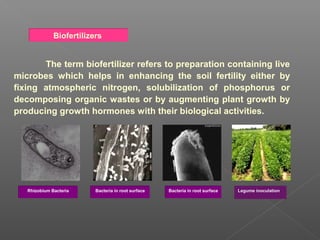
The term biofertilizer refers to preparation containing live
microbes which helps in enhancing the soil fertility either by
fixing atmospheric nitrogen, solubilization of phosphorus or
decomposing organic wastes or by augmenting plant growth by
producing growth hormones with their biological activities.
BiofertilizersBiofertilizers
Bacteria in root surfaceBacteria in root surface Bacteria in root surfaceBacteria in root surface Legume inoculationLegume inoculationRhizobium BacteriaRhizobium Bacteria
The role of biofertilizers assumes special
significance due to increased cost of
chemical fertilizers and their ill effects on
soil health
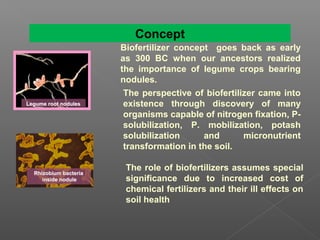
Legume root nodulesLegume root nodules
Rhizobium bacteria
inside nodule
Rhizobium bacteria
inside nodule
Biofertilizer concept goes back as early
as 300 BC when our ancestors realized
the importance of legume crops bearing
nodules.
The perspective of biofertilizer came into
existence through discovery of many
organisms capable of nitrogen fixation, P-
solubilization, P. mobilization, potash
solubilization and micronutrient
transformation in the soil.
Concept
Advantages of Biofertilizers
Renewable source of nutrients
Sustain soil health
Supplement chemical fertilizers.
Replace 25-30% chemical fertilizers
Increase the grain yields by 10-40%.
Decompose plant residues, and stabilize C:N ratio of soil
Improve texture, structure and water holding capacity of soil
No adverse effect on plant growth and soil fertility.
Stimulates plant growth by secreting growth hormones.
Secrete fungistatic and antibiotic like substances
Solubilize and mobilize nutrients
Eco-friendly, non-pollutants and cost effective method
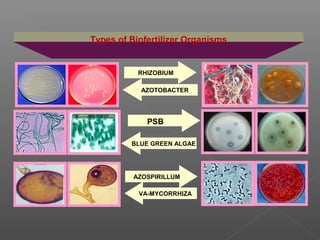
Types of Biofertilizer Organisms
RHIZOBIUM
AZOSPIRILLUM
VA-MYCORRHIZA
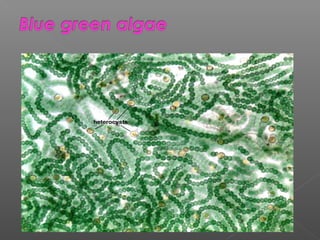
BLUE GREEN ALGAE
AZOTOBACTER
PSB
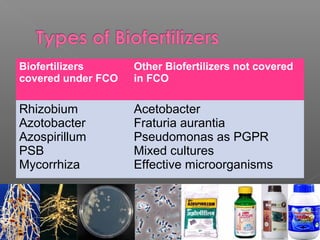
Biofertilizers
covered under FCO
Other Biofertilizers not covered
in FCO
Rhizobium
Azotobacter
Azospirillum
PSB
Mycorrhiza
Acetobacter
Fraturia aurantia
Pseudomonas as PGPR
Mixed cultures
Effective microorganisms
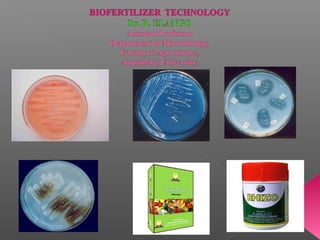
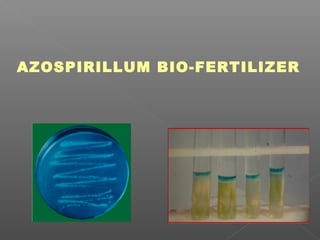
AZOSPIRILLUM BIO-FERTILIZER
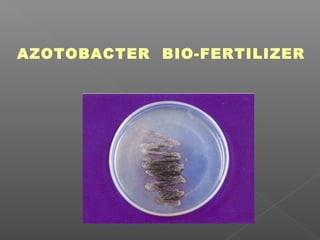
AZOTOBACTER BIO-FERTILIZER
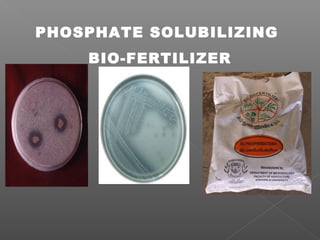
PHOSPHATE SOLUBILIZING
BIO-FERTILIZER
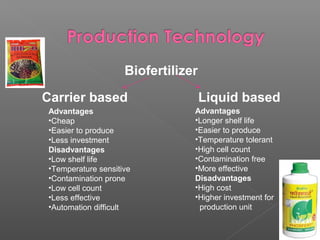
Biofertilizer
Carrier based Liquid based
Advantages
•Cheap
•Easier to produce
•Less investment
Disadvantages
•Low shelf life
•Temperature sensitive
•Contamination prone
•Low cell count
•Less effective
•Automation difficult
Advantages
•Longer shelf life
•Easier to produce
•Temperature tolerant
•High cell count
•Contamination free
•More effective
Disadvantages
•High cost
•Higher investment for
production unit
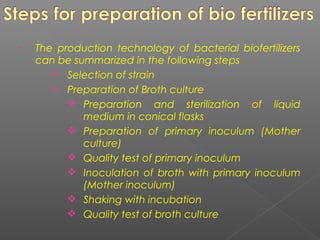
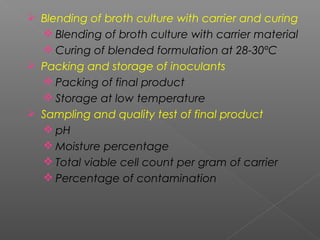
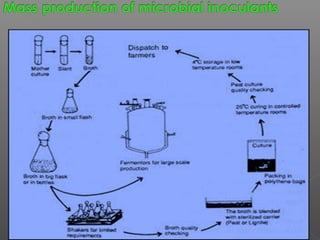
• The production technology of bacterial biofertilizers
can be summarized in the following steps
 Selection of strain
 Preparation of Broth culture
 Preparation and sterilization of liquid
medium in conical flasks
 Preparation of primary inoculum (Mother
culture)
 Quality test of primary inoculum
 Inoculation of broth with primary inoculum
(Mother inoculum)
 Shaking with incubation
 Quality test of broth culture
 Blending of broth culture with carrier and curing
 Blending of broth culture with carrier material
 Curing of blended formulation at 28-30ºC
 Packing and storage of inoculants
 Packing of final product
 Storage at low temperature
 Sampling and quality test of final product
 pH
 Moisture percentage
 Total viable cell count per gram of carrier
 Percentage of contamination
Rhizobium
Azotobacter
Azospirillum
PSB
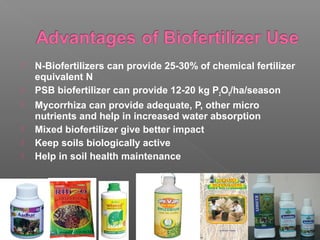
 N-Biofertilizers can provide 25-30% of chemical fertilizer
equivalent N
 PSB biofertilizer can provide 12-20 kg P2O5/ha/season
 Mycorrhiza can provide adequate, P, other micro
nutrients and help in increased water absorption
 Mixed biofertilizer give better impact
 Keep soils biologically active
 Help in soil health maintenance
Biofertilizer/ crop Quantity
required
lit/ha
Cost of
application
(Rs/ha)
Amount of nutrient
mobilized kg/ha
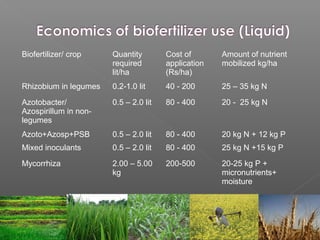
Rhizobium in legumes 0.2-1.0 lit 40 - 200 25 – 35 kg N
Azotobacter/
Azospirillum in non-
legumes
0.5 – 2.0 lit 80 - 400 20 - 25 kg N
Azoto+Azosp+PSB 0.5 – 2.0 lit 80 - 400 20 kg N + 12 kg P
Mixed inoculants 0.5 – 2.0 lit 80 - 400 25 kg N +15 kg P
Mycorrhiza 2.00 – 5.00
kg
200-500 20-25 kg P +
micronutrients+
moisture
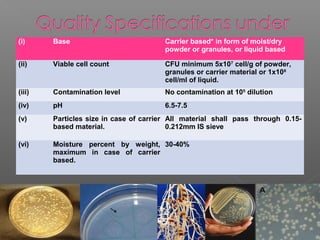
(i) Base Carrier based* in form of moist/dry
powder or granules, or liquid based
(ii) Viable cell count CFU minimum 5x10⁷
cell/g of powder,
granules or carrier material or 1x10⁸
cell/ml of liquid.
(iii) Contamination level No contamination at 105
dilution
(iv) pH 6.5-7.5
(v) Particles size in case of carrier
based material.
All material shall pass through 0.15-
0.212mm IS sieve
(vi) Moisture percent by weight,
maximum in case of carrier
based.
30-40%
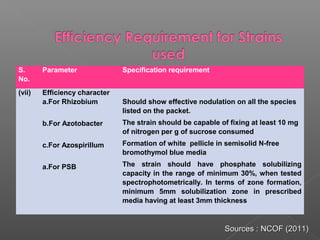
S.
No.
Parameter Specification requirement
(vii) Efficiency character
a.For Rhizobium
b.For Azotobacter
c.For Azospirillum
a.For PSB
Should show effective nodulation on all the species
listed on the packet.
The strain should be capable of fixing at least 10 mg
of nitrogen per g of sucrose consumed
Formation of white pellicle in semisolid N-free
bromothymol blue media
The strain should have phosphate solubilizing
capacity in the range of minimum 30%, when tested
spectrophotometrically. In terms of zone formation,
minimum 5mm solubilization zone in prescribed
media having at least 3mm thickness
Sources : NCOF (2011)Sources : NCOF (2011)
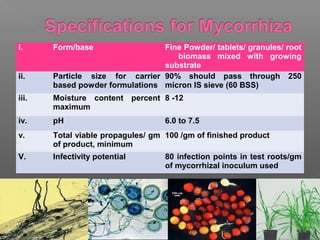
i. Form/base Fine Powder/ tablets/ granules/ root
biomass mixed with growing
substrate
ii. Particle size for carrier
based powder formulations
90% should pass through 250
micron IS sieve (60 BSS)
iii. Moisture content percent
maximum
8 -12
iv. pH 6.0 to 7.5
v. Total viable propagules/ gm
of product, minimum
100 /gm of finished product
V. Infectivity potential 80 infection points in test roots/gm
of mycorrhizal inoculum used
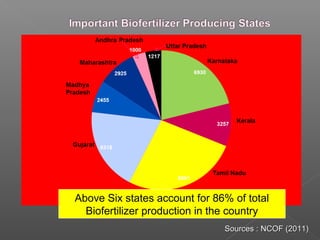
Above Six states account for 86% of total
Biofertilizer production in the country
Sources : NCOF (2011)Sources : NCOF (2011)
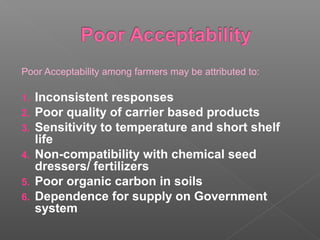
Poor Acceptability among farmers may be attributed to:
1. Inconsistent responses
2. Poor quality of carrier based products
3. Sensitivity to temperature and short shelf
life
4. Non-compatibility with chemical seed
dressers/ fertilizers
5. Poor organic carbon in soils
6. Dependence for supply on Government
system
Poor quality unsterile carrier is biggest
constraint
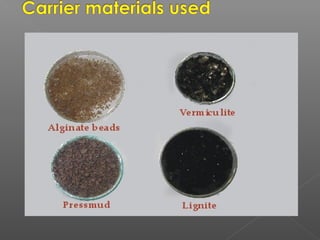
 Replace lignite/ charcoal with other carriers having high
moisture potential
 Such as Exfoliated vermiculite, ppt grade silica, Quartz or inert
mineral powder enriched with synthetic water holding gels.
 All carriers must be sterilized and
 Product handling process must be automatic
 Product must be free from contamination
Efforts needed to replace existing carrier based
system to liquid system as it is:
a. Easier to produce
b. 100% automation possible
c. Product can be 100% sterile
d. Offer higher shelf life, higher cell count
e. Temperature tolerant
f. Easy to apply through mechanical means
Sources : NCOF (2011)Sources : NCOF (2011)
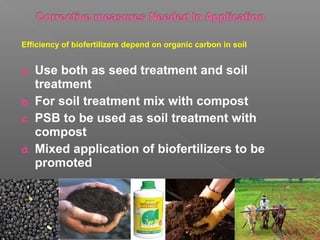
Efficiency of biofertilizers depend on organic carbon in soil
a. Use both as seed treatment and soil
treatment
b. For soil treatment mix with compost
c. PSB to be used as soil treatment with
compost
d. Mixed application of biofertilizers to be
promoted
 Use of multiple inoculants have proved
beneficial over single inoculants
 Many producers have launched mixed liquid
inoculants having Azotobacter, Azospirillum
and PSB.
 States can promote use of mixed inoculants
Use Biofertilizers
For Healthy and living soil

Biofertilizer Technology ppt

  • 2.
    The term biofertilizerrefers to preparation containing live microbes which helps in enhancing the soil fertility either by fixing atmospheric nitrogen, solubilization of phosphorus or decomposing organic wastes or by augmenting plant growth by producing growth hormones with their biological activities. BiofertilizersBiofertilizers Bacteria in root surfaceBacteria in root surface Bacteria in root surfaceBacteria in root surface Legume inoculationLegume inoculationRhizobium BacteriaRhizobium Bacteria
  • 3.
    The role ofbiofertilizers assumes special significance due to increased cost of chemical fertilizers and their ill effects on soil health Legume root nodulesLegume root nodules Rhizobium bacteria inside nodule Rhizobium bacteria inside nodule Biofertilizer concept goes back as early as 300 BC when our ancestors realized the importance of legume crops bearing nodules. The perspective of biofertilizer came into existence through discovery of many organisms capable of nitrogen fixation, P- solubilization, P. mobilization, potash solubilization and micronutrient transformation in the soil. Concept
  • 4.
    Advantages of Biofertilizers Renewablesource of nutrients Sustain soil health Supplement chemical fertilizers. Replace 25-30% chemical fertilizers Increase the grain yields by 10-40%. Decompose plant residues, and stabilize C:N ratio of soil Improve texture, structure and water holding capacity of soil No adverse effect on plant growth and soil fertility. Stimulates plant growth by secreting growth hormones. Secrete fungistatic and antibiotic like substances Solubilize and mobilize nutrients Eco-friendly, non-pollutants and cost effective method
  • 5.
    Types of BiofertilizerOrganisms RHIZOBIUM AZOSPIRILLUM VA-MYCORRHIZA BLUE GREEN ALGAE AZOTOBACTER PSB
  • 6.
    Biofertilizers covered under FCO OtherBiofertilizers not covered in FCO Rhizobium Azotobacter Azospirillum PSB Mycorrhiza Acetobacter Fraturia aurantia Pseudomonas as PGPR Mixed cultures Effective microorganisms
  • 7.
  • 8.
  • 9.
  • 15.
    Biofertilizer Carrier based Liquidbased Advantages •Cheap •Easier to produce •Less investment Disadvantages •Low shelf life •Temperature sensitive •Contamination prone •Low cell count •Less effective •Automation difficult Advantages •Longer shelf life •Easier to produce •Temperature tolerant •High cell count •Contamination free •More effective Disadvantages •High cost •Higher investment for production unit
  • 16.
    • The productiontechnology of bacterial biofertilizers can be summarized in the following steps  Selection of strain  Preparation of Broth culture  Preparation and sterilization of liquid medium in conical flasks  Preparation of primary inoculum (Mother culture)  Quality test of primary inoculum  Inoculation of broth with primary inoculum (Mother inoculum)  Shaking with incubation  Quality test of broth culture
  • 17.
     Blending ofbroth culture with carrier and curing  Blending of broth culture with carrier material  Curing of blended formulation at 28-30ºC  Packing and storage of inoculants  Packing of final product  Storage at low temperature  Sampling and quality test of final product  pH  Moisture percentage  Total viable cell count per gram of carrier  Percentage of contamination
  • 21.
  • 22.
     N-Biofertilizers canprovide 25-30% of chemical fertilizer equivalent N  PSB biofertilizer can provide 12-20 kg P2O5/ha/season  Mycorrhiza can provide adequate, P, other micro nutrients and help in increased water absorption  Mixed biofertilizer give better impact  Keep soils biologically active  Help in soil health maintenance
  • 23.
    Biofertilizer/ crop Quantity required lit/ha Costof application (Rs/ha) Amount of nutrient mobilized kg/ha Rhizobium in legumes 0.2-1.0 lit 40 - 200 25 – 35 kg N Azotobacter/ Azospirillum in non- legumes 0.5 – 2.0 lit 80 - 400 20 - 25 kg N Azoto+Azosp+PSB 0.5 – 2.0 lit 80 - 400 20 kg N + 12 kg P Mixed inoculants 0.5 – 2.0 lit 80 - 400 25 kg N +15 kg P Mycorrhiza 2.00 – 5.00 kg 200-500 20-25 kg P + micronutrients+ moisture
  • 24.
    (i) Base Carrierbased* in form of moist/dry powder or granules, or liquid based (ii) Viable cell count CFU minimum 5x10⁷ cell/g of powder, granules or carrier material or 1x10⁸ cell/ml of liquid. (iii) Contamination level No contamination at 105 dilution (iv) pH 6.5-7.5 (v) Particles size in case of carrier based material. All material shall pass through 0.15- 0.212mm IS sieve (vi) Moisture percent by weight, maximum in case of carrier based. 30-40%
  • 25.
    S. No. Parameter Specification requirement (vii)Efficiency character a.For Rhizobium b.For Azotobacter c.For Azospirillum a.For PSB Should show effective nodulation on all the species listed on the packet. The strain should be capable of fixing at least 10 mg of nitrogen per g of sucrose consumed Formation of white pellicle in semisolid N-free bromothymol blue media The strain should have phosphate solubilizing capacity in the range of minimum 30%, when tested spectrophotometrically. In terms of zone formation, minimum 5mm solubilization zone in prescribed media having at least 3mm thickness Sources : NCOF (2011)Sources : NCOF (2011)
  • 26.
    i. Form/base FinePowder/ tablets/ granules/ root biomass mixed with growing substrate ii. Particle size for carrier based powder formulations 90% should pass through 250 micron IS sieve (60 BSS) iii. Moisture content percent maximum 8 -12 iv. pH 6.0 to 7.5 v. Total viable propagules/ gm of product, minimum 100 /gm of finished product V. Infectivity potential 80 infection points in test roots/gm of mycorrhizal inoculum used
  • 27.
    Above Six statesaccount for 86% of total Biofertilizer production in the country Sources : NCOF (2011)Sources : NCOF (2011)
  • 28.
    Poor Acceptability amongfarmers may be attributed to: 1. Inconsistent responses 2. Poor quality of carrier based products 3. Sensitivity to temperature and short shelf life 4. Non-compatibility with chemical seed dressers/ fertilizers 5. Poor organic carbon in soils 6. Dependence for supply on Government system
  • 29.
    Poor quality unsterilecarrier is biggest constraint  Replace lignite/ charcoal with other carriers having high moisture potential  Such as Exfoliated vermiculite, ppt grade silica, Quartz or inert mineral powder enriched with synthetic water holding gels.  All carriers must be sterilized and  Product handling process must be automatic  Product must be free from contamination
  • 30.
    Efforts needed toreplace existing carrier based system to liquid system as it is: a. Easier to produce b. 100% automation possible c. Product can be 100% sterile d. Offer higher shelf life, higher cell count e. Temperature tolerant f. Easy to apply through mechanical means Sources : NCOF (2011)Sources : NCOF (2011)
  • 31.
    Efficiency of biofertilizersdepend on organic carbon in soil a. Use both as seed treatment and soil treatment b. For soil treatment mix with compost c. PSB to be used as soil treatment with compost d. Mixed application of biofertilizers to be promoted
  • 32.
     Use ofmultiple inoculants have proved beneficial over single inoculants  Many producers have launched mixed liquid inoculants having Azotobacter, Azospirillum and PSB.  States can promote use of mixed inoculants
  • 33.