VIVEKANANDHA
ARTS AND SCIENCE COLLEGE FOR WOMEN
Veerachipalayam - 637 303, Sankagiri, Salem Dt., Tamil Nadu India. Affiliated to
Periyar
University, Salem ; Recognised Under Section 2(f) & 12(B) of the UGC Act, 1956 )
SUBJECT : SOILAND AGRICULTURAL MICROBIOLOGY
TOPIC: INTERELATIONSHIP BETWEEN PLANTS AND
MICRO ORAGANISMS
DEPARTMENT OF MICROBIOLOGY
SUBJECT INCHARGE:
Dr. R. Dineshkumar
Assitant professer
Department of Microbiology
VIAAS, Sankagiri
SUBMITTED BY:
V. G.Monika lakshmi,
III B.Sc., Microbiology,
Department of Microbiology
VIAAS,Sankagiri
CONTENTS :
✓ INTRODUCTION
✓ INTERACTION OF PLANT-MICROBE
✓ THREE TYPES OF RELATIONSHIP
✓ PATHOGENIC RELATIONSHIP
✓ SYMBIOTIC RELATIONSHIP
✓ ASSOCIATIVE RELATIONSHIP
✓ RHIZOSPHERE AND
NON-RHIZOSPHERE
✓ SPERMOSPHERE
✓ PHYLLOSPHERE
✓ MYCORRHIZAE
INTERRELATIONSHIPS BETWEEN
PLANT AND MICROORGANISMS
INTRODUCTION:
Its an interaction between the pathogenic microbes and the
host plant in which it determines resistance or disease.
INTERACTION OF PLANTS AND MICROBE:
➢ plants produce organic compounds in a nutritional enriched
environment for microbial growth
➢ Microbes that colonize surface of plants are called epiphytes
and microbes that colonize interior of plants are known as
endophytes.
➢ The rhizosphere is an environment where microbial activities
contribute to plant growth. bacteria and fungi grow on organic
compounds released from the plant root and produce plant line
hormones.
MICROBIAL COMMUNITY :
➢ It’s a group of micro organiosms that live together in a
shared environment, interacting with each other and affecting
the eco system. Here the interaction occurs between the plant
and microbe.
➢ These communities include bacteria , fungi and micro
eukaryotes.
➢ The two communites were interact by exchanging nutrients,
providing defence responses
THREE WAYS OF RELATIONSHIPS:
Microbial community influenze plants in direct way and indirect
way.
➢ Pathogenic relationship
➢ Symbiotic relationship
➢ Associative relationship
THREE WAYS OF RELATIONSHIPS:
Pathogenic relationship
Necrotrophy
Biotrophy
hemibiotrophy
Symbiotic relationship
Mutualism
Commensalism
parasitism
Associative relationship
Synergistic
Rhizosphere
Spermosphere
mycorrhizae
PATHOGENIC REALTIONSHIPS
➢ The contact between plant and pathogenic
microorganisms lead to a particular chain of events in
plant organism.
➢ the space between the cell and plasma membrane acts
first battle between plants and microbes.
➢ The initiation of infection starts with living plant tissues
by bacteria, fungi, viruses,and oomycetes.
➢ The space between plasma membrane and the external
surface of plant cell is known as apoplastic region. The
secreted protiens and other metabolites derived from
the both host and pathogen,this interact this apoplastic
region and govern the final relationship between them.
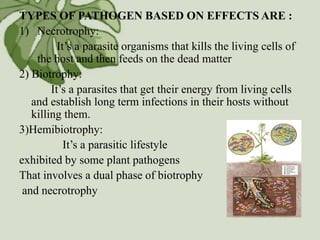
TYPES OF PATHOGEN BASED ON EFFECTS ARE :
1) Necrotrophy:
It’s a parasite organisms that kills the living cells of
the host and then feeds on the dead matter
2) Biotrophy:
It’s a parasites that get their energy from living cells
and establish long term infections in their hosts without
killing them.
3)Hemibiotrophy:
It’s a parasitic lifestyle
exhibited by some plant pathogens
That involves a dual phase of biotrophy
and necrotrophy
SYMBIOTIC RELATIONSHIP
➢ A symbiotic Relationship between a plant
and a microbe depends on each other for
➢ their survival , where both organisms gets
benefit from the interaction.
➢ These benefits may be provide nutritional
advantage for any one species.
➢ Based on the nature of relationship,
➢ Three types of symbiosis were
classified:
1) Mutualism
2) Commensalism
3) Parasitism
MUTUALISM:
➢Its a biological interaction between two different
organisms of different species benefit each other.
➢It was first discovered by pierre –joseph van
beneden in1876
➢ Both organisms benefit: Each partner receives a
benefit, such as food,shelter or protection
➢Non-harmful: neither organism harms the other
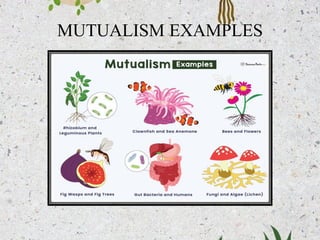
MUTUALISM EXAMPLES:
1. Clownfish and Sea Anemone:
Clownfish live among the anemone's stinging
tentacles, which protect them from the predators
.In return, the clownfish helps keep the anemone
clean and free of parasites.
2. Bees and Flowers:
Bees collect nectar from flowers, which
provides them with food. As they move from flower to
flower, they transfer pollen, allowing the flowers to
reproduce.
3. Oxpeckers and Rhinoceros:
Oxpeckers (birds) land on rhinoceroses
and eat ticks, lice, and other parasites that live on the
rhino's skin. The rhino benefits from the cleaning
service, while the oxpeckers receive a meal.
4.Fungi and Tree Roots:
Mycorrhizal fungi form relationships with tree
roots, providing essential nutrients like phosphorus
and water. In return, the trees provide the fungi with
carbohydrates produced during photosynthesis.
MUTUALISM EXAMPLES
COMMENSALISM:
Commensalism is a biological interaction where one species
get benefit and another couldn’t be harmed or beneficial.
COMMENSALISM EXAMPLES:
1.Epiphytic plants:
Orchids, bromeliads, and air plants grow on other plants (e.g.,
trees) without harming them. They benefit from the host plant's
structure and receive light, water, and nutrients.
2. Mistletoe:
Mistletoe plants grow on host trees, tapping into their vascular
system for nutrients and water. While mistletoe benefits, the host
tree is not significantly affected.
3. Remora fish:
Remora fish attach themselves to sharks and feed on their leftover
food and parasites. The shark is not harmed, while the remora
benefits from the food source.
4. Soil microorganisms:
Microorganisms like bacteria and fungi live in soil and
feed on organic matter. They benefit from the nutrients and
shelter provided by the soil, while the soil is not significantly
affected.
AMMENSALISM:
➢ Its the ecological interaction in which an individual species
harms and another be without benefit.
➢ These relationships are common but not considered as
important because they are accidental and harm the species
without any benefit.
Ammensalism example:
1. Algal blooms:
Algal blooms exhibit amensalism, a type of ecological
interaction where one organism (the algae) inhibits the growth
or survival of other organisms.
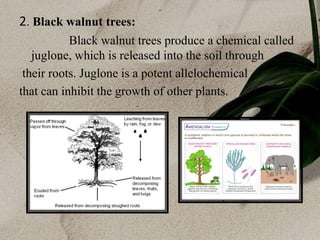
2. Black walnut trees:
Black walnut trees produce a chemical called
juglone, which is released into the soil through
their roots. Juglone is a potent allelochemical
that can inhibit the growth of other plants.
PARASITISM:
➢ parasitism is a relationship between organisms
where the parasite lives on or inside the host,
causing it harm.
➢ These are chemoautotrophs.
SYNERGISM:
➢ The intraction of two more organizations, substances to
produce a combined effect greater than the sum of their
seperate effects.
➢ Eg: E.coli which obtains nutrients from food materials
ingested by host produces vitamins which are used by the host.
➢ The synergistic action of lactobacillus bulgaricus and
streptococcus thermophilus in the production of yogurt.
RHIZOSPHERE:
➢ The rhizosphere is the narrow region of soil that is directly
influenced by root secreations and associated with soil micro
organisms.
➢ The rhizosphere contains many bacteria and other micro
organisms that feed on plant cells, termed as rhizodeposition
and the protiens and sugars are released by roots.
➢ Nutrient cycle and disease suppresion needed for plants.
➢ The rhizosphere produce allelochemmicals to control neibour
plant
NON RHIZOSPHERE:
➢ The region away from roots
➢ The poor microbiological activity occurs
➢ R:S RATIO:
➢ R refers the soil of rhizosphere
➢ S refers the soil of non rhizosphere
➢ R:S ratio is defined as the ratio of microbial population per
unit weight of rhizosphere soil(R)n,to the microbial population
per unit wight of adjacent non-rhizosphere soil(S)
PHYLLOSPHERE:
➢ It defined as the above ground part of a plant,
Including the leaves, stem, buds, flowers and fruits,
where microorganisms live.
➢ It provide niche for nitrogen fixation and secretion of
substances to promote plant growth.
Factors that affect phyllosphere:
❖Light & temperature
❖Nutrient availablity & water
❖Uv light & leaf physiology
❖Leaf epidermal cell
arrangement
SPERMOSPHERE:
➢ the spermosphere is the area of soil that surrounds a
germinating seed and where the seed, soil and micro
orgnaisms interact.
➢ It short lived, dynamic zone that’s established when
the seeds releases carbon compounds into soil as it
hydrates.
MYCORRHIZAE:
➢ Its an product of symbiotic association between fungi
and green plants.
➢ Plants prepare food through the process of
photosynthesis for the fungus and in turn ,the fungus
enhances the surface area for the absorbtion of
essential minerals such as phosphorous into plant.
➢ These plants are also more adapted
in terms of survival
than non-mycorrhizal
plants
These classified into two types were:
ECTOMYCORRHIZAE:
These are the symbiotic relationships between fungi and
plant roots,where the fungus grows around the
root cell,forming a network of hyphae.
Eg: basidomycota,ascomycota
ENDOMYCORRHIZAE:
These are the symbiotic relationship
between fungi and plant roots,where
the fungus grows within the root cell,
Forming structures like arbuscles and
Vesicles Eg:glomeromycota,AMF
(arbuscular mycorrhizal fungi)
endomycorrizae
ectomycorrizae
REFRECENCES:
• https://www.slideshare.net/slideshow/plant-
microbe-interaction/101751541
• https://byjus.com/question-answer/what-are-
5-examples-of-commensalism/
• https://www.slideshare.net/slideshow/microb
e-plant-interaction/179817558
• https://www.slideserve.com/pippa/plant-
microbe-interactions
• https://www.scribd.com/presentation/401584
345/Slides18-13Nv07-ppt
Thank you !

interrelationship_between_plants_and_microbe.pdf

  • 1.
    VIVEKANANDHA ARTS AND SCIENCECOLLEGE FOR WOMEN Veerachipalayam - 637 303, Sankagiri, Salem Dt., Tamil Nadu India. Affiliated to Periyar University, Salem ; Recognised Under Section 2(f) & 12(B) of the UGC Act, 1956 ) SUBJECT : SOILAND AGRICULTURAL MICROBIOLOGY TOPIC: INTERELATIONSHIP BETWEEN PLANTS AND MICRO ORAGANISMS DEPARTMENT OF MICROBIOLOGY SUBJECT INCHARGE: Dr. R. Dineshkumar Assitant professer Department of Microbiology VIAAS, Sankagiri SUBMITTED BY: V. G.Monika lakshmi, III B.Sc., Microbiology, Department of Microbiology VIAAS,Sankagiri
  • 2.
    CONTENTS : ✓ INTRODUCTION ✓INTERACTION OF PLANT-MICROBE ✓ THREE TYPES OF RELATIONSHIP ✓ PATHOGENIC RELATIONSHIP ✓ SYMBIOTIC RELATIONSHIP ✓ ASSOCIATIVE RELATIONSHIP ✓ RHIZOSPHERE AND NON-RHIZOSPHERE ✓ SPERMOSPHERE ✓ PHYLLOSPHERE ✓ MYCORRHIZAE
  • 3.
    INTERRELATIONSHIPS BETWEEN PLANT ANDMICROORGANISMS INTRODUCTION: Its an interaction between the pathogenic microbes and the host plant in which it determines resistance or disease. INTERACTION OF PLANTS AND MICROBE: ➢ plants produce organic compounds in a nutritional enriched environment for microbial growth ➢ Microbes that colonize surface of plants are called epiphytes and microbes that colonize interior of plants are known as endophytes. ➢ The rhizosphere is an environment where microbial activities contribute to plant growth. bacteria and fungi grow on organic compounds released from the plant root and produce plant line hormones.
  • 4.
    MICROBIAL COMMUNITY : ➢It’s a group of micro organiosms that live together in a shared environment, interacting with each other and affecting the eco system. Here the interaction occurs between the plant and microbe. ➢ These communities include bacteria , fungi and micro eukaryotes. ➢ The two communites were interact by exchanging nutrients, providing defence responses THREE WAYS OF RELATIONSHIPS: Microbial community influenze plants in direct way and indirect way. ➢ Pathogenic relationship ➢ Symbiotic relationship ➢ Associative relationship
  • 5.
    THREE WAYS OFRELATIONSHIPS: Pathogenic relationship Necrotrophy Biotrophy hemibiotrophy Symbiotic relationship Mutualism Commensalism parasitism Associative relationship Synergistic Rhizosphere Spermosphere mycorrhizae
  • 6.
    PATHOGENIC REALTIONSHIPS ➢ Thecontact between plant and pathogenic microorganisms lead to a particular chain of events in plant organism. ➢ the space between the cell and plasma membrane acts first battle between plants and microbes. ➢ The initiation of infection starts with living plant tissues by bacteria, fungi, viruses,and oomycetes. ➢ The space between plasma membrane and the external surface of plant cell is known as apoplastic region. The secreted protiens and other metabolites derived from the both host and pathogen,this interact this apoplastic region and govern the final relationship between them.
  • 7.
    TYPES OF PATHOGENBASED ON EFFECTS ARE : 1) Necrotrophy: It’s a parasite organisms that kills the living cells of the host and then feeds on the dead matter 2) Biotrophy: It’s a parasites that get their energy from living cells and establish long term infections in their hosts without killing them. 3)Hemibiotrophy: It’s a parasitic lifestyle exhibited by some plant pathogens That involves a dual phase of biotrophy and necrotrophy
  • 8.
    SYMBIOTIC RELATIONSHIP ➢ Asymbiotic Relationship between a plant and a microbe depends on each other for ➢ their survival , where both organisms gets benefit from the interaction. ➢ These benefits may be provide nutritional advantage for any one species. ➢ Based on the nature of relationship, ➢ Three types of symbiosis were classified: 1) Mutualism 2) Commensalism 3) Parasitism
  • 9.
    MUTUALISM: ➢Its a biologicalinteraction between two different organisms of different species benefit each other. ➢It was first discovered by pierre –joseph van beneden in1876 ➢ Both organisms benefit: Each partner receives a benefit, such as food,shelter or protection ➢Non-harmful: neither organism harms the other MUTUALISM EXAMPLES: 1. Clownfish and Sea Anemone: Clownfish live among the anemone's stinging tentacles, which protect them from the predators .In return, the clownfish helps keep the anemone clean and free of parasites.
  • 10.
    2. Bees andFlowers: Bees collect nectar from flowers, which provides them with food. As they move from flower to flower, they transfer pollen, allowing the flowers to reproduce. 3. Oxpeckers and Rhinoceros: Oxpeckers (birds) land on rhinoceroses and eat ticks, lice, and other parasites that live on the rhino's skin. The rhino benefits from the cleaning service, while the oxpeckers receive a meal. 4.Fungi and Tree Roots: Mycorrhizal fungi form relationships with tree roots, providing essential nutrients like phosphorus and water. In return, the trees provide the fungi with carbohydrates produced during photosynthesis.
  • 11.
  • 12.
    COMMENSALISM: Commensalism is abiological interaction where one species get benefit and another couldn’t be harmed or beneficial. COMMENSALISM EXAMPLES: 1.Epiphytic plants: Orchids, bromeliads, and air plants grow on other plants (e.g., trees) without harming them. They benefit from the host plant's structure and receive light, water, and nutrients. 2. Mistletoe: Mistletoe plants grow on host trees, tapping into their vascular system for nutrients and water. While mistletoe benefits, the host tree is not significantly affected. 3. Remora fish: Remora fish attach themselves to sharks and feed on their leftover food and parasites. The shark is not harmed, while the remora benefits from the food source.
  • 13.
    4. Soil microorganisms: Microorganismslike bacteria and fungi live in soil and feed on organic matter. They benefit from the nutrients and shelter provided by the soil, while the soil is not significantly affected.
  • 14.
    AMMENSALISM: ➢ Its theecological interaction in which an individual species harms and another be without benefit. ➢ These relationships are common but not considered as important because they are accidental and harm the species without any benefit. Ammensalism example: 1. Algal blooms: Algal blooms exhibit amensalism, a type of ecological interaction where one organism (the algae) inhibits the growth or survival of other organisms.
  • 15.
    2. Black walnuttrees: Black walnut trees produce a chemical called juglone, which is released into the soil through their roots. Juglone is a potent allelochemical that can inhibit the growth of other plants.
  • 16.
    PARASITISM: ➢ parasitism isa relationship between organisms where the parasite lives on or inside the host, causing it harm. ➢ These are chemoautotrophs.
  • 17.
    SYNERGISM: ➢ The intractionof two more organizations, substances to produce a combined effect greater than the sum of their seperate effects. ➢ Eg: E.coli which obtains nutrients from food materials ingested by host produces vitamins which are used by the host. ➢ The synergistic action of lactobacillus bulgaricus and streptococcus thermophilus in the production of yogurt.
  • 18.
    RHIZOSPHERE: ➢ The rhizosphereis the narrow region of soil that is directly influenced by root secreations and associated with soil micro organisms. ➢ The rhizosphere contains many bacteria and other micro organisms that feed on plant cells, termed as rhizodeposition and the protiens and sugars are released by roots. ➢ Nutrient cycle and disease suppresion needed for plants. ➢ The rhizosphere produce allelochemmicals to control neibour plant
  • 19.
    NON RHIZOSPHERE: ➢ Theregion away from roots ➢ The poor microbiological activity occurs ➢ R:S RATIO: ➢ R refers the soil of rhizosphere ➢ S refers the soil of non rhizosphere ➢ R:S ratio is defined as the ratio of microbial population per unit weight of rhizosphere soil(R)n,to the microbial population per unit wight of adjacent non-rhizosphere soil(S)
  • 20.
    PHYLLOSPHERE: ➢ It definedas the above ground part of a plant, Including the leaves, stem, buds, flowers and fruits, where microorganisms live. ➢ It provide niche for nitrogen fixation and secretion of substances to promote plant growth. Factors that affect phyllosphere: ❖Light & temperature ❖Nutrient availablity & water ❖Uv light & leaf physiology ❖Leaf epidermal cell arrangement
  • 21.
    SPERMOSPHERE: ➢ the spermosphereis the area of soil that surrounds a germinating seed and where the seed, soil and micro orgnaisms interact. ➢ It short lived, dynamic zone that’s established when the seeds releases carbon compounds into soil as it hydrates.
  • 22.
    MYCORRHIZAE: ➢ Its anproduct of symbiotic association between fungi and green plants. ➢ Plants prepare food through the process of photosynthesis for the fungus and in turn ,the fungus enhances the surface area for the absorbtion of essential minerals such as phosphorous into plant. ➢ These plants are also more adapted in terms of survival than non-mycorrhizal plants
  • 23.
    These classified intotwo types were: ECTOMYCORRHIZAE: These are the symbiotic relationships between fungi and plant roots,where the fungus grows around the root cell,forming a network of hyphae. Eg: basidomycota,ascomycota ENDOMYCORRHIZAE: These are the symbiotic relationship between fungi and plant roots,where the fungus grows within the root cell, Forming structures like arbuscles and Vesicles Eg:glomeromycota,AMF (arbuscular mycorrhizal fungi)
  • 24.
  • 25.
    REFRECENCES: • https://www.slideshare.net/slideshow/plant- microbe-interaction/101751541 • https://byjus.com/question-answer/what-are- 5-examples-of-commensalism/ •https://www.slideshare.net/slideshow/microb e-plant-interaction/179817558 • https://www.slideserve.com/pippa/plant- microbe-interactions • https://www.scribd.com/presentation/401584 345/Slides18-13Nv07-ppt
  • 26.