Introduction
• Microbial ecologyrefers to the presence and
contributions of microorganisms, through their
activities, to the places where they are found.
• The presence and contributions refer to their
effects on soils, waters and association with
plants and humans.
• Microbial ecology is therefore the study of the
behaviour and activities of microorganisms in
their natural environments.
3.
Introduction
• Symbiosis isan association of two or more different
species.
• Interactions of organisms with each other and with
their physical environment contribute to the
functioning of ecosystems.
• Populations are assemblages of similar organisms
within an ecosystem.
• Communities are mixtures of different populations
within an ecosystem.
• Ecosystems are therefore self-regulating biological
communities and their physical environment.
4.
Microbial Interactions
• Microorganismscan be physically associated with
other organisms in a number of ways:
• Ectosymbiosis- microorganism remains
outside the other organism.
• Endosymbiosis- microorganism is found
within the other organism.
• Ecto/endosymbiosis- microorganism lives both on
the inside and the outside of the other organism.
• Physical associations can be
intermittent (irregular) and cyclic or permanent.
5.
Mutualism
• An obligatoryassociation that provides
some reciprocal benefit to both partners:
• Protozoan-termite relationship- protozoa live
in
the guts of
metabolize
insects
cellulose;
that ingest
but the
protozoa
cannot
secrete
cellulases, which metabolize cellulose, releasing
nutrients that the insects can use.
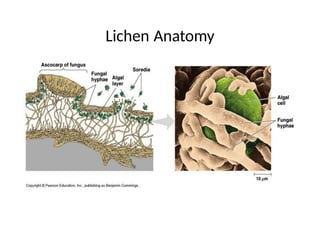
• Lichens- an association between a fungus
(ascomycetes) and an alga (green algae) or
cyanobacterium.
6.
Lichens
• Fungal partner(mycobiont) obtains nutrients
from alga by hyphal projections (haustoria)
that penetrate the algal cell wall as well as
oxygen for respiration.
• Algal partner (phycobiont) is protected from
excess light intensity and is provided with
water, minerals, and a firm substratum in
which it can grow protected from
environmental stress.
Commensalism
• The microorganism(commensal) benefits, while
the host is neither harmed nor helped; often the
microorganism shares the same food source with
the host.
• Occurs in situations in which waste products of
one microorganism serves as the substrate for
another;
• Also occurs in situations where one
microorganism modifies the environment making
it better suited for another microorganism.
9.
Examples of Commensalism
•Nitrification- requires the activity of two different
species; one oxidizes ammonia to nitrite
(Nitrosomonas sp.) and the other oxidizes nitrite
to nitrate (Nitrobacter sp.).
• The common nonpathogenic strain of Escherichia
coli lives in the human colon; this facultative
anaerobe uses oxygen creating an anaerobic
environment in which obligate anaerobes (e.g.,
Bacteroides sp.) can grow;
• E. coli derives no obvious benefit or harm.
10.
Commensalism Continued
• Modificationof environment is also seen in
the Succession of microorganisms in an
environment-
• During
milk
synthesis of acidic
by one population
fermentation
stimulates
spoilage,
products
proliferation of acid-tolerant
microorganisms;
• During biofilm formation, the first
colonizer makes it possible for others to
colonize.
11.
Biofilms
• Biofilms-organized microbialsystems consisting of layers of
microbial cells associated with surfaces.
• Biofilms on living surfaces usually play a role in
causing disease; there are numerous advantages to
forming biofilms in this situation.
• The biofilm provides protection from antibiotics.
• The biofilm creates a focus for later occurrence of
disease.
• Release of microbial cells or products from the biofilm
can affect the immune system of the host.
• Microbial mats-large biofilms that have macroscopic
dimensions; found in many freshwater and marine habitats.
12.
Predation
• Predator organismengulfs or attacks a prey
organism; prey can be larger or smaller than
predator; normally results in death of prey.
• Predatory bacteria are known:-
• e.g., Bdellovibrio bacteriovorus, Vampirococcus
sp, and Daptobacter sp which may cause lysis of
prey, release of cell contents while attached to
surface of prey, or penetrate cytoplasm of prey.
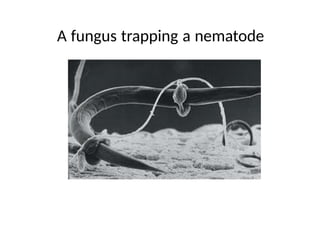
• Predatory fungi are known (e.g., fungi that trap
nematodes)
Positive Outcomes ofPredation
• Microbial loop- microbial predators mineralize
the organic matter produced by autotrophs
(primary producers) before it reaches the
higher consumers; this returns nutrients to
the primary producers and promotes their
activity.
• Ingestion of prey provides protective
environment for the prey.
15.
Parasitism
• One organism(parasite) benefits from another (host);
• There is a degree of coexistence between the host
and parasite that can shift to a pathogenic relationship (a
type of predation).
• Examples include:
• Parasitic fungi and an algal host.
• Biocontrol- use of one microorganism to control activity of
another.
• Ammensalism- organism releases a specific compound that
harms another organism.
• Antibiotics.
• Bacteriocins.
16.
Competition
• Different organismswithin a population or community
try to acquire the same resources (e.g., nutrients,
location, etc).
• Competitive exclusion principle- if two populations
overlap too much in terms of their resource use, then
one of the populations is excluded.
• Symbioses in complex systems- interactions between
two populations lead to the occurrence of feedback
responses in the larger biotic community; these
feedback responses impact all other parts of the
ecosystem and lead to equilibrium of all populations
within the community.
17.
Functions of Microorganismsin
Ecosystems
• They function as primary producers-synthesize
organic matter through photosynthetic and
chemosynthetic processes.
• They decompose organic matter, often with
the release of inorganic compounds
(mineralization).
• They serve as nutrient rich food sources
for chemoheterotrophic microorganisms
and animals.
18.
Functions of Microorganismsin
Ecosystems
• Modify substrates and nutrients used in
symbiotic growth processes and interactions,
thus contributing to biogeochemical cycling.
• Change the amounts of materials in soluble
and gaseous forms.
• Produce inhibitory compounds that
decrease microbial activity or limit the
survival and functioning of plants and
animals.
• Contribute to the functioning of plants and
animals through positive and negative symbiotic
interactions.
19.
Nutrient Cycling Interactions
•Biogeochemical cycling
(nutrient
cycling)
involves both biological and chemical
processes;
• Oxidation-reduction reactions change the
the
chemical and physical properties
of nutrient.
• Nutrients include Carbon, Sulphur,
Nitrogen, Iron and Manganese.
20.
The Physical Environment
•The microenvironment is the specific physical
location of a microorganism
reductants, nutrients, and waste
• The fluxes and gradients of
oxidants,
products
create a unique niche (the microorganism, the
physical habitat, the time of resource use, and
resources available for growth and function)
• An example is biofilm
21.
Stress and Ecosystems
•Factors such as pH, temperature, pressure,
salinity, water availability, and ionizing
radiation can act as stress factors
• If one or more of these factors is extremely
high or low, it creates an extreme
environment
• Extremophiles are organisms that survive in
extreme environments
22.
Extremophiles
• Salinity-favors extremehalophiles.
• High barometric pressure (e.g., deep sea
environments) favor barotolerant, moderately
barophilic, and extremely barophilic bacteria.
• Acidity- acidophiles maintain a high internal pH
relative to the environment.
• Alkalinity- alkalophiles maintain a low internal pH
relative to the environment.
• High temperature (up to 113°C) favors
thermophiles and extreme thermophiles.
23.
Methods Used inMicrobial
Ecology
• Methods in microbial ecology are used to
evaluate presence, types, and activities of
microorganisms in ecosystems; measurements
must span a range of time scales and physical
dimensions; methods used include:
• Microscopic examination.
• Viable cell counting.
• Measurement of nutrient cycling.
• Measurement of organic carbon by biochemical
oxygen demand (BOD), chemical oxygen demand
(COD), or total organic carbon (TOC).
 Most read