MFC Presentation
By: Kayla Kernich, Benjamin Rawls,
and Adrianna Thompson
Governing Equations
V=IR P=IV PDV=IV/V
Oxidation of Glucose:(e- loss in soil anode chamber)
C6H12O6 + 6H2O → 6CO2 + 24H+ + 24e-
Reduction of O2: (e- accepted in cathode chamber)
24e- + 6O2 + 24H+ → 12H2O
Overall reaction:
C6H12O6 + 6O2 → 6CO2+ 6H2O
Problem Specifics and Goals
● Sustainably produce 1W/m3 of recoverable electrical power output in a
sediment MFC
Process:
- Anode must be anaerobic and compatible with sediment bacteria
- Cathode must be in aerobic environment
Structural:
- Connectivity of wires must allow e- flow
- Protect the potentiometer from rainwater
- Stabilize MFC in the pond and keep electrodes in place
Constraints and Considerations
- Must be constructed in 2 weeks on a $20 budget
- At least 75% of the MFC weight must be recycled or natural
material
- Must not be harmful or disruptive to the environment
- Must be biologically compatible with bacteria cultures and algae
in water
- Construction limited by student skills and available tools (hand
saws, electric drill)
- Must use proper safety precautions with tools
- Should last until at least the end of the semester (~1 month
lifetime)
Literature Review
Description of Various MFCs
A microbial fuel cell is a specialized biological reactor
that captures the electrons processed by the microbes
during respiration into usable electrical energy.
● Two-chamber MFC
● Single-chamber MFC
● Sediment MFC
Information from Research Articles
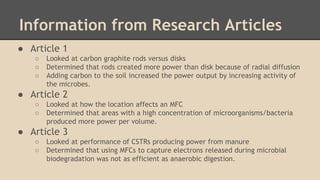
● Article 1
○ Looked at carbon graphite rods versus disks
○ Determined that rods created more power than disk because of radial diffusion
○ Adding carbon to the soil increased the power output by increasing activity of
the microbes.
● Article 2
○ Looked at how the location affects an MFC
○ Determined that areas with a high concentration of microorganisms/bacteria
produced more power per volume.
● Article 3
○ Looked at performance of CSTRs producing power from manure
○ Determined that using MFCs to capture electrons released during microbial
biodegradation was not as efficient as anaerobic digestion.
Information from Research Articles
Although biochar produces slightly less power
per volume than graphite granules, it cost 11x
less than graphite granules.
Past Experience, Heuristics
The goal of this experiment was to produce 1 W/m3 of
power. Using heuristics, we believed we would be able to
accomplish this by creating rectangular pouch of carbon
graphite and biochar. We found that one of our pouches
could hold approximately 26 g of material. Using an
article online we found that a volume of 75 cm3 of biochar
produced 4.97 W/m3, so we assumed that using ½
graphite would only increase the wattage, ensuring that
the goal of 1 W/m3 would be produced.
Design Methodology and Materials
Analysis of Information
Fundamentals of Benthic Microbial Fuel Cells. Theory, Development and Application
● Comparing power densities for different carbon anode forms: carbon fiber, cloth, and
sponges
○ Sponge form of carbon had highest power density: 55mV/m2 (~2x cloth power)
● Treating graphite anodes with metallic compounds typically leads to a 5X power density
increase in anodes over time
Biochar as a Sustainable Electrode Material for Electricity Production in Microbial Fuel Cells
● Biochar reduces cost and carbon footprint of MFCs
● Graphite has higher power density than biochar, despite biochar’s higher surface area
○ Biochar: 4.97 W/m3
○ Graphite Granules: 6.15 W/m3
● Estimated biochar power output based on this article
Synthesis of Design
● From research
○ graphite granules could give 6.15 W/m3
○ biochar could produce 4.97 W/m3
● Decided that a 50/50 mix would give necessary power
density more sustainably and at reduced cost
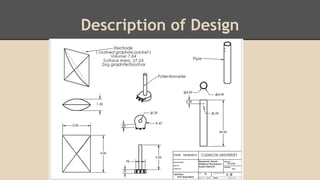
Description of Design
Listing of Materials/Costs
● 0.2 lbs of crushed biochar = free
● 0.2lbs of FMEV-213ESV Granular graphite carbon = $0.99
● 100 sq in of Phifer Charcoal Fiberglass Screen = $0.26
● Potentiometer and Voltmeter = free
● 14-AWG Solid Blue Copper THHN Wire (7.083ft) =$2.05
● Recycled PVC pipe = free
● Thread to sew anode/cathode pouches = $0.02
● Rubber band = $0.04
● 2 Ziploc bags = $0.30
Total Cost = $3.66
% Recycled Material by Mass = 85.86%
Description of Alternatives
● Alternative electrode Materials
○ 100% Granular Graphite
○Chitin
○Magnesium
● Alternative Electrode Designs
○ Graphite rods
○Graphite disks
Results and Discussion
Polarization Curve
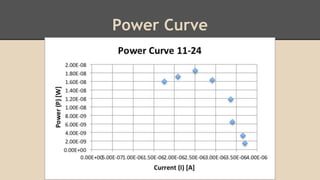
Power Curve
Power Density over Time
Redesign
●Should have raised potentiometer higher
above the water surface.
●Better contact between wires and
electrodes
●Better flow of oxygen to cathode
Conclusions
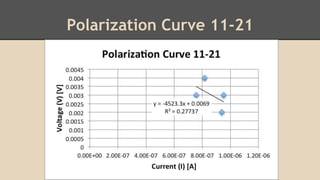
●The internal resistance of our MFC was
4518Ω
●The goal of 1 W/m3 was not met,
unfortunately.
○Highest Power Density: 0.205 mW/m3
●Our other parameters were well met as our
MFC was cost effective and sustainable in
the environment.
References
Girguis, Peter R., Mark E. Nielsen, and Clare E. Reimers. "Fundamentals of Benethic Microbial Fuel Cells. Theory,
Development and Application." (n.d.): 1-30. Harvard. Web. 20 Oct. 2014.
<http://www.oeb.harvard.edu/faculty/girguis/pdf/2010GirguisFundamentals.pdf>.
Huggins, Tyler, Himing Wang, Joshua Kearns, Peter Jenkins, and Zhiyong J. Ren. "Biochar as a Sustainable Electrode
Material for Electricity Production in Microbial Fuel Cells." Bioresource Technology 157 (2014): 114-19. Academia.edu.
Apr. 2014. Web. 18 Oct. 2014.
<http://www.academia.edu/6236128/Biochar_as_a_sustainable_electrode_material_for_electricity_production_in_microbi
al_fuel_cells>.
Lovley, Derek R. "Microbial Energizers: Fuel Cells That Keep on Going."Microbe 1.7 (2006): 323-29.
Www.microbialfuelcell.org. 7 Nov. 2006. Web. 19 Oct. 2014.
<http://www.microbialfuelcell.org/Publications/EBC/Microbe_July_2006.pdf>.
Rezaei, Farzaneh, Tom L. Richard, and Bruce E. Logan. "Analysis of Chitin Particle Size on Maximum Power Generation,
Power Longevity, and Coulombic Efficiency in Solid–substrate Microbial Fuel Cells." Journal of Power Sources (2009):
n. pag. Journal of Power Sources. 21 Mar. 2009. Web. Nov. 2014.
Sci., Int. J. Electrochem. Power Generation and Anode Bacterial Community Compositions of Sediment Fuel Cells
Differing in Anode Materials and Carbon Sources (2013): n. pag. International Journal of ELECTROCHEMICAL
SCIENCE. Web. <http://www.electrochemsci.org/papers/vol9/90100315.pdf>.
Appendices
Polarization Curve 11-17
Power Curve 11-17
Polarization Curve 11-21
Power Curve 11-21
Data for Polarization and Power Curve for 11-17
Resistance
(R) [ Ω ]
Voltage
(V) [V]
Current (I)
[A]
Power (P)
[W]
Power / Volume
(P/V) [W/m3]
Power/Area
(P/SA) [W/m2]
5070 0.01 1.97E-06 1.97E-08 1.54E-04 1.12E-06
4010 0.009 2.24E-06 2.02E-08 1.57E-04 1.15E-06
3075 0.008 2.60E-06 2.08E-08 1.62E-04 1.18E-06
2017 0.005 2.48E-06 1.24E-08 9.65E-05 7.05E-07
1038 0.003 2.89E-06 8.67E-09 6.75E-05 4.93E-07
493 0.001 2.03E-06 2.03E-09 1.58E-05 1.15E-07
Data for Polarization and Power Curve for 11-21
Resistance
(R) [ Ω ]
Voltage
(V) [V]
Current
(I) [A]
Power
(P) [W]
Power/volume
(P/V) [W/m3]
Power/Area
(P/SA) [W/m2]
4900 0.004 8.16E-07 3.27E-09 2.54E-05 1.86E-07
3960 0.003 7.58E-07 2.27E-09 1.77E-05 1.29E-07
3148 0.003 9.53E-07 2.86E-09 2.23E-05 1.63E-07
2130 0.002 9.39E-07 1.88E-09 1.46E-05 1.07E-07
Data for Polarization and Power Curve for 11-24
Resistance
(R) [ Ω ]
Voltage (V)
[V]
Current (I)
[A]
Power (P)
[W]
Power/volume
(P/V) [W/m3]
Power/Area
(P/SA) [W/m2]
5,180 0.0091 1.76E-06 1.60E-08 1.24E-04 9.10E-07
3930 0.0082 2.09E-06 1.71E-08 1.33E-04 9.74E-07
2950 0.0074 2.51E-06 1.86E-08 1.44E-04 1.06E-06
1920 0.0056 2.92E-06 1.63E-08 1.27E-04 9.29E-07
1040 0.0035 3.37E-06 1.18E-08 9.17E-05 6.70E-07
558 0.0019 3.41E-06 6.47E-09 5.04E-05 3.68E-07
246 0.0009 3.66E-06 3.29E-09 2.56E-05 1.87E-07
108 0.0004 3.70E-06 1.48E-09 1.15E-05 8.43E-08
55 0.0001 1.82E-06 1.82E-10 1.42E-06 1.03E-08
Highest Power Densities by Day
Day
Resistance
(R) [Ω]
Voltage
(V) [V]
Current
(I) [A]
Power
(P) [W]
Power Density
(P/V) [W/m3]
Water
Temperature
(T) [℃]
0 3075 0.008 2.60E-06 2.08E-08 1.62E-04 11.9
1 2338 0.003 1.28E-06 3.85E-09 3.00E-05 8.8
2 2324 0.003 1.29E-06 3.87E-09 3.01E-05 8.6
3 2338 0.003 1.28E-06 3.85E-09 3.00E-05 11.1
4 4900 0.004 8.16E-07 3.27E-09 2.54E-05 12.6
5 2430 0.008 3.29E-06 2.63E-08 2.05E-04 9.3
7 2950 0.0074 2.51E-06 1.86E-08 1.44E-04 11.4
8 4518.2 0.0065 1.44E-06 9.35E-09 7.28E-05 11.7

Microbial Fuel Cell Project

  • 1.
    MFC Presentation By: KaylaKernich, Benjamin Rawls, and Adrianna Thompson
  • 2.
    Governing Equations V=IR P=IVPDV=IV/V Oxidation of Glucose:(e- loss in soil anode chamber) C6H12O6 + 6H2O → 6CO2 + 24H+ + 24e- Reduction of O2: (e- accepted in cathode chamber) 24e- + 6O2 + 24H+ → 12H2O Overall reaction: C6H12O6 + 6O2 → 6CO2+ 6H2O
  • 3.
    Problem Specifics andGoals ● Sustainably produce 1W/m3 of recoverable electrical power output in a sediment MFC Process: - Anode must be anaerobic and compatible with sediment bacteria - Cathode must be in aerobic environment Structural: - Connectivity of wires must allow e- flow - Protect the potentiometer from rainwater - Stabilize MFC in the pond and keep electrodes in place
  • 4.
    Constraints and Considerations -Must be constructed in 2 weeks on a $20 budget - At least 75% of the MFC weight must be recycled or natural material - Must not be harmful or disruptive to the environment - Must be biologically compatible with bacteria cultures and algae in water - Construction limited by student skills and available tools (hand saws, electric drill) - Must use proper safety precautions with tools - Should last until at least the end of the semester (~1 month lifetime)
  • 5.
  • 6.
    Description of VariousMFCs A microbial fuel cell is a specialized biological reactor that captures the electrons processed by the microbes during respiration into usable electrical energy. ● Two-chamber MFC ● Single-chamber MFC ● Sediment MFC
  • 7.
    Information from ResearchArticles ● Article 1 ○ Looked at carbon graphite rods versus disks ○ Determined that rods created more power than disk because of radial diffusion ○ Adding carbon to the soil increased the power output by increasing activity of the microbes. ● Article 2 ○ Looked at how the location affects an MFC ○ Determined that areas with a high concentration of microorganisms/bacteria produced more power per volume. ● Article 3 ○ Looked at performance of CSTRs producing power from manure ○ Determined that using MFCs to capture electrons released during microbial biodegradation was not as efficient as anaerobic digestion.
  • 8.
    Information from ResearchArticles Although biochar produces slightly less power per volume than graphite granules, it cost 11x less than graphite granules.
  • 9.
    Past Experience, Heuristics Thegoal of this experiment was to produce 1 W/m3 of power. Using heuristics, we believed we would be able to accomplish this by creating rectangular pouch of carbon graphite and biochar. We found that one of our pouches could hold approximately 26 g of material. Using an article online we found that a volume of 75 cm3 of biochar produced 4.97 W/m3, so we assumed that using ½ graphite would only increase the wattage, ensuring that the goal of 1 W/m3 would be produced.
  • 10.
  • 11.
    Analysis of Information Fundamentalsof Benthic Microbial Fuel Cells. Theory, Development and Application ● Comparing power densities for different carbon anode forms: carbon fiber, cloth, and sponges ○ Sponge form of carbon had highest power density: 55mV/m2 (~2x cloth power) ● Treating graphite anodes with metallic compounds typically leads to a 5X power density increase in anodes over time Biochar as a Sustainable Electrode Material for Electricity Production in Microbial Fuel Cells ● Biochar reduces cost and carbon footprint of MFCs ● Graphite has higher power density than biochar, despite biochar’s higher surface area ○ Biochar: 4.97 W/m3 ○ Graphite Granules: 6.15 W/m3 ● Estimated biochar power output based on this article
  • 12.
    Synthesis of Design ●From research ○ graphite granules could give 6.15 W/m3 ○ biochar could produce 4.97 W/m3 ● Decided that a 50/50 mix would give necessary power density more sustainably and at reduced cost
  • 13.
  • 14.
  • 16.
    Listing of Materials/Costs ●0.2 lbs of crushed biochar = free ● 0.2lbs of FMEV-213ESV Granular graphite carbon = $0.99 ● 100 sq in of Phifer Charcoal Fiberglass Screen = $0.26 ● Potentiometer and Voltmeter = free ● 14-AWG Solid Blue Copper THHN Wire (7.083ft) =$2.05 ● Recycled PVC pipe = free ● Thread to sew anode/cathode pouches = $0.02 ● Rubber band = $0.04 ● 2 Ziploc bags = $0.30 Total Cost = $3.66 % Recycled Material by Mass = 85.86%
  • 17.
    Description of Alternatives ●Alternative electrode Materials ○ 100% Granular Graphite ○Chitin ○Magnesium ● Alternative Electrode Designs ○ Graphite rods ○Graphite disks
  • 18.
  • 19.
  • 20.
  • 21.
  • 22.
    Redesign ●Should have raisedpotentiometer higher above the water surface. ●Better contact between wires and electrodes ●Better flow of oxygen to cathode
  • 23.
    Conclusions ●The internal resistanceof our MFC was 4518Ω ●The goal of 1 W/m3 was not met, unfortunately. ○Highest Power Density: 0.205 mW/m3 ●Our other parameters were well met as our MFC was cost effective and sustainable in the environment.
  • 24.
    References Girguis, Peter R.,Mark E. Nielsen, and Clare E. Reimers. "Fundamentals of Benethic Microbial Fuel Cells. Theory, Development and Application." (n.d.): 1-30. Harvard. Web. 20 Oct. 2014. <http://www.oeb.harvard.edu/faculty/girguis/pdf/2010GirguisFundamentals.pdf>. Huggins, Tyler, Himing Wang, Joshua Kearns, Peter Jenkins, and Zhiyong J. Ren. "Biochar as a Sustainable Electrode Material for Electricity Production in Microbial Fuel Cells." Bioresource Technology 157 (2014): 114-19. Academia.edu. Apr. 2014. Web. 18 Oct. 2014. <http://www.academia.edu/6236128/Biochar_as_a_sustainable_electrode_material_for_electricity_production_in_microbi al_fuel_cells>. Lovley, Derek R. "Microbial Energizers: Fuel Cells That Keep on Going."Microbe 1.7 (2006): 323-29. Www.microbialfuelcell.org. 7 Nov. 2006. Web. 19 Oct. 2014. <http://www.microbialfuelcell.org/Publications/EBC/Microbe_July_2006.pdf>. Rezaei, Farzaneh, Tom L. Richard, and Bruce E. Logan. "Analysis of Chitin Particle Size on Maximum Power Generation, Power Longevity, and Coulombic Efficiency in Solid–substrate Microbial Fuel Cells." Journal of Power Sources (2009): n. pag. Journal of Power Sources. 21 Mar. 2009. Web. Nov. 2014. Sci., Int. J. Electrochem. Power Generation and Anode Bacterial Community Compositions of Sediment Fuel Cells Differing in Anode Materials and Carbon Sources (2013): n. pag. International Journal of ELECTROCHEMICAL SCIENCE. Web. <http://www.electrochemsci.org/papers/vol9/90100315.pdf>.
  • 25.
  • 26.
  • 27.
  • 28.
  • 29.
  • 30.
    Data for Polarizationand Power Curve for 11-17 Resistance (R) [ Ω ] Voltage (V) [V] Current (I) [A] Power (P) [W] Power / Volume (P/V) [W/m3] Power/Area (P/SA) [W/m2] 5070 0.01 1.97E-06 1.97E-08 1.54E-04 1.12E-06 4010 0.009 2.24E-06 2.02E-08 1.57E-04 1.15E-06 3075 0.008 2.60E-06 2.08E-08 1.62E-04 1.18E-06 2017 0.005 2.48E-06 1.24E-08 9.65E-05 7.05E-07 1038 0.003 2.89E-06 8.67E-09 6.75E-05 4.93E-07 493 0.001 2.03E-06 2.03E-09 1.58E-05 1.15E-07
  • 31.
    Data for Polarizationand Power Curve for 11-21 Resistance (R) [ Ω ] Voltage (V) [V] Current (I) [A] Power (P) [W] Power/volume (P/V) [W/m3] Power/Area (P/SA) [W/m2] 4900 0.004 8.16E-07 3.27E-09 2.54E-05 1.86E-07 3960 0.003 7.58E-07 2.27E-09 1.77E-05 1.29E-07 3148 0.003 9.53E-07 2.86E-09 2.23E-05 1.63E-07 2130 0.002 9.39E-07 1.88E-09 1.46E-05 1.07E-07
  • 32.
    Data for Polarizationand Power Curve for 11-24 Resistance (R) [ Ω ] Voltage (V) [V] Current (I) [A] Power (P) [W] Power/volume (P/V) [W/m3] Power/Area (P/SA) [W/m2] 5,180 0.0091 1.76E-06 1.60E-08 1.24E-04 9.10E-07 3930 0.0082 2.09E-06 1.71E-08 1.33E-04 9.74E-07 2950 0.0074 2.51E-06 1.86E-08 1.44E-04 1.06E-06 1920 0.0056 2.92E-06 1.63E-08 1.27E-04 9.29E-07 1040 0.0035 3.37E-06 1.18E-08 9.17E-05 6.70E-07 558 0.0019 3.41E-06 6.47E-09 5.04E-05 3.68E-07 246 0.0009 3.66E-06 3.29E-09 2.56E-05 1.87E-07 108 0.0004 3.70E-06 1.48E-09 1.15E-05 8.43E-08 55 0.0001 1.82E-06 1.82E-10 1.42E-06 1.03E-08
  • 33.
    Highest Power Densitiesby Day Day Resistance (R) [Ω] Voltage (V) [V] Current (I) [A] Power (P) [W] Power Density (P/V) [W/m3] Water Temperature (T) [℃] 0 3075 0.008 2.60E-06 2.08E-08 1.62E-04 11.9 1 2338 0.003 1.28E-06 3.85E-09 3.00E-05 8.8 2 2324 0.003 1.29E-06 3.87E-09 3.01E-05 8.6 3 2338 0.003 1.28E-06 3.85E-09 3.00E-05 11.1 4 4900 0.004 8.16E-07 3.27E-09 2.54E-05 12.6 5 2430 0.008 3.29E-06 2.63E-08 2.05E-04 9.3 7 2950 0.0074 2.51E-06 1.86E-08 1.44E-04 11.4 8 4518.2 0.0065 1.44E-06 9.35E-09 7.28E-05 11.7

Editor's Notes

  • #12 metallic compounds including iron, nickel, and manganese
  • #13 45s