
#adrdforum @adbioresources
DR MICHELLE MORRISON
PRINCIPAL AD SCIENTIST & GROUP LEADER, CENTRE FOR PROCESS INNOVATION
NOVEL TUBULAR TECHNOLOGY FOR
IMPROVED SMALL SCALE
ANAEROBIC DIGESTION
© 2014 Centre for Process Innovation Limited. All Rights Reserved.
Novel application of OBR technology
to anaerobic digestion
Michelle Morrison
Principal AD Scientist & Group Leader
Outline
ResultsThe experiment And so?What is OBR?
Project Aims
This study evaluated anaerobic co-digestion of dairy slurry and glycerol, with the aim of :
1. testing the feasibility of a novel digester design based on OBR technology;
2. comparing its overall performance to a more conventional digester based on STR technology and
3. determining the effects of agitation and HRT on methane yield in both digester designs.
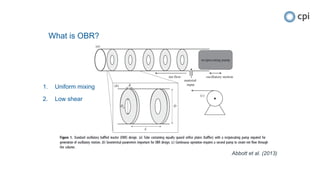
What is OBR?
1. Uniform mixing
2. Low shear
Abbott et al. (2013)
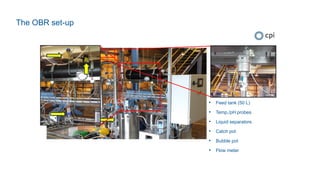
• Feed tank (50 L)
• Temp./pH probes
• Liquid separators
• Catch pot
• Bubble pot
• Flow meter
The OBR set-up
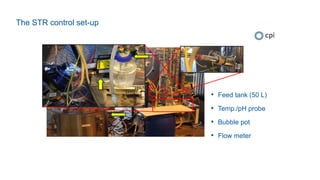
The STR control set-up
• Feed tank (50 L)
• Temp./pH probe
• Bubble pot
• Flow meter
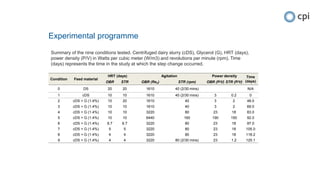
Experimental programme
Condition Feed material
HRT (days) Agitation Power density Time
(days)OBR STR OBR (Reo) STR (rpm) OBR (P/V) STR (P/V)
0 DS 20 20 1610 40 (2/30 mins) N/A
1 cDS 10 10 1610 40 (2/30 mins) 3 0.2 0
2 cDS + G (1.4%) 10 20 1610 40 3 2 48.0
3 cDS + G (1.4%) 10 10 1610 40 3 2 69.0
4 cDS + G (1.4%) 10 10 3220 80 23 18 83.0
5 cDS + G (1.4%) 10 10 6440 160 190 150 92.0
6 cDS + G (1.4%) 6.7 6.7 3220 80 23 18 97.0
7 cDS + G (1.4%) 5 5 3220 80 23 18 105.0
8 cDS + G (1.4%) 4 4 3220 80 23 18 118.2
9 cDS + G (1.4%) 4 4 3220 80 (2/30 mins) 23 1.2 125.1
Summary of the nine conditions tested. Centrifuged dairy slurry (cDS), Glycerol (G), HRT (days),
power density (P/V) in Watts per cubic meter (W/m3) and revolutions per minute (rpm). Time
(days) represents the time in the study at which the step change occurred.
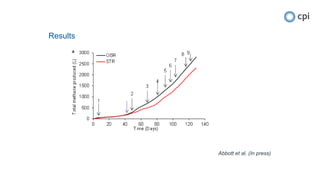
Results
Abbott et al. (In press)
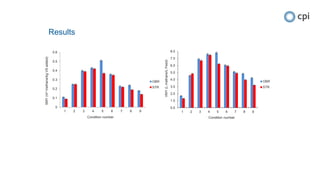
Results
0.0
1.0
2.0
3.0
4.0
5.0
6.0
7.0
8.0
1 2 3 4 5 6 7 8 9
VMY(Lmethane/LFeed)
Condition number
OBR
STR
0
0.1
0.2
0.3
0.4
0.5
0.6
1 2 3 4 5 6 7 8 9
SMY(m3methane/kgVSadded)
Condition number
OBR
STR
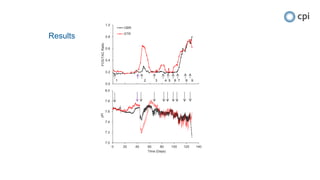
Results
7.0
7.2
7.4
7.6
7.8
8.0
0 20 40 60 80 100 120 140
pH
Time (Days)
0.0
0.2
0.4
0.6
0.8
1.0
FOS/TACRatio
OBR
STR
2 3 4 5 6 7 8 91
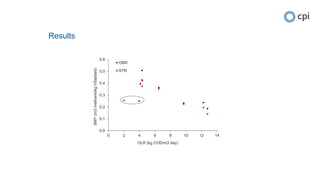
Results
0.0
0.1
0.2
0.3
0.4
0.5
0.6
0 2 4 6 8 10 12 14
SMY(m3methane/kgVSadded)
OLR (kg COD/m3 day)
OBR
STR
And so?
• A digester based on OBR technology was successfully used for AD of DS and co-digestion with glycerol.
• Continuous agitation improved methane yields in both digesters (up to a certain mixing intensity).
• Reducing HRTs had a negative effect on both digesters.
• The OBR was unable to process particulates. However, with cDS the maximum SMY obtained was
increased by 28% in the OBR compared with the STR, at an optimum OLR of 4.3 kg COD/m3 day.
• At high mixing intensities, the OBR outperformed the STR due to low shear.
• The OBR was better at withstanding shocks to the system i.e. It was more stable than the STR.
• More power was required for temperature control and pumping of the OBR, than for the STR (81kWhr/d
versus 5kWhr/d).
Acknowledgements
• Thanks to our funders for this project, TSB Smart Award.
• To those involved with the original idea and design (Prof. Mike Theodorou)
• Thanks to our Eng.D student, Matthew Abbott, for his hard work on the project.
Thank you for listening. Any questions?
Thank you...
For more information visit www.uk-cpi.com
Email:
Twitter:
info@uk-cpi.com
@ukCPI

Michelle Morrison

  • 1.
    #adrdforum @adbioresources DR MICHELLEMORRISON PRINCIPAL AD SCIENTIST & GROUP LEADER, CENTRE FOR PROCESS INNOVATION NOVEL TUBULAR TECHNOLOGY FOR IMPROVED SMALL SCALE ANAEROBIC DIGESTION
  • 2.
    © 2014 Centrefor Process Innovation Limited. All Rights Reserved. Novel application of OBR technology to anaerobic digestion Michelle Morrison Principal AD Scientist & Group Leader
  • 3.
  • 4.
    Project Aims This studyevaluated anaerobic co-digestion of dairy slurry and glycerol, with the aim of : 1. testing the feasibility of a novel digester design based on OBR technology; 2. comparing its overall performance to a more conventional digester based on STR technology and 3. determining the effects of agitation and HRT on methane yield in both digester designs.
  • 5.
    What is OBR? 1.Uniform mixing 2. Low shear Abbott et al. (2013)
  • 6.
    • Feed tank(50 L) • Temp./pH probes • Liquid separators • Catch pot • Bubble pot • Flow meter The OBR set-up
  • 7.
    The STR controlset-up • Feed tank (50 L) • Temp./pH probe • Bubble pot • Flow meter
  • 8.
    Experimental programme Condition Feedmaterial HRT (days) Agitation Power density Time (days)OBR STR OBR (Reo) STR (rpm) OBR (P/V) STR (P/V) 0 DS 20 20 1610 40 (2/30 mins) N/A 1 cDS 10 10 1610 40 (2/30 mins) 3 0.2 0 2 cDS + G (1.4%) 10 20 1610 40 3 2 48.0 3 cDS + G (1.4%) 10 10 1610 40 3 2 69.0 4 cDS + G (1.4%) 10 10 3220 80 23 18 83.0 5 cDS + G (1.4%) 10 10 6440 160 190 150 92.0 6 cDS + G (1.4%) 6.7 6.7 3220 80 23 18 97.0 7 cDS + G (1.4%) 5 5 3220 80 23 18 105.0 8 cDS + G (1.4%) 4 4 3220 80 23 18 118.2 9 cDS + G (1.4%) 4 4 3220 80 (2/30 mins) 23 1.2 125.1 Summary of the nine conditions tested. Centrifuged dairy slurry (cDS), Glycerol (G), HRT (days), power density (P/V) in Watts per cubic meter (W/m3) and revolutions per minute (rpm). Time (days) represents the time in the study at which the step change occurred.
  • 9.
  • 10.
    Results 0.0 1.0 2.0 3.0 4.0 5.0 6.0 7.0 8.0 1 2 34 5 6 7 8 9 VMY(Lmethane/LFeed) Condition number OBR STR 0 0.1 0.2 0.3 0.4 0.5 0.6 1 2 3 4 5 6 7 8 9 SMY(m3methane/kgVSadded) Condition number OBR STR
  • 11.
    Results 7.0 7.2 7.4 7.6 7.8 8.0 0 20 4060 80 100 120 140 pH Time (Days) 0.0 0.2 0.4 0.6 0.8 1.0 FOS/TACRatio OBR STR 2 3 4 5 6 7 8 91
  • 12.
    Results 0.0 0.1 0.2 0.3 0.4 0.5 0.6 0 2 46 8 10 12 14 SMY(m3methane/kgVSadded) OLR (kg COD/m3 day) OBR STR
  • 13.
    And so? • Adigester based on OBR technology was successfully used for AD of DS and co-digestion with glycerol. • Continuous agitation improved methane yields in both digesters (up to a certain mixing intensity). • Reducing HRTs had a negative effect on both digesters. • The OBR was unable to process particulates. However, with cDS the maximum SMY obtained was increased by 28% in the OBR compared with the STR, at an optimum OLR of 4.3 kg COD/m3 day. • At high mixing intensities, the OBR outperformed the STR due to low shear. • The OBR was better at withstanding shocks to the system i.e. It was more stable than the STR. • More power was required for temperature control and pumping of the OBR, than for the STR (81kWhr/d versus 5kWhr/d).
  • 14.
    Acknowledgements • Thanks toour funders for this project, TSB Smart Award. • To those involved with the original idea and design (Prof. Mike Theodorou) • Thanks to our Eng.D student, Matthew Abbott, for his hard work on the project.
  • 15.
    Thank you forlistening. Any questions?
  • 16.
    Thank you... For moreinformation visit www.uk-cpi.com Email: Twitter: info@uk-cpi.com @ukCPI