





16 MAY 2016
CLARKE WILLMOTT LLP, BRISTOL
ADBA SPRING
REGULATORY FORUM
PRISCILLA HALL
PARTNER & HEAD OF RENEWABLES, CLARKE WILLMOTT LLP
WELCOME AND
INTRODUCTION
MATT HINDLE
HEAD OF POLICY, ADBA
ADBA POLICY UPDATE
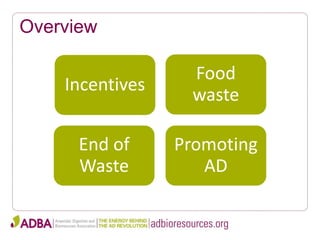
Overview
Incentives
Food
waste
End of
Waste
Promoting
AD
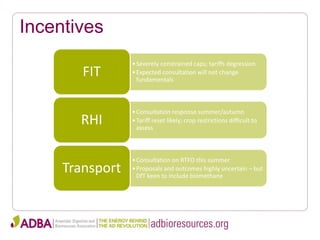
Incentives
•Severely constrained caps; tariffs degression
•Expected consultation will not change
fundamentals
FIT
•Consultation response summer/autumn
•Tariff reset likely; crop restrictions difficult to
assess
RHI
•Consultation on RTFO this summer
•Proposals and outcomes highly uncertain – but
DfT keen to include biomethane
Transport
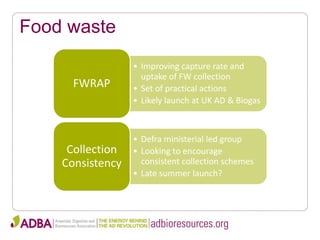
Food waste
• Improving capture rate and
uptake of FW collection
• Set of practical actions
• Likely launch at UK AD & Biogas
FWRAP
• Defra ministerial led group
• Looking to encourage
consistent collection schemes
• Late summer launch?
Collection
Consistency
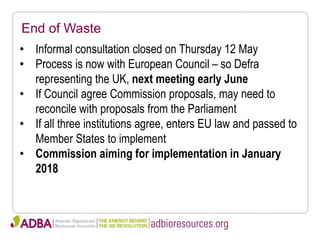
End of Waste
• Informal consultation closed on Thursday 12 May
• Process is now with European Council – so Defra
representing the UK, next meeting early June
• If Council agree Commission proposals, may need to
reconcile with proposals from the Parliament
• If all three institutions agree, enters EU law and passed to
Member States to implement
• Commission aiming for implementation in January
2018
Feeding in
• Blog and detailed ADBA response available this week –
let us know what you think
• Expect some ongoing discussion directly and via EBA
• Defra representing UK in meetings throughout June which
will discuss detail of proposals – feed in through this route
by end of May
• European Parliament will also consider
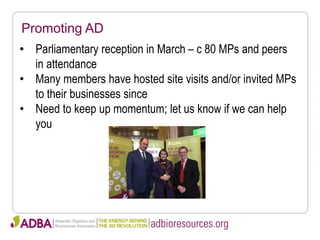
Promoting AD
• Parliamentary reception in March – c 80 MPs and peers
in attendance
• Many members have hosted site visits and/or invited MPs
to their businesses since
• Need to keep up momentum; let us know if we can help
you
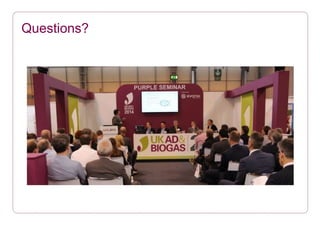
Questions?
ADBA POLICY UPDATE
MATT HINDLE
HEAD OF POLICY, ADBA
OPEN DISCUSSION
UPDATE FROM THE
ENVIRONMENT AGENCY
VIV DENNIS
SENIOR ADVISOR (BIOWASTE) - ENVIRONMENT & BUSINESS DIRECTORATE,
ENVIRONMENT AGENCY
Environment Agency Regulatory
Update
Viv Dennis
Senior Advisor, Environment Agency
ADBA Regulatory Forum 16th May 2016
Waste permit exemptions – our
proposals for changes
• Submitted to Defra in March, English and Welsh Ministers will
decide what to take forward, Govt consultation would follow,
autumn at the earliest
• U10 landspreading
– Details of waste types & quantities, expected period and duration - pre-
assessment
– Ongoing – records, waste types & quantities, plan of tipping areas, technical
competence
• T25 small scale AD
– Details of waste types & quantities, plant capacity, planning status evidence,
operator competence - pre-assessment
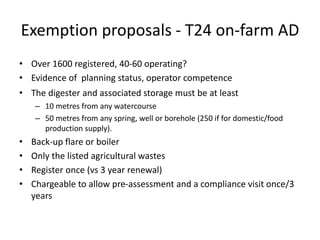
Exemption proposals - T24 on-farm AD
• Over 1600 registered, 40-60 operating?
• Evidence of planning status, operator competence
• The digester and associated storage must be at least
– 10 metres from any watercourse
– 50 metres from any spring, well or borehole (250 if for domestic/food
production supply).
• Back-up flare or boiler
• Only the listed agricultural wastes
• Register once (vs 3 year renewal)
• Chargeable to allow pre-assessment and a compliance visit once/3
years
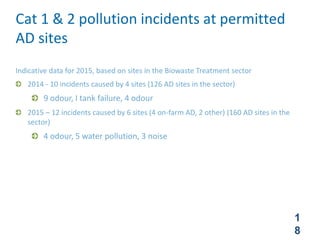
Cat 1 & 2 pollution incidents at permitted
AD sites
Indicative data for 2015, based on sites in the Biowaste Treatment sector
2014 - 10 incidents caused by 4 sites (126 AD sites in the sector)
9 odour, I tank failure, 4 odour
2015 – 12 incidents caused by 6 sites (4 on-farm AD, 2 other) (160 AD sites in the
sector)
4 odour, 5 water pollution, 3 noise
1
8
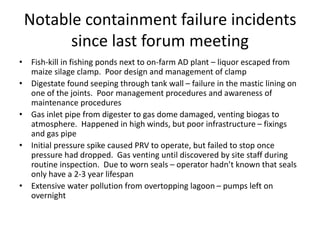
Notable containment failure incidents
since last forum meeting
• Fish-kill in fishing ponds next to on-farm AD plant – liquor escaped from
maize silage clamp. Poor design and management of clamp
• Digestate found seeping through tank wall – failure in the mastic lining on
one of the joints. Poor management procedures and awareness of
maintenance procedures
• Gas inlet pipe from digester to gas dome damaged, venting biogas to
atmosphere. Happened in high winds, but poor infrastructure – fixings
and gas pipe
• Initial pressure spike caused PRV to operate, but failed to stop once
pressure had dropped. Gas venting until discovered by site staff during
routine inspection. Due to worn seals – operator hadn’t known that seals
only have a 2-3 year lifespan
• Extensive water pollution from overtopping lagoon – pumps left on
overnight
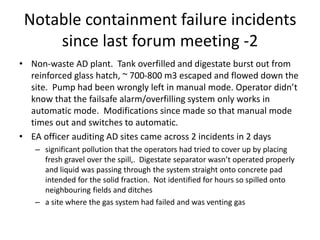
Notable containment failure incidents
since last forum meeting -2
• Non-waste AD plant. Tank overfilled and digestate burst out from
reinforced glass hatch, ~ 700-800 m3 escaped and flowed down the
site. Pump had been wrongly left in manual mode. Operator didn’t
know that the failsafe alarm/overfilling system only works in
automatic mode. Modifications since made so that manual mode
times out and switches to automatic.
• EA officer auditing AD sites came across 2 incidents in 2 days
– significant pollution that the operators had tried to cover up by placing
fresh gravel over the spill,. Digestate separator wasn’t operated properly
and liquid was passing through the system straight onto concrete pad
intended for the solid fraction. Not identified for hours so spilled onto
neighbouring fields and ditches
– a site where the gas system had failed and was venting gas
Waste treatment BREF update
• Deadline for comments on WT BRef first draft of the was 18th March
2016. Now awaiting Bureau’s assessment of the comments and the
next steps.
• Some feedback on the comments in screenshots following
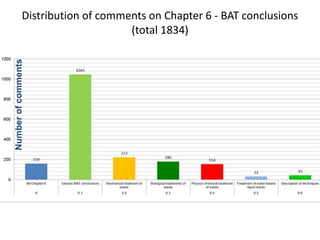
NumberofcommentsDistribution of comments on Chapter 6 - BAT conclusions
(total 1834)
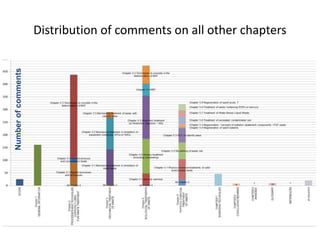
Distribution of comments on all other chapters
Numberofcomments
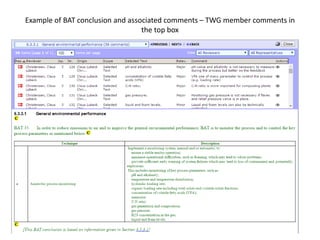
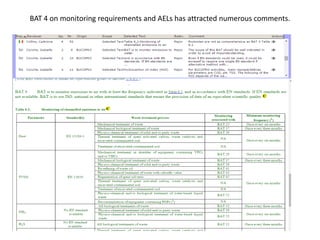
Example of BAT conclusion and associated comments – TWG member comments in
the top box
BAT 4 on monitoring requirements and AELs has attracted numerous comments.
Waste treatment BREF update 2
• Germany supported by the UK and others have asked Bureau for an
additional TWG meeting to discuss proposed AEL’s and supporting
data. WT BRef is sent on for approval after final TWG meeting.
• Commission will publish BAT conclusions in the Official Journal in all
MS languages. Regulatory bodies across Europe then have four
years in which to implement for existing installations. Bureau
publish the Bref in English.
Defra 'Smarter Environmental Regulation
Review’ - permitting guidance on gov.uk
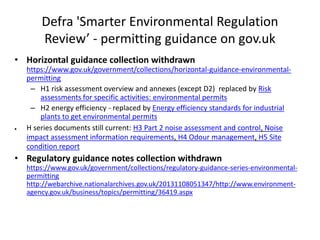
• Horizontal guidance collection withdrawn
https://www.gov.uk/government/collections/horizontal-guidance-environmental-
permitting
– H1 risk assessment overview and annexes (except D2) replaced by Risk
assessments for specific activities: environmental permits
– H2 energy efficiency - replaced by Energy efficiency standards for industrial
plants to get environmental permits
 H series documents still current: H3 Part 2 noise assessment and control, Noise
impact assessment information requirements, H4 Odour management, H5 Site
condition report
• Regulatory guidance notes collection withdrawn
https://www.gov.uk/government/collections/regulatory-guidance-series-environmental-
permitting
http://webarchive.nationalarchives.gov.uk/20131108051347/http://www.environment-
agency.gov.uk/business/topics/permitting/36419.aspx
Regulatory guidance changes on gov.uk – 2
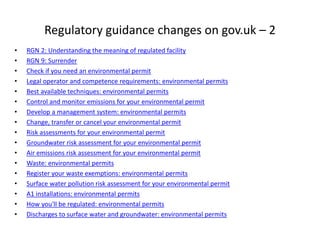
• RGN 2: Understanding the meaning of regulated facility
• RGN 9: Surrender
• Check if you need an environmental permit
• Legal operator and competence requirements: environmental permits
• Best available techniques: environmental permits
• Control and monitor emissions for your environmental permit
• Develop a management system: environmental permits
• Change, transfer or cancel your environmental permit
• Risk assessments for your environmental permit
• Groundwater risk assessment for your environmental permit
• Air emissions risk assessment for your environmental permit
• Waste: environmental permits
• Register your waste exemptions: environmental permits
• Surface water pollution risk assessment for your environmental permit
• A1 installations: environmental permits
• How you'll be regulated: environmental permits
• Discharges to surface water and groundwater: environmental permits
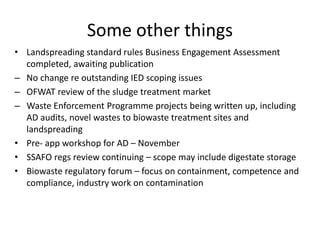
Some other things
• Landspreading standard rules Business Engagement Assessment
completed, awaiting publication
– No change re outstanding IED scoping issues
– OFWAT review of the sludge treatment market
– Waste Enforcement Programme projects being written up, including
AD audits, novel wastes to biowaste treatment sites and
landspreading
• Pre- app workshop for AD – November
• SSAFO regs review continuing – scope may include digestate storage
• Biowaste regulatory forum – focus on containment, competence and
compliance, industry work on contamination
UPDATE FROM THE
ENVIRONMENT AGENCY
VIV DENNIS
SENIOR ADVISOR (BIOWASTE) - ENVIRONMENT & BUSINESS DIRECTORATE,
ENVIRONMENT AGENCY
OPEN DISCUSSION
ADBA BEST PRACTICE
UPDATE
JESS ALLAN
ENVIRONMENT AND REGULATION MANAGER, ADBA
AMAYA ARIAS-GARCIA
TECHNICAL DIRECTOR, GOALS PROJECT MANAGEMENT & ENGINEERING SUPPORT
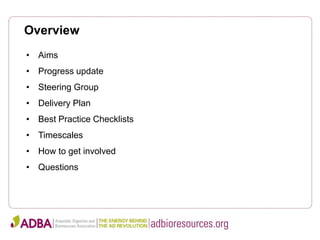
Overview
• Aims
• Progress update
• Steering Group
• Delivery Plan
• Best Practice Checklists
• Timescales
• How to get involved
• Questions
Aims
The Best Practice Scheme aims to help the industry to:
• Improve environmental performance.
• Improve safety performance.
• Improve operational performance.
Impression from Defra is that they support the concept of the BPS as
a way of driving improvement in performance – an alternative to
stricter regulation.
Progress Update
 Set up Steering Group.
 Provided a briefing note to all ADBA members and run a survey.
 Begun communications with regulators and government.
 Produced a Delivery Plan.
 Held workshops for Steering Group and regulators.
Steering Group
Chaired by Amaya Arias-Garcia (Goals-PME)
ADBA
Chartered Institute of Wastes Management (CIWM)
Chartered Institute of Water and Environmental Management (CIWEM)
CNA Hardy (insurer)
Country Land and Business Association (CLA)
Energy Networks Association (ENA)
Environmental Services Association (ESA)
Institute of Chemical Engineers (IChemE)
Jelf (insurance broker)
NFU
NFU Cymru
NFU Scotland
Renewable Energy Association (REA)
Water UK
WRAP
Zero Waste Scotland
Plus input from regulators:
APHA, EA, HSE, NRW, SEPA
Steering Group Survey Conclusions
• Current Performance
• Poor competence
• Poor environmental record
• Poor return on investment record
• Poor H&S record
• Most urgent issues
• Containment
• Foam and crust formation
• Equipment failure (pump, stirrer.. )
• Overpressure
• Overflow
• Odour
• Risk Management
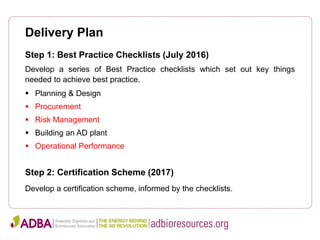
Delivery Plan
Step 1: Best Practice Checklists (July 2016)
Develop a series of Best Practice checklists which set out key things
needed to achieve best practice.
 Planning & Design
 Procurement
 Risk Management
 Building an AD plant
 Operational Performance
Step 2: Certification Scheme (2017)
Develop a certification scheme, informed by the checklists.
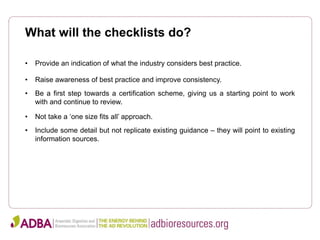
What will the checklists do?
• Provide an indication of what the industry considers best practice.
• Raise awareness of best practice and improve consistency.
• Be a first step towards a certification scheme, giving us a starting point to work
with and continue to review.
• Not take a ‘one size fits all’ approach.
• Include some detail but not replicate existing guidance – they will point to existing
information sources.
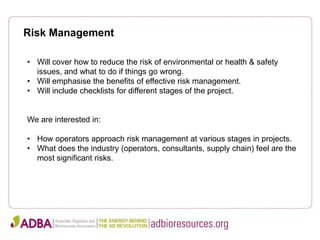
Risk Management
• Will cover how to reduce the risk of environmental or health & safety
issues, and what to do if things go wrong.
• Will emphasise the benefits of effective risk management.
• Will include checklists for different stages of the project.
We are interested in:
• How operators approach risk management at various stages in projects.
• What does the industry (operators, consultants, supply chain) feel are the
most significant risks.
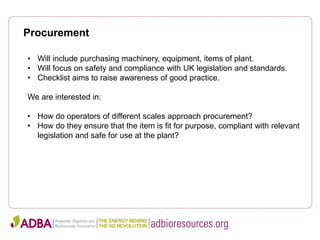
Procurement
• Will include purchasing machinery, equipment, items of plant.
• Will focus on safety and compliance with UK legislation and standards.
• Checklist aims to raise awareness of good practice.
We are interested in:
• How do operators of different scales approach procurement?
• How do they ensure that the item is fit for purpose, compliant with relevant
legislation and safe for use at the plant?
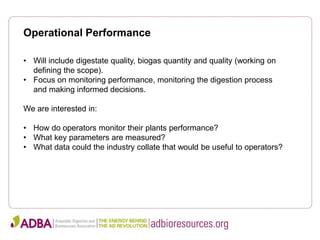
Operational Performance
• Will include digestate quality, biogas quantity and quality (working on
defining the scope).
• Focus on monitoring performance, monitoring the digestion process
and making informed decisions.
We are interested in:
• How do operators monitor their plants performance?
• What key parameters are measured?
• What data could the industry collate that would be useful to operators?
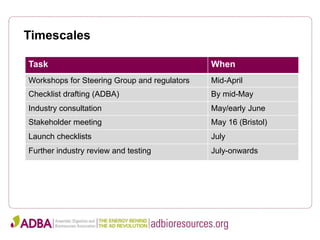
Task When
Workshops for Steering Group and regulators Mid-April
Checklist drafting (ADBA) By mid-May
Industry consultation May/early June
Stakeholder meeting May 16 (Bristol)
Launch checklists July
Further industry review and testing July-onwards
Timescales
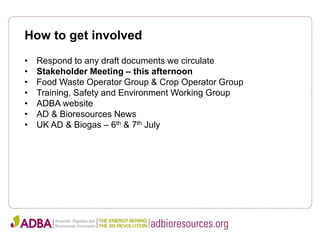
How to get involved
• Respond to any draft documents we circulate
• Stakeholder Meeting – this afternoon
• Food Waste Operator Group & Crop Operator Group
• Training, Safety and Environment Working Group
• ADBA website
• AD & Bioresources News
• UK AD & Biogas – 6th & 7th July
Any questions?
Jess Allan
Environment and Regulation Manager
jessica.allan@adbioresources.org
Dr Amaya Arias-Garcia
Goals Project Management and Engineering Support
aag@goals-pme.co.uk
ADBA BEST PRACTICE
UPDATE
JESS ALLAN
ENVIRONMENT AND REGULATION MANAGER, ADBA
AMAYA ARIAS-GARCIA
TECHNICAL DIRECTOR, GOALS PROJECT MANAGEMENT & ENGINEERING SUPPORT
OPEN DISCUSSION
Interested in Training, Safety and Environment?
Our working group is restructuring, and looking for
volunteers to lead two sub-groups:
Sub-group 1: Training, Health and Safety
Sub-group 2: Environment
Let me know:
Jess Allan
Environment and Regulation Manager
jessica.allan@adbioresources.org
PLEASE JOIN US
FOR LUNCH
UPDATE FROM THE
HEALTH AND SAFETY
EXECUTIVE
SIÂN CLAYTON
WASTE & RECYCLING TEAM - VULNERABLE WORKERS, AGRICULTURE, WASTE &
RECYCLING UNIT, HEALTH & SAFETY EXECUTIVE
A new strategy for health and safety
A record to be proud
• One of the safest working countries in the world
• Mature system of regulation, with lots of experienced
and committed participants
• Together, we can make the health and safety system
even better
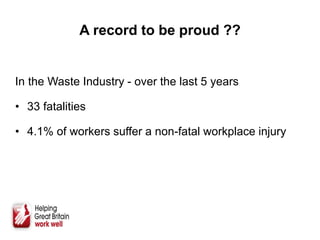
A record to be proud ??
In the Waste Industry - over the last 5 years
• 33 fatalities
• 4.1% of workers suffer a non-fatal workplace injury
Opportunities and challenges
Success has created many opportunities but also
challenges:
• It will be stretching to drive further improvement
• Need to resist temptation to set disproportionate
standards
• Immediacy of safety challenges has detracted from
effectively tackling health issues
Help Great Britain Work Well
• The strategy will help to build a safer, healthier
and more prosperous Great Britain
• Collective ownership and commitment will help
to protect lives, quality of life and livelihoods
• Helping Great Britain work well will enable businesses to
be more productive and grow
A note of caution
Better doesn’t always mean doing more…
…it’s about identifying and managing real risks smartly
Three overarching aspects
• Ownership
• Health
• Boosting Britain’s businesses
• A healthy workforce that feels valued by
their employers
• Reduced public expense dealing with unnecessary ill
health
• Business sectors boosted by improved staff retention
and increased productivity
What we all stand to gain
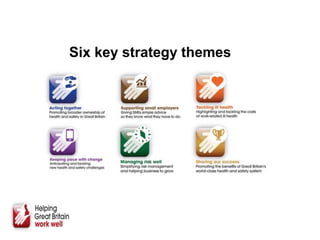
Six key strategy themes
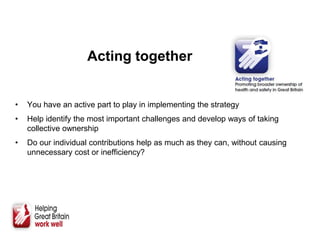
Acting together
• You have an active part to play in implementing the strategy
• Help identify the most important challenges and develop ways of taking
collective ownership
• Do our individual contributions help as much as they can, without causing
unnecessary cost or inefficiency?
Tackling ill-health
• C13,000 deaths from work-related lung disease and cancer last year -
reflecting historical conditions and standards
• 1.2 m working people suffering from work-related illness last year - half a
million were new conditions
• Long-latency hazards, stress and musculoskeletal disorders
• Drive for improvement must come from everyone with a stake in keeping
people healthy and fit for work
Supporting small employers
• HSE has already simplified legislation and guidance, produced straightforward
tools and examples
• Reaching all SMEs is challenging
• The best large businesses and intermediaries point SMEs they deal with in the
right direction – not offering overcomplicated advice or unnecessary barriers to
business
Managing risk well
• Risk assessments don’t need excessive paperwork
• Risk management doesn’t mean managing trivial risks
• Getting it wrong inhibits productivity, creativity and growth
• Managing the right risks in the right ways
• Help smaller companies get it right efficiently and effectively
Keeping pace with change
• HSE’s world-leading research capabilities increase its efficiency
and targeting
• Horizon-scanning expertise will be used as demographic, technological and
other changes affect the world of work
• We want to hear your ideas for how we can keep track of trends, as well as
any particular challenges you see ahead
Sharing success
• Sharing good practice, both at home and abroad
• Promoting our goal-based approach overseas,
making it easier for British businesses to expand into new markets
HSE’s contribution
• Continue as the prime mover in the health and safety system
• Work with industry, co-regulators and colleagues across government
to ensure our regulation is as simple and effective as possible
• We need to act together - talk, share ideas and set the right direction for the
future
UPDATE FROM THE
HEALTH AND SAFETY
EXECUTIVE
SIÂN CLAYTON
WASTE & RECYCLING TEAM - VULNERABLE WORKERS, AGRICULTURE, WASTE &
RECYCLING UNIT, HEALTH & SAFETY EXECUTIVE
OPEN DISCUSSION
CARL GURNEY
RENEWABLE ENERGY DIRECTOR, JELF INSURANCE BROKERS
CASE STUDY:
OPERATIONAL RISK
MANAGEMENT
Risk management and
insurance considerations
for your AD and Biogas
plant
Carl Gurney
Jelf Group
The importance of risk management and
insurance programmes and why they need to
be on your project agenda
Carl Gurney Cert CII
Renewable Energy Director
Email: carl.gurney@jelfgroup.com
MOB: 07799 474419
Presentation title | Page 70
What we will cover today
1. Risk management considerations
2. Insurance considerations
3. Conclusion
Presentation title | Page 71
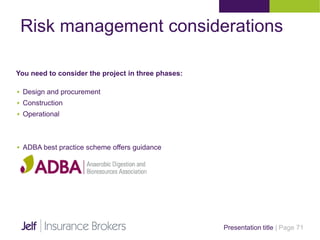
Risk management considerations
 Design and procurement
 Construction
 Operational
 ADBA best practice scheme offers guidance
You need to consider the project in three phases:
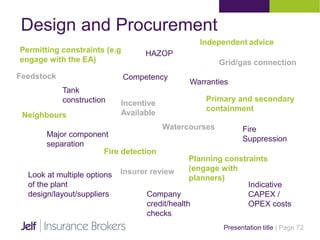
Design and Procurement
Presentation title | Page 72
Permitting constraints (e.g
engage with the EA)
Competency
HAZOP
Grid/gas connection
Tank
construction
Independent advice
Warranties
Incentive
Available
Primary and secondary
containment
Neighbours
Major component
separation
Fire detection
Insurer reviewLook at multiple options
of the plant
design/layout/suppliers
Feedstock
Fire
Suppression
Planning constraints
(engage with
planners)
Indicative
CAPEX /
OPEX costs
Watercourses
Company
credit/health
checks
Construction
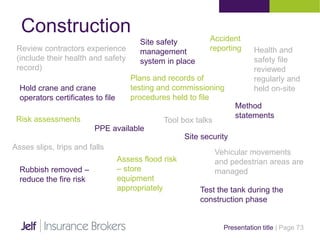
Presentation title | Page 73
Review contractors experience
(include their health and safety
record)
Hold crane and crane
operators certificates to file
Site safety
management
system in place
Plans and records of
testing and commissioning
procedures held to file
Accident
reporting Health and
safety file
reviewed
regularly and
held on-site
Method
statementsRisk assessments Tool box talks
PPE available
Vehicular movements
and pedestrian areas are
managedRubbish removed –
reduce the fire risk
Asses slips, trips and falls
Site security
Assess flood risk
– store
equipment
appropriately Test the tank during the
construction phase
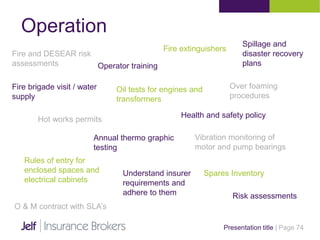
Operation
Presentation title | Page 74
Operator training
Fire and DESEAR risk
assessments
Fire extinguishers
Fire brigade visit / water
supply
Oil tests for engines and
transformers
Hot works permits
Health and safety policy
Spillage and
disaster recovery
plans
Over foaming
procedures
Annual thermo graphic
testing
Vibration monitoring of
motor and pump bearings
Rules of entry for
enclosed spaces and
electrical cabinets
Spares InventoryUnderstand insurer
requirements and
adhere to them Risk assessments
O & M contract with SLA’s
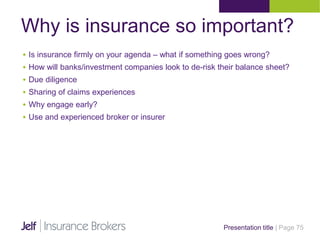
Why is insurance so important?
Presentation title | Page 75
 Is insurance firmly on your agenda – what if something goes wrong?
 How will banks/investment companies look to de-risk their balance sheet?
 Due diligence
 Sharing of claims experiences
 Why engage early?
 Use and experienced broker or insurer
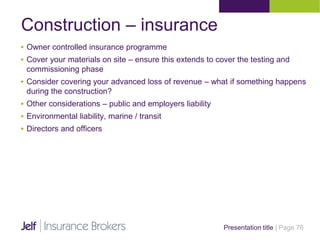
Construction – insurance
Presentation title | Page 76
 Owner controlled insurance programme
 Cover your materials on site – ensure this extends to cover the testing and
commissioning phase
 Consider covering your advanced loss of revenue – what if something happens
during the construction?
 Other considerations – public and employers liability
 Environmental liability, marine / transit
 Directors and officers
Operational - insurance
Presentation title | Page 77
 Material damage on an “All Risks Basis”
 Business interruption – cover your loss of revenue
 Mechanical breakdown
 Other considerations - public and employers liability
 Environmental liability, directors and officers, cyber, contingent business
interruption
The small print
Presentation title | Page 78
Warranties, conditions and endorsements
– Are quotations subject to survey
– What are the security conditions
– Is there a requirement for an annual maintenance contract
Excesses and indemnity periods
– What are the excesses for the differing sections of cover
– How long are the indemnity periods
Significant exclusions
– Do you know what these are? – have they been explained?
– Cyber cover
Conclusion
 Early engagement and working in atripartite partnership with brokers and
insurers will seriously benefit your project
 Spend time on your insurance and ensure it is firmly on the agenda
 Consider the different stages of your project
 Check the small print
 Risk management and health and safety, are these robust
 Plan for the worse
Presentation title | Page 79
CARL GURNEY
RENEWABLE ENERGY DIRECTOR, JELF INSURANCE BROKERS
CASE STUDY:
OPERATIONAL RISK
MANAGEMENT
OPEN DISCUSSION
PLEASE JOIN US
FOR COFFEE
SCOTT REANEY
APHA ADVISOR – ANIMAL BY-PRODUCTS, ANIMAL & PLANT HEALTH AGENCY
CHARGING FOR ABP
INSPECTIONS
Charging for ABP Inspections
Scott Reaney
Animal & Plant Health Agency
Subject to © Crown Copyright (2014)
Charging - Background
• APHA carry out important work in ensuring that
GB complies with the ABP regs.
– EC1069/2009
– EC142/2011
• This in turn safeguards against notifiable disease
and protects trade
Charging - Background
• APHA deliver a wide range of inspection, to ABP
sites, which support consumer confidence and
assist in the ability to trade
• This role is currently funded by the taxpayer
Charging - Background
• Government policy (‘Managing Public Money’)
requires that those who benefit commercially
from services provided by Government should
bear the cost, rather than it being subsidised by
tax payers
Charging - Background
• In line with this policy, Defra and APHA have
been exploring options to reduce the burden on
the tax payer
• One option is to charge for certain aspects of
ABP inspection work
Charging - Background
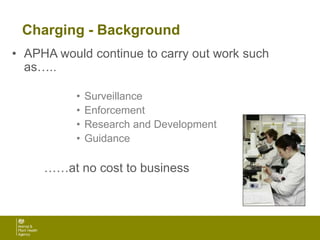
• APHA would continue to carry out work such
as…..
• Surveillance
• Enforcement
• Research and Development
• Guidance
……at no cost to business
Charging Areas
• Approval of premises
• Risk-based inspections of approved
premises
Charging Areas
• Visits are carried out on an annual, quarterly, or
monthly basis
• Frequency is driven by a number of factors:
• category of material being handled
• volume of material being handled
• use of the material
• management of the process
• compliance record of the operator
Efficiencies
• Review of risk based approach
• Review and publication of inspection
forms
• Centralisation of admin function
• Supporting earned recognition
– Formal schemes
– Best practice
Consistency
• Centralisation of administration
• Quality assurance
• Formal training ‘pathway’
• Review / revision of APHA instructions
Public Consultation
• Consultation on the proposed introduction
of fees was held in the Autumn 2015
• Responses are being considered
• Purdah Period
• A Formal Response will be issued shortly.
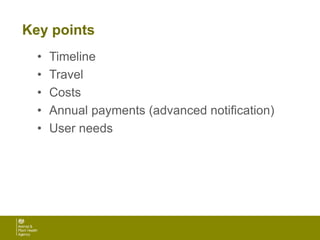
Key points
• Timeline
• Travel
• Costs
• Annual payments (advanced notification)
• User needs
SCOTT REANEY
APHA ADVISOR – ANIMAL BY-PRODUCTS, ANIMAL & PLANT HEALTH AGENCY
CHARGING FOR ABP
INSPECTIONS
OPEN DISCUSSION
THANK YOU FOR
JOINING US.
JESS ALLAN
ENVIRONMENT & REGULATION MANAGER, ADBA
EMAIL: JESSICA.ALLAN@ADBIORESOURCES.ORG@ADBIORESOURCES.ORG
IF YOU HAVE ANY QUESTIONS PLEASE
CONTACT:

ADBA Spring Regulatory Forum - May 2016

  • 1.
    16 MAY 2016 CLARKEWILLMOTT LLP, BRISTOL ADBA SPRING REGULATORY FORUM
  • 2.
    PRISCILLA HALL PARTNER &HEAD OF RENEWABLES, CLARKE WILLMOTT LLP WELCOME AND INTRODUCTION
  • 3.
    MATT HINDLE HEAD OFPOLICY, ADBA ADBA POLICY UPDATE
  • 4.
  • 5.
    Incentives •Severely constrained caps;tariffs degression •Expected consultation will not change fundamentals FIT •Consultation response summer/autumn •Tariff reset likely; crop restrictions difficult to assess RHI •Consultation on RTFO this summer •Proposals and outcomes highly uncertain – but DfT keen to include biomethane Transport
  • 6.
    Food waste • Improvingcapture rate and uptake of FW collection • Set of practical actions • Likely launch at UK AD & Biogas FWRAP • Defra ministerial led group • Looking to encourage consistent collection schemes • Late summer launch? Collection Consistency
  • 7.
    End of Waste •Informal consultation closed on Thursday 12 May • Process is now with European Council – so Defra representing the UK, next meeting early June • If Council agree Commission proposals, may need to reconcile with proposals from the Parliament • If all three institutions agree, enters EU law and passed to Member States to implement • Commission aiming for implementation in January 2018
  • 10.
    Feeding in • Blogand detailed ADBA response available this week – let us know what you think • Expect some ongoing discussion directly and via EBA • Defra representing UK in meetings throughout June which will discuss detail of proposals – feed in through this route by end of May • European Parliament will also consider
  • 11.
    Promoting AD • Parliamentaryreception in March – c 80 MPs and peers in attendance • Many members have hosted site visits and/or invited MPs to their businesses since • Need to keep up momentum; let us know if we can help you
  • 12.
  • 13.
    ADBA POLICY UPDATE MATTHINDLE HEAD OF POLICY, ADBA OPEN DISCUSSION
  • 14.
    UPDATE FROM THE ENVIRONMENTAGENCY VIV DENNIS SENIOR ADVISOR (BIOWASTE) - ENVIRONMENT & BUSINESS DIRECTORATE, ENVIRONMENT AGENCY
  • 15.
    Environment Agency Regulatory Update VivDennis Senior Advisor, Environment Agency ADBA Regulatory Forum 16th May 2016
  • 16.
    Waste permit exemptions– our proposals for changes • Submitted to Defra in March, English and Welsh Ministers will decide what to take forward, Govt consultation would follow, autumn at the earliest • U10 landspreading – Details of waste types & quantities, expected period and duration - pre- assessment – Ongoing – records, waste types & quantities, plan of tipping areas, technical competence • T25 small scale AD – Details of waste types & quantities, plant capacity, planning status evidence, operator competence - pre-assessment
  • 17.
    Exemption proposals -T24 on-farm AD • Over 1600 registered, 40-60 operating? • Evidence of planning status, operator competence • The digester and associated storage must be at least – 10 metres from any watercourse – 50 metres from any spring, well or borehole (250 if for domestic/food production supply). • Back-up flare or boiler • Only the listed agricultural wastes • Register once (vs 3 year renewal) • Chargeable to allow pre-assessment and a compliance visit once/3 years
  • 18.
    Cat 1 &2 pollution incidents at permitted AD sites Indicative data for 2015, based on sites in the Biowaste Treatment sector 2014 - 10 incidents caused by 4 sites (126 AD sites in the sector) 9 odour, I tank failure, 4 odour 2015 – 12 incidents caused by 6 sites (4 on-farm AD, 2 other) (160 AD sites in the sector) 4 odour, 5 water pollution, 3 noise 1 8
  • 19.
    Notable containment failureincidents since last forum meeting • Fish-kill in fishing ponds next to on-farm AD plant – liquor escaped from maize silage clamp. Poor design and management of clamp • Digestate found seeping through tank wall – failure in the mastic lining on one of the joints. Poor management procedures and awareness of maintenance procedures • Gas inlet pipe from digester to gas dome damaged, venting biogas to atmosphere. Happened in high winds, but poor infrastructure – fixings and gas pipe • Initial pressure spike caused PRV to operate, but failed to stop once pressure had dropped. Gas venting until discovered by site staff during routine inspection. Due to worn seals – operator hadn’t known that seals only have a 2-3 year lifespan • Extensive water pollution from overtopping lagoon – pumps left on overnight
  • 20.
    Notable containment failureincidents since last forum meeting -2 • Non-waste AD plant. Tank overfilled and digestate burst out from reinforced glass hatch, ~ 700-800 m3 escaped and flowed down the site. Pump had been wrongly left in manual mode. Operator didn’t know that the failsafe alarm/overfilling system only works in automatic mode. Modifications since made so that manual mode times out and switches to automatic. • EA officer auditing AD sites came across 2 incidents in 2 days – significant pollution that the operators had tried to cover up by placing fresh gravel over the spill,. Digestate separator wasn’t operated properly and liquid was passing through the system straight onto concrete pad intended for the solid fraction. Not identified for hours so spilled onto neighbouring fields and ditches – a site where the gas system had failed and was venting gas
  • 21.
    Waste treatment BREFupdate • Deadline for comments on WT BRef first draft of the was 18th March 2016. Now awaiting Bureau’s assessment of the comments and the next steps. • Some feedback on the comments in screenshots following
  • 22.
    NumberofcommentsDistribution of commentson Chapter 6 - BAT conclusions (total 1834)
  • 23.
    Distribution of commentson all other chapters Numberofcomments
  • 24.
    Example of BATconclusion and associated comments – TWG member comments in the top box
  • 25.
    BAT 4 onmonitoring requirements and AELs has attracted numerous comments.
  • 26.
    Waste treatment BREFupdate 2 • Germany supported by the UK and others have asked Bureau for an additional TWG meeting to discuss proposed AEL’s and supporting data. WT BRef is sent on for approval after final TWG meeting. • Commission will publish BAT conclusions in the Official Journal in all MS languages. Regulatory bodies across Europe then have four years in which to implement for existing installations. Bureau publish the Bref in English.
  • 27.
    Defra 'Smarter EnvironmentalRegulation Review’ - permitting guidance on gov.uk • Horizontal guidance collection withdrawn https://www.gov.uk/government/collections/horizontal-guidance-environmental- permitting – H1 risk assessment overview and annexes (except D2) replaced by Risk assessments for specific activities: environmental permits – H2 energy efficiency - replaced by Energy efficiency standards for industrial plants to get environmental permits  H series documents still current: H3 Part 2 noise assessment and control, Noise impact assessment information requirements, H4 Odour management, H5 Site condition report • Regulatory guidance notes collection withdrawn https://www.gov.uk/government/collections/regulatory-guidance-series-environmental- permitting http://webarchive.nationalarchives.gov.uk/20131108051347/http://www.environment- agency.gov.uk/business/topics/permitting/36419.aspx
  • 28.
    Regulatory guidance changeson gov.uk – 2 • RGN 2: Understanding the meaning of regulated facility • RGN 9: Surrender • Check if you need an environmental permit • Legal operator and competence requirements: environmental permits • Best available techniques: environmental permits • Control and monitor emissions for your environmental permit • Develop a management system: environmental permits • Change, transfer or cancel your environmental permit • Risk assessments for your environmental permit • Groundwater risk assessment for your environmental permit • Air emissions risk assessment for your environmental permit • Waste: environmental permits • Register your waste exemptions: environmental permits • Surface water pollution risk assessment for your environmental permit • A1 installations: environmental permits • How you'll be regulated: environmental permits • Discharges to surface water and groundwater: environmental permits
  • 29.
    Some other things •Landspreading standard rules Business Engagement Assessment completed, awaiting publication – No change re outstanding IED scoping issues – OFWAT review of the sludge treatment market – Waste Enforcement Programme projects being written up, including AD audits, novel wastes to biowaste treatment sites and landspreading • Pre- app workshop for AD – November • SSAFO regs review continuing – scope may include digestate storage • Biowaste regulatory forum – focus on containment, competence and compliance, industry work on contamination
  • 31.
    UPDATE FROM THE ENVIRONMENTAGENCY VIV DENNIS SENIOR ADVISOR (BIOWASTE) - ENVIRONMENT & BUSINESS DIRECTORATE, ENVIRONMENT AGENCY OPEN DISCUSSION
  • 32.
    ADBA BEST PRACTICE UPDATE JESSALLAN ENVIRONMENT AND REGULATION MANAGER, ADBA AMAYA ARIAS-GARCIA TECHNICAL DIRECTOR, GOALS PROJECT MANAGEMENT & ENGINEERING SUPPORT
  • 33.
    Overview • Aims • Progressupdate • Steering Group • Delivery Plan • Best Practice Checklists • Timescales • How to get involved • Questions
  • 34.
    Aims The Best PracticeScheme aims to help the industry to: • Improve environmental performance. • Improve safety performance. • Improve operational performance. Impression from Defra is that they support the concept of the BPS as a way of driving improvement in performance – an alternative to stricter regulation.
  • 35.
    Progress Update  Setup Steering Group.  Provided a briefing note to all ADBA members and run a survey.  Begun communications with regulators and government.  Produced a Delivery Plan.  Held workshops for Steering Group and regulators.
  • 36.
    Steering Group Chaired byAmaya Arias-Garcia (Goals-PME) ADBA Chartered Institute of Wastes Management (CIWM) Chartered Institute of Water and Environmental Management (CIWEM) CNA Hardy (insurer) Country Land and Business Association (CLA) Energy Networks Association (ENA) Environmental Services Association (ESA) Institute of Chemical Engineers (IChemE) Jelf (insurance broker) NFU NFU Cymru NFU Scotland Renewable Energy Association (REA) Water UK WRAP Zero Waste Scotland Plus input from regulators: APHA, EA, HSE, NRW, SEPA
  • 37.
    Steering Group SurveyConclusions • Current Performance • Poor competence • Poor environmental record • Poor return on investment record • Poor H&S record • Most urgent issues • Containment • Foam and crust formation • Equipment failure (pump, stirrer.. ) • Overpressure • Overflow • Odour • Risk Management
  • 38.
    Delivery Plan Step 1:Best Practice Checklists (July 2016) Develop a series of Best Practice checklists which set out key things needed to achieve best practice.  Planning & Design  Procurement  Risk Management  Building an AD plant  Operational Performance Step 2: Certification Scheme (2017) Develop a certification scheme, informed by the checklists.
  • 39.
    What will thechecklists do? • Provide an indication of what the industry considers best practice. • Raise awareness of best practice and improve consistency. • Be a first step towards a certification scheme, giving us a starting point to work with and continue to review. • Not take a ‘one size fits all’ approach. • Include some detail but not replicate existing guidance – they will point to existing information sources.
  • 40.
    Risk Management • Willcover how to reduce the risk of environmental or health & safety issues, and what to do if things go wrong. • Will emphasise the benefits of effective risk management. • Will include checklists for different stages of the project. We are interested in: • How operators approach risk management at various stages in projects. • What does the industry (operators, consultants, supply chain) feel are the most significant risks.
  • 41.
    Procurement • Will includepurchasing machinery, equipment, items of plant. • Will focus on safety and compliance with UK legislation and standards. • Checklist aims to raise awareness of good practice. We are interested in: • How do operators of different scales approach procurement? • How do they ensure that the item is fit for purpose, compliant with relevant legislation and safe for use at the plant?
  • 42.
    Operational Performance • Willinclude digestate quality, biogas quantity and quality (working on defining the scope). • Focus on monitoring performance, monitoring the digestion process and making informed decisions. We are interested in: • How do operators monitor their plants performance? • What key parameters are measured? • What data could the industry collate that would be useful to operators?
  • 43.
    Task When Workshops forSteering Group and regulators Mid-April Checklist drafting (ADBA) By mid-May Industry consultation May/early June Stakeholder meeting May 16 (Bristol) Launch checklists July Further industry review and testing July-onwards Timescales
  • 44.
    How to getinvolved • Respond to any draft documents we circulate • Stakeholder Meeting – this afternoon • Food Waste Operator Group & Crop Operator Group • Training, Safety and Environment Working Group • ADBA website • AD & Bioresources News • UK AD & Biogas – 6th & 7th July
  • 45.
    Any questions? Jess Allan Environmentand Regulation Manager jessica.allan@adbioresources.org Dr Amaya Arias-Garcia Goals Project Management and Engineering Support aag@goals-pme.co.uk
  • 46.
    ADBA BEST PRACTICE UPDATE JESSALLAN ENVIRONMENT AND REGULATION MANAGER, ADBA AMAYA ARIAS-GARCIA TECHNICAL DIRECTOR, GOALS PROJECT MANAGEMENT & ENGINEERING SUPPORT OPEN DISCUSSION
  • 47.
    Interested in Training,Safety and Environment? Our working group is restructuring, and looking for volunteers to lead two sub-groups: Sub-group 1: Training, Health and Safety Sub-group 2: Environment Let me know: Jess Allan Environment and Regulation Manager jessica.allan@adbioresources.org
  • 48.
  • 49.
    UPDATE FROM THE HEALTHAND SAFETY EXECUTIVE SIÂN CLAYTON WASTE & RECYCLING TEAM - VULNERABLE WORKERS, AGRICULTURE, WASTE & RECYCLING UNIT, HEALTH & SAFETY EXECUTIVE
  • 50.
    A new strategyfor health and safety
  • 51.
    A record tobe proud • One of the safest working countries in the world • Mature system of regulation, with lots of experienced and committed participants • Together, we can make the health and safety system even better
  • 52.
    A record tobe proud ?? In the Waste Industry - over the last 5 years • 33 fatalities • 4.1% of workers suffer a non-fatal workplace injury
  • 53.
    Opportunities and challenges Successhas created many opportunities but also challenges: • It will be stretching to drive further improvement • Need to resist temptation to set disproportionate standards • Immediacy of safety challenges has detracted from effectively tackling health issues
  • 54.
    Help Great BritainWork Well • The strategy will help to build a safer, healthier and more prosperous Great Britain • Collective ownership and commitment will help to protect lives, quality of life and livelihoods • Helping Great Britain work well will enable businesses to be more productive and grow
  • 55.
    A note ofcaution Better doesn’t always mean doing more… …it’s about identifying and managing real risks smartly
  • 56.
    Three overarching aspects •Ownership • Health • Boosting Britain’s businesses
  • 57.
    • A healthyworkforce that feels valued by their employers • Reduced public expense dealing with unnecessary ill health • Business sectors boosted by improved staff retention and increased productivity What we all stand to gain
  • 58.
  • 59.
    Acting together • Youhave an active part to play in implementing the strategy • Help identify the most important challenges and develop ways of taking collective ownership • Do our individual contributions help as much as they can, without causing unnecessary cost or inefficiency?
  • 60.
    Tackling ill-health • C13,000deaths from work-related lung disease and cancer last year - reflecting historical conditions and standards • 1.2 m working people suffering from work-related illness last year - half a million were new conditions • Long-latency hazards, stress and musculoskeletal disorders • Drive for improvement must come from everyone with a stake in keeping people healthy and fit for work
  • 61.
    Supporting small employers •HSE has already simplified legislation and guidance, produced straightforward tools and examples • Reaching all SMEs is challenging • The best large businesses and intermediaries point SMEs they deal with in the right direction – not offering overcomplicated advice or unnecessary barriers to business
  • 62.
    Managing risk well •Risk assessments don’t need excessive paperwork • Risk management doesn’t mean managing trivial risks • Getting it wrong inhibits productivity, creativity and growth • Managing the right risks in the right ways • Help smaller companies get it right efficiently and effectively
  • 63.
    Keeping pace withchange • HSE’s world-leading research capabilities increase its efficiency and targeting • Horizon-scanning expertise will be used as demographic, technological and other changes affect the world of work • We want to hear your ideas for how we can keep track of trends, as well as any particular challenges you see ahead
  • 64.
    Sharing success • Sharinggood practice, both at home and abroad • Promoting our goal-based approach overseas, making it easier for British businesses to expand into new markets
  • 65.
    HSE’s contribution • Continueas the prime mover in the health and safety system • Work with industry, co-regulators and colleagues across government to ensure our regulation is as simple and effective as possible • We need to act together - talk, share ideas and set the right direction for the future
  • 66.
    UPDATE FROM THE HEALTHAND SAFETY EXECUTIVE SIÂN CLAYTON WASTE & RECYCLING TEAM - VULNERABLE WORKERS, AGRICULTURE, WASTE & RECYCLING UNIT, HEALTH & SAFETY EXECUTIVE OPEN DISCUSSION
  • 67.
    CARL GURNEY RENEWABLE ENERGYDIRECTOR, JELF INSURANCE BROKERS CASE STUDY: OPERATIONAL RISK MANAGEMENT
  • 68.
    Risk management and insuranceconsiderations for your AD and Biogas plant Carl Gurney Jelf Group
  • 69.
    The importance ofrisk management and insurance programmes and why they need to be on your project agenda Carl Gurney Cert CII Renewable Energy Director Email: carl.gurney@jelfgroup.com MOB: 07799 474419
  • 70.
    Presentation title |Page 70 What we will cover today 1. Risk management considerations 2. Insurance considerations 3. Conclusion
  • 71.
    Presentation title |Page 71 Risk management considerations  Design and procurement  Construction  Operational  ADBA best practice scheme offers guidance You need to consider the project in three phases:
  • 72.
    Design and Procurement Presentationtitle | Page 72 Permitting constraints (e.g engage with the EA) Competency HAZOP Grid/gas connection Tank construction Independent advice Warranties Incentive Available Primary and secondary containment Neighbours Major component separation Fire detection Insurer reviewLook at multiple options of the plant design/layout/suppliers Feedstock Fire Suppression Planning constraints (engage with planners) Indicative CAPEX / OPEX costs Watercourses Company credit/health checks
  • 73.
    Construction Presentation title |Page 73 Review contractors experience (include their health and safety record) Hold crane and crane operators certificates to file Site safety management system in place Plans and records of testing and commissioning procedures held to file Accident reporting Health and safety file reviewed regularly and held on-site Method statementsRisk assessments Tool box talks PPE available Vehicular movements and pedestrian areas are managedRubbish removed – reduce the fire risk Asses slips, trips and falls Site security Assess flood risk – store equipment appropriately Test the tank during the construction phase
  • 74.
    Operation Presentation title |Page 74 Operator training Fire and DESEAR risk assessments Fire extinguishers Fire brigade visit / water supply Oil tests for engines and transformers Hot works permits Health and safety policy Spillage and disaster recovery plans Over foaming procedures Annual thermo graphic testing Vibration monitoring of motor and pump bearings Rules of entry for enclosed spaces and electrical cabinets Spares InventoryUnderstand insurer requirements and adhere to them Risk assessments O & M contract with SLA’s
  • 75.
    Why is insuranceso important? Presentation title | Page 75  Is insurance firmly on your agenda – what if something goes wrong?  How will banks/investment companies look to de-risk their balance sheet?  Due diligence  Sharing of claims experiences  Why engage early?  Use and experienced broker or insurer
  • 76.
    Construction – insurance Presentationtitle | Page 76  Owner controlled insurance programme  Cover your materials on site – ensure this extends to cover the testing and commissioning phase  Consider covering your advanced loss of revenue – what if something happens during the construction?  Other considerations – public and employers liability  Environmental liability, marine / transit  Directors and officers
  • 77.
    Operational - insurance Presentationtitle | Page 77  Material damage on an “All Risks Basis”  Business interruption – cover your loss of revenue  Mechanical breakdown  Other considerations - public and employers liability  Environmental liability, directors and officers, cyber, contingent business interruption
  • 78.
    The small print Presentationtitle | Page 78 Warranties, conditions and endorsements – Are quotations subject to survey – What are the security conditions – Is there a requirement for an annual maintenance contract Excesses and indemnity periods – What are the excesses for the differing sections of cover – How long are the indemnity periods Significant exclusions – Do you know what these are? – have they been explained? – Cyber cover
  • 79.
    Conclusion  Early engagementand working in atripartite partnership with brokers and insurers will seriously benefit your project  Spend time on your insurance and ensure it is firmly on the agenda  Consider the different stages of your project  Check the small print  Risk management and health and safety, are these robust  Plan for the worse Presentation title | Page 79
  • 80.
    CARL GURNEY RENEWABLE ENERGYDIRECTOR, JELF INSURANCE BROKERS CASE STUDY: OPERATIONAL RISK MANAGEMENT OPEN DISCUSSION
  • 81.
  • 82.
    SCOTT REANEY APHA ADVISOR– ANIMAL BY-PRODUCTS, ANIMAL & PLANT HEALTH AGENCY CHARGING FOR ABP INSPECTIONS
  • 83.
    Charging for ABPInspections Scott Reaney Animal & Plant Health Agency Subject to © Crown Copyright (2014)
  • 84.
    Charging - Background •APHA carry out important work in ensuring that GB complies with the ABP regs. – EC1069/2009 – EC142/2011 • This in turn safeguards against notifiable disease and protects trade
  • 85.
    Charging - Background •APHA deliver a wide range of inspection, to ABP sites, which support consumer confidence and assist in the ability to trade • This role is currently funded by the taxpayer
  • 86.
    Charging - Background •Government policy (‘Managing Public Money’) requires that those who benefit commercially from services provided by Government should bear the cost, rather than it being subsidised by tax payers
  • 87.
    Charging - Background •In line with this policy, Defra and APHA have been exploring options to reduce the burden on the tax payer • One option is to charge for certain aspects of ABP inspection work
  • 88.
    Charging - Background •APHA would continue to carry out work such as….. • Surveillance • Enforcement • Research and Development • Guidance ……at no cost to business
  • 89.
    Charging Areas • Approvalof premises • Risk-based inspections of approved premises
  • 90.
    Charging Areas • Visitsare carried out on an annual, quarterly, or monthly basis • Frequency is driven by a number of factors: • category of material being handled • volume of material being handled • use of the material • management of the process • compliance record of the operator
  • 91.
    Efficiencies • Review ofrisk based approach • Review and publication of inspection forms • Centralisation of admin function • Supporting earned recognition – Formal schemes – Best practice
  • 92.
    Consistency • Centralisation ofadministration • Quality assurance • Formal training ‘pathway’ • Review / revision of APHA instructions
  • 93.
    Public Consultation • Consultationon the proposed introduction of fees was held in the Autumn 2015 • Responses are being considered • Purdah Period • A Formal Response will be issued shortly.
  • 94.
    Key points • Timeline •Travel • Costs • Annual payments (advanced notification) • User needs
  • 95.
    SCOTT REANEY APHA ADVISOR– ANIMAL BY-PRODUCTS, ANIMAL & PLANT HEALTH AGENCY CHARGING FOR ABP INSPECTIONS OPEN DISCUSSION
  • 96.
    THANK YOU FOR JOININGUS. JESS ALLAN ENVIRONMENT & REGULATION MANAGER, ADBA EMAIL: JESSICA.ALLAN@ADBIORESOURCES.ORG@ADBIORESOURCES.ORG IF YOU HAVE ANY QUESTIONS PLEASE CONTACT: