#adrdforum @adbioresources
DR RAFFAELLA VILLA
SENIOR LECTURER IN BIOPRESS TECHNOLOGY, BIOENERGY AND RESOURCE
MANAGEMENT CENTRE, SCHOOL OF ENERGY, ENVIRONMENT AND AGRIFOOD (SEEA),
CRANFIELD UNIVERSITY
RED: SUPPORTING SMES
IN ANAEROBIC DIGESTION
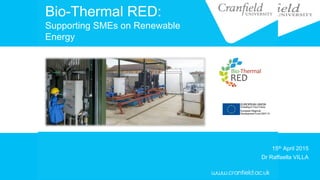
Bio-Thermal RED:
Supporting SMEs on Renewable
Energy
15th April 2015
Dr Raffaella VILLA
Bio-Thermal RED
• Biological & Thermal Renewable Energy Demonstrator
• European Regional Development Fund Project
• > £800,000 value (40% from ERDF – 60% from Cranfield
University)
@BioThermalRED
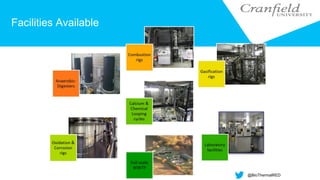
Facilities Available
@BioThermalRED
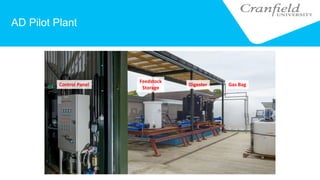
AD Pilot Plant
Control Panel
Feedstock
Storage
Digester Gas Bag
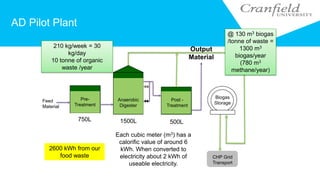
CHP Grid
Transport
Post -
Treatment
Biogas
Storage
Anaerobic
Digester
Feed
Material
Pre-
Treatment
Output
Material
750L 1500L 500L
AD Pilot Plant
Each cubic meter (m3) has a
calorific value of around 6
kWh. When converted to
electricity about 2 kWh of
useable electricity.
@ 130 m3 biogas
/tonne of waste =
1300 m3
biogas/year
(780 m3
methane/year)
210 kg/week = 30
kg/day
10 tonne of organic
waste /year
2600 kWh from our
food waste
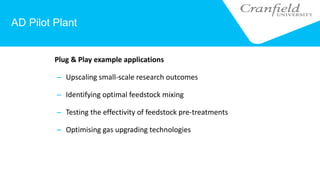
AD Pilot Plant
Plug & Play example applications
– Upscaling small-scale research outcomes
– Identifying optimal feedstock mixing
– Testing the effectivity of feedstock pre-treatments
– Optimising gas upgrading technologies
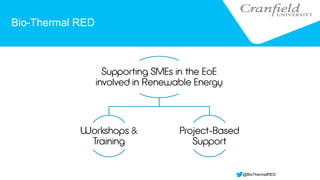
Bio-Thermal RED
@BioThermalRED
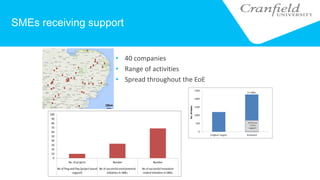
SMEs receiving support
• 40 companies
• Range of activities
• Spread throughout the EoE
10km
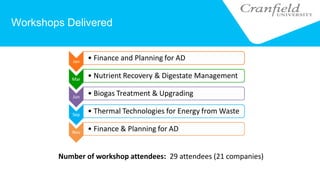
Workshops Delivered
Number of workshop attendees: 29 attendees (21 companies)
Project Based Support
• Similar to TSB innovation vouchers.
• £1000-£5000 average grants.
• Business support from Cranfield technical & academic staff
funded 100%.
• Capital investment & consumables are SME funded.
@BioThermalRED
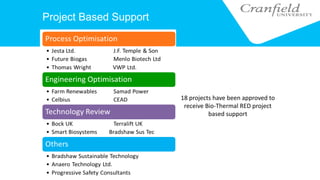
Project Based Support
18 projects have been approved to
receive Bio-Thermal RED project
based support
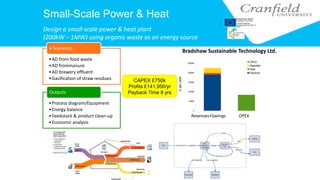
Small-Scale Power & Heat
Bradshaw Sustainable Technology Ltd.
Design a small-scale power & heat plant
(200kW – 1MW) using organic waste as an energy source
•AD from food waste
•AD frommanure
•AD brewery effluent
•Gasification of straw residues
4 Scenarios
•Process diagram/Equipment
•Energy balance
•Feedstock & product clean-up
•Economic analysis
Outputs
1 2
0
50000
100000
150000
200000
250000
OPEX
Digestate
Heat
Electricty
£peryear
Revenues+Savings OPEX
CAPEX £750k
Profits £141,950/yr
Payback Time 8 yrs
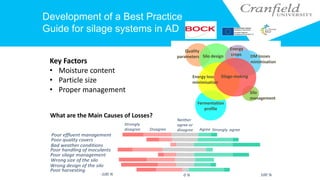
Development of a Best Practice
Guide for silage systems in AD
Silage-makingEnergy loss
minimisation
DM losses
minimisation
Silo design
Fermentation
profile
Quality
parameters
Silo
management
Energy
crops
What are the Main Causes of Losses?
Key Factors
• Moisture content
• Particle size
• Proper management
Low Carbon KEEP
Farm Renewables Ltd.
• Development of a cost effective farm scale anaerobic digester system
• Modular components to allow technical adaptation to locally available
waste quantities
• Emphasis of development on easy maintenance and operation of the AD
plant
• Flexible system to allow the digestion of carious waste streams (e.g. food
waste, manure, energy crops)
• Spatial efficiency [LCH4 / m-3] needs to be
determined
• For this comparably small AD system,
special attention has to be directed
towards energy efficiency (pumping,
mixing, heating…)
Thank You
@BioThermalRED
r.villa@cranfield.ac.uk
+44(0)1234 750111 ext. 2320
uk.linkedin.com/in/raffaellavilla/

Raffaella Villa

  • 1.
    #adrdforum @adbioresources DR RAFFAELLAVILLA SENIOR LECTURER IN BIOPRESS TECHNOLOGY, BIOENERGY AND RESOURCE MANAGEMENT CENTRE, SCHOOL OF ENERGY, ENVIRONMENT AND AGRIFOOD (SEEA), CRANFIELD UNIVERSITY RED: SUPPORTING SMES IN ANAEROBIC DIGESTION
  • 2.
    Bio-Thermal RED: Supporting SMEson Renewable Energy 15th April 2015 Dr Raffaella VILLA
  • 3.
    Bio-Thermal RED • Biological& Thermal Renewable Energy Demonstrator • European Regional Development Fund Project • > £800,000 value (40% from ERDF – 60% from Cranfield University) @BioThermalRED
  • 4.
  • 5.
    AD Pilot Plant ControlPanel Feedstock Storage Digester Gas Bag
  • 6.
    CHP Grid Transport Post - Treatment Biogas Storage Anaerobic Digester Feed Material Pre- Treatment Output Material 750L1500L 500L AD Pilot Plant Each cubic meter (m3) has a calorific value of around 6 kWh. When converted to electricity about 2 kWh of useable electricity. @ 130 m3 biogas /tonne of waste = 1300 m3 biogas/year (780 m3 methane/year) 210 kg/week = 30 kg/day 10 tonne of organic waste /year 2600 kWh from our food waste
  • 7.
    AD Pilot Plant Plug& Play example applications – Upscaling small-scale research outcomes – Identifying optimal feedstock mixing – Testing the effectivity of feedstock pre-treatments – Optimising gas upgrading technologies
  • 8.
  • 9.
    SMEs receiving support •40 companies • Range of activities • Spread throughout the EoE 10km
  • 10.
    Workshops Delivered Number ofworkshop attendees: 29 attendees (21 companies)
  • 11.
    Project Based Support •Similar to TSB innovation vouchers. • £1000-£5000 average grants. • Business support from Cranfield technical & academic staff funded 100%. • Capital investment & consumables are SME funded. @BioThermalRED
  • 12.
    Project Based Support 18projects have been approved to receive Bio-Thermal RED project based support
  • 13.
    Small-Scale Power &Heat Bradshaw Sustainable Technology Ltd. Design a small-scale power & heat plant (200kW – 1MW) using organic waste as an energy source •AD from food waste •AD frommanure •AD brewery effluent •Gasification of straw residues 4 Scenarios •Process diagram/Equipment •Energy balance •Feedstock & product clean-up •Economic analysis Outputs 1 2 0 50000 100000 150000 200000 250000 OPEX Digestate Heat Electricty £peryear Revenues+Savings OPEX CAPEX £750k Profits £141,950/yr Payback Time 8 yrs
  • 14.
    Development of aBest Practice Guide for silage systems in AD Silage-makingEnergy loss minimisation DM losses minimisation Silo design Fermentation profile Quality parameters Silo management Energy crops What are the Main Causes of Losses? Key Factors • Moisture content • Particle size • Proper management
  • 15.
    Low Carbon KEEP FarmRenewables Ltd. • Development of a cost effective farm scale anaerobic digester system • Modular components to allow technical adaptation to locally available waste quantities • Emphasis of development on easy maintenance and operation of the AD plant • Flexible system to allow the digestion of carious waste streams (e.g. food waste, manure, energy crops) • Spatial efficiency [LCH4 / m-3] needs to be determined • For this comparably small AD system, special attention has to be directed towards energy efficiency (pumping, mixing, heating…)
  • 16.
    Thank You @BioThermalRED r.villa@cranfield.ac.uk +44(0)1234 750111ext. 2320 uk.linkedin.com/in/raffaellavilla/