

#adrdforum @adbioresources
CARLY WHITTAKER
AGRICULTURE SYSTEMS SPECIALIST, ROTHAMSTED RESEARCH
TESTING THE BIOMETHANE
POTENTIAL OF
MISCANTHUS
TESTING THE BIOMETHANE
POTENTIAL OF MISCANTHUS
Carly Whittaker & Ian Shield
Rothamsted Research
14th April 2015
ADBA R&D Forum 2015
Alittle bit about
Rothamsted
Research
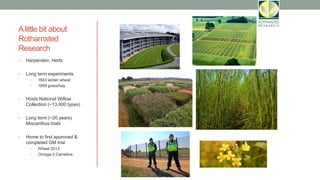
• Harpenden, Herts
• Long term experiments
• 1843 winter wheat
• 1859 grass/hay
• Hosts National Willow
Collection (~13,000 types)
• Long term (~20 years)
Miscanthus trials
• Home to first approved &
completed GM trial
• Wheat 2013
• Omega-3 Camelina
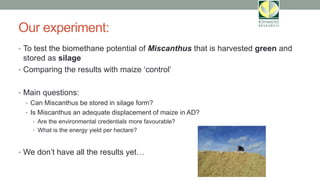
Our experiment:
• To test the biomethane potential of Miscanthus that is harvested green and
stored as silage
• Comparing the results with maize ‘control’
• Main questions:
• Can Miscanthus be stored in silage form?
• Is Miscanthus an adequate displacement of maize in AD?
• Are the environmental credentials more favourable?
• What is the energy yield per hectare?
• We don’t have all the results yet…
Background
Miscanthus
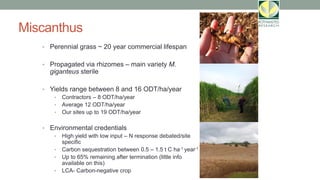
• Perennial grass ~ 20 year commercial lifespan
• Propagated via rhizomes – main variety M.
giganteus sterile
• Yields range between 8 and 16 ODT/ha/year
• Contractors – 8 ODT/ha/year
• Average 12 ODT/ha/year
• Our sites up to 19 ODT/ha/year
• Environmental credentials
• High yield with low input – N response debated/site
specific
• Carbon sequestration between 0.5 – 1.5 t C ha-1 year-1
• Up to 65% remaining after termination (little info
available on this)
• LCA- Carbon-negative crop
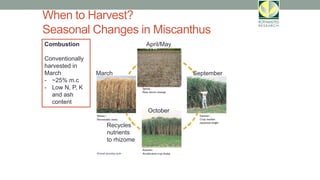
When to Harvest?
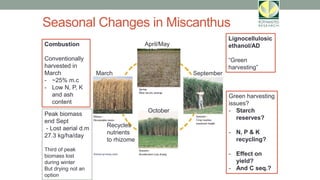
Seasonal Changes in Miscanthus
April/May
March September
October
Combustion
Conventionally
harvested in
March
- ~25% m.c
- Low N, P, K
and ash
content
Recycles
nutrients
to rhizome
Seasonal Changes in Miscanthus
Combustion
Conventionally
harvested in
March
- ~25% m.c
- Low N, P, K
and ash
content
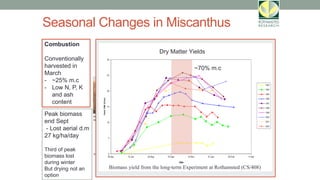
Biomass yield from the long-term Experiment at Rothamsted (CS/408)
Peak biomass
end Sept
- Lost aerial d.m
27 kg/ha/day
Third of peak
biomass lost
during winter
But drying not an
option
~70% m.c
Dry Matter Yields
Recycles
nutrients
to rhizome
April/May
March September
October
Seasonal Changes in Miscanthus
Combustion
Conventionally
harvested in
March
- ~25% m.c
- Low N, P, K
and ash
content
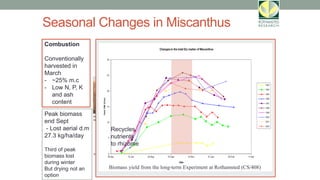
Biomass yield from the long-term Experiment at Rothamsted (CS/408)
Peak biomass
end Sept
- Lost aerial d.m
27.3 kg/ha/day
Third of peak
biomass lost
during winter
But drying not an
option
Recycles
nutrients
to rhizome
Seasonal Changes in Miscanthus
April/May
March September
October
Combustion
Conventionally
harvested in
March
- ~25% m.c
- Low N, P, K
and ash
content
Lignocellulosic
ethanol/AD
“Green
harvesting”
Peak biomass
end Sept
- Lost aerial d.m
27.3 kg/ha/day
Third of peak
biomass lost
during winter
But drying not an
option
Green harvesting
issues?
- Starch
reserves?
- N, P & K
recycling?
- Effect on
yield?
- And C seq.?
Recycles
nutrients
to rhizome
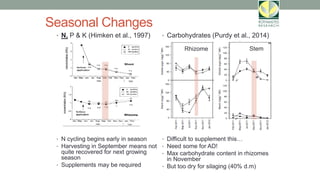
Seasonal Changes
• N, P & K (Himken et al., 1997)
• N cycling begins early in season
• Harvesting in September means not
quite recovered for next growing
season
• Supplements may be required
• Carbohydrates (Purdy et al., 2014)
• Difficult to supplement this…
• Need some for AD!
• Max carbohydrate content in rhizomes
in November
• But too dry for silaging (40% d.m)
Rhizome Stem
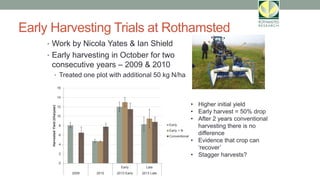
Early Harvesting Trials at Rothamsted
• Work by Nicola Yates & Ian Shield
• Early harvesting in October for two
consecutive years – 2009 & 2010
• Treated one plot with additional 50 kg N/ha
0
2
4
6
8
10
12
14
16
Early Late
2009 2010 2013 Early 2013 Late
HarvestedYield(t/ha/year)
Early
Early + N
Conventional
• Higher initial yield
• Early harvest = 50% drop
• After 2 years conventional
harvesting there is no
difference
• Evidence that crop can
‘recover’
• Stagger harvests?
The Experiment
The Experiment:
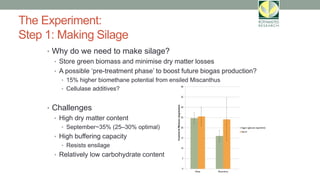
Step 1: Making Silage
• Why do we need to make silage?
• Store green biomass and minimise dry matter losses
• A possible ‘pre-treatment phase’ to boost future biogas production?
• 15% higher biomethane potential from ensiled Miscanthus
• Cellulase additives?
• Challenges
• High dry matter content
• September~35% (25–30% optimal)
• High buffering capacity
• Resists ensilage
• Relatively low carbohydrate content
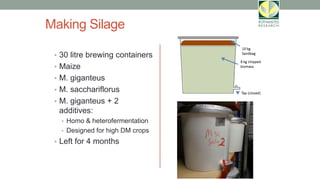
Making Silage
• 30 litre brewing containers
• Maize
• M. giganteus
• M. sacchariflorus
• M. giganteus + 2
additives:
• Homo & heterofermentation
• Designed for high DM crops
• Left for 4 months
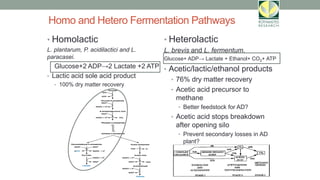
Homo and Hetero Fermentation Pathways
• Heterolactic
L. brevis and L. fermentum.
Glucose+ ADP→ Lactate + Ethanol+ CO2+ ATP
• Acetic/lactic/ethanol products
• 76% dry matter recovery
• Acetic acid precursor to
methane
• Better feedstock for AD?
• Acetic acid stops breakdown
after opening silo
• Prevent secondary losses in AD
plant?
• Homolactic
L. plantarum, P. acidilactici and L.
paracasei.
Glucose+2 ADP→2 Lactate +2 ATP
• Lactic acid sole acid product
• 100% dry matter recovery
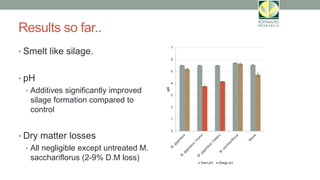
Results so far..
• Smelt like silage.
• pH
• Additives significantly improved
silage formation compared to
control
• Dry matter losses
• All negligible except untreated M.
sacchariflorus (2-9% D.M loss)
0
1
2
3
4
5
6
7
pH
Start pH Silage pH
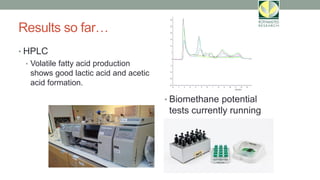
Results so far…
• HPLC
• Volatile fatty acid production
shows good lactic acid and acetic
acid formation.
• Biomethane potential
tests currently running
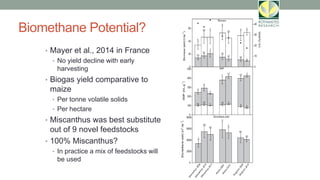
Biomethane Potential?
• Mayer et al., 2014 in France
• No yield decline with early
harvesting
• Biogas yield comparative to
maize
• Per tonne volatile solids
• Per hectare
• Miscanthus was best substitute
out of 9 novel feedstocks
• 100% Miscanthus?
• In practice a mix of feedstocks will
be used
Conclusions so far
• Early harvesting could be an option for uses in AD
• Staggered early harvests to boost biomass yield and improve suitability for AD
• Miscanthus on it’s own doesn’t silage very well but:
• Miscanthus benefits from additive application to improve silage formation
• Negligible dry matter losses
• pH down to 3.8 with homofermentative silage additive
Thank you for listening
• Thanks to
• Nicola Yates
• Richard Webster – Free silage
additives
• Farm Team
• Peter Fruen, Tim Barraclough &
March Castle & Richard Hull
• Chris Hall
• Neil Donovan, Tom
Misselbrook, Andy Retter &
James Hunt at N. Wyke
• carly.whittaker@rothamsted.a
c.uk
• http://www.supergen-
bioenergy.net/

Carly Whittaker

  • 1.
    #adrdforum @adbioresources CARLY WHITTAKER AGRICULTURESYSTEMS SPECIALIST, ROTHAMSTED RESEARCH TESTING THE BIOMETHANE POTENTIAL OF MISCANTHUS
  • 2.
    TESTING THE BIOMETHANE POTENTIALOF MISCANTHUS Carly Whittaker & Ian Shield Rothamsted Research 14th April 2015 ADBA R&D Forum 2015
  • 3.
    Alittle bit about Rothamsted Research •Harpenden, Herts • Long term experiments • 1843 winter wheat • 1859 grass/hay • Hosts National Willow Collection (~13,000 types) • Long term (~20 years) Miscanthus trials • Home to first approved & completed GM trial • Wheat 2013 • Omega-3 Camelina
  • 4.
    Our experiment: • Totest the biomethane potential of Miscanthus that is harvested green and stored as silage • Comparing the results with maize ‘control’ • Main questions: • Can Miscanthus be stored in silage form? • Is Miscanthus an adequate displacement of maize in AD? • Are the environmental credentials more favourable? • What is the energy yield per hectare? • We don’t have all the results yet…
  • 5.
  • 6.
    Miscanthus • Perennial grass~ 20 year commercial lifespan • Propagated via rhizomes – main variety M. giganteus sterile • Yields range between 8 and 16 ODT/ha/year • Contractors – 8 ODT/ha/year • Average 12 ODT/ha/year • Our sites up to 19 ODT/ha/year • Environmental credentials • High yield with low input – N response debated/site specific • Carbon sequestration between 0.5 – 1.5 t C ha-1 year-1 • Up to 65% remaining after termination (little info available on this) • LCA- Carbon-negative crop
  • 7.
    When to Harvest? SeasonalChanges in Miscanthus April/May March September October Combustion Conventionally harvested in March - ~25% m.c - Low N, P, K and ash content Recycles nutrients to rhizome
  • 8.
    Seasonal Changes inMiscanthus Combustion Conventionally harvested in March - ~25% m.c - Low N, P, K and ash content Biomass yield from the long-term Experiment at Rothamsted (CS/408) Peak biomass end Sept - Lost aerial d.m 27 kg/ha/day Third of peak biomass lost during winter But drying not an option ~70% m.c Dry Matter Yields
  • 9.
    Recycles nutrients to rhizome April/May March September October SeasonalChanges in Miscanthus Combustion Conventionally harvested in March - ~25% m.c - Low N, P, K and ash content Biomass yield from the long-term Experiment at Rothamsted (CS/408) Peak biomass end Sept - Lost aerial d.m 27.3 kg/ha/day Third of peak biomass lost during winter But drying not an option Recycles nutrients to rhizome
  • 10.
    Seasonal Changes inMiscanthus April/May March September October Combustion Conventionally harvested in March - ~25% m.c - Low N, P, K and ash content Lignocellulosic ethanol/AD “Green harvesting” Peak biomass end Sept - Lost aerial d.m 27.3 kg/ha/day Third of peak biomass lost during winter But drying not an option Green harvesting issues? - Starch reserves? - N, P & K recycling? - Effect on yield? - And C seq.? Recycles nutrients to rhizome
  • 11.
    Seasonal Changes • N,P & K (Himken et al., 1997) • N cycling begins early in season • Harvesting in September means not quite recovered for next growing season • Supplements may be required • Carbohydrates (Purdy et al., 2014) • Difficult to supplement this… • Need some for AD! • Max carbohydrate content in rhizomes in November • But too dry for silaging (40% d.m) Rhizome Stem
  • 12.
    Early Harvesting Trialsat Rothamsted • Work by Nicola Yates & Ian Shield • Early harvesting in October for two consecutive years – 2009 & 2010 • Treated one plot with additional 50 kg N/ha 0 2 4 6 8 10 12 14 16 Early Late 2009 2010 2013 Early 2013 Late HarvestedYield(t/ha/year) Early Early + N Conventional • Higher initial yield • Early harvest = 50% drop • After 2 years conventional harvesting there is no difference • Evidence that crop can ‘recover’ • Stagger harvests?
  • 13.
  • 14.
    The Experiment: Step 1:Making Silage • Why do we need to make silage? • Store green biomass and minimise dry matter losses • A possible ‘pre-treatment phase’ to boost future biogas production? • 15% higher biomethane potential from ensiled Miscanthus • Cellulase additives? • Challenges • High dry matter content • September~35% (25–30% optimal) • High buffering capacity • Resists ensilage • Relatively low carbohydrate content
  • 15.
    Making Silage • 30litre brewing containers • Maize • M. giganteus • M. sacchariflorus • M. giganteus + 2 additives: • Homo & heterofermentation • Designed for high DM crops • Left for 4 months
  • 16.
    Homo and HeteroFermentation Pathways • Heterolactic L. brevis and L. fermentum. Glucose+ ADP→ Lactate + Ethanol+ CO2+ ATP • Acetic/lactic/ethanol products • 76% dry matter recovery • Acetic acid precursor to methane • Better feedstock for AD? • Acetic acid stops breakdown after opening silo • Prevent secondary losses in AD plant? • Homolactic L. plantarum, P. acidilactici and L. paracasei. Glucose+2 ADP→2 Lactate +2 ATP • Lactic acid sole acid product • 100% dry matter recovery
  • 17.
    Results so far.. •Smelt like silage. • pH • Additives significantly improved silage formation compared to control • Dry matter losses • All negligible except untreated M. sacchariflorus (2-9% D.M loss) 0 1 2 3 4 5 6 7 pH Start pH Silage pH
  • 18.
    Results so far… •HPLC • Volatile fatty acid production shows good lactic acid and acetic acid formation. • Biomethane potential tests currently running
  • 19.
    Biomethane Potential? • Mayeret al., 2014 in France • No yield decline with early harvesting • Biogas yield comparative to maize • Per tonne volatile solids • Per hectare • Miscanthus was best substitute out of 9 novel feedstocks • 100% Miscanthus? • In practice a mix of feedstocks will be used
  • 20.
    Conclusions so far •Early harvesting could be an option for uses in AD • Staggered early harvests to boost biomass yield and improve suitability for AD • Miscanthus on it’s own doesn’t silage very well but: • Miscanthus benefits from additive application to improve silage formation • Negligible dry matter losses • pH down to 3.8 with homofermentative silage additive
  • 21.
    Thank you forlistening • Thanks to • Nicola Yates • Richard Webster – Free silage additives • Farm Team • Peter Fruen, Tim Barraclough & March Castle & Richard Hull • Chris Hall • Neil Donovan, Tom Misselbrook, Andy Retter & James Hunt at N. Wyke • carly.whittaker@rothamsted.a c.uk • http://www.supergen- bioenergy.net/