

#adrdforum @adbioresources
DR ROBERT LOVITT
READER IN BIOCHEMICAL ENGINEERING, SWANSEA UNIVERSITY
ALGAE AND AD: A KEY AREA
OF STUDY IN THE ENALGAE
PROJECT
Algae and AD: A key area of
study for the EnAlgae project
Dr Bob Lovitt
Reader in Biochemical Engineering
Swansea University
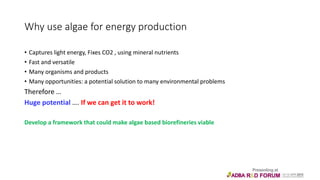
Why use algae for energy production
• Captures light energy, Fixes CO2 , using mineral nutrients
• Fast and versatile
• Many organisms and products
• Many opportunities: a potential solution to many environmental problems
Therefore …
Huge potential …. If we can get it to work!
Develop a framework that could make algae based biorefineries viable
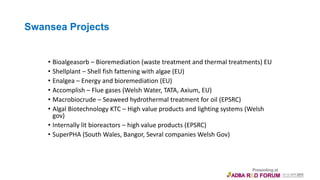
Swansea Projects
• Bioalgeasorb – Bioremediation (waste treatment and thermal treatments) EU
• Shellplant – Shell fish fattening with algae (EU)
• Enalgea – Energy and bioremediation (EU)
• Accomplish – Flue gases (Welsh Water, TATA, Axium, EU)
• Macrobiocrude – Seaweed hydrothermal treatment for oil (EPSRC)
• Algal Biotechnology KTC – High value products and lighting systems (Welsh
gov)
• Internally lit bioreactors – high value products (EPSRC)
• SuperPHA (South Wales, Bangor, Sevral companies Welsh Gov)
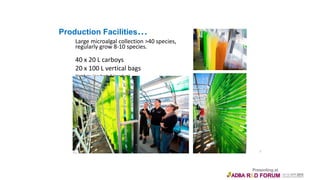
Production Facilities…
Large microalgal collection >40 species,
regularly grow 8-10 species.
40 x 20 L carboys
20 x 100 L vertical bags
(Hatchery, Live feeds & inoculum)
400 L indoor horizontal tubular system ie
‘BioFence’(sensored-up to the max)
2 x 600 L outdoor BioFence system
1 x 2000 L outdoor vertical tubular system
‘Helios’
5
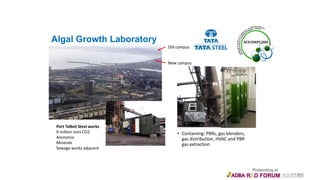
• Containing: PBRs, gas blenders,
gas distribution, HVAC and PBR
gas extraction
Algal Growth Laboratory
Port Talbot Steel works
9 million tons CO2
Ammonia
Minerals
Sewage works adjacent
New campus
Old campus
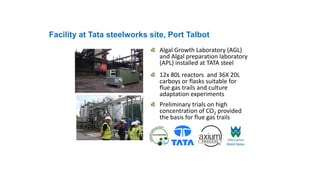
Facility at Tata steelworks site, Port Talbot
Algal Growth Laboratory (AGL)
and Algal preparation laboratory
(APL) installed at TATA steel
12x 80L reactors and 36X 20L
carboys or flasks suitable for
flue gas trails and culture
adaptation experiments
Preliminary trials on high
concentration of CO2 provided
the basis for flue gas trails
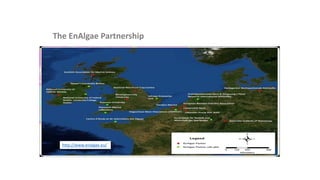
The EnAlgea Project
• Energetic Algae (EnAlgae)
• EnAlgae is a 4 year, €14.6M Strategic Initiative of the INTERREG IVB North West Europe (NWE)
Programme, combining the expertise and resources of 19 Partners plus Observers encompassing 7
EU Member States.
• Overall aim: To develop sustainable pathways for algal bioenergy in NW Europe
• EnAlgae Aims to….
• Address the current lack of verifiable information on algal productivity via a new network of 9 algal
pilots (microalgae and microalgae).
• Integrate with existing industrial, agricultural and municipal processes to capture and remediate flue
gas CO2 and soluble aqueous wastes.
• Engage with diverse stakeholders across NWE to resolve technological and legislative bottlenecks for
the sustainable deployment of algae-based bioenergy production, GHG mitigation and bioremediation.
The EnAlgae Partnership
http://www.enalgae.eu/
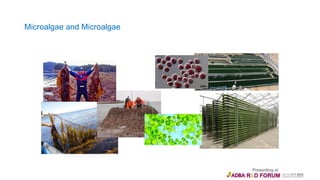
Microalgae and Microalgae
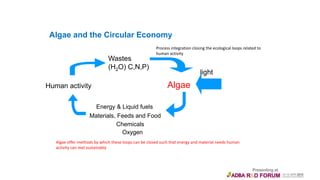
Algae and the Circular Economy
Human activity
Wastes
(H2O) C,N,P)
Energy & Liquid fuels
Materials, Feeds and Food
Chemicals
Algae
light
Oxygen
Algae offer methods by which these loops can be closed such that energy and material needs human
activity can met sustainably
Process integration closing the ecological loops related to
human activity
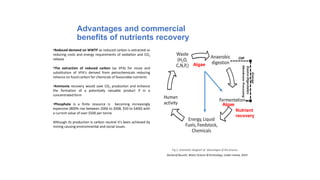
Advantages and commercial
benefits of nutrients recovery
•Reduced demand on WWTP as reduced carbon is extracted so
reducing costs and energy requirements of oxidation and CO2
release
•The extraction of reduced carbon (as VFA) for reuse and
substitution of VFA’s derived from petrochemicals reducing
reliance on fossil carbon for chemicals of favourable nutrients
•Ammonia recovery would save CO2 production and enhance
the formation of a potentially valuable product if in a
concentrated form
•Phosphate is a finite resource is becoming increasingly
expensive (800% rise between 2006 to 2008, $50 to $400) with
a current value of over $500 per tonne
Although its production is carbon neutral it’s been achieved by
mining causing environmental and social issues.
Fig.2. Schematic diagram of advantages of the process
Zacharof &Lovitt, Water Science &Technology, Under review, 2014
Nutrient
recovery
Algae
Algae
Algae as a feedstock for AD
• Microalgae
• 10% dry weight
• 50% C, 7% N, H, O, S
• Macroalgae
• 5% dry weight
• 50% C 1% N, H, O, S
• Productivity
• Microalgae (best), 60 tonnes/ha, with about 2% efficiency of sunlight
conversion typically at 1g/L, susceptible to predation and contamination.
• Macroalgae, seasonal growth, autumn ( Laminaria, North Atlantic), can be
stored as silage then fermented as required
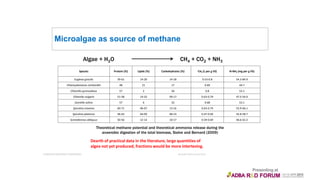
Microalgae as source of methane
Algae + H2O CH4 + CO2 + NH3
Species Protein (%) Lipids (%) Carbohydrates (%) CH4 (L per g VS) N-NH3 (mg per g VS)
Euglena gracilis 39-61 14-20 14-18 0.53-0.8 54.3-84.9
Chlamydomonas reinhardtii 48 21 17 0.69 44.7
Chlorella pyrenoidosa 57 2 26 0.8 53.1
Chlorella vulgaris 51-58 14-22 09-17 0.63-0.79 47.5-54.0
Duniella salina 57 6 32 0.68 53.1
Spirulina maxima 60-71 06-07 13-16 0.63-0.74 55.9-66.1
Spirulina platensis 46-63 04-09 08-14 0.47-0.69 42.8-58.7
Scenedesmus obliquus 50-56 12-14 10-17 0.59-0.69 46.6-42.2
Theoretical methane potential and theoretical ammonia release during the
anaerobic digestion of the total biomass, Sialve and Bernard (2009)
EUROPEAN BIOENERGY CONFERENCE Brussels 25th of June 2012
Dearth of practical data in the literature, large quantities of
algea not yet produced, fractions would be more intertesing.
AD fluids and gases for growing for Algae
• Nutrients
• N (ammonia)
• P
• Minerals
• Gases (Digester or engine)(CO2, CO, SOx, NOx, H2S)
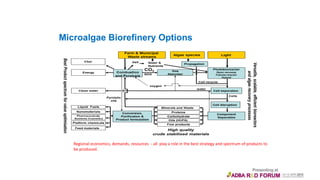
Microalgae Biorefinery Options
Regional economics, demands, resources - all play a role in the best strategy and spectrum of products to
be produced.
Key aspects of algal processing
• Costs and Value
• Production cost and quality of biomass
• Key areas DSP costs
• Reactors and DSP
• Harvesting
• Disruption
• Fractionation
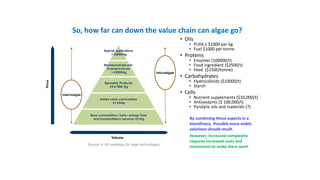
So, how far can down the value chain can algae go?
Source: A UK roadmap for algal technologies
• Oils
• PUFA ≥ $1000 per kg
• Fuel $1000 per tonne
• Proteins
• Enzymes (100000/t)
• Food ingredient ($2500/t)
• Feed ($1500/tonne)
• Carbohydrates
• Hydrocolloids ($10000/t)
• Starch
• Cells
• Nutrient supplements ($10,000/t)
• Antioxidants ($ 100,000/t)
• Pyrolytic oils and materials (?)
However, increased complexity
requires increased costs and
investment to make them work.
By combining these aspects in a
biorefinery. Possible more viable
solutions should result.
Export Options
AD
Coarse
filtratio
n
MF
Nutrient
PBR
Dewatered
course solid
MF Algae
harvesting
Food
Waste
etc.
Fine solids
Water
CO2, Heat,
Engine Power
O2
O2
Protein
recovery
Protein
Feed
Compost
Cell debris
N and P
minerals
Power
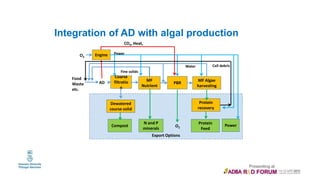
Integration of AD with algal production
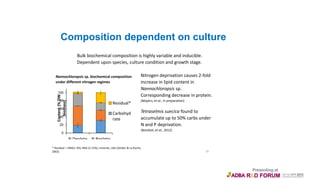
Composition dependent on culture
20
Bulk biochemical composition is highly variable and inducible.
Dependent upon species, culture condition and growth stage.
* Residual = DNA(1-3%), RNA (2-15%), minerals, salts (Geider & La Roche,
2002)
Nannochloropsis sp. biochemical composition
under different nitrogen regimes
Nitrogen deprivation causes 2-fold
increase in lipid content in
Nannochloropsis sp.
Corresponding decrease in protein.
(Mayers, et al., In preparation)
Tetraselmis suecica found to
accumulate up to 50% carbs under
N and P deprivation.
(Bondioli, et al., 2012)
0
20
40
60
80
100
N Deplete N Replete
Content(%DW
biomass)
Residual*
Carbohyd
rate
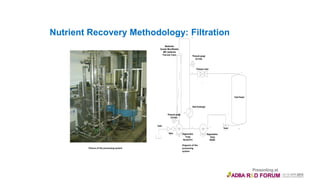
Nutrient Recovery Methodology: Filtration
E-3
P-4
P-2
E-1
P-8P-7P-10
E-5
E-4
V-2
E-2
V-3
P-5
P-6
V-1
P-3
P-9
Membralox
Ceramic Microfiltration
(MF) membrane
Pore size: 0.2μm
Regenerative
Pump
Kennet K12
Feed Vessel
Pressure valve
Pressure gauge
(0-4 bar)
Pressure gauge
(0-4 bar)
Valve
Valve
Drain
Regenerative
Pump
RG550
Heat Exchanger
P-11
P-6
P-12
Picture of the processing system
Diagram of the
processing
system
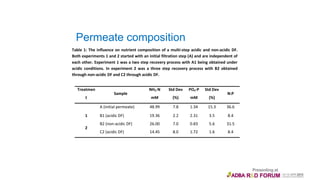
Permeate composition
Table 1: The influence on nutrient composition of a multi-step acidic and non-acidic DF.
Both experiments 1 and 2 started with an initial filtration step (A) and are independent of
each other. Experiment 1 was a two step recovery process with A1 being obtained under
acidic conditions. In experiment 2 was a three step recovery process with B2 obtained
through non-acidic DF and C2 through acidic DF.
Treatmen
t
Sample
NH3-N
mM
Std Dev
(%)
PO4-P
mM
Std Dev
(%)
N:P
A (initial permeate) 48.99 7.8 1.34 15.3 36.6
1 B1 (acidic DF) 19.36 2.2 2.31 3.5 8.4
2
B2 (non-acidic DF) 26.00 7.0 0.83 5.6 31.5
C2 (acidic DF) 14.45 8.0 1.72 1.6 8.4
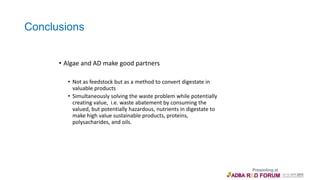
Conclusions
• Algae and AD make good partners
• Not as feedstock but as a method to convert digestate in
valuable products
• Simultaneously solving the waste problem while potentially
creating value, i.e. waste abatement by consuming the
valued, but potentially hazardous, nutrients in digestate to
make high value sustainable products, proteins,
polysacharides, and oils.
Thanks for your attention !
Thanks to my colleagues
Darren Oatley-Radcliffe Kevin Flynn
Paul Williams Steve Skill
Michael Gerardo Carol Llewellyn
Thea Coward Alla Silkina
R.W.Lovitt@Swansea.ac.uk
www.enalgae.eu info@enalgae.eu
EnAlgae is a Strategic Initiative of the INTERREG IVB NWE Programme
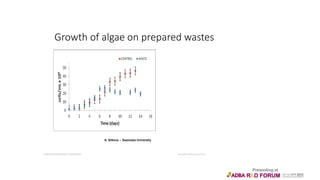
Growth of algae on prepared wastes
A. Silkina – Swansea University
EUROPEAN BIOENERGY CONFERENCE Brussels 25th of June 2012
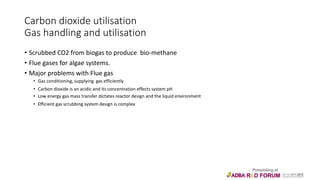
Carbon dioxide utilisation
Gas handling and utilisation
• Scrubbed CO2 from biogas to produce bio-methane
• Flue gases for algae systems.
• Major problems with Flue gas
• Gas conditioning, supplying gas efficiently
• Carbon dioxide is an acidic and its concentration effects system pH
• Low energy gas mass transfer dictates reactor design and the liquid environment
• Efficient gas scrubbing system design is complex
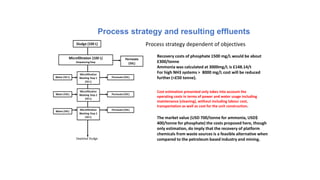
The market value (USD 700/tonne for ammonia, USD$
400/tonne for phosphate) the costs proposed here, though
only estimation, do imply that the recovery of platform
chemicals from waste sources is a feasible alternative when
compared to the petroleum based industry and mining.
Recovery costs of phosphate 1500 mg/L would be about
£300/tonne
Ammonia was calculated at 3000mg/L is £148.14/t
For high NH3 systems > 8000 mg/L cost will be reduced
further (<£50 tonne).
Cost estimation presented only takes into account the
operating costs in terms of power and water usage including
maintenance (cleaning), without including labour cost,
transportation as well as cost for the unit construction.
Process strategy and resulting effluents
Process strategy dependent of objectives
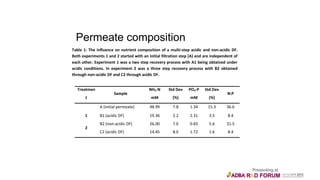
Permeate composition
Table 1: The influence on nutrient composition of a multi-step acidic and non-acidic DF.
Both experiments 1 and 2 started with an initial filtration step (A) and are independent of
each other. Experiment 1 was a two step recovery process with A1 being obtained under
acidic conditions. In experiment 2 was a three step recovery process with B2 obtained
through non-acidic DF and C2 through acidic DF.
Treatmen
t
Sample
NH3-N
mM
Std Dev
(%)
PO4-P
mM
Std Dev
(%)
N:P
A (initial permeate) 48.99 7.8 1.34 15.3 36.6
1 B1 (acidic DF) 19.36 2.2 2.31 3.5 8.4
2
B2 (non-acidic DF) 26.00 7.0 0.83 5.6 31.5
C2 (acidic DF) 14.45 8.0 1.72 1.6 8.4

Robert Lovitt

  • 1.
    #adrdforum @adbioresources DR ROBERTLOVITT READER IN BIOCHEMICAL ENGINEERING, SWANSEA UNIVERSITY ALGAE AND AD: A KEY AREA OF STUDY IN THE ENALGAE PROJECT
  • 2.
    Algae and AD:A key area of study for the EnAlgae project Dr Bob Lovitt Reader in Biochemical Engineering Swansea University
  • 3.
    Why use algaefor energy production • Captures light energy, Fixes CO2 , using mineral nutrients • Fast and versatile • Many organisms and products • Many opportunities: a potential solution to many environmental problems Therefore … Huge potential …. If we can get it to work! Develop a framework that could make algae based biorefineries viable
  • 4.
    Swansea Projects • Bioalgeasorb– Bioremediation (waste treatment and thermal treatments) EU • Shellplant – Shell fish fattening with algae (EU) • Enalgea – Energy and bioremediation (EU) • Accomplish – Flue gases (Welsh Water, TATA, Axium, EU) • Macrobiocrude – Seaweed hydrothermal treatment for oil (EPSRC) • Algal Biotechnology KTC – High value products and lighting systems (Welsh gov) • Internally lit bioreactors – high value products (EPSRC) • SuperPHA (South Wales, Bangor, Sevral companies Welsh Gov)
  • 5.
    Production Facilities… Large microalgalcollection >40 species, regularly grow 8-10 species. 40 x 20 L carboys 20 x 100 L vertical bags (Hatchery, Live feeds & inoculum) 400 L indoor horizontal tubular system ie ‘BioFence’(sensored-up to the max) 2 x 600 L outdoor BioFence system 1 x 2000 L outdoor vertical tubular system ‘Helios’ 5
  • 6.
    • Containing: PBRs,gas blenders, gas distribution, HVAC and PBR gas extraction Algal Growth Laboratory Port Talbot Steel works 9 million tons CO2 Ammonia Minerals Sewage works adjacent New campus Old campus
  • 7.
    Facility at Tatasteelworks site, Port Talbot Algal Growth Laboratory (AGL) and Algal preparation laboratory (APL) installed at TATA steel 12x 80L reactors and 36X 20L carboys or flasks suitable for flue gas trails and culture adaptation experiments Preliminary trials on high concentration of CO2 provided the basis for flue gas trails
  • 8.
    The EnAlgea Project •Energetic Algae (EnAlgae) • EnAlgae is a 4 year, €14.6M Strategic Initiative of the INTERREG IVB North West Europe (NWE) Programme, combining the expertise and resources of 19 Partners plus Observers encompassing 7 EU Member States. • Overall aim: To develop sustainable pathways for algal bioenergy in NW Europe • EnAlgae Aims to…. • Address the current lack of verifiable information on algal productivity via a new network of 9 algal pilots (microalgae and microalgae). • Integrate with existing industrial, agricultural and municipal processes to capture and remediate flue gas CO2 and soluble aqueous wastes. • Engage with diverse stakeholders across NWE to resolve technological and legislative bottlenecks for the sustainable deployment of algae-based bioenergy production, GHG mitigation and bioremediation.
  • 9.
  • 10.
  • 11.
    Algae and theCircular Economy Human activity Wastes (H2O) C,N,P) Energy & Liquid fuels Materials, Feeds and Food Chemicals Algae light Oxygen Algae offer methods by which these loops can be closed such that energy and material needs human activity can met sustainably Process integration closing the ecological loops related to human activity
  • 12.
    Advantages and commercial benefitsof nutrients recovery •Reduced demand on WWTP as reduced carbon is extracted so reducing costs and energy requirements of oxidation and CO2 release •The extraction of reduced carbon (as VFA) for reuse and substitution of VFA’s derived from petrochemicals reducing reliance on fossil carbon for chemicals of favourable nutrients •Ammonia recovery would save CO2 production and enhance the formation of a potentially valuable product if in a concentrated form •Phosphate is a finite resource is becoming increasingly expensive (800% rise between 2006 to 2008, $50 to $400) with a current value of over $500 per tonne Although its production is carbon neutral it’s been achieved by mining causing environmental and social issues. Fig.2. Schematic diagram of advantages of the process Zacharof &Lovitt, Water Science &Technology, Under review, 2014 Nutrient recovery Algae Algae
  • 13.
    Algae as afeedstock for AD • Microalgae • 10% dry weight • 50% C, 7% N, H, O, S • Macroalgae • 5% dry weight • 50% C 1% N, H, O, S • Productivity • Microalgae (best), 60 tonnes/ha, with about 2% efficiency of sunlight conversion typically at 1g/L, susceptible to predation and contamination. • Macroalgae, seasonal growth, autumn ( Laminaria, North Atlantic), can be stored as silage then fermented as required
  • 14.
    Microalgae as sourceof methane Algae + H2O CH4 + CO2 + NH3 Species Protein (%) Lipids (%) Carbohydrates (%) CH4 (L per g VS) N-NH3 (mg per g VS) Euglena gracilis 39-61 14-20 14-18 0.53-0.8 54.3-84.9 Chlamydomonas reinhardtii 48 21 17 0.69 44.7 Chlorella pyrenoidosa 57 2 26 0.8 53.1 Chlorella vulgaris 51-58 14-22 09-17 0.63-0.79 47.5-54.0 Duniella salina 57 6 32 0.68 53.1 Spirulina maxima 60-71 06-07 13-16 0.63-0.74 55.9-66.1 Spirulina platensis 46-63 04-09 08-14 0.47-0.69 42.8-58.7 Scenedesmus obliquus 50-56 12-14 10-17 0.59-0.69 46.6-42.2 Theoretical methane potential and theoretical ammonia release during the anaerobic digestion of the total biomass, Sialve and Bernard (2009) EUROPEAN BIOENERGY CONFERENCE Brussels 25th of June 2012 Dearth of practical data in the literature, large quantities of algea not yet produced, fractions would be more intertesing.
  • 15.
    AD fluids andgases for growing for Algae • Nutrients • N (ammonia) • P • Minerals • Gases (Digester or engine)(CO2, CO, SOx, NOx, H2S)
  • 16.
    Microalgae Biorefinery Options Regionaleconomics, demands, resources - all play a role in the best strategy and spectrum of products to be produced.
  • 17.
    Key aspects ofalgal processing • Costs and Value • Production cost and quality of biomass • Key areas DSP costs • Reactors and DSP • Harvesting • Disruption • Fractionation
  • 18.
    So, how farcan down the value chain can algae go? Source: A UK roadmap for algal technologies • Oils • PUFA ≥ $1000 per kg • Fuel $1000 per tonne • Proteins • Enzymes (100000/t) • Food ingredient ($2500/t) • Feed ($1500/tonne) • Carbohydrates • Hydrocolloids ($10000/t) • Starch • Cells • Nutrient supplements ($10,000/t) • Antioxidants ($ 100,000/t) • Pyrolytic oils and materials (?) However, increased complexity requires increased costs and investment to make them work. By combining these aspects in a biorefinery. Possible more viable solutions should result.
  • 19.
    Export Options AD Coarse filtratio n MF Nutrient PBR Dewatered course solid MFAlgae harvesting Food Waste etc. Fine solids Water CO2, Heat, Engine Power O2 O2 Protein recovery Protein Feed Compost Cell debris N and P minerals Power Integration of AD with algal production
  • 20.
    Composition dependent onculture 20 Bulk biochemical composition is highly variable and inducible. Dependent upon species, culture condition and growth stage. * Residual = DNA(1-3%), RNA (2-15%), minerals, salts (Geider & La Roche, 2002) Nannochloropsis sp. biochemical composition under different nitrogen regimes Nitrogen deprivation causes 2-fold increase in lipid content in Nannochloropsis sp. Corresponding decrease in protein. (Mayers, et al., In preparation) Tetraselmis suecica found to accumulate up to 50% carbs under N and P deprivation. (Bondioli, et al., 2012) 0 20 40 60 80 100 N Deplete N Replete Content(%DW biomass) Residual* Carbohyd rate
  • 21.
    Nutrient Recovery Methodology:Filtration E-3 P-4 P-2 E-1 P-8P-7P-10 E-5 E-4 V-2 E-2 V-3 P-5 P-6 V-1 P-3 P-9 Membralox Ceramic Microfiltration (MF) membrane Pore size: 0.2μm Regenerative Pump Kennet K12 Feed Vessel Pressure valve Pressure gauge (0-4 bar) Pressure gauge (0-4 bar) Valve Valve Drain Regenerative Pump RG550 Heat Exchanger P-11 P-6 P-12 Picture of the processing system Diagram of the processing system
  • 22.
    Permeate composition Table 1:The influence on nutrient composition of a multi-step acidic and non-acidic DF. Both experiments 1 and 2 started with an initial filtration step (A) and are independent of each other. Experiment 1 was a two step recovery process with A1 being obtained under acidic conditions. In experiment 2 was a three step recovery process with B2 obtained through non-acidic DF and C2 through acidic DF. Treatmen t Sample NH3-N mM Std Dev (%) PO4-P mM Std Dev (%) N:P A (initial permeate) 48.99 7.8 1.34 15.3 36.6 1 B1 (acidic DF) 19.36 2.2 2.31 3.5 8.4 2 B2 (non-acidic DF) 26.00 7.0 0.83 5.6 31.5 C2 (acidic DF) 14.45 8.0 1.72 1.6 8.4
  • 23.
    Conclusions • Algae andAD make good partners • Not as feedstock but as a method to convert digestate in valuable products • Simultaneously solving the waste problem while potentially creating value, i.e. waste abatement by consuming the valued, but potentially hazardous, nutrients in digestate to make high value sustainable products, proteins, polysacharides, and oils.
  • 24.
    Thanks for yourattention ! Thanks to my colleagues Darren Oatley-Radcliffe Kevin Flynn Paul Williams Steve Skill Michael Gerardo Carol Llewellyn Thea Coward Alla Silkina R.W.Lovitt@Swansea.ac.uk
  • 25.
    www.enalgae.eu info@enalgae.eu EnAlgae isa Strategic Initiative of the INTERREG IVB NWE Programme
  • 26.
    Growth of algaeon prepared wastes A. Silkina – Swansea University EUROPEAN BIOENERGY CONFERENCE Brussels 25th of June 2012
  • 27.
    Carbon dioxide utilisation Gashandling and utilisation • Scrubbed CO2 from biogas to produce bio-methane • Flue gases for algae systems. • Major problems with Flue gas • Gas conditioning, supplying gas efficiently • Carbon dioxide is an acidic and its concentration effects system pH • Low energy gas mass transfer dictates reactor design and the liquid environment • Efficient gas scrubbing system design is complex
  • 28.
    The market value(USD 700/tonne for ammonia, USD$ 400/tonne for phosphate) the costs proposed here, though only estimation, do imply that the recovery of platform chemicals from waste sources is a feasible alternative when compared to the petroleum based industry and mining. Recovery costs of phosphate 1500 mg/L would be about £300/tonne Ammonia was calculated at 3000mg/L is £148.14/t For high NH3 systems > 8000 mg/L cost will be reduced further (<£50 tonne). Cost estimation presented only takes into account the operating costs in terms of power and water usage including maintenance (cleaning), without including labour cost, transportation as well as cost for the unit construction. Process strategy and resulting effluents Process strategy dependent of objectives
  • 29.
    Permeate composition Table 1:The influence on nutrient composition of a multi-step acidic and non-acidic DF. Both experiments 1 and 2 started with an initial filtration step (A) and are independent of each other. Experiment 1 was a two step recovery process with A1 being obtained under acidic conditions. In experiment 2 was a three step recovery process with B2 obtained through non-acidic DF and C2 through acidic DF. Treatmen t Sample NH3-N mM Std Dev (%) PO4-P mM Std Dev (%) N:P A (initial permeate) 48.99 7.8 1.34 15.3 36.6 1 B1 (acidic DF) 19.36 2.2 2.31 3.5 8.4 2 B2 (non-acidic DF) 26.00 7.0 0.83 5.6 31.5 C2 (acidic DF) 14.45 8.0 1.72 1.6 8.4