MICRO–RNA and LONG
NONCODING RNA
DR.ABHINAV
MEDICURE DIAGNOSTICS AND RESEARCH
CENTER
HYDERABAD. Vijayanagar colony
• INTRODUCTION:
• Gene regulation depends on functions of non
coding RNAs.These are encoded by genes
that are transcribed but not translated.
Although many distinct families of noncoding
RNAs exist we will only discuss two examples
here :small RNA molecules called microRNAs, and
long non coding RNAs >200 nucleotides in length.
• Micro –RNA(miRNA)
– The miRNAs do not encode proteins:instead,they
function primarily to modulate the translation of
target mRNAs into their corresponding proteins.
– Posttranscriptional silencing of gene expression
by miRNA is a fundemental and well conserved
mechanism of gene regulation present in all
eukaryotes(plants and animals).
• Even microorganisms have a more primitive
version of the same general machinery that
they can use to protect themselves against
foreign DNA (e.g., from phages and viruses).
• Because of the profound influence of miRNAs
on gene regulation these relatively short RNAs
(which are 22 nucleotides in length on
average) have assumed central importance in
illumination of both normal developmental
pathways,as well as pathologic conditions like
cancer.
• Indeed the nobel prize in Physiology or
Medicine in 2006 was awarded for discovery
of miRNAs.(DR.Andrew Z.fire and DR.craig
C.Mello)
• By current estimates human genome encodes
approximately 1000 miRNA genes,some 20
fold less than the protein- coding genes.
• However individual miRNAs appear to
regulate multiple protein-coding
genes,allowing each micro RNA to co-regulate
entire programmes of gene expression .
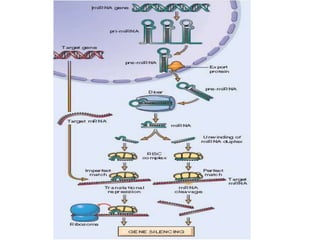
• Transcription of miRNA genes produces a primary
miRNA,which is progressively processed through
various steps including trimming by the enzyme
DICER(it is also know as endoribonuclease dicer
or helicase with Rnase motif,is an enzyme that in
humans is encoded by the DICER1 gene.
• Being part of the Rnase 3 family ,Dicer cleaves
dsRNA and pre-miRNA into short double stranded
RNA fragments called small interferring RNA and
microRNA respectively).
• This generates mature single-stranded miRNAs
of 21 to 30 nucleotides that are associated
with a multiprotein aggregate called RNA
induced silencing complex(RISC).
• Subsequent base pairing between a microRNA
strand and its target messenger RNA directs
the RISC to either induce messenger RNA
cleavage or repress its translation .
• All mRNAs contain so called seed sequence in
their 3’ UTR that determines the specificity of
miRNA binding and gene silencing .
• In this way the target messenger RNA is
posttrancriptionally silenced.
Small interfering RNAs (siRNAs) are short rna
sequences that can be introduced
experimentally into cells .
These serves as substrates for Dicer and interact
with the RISC complex in manner analogous to
endogenous miRNAs.
Synthetic siRNAs targeted against specific
messenger RNA species have become useful
laboratory tools to study gene functions (so
called knock –down technology);
• They are also being developed as possible
therapeutic agents to silence pathogenic genes
,such as oncogenes involved in neoplastic
transformation.
• Long Noncoding RNA(lncRNA):
• Recent studies have further identified an
untapped universe of lncRNAs- by some
calculations ,the number of lncRNAs may exceed
coding messenger RNAs by 10 to 20 fold.
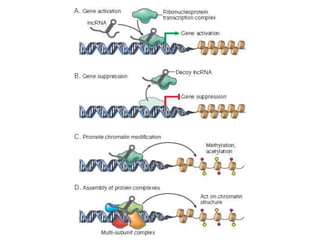
• lncRNAs modulate gene expression in many ways
.For example they can bind to regions of
chromatin ,restricting RNA polymerase access to
coding genes within the region.
• The best known example of a repressive
function involves XIST ,which is transcribed
from the X chromosome and plays an essential
role in physiologic X chromosome inactivation.
• XIST itself escapes X inactivation ,but forms a
repressive “cloak” on X chromosome from
which it is transcribed ,resulting in gene
silencing .
• Conversely ,it has recently been appreciated
that many enhancers are sites of lncRNA
synthesis ,and these lncRNAs appear to often
increase transcription from gene promoters
through a variety of mechanisms.
• Emerging studies are exploring the roles of
lncRNAs in various human diseases ,from
atherosclerosis to cancer.
TAKE HOME MESSAGE
• miRNAs:
• Generation of miRNAs and their mode of action
in regulating gene function .miRNA genes are
transcribed to produce a primary miRNA .
• Which is processed with in the nucleus to form
pre-miRNA composed of single RNA strand with
secondary hairpin loop like structure that form
stretches of dsRNA.
• After this pre-miRNA is exported out of the
nucleus via specific transporter proteins ,
• The cytoplasmic dicer enzyme trims the pre-
miRNA to generate mature double stranded
miRNAs of 21 to 30 nucleotides .
The miRNA subsequently unwinds ,and the
resulting single strands are incorporated into the
multiprotein RISC .
• Base pairing between the single stranded miRNA
and its target messenger RNA directs RISC to
either cleave the messenger RNA target or
repress its translation .In either case ,the target
messenger RNA gene is silenced post
transcriptionally.
• Long Noncoding RNAs:
• 1)lncRNAs can facilitate transcription factor
binding and thus promote gene activation .
2)Conversely ,lncRNAs can premptively bind
transcription factors and thus prevent gene
transcription .
• 3)Histone and DNA modification by acetylases or
methylases may be directed by the binding of
lncRNAs .
• 4)In other instances ,lncRNAs may act as
scaffolding to stabilize secondary or tertiary
structures or multi subunit complexes that
influence general chromatin architecture or gene
activity.
• REFERENCES:
ROBBINS AND COTRAN 9TH EDITION.
• WWW.WIKIPEDIA.ORG
THANK YOU

Mi Rna and long non coding Rna. Dr. Abhinav Golla , Associate Professor , Lab Director & Consultant Pathologist . Aadhya Medicure Pathlabs .

  • 1.
    MICRO–RNA and LONG NONCODINGRNA DR.ABHINAV MEDICURE DIAGNOSTICS AND RESEARCH CENTER HYDERABAD. Vijayanagar colony
  • 2.
    • INTRODUCTION: • Generegulation depends on functions of non coding RNAs.These are encoded by genes that are transcribed but not translated. Although many distinct families of noncoding RNAs exist we will only discuss two examples here :small RNA molecules called microRNAs, and long non coding RNAs >200 nucleotides in length.
  • 3.
    • Micro –RNA(miRNA) –The miRNAs do not encode proteins:instead,they function primarily to modulate the translation of target mRNAs into their corresponding proteins. – Posttranscriptional silencing of gene expression by miRNA is a fundemental and well conserved mechanism of gene regulation present in all eukaryotes(plants and animals).
  • 4.
    • Even microorganismshave a more primitive version of the same general machinery that they can use to protect themselves against foreign DNA (e.g., from phages and viruses).
  • 5.
    • Because ofthe profound influence of miRNAs on gene regulation these relatively short RNAs (which are 22 nucleotides in length on average) have assumed central importance in illumination of both normal developmental pathways,as well as pathologic conditions like cancer. • Indeed the nobel prize in Physiology or Medicine in 2006 was awarded for discovery of miRNAs.(DR.Andrew Z.fire and DR.craig C.Mello)
  • 6.
    • By currentestimates human genome encodes approximately 1000 miRNA genes,some 20 fold less than the protein- coding genes. • However individual miRNAs appear to regulate multiple protein-coding genes,allowing each micro RNA to co-regulate entire programmes of gene expression .
  • 7.
    • Transcription ofmiRNA genes produces a primary miRNA,which is progressively processed through various steps including trimming by the enzyme DICER(it is also know as endoribonuclease dicer or helicase with Rnase motif,is an enzyme that in humans is encoded by the DICER1 gene. • Being part of the Rnase 3 family ,Dicer cleaves dsRNA and pre-miRNA into short double stranded RNA fragments called small interferring RNA and microRNA respectively).
  • 8.
    • This generatesmature single-stranded miRNAs of 21 to 30 nucleotides that are associated with a multiprotein aggregate called RNA induced silencing complex(RISC). • Subsequent base pairing between a microRNA strand and its target messenger RNA directs the RISC to either induce messenger RNA cleavage or repress its translation .
  • 9.
    • All mRNAscontain so called seed sequence in their 3’ UTR that determines the specificity of miRNA binding and gene silencing . • In this way the target messenger RNA is posttrancriptionally silenced.
  • 11.
    Small interfering RNAs(siRNAs) are short rna sequences that can be introduced experimentally into cells . These serves as substrates for Dicer and interact with the RISC complex in manner analogous to endogenous miRNAs.
  • 12.
    Synthetic siRNAs targetedagainst specific messenger RNA species have become useful laboratory tools to study gene functions (so called knock –down technology); • They are also being developed as possible therapeutic agents to silence pathogenic genes ,such as oncogenes involved in neoplastic transformation.
  • 13.
    • Long NoncodingRNA(lncRNA): • Recent studies have further identified an untapped universe of lncRNAs- by some calculations ,the number of lncRNAs may exceed coding messenger RNAs by 10 to 20 fold. • lncRNAs modulate gene expression in many ways .For example they can bind to regions of chromatin ,restricting RNA polymerase access to coding genes within the region.
  • 14.
    • The bestknown example of a repressive function involves XIST ,which is transcribed from the X chromosome and plays an essential role in physiologic X chromosome inactivation. • XIST itself escapes X inactivation ,but forms a repressive “cloak” on X chromosome from which it is transcribed ,resulting in gene silencing .
  • 15.
    • Conversely ,ithas recently been appreciated that many enhancers are sites of lncRNA synthesis ,and these lncRNAs appear to often increase transcription from gene promoters through a variety of mechanisms. • Emerging studies are exploring the roles of lncRNAs in various human diseases ,from atherosclerosis to cancer.
  • 17.
    TAKE HOME MESSAGE •miRNAs: • Generation of miRNAs and their mode of action in regulating gene function .miRNA genes are transcribed to produce a primary miRNA . • Which is processed with in the nucleus to form pre-miRNA composed of single RNA strand with secondary hairpin loop like structure that form stretches of dsRNA.
  • 18.
    • After thispre-miRNA is exported out of the nucleus via specific transporter proteins , • The cytoplasmic dicer enzyme trims the pre- miRNA to generate mature double stranded miRNAs of 21 to 30 nucleotides .
  • 19.
    The miRNA subsequentlyunwinds ,and the resulting single strands are incorporated into the multiprotein RISC . • Base pairing between the single stranded miRNA and its target messenger RNA directs RISC to either cleave the messenger RNA target or repress its translation .In either case ,the target messenger RNA gene is silenced post transcriptionally.
  • 20.
    • Long NoncodingRNAs: • 1)lncRNAs can facilitate transcription factor binding and thus promote gene activation . 2)Conversely ,lncRNAs can premptively bind transcription factors and thus prevent gene transcription .
  • 21.
    • 3)Histone andDNA modification by acetylases or methylases may be directed by the binding of lncRNAs . • 4)In other instances ,lncRNAs may act as scaffolding to stabilize secondary or tertiary structures or multi subunit complexes that influence general chromatin architecture or gene activity.
  • 22.
    • REFERENCES: ROBBINS ANDCOTRAN 9TH EDITION. • WWW.WIKIPEDIA.ORG
  • 23.