
MULTIPLE
INTELLIGENCES IN
LANGUAGE CLASSROOM
Atula Ahuja
ORIGINAL THEORY
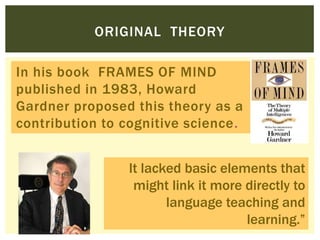
In his book FRAMES OF MIND
published in 1983, Howard
Gardner proposed this theory as a
contribution to cognitive science.
It lacked basic elements that
might link it more directly to
language teaching and
learning.”
The application of the MI theory in language
teaching is fairly recent, although many
schools had started experimenting with the
idea in mainstream teaching beginning 1993.
Research questions:
Can Howard Gardner's theory of Multiple
Intelligences be applied to language
classroom?
How effective will it be?
RESEARCH QUESTION
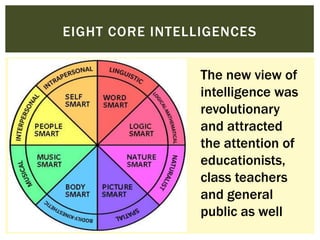
EIGHT CORE INTELLIGENCES
The new view of
intelligence was
revolutionary
and attracted
the attention of
educationists,
class teachers
and general
public as well
1993 Gardner wrote: Multiple Intelligences:
The Theory in Practice
 proposed an extension of the MI view
 termed it “Multiple Intelligences Model”
linked it to general education.
The model well received by many educators.
prominent among those were Thomas Armstrong,
Mary Ann Christison and David Lazear.
HOW HAS M.I THEORY DEVELOPED SINCE
1983?
Bruce Campbell, an educationist, developed a
nationally acclaimed classroom model based upon
Howard Gardner's Theory of Multiple Intelligences &
presented it to the U.S. Department of Education
and numerous state departments of education .
Robert J. Sternberg, Professor of Educational
Phycology at Yale, in his book Beyond IQ: A Triarchic
Theory Of Intelligence‟ proposed a theory which is
complements the M.I theory.
Teacher trainer Carolyn Chapman authored “If the
Shoe Fits . . .. How to Develop Multiple Intelligences
in the Classroom”
HOW HAS M.I. THEORY DEVELOPED
SINCE 1983?
In his book Eight Ways of Teaching: The Artistry
of Teaching with Multiple Intelligences, Lazear
provided practical advice for using multiple
intelligences in the classroom.
In Garner‟s words “It's very important that a
teacher take individual differences among kids
very seriously. The bottom line is a deep interest
in children, how their minds are different from
one another, and in helping them use their
minds well."
THE EIGHT INTELLIGENCES
IN CLASSROOM
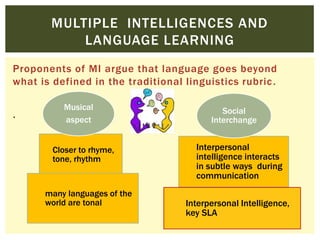
Proponents of MI argue that language goes beyond
what is defined in the traditional linguistics rubric.
.
MULTIPLE INTELLIGENCES AND
LANGUAGE LEARNING
Closer to rhyme,
tone, rhythm
many languages of the
world are tonal
Musical
aspect
Interpersonal
intelligence interacts
in subtle ways during
communication
Interpersonal Intelligence,
key SLA
Social
Interchange
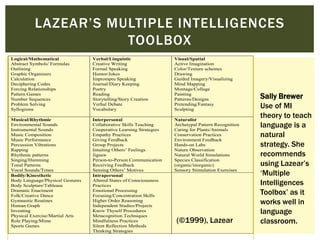
LAZEAR‟S MULTIPLE INTELLIGENCES
TOOLBOX
Logical/Mathematical
Abstract Symbols/ Formulas
Outlining
Graphic Organizers
Calculation
Deciphering Codes
Forcing Relationships
Pattern Games
Number Sequences
Problem Solving
Syllogisms
Verbal/Linguistic
Creative Writing
Formal Speaking
Humor/Jokes
Impromptu Speaking
Journal/Diary Keeping
Poetry
Reading
Storytelling/Story Creation
Verbal Debate
Vocabulary
Visual/Spatial
Active Imagination
Color/Texture schemes
Drawing
Guided Imagery/Visualizing
Mind Mapping
Montage/Collage
Painting
Patterns/Designs
Pretending/Fantasy
Sculpting
Musical/Rhythmic
Environmental Sounds
Instrumental Sounds
Music Composition
Music Performance
Percussion Vibrations
Rapping
Rhythmic patterns
Singing/Humming
Tonal Patterns
Vocal Sounds/Tones
Interpersonal
Collaborative Skills Teaching
Cooperative Learning Strategies
Empathy Practices
Giving Feedback
Group Projects
Intuiting Others’ Feelings
Jigsaw
Person-to-Person Communication
Receiving Feedback
Sensing Others’ Motives
Naturalist
Archetypal Pattern Recognition
Caring for Plants/Animals
Conservation Practices
Environment Feedback
Hands-on Labs
Nature Observation
Natural World Simulations
Species Classification
(organic/inorganic)
Sensory Stimulation Exercises
Bodily/Kinesthetic
Body Language/Physical Gestures
Body Sculpture/Tableaus
Dramatic Enactment
Folk/Creative Dance
Gymnastic Routines
Human Graph
Inventing
Physical Exercise/Martial Arts
Role Playing/Mime
Sports Games
Intrapersonal
Altered States of Consciousness
Practices
Emotional Processing
Focusing/Concentration Skills
Higher Order Reasoning
Independent Studies/Projects
Know Thyself Procedures
Metacognition Techniques
Mindfulness Practices
Silent Reflection Methods
Thinking Strategies
(©1999), Lazear
Sally Brewer
Use of MI
theory to teach
language is a
natural
strategy. She
recommends
using Lazear‟s
„Multiple
Intelligences
Toolbox‟ as it
works well in
language
classroom.
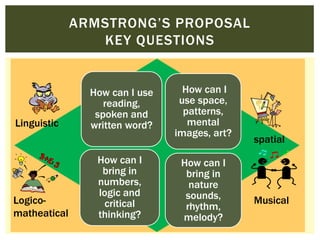
How can I use
reading,
spoken and
written word?
How can I
use space,
patterns,
mental
images, art?
How can I
bring in
numbers,
logic and
critical
thinking?
How can I
bring in
nature
sounds,
rhythm,
melody?
ARMSTRONG‟S PROPOSAL
KEY QUESTIONS
Linguistic
spatial
MusicalLogico-
matheatical
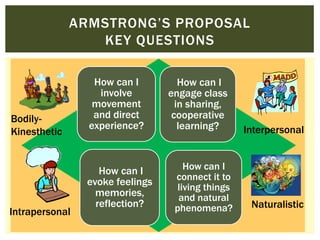
How can I
involve
movement
and direct
experience?
How can I
engage class
in sharing,
cooperative
learning?
How can I
evoke feelings
memories,
reflection?
How can I
connect it to
living things
and natural
phenomena?
ARMSTRONG‟S PROPOSAL
KEY QUESTIONS
Bodily-
Kinesthetic Interpersonal
Naturalistic
Intrapersonal
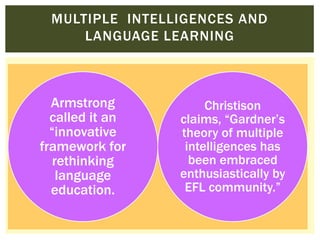
Armstrong
called it an
“innovative
framework for
rethinking
language
education.
Christison
claims, “Gardner‟s
theory of multiple
intelligences has
been embraced
enthusiastically by
EFL community.”
MULTIPLE INTELLIGENCES AND
LANGUAGE LEARNING
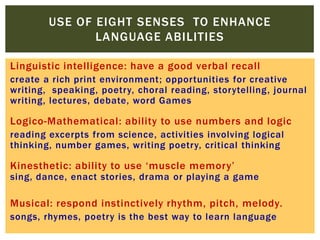
Linguistic intelligence: have a good verbal recall
create a rich print environment; opportunities for creative
writing, speaking, poetry, choral reading, storytelling, journal
writing, lectures, debate, word Games
Logico-Mathematical: ability to use numbers and logic
reading excerpts from science, activities involving logical
thinking, number games, writing poetry, critical thinking
Kinesthetic: ability to use „muscle memory‟
sing, dance, enact stories, drama or playing a game
Musical: respond instinctively rhythm, pitch, melody.
songs, rhymes, poetry is the best way to learn language
USE OF EIGHT SENSES TO ENHANCE
LANGUAGE ABILITIES
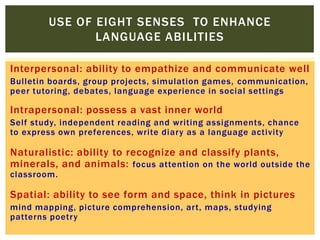
Interpersonal: ability to empathize and communicate well
Bulletin boards, group projects, simulation games, communication,
peer tutoring, debates, language experience in social settings
Intrapersonal: possess a vast inner world
Self study, independent reading and writing assignments, chance
to express own preferences, write diary as a language activity
Naturalistic: ability to recognize and classify plants,
minerals, and animals: focus attention on the world outside the
classroom.
Spatial: ability to see form and space, think in pictures
mind mapping, picture comprehension, art, maps, studying
patterns poetry
USE OF EIGHT SENSES TO ENHANCE
LANGUAGE ABILITIES
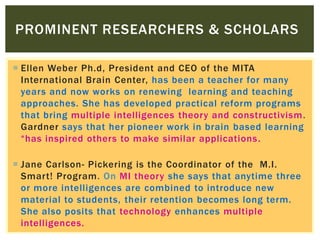
 Ellen Weber Ph.d, President and CEO of the MITA
International Brain Center, has been a teacher for many
years and now works on renewing learning and teaching
approaches. She has developed practical reform programs
that bring multiple intelligences theory and constructivism.
Gardner says that her pioneer work in brain based learning
“has inspired others to make similar applications.
 Jane Carlson- Pickering is the Coordinator of the M.I.
Smart! Program. On MI theory she says that anytime three
or more intelligences are combined to introduce new
material to students, their retention becomes long term.
She also posits that technology enhances multiple
intelligences.
PROMINENT RESEARCHERS & SCHOLARS
http://www.youtube.com/watch?v=WON2VnQOKaE&feature=player_embedded#!
Data presented indicates that MI can offer English
language teachers, a rich, diverse way of
understanding human cognitive abilities.
Can provide a variety of activities from different
resources for specific lessons. So it can be
concluded the MI theory can be very useful in
language teaching.
 The theory acknowledges learner differences and
keeps them in mind while designing curriculum,
hence leads to high student satisfaction leading to
greater student achievement.
MI has something for all and is theory for everyone!
CONCLUSION
 Gardner, H. 1999. Intelligence Reframed: Multiple Intelligences
for the 21st Century New York Basic books
 Christison, MA.1996. Teaching and Learning Language through
Multiple Intelligences, TESOL Journal. (6)1,
 Armstrong, T. 1994. Multiple intelligences in the classroom.
Alexandria, VA: ASCD
 Clench, R. (2010). Howard Gardner's Multiple Intelligences
Theory, Outcomes-based Education and Curriculum
Implementation in South Africa: A Critique of Music Education in
the General Education and Training Phase
 Weber, E. (1997). Roundtable learning: Building understanding
through enhanced MI strategies. Tucson, AZ: Zephyr Press.
 Christison, Mary Ann (1996). "Teaching and learning language
through multiple intelligences." TESOL Journal, 6(1): 10-14.
 Christison, Mary Ann (1998). “Applying Multiple Intelligences
Theory in Pre-service and In service TEFL Education Programs.”
English Teaching Forum, April-June: 3-13.
 Berman M.1998. A Multiple Intelligences Road to an ELT
Classroom. Bancyfelin: Crown House Publishing Ltd.
 Emma,Zevik.Multiple Intelligences:What It Is and Why It's Vital
Today, Performing & Visual Arts
 http://www.gse.gmu.edu/research/mirs
 http://montrose42.wordpress.com/2010/04/05/multiple-
intelligences-and-their-impact-on-education/
Thank you!

MI in language classroom- Atula Ahuja

  • 1.
  • 2.
    ORIGINAL THEORY In hisbook FRAMES OF MIND published in 1983, Howard Gardner proposed this theory as a contribution to cognitive science. It lacked basic elements that might link it more directly to language teaching and learning.”
  • 3.
    The application ofthe MI theory in language teaching is fairly recent, although many schools had started experimenting with the idea in mainstream teaching beginning 1993. Research questions: Can Howard Gardner's theory of Multiple Intelligences be applied to language classroom? How effective will it be? RESEARCH QUESTION
  • 4.
    EIGHT CORE INTELLIGENCES Thenew view of intelligence was revolutionary and attracted the attention of educationists, class teachers and general public as well
  • 5.
    1993 Gardner wrote:Multiple Intelligences: The Theory in Practice  proposed an extension of the MI view  termed it “Multiple Intelligences Model” linked it to general education. The model well received by many educators. prominent among those were Thomas Armstrong, Mary Ann Christison and David Lazear. HOW HAS M.I THEORY DEVELOPED SINCE 1983?
  • 6.
    Bruce Campbell, aneducationist, developed a nationally acclaimed classroom model based upon Howard Gardner's Theory of Multiple Intelligences & presented it to the U.S. Department of Education and numerous state departments of education . Robert J. Sternberg, Professor of Educational Phycology at Yale, in his book Beyond IQ: A Triarchic Theory Of Intelligence‟ proposed a theory which is complements the M.I theory. Teacher trainer Carolyn Chapman authored “If the Shoe Fits . . .. How to Develop Multiple Intelligences in the Classroom” HOW HAS M.I. THEORY DEVELOPED SINCE 1983?
  • 7.
    In his bookEight Ways of Teaching: The Artistry of Teaching with Multiple Intelligences, Lazear provided practical advice for using multiple intelligences in the classroom. In Garner‟s words “It's very important that a teacher take individual differences among kids very seriously. The bottom line is a deep interest in children, how their minds are different from one another, and in helping them use their minds well." THE EIGHT INTELLIGENCES IN CLASSROOM
  • 8.
    Proponents of MIargue that language goes beyond what is defined in the traditional linguistics rubric. . MULTIPLE INTELLIGENCES AND LANGUAGE LEARNING Closer to rhyme, tone, rhythm many languages of the world are tonal Musical aspect Interpersonal intelligence interacts in subtle ways during communication Interpersonal Intelligence, key SLA Social Interchange
  • 9.
    LAZEAR‟S MULTIPLE INTELLIGENCES TOOLBOX Logical/Mathematical AbstractSymbols/ Formulas Outlining Graphic Organizers Calculation Deciphering Codes Forcing Relationships Pattern Games Number Sequences Problem Solving Syllogisms Verbal/Linguistic Creative Writing Formal Speaking Humor/Jokes Impromptu Speaking Journal/Diary Keeping Poetry Reading Storytelling/Story Creation Verbal Debate Vocabulary Visual/Spatial Active Imagination Color/Texture schemes Drawing Guided Imagery/Visualizing Mind Mapping Montage/Collage Painting Patterns/Designs Pretending/Fantasy Sculpting Musical/Rhythmic Environmental Sounds Instrumental Sounds Music Composition Music Performance Percussion Vibrations Rapping Rhythmic patterns Singing/Humming Tonal Patterns Vocal Sounds/Tones Interpersonal Collaborative Skills Teaching Cooperative Learning Strategies Empathy Practices Giving Feedback Group Projects Intuiting Others’ Feelings Jigsaw Person-to-Person Communication Receiving Feedback Sensing Others’ Motives Naturalist Archetypal Pattern Recognition Caring for Plants/Animals Conservation Practices Environment Feedback Hands-on Labs Nature Observation Natural World Simulations Species Classification (organic/inorganic) Sensory Stimulation Exercises Bodily/Kinesthetic Body Language/Physical Gestures Body Sculpture/Tableaus Dramatic Enactment Folk/Creative Dance Gymnastic Routines Human Graph Inventing Physical Exercise/Martial Arts Role Playing/Mime Sports Games Intrapersonal Altered States of Consciousness Practices Emotional Processing Focusing/Concentration Skills Higher Order Reasoning Independent Studies/Projects Know Thyself Procedures Metacognition Techniques Mindfulness Practices Silent Reflection Methods Thinking Strategies (©1999), Lazear Sally Brewer Use of MI theory to teach language is a natural strategy. She recommends using Lazear‟s „Multiple Intelligences Toolbox‟ as it works well in language classroom.
  • 10.
    How can Iuse reading, spoken and written word? How can I use space, patterns, mental images, art? How can I bring in numbers, logic and critical thinking? How can I bring in nature sounds, rhythm, melody? ARMSTRONG‟S PROPOSAL KEY QUESTIONS Linguistic spatial MusicalLogico- matheatical
  • 11.
    How can I involve movement anddirect experience? How can I engage class in sharing, cooperative learning? How can I evoke feelings memories, reflection? How can I connect it to living things and natural phenomena? ARMSTRONG‟S PROPOSAL KEY QUESTIONS Bodily- Kinesthetic Interpersonal Naturalistic Intrapersonal
  • 12.
    Armstrong called it an “innovative frameworkfor rethinking language education. Christison claims, “Gardner‟s theory of multiple intelligences has been embraced enthusiastically by EFL community.” MULTIPLE INTELLIGENCES AND LANGUAGE LEARNING
  • 13.
    Linguistic intelligence: havea good verbal recall create a rich print environment; opportunities for creative writing, speaking, poetry, choral reading, storytelling, journal writing, lectures, debate, word Games Logico-Mathematical: ability to use numbers and logic reading excerpts from science, activities involving logical thinking, number games, writing poetry, critical thinking Kinesthetic: ability to use „muscle memory‟ sing, dance, enact stories, drama or playing a game Musical: respond instinctively rhythm, pitch, melody. songs, rhymes, poetry is the best way to learn language USE OF EIGHT SENSES TO ENHANCE LANGUAGE ABILITIES
  • 14.
    Interpersonal: ability toempathize and communicate well Bulletin boards, group projects, simulation games, communication, peer tutoring, debates, language experience in social settings Intrapersonal: possess a vast inner world Self study, independent reading and writing assignments, chance to express own preferences, write diary as a language activity Naturalistic: ability to recognize and classify plants, minerals, and animals: focus attention on the world outside the classroom. Spatial: ability to see form and space, think in pictures mind mapping, picture comprehension, art, maps, studying patterns poetry USE OF EIGHT SENSES TO ENHANCE LANGUAGE ABILITIES
  • 15.
     Ellen WeberPh.d, President and CEO of the MITA International Brain Center, has been a teacher for many years and now works on renewing learning and teaching approaches. She has developed practical reform programs that bring multiple intelligences theory and constructivism. Gardner says that her pioneer work in brain based learning “has inspired others to make similar applications.  Jane Carlson- Pickering is the Coordinator of the M.I. Smart! Program. On MI theory she says that anytime three or more intelligences are combined to introduce new material to students, their retention becomes long term. She also posits that technology enhances multiple intelligences. PROMINENT RESEARCHERS & SCHOLARS
  • 16.
    http://www.youtube.com/watch?v=WON2VnQOKaE&feature=player_embedded#! Data presented indicatesthat MI can offer English language teachers, a rich, diverse way of understanding human cognitive abilities. Can provide a variety of activities from different resources for specific lessons. So it can be concluded the MI theory can be very useful in language teaching.  The theory acknowledges learner differences and keeps them in mind while designing curriculum, hence leads to high student satisfaction leading to greater student achievement. MI has something for all and is theory for everyone! CONCLUSION
  • 17.
     Gardner, H.1999. Intelligence Reframed: Multiple Intelligences for the 21st Century New York Basic books  Christison, MA.1996. Teaching and Learning Language through Multiple Intelligences, TESOL Journal. (6)1,  Armstrong, T. 1994. Multiple intelligences in the classroom. Alexandria, VA: ASCD  Clench, R. (2010). Howard Gardner's Multiple Intelligences Theory, Outcomes-based Education and Curriculum Implementation in South Africa: A Critique of Music Education in the General Education and Training Phase  Weber, E. (1997). Roundtable learning: Building understanding through enhanced MI strategies. Tucson, AZ: Zephyr Press.
  • 18.
     Christison, MaryAnn (1996). "Teaching and learning language through multiple intelligences." TESOL Journal, 6(1): 10-14.  Christison, Mary Ann (1998). “Applying Multiple Intelligences Theory in Pre-service and In service TEFL Education Programs.” English Teaching Forum, April-June: 3-13.  Berman M.1998. A Multiple Intelligences Road to an ELT Classroom. Bancyfelin: Crown House Publishing Ltd.  Emma,Zevik.Multiple Intelligences:What It Is and Why It's Vital Today, Performing & Visual Arts  http://www.gse.gmu.edu/research/mirs  http://montrose42.wordpress.com/2010/04/05/multiple- intelligences-and-their-impact-on-education/
  • 19.

Editor's Notes

  • #5 In order for a teacher to implement the theory of MI in their classroom, they mustfirst understand the 8 intelligences.Using biological as well as cultural research, he formulated a list of seven intelligences. "the capacity to solve problems or to fashion products that are valued in one or more cultural setting“
  • #6 In light of this view Gardner and others expanded the theoryMary Ann Christison , TESOL President 1997-1998- classroom teacher for 30 years Armstron is Phd, Author, Speaker, Educational ConsultantDavid Lazear in an MI Application Expert
  • #9 Any languages of the world are tone languagesThus it’s important to have a multi- sensory view of language while developing lesson plans. Musical aspects of language- tone and rhythm are closer to the theory of music than to linguistics. According to Elisabeth Smith Language is a social interchange, and interpersonal and intrapersonalintelligences interact in complex and subtle ways during the communicationprocess. Interpersonal intelligence can be seen to play a key role in secondlanguage learning. Empathy is an aspect of interpersonal intelligence involving theability to understand people and respond to them appropriately, and those with ahigh degree of empathy seem likely to more successful second language learners.
  • #10 Eight Ways of Teaching, The Artistry of Teaching with Multiple Intelligences Use of MI theory to teach language is a natural strategy.
  • #11 Armstrong has also proposed 8 ways of teaching keeping I theory in mind- very similar of David Lazear. He also
  • #13 In light of this view Gardner and others expanded the theoryCountless educators have incorporated multiple intelligence theory into their work.
  • #14 body movements help coordinate mental abilities
  • #15 body movements help coordinate mental abilities
  • #16 Jane Carlson- Pickering specializes on MI pedagogy
  • #17 It offers English language teachers, a rich, diverse way of understanding human cognitive abilities and combinations of abilities, heightening our awareness of what makes learning possible and effective for individual students