Testing    GrammarJonathan Magdalena
What are we trying to MEASURE?“English grammar is chiefly a system of                   syntax that decides 	   the order and               patternsin which 	words are arranged	        	into sentences.”(Close, 1982)
Why should we test grammar?Linguisticor communicative competence?Structures or functions?Usage or use?Prescriptive or descriptive?
Howshould we test grammar?Separated from skills?Discrete point or integrative items?Focus on grammar or meaning?
What are the most common test formats for testing grammar?RECOGNITIONMultiple choice items (Liu, 121)Error-recognition items (Liu, 129)True/False (Baxter, 35) Pairing and matching itemsCloze/Modified Cloze (Hughes, 144)
What are the most common test formats for testing grammar?ProductionCompletion items (Hughes, 143) Transformation items (Liu, 131)Paraphrase (Hughes, 143)RearrangementEditingCombination and addition itemsItems involving the changing of words
When should we go for grammarrecognition?When…More material needs to be covered. You want to test different levels of learning. You have little time for scoring. You are not interested in evaluating how well a test taker can formulate a correct answer. You have a large number of test takers.
When should we go for grammarproduction?When…You want to evaluate a person’s ability to formulate a correct answer. You have more time to score the itemsYou want to test a persons ability to apply concepts and information to a new situation. You have a clear idea of the aspects and concepts that should be tested.
True/FalseIs this sentences true or false?“He works from Monday to Friday”Does not demonstrate broader knowledge Difficult to construct in higher levels  Encourages guessing due to 50/50 chance  Difficult to test attitudes toward learning
Multiple ChoiceJohn usually ______from Monday to Fridaya. works    b. worked   c. has worked   d. is working They can be tricky or too picky   Difficult to test attitudes towards learning Knowledge is limited to options provided Difficult to construct at higher levels Encourages guessing (25% chance) More than one option may be possibleAll options must be grammatically possible
Gap-FillingJohn usually ______(work) from Monday to FridayThey must be part of a broader context   More than one option may be possibleFirst gap may be offered as a sampleDifficult to test attitudes towards learning Knowledge is limited to options provided Limitations result in negative backwashFocus should be on the aspect assessed.
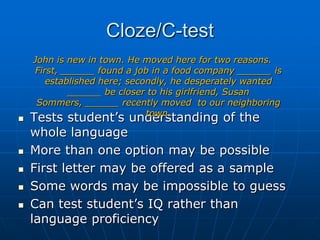
Cloze/C-testJohn is new in town. He moved here for two reasons. First, ______ found a job in a food company ______ is established here; secondly, he desperately wanted ______ be closer to his girlfriend, Susan Sommers, ______ recently moved  to our neighboring town.Tests student’s understanding of the whole language   More than one option may be possibleFirst letter may be offered as a sampleSome words may be impossible to guess Can test student’s IQ rather than language proficiency
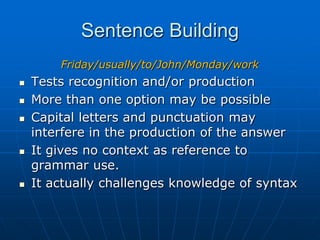
Sentence BuildingFriday/usually/to/John/Monday/workTests recognition and/or production  More than one option may be possibleCapital letters and punctuation may interfere in the production of the answerIt gives no context as reference to grammar use. It actually challenges knowledge of syntax
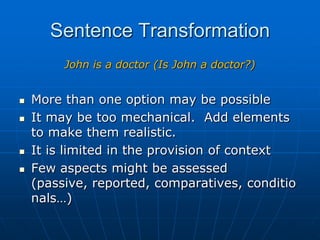
Sentence TransformationJohn is a doctor (Is John a doctor?)More than one option may be possibleIt may be too mechanical.  Add elements to make them realistic.It is limited in the provision of context Few aspects might be assessed (passive, reported, comparatives, conditionals…)
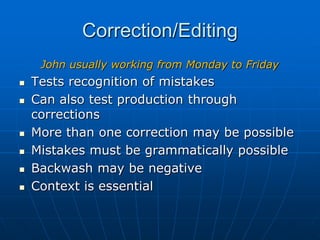
Correction/EditingJohn usually working from Monday to FridayTests recognition of mistakesCan also test production through correctionsMore than one correction may be possibleMistakes must be grammatically possible Backwash may be negative Context is essential
Five characteristics to measure communicativegrammarThe test must provide more context than only a single sentence.The test taker should understand what the communicative purpose of the task is.S/He should also know who the intended audience is.Items should promote a focus on meaning and not just form to answer correctly.Recognition is not sufficient.  The test taker must be able “to produce grammatical responses ” adequate to the communicative situation given- (R. Dickins)
Therefore…Have the test taker say or write something of discourse length in order to perform some communicative task for a known audience.What is said or written must make sense.
Sampleactivities
Split SentencesWrite out some sentences, and then cut each sentence in half. Place the two halves in two separate columns and ask students to find the matching half. Students’ abilities in combing sentencesGrammar knowledge to all forms of the sentences
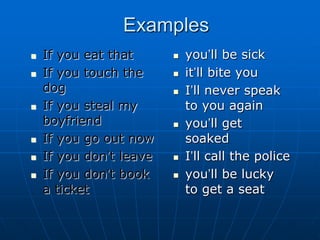
ExamplesIf you eat thatIf you touch the dogIf you steal my boyfriendIf you go out nowIf you don’t leaveIf you don’t book a ticketyou’ll be sickit’ll bite youI’ll never speak to you againyou’ll get soakedI’ll call the policeyou’ll be lucky to get a seat
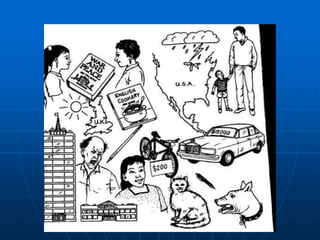
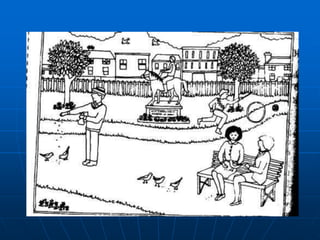
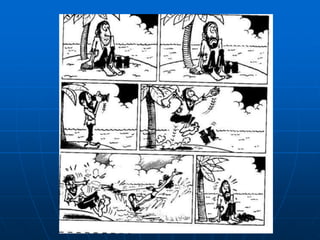
Sentences from picturesHand out a sheet of pictures.  Ask students to come out sentences from the pictures or ask them to tell a story.Enough grammar knowledge to make sentences by students. Accuracy
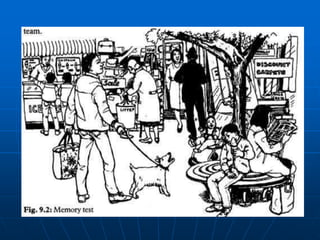
Memory TestGive limited time for students to see the picture.  Ask them to describe the picture without seeing it.    Testing students’ ability of making sentences.(enough grammar knowledge)AccuracyThe transformation of students’ sentences
Picture DictationA student try to describe the picture to other students who haven’t seen it.Testing if a student can make sentences which can help him/her communicate well.Accuracy
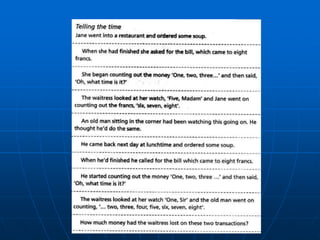
Strip StoryGive students a text from a strip story.  Ask them to find the order and resolve the problem from the story.See if students can find the time order from the tenses of the sentences.Accuracy
Miming an actionAsk students to role play in a limited situation.Through acting, it can test students’ ability of thinking of lines.  (which may contains different tenses.)Accuracy
Growing StoriesStory-building activitiesStudents’ ability of making sentences with different tenses
QuestionnairesTurn what have taught in class into a questionnaire.  Get students to survey each other.  (does not contain fully-written-out questions.)It can see if students’ totally understand what they have learned in class.  Also it can show if students’ can use it well.
Testing Grammar

Testing Grammar

  • 1.
    Testing GrammarJonathan Magdalena
  • 2.
    What are wetrying to MEASURE?“English grammar is chiefly a system of syntax that decides the order and patternsin which words are arranged into sentences.”(Close, 1982)
  • 3.
    Why should wetest grammar?Linguisticor communicative competence?Structures or functions?Usage or use?Prescriptive or descriptive?
  • 4.
    Howshould we testgrammar?Separated from skills?Discrete point or integrative items?Focus on grammar or meaning?
  • 5.
    What are themost common test formats for testing grammar?RECOGNITIONMultiple choice items (Liu, 121)Error-recognition items (Liu, 129)True/False (Baxter, 35) Pairing and matching itemsCloze/Modified Cloze (Hughes, 144)
  • 6.
    What are themost common test formats for testing grammar?ProductionCompletion items (Hughes, 143) Transformation items (Liu, 131)Paraphrase (Hughes, 143)RearrangementEditingCombination and addition itemsItems involving the changing of words
  • 7.
    When should wego for grammarrecognition?When…More material needs to be covered. You want to test different levels of learning. You have little time for scoring. You are not interested in evaluating how well a test taker can formulate a correct answer. You have a large number of test takers.
  • 8.
    When should wego for grammarproduction?When…You want to evaluate a person’s ability to formulate a correct answer. You have more time to score the itemsYou want to test a persons ability to apply concepts and information to a new situation. You have a clear idea of the aspects and concepts that should be tested.
  • 9.
    True/FalseIs this sentencestrue or false?“He works from Monday to Friday”Does not demonstrate broader knowledge Difficult to construct in higher levels  Encourages guessing due to 50/50 chance Difficult to test attitudes toward learning
  • 10.
    Multiple ChoiceJohn usually______from Monday to Fridaya. works b. worked c. has worked d. is working They can be tricky or too picky   Difficult to test attitudes towards learning Knowledge is limited to options provided Difficult to construct at higher levels Encourages guessing (25% chance) More than one option may be possibleAll options must be grammatically possible
  • 11.
    Gap-FillingJohn usually ______(work)from Monday to FridayThey must be part of a broader context   More than one option may be possibleFirst gap may be offered as a sampleDifficult to test attitudes towards learning Knowledge is limited to options provided Limitations result in negative backwashFocus should be on the aspect assessed.
  • 12.
    Cloze/C-testJohn is newin town. He moved here for two reasons. First, ______ found a job in a food company ______ is established here; secondly, he desperately wanted ______ be closer to his girlfriend, Susan Sommers, ______ recently moved to our neighboring town.Tests student’s understanding of the whole language   More than one option may be possibleFirst letter may be offered as a sampleSome words may be impossible to guess Can test student’s IQ rather than language proficiency
  • 13.
    Sentence BuildingFriday/usually/to/John/Monday/workTests recognitionand/or production  More than one option may be possibleCapital letters and punctuation may interfere in the production of the answerIt gives no context as reference to grammar use. It actually challenges knowledge of syntax
  • 14.
    Sentence TransformationJohn isa doctor (Is John a doctor?)More than one option may be possibleIt may be too mechanical. Add elements to make them realistic.It is limited in the provision of context Few aspects might be assessed (passive, reported, comparatives, conditionals…)
  • 15.
    Correction/EditingJohn usually workingfrom Monday to FridayTests recognition of mistakesCan also test production through correctionsMore than one correction may be possibleMistakes must be grammatically possible Backwash may be negative Context is essential
  • 16.
    Five characteristics tomeasure communicativegrammarThe test must provide more context than only a single sentence.The test taker should understand what the communicative purpose of the task is.S/He should also know who the intended audience is.Items should promote a focus on meaning and not just form to answer correctly.Recognition is not sufficient. The test taker must be able “to produce grammatical responses ” adequate to the communicative situation given- (R. Dickins)
  • 17.
    Therefore…Have the testtaker say or write something of discourse length in order to perform some communicative task for a known audience.What is said or written must make sense.
  • 18.
  • 19.
    Split SentencesWrite outsome sentences, and then cut each sentence in half. Place the two halves in two separate columns and ask students to find the matching half. Students’ abilities in combing sentencesGrammar knowledge to all forms of the sentences
  • 20.
    ExamplesIf you eatthatIf you touch the dogIf you steal my boyfriendIf you go out nowIf you don’t leaveIf you don’t book a ticketyou’ll be sickit’ll bite youI’ll never speak to you againyou’ll get soakedI’ll call the policeyou’ll be lucky to get a seat
  • 21.
    Sentences from picturesHandout a sheet of pictures. Ask students to come out sentences from the pictures or ask them to tell a story.Enough grammar knowledge to make sentences by students. Accuracy
  • 23.
    Memory TestGive limitedtime for students to see the picture. Ask them to describe the picture without seeing it. Testing students’ ability of making sentences.(enough grammar knowledge)AccuracyThe transformation of students’ sentences
  • 25.
    Picture DictationA studenttry to describe the picture to other students who haven’t seen it.Testing if a student can make sentences which can help him/her communicate well.Accuracy
  • 27.
    Strip StoryGive studentsa text from a strip story. Ask them to find the order and resolve the problem from the story.See if students can find the time order from the tenses of the sentences.Accuracy
  • 29.
    Miming an actionAskstudents to role play in a limited situation.Through acting, it can test students’ ability of thinking of lines. (which may contains different tenses.)Accuracy
  • 30.
    Growing StoriesStory-building activitiesStudents’ability of making sentences with different tenses
  • 32.
    QuestionnairesTurn what havetaught in class into a questionnaire. Get students to survey each other. (does not contain fully-written-out questions.)It can see if students’ totally understand what they have learned in class. Also it can show if students’ can use it well.