
Presentation by Atula Ahuja
SCHEMA THEORY AND
THE ANALYSIS OF TEXT
WORLDS IN POETRY
Elena Semino
Nature of the study
• This is a study of text-world in poetry and is
based on the schema theory, known as the
cognitive theory of background knowledge and
comprehension.
• Seen from cognitive point of view, a reader’s
perception of the text depends on how well he
or she is able to apply the existing schema to
the interpretation of the text- whether schema
is challenged or confirmed, while interpreting
the text.
OBJECTIVE
 To show how schema theory can be used to
account for the way in which text worlds are
constructed and perceived in discourse processing,
specifically in reading poetry.
• show the possibility of combining linguistic
description and schema theory in the
analysis of texts.
• To demonstrate the usefulness of the notions of
schema reinforcement and schema refreshment in
accounting for the differences between the worlds
projected by different texts.
An Alternative
• Applying schema theory to the description of
fictional worlds could prove to be a useful
alternative to the possible-world models
which have traditionally been applied.
Possible world theory
Original theory- developed by Gottfried Leibniz, states
that our actual world is the best of all the possible
worlds that existed in the mind of God.
Modern theory argues that:
* there are an infinite number of possible alternatives to
the actual world, defined as abstract sets of states of
affairs where every proposition is either true or false.
* Possible world theorists claim that their approach is
equally relevant to the study of poetry.
Fictional World theory
Fictional world theories apply possible world theories to
literature. Fiction theorists study the relationships
between textual worlds and the world outside the text.
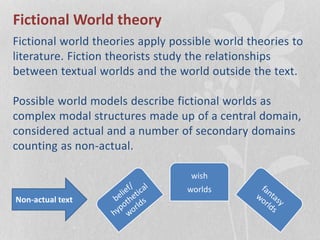
Possible world models describe fictional worlds as
complex modal structures made up of a central domain,
considered actual and a number of secondary domains
counting as non-actual.
wish
worlds
Non-actual text
Fictional world and outside world
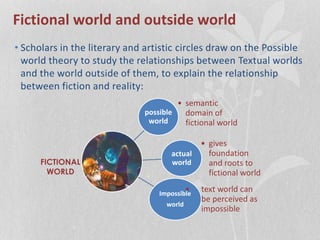
• Scholars in the literary and artistic circles draw on the Possible
world theory to study the relationships between Textual worlds
and the world outside of them, to explain the relationship
between fiction and reality:
possible
world
• semantic
domain of
fictional world
actual
world
• gives
foundation
and roots to
fictional world
Impossible
world
• text world can
be perceived as
impossible
FICTIONAL
WORLD
Why Schema theory?
 Readers may perceive a text as impossible-
challenging, puzzling or improbable because it may
go against their set of expectations and assumptions
formed on the basis of their experience of the world.
 Texts may project many different worlds, but the
possible world theories do not account for this fact.
• In such cases, schema theory can provide a useful
alternative to possible-world theories.
Schemas Theory: Piaget, Frederic Bartlet,
 Schema theory- to explain how text worlds are
constructed in the interaction between readers and
texts. It provides a useful alternative to possible-world
models.
The term ‘schema’ was introduced by Piaget in 1926 who
defined schema the basic building block of intelligent
behaviour. Schemas as “units” of knowledge.
Schemas as a basic concept: was first used by Frederic
Bartlett in 1932 as a learning theory. He suggested that our
understanding, perceptions and memory are shaped on
the basis of prior knowledge and described ‘Schema‘ as
the basic unit in the organisation of prior knowledge.
Main Tenets of Schema Theory
Schema has 2 categories: 1. that of knowledge itself
2. process of obtaining that knowledge
1. Abstract concepts are understood well only after concrete
information has been acquired. In other words
comprehension crucially depends on the availability and
activation of relevant prior knowledge.
2. This knowledge establishes the framework into which new
knowledge can be assimilated. Or, we make sense of new texts
by relating the current input to existing mental representations
of entities and situations experienced in the past.
http://www.simplypsychology.org/piaget.html
Schema theory and literature
Since the 1980s, the Schema theory has been applied to the
analysis of literary texts and literary reading.
 It provides a flexible framework within which the
interplay between readers' prior knowledge and texts in
literary comprehension can be scrutinized.
 It is claimed that literary texts tend to challenge and
modify the readers' existing schemata, which means that
literary texts can disrupt the ordinary application of
schemata and have the potential to cause schema
change.
Interpretation of literary text
Comprehension depends on the ability of the reader to be
able to construct worlds encountered in the text.
“a text is interpretable to those who can build around that
text a scenario, a text world, a state of affairs, in which that
text makes sense.” (Enkvist 1989; 1991)
This implies that the interpretability of texts, especially
literary texts depends on the readers‘ ability to imagine
meaningful worlds (created by the writer) when they
interact with the language of texts.
X syntactic well-formedness
X explicit intersentential links
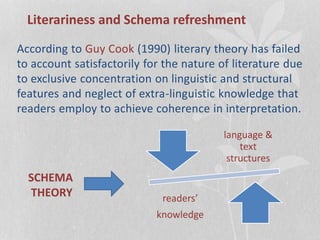
Literariness and Schema refreshment
According to Guy Cook (1990) literary theory has failed
to account satisfactorily for the nature of literature due
to exclusive concentration on linguistic and structural
features and neglect of extra-linguistic knowledge that
readers employ to achieve coherence in interpretation.
language &
text
structures
readers’
knowledge
SCHEMA
THEORY
Literariness and Schema refreshment
Literariness arises when deviations at the level of
language and text leads to schema disruption, and
result in schema refreshment. Such a change may
involve destruction of old schemata, the creation of
new ones and establishing of new connection between
existing schemata. (Cook 1990)
Schema theory and poetic text worlds
Schema theory perspective: A text world corresponds to
the configuration of schemata that are instantiated by a
reader during processing of the text.
The sum of the reader's existing schemata forms the
basis of that person's reality - or 'actual world’.
The totality of the existing schemata serves as a frame
of reference in constructing and evaluating text worlds.
A particular reader will perceive a particular text
depending on how her many schemata interact with
one another.
A Pillowed Head' by Seamus Heaney
Text worlds are constructed in the interaction between
readers and the language of texts, hence it’s important
to consider the role of linguistic choices and patterns in
the activation and modification of schemata.
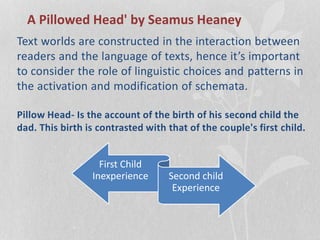
Pillow Head- Is the account of the birth of his second child the
dad. This birth is contrasted with that of the couple's first child.
First Child
Inexperience Second child
Experience
CHILDBIRTH SCHEMA- Pillowed Head
The schema is triggered by repeated references to the following elements:
the pangs (line 8), the trauma (line 10),
your cut-off white cotton gown (line13),
earth-mother (line 14),
the stirrup-rigged bed (line 15),
checked in (line 18),
the little slapped palpable girl (line 20).
The activation all the above schema together, enables
readers to make sense of the sequence of events
described in the text. This schema will be shared by
other readers who are familiar with pregnancy and
child birth.
CHILDBIRTH SCHEMA- Pillowed Head
These events don’t actually occur in the correct sequence
in the poem, but the reader is able to put them in logical
sequence due to the activation of schemata:
the onset of labour (lines 7-11), the trip to the hospital (lines 4-
5), the admission into hospital (line 18), the delivery room (lines
12-24) and the sight of the mother in her
hospital bed (lines 21-24 and title)
CHILDBIRTH schema enables readers to infer details such as the
identity of ‘I’ and ‘you’ and their relationship with the little girl.
In a nutshell, through CHILDBIRTH schema, readers easily
establish logical connections between the actions, people and
objects presented, thereby constructing a coherent text world.
Analysis- Pillowed Head
 Poem, unlikely to challenge the CHILDBIRTH schemata as
it presents a fairly conventional perspective of childbirth
and a fairly harmonious and conventional view of reality.
 The poem can be described as a 'possible' or 'potentially
actual' in possible-world terms because it presents this
conventional view and also because the text is
compatibility with the schemata that are required for its
interpretation.
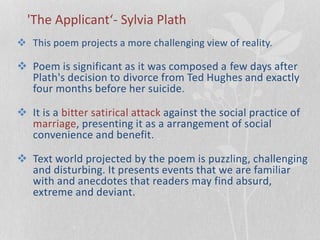
'The Applicant‘- Sylvia Plath
 This poem projects a more challenging view of reality.
 Poem is significant as it was composed a few days after
Plath's decision to divorce from Ted Hughes and exactly
four months before her suicide.
 It is a bitter satirical attack against the social practice of
marriage, presenting it as a arrangement of social
convenience and benefit.
 Text world projected by the poem is puzzling, challenging
and disturbing. It presents events that we are familiar
with and anecdotes that readers may find absurd,
extreme and deviant.
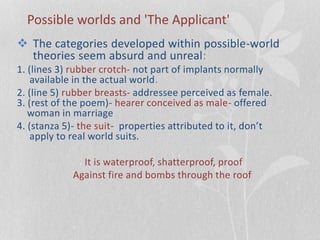
Possible worlds and 'The Applicant'
 The categories developed within possible-world
theories seem absurd and unreal:
1. (lines 3) rubber crotch- not part of implants normally
available in the actual world.
2. (line 5) rubber breasts- addressee perceived as female.
3. (rest of the poem)- hearer conceived as male- offered
woman in marriage
4. (stanza 5)- the suit- properties attributed to it, don’t
apply to real world suits.
It is waterproof, shatterproof, proof
Against fire and bombs through the roof
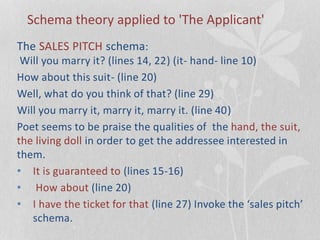
Schema theory applied to 'The Applicant'
The SALES PITCH schema:
Will you marry it? (lines 14, 22) (it- hand- line 10)
How about this suit- (line 20)
Well, what do you think of that? (line 29)
Will you marry it, marry it, marry it. (line 40)
Poet seems to be praise the qualities of the hand, the suit,
the living doll in order to get the addressee interested in
them.
• It is guaranteed to (lines 15-16)
• How about (line 20)
• I have the ticket for that (line 27) Invoke the ‘sales pitch’
schema.
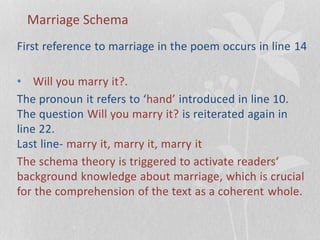
Marriage Schema
First reference to marriage in the poem occurs in line 14
• Will you marry it?.
The pronoun it refers to ‘hand’ introduced in line 10.
The question Will you marry it? is reiterated again in
line 22.
Last line- marry it, marry it, marry it
The schema theory is triggered to activate readers‘
background knowledge about marriage, which is crucial
for the comprehension of the text as a coherent whole.
Schema conflict in “The Applicant”
• In all three cases the goal of the poet is to achieve some kind of
persuasion of the other. One of the objects included in the fictional
world, namely the suit, is relevant to all three schemata: as a standard
requirement of formal interviews, a necessary component of weddings
and a possible object for sale.
• On the other hand, some features of the evoked situation, such as the
nakedness of the addressee expectations induced by all three
schemata.
Conclusion
Hence we see that a schema-based approach to textual
analysis focuses on:
 how the reader's background knowledge interacts with
the language of texts,
 how the reader is challenged or reinforced in its
interaction with the text.
 Such an analysis describe the relationship between the
worlds projected by texts and the readers' own actual
worlds.
 Linguistic features of texts and background
knowledge/schemata in comprehension, should be
compatible.
 schema theory approach to the study text worlds
provides a useful alternative to the traditional possible-
world models.
Reference
Semino, Elena (1995) Schema theory and the analysis of text
worlds in poetry. Language and Literature, 4 (2). pp. 79-108.

Schema theory in poetry

  • 1.
    Presentation by AtulaAhuja SCHEMA THEORY AND THE ANALYSIS OF TEXT WORLDS IN POETRY Elena Semino
  • 2.
    Nature of thestudy • This is a study of text-world in poetry and is based on the schema theory, known as the cognitive theory of background knowledge and comprehension. • Seen from cognitive point of view, a reader’s perception of the text depends on how well he or she is able to apply the existing schema to the interpretation of the text- whether schema is challenged or confirmed, while interpreting the text.
  • 3.
    OBJECTIVE  To showhow schema theory can be used to account for the way in which text worlds are constructed and perceived in discourse processing, specifically in reading poetry. • show the possibility of combining linguistic description and schema theory in the analysis of texts. • To demonstrate the usefulness of the notions of schema reinforcement and schema refreshment in accounting for the differences between the worlds projected by different texts.
  • 4.
    An Alternative • Applyingschema theory to the description of fictional worlds could prove to be a useful alternative to the possible-world models which have traditionally been applied.
  • 5.
    Possible world theory Originaltheory- developed by Gottfried Leibniz, states that our actual world is the best of all the possible worlds that existed in the mind of God. Modern theory argues that: * there are an infinite number of possible alternatives to the actual world, defined as abstract sets of states of affairs where every proposition is either true or false. * Possible world theorists claim that their approach is equally relevant to the study of poetry.
  • 6.
    Fictional World theory Fictionalworld theories apply possible world theories to literature. Fiction theorists study the relationships between textual worlds and the world outside the text. Possible world models describe fictional worlds as complex modal structures made up of a central domain, considered actual and a number of secondary domains counting as non-actual. wish worlds Non-actual text
  • 7.
    Fictional world andoutside world • Scholars in the literary and artistic circles draw on the Possible world theory to study the relationships between Textual worlds and the world outside of them, to explain the relationship between fiction and reality: possible world • semantic domain of fictional world actual world • gives foundation and roots to fictional world Impossible world • text world can be perceived as impossible FICTIONAL WORLD
  • 8.
    Why Schema theory? Readers may perceive a text as impossible- challenging, puzzling or improbable because it may go against their set of expectations and assumptions formed on the basis of their experience of the world.  Texts may project many different worlds, but the possible world theories do not account for this fact. • In such cases, schema theory can provide a useful alternative to possible-world theories.
  • 9.
    Schemas Theory: Piaget,Frederic Bartlet,  Schema theory- to explain how text worlds are constructed in the interaction between readers and texts. It provides a useful alternative to possible-world models. The term ‘schema’ was introduced by Piaget in 1926 who defined schema the basic building block of intelligent behaviour. Schemas as “units” of knowledge. Schemas as a basic concept: was first used by Frederic Bartlett in 1932 as a learning theory. He suggested that our understanding, perceptions and memory are shaped on the basis of prior knowledge and described ‘Schema‘ as the basic unit in the organisation of prior knowledge.
  • 10.
    Main Tenets ofSchema Theory Schema has 2 categories: 1. that of knowledge itself 2. process of obtaining that knowledge 1. Abstract concepts are understood well only after concrete information has been acquired. In other words comprehension crucially depends on the availability and activation of relevant prior knowledge. 2. This knowledge establishes the framework into which new knowledge can be assimilated. Or, we make sense of new texts by relating the current input to existing mental representations of entities and situations experienced in the past. http://www.simplypsychology.org/piaget.html
  • 11.
    Schema theory andliterature Since the 1980s, the Schema theory has been applied to the analysis of literary texts and literary reading.  It provides a flexible framework within which the interplay between readers' prior knowledge and texts in literary comprehension can be scrutinized.  It is claimed that literary texts tend to challenge and modify the readers' existing schemata, which means that literary texts can disrupt the ordinary application of schemata and have the potential to cause schema change.
  • 12.
    Interpretation of literarytext Comprehension depends on the ability of the reader to be able to construct worlds encountered in the text. “a text is interpretable to those who can build around that text a scenario, a text world, a state of affairs, in which that text makes sense.” (Enkvist 1989; 1991) This implies that the interpretability of texts, especially literary texts depends on the readers‘ ability to imagine meaningful worlds (created by the writer) when they interact with the language of texts. X syntactic well-formedness X explicit intersentential links
  • 13.
    Literariness and Schemarefreshment According to Guy Cook (1990) literary theory has failed to account satisfactorily for the nature of literature due to exclusive concentration on linguistic and structural features and neglect of extra-linguistic knowledge that readers employ to achieve coherence in interpretation. language & text structures readers’ knowledge SCHEMA THEORY
  • 14.
    Literariness and Schemarefreshment Literariness arises when deviations at the level of language and text leads to schema disruption, and result in schema refreshment. Such a change may involve destruction of old schemata, the creation of new ones and establishing of new connection between existing schemata. (Cook 1990)
  • 15.
    Schema theory andpoetic text worlds Schema theory perspective: A text world corresponds to the configuration of schemata that are instantiated by a reader during processing of the text. The sum of the reader's existing schemata forms the basis of that person's reality - or 'actual world’. The totality of the existing schemata serves as a frame of reference in constructing and evaluating text worlds. A particular reader will perceive a particular text depending on how her many schemata interact with one another.
  • 16.
    A Pillowed Head'by Seamus Heaney Text worlds are constructed in the interaction between readers and the language of texts, hence it’s important to consider the role of linguistic choices and patterns in the activation and modification of schemata. Pillow Head- Is the account of the birth of his second child the dad. This birth is contrasted with that of the couple's first child. First Child Inexperience Second child Experience
  • 17.
    CHILDBIRTH SCHEMA- PillowedHead The schema is triggered by repeated references to the following elements: the pangs (line 8), the trauma (line 10), your cut-off white cotton gown (line13), earth-mother (line 14), the stirrup-rigged bed (line 15), checked in (line 18), the little slapped palpable girl (line 20). The activation all the above schema together, enables readers to make sense of the sequence of events described in the text. This schema will be shared by other readers who are familiar with pregnancy and child birth.
  • 18.
    CHILDBIRTH SCHEMA- PillowedHead These events don’t actually occur in the correct sequence in the poem, but the reader is able to put them in logical sequence due to the activation of schemata: the onset of labour (lines 7-11), the trip to the hospital (lines 4- 5), the admission into hospital (line 18), the delivery room (lines 12-24) and the sight of the mother in her hospital bed (lines 21-24 and title) CHILDBIRTH schema enables readers to infer details such as the identity of ‘I’ and ‘you’ and their relationship with the little girl. In a nutshell, through CHILDBIRTH schema, readers easily establish logical connections between the actions, people and objects presented, thereby constructing a coherent text world.
  • 19.
    Analysis- Pillowed Head Poem, unlikely to challenge the CHILDBIRTH schemata as it presents a fairly conventional perspective of childbirth and a fairly harmonious and conventional view of reality.  The poem can be described as a 'possible' or 'potentially actual' in possible-world terms because it presents this conventional view and also because the text is compatibility with the schemata that are required for its interpretation.
  • 20.
    'The Applicant‘- SylviaPlath  This poem projects a more challenging view of reality.  Poem is significant as it was composed a few days after Plath's decision to divorce from Ted Hughes and exactly four months before her suicide.  It is a bitter satirical attack against the social practice of marriage, presenting it as a arrangement of social convenience and benefit.  Text world projected by the poem is puzzling, challenging and disturbing. It presents events that we are familiar with and anecdotes that readers may find absurd, extreme and deviant.
  • 21.
    Possible worlds and'The Applicant'  The categories developed within possible-world theories seem absurd and unreal: 1. (lines 3) rubber crotch- not part of implants normally available in the actual world. 2. (line 5) rubber breasts- addressee perceived as female. 3. (rest of the poem)- hearer conceived as male- offered woman in marriage 4. (stanza 5)- the suit- properties attributed to it, don’t apply to real world suits. It is waterproof, shatterproof, proof Against fire and bombs through the roof
  • 22.
    Schema theory appliedto 'The Applicant' The SALES PITCH schema: Will you marry it? (lines 14, 22) (it- hand- line 10) How about this suit- (line 20) Well, what do you think of that? (line 29) Will you marry it, marry it, marry it. (line 40) Poet seems to be praise the qualities of the hand, the suit, the living doll in order to get the addressee interested in them. • It is guaranteed to (lines 15-16) • How about (line 20) • I have the ticket for that (line 27) Invoke the ‘sales pitch’ schema.
  • 23.
    Marriage Schema First referenceto marriage in the poem occurs in line 14 • Will you marry it?. The pronoun it refers to ‘hand’ introduced in line 10. The question Will you marry it? is reiterated again in line 22. Last line- marry it, marry it, marry it The schema theory is triggered to activate readers‘ background knowledge about marriage, which is crucial for the comprehension of the text as a coherent whole.
  • 24.
    Schema conflict in“The Applicant” • In all three cases the goal of the poet is to achieve some kind of persuasion of the other. One of the objects included in the fictional world, namely the suit, is relevant to all three schemata: as a standard requirement of formal interviews, a necessary component of weddings and a possible object for sale. • On the other hand, some features of the evoked situation, such as the nakedness of the addressee expectations induced by all three schemata.
  • 25.
    Conclusion Hence we seethat a schema-based approach to textual analysis focuses on:  how the reader's background knowledge interacts with the language of texts,  how the reader is challenged or reinforced in its interaction with the text.  Such an analysis describe the relationship between the worlds projected by texts and the readers' own actual worlds.  Linguistic features of texts and background knowledge/schemata in comprehension, should be compatible.  schema theory approach to the study text worlds provides a useful alternative to the traditional possible- world models.
  • 27.
    Reference Semino, Elena (1995)Schema theory and the analysis of text worlds in poetry. Language and Literature, 4 (2). pp. 79-108.

Editor's Notes

  • #3 text worlds result from the application of some parts of the reader’s schema to the interpretation of the text.
  • #4 Which includes
  • #5 text worlds result from the application of some parts of the reader’s schema to the interpretation of the text.
  • #6 Modern logicians discount Leibniz's view as too potimistic- that the actual world is the best of all the possible worlds.
  • #8 treatment of impossible within a possible-world framework was done by David Lewis. There can be such thing as impossible fiction
  • #10 http://www.simplypsychology.org/piaget.html But the use of schemas as a basic concept was first used by a British psychologist named Frederic Bartlett as part of his learning.
  • #11 Frederic Bartlett
  • #12 Frederic Bartlett Schemas are organized meaningfully. change with new knowledge. reorganize and restructure themselves if concept changes.
  • #13 Interpretability does NOT depend
  • #14 Schema theory can provide a framework to account for the interaction between language and structure of texts on the one hand, and the readers' knowledge on the other
  • #15 Literariness arises when deviations at the level of language and text pose a challenge to reader’s schema and leads to schema disruption, and result in schema change (schema refreshment) Cook's analyses aim to show how advertisements tend to rely on and confirm stereotypical assumptions about people and the world and so cannot be called literary. literary texts typically evoke conflicting and open-ended schemata, and establish complex and novel relationships between them
  • #17 Let us see how a schema theory approach can be systematically related to a linguistic analysis of the texts. Let’s begin with the poem Pillow Head
  • #18 Main schema of childbirth
  • #19 Main schema of childbirth
  • #20 Main schema of childbirth
  • #21 Challenges our schemata- it does not fit into our schema- leads to schema disruption, and result in schema change (schema refreshment)
  • #22 Crotch – fork of the legs Suits can be waterproof and, to some extent, fireproof (although not normally), but they cannot be shatterproof, nor bombproof.
  • #23 is typical of the language used by sellers to convince potential customers of the product's excellence and of their own reliability.
  • #24 is typical of the language used by sellers to convince potential customers of the product's excellence and of their own reliability.
  • #28 Ans 1. In advertising discourse, he argues, linguistic experimentation does not usually correspond to deviation at the level of the background knowledge that is likely to be shared by the audience. Advertisements tend to rely on and confirm stereotypical assumptions about people and the world- they simply confirm existing schemata. Any new information provided fits into the existing schemata. 2. When text presents a view of reality that goes against the reader's existing assumptions, or the assumptions shared by a particular cultural group. If a text reinforces the reader's schemata, the world it projects will be perceived as conventional, familiar, realistic and so on. 3. Interpretation of text is the result of interplay between the text and reader’s background knowledge and his/her ability to imagine a scenario in which the text makes sense. “Like a serpent to the calling voice of flutes, Glides my heart into thy fingers, O’ my love.” Indian Love Song