12-Nov-19 1
12-Nov-19 2
Submitted by, Submitted to,
Group: 2
Roll: 151002, 151009, 151018,
151025, 151034, 141021
4th year, 2nd semester
Dept. Of Pharmacy
Jashore University of Science &
Technology
Md. Shahin Sarker
Lecturer
Dept. Of Pharmacy
Jashore University of Science &
Technology
12-Nov-19 3
outline
Introduction
History
Function of MHRA
Licensing
Process of Licensing
The MHRA licenses / authorizes
Renewal of license
Cancellation of license
12-Nov-19 4
Introduction
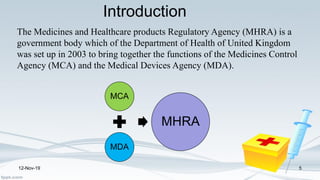
The Medicines and Healthcare products Regulatory Agency (MHRA) is a
government body which of the Department of Health of United Kingdom
was set up in 2003 to bring together the functions of the Medicines Control
Agency (MCA) and the Medical Devices Agency (MDA).
MCA
MDA
MHRA
12-Nov-19 5
History
In 1999, the Medicines Control
Agency (MCA) took over control of
the General Practice Research
Database (GPRD) from Office for
National Statistics.
Medicines Control Agency (MCA)
and the Medical Devices Agency
(MDA) merged in 2003 to form
MHRA.
12-Nov-19 6
In April 2012, the GPRD was expanded and re-launched as the Clinical
Practice Research Data-link (CPRD).
In April 2013, MHRA merged with the National Institute for Biological
Standards and Control (NIBSC) and was rebranded, with MHRA identity
being used for the parent organization and one of the centres within the
group. At the same time CPRD was formally declared a separate centre
of MHRA, too.
12-Nov-19 7
clinical trials
Preformulation
and laboratory
tests
Drug
discovery
Mechanism
of action
The MHRA has no
interest in these
early stages of
drug development.
MHRA comes in
play when the
company wants to
start clinical trials
in patients.
Function of MHRA
12-Nov-19 8
MHRA functions
 Regulation of clinical trials
 Safety and efficacy monitoring
 Providing information to public and health professionals
 Licensing
 Manufacturer and dealer licenses
 Clinical trial licenses
 Parallel import licenses
 Enforcement of law
12-Nov-19 9
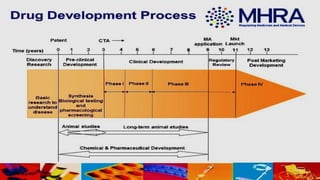
Development new drugs
1. Discovery
 A fundamental first step to discovering new drugs is knowledge of the biology of a disease. This involves
understanding how cell and biological processes work in health as well as what goes wrong in disease. This will
reveal potential targets that a drug could act on.
 Studies in cells and animals are crucial first steps and should not be undervalued. However, many drugs that show
promising results in cells in laboratories don't work in animals, and many drugs that show promising results in
animals don't work in humans.
 Many thousands of new chemical compounds are created and tested to identify those that have potential. There is a
very high drop out rate at this stage; fewer than 1 in 1,000 of all the compounds that are made ever progress to
testing in humans.
2. Phase I
 The first step in testing a new drug is to determine the safety of single doses
in a small number of healthy volunteers.
12-Nov-19 10
3. Phase II
If the treatment proves to be safe, studies begin to determine the effectiveness of the drug in people with the condition
to be treated. The study may be:
 controlled - the drug is compared with the standard treatment or placebo (dummy treatment)
 double-blind - neither the investigators nor the participants know which treatment they are receiving
 randomized - participants will be randomly allocated to receive active treatment or placebo.
4. Phase III
 If a drug shows effectiveness, a larger study is conducted in hundreds of people.
 Phase III studies in relapsing remitting MS generally run for two years and compare
the number of relapses in people taking the new drug with those taking the standard
treatment or placebo.
12-Nov-19 11
5. Licensing
Data from all of these three phases is presented to the regulatory authorities (in the UK this is the MHRA - Medicines
and Healthcare products Regulatory Agency or the EMA - European Medicines Agency). If the authorities are
satisfied that the new medicine is effective, safe and meets manufacturing quality standards, a marketing authorization
or license is issued.
6. NHS appraisal
 Once a new medicine has been licensed, there may still be one final hurdle. Set up to help eliminate postcode
lottery prescribing, NICE (National Institute for Health and Care Excellence) for England and Wales
and SMC (Scottish Medicines Consortium) for Scotland appraise certain new medicines and will look at issues
such as cost effectiveness of the new treatments.
 The NHS is legally obliged to fund medicines recommended by NICE or SMC. The reverse also holds true – if
NICE or SMC do not approve a new medicine, then local health authorities are not required to
provide funding for it.
Post-marketing surveillance and Yellow Card Scheme
 Once the newly-licensed medicine is in general use, it will be carefully monitored
for safety. All medicines have a patient information leaflet (PIL), which gives
instructions on how the medicine should be used, and on its side effects.
12-Nov-19 12
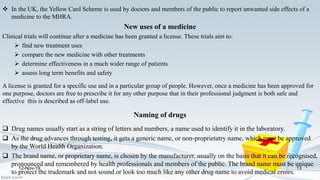
 In the UK, the Yellow Card Scheme is used by doctors and members of the public to report unwanted side effects of a
medicine to the MHRA.
New uses of a medicine
Clinical trials will continue after a medicine has been granted a license. These trials aim to:
 find new treatment uses
 compare the new medicine with other treatments
 determine effectiveness in a much wider range of patients
 assess long term benefits and safety
A license is granted for a specific use and in a particular group of people. However, once a medicine has been approved for
one purpose, doctors are free to prescribe it for any other purpose that in their professional judgment is both safe and
effective this is described as off-label use.
Naming of drugs
 Drug names usually start as a string of letters and numbers, a name used to identify it in the laboratory.
 As the drug advances through testing, it gets a generic name, or non-proprietatry name, which must be approved
by the World Health Organization.
 The brand name, or proprietary name, is chosen by the manufacturer, usually on the basis that it can be recognised,
pronounced and remembered by health professionals and members of the public. The brand name must be unique
to protect the trademark and not sound or look too much like any other drug name to avoid medical errors.
12-Nov-19 13
12-Nov-19 14
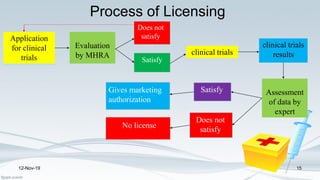
Process of Licensing
Application
for clinical
trials
Evaluation
by MHRA
Does not
satisfy
Satisfy
clinical trials
clinical trials
results
Assessment
of data by
expert
Satisfy
Does not
satisfy
Gives marketing
authorization
No license
12-Nov-19 15
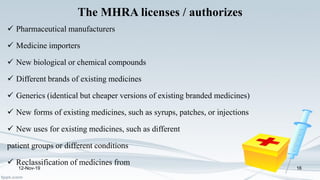
The MHRA licenses / authorizes
 Pharmaceutical manufacturers
 Medicine importers
 New biological or chemical compounds
 Different brands of existing medicines
 Generics (identical but cheaper versions of existing branded medicines)
 New forms of existing medicines, such as syrups, patches, or injections
 New uses for existing medicines, such as different
patient groups or different conditions
 Reclassification of medicines from
12-Nov-19 16
 prescription only to over the counter use, such as the cholesterol lowering
medicine Simvastatin (Zocor Heart-Pro)
 Traditional herbal medicines sold over the counter that meet required
safety and quality standards
 Designated authorities (Notified Bodies) that approve the quality marking
system (CE marking) for medical devices /equipment
 Clinical trials of both medicines and devices, from toothpaste to gene
therapy
 Blood banks that meet required safety and quality standards
 Applications on humanitarian grounds to use certain medical devices in
the UK not carrying a CE marking
12-Nov-19 17
Renewal of license
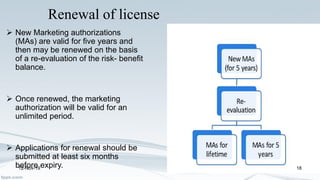
 New Marketing authorizations
(MAs) are valid for five years and
then may be renewed on the basis
of a re-evaluation of the risk- benefit
balance.
 Once renewed, the marketing
authorization will be valid for an
unlimited period.
 Applications for renewal should be
submitted at least six months
before expiry.12-Nov-19 18
Cancellation of license
 If MAs holder does not file an application for renewal within specified time, MAs expires
automatically.
 If the MAs holder does not wish to renew the license, a letter should be sent indicating the
cancellation to:
Administrative Support Team
Medicines and Healthcare products Regulatory Agency (MHRA).
 MHRA has authority to cancel license of product if it affects public health.
12-Nov-19 19
Export drugs and medicines
12-Nov-19 20
Permission must need to export certain drugs and medicines.
These are:
 Controlled drugs
 Drugs that can be used for lethal injections
 Medicines
 Export certificates for medicines for animals
12-Nov-19 21
Controlled drugs
 Check the list of common controlled drugs.
 If your drug is controlled, need a Home Office controlled drug license to export it. This is in addition to any
domestic license you need to possess the drug in the UK.
 If drug is not on the list but you think it might have the properties of a controlled drug, check the relevant
legislation to find out if it’s controlled. The list of common controlled drugs has links to the relevant legislation.
Apply for an export license
 Need a Home Office controlled drug license to export controlled drugs anywhere in the world.
To apply:
 register for a Home Office controlled drugs license
 log in once has registered
 License will be valid for up to 2 months (or until your import permit expires, if sooner).
Fees: The export license costs £24.
12-Nov-19 22
Drugs that can be used for lethal injections
Medicines
 Export certificates for medicines for humans
There are 5 types of certificate. Which one you need will depend on the requirements of the importing country. Talk
to the importer who’s receiving your goods to find out.
1. Certificate of a pharmaceutical product (licensed)
2. Certificate of a pharmaceutical product (unlicensed)
3. Certificate of manufacturing status
4. Certificate of licensing status
5. Certificate for the importation of a pharmaceutical constituent
 If your application is successful, you’ll get the original version of your certificate and 2 copies.
 You can get extra copies of certificates for £34 each.
 Export certificates for medicines for animals
There are 5 types of certificate. These are:
a) Defra-1
b) Defra-2
c) Defra-3
d) Defra-4
e) Defra-SFA
 Anyone should get certificate or be told why it hasn’t been issued within 10 days.
 The fee is £30 (plus £15 for each certified copy, if anyone need these).
12-Nov-19 23
Import a human medicine
12-Nov-19 24
 Import a licensed medicine
 Import an unlicensed medicine
 Make an urgent import notification
Import a licensed medicine
 Wholesale
 Manufacturer
 Marketing authorization (MA)
Import an unlicensed medicine
 Import an introduced product
 Import a special product
12-Nov-19 25
Make an urgent import notification
 In cases of clinical emergency (usually the treatment of life-threatening illness or where significant injury is
likely) MHRA is able to process an import notification within one working day.
 Commercial or other non-clinical reasons aren’t acceptable reasons for urgency.
Fees
Fees are charged annually using a banding system based on the number of notifications anyone submit. Customers
are provided with an estimate early in the financial year, followed by an invoice once all the information for the year
is available.
A doctor may make the request to a licensed importer, or to a pharmacist who then places the order with the
importer. If a doctor or pharmacist holds their own wholesaler or specials license, they can make the order
themselves.
Fees for safety and quality vetting of unlicensed imported medicines
Combination medicines and products, which have two different medicines within
one pack, are considered a single notification. Separate packs of different products
would require separate notifications.
References
1. http://www.mhra.gov.uk
2. https://www.slideshare.net/HimalBarakoti/regulatory-requirement-of-eu-mhra-and-tga
3. https://www.slideshare.net/HariKadkol/mhra-81701291?from_action=save
4. https://en.wikipedia.org/wiki/Medicines_and_Healthcare_products_Regulatory_Agency
5. https://www.gov.uk/government/organisations/medicines-and- healthcare-products-regulatory-agency
6. https://europa.eu/european-union/index_en
7. https://www.google.com/search?q=licensing+process+in+uk+mHRA&sxsrf=ACYBGNR7wpBmS5eCMJJAP1gXrgoLpCKC
Eg:1573529966658&source=lnms&tbm=isch&sa=X&ved=0ahUKEwid2NL13-
PlAhW0V3wKHWi_D9UQ_AUIESgB&biw=1366&bih=664#imgrc=nCuvWk_3k9DuVM:
8. https://www.gov.uk/guidance/export-drugs-and-medicines-special-
rules?fbclid=IwAR2l1zQprVEIugLO6fneazUA9C5CJMHYkuzPDry6W28HbuRbGNY6X9fjpbY
9. https://www.gov.uk/guidance/import-a-human-
medicine?fbclid=IwAR3oAGxPv_Yi_AKOvlneZgr2er0QBX4_C6mhN0g0Qx2V4R-npeQirOiJzIw
10. https://www.mstrust.org.uk/a-z/drug-development-process
11. https://www.google.com/search?q=drug+development+process+in+UK+MHR
A&client=firefox-b-d&source=lnms&tbm=isch&sa=X&ved=0ahUKEwiOpNLc-
eTlAhUJ7HMBHYoDCyoQ_AUIESgB&biw=1366&bih=664#imgrc=F1hzEn7vI9g4fM:
12-Nov-19 26
12-Nov-19 27
12-Nov-19 28

MHRA

  • 1.
  • 2.
  • 3.
    Submitted by, Submittedto, Group: 2 Roll: 151002, 151009, 151018, 151025, 151034, 141021 4th year, 2nd semester Dept. Of Pharmacy Jashore University of Science & Technology Md. Shahin Sarker Lecturer Dept. Of Pharmacy Jashore University of Science & Technology 12-Nov-19 3
  • 4.
    outline Introduction History Function of MHRA Licensing Processof Licensing The MHRA licenses / authorizes Renewal of license Cancellation of license 12-Nov-19 4
  • 5.
    Introduction The Medicines andHealthcare products Regulatory Agency (MHRA) is a government body which of the Department of Health of United Kingdom was set up in 2003 to bring together the functions of the Medicines Control Agency (MCA) and the Medical Devices Agency (MDA). MCA MDA MHRA 12-Nov-19 5
  • 6.
    History In 1999, theMedicines Control Agency (MCA) took over control of the General Practice Research Database (GPRD) from Office for National Statistics. Medicines Control Agency (MCA) and the Medical Devices Agency (MDA) merged in 2003 to form MHRA. 12-Nov-19 6
  • 7.
    In April 2012,the GPRD was expanded and re-launched as the Clinical Practice Research Data-link (CPRD). In April 2013, MHRA merged with the National Institute for Biological Standards and Control (NIBSC) and was rebranded, with MHRA identity being used for the parent organization and one of the centres within the group. At the same time CPRD was formally declared a separate centre of MHRA, too. 12-Nov-19 7
  • 8.
    clinical trials Preformulation and laboratory tests Drug discovery Mechanism ofaction The MHRA has no interest in these early stages of drug development. MHRA comes in play when the company wants to start clinical trials in patients. Function of MHRA 12-Nov-19 8
  • 9.
    MHRA functions  Regulationof clinical trials  Safety and efficacy monitoring  Providing information to public and health professionals  Licensing  Manufacturer and dealer licenses  Clinical trial licenses  Parallel import licenses  Enforcement of law 12-Nov-19 9
  • 10.
    Development new drugs 1.Discovery  A fundamental first step to discovering new drugs is knowledge of the biology of a disease. This involves understanding how cell and biological processes work in health as well as what goes wrong in disease. This will reveal potential targets that a drug could act on.  Studies in cells and animals are crucial first steps and should not be undervalued. However, many drugs that show promising results in cells in laboratories don't work in animals, and many drugs that show promising results in animals don't work in humans.  Many thousands of new chemical compounds are created and tested to identify those that have potential. There is a very high drop out rate at this stage; fewer than 1 in 1,000 of all the compounds that are made ever progress to testing in humans. 2. Phase I  The first step in testing a new drug is to determine the safety of single doses in a small number of healthy volunteers. 12-Nov-19 10
  • 11.
    3. Phase II Ifthe treatment proves to be safe, studies begin to determine the effectiveness of the drug in people with the condition to be treated. The study may be:  controlled - the drug is compared with the standard treatment or placebo (dummy treatment)  double-blind - neither the investigators nor the participants know which treatment they are receiving  randomized - participants will be randomly allocated to receive active treatment or placebo. 4. Phase III  If a drug shows effectiveness, a larger study is conducted in hundreds of people.  Phase III studies in relapsing remitting MS generally run for two years and compare the number of relapses in people taking the new drug with those taking the standard treatment or placebo. 12-Nov-19 11
  • 12.
    5. Licensing Data fromall of these three phases is presented to the regulatory authorities (in the UK this is the MHRA - Medicines and Healthcare products Regulatory Agency or the EMA - European Medicines Agency). If the authorities are satisfied that the new medicine is effective, safe and meets manufacturing quality standards, a marketing authorization or license is issued. 6. NHS appraisal  Once a new medicine has been licensed, there may still be one final hurdle. Set up to help eliminate postcode lottery prescribing, NICE (National Institute for Health and Care Excellence) for England and Wales and SMC (Scottish Medicines Consortium) for Scotland appraise certain new medicines and will look at issues such as cost effectiveness of the new treatments.  The NHS is legally obliged to fund medicines recommended by NICE or SMC. The reverse also holds true – if NICE or SMC do not approve a new medicine, then local health authorities are not required to provide funding for it. Post-marketing surveillance and Yellow Card Scheme  Once the newly-licensed medicine is in general use, it will be carefully monitored for safety. All medicines have a patient information leaflet (PIL), which gives instructions on how the medicine should be used, and on its side effects. 12-Nov-19 12
  • 13.
     In theUK, the Yellow Card Scheme is used by doctors and members of the public to report unwanted side effects of a medicine to the MHRA. New uses of a medicine Clinical trials will continue after a medicine has been granted a license. These trials aim to:  find new treatment uses  compare the new medicine with other treatments  determine effectiveness in a much wider range of patients  assess long term benefits and safety A license is granted for a specific use and in a particular group of people. However, once a medicine has been approved for one purpose, doctors are free to prescribe it for any other purpose that in their professional judgment is both safe and effective this is described as off-label use. Naming of drugs  Drug names usually start as a string of letters and numbers, a name used to identify it in the laboratory.  As the drug advances through testing, it gets a generic name, or non-proprietatry name, which must be approved by the World Health Organization.  The brand name, or proprietary name, is chosen by the manufacturer, usually on the basis that it can be recognised, pronounced and remembered by health professionals and members of the public. The brand name must be unique to protect the trademark and not sound or look too much like any other drug name to avoid medical errors. 12-Nov-19 13
  • 14.
  • 15.
    Process of Licensing Application forclinical trials Evaluation by MHRA Does not satisfy Satisfy clinical trials clinical trials results Assessment of data by expert Satisfy Does not satisfy Gives marketing authorization No license 12-Nov-19 15
  • 16.
    The MHRA licenses/ authorizes  Pharmaceutical manufacturers  Medicine importers  New biological or chemical compounds  Different brands of existing medicines  Generics (identical but cheaper versions of existing branded medicines)  New forms of existing medicines, such as syrups, patches, or injections  New uses for existing medicines, such as different patient groups or different conditions  Reclassification of medicines from 12-Nov-19 16
  • 17.
     prescription onlyto over the counter use, such as the cholesterol lowering medicine Simvastatin (Zocor Heart-Pro)  Traditional herbal medicines sold over the counter that meet required safety and quality standards  Designated authorities (Notified Bodies) that approve the quality marking system (CE marking) for medical devices /equipment  Clinical trials of both medicines and devices, from toothpaste to gene therapy  Blood banks that meet required safety and quality standards  Applications on humanitarian grounds to use certain medical devices in the UK not carrying a CE marking 12-Nov-19 17
  • 18.
    Renewal of license New Marketing authorizations (MAs) are valid for five years and then may be renewed on the basis of a re-evaluation of the risk- benefit balance.  Once renewed, the marketing authorization will be valid for an unlimited period.  Applications for renewal should be submitted at least six months before expiry.12-Nov-19 18
  • 19.
    Cancellation of license If MAs holder does not file an application for renewal within specified time, MAs expires automatically.  If the MAs holder does not wish to renew the license, a letter should be sent indicating the cancellation to: Administrative Support Team Medicines and Healthcare products Regulatory Agency (MHRA).  MHRA has authority to cancel license of product if it affects public health. 12-Nov-19 19
  • 20.
    Export drugs andmedicines 12-Nov-19 20 Permission must need to export certain drugs and medicines. These are:  Controlled drugs  Drugs that can be used for lethal injections  Medicines  Export certificates for medicines for animals
  • 21.
    12-Nov-19 21 Controlled drugs Check the list of common controlled drugs.  If your drug is controlled, need a Home Office controlled drug license to export it. This is in addition to any domestic license you need to possess the drug in the UK.  If drug is not on the list but you think it might have the properties of a controlled drug, check the relevant legislation to find out if it’s controlled. The list of common controlled drugs has links to the relevant legislation. Apply for an export license  Need a Home Office controlled drug license to export controlled drugs anywhere in the world. To apply:  register for a Home Office controlled drugs license  log in once has registered  License will be valid for up to 2 months (or until your import permit expires, if sooner). Fees: The export license costs £24.
  • 22.
    12-Nov-19 22 Drugs thatcan be used for lethal injections Medicines  Export certificates for medicines for humans There are 5 types of certificate. Which one you need will depend on the requirements of the importing country. Talk to the importer who’s receiving your goods to find out. 1. Certificate of a pharmaceutical product (licensed) 2. Certificate of a pharmaceutical product (unlicensed) 3. Certificate of manufacturing status 4. Certificate of licensing status 5. Certificate for the importation of a pharmaceutical constituent
  • 23.
     If yourapplication is successful, you’ll get the original version of your certificate and 2 copies.  You can get extra copies of certificates for £34 each.  Export certificates for medicines for animals There are 5 types of certificate. These are: a) Defra-1 b) Defra-2 c) Defra-3 d) Defra-4 e) Defra-SFA  Anyone should get certificate or be told why it hasn’t been issued within 10 days.  The fee is £30 (plus £15 for each certified copy, if anyone need these). 12-Nov-19 23
  • 24.
    Import a humanmedicine 12-Nov-19 24  Import a licensed medicine  Import an unlicensed medicine  Make an urgent import notification Import a licensed medicine  Wholesale  Manufacturer  Marketing authorization (MA) Import an unlicensed medicine  Import an introduced product  Import a special product
  • 25.
    12-Nov-19 25 Make anurgent import notification  In cases of clinical emergency (usually the treatment of life-threatening illness or where significant injury is likely) MHRA is able to process an import notification within one working day.  Commercial or other non-clinical reasons aren’t acceptable reasons for urgency. Fees Fees are charged annually using a banding system based on the number of notifications anyone submit. Customers are provided with an estimate early in the financial year, followed by an invoice once all the information for the year is available. A doctor may make the request to a licensed importer, or to a pharmacist who then places the order with the importer. If a doctor or pharmacist holds their own wholesaler or specials license, they can make the order themselves. Fees for safety and quality vetting of unlicensed imported medicines Combination medicines and products, which have two different medicines within one pack, are considered a single notification. Separate packs of different products would require separate notifications.
  • 26.
    References 1. http://www.mhra.gov.uk 2. https://www.slideshare.net/HimalBarakoti/regulatory-requirement-of-eu-mhra-and-tga 3.https://www.slideshare.net/HariKadkol/mhra-81701291?from_action=save 4. https://en.wikipedia.org/wiki/Medicines_and_Healthcare_products_Regulatory_Agency 5. https://www.gov.uk/government/organisations/medicines-and- healthcare-products-regulatory-agency 6. https://europa.eu/european-union/index_en 7. https://www.google.com/search?q=licensing+process+in+uk+mHRA&sxsrf=ACYBGNR7wpBmS5eCMJJAP1gXrgoLpCKC Eg:1573529966658&source=lnms&tbm=isch&sa=X&ved=0ahUKEwid2NL13- PlAhW0V3wKHWi_D9UQ_AUIESgB&biw=1366&bih=664#imgrc=nCuvWk_3k9DuVM: 8. https://www.gov.uk/guidance/export-drugs-and-medicines-special- rules?fbclid=IwAR2l1zQprVEIugLO6fneazUA9C5CJMHYkuzPDry6W28HbuRbGNY6X9fjpbY 9. https://www.gov.uk/guidance/import-a-human- medicine?fbclid=IwAR3oAGxPv_Yi_AKOvlneZgr2er0QBX4_C6mhN0g0Qx2V4R-npeQirOiJzIw 10. https://www.mstrust.org.uk/a-z/drug-development-process 11. https://www.google.com/search?q=drug+development+process+in+UK+MHR A&client=firefox-b-d&source=lnms&tbm=isch&sa=X&ved=0ahUKEwiOpNLc- eTlAhUJ7HMBHYoDCyoQ_AUIESgB&biw=1366&bih=664#imgrc=F1hzEn7vI9g4fM: 12-Nov-19 26
  • 27.
  • 28.