Metro and
Mega cities
problem and
issues
MASTER IN PLANNING
UNIT 3, LECTURE 1,2,3,4
PROF. DR. NEHA BANSAL
A metro city or metropolitan area is a large urban
area that includes a city and its surrounding suburbs
and towns. It typically has a population of at least one
one million people and is the economic, political, and
and cultural center of a region
A mega city, on the other hand, is an urban area with a
population of more than 10 million people. It is a term
used to describe the largest and most populous cities in
the world, such as Tokyo, Mumbai, and New York City.
Mega cities are often characterized by high population
density, rapid growth, and significant economic and
cultural influence.
Facts
As of 2021, there are over 30 metro areas in the world with populations of 10 million or
more, and over 500 metro areas with populations of at least one million. (Source: World
Atlas)
The Tokyo-Yokohama metropolitan area is the largest metro area in
the world, with a population of over 37 million people. (Source:
United Nations
As of 2020, there were 33 mega cities in the world, accounting for roughly 10%
of the global population. (Source: World Population Review)
The urbanization rate (i.e. the percentage of the world's population living in
urban areas) has been steadily increasing, from 30% in 1950 to 55% in 2018.
By 2050, it is expected to reach 68%. (Source: United Nations)
Growth trends
and Processes
Migration
from rural to
urban
Population
growth of
urban areas
Globalization
Metro and mega cities are typically
characterized by rapid population
growth and urbanization.
These trends have been driven by a
variety of factors, including migration
from rural areas, natural population
growth, and globalization.
Factors driving the growth
Urbanization
Economic development
Demographic changes
Land use changes
Infrastructure development
Social and cultural changes
Growth trends and processes
commonly observed in metro and
mega cities
1. Urbanization: As people migrate from rural areas to cities in
search of better opportunities, urbanization rates in metro and
mega cities tend to rise. This process is fueled by the growth of
industries, which attract workers to urban areas, and the
availability of basic amenities such as healthcare, education,
and housing.
2. Economic development: Metro and mega cities often serve as
economic hubs for their respective regions, attracting
businesses and investors from around the world. This growth
is supported by the presence of advanced infrastructure, such
as transport networks, communication systems, and energy
grids.
3. Demographic changes: As cities grow, so do their populations,
leading to changes in the demographics of these areas. This
can include changes in age distribution, ethnic and cultural
diversity, and household size.
4. Land use changes: As cities expand, land use patterns tend to
change. Agricultural land may be converted to urban
development, and green spaces may be replaced with
buildings and roads. This can have significant impacts on the
environment and local ecosystems.
5. Social and cultural changes: As cities grow, they become
melting pots of different cultures and social groups, leading to
new forms of cultural expression, social norms, and identity
formation.
6. Infrastructure development: As cities grow, they require more
extensive and advanced infrastructure to support their
populations. This includes transport networks, power grids,
and water and sanitation systems, which are often developed
in response to the needs of growing urban areas.
Characteristics of Metropolitan
areas
Positive
(opportunities) Negative
(challenges)
Characteristics of
Metropolitan
areas
Population
•Metropolitan areas have
large populations,
typically consisting of a
central city and its
surrounding suburbs
•They attract a significant
number of residents due
to job opportunities,
amenities, and cultural
attractions.
Economic Center
•Metropolitan areas serve
as economic
powerhouses, with a
concentration of
businesses, industries,
and employment
opportunities.
•They are often hubs for
finance, technology,
manufacturing, and other
sectors, driving regional
and national economies.
Urbanization
•Metropolitan areas are
heavily urbanized,
characterized by high
population density and
built-up environments.
•They have a mix of
residential, commercial,
and industrial areas, and
often feature tall
buildings and urban
infrastructure.
Infrastructure
•Metropolitan areas have
well-developed
infrastructure, including
transportation networks
(such as roads, highways,
railways, and airports),
utilities (water,
electricity, and
telecommunications), and
public services (schools,
hospitals, and public
safety).
Cultural and
Social Diversity
•Metropolitan areas are
melting pots of diverse
cultures and social
backgrounds. They
attract people from
various ethnicities,
religions, and
nationalities,
contributing to a rich
multicultural
environment
•This diversity is
reflected in the arts,
cuisine, and social
fabric of the
metropolitan
Cultural and
Entertainment
Facilities
•Metropolitan areas
offer a wide range of
cultural and
entertainment
amenities, including
museums, art
galleries, theaters,
music venues, sports
stadiums, shopping
centers, and
restaurants.
•They provide
residents and visitors
with a diverse array of
cultural experiences
and recreational
activities.
Research and
Education
•Many metropolitan
areas are home to
renowned universities,
research institutions,
and educational
facilities.
•They foster innovation,
knowledge exchange,
and intellectual
development, driving
advancements in various
various fields.
Governance and
Administration
•Metropolitan areas
often have specific
governance structures
and administrative
bodies responsible for
managing the region's
affairs. This can involve
collaboration among
multiple local
governments and
authorities to address
common challenges and
plan for sustainable
development.
Characteristics
of Metropolitan
areas
Socioeconomic Disparities
While metropolitan areas offer
opportunities, they also exhibit
socioeconomic disparities. There
can be stark differences in income
levels, access to services, and
quality of life between different
neighborhoods and communities
within the metropolitan area.
Commuting and Transportation
Metropolitan areas often face
significant commuting challenges
due to the large population and
traffic congestion
They typically have complex
transportation systems, including
highways, public transit networks,
and commuter rail services, to
facilitate the movement of people
within and between cities.
Housing Diversity and Affordability
Metropolitan areas tend to have
a diverse range of housing
options to accommodate the
needs of their residents.
However, affordability can be a
significant issue, particularly in
highly desirable areas where
housing costs may be high
relative to average incomes.
However, affordability can be a
significant issue, particularly in
highly desirable areas where
housing costs may be high relative
to average incomes.
Cultural and Intellectual
Institutions
Metropolitan areas are home to a
wide array of cultural and
intellectual institutions, including
universities, research centers,
libraries, and think tanks. These
institutions contribute to the
intellectual and creative vibrancy of
the region, fostering innovation,
research, and intellectual discourse.
Characteristics of
Metropolitan areas
Healthcare
Facilities
•Metropolitan areas
often have a
concentration of
healthcare facilities,
including hospitals,
specialized clinics, and
medical research
centers. This ensures
access to advanced
medical care and
specialized treatments
for residents.
Social Services
and Community
Support
•Metropolitan areas
typically have a range
of social services and
community support
organizations to
address the needs of
diverse populations.
These may include
programs for affordable
housing, employment
assistance, healthcare
access, education, and
social welfare.
Environmental
Concerns
•As urbanized regions,
metropolitan areas
face environmental
challenges such as air
pollution, waste
management, and
strain on natural
resources. Many
metropolitan areas are
implementing
sustainable practices
and initiatives to
mitigate these
environmental impacts.
Cultural Exchange
and Innovation
•Metropolitan areas are
hubs for cultural
exchange and
innovation, attracting
creative professionals,
entrepreneurs, and
artists. They offer
opportunities for
collaboration,
networking, and
exposure to new ideas,
which contribute to
cultural and economic
growth.
Characteristics
of Metropolitan
areas
Political and Administrative Influence
Metropolitan areas often
wield significant political
and administrative
influence due to their
economic importance and
concentration of
population. They may
have unique governance
structures and policies to
address the specific needs
and challenges of the
region
Environmental Challenges
Metropolitan areas face a
range of environmental
challenges, including air
pollution, water pollution,
and waste management.
The high population
density and urbanization
can exacerbate these
issues, making sustainable
development a critical goal
for many metropolitan
areas.
Housing
Housing is often a major
concern in metropolitan
areas, with high demand
and limited availability
leading to high prices. This
can contribute to housing
affordability issues,
homelessness, and
displacement.
Security
Metropolitan areas can
face security challenges
such as crime and
terrorism due to the high
population density and
complex infrastructure.
Law enforcement agencies
often have specialized
units to address these
issues and keep residents
safe.
Political and Cultural
Influence
Metropolitan areas often
have significant political
and cultural influence,
shaping national and
international policies and
trends. They serve as hubs
for media, entertainment,
and cultural production,
influencing the global
zeitgeist.
Characteristics
of Sustainable
Metropolitan
areas
Concepts of sustainability in metropolitan cities
https://www.mdpi.com/2071-
1050/10/6/2031
https://courses.lumenlearning.com/suny-monroe-
environmentalbiology/chapter/17-4-the-sustainable-city/
Conceptual map of the literature landscape related to this
review.
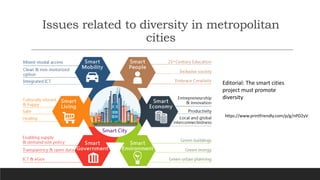
Issues related to diversity in metropolitan
cities
Editorial: The smart cities
project must promote
diversity
https://www.printfriendly.com/p/g/nPD2yV
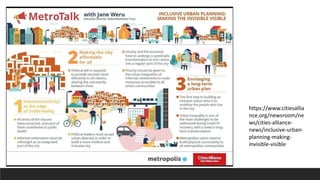
https://www.citiesallia
nce.org/newsroom/ne
ws/cities-alliance-
news/inclusive-urban-
planning-making-
invisible-visible
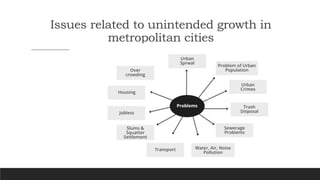
Issues related to unintended growth in
metropolitan cities
Examples and references
Social, economic and environmental
sustainability of metropolitan cities
Social, economic, and environmental sustainability are crucial
considerations for the long-term success and well-being of
metropolitan cities
Achieving social, economic, and environmental sustainability in
metropolitan cities requires a comprehensive and integrated
approach that involves collaboration between government
entities, private sector stakeholders, community organizations,
and residents. By prioritizing these aspects, metropolitan areas
can become more livable, resilient, and inclusive, ensuring a
better quality of life for current and future generations.
Social Sustainability:
Affordable Housing: Promoting affordable housing
options and preventing the displacement of lower-
income residents is essential for social equity and
inclusivity.
Community Engagement: Encouraging active
community participation and fostering a sense of
belonging through initiatives like neighborhood
associations and participatory decision-making
processes.
Social Services: Ensuring access to quality education,
healthcare, and social services for all residents,
irrespective of their socioeconomic status or
background.
Cultural Preservation: Preserving and promoting
diverse cultural heritage, traditions, and identities
through support for arts, cultural events, and
inclusive urban planning.
Affordable
Housing
Community
Engagement
Social Services
Cultural
Preservation
Economic Sustainability:
Economic Diversity: Promoting a diverse range of
industries and sectors to reduce reliance on a single
sector, ensuring economic resilience and job
opportunities for a broad spectrum of skills.
Entrepreneurship and Innovation: Supporting and
nurturing a culture of entrepreneurship and innovation
to foster economic growth, job creation, and the
development of new industries.
Small Business Support: Providing resources,
mentorship, and financial assistance to small and local
businesses to promote their growth and contribute to
the local economy.
Workforce Development: Investing in education and
skills training programs that align with the evolving
needs of the job market to enhance employability and
attract businesses.
Economic diversity
Entrepreneurship and
Innovation
Small Business Support
Environmental Sustainability
Sustainable Infrastructure: Developing energy-efficient buildings,
promoting green building practices, and investing in renewable energy
sources to reduce carbon emissions and resource consumption.
Sustainable Transportation: Expanding and improving public
transportation systems, supporting non-motorized transportation
options, and incentivizing the use of electric vehicles to reduce traffic
congestion and air pollution.
Green Spaces and Biodiversity: Preserving and creating urban green
spaces, parks, and urban forests to enhance the quality of life, provide
recreational opportunities, and promote biodiversity.
Waste Management and Recycling: Implementing effective waste
management systems, including recycling programs, waste reduction
initiatives, and the promotion of circular economy principles.
Sustainable
Infrastructure
Sustainable
transportation
Green spaces
and bio diversity
Waste
management
and recycling
Quality of life in metropolitan
cities
Social
Connectivity and
Networking
Diversity and
Multiculturalism
Infrastructure
and Services
Education and
Healthcare
Cultural and
Recreational
Amenities
Opportunities
and Economic
Prosperity
Inclusivity and equity in
metropolitan cities
Inclusivity and equity are crucial aspects of creating thriving and
sustainable metropolitan cities. To achieve inclusivity and
equity, collaboration among various stakeholders,
including government entities, community organizations,
advocacy groups, and residents, is crucial. It requires a
commitment to addressing systemic inequities and
implementing policies and programs that promote equal
opportunities and access to resources for all residents,
regardless of their socioeconomic background, race,
ethnicity, or other characteristics.
Aspects contributing to inclusivity
and equity in metropolitan areas Inclusivity
and Equity in
metropolitan
cities
Affordable Housing -rent control, housing
subsidies, mixed-income developments,
and inclusionary zoning
Accessible Transportation- providing
wheelchair-accessible infrastructure,
reducing transportation costs for low-
income individuals, and improving
connectivity to underserved
neighborhoods
Social Services and Support-equitable
access to social services, such as
healthcare, education, childcare, and
social welfare programs
Community Engagement and
Participation-Establishing
neighborhood associations,
community forums, and
participatory planning initiatives
Continued..
Inclusivity
and Equity in
metropolitan
cities
Promoting Diversity and Inclusion-Encouraging
cultural events, supporting minority-owned
businesses, and implementing policies that
prevent discrimination and promote equal rights
Reducing Economic Disparities- implementing
policies that support small businesses, fostering
entrepreneurship, providing job training and
educational opportunities, and ensuring fair wages
and labor protections
Environmental Justice- Avoiding the
disproportionate burden of pollution, improving
access to green spaces in underserved areas, and
implementing sustainable practices that benefit all
residents
Data-Driven Decision Making- Utilizing data and
conducting equity assessments, Analyzing data on
income, education, healthcare access, and other
relevant factors can inform targeted interventions
and ensure resources are allocated equitably
Climate change aspects in
metropolitan cities
In the context of metropolitan cities, climate change refers to
the long-term changes in weather patterns and environmental
conditions that are primarily driven by human activities, such
as the emission of greenhouse gases. the scale of
metropolitan cities influences the magnitude and
complexity of climate change impacts. While larger urban
areas face unique challenges, they also possess the
potential to drive significant climate action, leverage
resources, and foster innovation to build resilient, low-
carbon, and sustainable urban environments
Temperature Rise
•an overall increase in
temperatures, resulting in more
frequent and intense heatwaves
in metropolitan cities
•can have adverse effects on
public health, increase energy
demands for cooling, and
exacerbate the urban heat island
effect
Increased Vulnerability
•densely populated and
concentrated areas, which makes
them particularly vulnerable to
the impacts of climate change
•Rising temperatures, heatwaves,
extreme weather events (such as
storms, floods, and hurricanes),
sea-level rise, and changes in
precipitation patterns can have
severe consequences for
infrastructure, public health, and
socioeconomic systems.
Infrastructure Risks
•Climate change places stress on
urban infrastructure systems,
including transportation
networks, water supply, energy
grids, and buildings
•extreme weather events can
damage infrastructure, leading to
disruptions in essential services.
For instance, heatwaves can
strain power grids, leading to
blackouts, while intense rainfall
can overwhelm drainage systems,
causing flooding and damage to
roads and buildings.
Public Health Concerns
•Heatwaves can lead to heat-
related illnesses and even deaths,
especially in densely built
environments with limited green
spaces and poor air quality
•Changes in precipitation patterns
contribute to waterborne
diseases and vector-borne
diseases- dengue fever and
malaria
•Air pollution, exacerbated by
climate change, worsen
respiratory and cardiovascular
diseases
Urban Heat Island
Effect
•Metropolitan cities often
experience the urban heat island
effect, where urban areas are
significantly hotter than
surrounding rural areas due to the
concentration of heat-absorbing
surfaces, reduced vegetation, and
waste heat from buildings and
transportation
•This effect exacerbates the
impacts of heatwaves, leading to
increased energy demands for
cooling, reduced air quality, and
negative health effects for
residents.
•to invest in infrastructure
adaptation and resilience measures
•strategies such as green
infrastructure (e.g., urban parks,
green roofs), improving drainage
systems, constructing climate-
resilient buildings
Infrastructure
and Resilience
•reducing greenhouse gas emissions
to mitigate climate change
•implement sustainable
transportation systems, promote
energy efficiency in buildings,
transition to renewable energy
sources, and adopt sustainable
waste management practices
Mitigation Efforts
•raise awareness about climate
change, provide education on
sustainable practices, and involve
residents in decision-making
processes
•Engaging citizens, businesses, and
community organizations fosters a
sense of ownership and collective
responsibility for climate action
Community Engagement
and Awareness
•Metropolitan cities are part of
broader regional systems,
interconnected through
transportation, infrastructure, and
economic activities which enables
fostering climate change as it sees
no border and requires regional
cooperation.
•They can collaborate with
neighboring jurisdictions, share
resources, and develop regional
climate action plans to address
common challenges, such as water
management, transportation
networks, and natural resource
conservation
Globalization,
Interconnectedness and
Regional Cooperation
Aspects needed to address climate change impacts in
metropolitan cities
Transit-oriented Development (TOD)
In Metropolitan Cities
Transit-oriented development (TOD) in metropolitan cities is a
planning approach that aims to create sustainable, livable, and
interconnected communities centered around efficient public
transportation systems. It involves designing and developing
neighborhoods, commercial areas, and public spaces in close
proximity to transit stations, promoting walking, cycling, and
the use of public transportation
some key aspects and benefits of transit-oriented
development in metropolitan cities
Transit-oriented development in metropolitan cities offers a holistic and sustainable approach to urban planning. It promotes efficient
transportation, mixed land uses, social equity, economic vitality, and environmental sustainability. By integrating these principles,
metropolitan areas can create vibrant and resilient communities that meet the needs and aspirations of their residents while
addressing the challenges of urbanization.
Improved
Quality of
Life
Proximity to
Transit
Compact
and Mixed-
Use
Developmen
t
Walkability
and Active
Transportati
on
Reduced Car
Dependence
Affordable
Housing and
Social Equity
Economic
Developmen
t
Public Space
and
Community
Integration
Enhanced
Mobility and
Accessibility
Health and Well-
being
•TOD promotes active
lifestyles by encouraging
encouraging walking
and cycling as viable
transportation options.
Accessible sidewalks,
bike lanes, and
pedestrian-friendly
infrastructure improve
physical activity levels
and promote better
health outcomes.
Preservation of
Greenfield Land
•TOD focuses on utilizing
existing urban areas and
underutilized land near
transit stations. By
intensifying
development in these
areas, it helps preserve
valuable greenfield land
on the outskirts of the
metropolitan region.
Transit
Infrastructure
Investment
•TOD can catalyze
investment in public
transportation
infrastructure. As the
demand for transit
services increases in
TOD areas, it incentivizes
incentivizes
governments and
transportation
authorities to improve
and expand transit
systems. .
Congestion
Reduction
•the compact and mixed-
use development
patterns of TOD help
reduce traffic congestion
congestion in
metropolitan areas. By
providing convenient
access to public
transportation, people
are encouraged to use
transit instead of driving
alone, leading to fewer
cars on the road and
smoother traffic flow.
Disaster Resilience
•Compact and connected
TOD communities are
more resilient to natural
disasters and other
emergencies. The
proximity of amenities
and services to transit
stations ensures better
access to essential
resources during crises.
Cultural and Social
Vibrancy
•Transit-oriented
development fosters
vibrant and diverse
neighborhoods where
people from different
backgrounds and
income levels can live
and interact. The
proximity of residents
and the mix of uses in
TOD areas create
opportunities for
cultural exchange, social
interaction, and the
formation of strong
community bonds.
Improved Air
Quality
•By reducing private
vehicle usage and
promoting public
transportation, TOD
helps improve air quality
quality in metropolitan
areas. Fewer cars on the
road result in reduced
emissions of pollutants,
such as carbon dioxide
and nitrogen oxides,
leading to cleaner and
healthier air for
residents
Accessibility for All
•TOD emphasizes
universal accessibility,
ensuring that transit
stations, sidewalks, and
buildings are designed
to accommodate people
with disabilities. This
promotes inclusivity and
allows individuals with
mobility challenges to
access transportation
and participate fully in
the community.
Inner city in metropolitan cities-
issues and problems
The inner city areas of metropolitan cities often face specific
issues and problems due to factors such as historical
development patterns, socioeconomic disparities, and urban
decay. Addressing the issues and problems faced by the
inner city areas of metropolitan cities requires
comprehensive strategies that involve community
engagement, urban revitalization, equitable policies, and
investments in education, infrastructure, and economic
development. It is crucial to prioritize social inclusion,
affordable housing, job creation, and the provision of
essential services to foster sustainable and thriving
communities within the inner city.
Urban Decay and Deterioration:
Many inner city areas suffer from physical decay, with dilapidated buildings, vacant lots, and neglected
infrastructure. Historical disinvestment, economic decline, and lack of maintenance contribute to the physical
deterioration of the built environment.
Poverty and Socioeconomic Disparities:
Inner city areas tend to have higher poverty rates and concentrated pockets of socioeconomic
disadvantage. Limited access to quality education, healthcare, employment opportunities, and
basic services perpetuates cycles of poverty and social inequality.
Crime and Safety Concerns:
Inner city areas often experience higher crime rates and safety concerns compared to other
parts of the city. Factors such as socioeconomic disadvantage, drug-related activities, and
social disorganization contribute to crime, leading to a sense of insecurity among residents
Limited Access to Affordable Housing:
The inner city areas may struggle with affordable housing options, as rising property prices and
gentrification push housing costs beyond the reach of low-income residents. This can lead to
housing instability, overcrowding, and homelessness.
Inadequate Infrastructure and Services:
Inner city areas may lack essential infrastructure and services, such as reliable public
transportation, quality schools, healthcare facilities, parks, and recreational spaces. This limits
residents' access to basic amenities and opportunities for personal and community development.
Gentrification and Displacement:
The process of gentrification can lead to the displacement of long-term residents in inner city areas. As
wealthier residents move in and property values rise, lower-income individuals and communities are often
forced to relocate, resulting in the loss of community cohesion and cultural identity.
Environmental Challenges:
Inner city areas may face environmental issues such as pollution, inadequate green spaces, and
limited access to clean air and water. Proximity to industrial zones, lack of environmental
regulations, and the presence of brownfield sites can contribute to environmental degradation and
health risks for residents.
Limited Economic Opportunities:
Inner city areas may struggle with limited job opportunities and economic development, leading
to higher unemployment rates and economic inequality. The lack of investment, inadequate
infrastructure for businesses, and skills gaps among residents contribute to the economic
challenges faced by the community.
Education Disparities:
Inner city schools often face significant challenges, including underfunding, overcrowding, and a
lack of resources. These educational disparities result in lower academic achievement levels,
limited opportunities for students, and perpetuation of socioeconomic inequality.
Social Exclusion and Segregation:
Inner city areas can experience social exclusion and segregation, with marginalized communities
facing limited access to resources, opportunities, and social networks. This exacerbates social
divisions and hampers social mobility and cohesion within the community.
Your best quote that reflects your
approach… “It’s one small step for
man, one giant leap for mankind.”
- NEIL ARMSTRONG

Metro and mega cities problems and issue.pptx

  • 1.
    Metro and Mega cities problemand issues MASTER IN PLANNING UNIT 3, LECTURE 1,2,3,4 PROF. DR. NEHA BANSAL
  • 2.
    A metro cityor metropolitan area is a large urban area that includes a city and its surrounding suburbs and towns. It typically has a population of at least one one million people and is the economic, political, and and cultural center of a region A mega city, on the other hand, is an urban area with a population of more than 10 million people. It is a term used to describe the largest and most populous cities in the world, such as Tokyo, Mumbai, and New York City. Mega cities are often characterized by high population density, rapid growth, and significant economic and cultural influence.
  • 3.
    Facts As of 2021,there are over 30 metro areas in the world with populations of 10 million or more, and over 500 metro areas with populations of at least one million. (Source: World Atlas) The Tokyo-Yokohama metropolitan area is the largest metro area in the world, with a population of over 37 million people. (Source: United Nations As of 2020, there were 33 mega cities in the world, accounting for roughly 10% of the global population. (Source: World Population Review) The urbanization rate (i.e. the percentage of the world's population living in urban areas) has been steadily increasing, from 30% in 1950 to 55% in 2018. By 2050, it is expected to reach 68%. (Source: United Nations)
  • 5.
    Growth trends and Processes Migration fromrural to urban Population growth of urban areas Globalization Metro and mega cities are typically characterized by rapid population growth and urbanization. These trends have been driven by a variety of factors, including migration from rural areas, natural population growth, and globalization. Factors driving the growth
  • 6.
    Urbanization Economic development Demographic changes Landuse changes Infrastructure development Social and cultural changes Growth trends and processes commonly observed in metro and mega cities 1. Urbanization: As people migrate from rural areas to cities in search of better opportunities, urbanization rates in metro and mega cities tend to rise. This process is fueled by the growth of industries, which attract workers to urban areas, and the availability of basic amenities such as healthcare, education, and housing. 2. Economic development: Metro and mega cities often serve as economic hubs for their respective regions, attracting businesses and investors from around the world. This growth is supported by the presence of advanced infrastructure, such as transport networks, communication systems, and energy grids. 3. Demographic changes: As cities grow, so do their populations, leading to changes in the demographics of these areas. This can include changes in age distribution, ethnic and cultural diversity, and household size. 4. Land use changes: As cities expand, land use patterns tend to change. Agricultural land may be converted to urban development, and green spaces may be replaced with buildings and roads. This can have significant impacts on the environment and local ecosystems. 5. Social and cultural changes: As cities grow, they become melting pots of different cultures and social groups, leading to new forms of cultural expression, social norms, and identity formation. 6. Infrastructure development: As cities grow, they require more extensive and advanced infrastructure to support their populations. This includes transport networks, power grids, and water and sanitation systems, which are often developed in response to the needs of growing urban areas.
  • 7.
  • 8.
    Characteristics of Metropolitan areas Population •Metropolitan areashave large populations, typically consisting of a central city and its surrounding suburbs •They attract a significant number of residents due to job opportunities, amenities, and cultural attractions. Economic Center •Metropolitan areas serve as economic powerhouses, with a concentration of businesses, industries, and employment opportunities. •They are often hubs for finance, technology, manufacturing, and other sectors, driving regional and national economies. Urbanization •Metropolitan areas are heavily urbanized, characterized by high population density and built-up environments. •They have a mix of residential, commercial, and industrial areas, and often feature tall buildings and urban infrastructure. Infrastructure •Metropolitan areas have well-developed infrastructure, including transportation networks (such as roads, highways, railways, and airports), utilities (water, electricity, and telecommunications), and public services (schools, hospitals, and public safety).
  • 9.
    Cultural and Social Diversity •Metropolitanareas are melting pots of diverse cultures and social backgrounds. They attract people from various ethnicities, religions, and nationalities, contributing to a rich multicultural environment •This diversity is reflected in the arts, cuisine, and social fabric of the metropolitan Cultural and Entertainment Facilities •Metropolitan areas offer a wide range of cultural and entertainment amenities, including museums, art galleries, theaters, music venues, sports stadiums, shopping centers, and restaurants. •They provide residents and visitors with a diverse array of cultural experiences and recreational activities. Research and Education •Many metropolitan areas are home to renowned universities, research institutions, and educational facilities. •They foster innovation, knowledge exchange, and intellectual development, driving advancements in various various fields. Governance and Administration •Metropolitan areas often have specific governance structures and administrative bodies responsible for managing the region's affairs. This can involve collaboration among multiple local governments and authorities to address common challenges and plan for sustainable development. Characteristics of Metropolitan areas
  • 10.
    Socioeconomic Disparities While metropolitanareas offer opportunities, they also exhibit socioeconomic disparities. There can be stark differences in income levels, access to services, and quality of life between different neighborhoods and communities within the metropolitan area. Commuting and Transportation Metropolitan areas often face significant commuting challenges due to the large population and traffic congestion They typically have complex transportation systems, including highways, public transit networks, and commuter rail services, to facilitate the movement of people within and between cities. Housing Diversity and Affordability Metropolitan areas tend to have a diverse range of housing options to accommodate the needs of their residents. However, affordability can be a significant issue, particularly in highly desirable areas where housing costs may be high relative to average incomes. However, affordability can be a significant issue, particularly in highly desirable areas where housing costs may be high relative to average incomes. Cultural and Intellectual Institutions Metropolitan areas are home to a wide array of cultural and intellectual institutions, including universities, research centers, libraries, and think tanks. These institutions contribute to the intellectual and creative vibrancy of the region, fostering innovation, research, and intellectual discourse. Characteristics of Metropolitan areas
  • 11.
    Healthcare Facilities •Metropolitan areas often havea concentration of healthcare facilities, including hospitals, specialized clinics, and medical research centers. This ensures access to advanced medical care and specialized treatments for residents. Social Services and Community Support •Metropolitan areas typically have a range of social services and community support organizations to address the needs of diverse populations. These may include programs for affordable housing, employment assistance, healthcare access, education, and social welfare. Environmental Concerns •As urbanized regions, metropolitan areas face environmental challenges such as air pollution, waste management, and strain on natural resources. Many metropolitan areas are implementing sustainable practices and initiatives to mitigate these environmental impacts. Cultural Exchange and Innovation •Metropolitan areas are hubs for cultural exchange and innovation, attracting creative professionals, entrepreneurs, and artists. They offer opportunities for collaboration, networking, and exposure to new ideas, which contribute to cultural and economic growth. Characteristics of Metropolitan areas
  • 12.
    Political and AdministrativeInfluence Metropolitan areas often wield significant political and administrative influence due to their economic importance and concentration of population. They may have unique governance structures and policies to address the specific needs and challenges of the region Environmental Challenges Metropolitan areas face a range of environmental challenges, including air pollution, water pollution, and waste management. The high population density and urbanization can exacerbate these issues, making sustainable development a critical goal for many metropolitan areas. Housing Housing is often a major concern in metropolitan areas, with high demand and limited availability leading to high prices. This can contribute to housing affordability issues, homelessness, and displacement. Security Metropolitan areas can face security challenges such as crime and terrorism due to the high population density and complex infrastructure. Law enforcement agencies often have specialized units to address these issues and keep residents safe. Political and Cultural Influence Metropolitan areas often have significant political and cultural influence, shaping national and international policies and trends. They serve as hubs for media, entertainment, and cultural production, influencing the global zeitgeist.
  • 13.
  • 14.
    Concepts of sustainabilityin metropolitan cities https://www.mdpi.com/2071- 1050/10/6/2031
  • 15.
  • 18.
    Conceptual map ofthe literature landscape related to this review.
  • 20.
    Issues related todiversity in metropolitan cities Editorial: The smart cities project must promote diversity https://www.printfriendly.com/p/g/nPD2yV
  • 21.
  • 22.
    Issues related tounintended growth in metropolitan cities
  • 23.
  • 24.
    Social, economic andenvironmental sustainability of metropolitan cities Social, economic, and environmental sustainability are crucial considerations for the long-term success and well-being of metropolitan cities Achieving social, economic, and environmental sustainability in metropolitan cities requires a comprehensive and integrated approach that involves collaboration between government entities, private sector stakeholders, community organizations, and residents. By prioritizing these aspects, metropolitan areas can become more livable, resilient, and inclusive, ensuring a better quality of life for current and future generations.
  • 25.
    Social Sustainability: Affordable Housing:Promoting affordable housing options and preventing the displacement of lower- income residents is essential for social equity and inclusivity. Community Engagement: Encouraging active community participation and fostering a sense of belonging through initiatives like neighborhood associations and participatory decision-making processes. Social Services: Ensuring access to quality education, healthcare, and social services for all residents, irrespective of their socioeconomic status or background. Cultural Preservation: Preserving and promoting diverse cultural heritage, traditions, and identities through support for arts, cultural events, and inclusive urban planning. Affordable Housing Community Engagement Social Services Cultural Preservation
  • 26.
    Economic Sustainability: Economic Diversity:Promoting a diverse range of industries and sectors to reduce reliance on a single sector, ensuring economic resilience and job opportunities for a broad spectrum of skills. Entrepreneurship and Innovation: Supporting and nurturing a culture of entrepreneurship and innovation to foster economic growth, job creation, and the development of new industries. Small Business Support: Providing resources, mentorship, and financial assistance to small and local businesses to promote their growth and contribute to the local economy. Workforce Development: Investing in education and skills training programs that align with the evolving needs of the job market to enhance employability and attract businesses. Economic diversity Entrepreneurship and Innovation Small Business Support
  • 27.
    Environmental Sustainability Sustainable Infrastructure:Developing energy-efficient buildings, promoting green building practices, and investing in renewable energy sources to reduce carbon emissions and resource consumption. Sustainable Transportation: Expanding and improving public transportation systems, supporting non-motorized transportation options, and incentivizing the use of electric vehicles to reduce traffic congestion and air pollution. Green Spaces and Biodiversity: Preserving and creating urban green spaces, parks, and urban forests to enhance the quality of life, provide recreational opportunities, and promote biodiversity. Waste Management and Recycling: Implementing effective waste management systems, including recycling programs, waste reduction initiatives, and the promotion of circular economy principles. Sustainable Infrastructure Sustainable transportation Green spaces and bio diversity Waste management and recycling
  • 29.
    Quality of lifein metropolitan cities Social Connectivity and Networking Diversity and Multiculturalism Infrastructure and Services Education and Healthcare Cultural and Recreational Amenities Opportunities and Economic Prosperity
  • 30.
    Inclusivity and equityin metropolitan cities Inclusivity and equity are crucial aspects of creating thriving and sustainable metropolitan cities. To achieve inclusivity and equity, collaboration among various stakeholders, including government entities, community organizations, advocacy groups, and residents, is crucial. It requires a commitment to addressing systemic inequities and implementing policies and programs that promote equal opportunities and access to resources for all residents, regardless of their socioeconomic background, race, ethnicity, or other characteristics.
  • 31.
    Aspects contributing toinclusivity and equity in metropolitan areas Inclusivity and Equity in metropolitan cities Affordable Housing -rent control, housing subsidies, mixed-income developments, and inclusionary zoning Accessible Transportation- providing wheelchair-accessible infrastructure, reducing transportation costs for low- income individuals, and improving connectivity to underserved neighborhoods Social Services and Support-equitable access to social services, such as healthcare, education, childcare, and social welfare programs Community Engagement and Participation-Establishing neighborhood associations, community forums, and participatory planning initiatives
  • 32.
    Continued.. Inclusivity and Equity in metropolitan cities PromotingDiversity and Inclusion-Encouraging cultural events, supporting minority-owned businesses, and implementing policies that prevent discrimination and promote equal rights Reducing Economic Disparities- implementing policies that support small businesses, fostering entrepreneurship, providing job training and educational opportunities, and ensuring fair wages and labor protections Environmental Justice- Avoiding the disproportionate burden of pollution, improving access to green spaces in underserved areas, and implementing sustainable practices that benefit all residents Data-Driven Decision Making- Utilizing data and conducting equity assessments, Analyzing data on income, education, healthcare access, and other relevant factors can inform targeted interventions and ensure resources are allocated equitably
  • 33.
    Climate change aspectsin metropolitan cities In the context of metropolitan cities, climate change refers to the long-term changes in weather patterns and environmental conditions that are primarily driven by human activities, such as the emission of greenhouse gases. the scale of metropolitan cities influences the magnitude and complexity of climate change impacts. While larger urban areas face unique challenges, they also possess the potential to drive significant climate action, leverage resources, and foster innovation to build resilient, low- carbon, and sustainable urban environments
  • 34.
    Temperature Rise •an overallincrease in temperatures, resulting in more frequent and intense heatwaves in metropolitan cities •can have adverse effects on public health, increase energy demands for cooling, and exacerbate the urban heat island effect Increased Vulnerability •densely populated and concentrated areas, which makes them particularly vulnerable to the impacts of climate change •Rising temperatures, heatwaves, extreme weather events (such as storms, floods, and hurricanes), sea-level rise, and changes in precipitation patterns can have severe consequences for infrastructure, public health, and socioeconomic systems. Infrastructure Risks •Climate change places stress on urban infrastructure systems, including transportation networks, water supply, energy grids, and buildings •extreme weather events can damage infrastructure, leading to disruptions in essential services. For instance, heatwaves can strain power grids, leading to blackouts, while intense rainfall can overwhelm drainage systems, causing flooding and damage to roads and buildings. Public Health Concerns •Heatwaves can lead to heat- related illnesses and even deaths, especially in densely built environments with limited green spaces and poor air quality •Changes in precipitation patterns contribute to waterborne diseases and vector-borne diseases- dengue fever and malaria •Air pollution, exacerbated by climate change, worsen respiratory and cardiovascular diseases Urban Heat Island Effect •Metropolitan cities often experience the urban heat island effect, where urban areas are significantly hotter than surrounding rural areas due to the concentration of heat-absorbing surfaces, reduced vegetation, and waste heat from buildings and transportation •This effect exacerbates the impacts of heatwaves, leading to increased energy demands for cooling, reduced air quality, and negative health effects for residents.
  • 35.
    •to invest ininfrastructure adaptation and resilience measures •strategies such as green infrastructure (e.g., urban parks, green roofs), improving drainage systems, constructing climate- resilient buildings Infrastructure and Resilience •reducing greenhouse gas emissions to mitigate climate change •implement sustainable transportation systems, promote energy efficiency in buildings, transition to renewable energy sources, and adopt sustainable waste management practices Mitigation Efforts •raise awareness about climate change, provide education on sustainable practices, and involve residents in decision-making processes •Engaging citizens, businesses, and community organizations fosters a sense of ownership and collective responsibility for climate action Community Engagement and Awareness •Metropolitan cities are part of broader regional systems, interconnected through transportation, infrastructure, and economic activities which enables fostering climate change as it sees no border and requires regional cooperation. •They can collaborate with neighboring jurisdictions, share resources, and develop regional climate action plans to address common challenges, such as water management, transportation networks, and natural resource conservation Globalization, Interconnectedness and Regional Cooperation Aspects needed to address climate change impacts in metropolitan cities
  • 36.
    Transit-oriented Development (TOD) InMetropolitan Cities Transit-oriented development (TOD) in metropolitan cities is a planning approach that aims to create sustainable, livable, and interconnected communities centered around efficient public transportation systems. It involves designing and developing neighborhoods, commercial areas, and public spaces in close proximity to transit stations, promoting walking, cycling, and the use of public transportation
  • 37.
    some key aspectsand benefits of transit-oriented development in metropolitan cities Transit-oriented development in metropolitan cities offers a holistic and sustainable approach to urban planning. It promotes efficient transportation, mixed land uses, social equity, economic vitality, and environmental sustainability. By integrating these principles, metropolitan areas can create vibrant and resilient communities that meet the needs and aspirations of their residents while addressing the challenges of urbanization. Improved Quality of Life Proximity to Transit Compact and Mixed- Use Developmen t Walkability and Active Transportati on Reduced Car Dependence Affordable Housing and Social Equity Economic Developmen t Public Space and Community Integration Enhanced Mobility and Accessibility
  • 38.
    Health and Well- being •TODpromotes active lifestyles by encouraging encouraging walking and cycling as viable transportation options. Accessible sidewalks, bike lanes, and pedestrian-friendly infrastructure improve physical activity levels and promote better health outcomes. Preservation of Greenfield Land •TOD focuses on utilizing existing urban areas and underutilized land near transit stations. By intensifying development in these areas, it helps preserve valuable greenfield land on the outskirts of the metropolitan region. Transit Infrastructure Investment •TOD can catalyze investment in public transportation infrastructure. As the demand for transit services increases in TOD areas, it incentivizes incentivizes governments and transportation authorities to improve and expand transit systems. . Congestion Reduction •the compact and mixed- use development patterns of TOD help reduce traffic congestion congestion in metropolitan areas. By providing convenient access to public transportation, people are encouraged to use transit instead of driving alone, leading to fewer cars on the road and smoother traffic flow. Disaster Resilience •Compact and connected TOD communities are more resilient to natural disasters and other emergencies. The proximity of amenities and services to transit stations ensures better access to essential resources during crises. Cultural and Social Vibrancy •Transit-oriented development fosters vibrant and diverse neighborhoods where people from different backgrounds and income levels can live and interact. The proximity of residents and the mix of uses in TOD areas create opportunities for cultural exchange, social interaction, and the formation of strong community bonds. Improved Air Quality •By reducing private vehicle usage and promoting public transportation, TOD helps improve air quality quality in metropolitan areas. Fewer cars on the road result in reduced emissions of pollutants, such as carbon dioxide and nitrogen oxides, leading to cleaner and healthier air for residents Accessibility for All •TOD emphasizes universal accessibility, ensuring that transit stations, sidewalks, and buildings are designed to accommodate people with disabilities. This promotes inclusivity and allows individuals with mobility challenges to access transportation and participate fully in the community.
  • 39.
    Inner city inmetropolitan cities- issues and problems The inner city areas of metropolitan cities often face specific issues and problems due to factors such as historical development patterns, socioeconomic disparities, and urban decay. Addressing the issues and problems faced by the inner city areas of metropolitan cities requires comprehensive strategies that involve community engagement, urban revitalization, equitable policies, and investments in education, infrastructure, and economic development. It is crucial to prioritize social inclusion, affordable housing, job creation, and the provision of essential services to foster sustainable and thriving communities within the inner city.
  • 40.
    Urban Decay andDeterioration: Many inner city areas suffer from physical decay, with dilapidated buildings, vacant lots, and neglected infrastructure. Historical disinvestment, economic decline, and lack of maintenance contribute to the physical deterioration of the built environment.
  • 41.
    Poverty and SocioeconomicDisparities: Inner city areas tend to have higher poverty rates and concentrated pockets of socioeconomic disadvantage. Limited access to quality education, healthcare, employment opportunities, and basic services perpetuates cycles of poverty and social inequality.
  • 42.
    Crime and SafetyConcerns: Inner city areas often experience higher crime rates and safety concerns compared to other parts of the city. Factors such as socioeconomic disadvantage, drug-related activities, and social disorganization contribute to crime, leading to a sense of insecurity among residents
  • 43.
    Limited Access toAffordable Housing: The inner city areas may struggle with affordable housing options, as rising property prices and gentrification push housing costs beyond the reach of low-income residents. This can lead to housing instability, overcrowding, and homelessness.
  • 44.
    Inadequate Infrastructure andServices: Inner city areas may lack essential infrastructure and services, such as reliable public transportation, quality schools, healthcare facilities, parks, and recreational spaces. This limits residents' access to basic amenities and opportunities for personal and community development.
  • 45.
    Gentrification and Displacement: Theprocess of gentrification can lead to the displacement of long-term residents in inner city areas. As wealthier residents move in and property values rise, lower-income individuals and communities are often forced to relocate, resulting in the loss of community cohesion and cultural identity.
  • 46.
    Environmental Challenges: Inner cityareas may face environmental issues such as pollution, inadequate green spaces, and limited access to clean air and water. Proximity to industrial zones, lack of environmental regulations, and the presence of brownfield sites can contribute to environmental degradation and health risks for residents.
  • 47.
    Limited Economic Opportunities: Innercity areas may struggle with limited job opportunities and economic development, leading to higher unemployment rates and economic inequality. The lack of investment, inadequate infrastructure for businesses, and skills gaps among residents contribute to the economic challenges faced by the community.
  • 48.
    Education Disparities: Inner cityschools often face significant challenges, including underfunding, overcrowding, and a lack of resources. These educational disparities result in lower academic achievement levels, limited opportunities for students, and perpetuation of socioeconomic inequality.
  • 49.
    Social Exclusion andSegregation: Inner city areas can experience social exclusion and segregation, with marginalized communities facing limited access to resources, opportunities, and social networks. This exacerbates social divisions and hampers social mobility and cohesion within the community.
  • 50.
    Your best quotethat reflects your approach… “It’s one small step for man, one giant leap for mankind.” - NEIL ARMSTRONG