Regional & Metropolitan Planning
Dr. Mohammed Firoz . C
Department of Architecture and Planning
National Institute of Technology Calicut, India
Lecture 4
Lecture 4 : Regions and their types
Definition of a region
• Oxford dictionary : An area, especially part of a country or the world having definable
characteristics but not always fixed boundaries. Eg "the equatorial regions“
• An area having some characteristic or characteristics that distinguish it from other
areas. A territory of interest to people and for which one or more distinctive traits are
used as the basis for its identity. www.geographic.org/glossary.html
• A larger-sized territory that includes many smaller places, all or most of which share
similar attributes, such as climate, landforms, plants, soils, language, religion, economy,
government or other natural or cultural attributes.
www.nmlites.org/standards/socialstudies/glossary.html
• A group of districts, located within a geographic area of a state
www.nejaycees.org/about/jargon.asp
Regions and Their types
• Classification based on Physical features and Economic
cohesiveness
A) Formal Regions
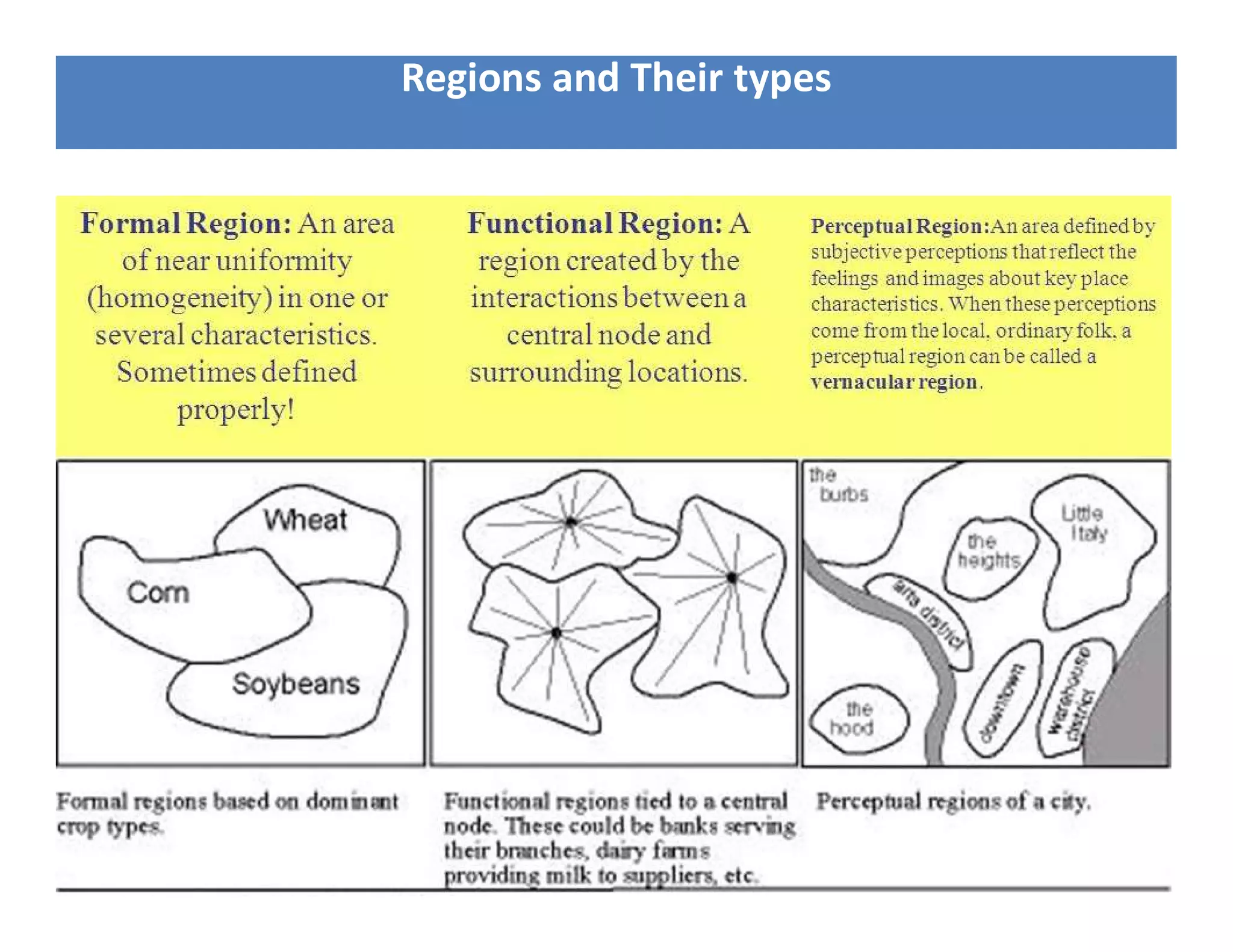
• Formal regions are uniform or homogeneous areas where everyone in that region shares
common attributes or traits like language, climate or political system, geo-physical
characteristic such as topography, vegetation etc . Formal regions are primarily used to
determine and outline political, cultural and economic regions.
Eg. India, Kerala, TamilNadu
B) Functional Regions
• Functional Regions : An economic interdependence exists between towns/Cities.
• Characterised by spatial flow of interactions of persons, money, materials, energy,
information's etc between or parts of the region.
• May have a common network of transport/Utilities/mobile network coverage (flow
analysis)
• Can be delineated on the basis of the direction and intensity of flows between the
dominant centre and the surrounding satellites.
• Each flow will show (a) decreasing intensity as it becomes more distant from the main
centre and (b) increasing intensity as it approaches another centre
Regions and Their types
• Export and import of goods, transfer of money, migration of persons in search of jobs
etc. are all ‘flows’ ;
• Students going to colleges in big cities nearby or to specialized hospitals are “Social Flows”.
• People going to pilgrimage are cultural flows,
• Information flows (Newspapers) also involve monetary transactions.
• Functional regions some times used synonymously with Polarized or nodal regions
• Its influence extends beyond the area of the city, usually-for service and assessed by
their sphere of influence.
• All functions require a particular threshold population and other facilities (each
settlement cannot have a college; or, unless there is electricity there cannot be cinema
hall; or a bank branch will require not only critical minimum deposit-credit ratio), higer
or lower order facilities ( Head post office to small offices), Higher secondary to
primary schools etc
• The Delhi NCR is a functional region ( connecting various states of India)
• E.g. : Metropolitan Areas , Urban regions etc
Regions and Their types
C) Perception Regions :
• A perceptual region is based on the shared feelings and attitudes of the people who
live in the area. Perceptual regions reflect the cultural identity of the people in
the region
• No clear boundaries and need not be based on any facts .They may be perceived
differently from person to person
• When the perception comes from the ordinary folk or local people, some times , it is
called as the vernacular region.
• Eg: Rich live here, poor people living region, Suburban region.
Regions and Their types
https://www.youtube.com/watch?v=3LVXiM_u_UM
Video Link
Adminstrative regions : District –Block Panchayath regions –Planning board defiend
regions.
Policy regions : Deliniated only for specific policies – Ex bad health regions-
Promote health infrastructure, No industry region- promote industrial growth
etc
Regions and Their types
Region Based on Planners perspective.
• Planning regions depend upon the type of multi-level planning in the country. A very
small country will naturally need not have all the regions.But, in India, we can
generalize it with regions like (I) national level (ii) macro level (iii) state level (iv) meso
level (v) and micro level.
Macro Regions
• Macro region is bigger. Macro region can be a state or even a group of states or a zone
( of a few states) . For example, in India there are East, West, North, South and Central
Zones .
• A physical macro region may comprise parts of different states of a country for project
planning purposes. (e.g., big river valley projects, an electric grid of different states,
and, for the purpose of a particular activity (facility) planning) the macro region will be
parts of different states. State boundaries are not respected and may transcend or
cut-across administrative boundaries of the states of a country.
• A macro region may not be uniform or homogeneous in all respects
• India has been divided into 11 to 20 macro regions-agro-climate or resource regions.
• The then planning Commission of India defined just 5 zonal councils-Eastern,
Northern, Central, Western and Southern comprising of certain states.
Regions and Their types
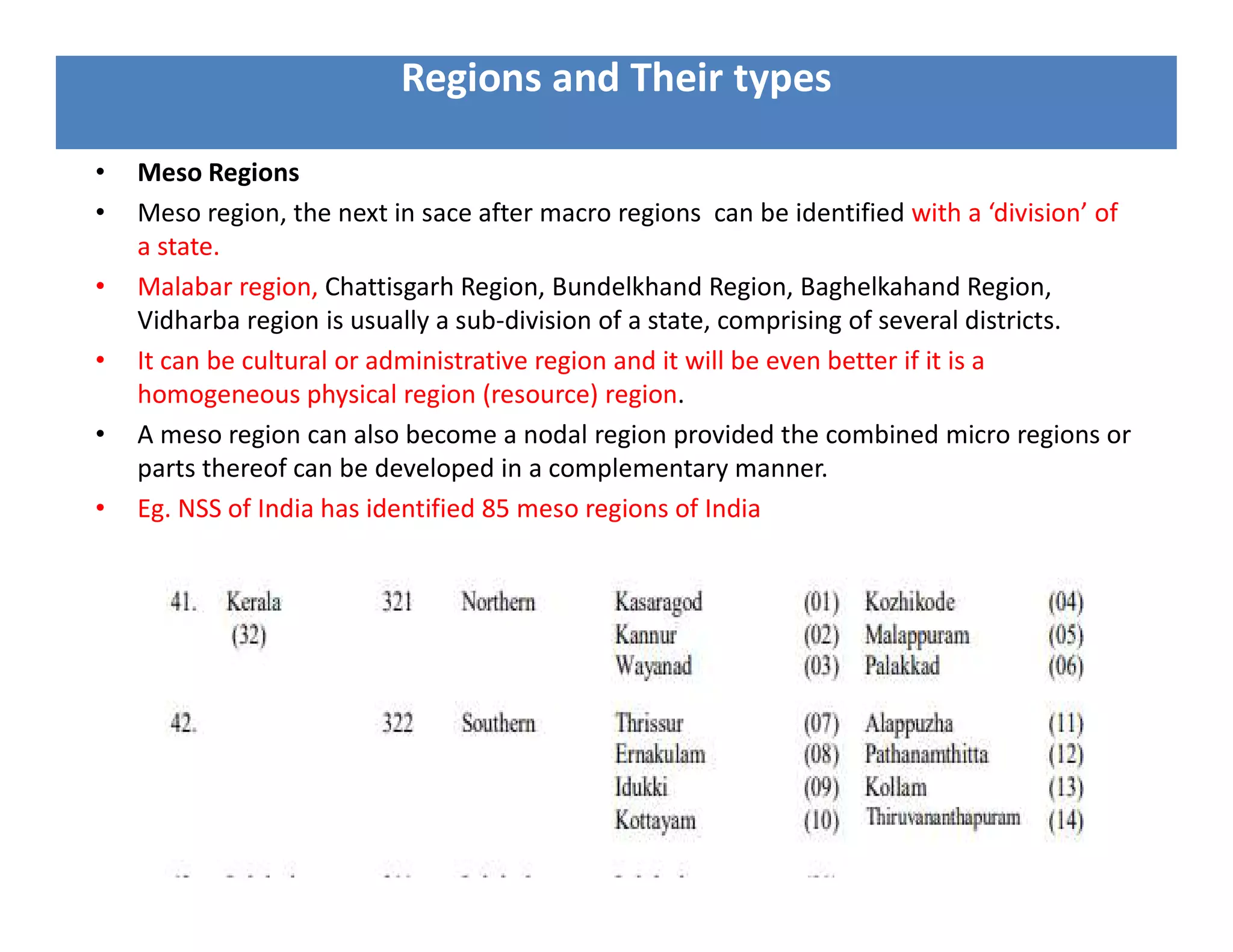
• Meso Regions
• Meso region, the next in sace after macro regions can be identified with a ‘division’ of
a state.
• Malabar region, Chattisgarh Region, Bundelkhand Region, Baghelkahand Region,
Vidharba region is usually a sub-division of a state, comprising of several districts.
• It can be cultural or administrative region and it will be even better if it is a
homogeneous physical region (resource) region.
• A meso region can also become a nodal region provided the combined micro regions or
parts thereof can be developed in a complementary manner.
• Eg. NSS of India has identified 85 meso regions of India
Regions and Their types
Micro Regions
•In multi-level planning, after, ‘meso’ comes micro regions ( Eg district).
•It becomes the lowest territorial unit of planning in the hierarchy of planning
regions. Generally an administrative unit .
•A nodal point is also a micro region, though in many cases micro regions may
comprise of urban and Rural .
• Eg .A district, A metropolitan area etc
•Micro – Minor Region
•This is the region which is associated with, what is called, the grass-root
planning
•Usually associated with data constraints for planning.
•Eg. Block level or Panchayath level .
Regions and Their types
Types Of Regions On The Basis Of Stages Of Economic Development
Developed Regions :
• Developed regions are having a high rate of accretion in goods and services with
their share in the GDP of the country is relatively higher.
• This growth may be with or without rich natural resources and may use
upgraded technology by highly skilled and motivated persons.
• They are accessible to high level of infrastructure and services with higher cost
of services and living.
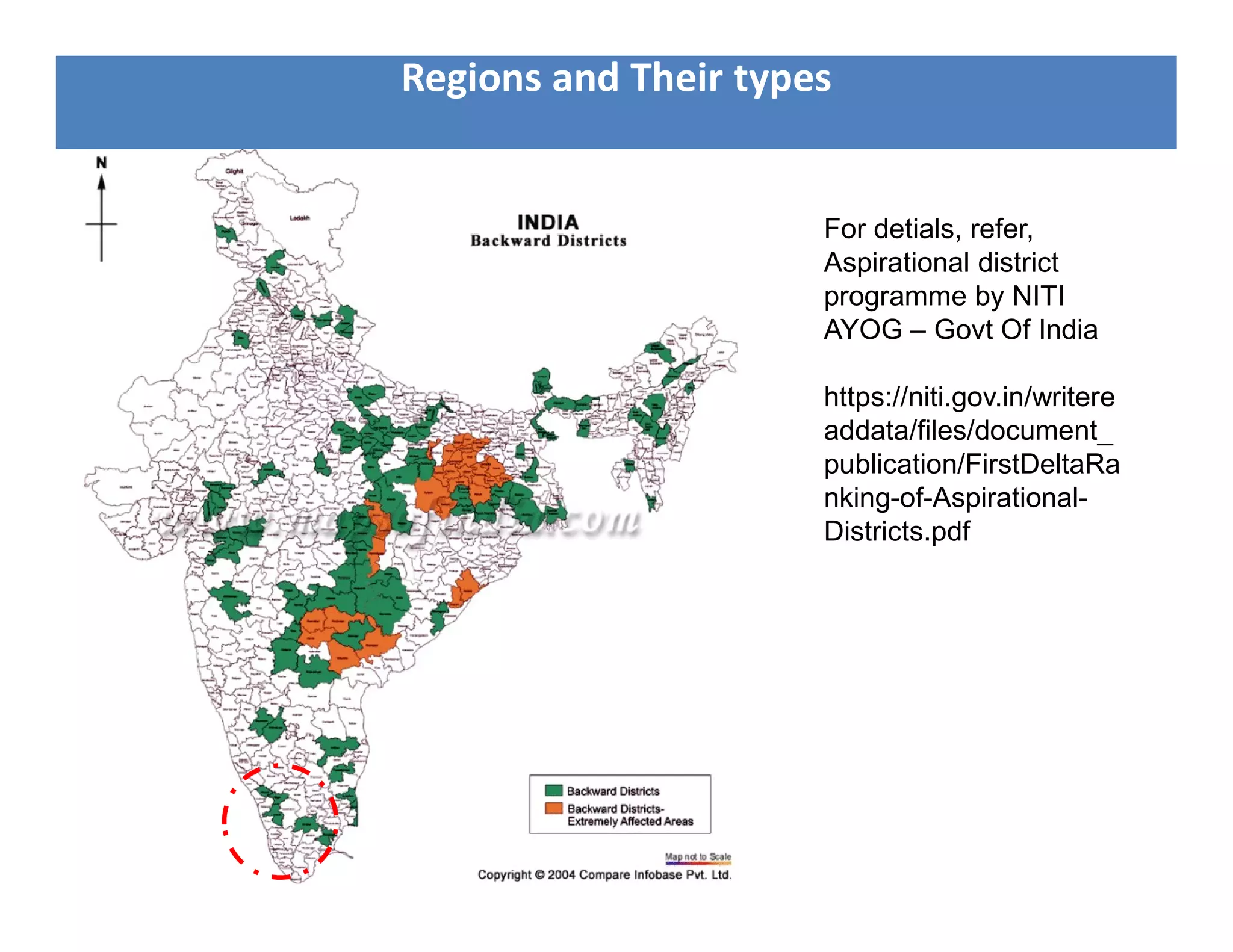
Backward Regions
• Backward or depressed’ regions in the developing as well as the developed
economies are backward economies.
• Lack of infrastructure facilities, adverse geo-climate conditions, low investment
rate, high rare of growth of population, and low levels of urbanization and
industrialization are causes and consequences of backwardness.
• Indicators of development like Road length per sq.km, literacy rate, Beds per
thousand population, % villages electrified, % cultivated land under irrigation,
Life expectance, IMR, Literacy rate, Availability of low, intermediate and high
order functions and facilities determines backwardness or forwardness.
Regions and Their types
For detials, refer,
Aspirational district
programme by NITI
AYOG – Govt Of India
https://niti.gov.in/writere
addata/files/document_
publication/FirstDeltaRa
nking-of-Aspirational-
Districts.pdf
Types of Regions based on the activity status analysis
Mineral Or resource regions :
• Rich in minerals as a natural boon for development .Eg Arab Regions.
Associated with Industrial development and more employment.
• Bihar Syndrome ? – Despite rich in resources ( Bihar –Jharkhand -The backbone
of India), Still needs development
Manufacturing Regions.
• With or with out natural resources, a region can become a manufacturing
region.
• Eg- Suburbs of Mumbai –Pune , Ahmedbad-Surat Belt, and many more
Cultural Regions.
• A cultural region is a region with people who share
common cultural characteristics. Such characteristics include language, political
system, religion, foods, customs, and participation in trading networks
Regions and Their types
Mineral and Industrial regions
of India
1. Bombay - Pune Region
2. The Ahmedabad-Vadodara
Region
3. Hoogly or Kolkata-Howrah
Region
4. Chotanagpur Plateau or
Damodar Valley Region
5. Southern Region (The
Coimbatore, Bengaluru
Chennai Industrial Region)
6. Ganga-Yamuna Plain
comprising Delhi and adjoining
region of Haryana, Uttar
Pradesh, Punjab and
Rajasthan
Regions and Their types
SOURCE : MAJID HUSSAIN’S GEOGRAPHY OF INDIA PAGE 13.41
•North Eastern (N.E.) India: Culture varies
with Tribes
•Western India: Culture transgresses
state borders-Gujarati, Marathi and Rajasthan
languages belong to the same Indo-Aryan
linguistic group, and Hinduism and Jainism have
significant presence in these three states
•South India: Individual states are
cultural units-Southern India consists of:
Andhra Pradesh (Telugu), Telengana (Telugu),
Karnataka (Kannada), Tamilnadu (Tamil) and
Kerala (Malyalam).
Northern India: Three different Cultures-
oSikh Gurumukhi cultural region in Punjab and the
UT of Chandigarh
oHindi-Hindu cultural belt across Bihar, Haryana,
Madhya Pradesh, Rajasthan, South Uttarakhand
and Uttar Pradesh- with Muslim presence in
certain pockets of W.Uttar Pradesh
oUrban cosmopolitan culture in the Delhi and NCR
region. Their cuisine, attire, speech-gestures,
attitudes are distinct from other parts of Northern
India
x

2.pdf

  • 1.
    Regional & MetropolitanPlanning Dr. Mohammed Firoz . C Department of Architecture and Planning National Institute of Technology Calicut, India Lecture 4
  • 2.
    Lecture 4 :Regions and their types
  • 3.
    Definition of aregion • Oxford dictionary : An area, especially part of a country or the world having definable characteristics but not always fixed boundaries. Eg "the equatorial regions“ • An area having some characteristic or characteristics that distinguish it from other areas. A territory of interest to people and for which one or more distinctive traits are used as the basis for its identity. www.geographic.org/glossary.html • A larger-sized territory that includes many smaller places, all or most of which share similar attributes, such as climate, landforms, plants, soils, language, religion, economy, government or other natural or cultural attributes. www.nmlites.org/standards/socialstudies/glossary.html • A group of districts, located within a geographic area of a state www.nejaycees.org/about/jargon.asp Regions and Their types
  • 4.
    • Classification basedon Physical features and Economic cohesiveness A) Formal Regions • Formal regions are uniform or homogeneous areas where everyone in that region shares common attributes or traits like language, climate or political system, geo-physical characteristic such as topography, vegetation etc . Formal regions are primarily used to determine and outline political, cultural and economic regions. Eg. India, Kerala, TamilNadu B) Functional Regions • Functional Regions : An economic interdependence exists between towns/Cities. • Characterised by spatial flow of interactions of persons, money, materials, energy, information's etc between or parts of the region. • May have a common network of transport/Utilities/mobile network coverage (flow analysis) • Can be delineated on the basis of the direction and intensity of flows between the dominant centre and the surrounding satellites. • Each flow will show (a) decreasing intensity as it becomes more distant from the main centre and (b) increasing intensity as it approaches another centre Regions and Their types
  • 5.
    • Export andimport of goods, transfer of money, migration of persons in search of jobs etc. are all ‘flows’ ; • Students going to colleges in big cities nearby or to specialized hospitals are “Social Flows”. • People going to pilgrimage are cultural flows, • Information flows (Newspapers) also involve monetary transactions. • Functional regions some times used synonymously with Polarized or nodal regions • Its influence extends beyond the area of the city, usually-for service and assessed by their sphere of influence. • All functions require a particular threshold population and other facilities (each settlement cannot have a college; or, unless there is electricity there cannot be cinema hall; or a bank branch will require not only critical minimum deposit-credit ratio), higer or lower order facilities ( Head post office to small offices), Higher secondary to primary schools etc • The Delhi NCR is a functional region ( connecting various states of India) • E.g. : Metropolitan Areas , Urban regions etc Regions and Their types
  • 6.
    C) Perception Regions: • A perceptual region is based on the shared feelings and attitudes of the people who live in the area. Perceptual regions reflect the cultural identity of the people in the region • No clear boundaries and need not be based on any facts .They may be perceived differently from person to person • When the perception comes from the ordinary folk or local people, some times , it is called as the vernacular region. • Eg: Rich live here, poor people living region, Suburban region. Regions and Their types https://www.youtube.com/watch?v=3LVXiM_u_UM Video Link Adminstrative regions : District –Block Panchayath regions –Planning board defiend regions. Policy regions : Deliniated only for specific policies – Ex bad health regions- Promote health infrastructure, No industry region- promote industrial growth etc
  • 7.
  • 8.
    Region Based onPlanners perspective. • Planning regions depend upon the type of multi-level planning in the country. A very small country will naturally need not have all the regions.But, in India, we can generalize it with regions like (I) national level (ii) macro level (iii) state level (iv) meso level (v) and micro level. Macro Regions • Macro region is bigger. Macro region can be a state or even a group of states or a zone ( of a few states) . For example, in India there are East, West, North, South and Central Zones . • A physical macro region may comprise parts of different states of a country for project planning purposes. (e.g., big river valley projects, an electric grid of different states, and, for the purpose of a particular activity (facility) planning) the macro region will be parts of different states. State boundaries are not respected and may transcend or cut-across administrative boundaries of the states of a country. • A macro region may not be uniform or homogeneous in all respects • India has been divided into 11 to 20 macro regions-agro-climate or resource regions. • The then planning Commission of India defined just 5 zonal councils-Eastern, Northern, Central, Western and Southern comprising of certain states. Regions and Their types
  • 9.
    • Meso Regions •Meso region, the next in sace after macro regions can be identified with a ‘division’ of a state. • Malabar region, Chattisgarh Region, Bundelkhand Region, Baghelkahand Region, Vidharba region is usually a sub-division of a state, comprising of several districts. • It can be cultural or administrative region and it will be even better if it is a homogeneous physical region (resource) region. • A meso region can also become a nodal region provided the combined micro regions or parts thereof can be developed in a complementary manner. • Eg. NSS of India has identified 85 meso regions of India Regions and Their types
  • 10.
    Regions and Theirtypes Micro Regions •In multi-level planning, after, ‘meso’ comes micro regions ( Eg district). •It becomes the lowest territorial unit of planning in the hierarchy of planning regions. Generally an administrative unit . •A nodal point is also a micro region, though in many cases micro regions may comprise of urban and Rural . • Eg .A district, A metropolitan area etc •Micro – Minor Region •This is the region which is associated with, what is called, the grass-root planning •Usually associated with data constraints for planning. •Eg. Block level or Panchayath level .
  • 11.
  • 12.
    Types Of RegionsOn The Basis Of Stages Of Economic Development Developed Regions : • Developed regions are having a high rate of accretion in goods and services with their share in the GDP of the country is relatively higher. • This growth may be with or without rich natural resources and may use upgraded technology by highly skilled and motivated persons. • They are accessible to high level of infrastructure and services with higher cost of services and living. Backward Regions • Backward or depressed’ regions in the developing as well as the developed economies are backward economies. • Lack of infrastructure facilities, adverse geo-climate conditions, low investment rate, high rare of growth of population, and low levels of urbanization and industrialization are causes and consequences of backwardness. • Indicators of development like Road length per sq.km, literacy rate, Beds per thousand population, % villages electrified, % cultivated land under irrigation, Life expectance, IMR, Literacy rate, Availability of low, intermediate and high order functions and facilities determines backwardness or forwardness. Regions and Their types
  • 13.
  • 14.
    Regions and Theirtypes For detials, refer, Aspirational district programme by NITI AYOG – Govt Of India https://niti.gov.in/writere addata/files/document_ publication/FirstDeltaRa nking-of-Aspirational- Districts.pdf
  • 15.
    Types of Regionsbased on the activity status analysis Mineral Or resource regions : • Rich in minerals as a natural boon for development .Eg Arab Regions. Associated with Industrial development and more employment. • Bihar Syndrome ? – Despite rich in resources ( Bihar –Jharkhand -The backbone of India), Still needs development Manufacturing Regions. • With or with out natural resources, a region can become a manufacturing region. • Eg- Suburbs of Mumbai –Pune , Ahmedbad-Surat Belt, and many more Cultural Regions. • A cultural region is a region with people who share common cultural characteristics. Such characteristics include language, political system, religion, foods, customs, and participation in trading networks Regions and Their types
  • 16.
    Regions and Theirtypes Mineral and Industrial regions of India 1. Bombay - Pune Region 2. The Ahmedabad-Vadodara Region 3. Hoogly or Kolkata-Howrah Region 4. Chotanagpur Plateau or Damodar Valley Region 5. Southern Region (The Coimbatore, Bengaluru Chennai Industrial Region) 6. Ganga-Yamuna Plain comprising Delhi and adjoining region of Haryana, Uttar Pradesh, Punjab and Rajasthan
  • 17.
    Regions and Theirtypes SOURCE : MAJID HUSSAIN’S GEOGRAPHY OF INDIA PAGE 13.41 •North Eastern (N.E.) India: Culture varies with Tribes •Western India: Culture transgresses state borders-Gujarati, Marathi and Rajasthan languages belong to the same Indo-Aryan linguistic group, and Hinduism and Jainism have significant presence in these three states •South India: Individual states are cultural units-Southern India consists of: Andhra Pradesh (Telugu), Telengana (Telugu), Karnataka (Kannada), Tamilnadu (Tamil) and Kerala (Malyalam). Northern India: Three different Cultures- oSikh Gurumukhi cultural region in Punjab and the UT of Chandigarh oHindi-Hindu cultural belt across Bihar, Haryana, Madhya Pradesh, Rajasthan, South Uttarakhand and Uttar Pradesh- with Muslim presence in certain pockets of W.Uttar Pradesh oUrban cosmopolitan culture in the Delhi and NCR region. Their cuisine, attire, speech-gestures, attitudes are distinct from other parts of Northern India x