Research: How to Write a
Good Paper
LS 620 Research Writing
JB Armstrong
Agenda
Research Basics
What research is and is not
Where research comes from
Research deliverables
Methodologies
Research process
Quantitative versus qualitative research
Questions
Research Basics
What research is and isn’t
Research characteristics
Research projects and pitfalls
Sources of research projects
Elements of research proposals
Literature reviews
What Research Is Not
Research isn’t information gathering:
Gathering information from resources such books
or magazines isn’t research.
No contribution to new knowledge.
Research isn’t the transportation of facts:
Merely transporting facts from one resource to
another doesn’t constitute research.
No contribution to new knowledge although this
might make existing knowledge more accessible.
What Research Is
Research is:
“…the systematic process of collecting and
analyzing information (data) in order to increase
our understanding of the phenomenon about
which we are concerned or interested.”1
Research Characteristics
1. Originates with a question or problem.
2. Requires clear articulation of a goal.
3. Follows a specific plan or procedure.
4. Often divides main problem into subproblems.
5. Guided by specific problem, question, or
hypothesis.
6. Accepts certain critical assumptions.
7. Requires collection and interpretation of data.
Research Projects
Research begins with a problem.
This problem is not limited.
Identifying this problem can actually be the
hardest part of research.
In general, good research projects should:
Address an important question.
Advance knowledge.
Stating the Research Problem
Once you’ve identified a research problem:
State that problem clearly and completely.
Determine the feasibility of the research.
Definitions
Define each technical term as it is used in
relation to your research project.
This helps remove significant ambiguity from the
research itself by ensuring that reviewers, while
they may not agree with your definitions, at least
know what you’re talking about.
Research Proposals
Research proposals are documents that
describe the intended research including:
Topic
Issue
Definitions
Assumptions
Importance
Literature Review
Literature Review
A literature review is a necessity.
Without this step, you won’t know if your problem
has been solved or what related research is
already underway.
When performing the review:
Start searching professional journals.
Begin with the most recent articles you can find.
Keep track of relevant articles in a bibliography.
Don’t be discouraged if work on the topic is
already underway.
Literature Review Pitfalls
(1 of 2)
Be very careful to check your sources when
doing your literature review.
Many trade magazines are not peer reviewed.
Professional conferences and journals often have
each article reviewed by multiple people before it
is even recommended for publication.
Literature Review Pitfalls
(2 of 2)
The Internet can be a good source of
information. It is also full of pseudo-science
and poor research.
Make sure you verify the claims of any
documentation that has not been peer
reviewed by other professionals in the
computing industry.
Processes & Methodologies
Research Process.
Common Methodologies.
Methodology Comparison.
Research Process
Research is an extremely cyclic process.

Later stages might necessitate a review of earlier
work.
This isn’t a weakness of the process but is
part of the built-in error correction machinery.
Because of the cyclic nature of research, it
can be difficult to determine where to start
and when to stop.
A Question Is Raised
A question occurs to or is posed to the
researcher for which that researcher has no
answer.
This doesn’t mean that someone else doesn’t
already have an answer.
The question needs to be converted to an
appropriate problem statement like that
documented in a research proposal.
Literature Review
The available literature is reviewed to
determine if there is already a solution to the
problem.
Existing solutions do not always explain new
observations.
The existing solution might require some revision
or even be discarded.
Literature Evaluation
It’s possible that the literature review has
yielded a solution to the proposed problem.
This means that you haven’t really done research.
On the other hand, if the literature review
turns up nothing, then additional research
activities are justified.
Acquire Data
The researcher now begins to gather data
relating to the research problem.
The means of data acquisition will often change
based on the type of the research problem.
This might entail only data gathering, but it could
also require the creation of new measurement
instruments.
Data Analysis
The data that were gathered in the previous
step are analyzed as a first step in
ascertaining their meaning.
As before, the analysis of the data does not
constitute research.
This is basic number crunching.
Data Interpretation
The researcher interprets the newly analyzed
data and suggests a conclusion
Claim (Thesis/Hypothesis)
A debatable statement or opinion that can be
supported with evidence
It answers the question: What can you prove?
Example:
• A basic fact (2 + 2 = 4) is not a claim. It can not be
debated.
• Atlanta is the best city for young people. This is
debatable because the writer would need to provide
evidence to prove why this statement would be true.
Claim Support
The data will either support the claim or they
won’t.
This may lead the researcher to cycle back to an
earlier step in the process and begin again with a
new hypothesis.
This is one of the self-correcting mechanisms
associated with the scientific method.
Valid Evidence
This includes facts and statistics from reliable
sources
Expert testimony
Direct quotes from text
Paraphrased information
Specific details
Warrant (Connector)
The warrant connects the evidence to the
claim. It answers the question: So what?
Transitions
Indicates that a change in information is
coming.
Helps the writing in organizing information.
Examples: also, in the same way, just as, likewise,
but, however, in spite of, on the one hand,
nevertheless, nonetheless, notwithstanding, in
contrast, on the contrary, yet, first, second, third,
next, then, finally
Quotes
Introduce quote: State who is writing/speaking
and when
Deliver: Use quote and cite properly
Explain: Use all your own words to
paraphrase the quote
Analyze: Explain how the quote proves your
claim or sub-claim
Introductory Paragraph
Attention grabber
Brief overview of claim
Paragraph 2
Supporting details. For example: After using a
quote, the next paragraph should explain how
the quote proves your claim.
Each paragraph should have a concluding
sentence.
Beulah Heights University is by far the fastest
growing Christian University in the Southeast.
Growth Rate of American
Colleges and Universities
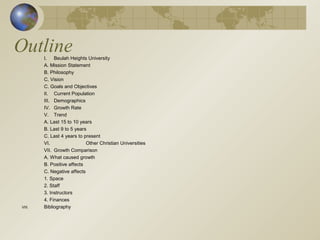
OutlineI. Beulah Heights University
A. Mission Statement
B. Philosophy
C. Vision
C. Goals and Objectives
II. Current Population
III. Demographics
IV. Growth Rate
V. Trend
A. Last 15 to 10 years
B. Last 9 to 5 years
C. Last 4 years to present
VI. Other Christian Universities
VII. Growth Comparison
A. What caused growth
B. Positive affects
C. Negative affects
1. Space
2. Staff
3. Instructors
4. Finances
VIII. Bibliography
References
1. Leedy P. D. and Ormrod J. E., Practical Research:
Planning and Design, 7th Edition. 2001.

Howtodo researchls620

  • 1.
    Research: How toWrite a Good Paper LS 620 Research Writing JB Armstrong
  • 2.
    Agenda Research Basics What researchis and is not Where research comes from Research deliverables Methodologies Research process Quantitative versus qualitative research Questions
  • 3.
    Research Basics What researchis and isn’t Research characteristics Research projects and pitfalls Sources of research projects Elements of research proposals Literature reviews
  • 4.
    What Research IsNot Research isn’t information gathering: Gathering information from resources such books or magazines isn’t research. No contribution to new knowledge. Research isn’t the transportation of facts: Merely transporting facts from one resource to another doesn’t constitute research. No contribution to new knowledge although this might make existing knowledge more accessible.
  • 5.
    What Research Is Researchis: “…the systematic process of collecting and analyzing information (data) in order to increase our understanding of the phenomenon about which we are concerned or interested.”1
  • 6.
    Research Characteristics 1. Originateswith a question or problem. 2. Requires clear articulation of a goal. 3. Follows a specific plan or procedure. 4. Often divides main problem into subproblems. 5. Guided by specific problem, question, or hypothesis. 6. Accepts certain critical assumptions. 7. Requires collection and interpretation of data.
  • 7.
    Research Projects Research beginswith a problem. This problem is not limited. Identifying this problem can actually be the hardest part of research. In general, good research projects should: Address an important question. Advance knowledge.
  • 8.
    Stating the ResearchProblem Once you’ve identified a research problem: State that problem clearly and completely. Determine the feasibility of the research.
  • 9.
    Definitions Define each technicalterm as it is used in relation to your research project. This helps remove significant ambiguity from the research itself by ensuring that reviewers, while they may not agree with your definitions, at least know what you’re talking about.
  • 10.
    Research Proposals Research proposalsare documents that describe the intended research including: Topic Issue Definitions Assumptions Importance Literature Review
  • 11.
    Literature Review A literaturereview is a necessity. Without this step, you won’t know if your problem has been solved or what related research is already underway. When performing the review: Start searching professional journals. Begin with the most recent articles you can find. Keep track of relevant articles in a bibliography. Don’t be discouraged if work on the topic is already underway.
  • 12.
    Literature Review Pitfalls (1of 2) Be very careful to check your sources when doing your literature review. Many trade magazines are not peer reviewed. Professional conferences and journals often have each article reviewed by multiple people before it is even recommended for publication.
  • 13.
    Literature Review Pitfalls (2of 2) The Internet can be a good source of information. It is also full of pseudo-science and poor research. Make sure you verify the claims of any documentation that has not been peer reviewed by other professionals in the computing industry.
  • 14.
    Processes & Methodologies ResearchProcess. Common Methodologies. Methodology Comparison.
  • 15.
    Research Process Research isan extremely cyclic process. Later stages might necessitate a review of earlier work. This isn’t a weakness of the process but is part of the built-in error correction machinery. Because of the cyclic nature of research, it can be difficult to determine where to start and when to stop.
  • 16.
    A Question IsRaised A question occurs to or is posed to the researcher for which that researcher has no answer. This doesn’t mean that someone else doesn’t already have an answer. The question needs to be converted to an appropriate problem statement like that documented in a research proposal.
  • 17.
    Literature Review The availableliterature is reviewed to determine if there is already a solution to the problem. Existing solutions do not always explain new observations. The existing solution might require some revision or even be discarded.
  • 18.
    Literature Evaluation It’s possiblethat the literature review has yielded a solution to the proposed problem. This means that you haven’t really done research. On the other hand, if the literature review turns up nothing, then additional research activities are justified.
  • 19.
    Acquire Data The researchernow begins to gather data relating to the research problem. The means of data acquisition will often change based on the type of the research problem. This might entail only data gathering, but it could also require the creation of new measurement instruments.
  • 20.
    Data Analysis The datathat were gathered in the previous step are analyzed as a first step in ascertaining their meaning. As before, the analysis of the data does not constitute research. This is basic number crunching.
  • 21.
    Data Interpretation The researcherinterprets the newly analyzed data and suggests a conclusion
  • 22.
    Claim (Thesis/Hypothesis) A debatablestatement or opinion that can be supported with evidence It answers the question: What can you prove? Example: • A basic fact (2 + 2 = 4) is not a claim. It can not be debated. • Atlanta is the best city for young people. This is debatable because the writer would need to provide evidence to prove why this statement would be true.
  • 23.
    Claim Support The datawill either support the claim or they won’t. This may lead the researcher to cycle back to an earlier step in the process and begin again with a new hypothesis. This is one of the self-correcting mechanisms associated with the scientific method.
  • 24.
    Valid Evidence This includesfacts and statistics from reliable sources Expert testimony Direct quotes from text Paraphrased information Specific details
  • 25.
    Warrant (Connector) The warrantconnects the evidence to the claim. It answers the question: So what?
  • 26.
    Transitions Indicates that achange in information is coming. Helps the writing in organizing information. Examples: also, in the same way, just as, likewise, but, however, in spite of, on the one hand, nevertheless, nonetheless, notwithstanding, in contrast, on the contrary, yet, first, second, third, next, then, finally
  • 27.
    Quotes Introduce quote: Statewho is writing/speaking and when Deliver: Use quote and cite properly Explain: Use all your own words to paraphrase the quote Analyze: Explain how the quote proves your claim or sub-claim
  • 28.
  • 29.
    Paragraph 2 Supporting details.For example: After using a quote, the next paragraph should explain how the quote proves your claim. Each paragraph should have a concluding sentence.
  • 30.
    Beulah Heights Universityis by far the fastest growing Christian University in the Southeast. Growth Rate of American Colleges and Universities
  • 31.
    OutlineI. Beulah HeightsUniversity A. Mission Statement B. Philosophy C. Vision C. Goals and Objectives II. Current Population III. Demographics IV. Growth Rate V. Trend A. Last 15 to 10 years B. Last 9 to 5 years C. Last 4 years to present VI. Other Christian Universities VII. Growth Comparison A. What caused growth B. Positive affects C. Negative affects 1. Space 2. Staff 3. Instructors 4. Finances VIII. Bibliography
  • 32.
    References 1. Leedy P.D. and Ormrod J. E., Practical Research: Planning and Design, 7th Edition. 2001.

Editor's Notes

  • #2 This presentation is a basic overview of research as it applies for Masters and DMin students. While the exact requirements between the two degrees are somewhat different, the basic concepts and approaches to research are not.
  • #3 This presentation is only an overview of research. The only way to get better at research is to do it.
  • #5 While both of these are tools used during research, they are not sufficient for research.
  • #7 These don’t represent some kind of linear plan, but are rather common characteristics shared by almost all legitimate research regardless of the venue by which that research was conducted.
  • #8 The concept of “important” questions is subjective and will depend on who you ask as well as the purpose of the research. For instance, PhD students have a different “bar” than Masters students owing to the requirement that their research be “original and significant.”
  • #9 When documenting the proposed research, you should be as precise as you can. You’ll probably find yourself editing and revising many times to attain the necessary level of precision and clarity.
  • #11 There are some basic variations on this theme, but all of these areas will be covered. This format serves to crystalize your thought process and to help ensure that no critical elements of your research have been neglected.
  • #12 Some journals include IEEE and ACM. Be careful of trade journals; they’re often not peer reviewed which can call the content into question in terms of its reliability and quality. The bibliography could be a Word document, Excel spreadsheet, or bibliographic database. Even if the article doesn’t directly pertain to your current project, it might provide you with ideas.
  • #16 We’ll try to give some guidelines as to how to choose starting and stopping points during your research work. Please keep in mind that the following steps don’t have to be slavishly followed in the sequence in which they are presented.
  • #18 The literature review is often a good source for additional ideas. This is also a good place to go in conjunction with the prior step; there’s no point in wasting good brain cells coming up with hypotheses that solve a problem that has already been adequately addressed.
  • #19 Keep in mind that just because you didn’t find a solution today, doesn’t mean that one won’t show up tomorrow. This is one of the reasons that researchers are always reading and trying to keep up to date with current trends.
  • #22 A statement of causality is very difficult to demonstrate because there often many other confounding factors. For an example of this, do a quick bit of reading on the hoops researchers had to go through while trying to show a causal link between smoking and certain kinds of cancer.
  • #23 A statement of causality is very difficult to demonstrate because there often many other confounding factors. For an example of this, do a quick bit of reading on the hoops researchers had to go through while trying to show a causal link between smoking and certain kinds of cancer.