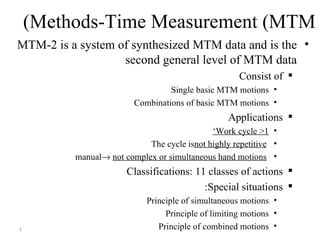
Methods-Time Measurement (MTM) MTM-2 is a system of synthesized MTM data and is the second general level of MTM data Consist of Single basic MTM motions Combinations of basic MTM motions Applications Work cycle >1’ The cycle is  not highly repetitive manual    not complex or simultaneous hand motions Classifications: 11 classes of actions Special situations:  Principle of simultaneous motions Principle of limiting motions Principle of combined motions
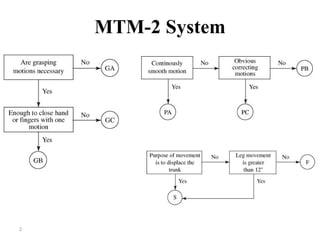
MTM-2 System
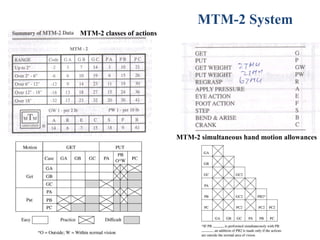
MTM-2 simultaneous hand motion allowances MTM-2 classes of actions MTM-2 System
Methods-Time Measurement (MTM) MTM-3 Save time at the expense of some accuracy: ±5%,95% Not use for operations: eye focus, eye travel time 4 categories of manual motions: handle, transport, step and foot motions, bend and arise MTM-V Use in metal cutting operations To establish setup time for all typical machine tools MTM-C Use in baking and insurance industries,2-level system To establish time standards for clerical-related works
Methods-Time Measurement (MTM) MTM-M: Use for evaluating operator work using a  stereoscopic microscope Other specialized MTM systems MTM-TE: electronic test, 3-level MTM-MEK: electronic test, 3-level, small-lot  MTM-UAS: describe process, determine allowed times for batch production, 3-level system MTM systems comparison Criteria: accuracy, number of therbligs utilized, time to analyze a job (at 90% confidence level) MTM-2 is the best
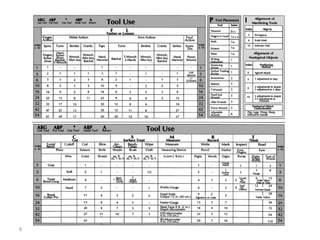
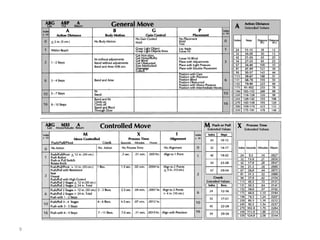
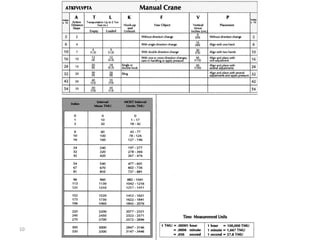
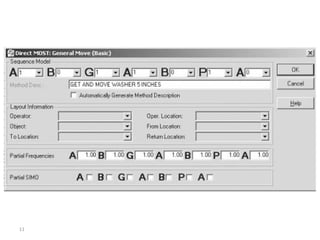
Maynard Operation Sequence Technique (MOST) A simplified system: fast establish time standards MOST identifies 3 basic sequence models: General move:  free  object movement through the air Controlled move: object remains  contact  with surface or  attached  to another objects during the movement Tool use: use of common hand tools Two adaptations: Mini and Maxi MOST Mini MOST:  identical, short-cycle  operations Maxi MOST:  long-cycle  operations Both manual and computerized versions
Methods time measurement (mtm)

Methods time measurement (mtm)

  • 1.
    Methods-Time Measurement (MTM)MTM-2 is a system of synthesized MTM data and is the second general level of MTM data Consist of Single basic MTM motions Combinations of basic MTM motions Applications Work cycle >1’ The cycle is not highly repetitive manual  not complex or simultaneous hand motions Classifications: 11 classes of actions Special situations: Principle of simultaneous motions Principle of limiting motions Principle of combined motions
  • 2.
  • 3.
    MTM-2 simultaneous handmotion allowances MTM-2 classes of actions MTM-2 System
  • 5.
    Methods-Time Measurement (MTM)MTM-3 Save time at the expense of some accuracy: ±5%,95% Not use for operations: eye focus, eye travel time 4 categories of manual motions: handle, transport, step and foot motions, bend and arise MTM-V Use in metal cutting operations To establish setup time for all typical machine tools MTM-C Use in baking and insurance industries,2-level system To establish time standards for clerical-related works
  • 6.
    Methods-Time Measurement (MTM)MTM-M: Use for evaluating operator work using a stereoscopic microscope Other specialized MTM systems MTM-TE: electronic test, 3-level MTM-MEK: electronic test, 3-level, small-lot MTM-UAS: describe process, determine allowed times for batch production, 3-level system MTM systems comparison Criteria: accuracy, number of therbligs utilized, time to analyze a job (at 90% confidence level) MTM-2 is the best
  • 7.
    Maynard Operation SequenceTechnique (MOST) A simplified system: fast establish time standards MOST identifies 3 basic sequence models: General move: free object movement through the air Controlled move: object remains contact with surface or attached to another objects during the movement Tool use: use of common hand tools Two adaptations: Mini and Maxi MOST Mini MOST: identical, short-cycle operations Maxi MOST: long-cycle operations Both manual and computerized versions