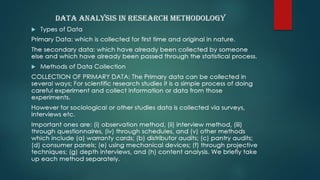
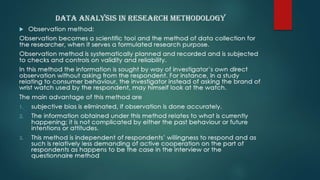
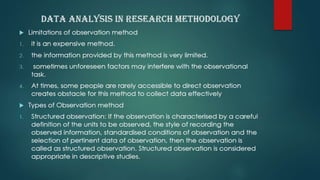
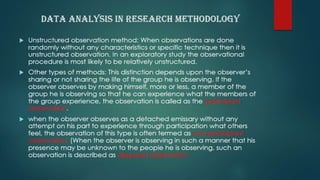
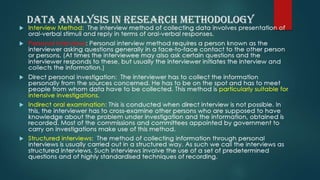
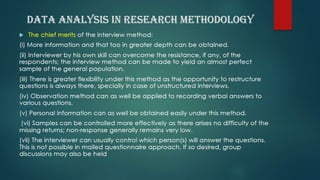
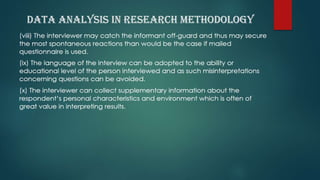
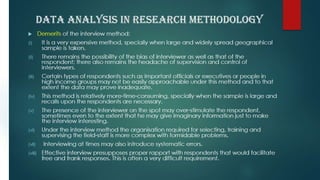
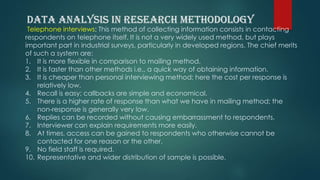
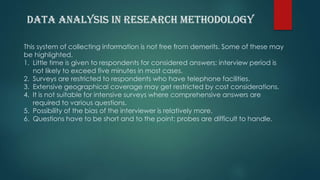
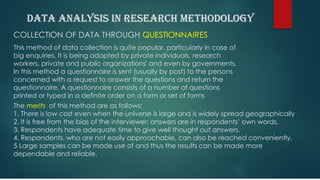
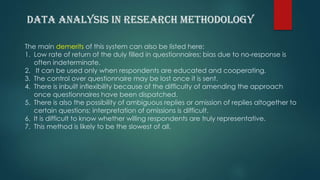
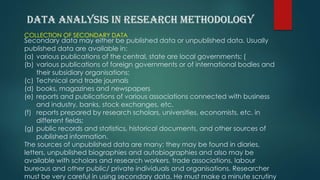
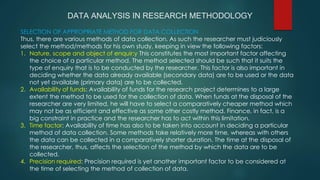
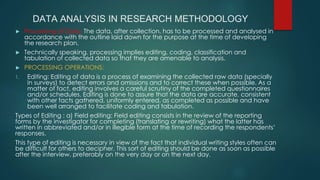
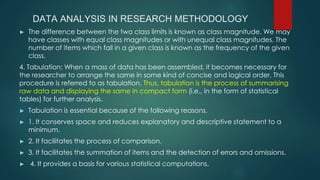
This document discusses various methods for collecting data in research, including telephone interviews, questionnaires, and secondary data. It provides details on the merits and limitations of telephone interviews, which allow flexible and fast collection of information but restrict responses to those with phone access. Questionnaires are popular due to low cost, but have low response rates and risk ambiguous answers. Secondary data can be published or unpublished, and must be carefully evaluated for reliability, suitability, and adequacy for the research purpose. The document also covers factors to consider when selecting appropriate data collection methods, such as the research scope and objectives, available funds and time, and required precision. It describes data processing steps like editing raw data to detect and correct errors.











![Skewness and Kurtosis[1].pptx](https://cdn.slidesharecdn.com/ss_thumbnails/skewnessandkurtosis1-230825165704-d8480639-thumbnail.jpg?width=640&height=640&fit=bounds)


![[DSC Europe 25] Ivan Lukovic & Marija Djukic - From Data to Value: Why Maturi...](https://cdn.slidesharecdn.com/ss_thumbnails/ahrfps8xr6knowwhacxh-1-ivan-marija-dsc-2025-ld-v1-presentation-260115093812-be21adfc-thumbnail.jpg?width=640&height=640&fit=bounds)


![[DSC Europe 25] Andrzej Kowalczyk - AI - how to start small and grow in the f...](https://cdn.slidesharecdn.com/ss_thumbnails/oy1zmo94qv6vpcqjvno2-andrzej-kowalczyk-ai-how-to-start-small-and-grow-in-the-future-1-260119121559-cf093b23-thumbnail.jpg?width=640&height=640&fit=bounds)


![[DSC Europe 25] Bojan Djuricic - Predictive Design Process.pdf](https://cdn.slidesharecdn.com/ss_thumbnails/5awdrbedqdek3gqu2ezy-4-the-predictive-design-bojan-djuricic-260120105856-6c399e9b-thumbnail.jpg?width=640&height=640&fit=bounds)


