VOLCANISM
By Hashim Ali (7A)
What is volcanism?
• When hot molten magma escapes from the Earth’s core becoming
cooler, and forming hard rocks, we refer to this process as
volcanism.
Types of Volcanism….!
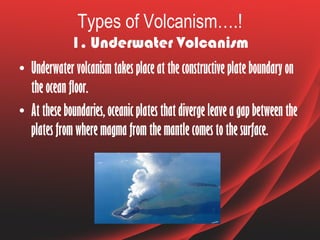
1. Underwater Volcanism
• Underwater volcanism takes place at the constructive plate boundary on
the ocean floor.
• At these boundaries, oceanic plates that diverge leave a gap between the
plates from where magma from the mantle comes to the surface.
Types of Volcanism….!
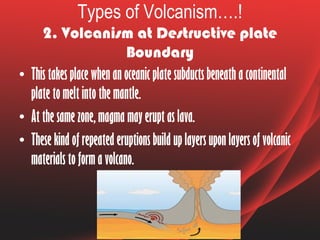
2. Volcanism at Destructive plate
Boundary
• This takes place when an oceanic plate subducts beneath a continental
plate to melt into the mantle.
• At the same zone, magma may erupt as lava.
• These kind of repeated eruptions build up layers upon layers of volcanic
materials to form a volcano.
Types of Volcanism…!
3. Volcanism at Hot Spots
• This takes place when columns of molten magma in the mantle rises from
the hot spot to the Earth’s surface.
• It melts the crustal plate directly above it.
• These columns of magma are found is fixed locations deep within the
mantle.
• This is called a hot spot volcano.
Parts of a volcano
• Vent: The opening or a hole through which magma comes to the surface.
• Cone: The layers of volcanic materials that build up around the vent to form a
cone-shaped structure.
• Pipe: The passageway which joins the vent to the crater of the volcano.
• Crater: The top of the pipe through which magma is forced onto the Earth’s
surface.
• Lava: The magma which is forced onto the Earth’s surface.
• Magma chamber: The cavity in the Earth’s crust below the vent that holds magma.
Parts of a volcano
Classifying Volcanoes…
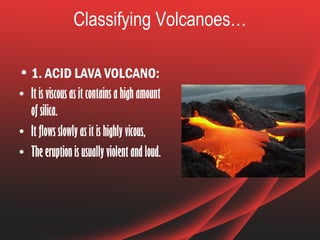
• 1. ACID LAVA VOLCANO:
• It is viscous as it contains a high amount
of silica.
• It flows slowly as it is highly vicous,
• The eruption is usually violent and loud.
Classifying Volcanoes…
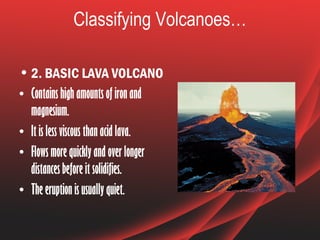
• 2. BASIC LAVA VOLCANO
• Contains high amounts of iron and
magnesium.
• It is less viscous than acid lava.
• Flows more quickly and over longer
distances before it solidifies.
• The eruption is usually quiet.
Classifying Volcanoes…
• 3. Composite Lava Volcano
• Also known as ash and cinder volcano.
• Eruptions are usually violent and loud.
• They contain viscous acid lava.
Volcanoes in Pakistan!
• The mainly found volcanoes here are mud volcanoes.
• They are generally passive, emitting gases that bubble passively in their craters.
• Balochistan has more than 80 active mud volcanoes.
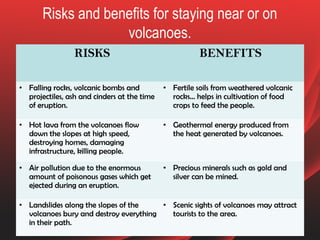
Risks and benefits for staying near or on
volcanoes.
RISKS BENEFITS
• Falling rocks, volcanic bombs and
projectiles, ash and cinders at the time
of eruption.
• Fertile soils from weathered volcanic
rocks… helps in cultivation of food
crops to feed the people.
• Hot lava from the volcanoes flow
down the slopes at high speed,
destroying homes, damaging
infrastructure, killing people.
• Geothermal energy produced from
the heat generated by volcanoes.
• Air pollution due to the enormous
amount of poisonous gases which get
ejected during an eruption.
• Precious minerals such as gold and
silver can be mined.
• Landslides along the slopes of the
volcanoes bury and destroy everything
in their path.
• Scenic sights of volcanoes may attract
tourists to the area.
Volcanism - Grade 7

Volcanism - Grade 7

  • 1.
  • 2.
    What is volcanism? •When hot molten magma escapes from the Earth’s core becoming cooler, and forming hard rocks, we refer to this process as volcanism.
  • 3.
    Types of Volcanism….! 1.Underwater Volcanism • Underwater volcanism takes place at the constructive plate boundary on the ocean floor. • At these boundaries, oceanic plates that diverge leave a gap between the plates from where magma from the mantle comes to the surface.
  • 4.
    Types of Volcanism….! 2.Volcanism at Destructive plate Boundary • This takes place when an oceanic plate subducts beneath a continental plate to melt into the mantle. • At the same zone, magma may erupt as lava. • These kind of repeated eruptions build up layers upon layers of volcanic materials to form a volcano.
  • 5.
    Types of Volcanism…! 3.Volcanism at Hot Spots • This takes place when columns of molten magma in the mantle rises from the hot spot to the Earth’s surface. • It melts the crustal plate directly above it. • These columns of magma are found is fixed locations deep within the mantle. • This is called a hot spot volcano.
  • 6.
    Parts of avolcano • Vent: The opening or a hole through which magma comes to the surface. • Cone: The layers of volcanic materials that build up around the vent to form a cone-shaped structure. • Pipe: The passageway which joins the vent to the crater of the volcano. • Crater: The top of the pipe through which magma is forced onto the Earth’s surface. • Lava: The magma which is forced onto the Earth’s surface. • Magma chamber: The cavity in the Earth’s crust below the vent that holds magma.
  • 7.
    Parts of avolcano
  • 8.
    Classifying Volcanoes… • 1.ACID LAVA VOLCANO: • It is viscous as it contains a high amount of silica. • It flows slowly as it is highly vicous, • The eruption is usually violent and loud.
  • 9.
    Classifying Volcanoes… • 2.BASIC LAVA VOLCANO • Contains high amounts of iron and magnesium. • It is less viscous than acid lava. • Flows more quickly and over longer distances before it solidifies. • The eruption is usually quiet.
  • 10.
    Classifying Volcanoes… • 3.Composite Lava Volcano • Also known as ash and cinder volcano. • Eruptions are usually violent and loud. • They contain viscous acid lava.
  • 11.
    Volcanoes in Pakistan! •The mainly found volcanoes here are mud volcanoes. • They are generally passive, emitting gases that bubble passively in their craters. • Balochistan has more than 80 active mud volcanoes.
  • 12.
    Risks and benefitsfor staying near or on volcanoes. RISKS BENEFITS • Falling rocks, volcanic bombs and projectiles, ash and cinders at the time of eruption. • Fertile soils from weathered volcanic rocks… helps in cultivation of food crops to feed the people. • Hot lava from the volcanoes flow down the slopes at high speed, destroying homes, damaging infrastructure, killing people. • Geothermal energy produced from the heat generated by volcanoes. • Air pollution due to the enormous amount of poisonous gases which get ejected during an eruption. • Precious minerals such as gold and silver can be mined. • Landslides along the slopes of the volcanoes bury and destroy everything in their path. • Scenic sights of volcanoes may attract tourists to the area.