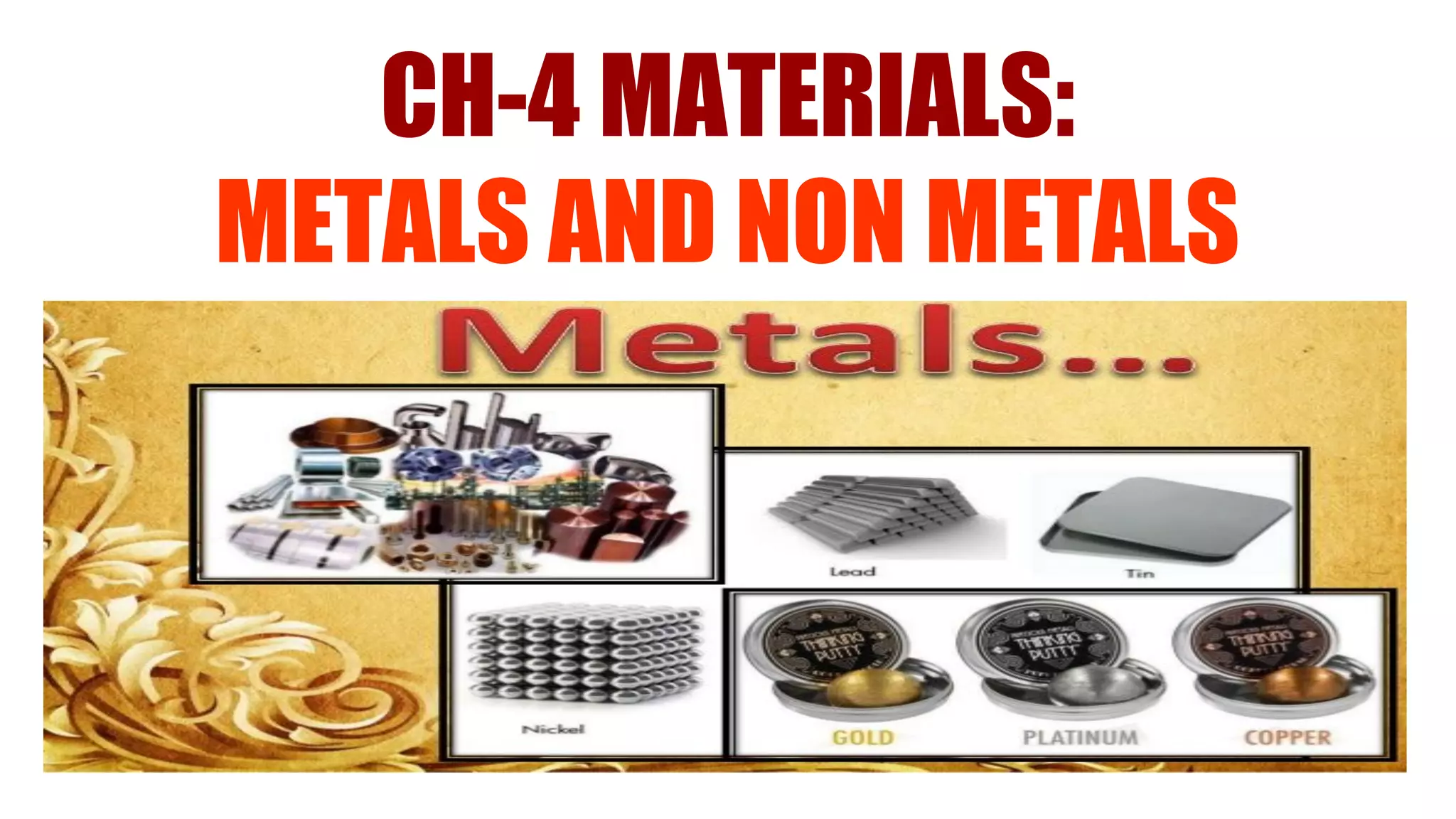
CH-4 MATERIALS:
METALS AND NON METALS
Physical properties of metals :-
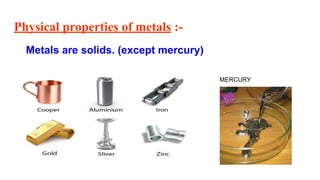
Metals are solids. (except mercury)
MERCURY
Physical properties of metals :-
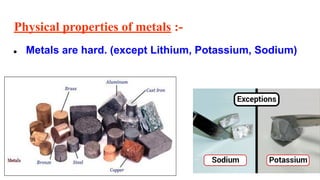
● Metals are hard. (except Lithium, Potassium, Sodium)
Physical properties of metals :-
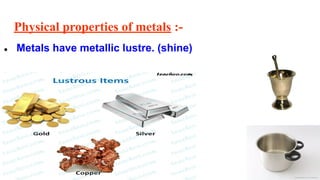
● Metals have metallic lustre. (shine)
Physical properties of metals :-
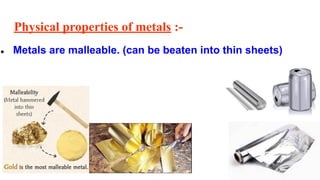
● Metals are malleable. (can be beaten into thin sheets)
Physical properties of metals :-
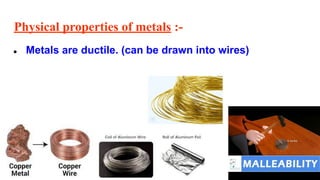
● Metals are ductile. (can be drawn into wires)
Physical properties of metals :-
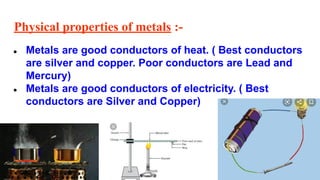
● Metals are good conductors of heat. ( Best conductors
are silver and copper. Poor conductors are Lead and
Mercury)
● Metals are good conductors of electricity. ( Best
conductors are Silver and Copper)
Physical properties of metals :-
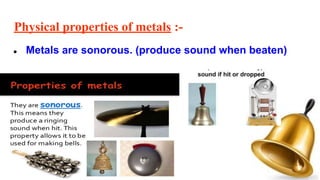
● Metals are sonorous. (produce sound when beaten)
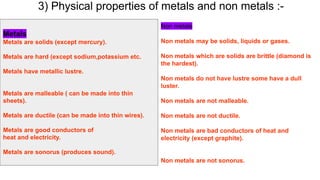
3) Physical properties of metals and non metals :-
METALS
Metals
Metals are solids (except mercury).
Metals are hard (except sodium,potassium etc.
Metals have metallic lustre.
Metals are malleable ( can be made into thin
sheets).
Metals are ductile (can be made into thin wires).
Metals are good conductors of
heat and electricity.
Metals are sonorus (produces sound).
Non metals
Non metals may be solids, liquids or gases.
Non metals which are solids are brittle (diamond is
the hardest).
Non metals do not have lustre some have a dull
luster.
Non metals are not malleable.
Non metals are not ductile.
Non metals are bad conductors of heat and
electricity (except graphite).
Non metals are not sonorus.
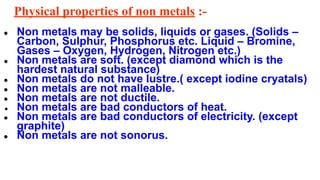
Physical properties of non metals :-
● Non metals may be solids, liquids or gases. (Solids –
Carbon, Sulphur, Phosphorus etc. Liquid – Bromine,
Gases – Oxygen, Hydrogen, Nitrogen etc.)
● Non metals are soft. (except diamond which is the
hardest natural substance)
● Non metals do not have lustre.( except iodine cryatals)
● Non metals are not malleable.
● Non metals are not ductile.
● Non metals are bad conductors of heat.
● Non metals are bad conductors of electricity. (except
graphite)
● Non metals are not sonorus.
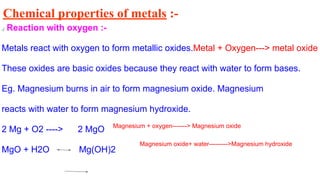
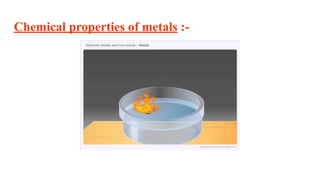
Chemical properties of metals :-
a) Reaction with oxygen :-
Metals react with oxygen to form metallic oxides.Metal + Oxygen---> metal oxide
These oxides are basic oxides because they react with water to form bases.
Eg. Magnesium burns in air to form magnesium oxide. Magnesium
reacts with water to form magnesium hydroxide.
2 Mg + O2 ----> 2 MgO
MgO + H2O Mg(OH)2
Magnesium + oxygen-------> Magnesium oxide
Magnesium oxide+ water--------->Magnesium hydroxide
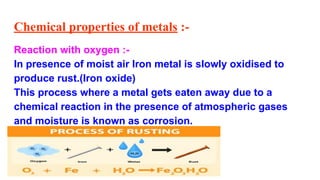
Chemical properties of metals :-
Reaction with oxygen :-
In presence of moist air Iron metal is slowly oxidised to
produce rust.(Iron oxide)
This process where a metal gets eaten away due to a
chemical reaction in the presence of atmospheric gases
and moisture is known as corrosion.
Reaction with oxygen :-
Copper articles exposed to moist air for long, they develop a dull greenish coating.
The green material is a mixture of copper hydroxide {Cu(OH)2} and copper
carbonate[ CuCO3]
Silver objects tarnish with time and get a black coating of silver sulphide when they
react with sulphur containing substances in the air.
Gold and Platinum do not react with oxygen in the air.
2 Cu+H2O+CO2+O2-------> Cu[OH]2+CuCO3
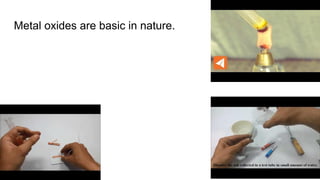
Metal oxides are basic in nature.
Chemical properties of metals :-
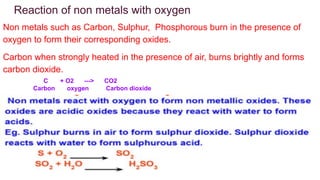
Reaction of non metals with oxygen
Non metals such as Carbon, Sulphur, Phosphorous burn in the presence of
oxygen to form their corresponding oxides.
Carbon when strongly heated in the presence of air, burns brightly and forms
carbon dioxide.
C + O2 ---> CO2
Carbon oxygen Carbon dioxide
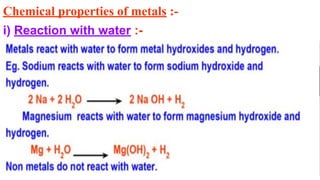
Chemical properties of metals :-
i) Reaction with water :-
Chemical properties of metals :-
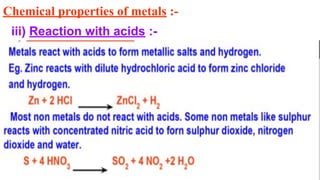
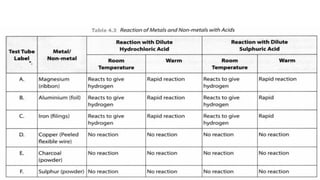
iii) Reaction with acids :-
Chemical properties of metals :-
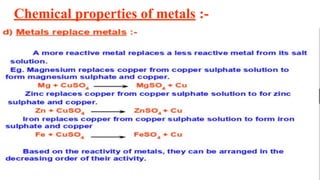
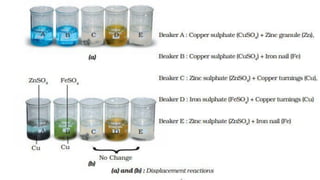
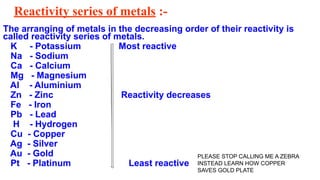
Reactivity series of metals :-
The arranging of metals in the decreasing order of their reactivity is
called reactivity series of metals.
K - Potassium Most reactive
Na - Sodium
Ca - Calcium
Mg - Magnesium
Al - Aluminium
Zn - Zinc Reactivity decreases
Fe - Iron
Pb - Lead
H - Hydrogen
Cu - Copper
Ag - Silver
Au - Gold
Pt - Platinum Least reactive
PLEASE STOP CALLING ME A ZEBRA
INSTEAD LEARN HOW COPPER
SAVES GOLD PLATE
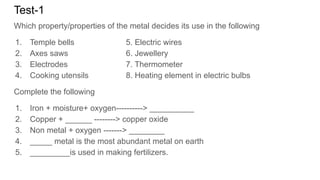
Test-1
Which property/properties of the metal decides its use in the following
1. Temple bells 5. Electric wires
2. Axes saws 6. Jewellery
3. Electrodes 7. Thermometer
4. Cooking utensils 8. Heating element in electric bulbs
Complete the following
1. Iron + moisture+ oxygen----------> __________
2. Copper + ______ --------> copper oxide
3. Non metal + oxygen -------> ________
4. _____ metal is the most abundant metal on earth
5. _________is used in making fertilizers.

CH-4 MATERIALS_ METALS AND NON METALS.pdf

  • 1.
  • 2.
    Physical properties ofmetals :- Metals are solids. (except mercury) MERCURY
  • 3.
    Physical properties ofmetals :- ● Metals are hard. (except Lithium, Potassium, Sodium)
  • 4.
    Physical properties ofmetals :- ● Metals have metallic lustre. (shine)
  • 5.
    Physical properties ofmetals :- ● Metals are malleable. (can be beaten into thin sheets)
  • 6.
    Physical properties ofmetals :- ● Metals are ductile. (can be drawn into wires)
  • 7.
    Physical properties ofmetals :- ● Metals are good conductors of heat. ( Best conductors are silver and copper. Poor conductors are Lead and Mercury) ● Metals are good conductors of electricity. ( Best conductors are Silver and Copper)
  • 8.
    Physical properties ofmetals :- ● Metals are sonorous. (produce sound when beaten)
  • 10.
    3) Physical propertiesof metals and non metals :- METALS Metals Metals are solids (except mercury). Metals are hard (except sodium,potassium etc. Metals have metallic lustre. Metals are malleable ( can be made into thin sheets). Metals are ductile (can be made into thin wires). Metals are good conductors of heat and electricity. Metals are sonorus (produces sound). Non metals Non metals may be solids, liquids or gases. Non metals which are solids are brittle (diamond is the hardest). Non metals do not have lustre some have a dull luster. Non metals are not malleable. Non metals are not ductile. Non metals are bad conductors of heat and electricity (except graphite). Non metals are not sonorus.
  • 11.
    Physical properties ofnon metals :- ● Non metals may be solids, liquids or gases. (Solids – Carbon, Sulphur, Phosphorus etc. Liquid – Bromine, Gases – Oxygen, Hydrogen, Nitrogen etc.) ● Non metals are soft. (except diamond which is the hardest natural substance) ● Non metals do not have lustre.( except iodine cryatals) ● Non metals are not malleable. ● Non metals are not ductile. ● Non metals are bad conductors of heat. ● Non metals are bad conductors of electricity. (except graphite) ● Non metals are not sonorus.
  • 12.
    Chemical properties ofmetals :- a) Reaction with oxygen :- Metals react with oxygen to form metallic oxides.Metal + Oxygen---> metal oxide These oxides are basic oxides because they react with water to form bases. Eg. Magnesium burns in air to form magnesium oxide. Magnesium reacts with water to form magnesium hydroxide. 2 Mg + O2 ----> 2 MgO MgO + H2O Mg(OH)2 Magnesium + oxygen-------> Magnesium oxide Magnesium oxide+ water--------->Magnesium hydroxide
  • 13.
    Chemical properties ofmetals :- Reaction with oxygen :- In presence of moist air Iron metal is slowly oxidised to produce rust.(Iron oxide) This process where a metal gets eaten away due to a chemical reaction in the presence of atmospheric gases and moisture is known as corrosion.
  • 14.
    Reaction with oxygen:- Copper articles exposed to moist air for long, they develop a dull greenish coating. The green material is a mixture of copper hydroxide {Cu(OH)2} and copper carbonate[ CuCO3] Silver objects tarnish with time and get a black coating of silver sulphide when they react with sulphur containing substances in the air. Gold and Platinum do not react with oxygen in the air. 2 Cu+H2O+CO2+O2-------> Cu[OH]2+CuCO3
  • 15.
    Metal oxides arebasic in nature.
  • 16.
  • 17.
    Reaction of nonmetals with oxygen Non metals such as Carbon, Sulphur, Phosphorous burn in the presence of oxygen to form their corresponding oxides. Carbon when strongly heated in the presence of air, burns brightly and forms carbon dioxide. C + O2 ---> CO2 Carbon oxygen Carbon dioxide
  • 18.
    Chemical properties ofmetals :- i) Reaction with water :-
  • 19.
    Chemical properties ofmetals :- iii) Reaction with acids :-
  • 21.
  • 23.
    Reactivity series ofmetals :- The arranging of metals in the decreasing order of their reactivity is called reactivity series of metals. K - Potassium Most reactive Na - Sodium Ca - Calcium Mg - Magnesium Al - Aluminium Zn - Zinc Reactivity decreases Fe - Iron Pb - Lead H - Hydrogen Cu - Copper Ag - Silver Au - Gold Pt - Platinum Least reactive PLEASE STOP CALLING ME A ZEBRA INSTEAD LEARN HOW COPPER SAVES GOLD PLATE
  • 27.
    Test-1 Which property/properties ofthe metal decides its use in the following 1. Temple bells 5. Electric wires 2. Axes saws 6. Jewellery 3. Electrodes 7. Thermometer 4. Cooking utensils 8. Heating element in electric bulbs Complete the following 1. Iron + moisture+ oxygen----------> __________ 2. Copper + ______ --------> copper oxide 3. Non metal + oxygen -------> ________ 4. _____ metal is the most abundant metal on earth 5. _________is used in making fertilizers.