General Chemistry I 
11/05/14 
1 
KSP General chemistry I
11/05/14 
2 
METAL AND NON-METALS
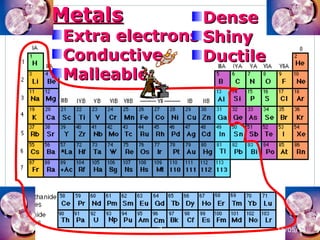
MMeettaallss 
EExxttrraa eelleeccttrroonnss 
CCoonndduuccttiivvee 
MMaalllleeaabbllee 
DDeennssee 
SShhiinnyy 
DDuuccttiillee 
3 11/05/14
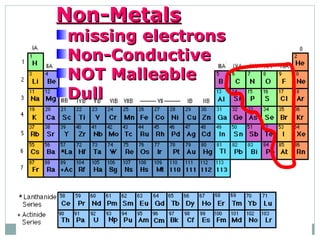
NNoonn--MMeettaallss 
mmiissssiinngg eelleeccttrroonnss 
NNoonn--CCoonndduuccttiivvee 
NNOOTT MMaalllleeaabbllee 
DDuullll 
4 11/05/14
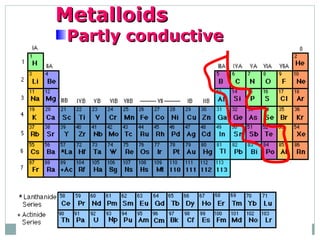
MMeettaallllooiiddss 
PPaarrttllyy ccoonndduuccttiivvee 
5 11/05/14
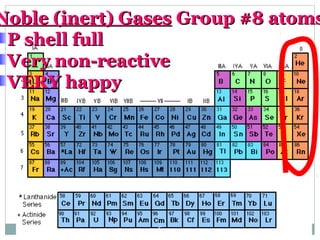
NNoobbllee ((iinneerrtt)) GGaasseess GGrroouupp ##88 aattoommss 
PP sshheellll ffuullll 
VVeerryy nnoonn--rreeaaccttiivvee 
VVEERRYY hhaappppyy 
6 11/05/14
Metal and Non-metals 
ELECTRONIC NATURE OF METALS AND NON METALS 
THE ESSENTIAL DIFFERENCE BETWEEN METAL AND NON METAL IS 
THEIR AFFINITY FOR ELECTRONS. 
A METAL IS AN ELEMENT WHICH BECOMES POSITIVELY CHARGE 
WHEN IT LOSES ELECTRONS. 
A NON METAL IS AN ELEMENT WHICH FORMS 
NEGATIVE IONS BY GAINING ELECTRONS. 
COMPARE THE ELECTRONIC CONFIGURATION OF METALS AND NON 
METALS WITH THOSE OF NOBLE GASES 
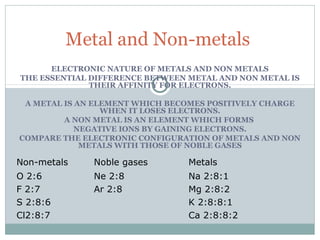
Non-metals Noble gases Metals 
O 2:6 
Ne 2:8 
F 2:7 
Ar 2:8 
S 2:8:6 
Cl2:8:7 
Na 2:8:1 
Mg 2:8:2 
K 2:8:8:1 
Ca 2:8:8:2
11/05/14 
8 
cont… 
Most metals have 1-3 electrons more than a noble gas 
and non metals have 1-4 electrons less than noble gas. 
Metal therefore reacts by electron loss forming an ionic 
compound, 
Non-metal combine either by electrons gain forming 
ionic compound or by sharing electrons forming covalent 
compounds.
11/05/14 
9 cont.. 
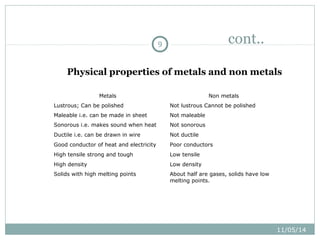
Physical properties of metals and non metals 
Metals Non metals 
Lustrous; Can be polished Not lustrous Cannot be polished 
Maleable i.e. can be made in sheet Not maleable 
Sonorous i.e. makes sound when heat Not sonorous 
Ductile i.e. can be drawn in wire Not ductile 
Good conductor of heat and electricity Poor conductors 
High tensile strong and tough Low tensile 
High density Low density 
Solids with high melting points About half are gases, solids have low 
melting points.
11/05/14 
10 
cont… 
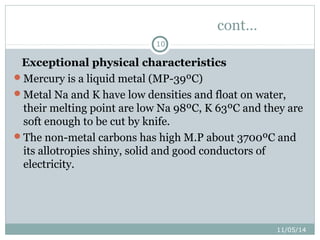
Exceptional physical characteristics 
Mercury is a liquid metal (MP-39ºC) 
Metal Na and K have low densities and float on water, 
their melting point are low Na 98ºC, K 63ºC and they are 
soft enough to be cut by knife. 
The non-metal carbons has high M.P about 3700ºC and 
its allotropies shiny, solid and good conductors of 
electricity.
11/05/14 
11 
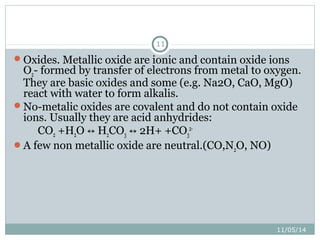
Oxides. Metallic oxide are ionic and contain oxide ions 
O2- formed by transfer of electrons from metal to oxygen. 
They are basic oxides and some (e.g. Na2O, CaO, MgO) 
react with water to form alkalis. 
No-metalic oxides are covalent and do not contain oxide 
ions. Usually they are acid anhydrides: 
CO2 +H2O ↔ H2CO3 ↔ 2H+ +CO3 
2- 
A few non metallic oxide are neutral.(CO,N2O, NO)
11/05/14 
1 2 cont.. 
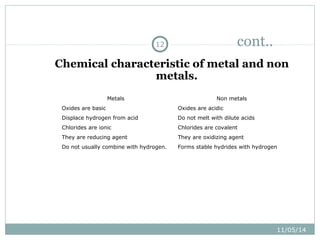
Chemical characteristic of metal and non 
metals. 
Metals Non metals 
Oxides are basic Oxides are acidic 
Displace hydrogen from acid Do not melt with dilute acids 
Chlorides are ionic Chlorides are covalent 
They are reducing agent They are oxidizing agent 
Do not usually combine with hydrogen. Forms stable hydrides with hydrogen
11/05/14 
13 
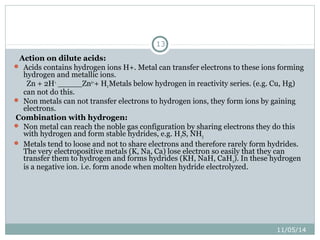
Action on dilute acids: 
 Acids contains hydrogen ions H+. Metal can transfer electrons to these ions forming 
hydrogen and metallic ions. 
Zn + 2H+ _____Zn2++ H2 Metals below hydrogen in reactivity series. (e.g. Cu, Hg) 
can not do this. 
 Non metals can not transfer electrons to hydrogen ions, they form ions by gaining 
electrons. 
Combination with hydrogen: 
 Non metal can reach the noble gas configuration by sharing electrons they do this 
with hydrogen and form stable hydrides, e.g. H2S, NH3 
 Metals tend to loose and not to share electrons and therefore rarely form hydrides. 
The very electropositive metals (K, Na, Ca) lose electron so easily that they can 
transfer them to hydrogen and forms hydrides (KH, NaH, CaH2). In these hydrogen 
is a negative ion. i.e. form anode when molten hydride electrolyzed.
11/05/14 
14 
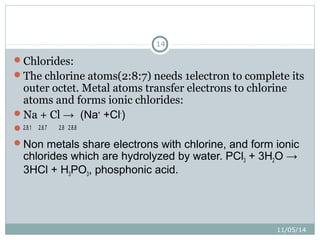
Chlorides: 
The chlorine atoms(2:8:7) needs 1electron to complete its 
outer octet. Metal atoms transfer electrons to chlorine 
atoms and forms ionic chlorides: 
Na + Cl → (Na+ +Cl-) 
2.8.1 2.8.7 2.8 2.8.8 
Non metals share electrons with chlorine, and form ionic 
chlorides which are hydrolyzed by water. PCl3 + 3H2O → 
3HCl + H3PO3, phosphonic acid.
Pharmaceutical use of metal and non- metal 
11/05/14 
15

5.metal and non metals

  • 1.
    General Chemistry I 11/05/14 1 KSP General chemistry I
  • 2.
    11/05/14 2 METALAND NON-METALS
  • 3.
    MMeettaallss EExxttrraa eelleeccttrroonnss CCoonndduuccttiivvee MMaalllleeaabbllee DDeennssee SShhiinnyy DDuuccttiillee 3 11/05/14
  • 4.
    NNoonn--MMeettaallss mmiissssiinngg eelleeccttrroonnss NNoonn--CCoonndduuccttiivvee NNOOTT MMaalllleeaabbllee DDuullll 4 11/05/14
  • 5.
  • 6.
    NNoobbllee ((iinneerrtt)) GGaasseessGGrroouupp ##88 aattoommss PP sshheellll ffuullll VVeerryy nnoonn--rreeaaccttiivvee VVEERRYY hhaappppyy 6 11/05/14
  • 7.
    Metal and Non-metals ELECTRONIC NATURE OF METALS AND NON METALS THE ESSENTIAL DIFFERENCE BETWEEN METAL AND NON METAL IS THEIR AFFINITY FOR ELECTRONS. A METAL IS AN ELEMENT WHICH BECOMES POSITIVELY CHARGE WHEN IT LOSES ELECTRONS. A NON METAL IS AN ELEMENT WHICH FORMS NEGATIVE IONS BY GAINING ELECTRONS. COMPARE THE ELECTRONIC CONFIGURATION OF METALS AND NON METALS WITH THOSE OF NOBLE GASES Non-metals Noble gases Metals O 2:6 Ne 2:8 F 2:7 Ar 2:8 S 2:8:6 Cl2:8:7 Na 2:8:1 Mg 2:8:2 K 2:8:8:1 Ca 2:8:8:2
  • 8.
    11/05/14 8 cont… Most metals have 1-3 electrons more than a noble gas and non metals have 1-4 electrons less than noble gas. Metal therefore reacts by electron loss forming an ionic compound, Non-metal combine either by electrons gain forming ionic compound or by sharing electrons forming covalent compounds.
  • 9.
    11/05/14 9 cont.. Physical properties of metals and non metals Metals Non metals Lustrous; Can be polished Not lustrous Cannot be polished Maleable i.e. can be made in sheet Not maleable Sonorous i.e. makes sound when heat Not sonorous Ductile i.e. can be drawn in wire Not ductile Good conductor of heat and electricity Poor conductors High tensile strong and tough Low tensile High density Low density Solids with high melting points About half are gases, solids have low melting points.
  • 10.
    11/05/14 10 cont… Exceptional physical characteristics Mercury is a liquid metal (MP-39ºC) Metal Na and K have low densities and float on water, their melting point are low Na 98ºC, K 63ºC and they are soft enough to be cut by knife. The non-metal carbons has high M.P about 3700ºC and its allotropies shiny, solid and good conductors of electricity.
  • 11.
    11/05/14 11 Oxides.Metallic oxide are ionic and contain oxide ions O2- formed by transfer of electrons from metal to oxygen. They are basic oxides and some (e.g. Na2O, CaO, MgO) react with water to form alkalis. No-metalic oxides are covalent and do not contain oxide ions. Usually they are acid anhydrides: CO2 +H2O ↔ H2CO3 ↔ 2H+ +CO3 2- A few non metallic oxide are neutral.(CO,N2O, NO)
  • 12.
    11/05/14 1 2cont.. Chemical characteristic of metal and non metals. Metals Non metals Oxides are basic Oxides are acidic Displace hydrogen from acid Do not melt with dilute acids Chlorides are ionic Chlorides are covalent They are reducing agent They are oxidizing agent Do not usually combine with hydrogen. Forms stable hydrides with hydrogen
  • 13.
    11/05/14 13 Actionon dilute acids:  Acids contains hydrogen ions H+. Metal can transfer electrons to these ions forming hydrogen and metallic ions. Zn + 2H+ _____Zn2++ H2 Metals below hydrogen in reactivity series. (e.g. Cu, Hg) can not do this.  Non metals can not transfer electrons to hydrogen ions, they form ions by gaining electrons. Combination with hydrogen:  Non metal can reach the noble gas configuration by sharing electrons they do this with hydrogen and form stable hydrides, e.g. H2S, NH3  Metals tend to loose and not to share electrons and therefore rarely form hydrides. The very electropositive metals (K, Na, Ca) lose electron so easily that they can transfer them to hydrogen and forms hydrides (KH, NaH, CaH2). In these hydrogen is a negative ion. i.e. form anode when molten hydride electrolyzed.
  • 14.
    11/05/14 14 Chlorides: The chlorine atoms(2:8:7) needs 1electron to complete its outer octet. Metal atoms transfer electrons to chlorine atoms and forms ionic chlorides: Na + Cl → (Na+ +Cl-) 2.8.1 2.8.7 2.8 2.8.8 Non metals share electrons with chlorine, and form ionic chlorides which are hydrolyzed by water. PCl3 + 3H2O → 3HCl + H3PO3, phosphonic acid.
  • 15.
    Pharmaceutical use ofmetal and non- metal 11/05/14 15