WEEK 4
organic and composed of C, H & O heterogeneous group of compounds related more of their physical rather than their chemical properties relatively insoluble in water and soluble in organic compounds (ether, chloroform) important dietary constituents of the body because of their high energy value and also of the fat-soluble vitamins and the essential fatty acids contained in the fat of natural foods FATS/LIPIDS
Fats or Triglycerides- largest class of lipids (95% of lipids in food and body); fats(solid) or oils(liquid) Phospholipids- ex. lecithin Sterols- ex. cholesterol CLASSIFICATION
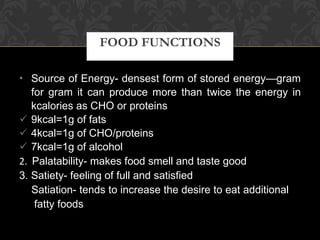
Source of Energy- densest form of stored energy—gram for gram it can produce more than twice the energy in kcalories as CHO or proteins 9kcal=1g of fats 4kcal=1g of CHO/proteins 7kcal=1g of alcohol 2.  Palatability- makes food smell and taste good 3. Satiety- feeling of full and satisfied Satiation- tends to increase the desire to eat additional  fatty foods FOOD FUNCTIONS
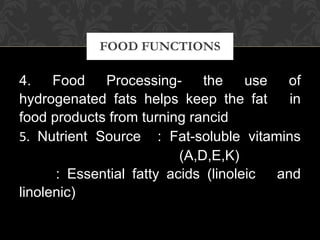
4. Food Processing- the use of hydrogenated fats helps keep the fat  in food products from turning rancid 5.  Nutrient Source  : Fat-soluble vitamins  (A,D,E,K) : Essential fatty acids (linoleic  and linolenic) FOOD FUNCTIONS
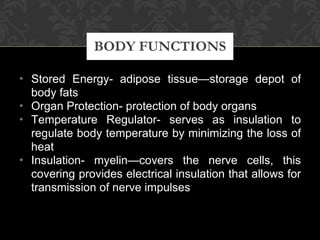
Stored Energy- adipose tissue—storage depot of body fats Organ Protection- protection of body organs Temperature Regulator- serves as insulation to regulate body temperature by minimizing the loss of heat Insulation- myelin—covers the nerve cells, this covering provides electrical insulation that allows for transmission of nerve impulses BODY FUNCTIONS
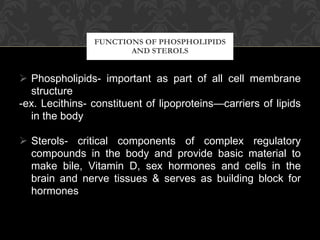
Phospholipids- important as part of all cell membrane structure -ex. Lecithins- constituent of lipoproteins—carriers of lipids in the body   Sterols- critical components of complex regulatory compounds in the body and provide basic material to make bile, Vitamin D, sex hormones and cells in the brain and nerve tissues & serves as building block for hormones FUNCTIONS OF PHOSPHOLIPIDS AND STEROLS
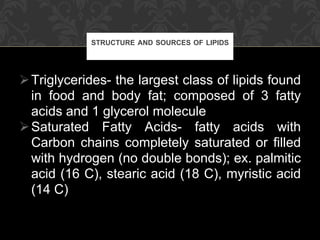
Triglycerides- the largest class of lipids found in food and body fat; composed of 3 fatty acids and 1 glycerol molecule Saturated Fatty Acids- fatty acids with Carbon chains completely saturated or filled with hydrogen (no double bonds); ex. palmitic acid (16 C), stearic acid (18 C), myristic acid (14 C) STRUCTURE AND SOURCES OF LIPIDS
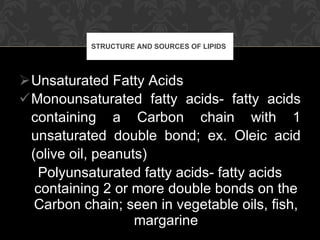
Unsaturated Fatty Acids Monounsaturated fatty acids- fatty acids containing a Carbon chain with 1 unsaturated double bond; ex. Oleic acid (olive oil, peanuts) Polyunsaturated fatty acids- fatty acids containing 2 or more double bonds on the Carbon chain; seen in vegetable oils, fish, margarine STRUCTURE AND SOURCES OF LIPIDS
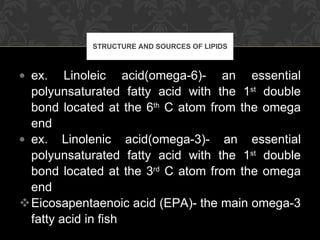
ex. Linoleic acid(omega-6)- an essential polyunsaturated fatty acid with the 1 st  double bond located at the 6 th  C atom from the omega end ex. Linolenic acid(omega-3)- an essential polyunsaturated fatty acid with the 1 st  double bond located at the 3 rd  C atom from the omega end Eicosapentaenoic acid (EPA)- the main omega-3 fatty acid in fish STRUCTURE AND SOURCES OF LIPIDS
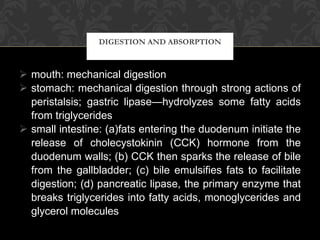
mouth: mechanical digestion stomach: mechanical digestion through strong actions of peristalsis; gastric lipase—hydrolyzes some fatty acids from triglycerides small intestine: (a)fats entering the duodenum initiate the release of cholecystokinin (CCK) hormone from the duodenum walls; (b) CCK then sparks the release of bile from the gallbladder; (c) bile emulsifies fats to facilitate digestion; (d) pancreatic lipase, the primary enzyme that breaks triglycerides into fatty acids, monoglycerides and glycerol molecules DIGESTION AND ABSORPTION
Anabolism: Lipogenesis—results in formation of triglycerides, phospholipids, cholesterol for use throughout the body Catabolism of lipids for energy involves hydrolysis of triglycerides into 2-Carbon units that become part of acetyl coenzyme A. The acetyl CoA then enters the series of reactions called Krebs cycle, eventually leading to the release of energy in the form of ATP Regulated mainly by the following hormones insulin, growth hormones, adrenocorticotropic hormone and glucocorticoids METABOLISM
a problem with unsaturated fats in foods is that Oxygen attacks the unsaturated double bonds (oxidation) causing damage that makes the fat rancid Hydrogenation breaking a double bond on a fatty acid C-chain and saturating it with hydrogen makes the fat solid and more stable, which provides cooking benefits changes the structure of some of the fatty acids from cis fatty acids to trans fatty acids trans fatty acids- consumption appears to increase the risk of coronary artery disease, cancer and elevated blood cholesterol level PRESERVING FATS IN FOODS
Cholesterol is a waxy substance found in all tissues in humans and other animals, thus all foods from animal sources contain cholesterol Highest sources of cholesterol are egg yolks and organ meats (kidney & liver) Lipoproteins specialized transporting compounds compounds that contain a mix of lipids--- including triglycerides, fatty acids, phospholipids, cholesterol and small amounts of other steroids and fat-soluble vitamins--- that are covered with a protein outer layer FOOD CHOLESTEROL VS. BLOOD CHOLESTEROL
the outer protein layer allows the compound to move through a watery substance, such as blood transport fats in the circulatory system 4 Forms Chylomicrons- transport absorbed fats from the intestinal wall to liver cells Very low-density lipoproteins( VLDL) Low-density lipoproteins ( LDL)- lipoproteins that carry fats and cholesterol to body cells and are made of large proportions of cholesterol High-density lipoproteins ( HDL)- are formed within the cells to remove cholesterol from the cell, bringing it to the liver for disposal FOOD CHOLESTEROL VS. BLOOD CHOLESTEROL
What is beta-oxidation? What are the steps in beta-oxidation? What is L-carnitine? What is the importance of L-carnitine? ASSIGNMENT

Fats

  • 1.
  • 2.
    organic and composedof C, H & O heterogeneous group of compounds related more of their physical rather than their chemical properties relatively insoluble in water and soluble in organic compounds (ether, chloroform) important dietary constituents of the body because of their high energy value and also of the fat-soluble vitamins and the essential fatty acids contained in the fat of natural foods FATS/LIPIDS
  • 3.
    Fats or Triglycerides-largest class of lipids (95% of lipids in food and body); fats(solid) or oils(liquid) Phospholipids- ex. lecithin Sterols- ex. cholesterol CLASSIFICATION
  • 4.
    Source of Energy-densest form of stored energy—gram for gram it can produce more than twice the energy in kcalories as CHO or proteins 9kcal=1g of fats 4kcal=1g of CHO/proteins 7kcal=1g of alcohol 2. Palatability- makes food smell and taste good 3. Satiety- feeling of full and satisfied Satiation- tends to increase the desire to eat additional fatty foods FOOD FUNCTIONS
  • 5.
    4. Food Processing-the use of hydrogenated fats helps keep the fat in food products from turning rancid 5. Nutrient Source : Fat-soluble vitamins (A,D,E,K) : Essential fatty acids (linoleic and linolenic) FOOD FUNCTIONS
  • 6.
    Stored Energy- adiposetissue—storage depot of body fats Organ Protection- protection of body organs Temperature Regulator- serves as insulation to regulate body temperature by minimizing the loss of heat Insulation- myelin—covers the nerve cells, this covering provides electrical insulation that allows for transmission of nerve impulses BODY FUNCTIONS
  • 7.
    Phospholipids- important aspart of all cell membrane structure -ex. Lecithins- constituent of lipoproteins—carriers of lipids in the body Sterols- critical components of complex regulatory compounds in the body and provide basic material to make bile, Vitamin D, sex hormones and cells in the brain and nerve tissues & serves as building block for hormones FUNCTIONS OF PHOSPHOLIPIDS AND STEROLS
  • 8.
    Triglycerides- the largestclass of lipids found in food and body fat; composed of 3 fatty acids and 1 glycerol molecule Saturated Fatty Acids- fatty acids with Carbon chains completely saturated or filled with hydrogen (no double bonds); ex. palmitic acid (16 C), stearic acid (18 C), myristic acid (14 C) STRUCTURE AND SOURCES OF LIPIDS
  • 9.
    Unsaturated Fatty AcidsMonounsaturated fatty acids- fatty acids containing a Carbon chain with 1 unsaturated double bond; ex. Oleic acid (olive oil, peanuts) Polyunsaturated fatty acids- fatty acids containing 2 or more double bonds on the Carbon chain; seen in vegetable oils, fish, margarine STRUCTURE AND SOURCES OF LIPIDS
  • 10.
    ex. Linoleic acid(omega-6)-an essential polyunsaturated fatty acid with the 1 st double bond located at the 6 th C atom from the omega end ex. Linolenic acid(omega-3)- an essential polyunsaturated fatty acid with the 1 st double bond located at the 3 rd C atom from the omega end Eicosapentaenoic acid (EPA)- the main omega-3 fatty acid in fish STRUCTURE AND SOURCES OF LIPIDS
  • 11.
    mouth: mechanical digestionstomach: mechanical digestion through strong actions of peristalsis; gastric lipase—hydrolyzes some fatty acids from triglycerides small intestine: (a)fats entering the duodenum initiate the release of cholecystokinin (CCK) hormone from the duodenum walls; (b) CCK then sparks the release of bile from the gallbladder; (c) bile emulsifies fats to facilitate digestion; (d) pancreatic lipase, the primary enzyme that breaks triglycerides into fatty acids, monoglycerides and glycerol molecules DIGESTION AND ABSORPTION
  • 12.
    Anabolism: Lipogenesis—results information of triglycerides, phospholipids, cholesterol for use throughout the body Catabolism of lipids for energy involves hydrolysis of triglycerides into 2-Carbon units that become part of acetyl coenzyme A. The acetyl CoA then enters the series of reactions called Krebs cycle, eventually leading to the release of energy in the form of ATP Regulated mainly by the following hormones insulin, growth hormones, adrenocorticotropic hormone and glucocorticoids METABOLISM
  • 13.
    a problem withunsaturated fats in foods is that Oxygen attacks the unsaturated double bonds (oxidation) causing damage that makes the fat rancid Hydrogenation breaking a double bond on a fatty acid C-chain and saturating it with hydrogen makes the fat solid and more stable, which provides cooking benefits changes the structure of some of the fatty acids from cis fatty acids to trans fatty acids trans fatty acids- consumption appears to increase the risk of coronary artery disease, cancer and elevated blood cholesterol level PRESERVING FATS IN FOODS
  • 14.
    Cholesterol is awaxy substance found in all tissues in humans and other animals, thus all foods from animal sources contain cholesterol Highest sources of cholesterol are egg yolks and organ meats (kidney & liver) Lipoproteins specialized transporting compounds compounds that contain a mix of lipids--- including triglycerides, fatty acids, phospholipids, cholesterol and small amounts of other steroids and fat-soluble vitamins--- that are covered with a protein outer layer FOOD CHOLESTEROL VS. BLOOD CHOLESTEROL
  • 15.
    the outer proteinlayer allows the compound to move through a watery substance, such as blood transport fats in the circulatory system 4 Forms Chylomicrons- transport absorbed fats from the intestinal wall to liver cells Very low-density lipoproteins( VLDL) Low-density lipoproteins ( LDL)- lipoproteins that carry fats and cholesterol to body cells and are made of large proportions of cholesterol High-density lipoproteins ( HDL)- are formed within the cells to remove cholesterol from the cell, bringing it to the liver for disposal FOOD CHOLESTEROL VS. BLOOD CHOLESTEROL
  • 16.
    What is beta-oxidation?What are the steps in beta-oxidation? What is L-carnitine? What is the importance of L-carnitine? ASSIGNMENT