Mesopotamia
Civilization
2 4 . 0 1 . 2 3 I I A R . A R C H A N A I I A S A D I
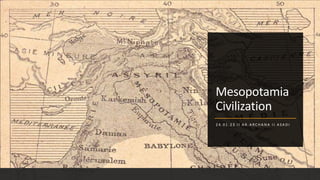
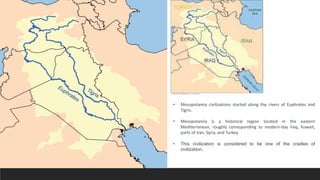
• Mesopotamia civilizations started along the rivers of Euphrates and
Tigris.
• Mesopotamia is a historical region located in the eastern
Mediterranean, roughly corresponding to modern-day Iraq, Kuwait,
parts of Iran, Syria, and Turkey.
• This civilization is considered to be one of the cradles of
civilization.
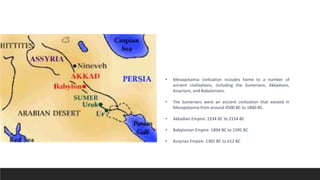
• Mesopotamia civilization includes home to a number of
ancient civilizations, including the Sumerians, Akkadians,
Assyrians, and Babylonians.
• The Sumerians were an ancient civilization that existed in
Mesopotamia from around 4500 BC to 1800 BC.
• Akkadian Empire: 2334 BC to 2154 BC
• Babylonian Empire: 1894 BC to 1595 BC
• Assyrian Empire: 1365 BC to 612 BC
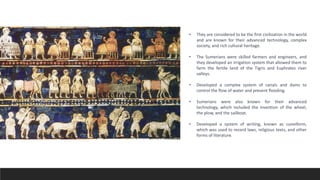
• They are considered to be the first civilization in the world
and are known for their advanced technology, complex
society, and rich cultural heritage.
• The Sumerians were skilled farmers and engineers, and
they developed an irrigation system that allowed them to
farm the fertile land of the Tigris and Euphrates river
valleys.
• Developed a complex system of canals and dams to
control the flow of water and prevent flooding.
• Sumerians were also known for their advanced
technology, which included the invention of the wheel,
the plow, and the sailboat.
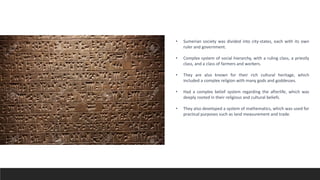
• Developed a system of writing, known as cuneiform,
which was used to record laws, religious texts, and other
forms of literature.
• Sumerian society was divided into city-states, each with its own
ruler and government.
• Complex system of social hierarchy, with a ruling class, a priestly
class, and a class of farmers and workers.
• They are also known for their rich cultural heritage, which
included a complex religion with many gods and goddesses.
• Had a complex belief system regarding the afterlife, which was
deeply rooted in their religious and cultural beliefs.
• They also developed a system of mathematics, which was used for
practical purposes such as land measurement and trade.
City of Ur
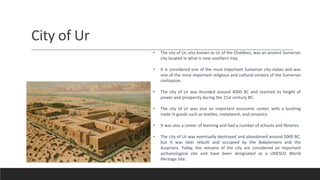
• The city of Ur, also known as Ur of the Chaldees, was an ancient Sumerian
city located in what is now southern Iraq
• It is considered one of the most important Sumerian city-states and was
one of the most important religious and cultural centers of the Sumerian
civilization.
• The city of Ur was founded around 4000 BC and reached its height of
power and prosperity during the 21st century BC.
• The city of Ur was also an important economic center, with a bustling
trade in goods such as textiles, metalwork, and ceramics.
• It was also a center of learning and had a number of schools and libraries.
• The city of Ur was eventually destroyed and abandoned around 2000 BC,
but it was later rebuilt and occupied by the Babylonians and the
Assyrians. Today, the remains of the city are considered an important
archaeological site and have been designated as a UNESCO World
Heritage Site.
City of Ur: Architecture
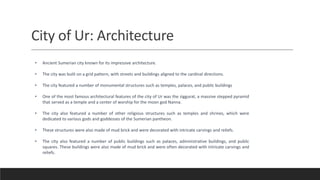
• Ancient Sumerian city known for its impressive architecture.
• The city was built on a grid pattern, with streets and buildings aligned to the cardinal directions.
• The city featured a number of monumental structures such as temples, palaces, and public buildings
• One of the most famous architectural features of the city of Ur was the ziggurat, a massive stepped pyramid
that served as a temple and a center of worship for the moon god Nanna.
• The city also featured a number of other religious structures such as temples and shrines, which were
dedicated to various gods and goddesses of the Sumerian pantheon.
• These structures were also made of mud brick and were decorated with intricate carvings and reliefs.
• The city also featured a number of public buildings such as palaces, administrative buildings, and public
squares. These buildings were also made of mud brick and were often decorated with intricate carvings and
reliefs.
Ziggurat at Ur
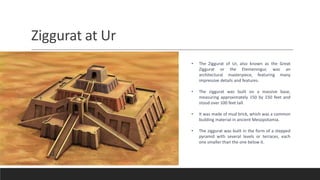
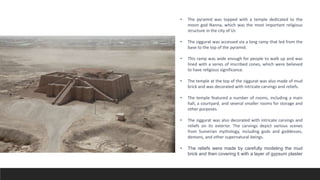
• The Ziggurat of Ur, also known as the Great
Ziggurat or the Etemennigur, was an
architectural masterpiece, featuring many
impressive details and features.
• The ziggurat was built on a massive base,
measuring approximately 150 by 150 feet and
stood over 100 feet tall.
• It was made of mud brick, which was a common
building material in ancient Mesopotamia.
• The ziggurat was built in the form of a stepped
pyramid with several levels or terraces, each
one smaller than the one below it.
• The pyramid was topped with a temple dedicated to the
moon god Nanna, which was the most important religious
structure in the city of Ur.
• The ziggurat was accessed via a long ramp that led from the
base to the top of the pyramid.
• This ramp was wide enough for people to walk up and was
lined with a series of inscribed cones, which were believed
to have religious significance.
• The temple at the top of the ziggurat was also made of mud
brick and was decorated with intricate carvings and reliefs.
• The temple featured a number of rooms, including a main
hall, a courtyard, and several smaller rooms for storage and
other purposes.
• The ziggurat was also decorated with intricate carvings and
reliefs on its exterior. The carvings depict various scenes
from Sumerian mythology, including gods and goddesses,
demons, and other supernatural beings.
• The reliefs were made by carefully modeling the mud
brick and then covering it with a layer of gypsum plaster
Earlier Egypt: Culture and social structure
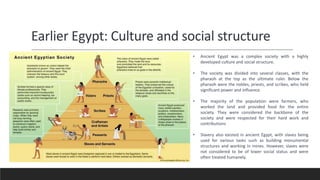
• Ancient Egypt was a complex society with a highly
developed culture and social structure.
• The society was divided into several classes, with the
pharaoh at the top as the ultimate ruler. Below the
pharaoh were the nobles, priests, and scribes, who held
significant power and influence.
• The majority of the population were farmers, who
worked the land and provided food for the entire
society. They were considered the backbone of the
society and were respected for their hard work and
contributions
• Slavery also existed in ancient Egypt, with slaves being
used for various tasks such as building monumental
structures and working in mines. However, slaves were
not considered to be of lower social status and were
often treated humanely.
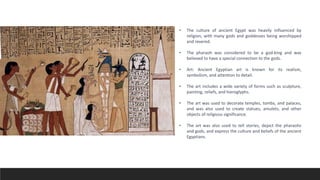
• The culture of ancient Egypt was heavily influenced by
religion, with many gods and goddesses being worshipped
and revered.
• The pharaoh was considered to be a god-king and was
believed to have a special connection to the gods.
• Art: Ancient Egyptian art is known for its realism,
symbolism, and attention to detail.
• The art includes a wide variety of forms such as sculpture,
painting, reliefs, and hieroglyphs.
• The art was used to decorate temples, tombs, and palaces,
and was also used to create statues, amulets, and other
objects of religious significance.
• The art was also used to tell stories, depict the pharaohs
and gods, and express the culture and beliefs of the ancient
Egyptians.
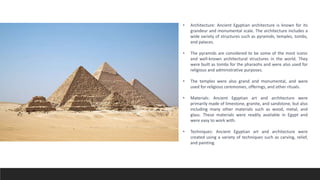
• Architecture: Ancient Egyptian architecture is known for its
grandeur and monumental scale. The architecture includes a
wide variety of structures such as pyramids, temples, tombs,
and palaces.
• The pyramids are considered to be some of the most iconic
and well-known architectural structures in the world. They
were built as tombs for the pharaohs and were also used for
religious and administrative purposes.
• The temples were also grand and monumental, and were
used for religious ceremonies, offerings, and other rituals.
• Materials: Ancient Egyptian art and architecture were
primarily made of limestone, granite, and sandstone, but also
including many other materials such as wood, metal, and
glass. These materials were readily available in Egypt and
were easy to work with.
• Techniques: Ancient Egyptian art and architecture were
created using a variety of techniques such as carving, relief,
and painting.
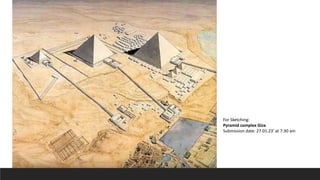
For Sketching:
Pyramid complex Giza
Submission date: 27.01.23’ at 7:30 am

Mesopotamia Civilization.pptx

  • 1.
    Mesopotamia Civilization 2 4 .0 1 . 2 3 I I A R . A R C H A N A I I A S A D I
  • 2.
    • Mesopotamia civilizationsstarted along the rivers of Euphrates and Tigris. • Mesopotamia is a historical region located in the eastern Mediterranean, roughly corresponding to modern-day Iraq, Kuwait, parts of Iran, Syria, and Turkey. • This civilization is considered to be one of the cradles of civilization.
  • 3.
    • Mesopotamia civilizationincludes home to a number of ancient civilizations, including the Sumerians, Akkadians, Assyrians, and Babylonians. • The Sumerians were an ancient civilization that existed in Mesopotamia from around 4500 BC to 1800 BC. • Akkadian Empire: 2334 BC to 2154 BC • Babylonian Empire: 1894 BC to 1595 BC • Assyrian Empire: 1365 BC to 612 BC
  • 4.
    • They areconsidered to be the first civilization in the world and are known for their advanced technology, complex society, and rich cultural heritage. • The Sumerians were skilled farmers and engineers, and they developed an irrigation system that allowed them to farm the fertile land of the Tigris and Euphrates river valleys. • Developed a complex system of canals and dams to control the flow of water and prevent flooding. • Sumerians were also known for their advanced technology, which included the invention of the wheel, the plow, and the sailboat. • Developed a system of writing, known as cuneiform, which was used to record laws, religious texts, and other forms of literature.
  • 5.
    • Sumerian societywas divided into city-states, each with its own ruler and government. • Complex system of social hierarchy, with a ruling class, a priestly class, and a class of farmers and workers. • They are also known for their rich cultural heritage, which included a complex religion with many gods and goddesses. • Had a complex belief system regarding the afterlife, which was deeply rooted in their religious and cultural beliefs. • They also developed a system of mathematics, which was used for practical purposes such as land measurement and trade.
  • 6.
    City of Ur •The city of Ur, also known as Ur of the Chaldees, was an ancient Sumerian city located in what is now southern Iraq • It is considered one of the most important Sumerian city-states and was one of the most important religious and cultural centers of the Sumerian civilization. • The city of Ur was founded around 4000 BC and reached its height of power and prosperity during the 21st century BC. • The city of Ur was also an important economic center, with a bustling trade in goods such as textiles, metalwork, and ceramics. • It was also a center of learning and had a number of schools and libraries. • The city of Ur was eventually destroyed and abandoned around 2000 BC, but it was later rebuilt and occupied by the Babylonians and the Assyrians. Today, the remains of the city are considered an important archaeological site and have been designated as a UNESCO World Heritage Site.
  • 7.
    City of Ur:Architecture • Ancient Sumerian city known for its impressive architecture. • The city was built on a grid pattern, with streets and buildings aligned to the cardinal directions. • The city featured a number of monumental structures such as temples, palaces, and public buildings • One of the most famous architectural features of the city of Ur was the ziggurat, a massive stepped pyramid that served as a temple and a center of worship for the moon god Nanna. • The city also featured a number of other religious structures such as temples and shrines, which were dedicated to various gods and goddesses of the Sumerian pantheon. • These structures were also made of mud brick and were decorated with intricate carvings and reliefs. • The city also featured a number of public buildings such as palaces, administrative buildings, and public squares. These buildings were also made of mud brick and were often decorated with intricate carvings and reliefs.
  • 8.
    Ziggurat at Ur •The Ziggurat of Ur, also known as the Great Ziggurat or the Etemennigur, was an architectural masterpiece, featuring many impressive details and features. • The ziggurat was built on a massive base, measuring approximately 150 by 150 feet and stood over 100 feet tall. • It was made of mud brick, which was a common building material in ancient Mesopotamia. • The ziggurat was built in the form of a stepped pyramid with several levels or terraces, each one smaller than the one below it.
  • 9.
    • The pyramidwas topped with a temple dedicated to the moon god Nanna, which was the most important religious structure in the city of Ur. • The ziggurat was accessed via a long ramp that led from the base to the top of the pyramid. • This ramp was wide enough for people to walk up and was lined with a series of inscribed cones, which were believed to have religious significance. • The temple at the top of the ziggurat was also made of mud brick and was decorated with intricate carvings and reliefs. • The temple featured a number of rooms, including a main hall, a courtyard, and several smaller rooms for storage and other purposes. • The ziggurat was also decorated with intricate carvings and reliefs on its exterior. The carvings depict various scenes from Sumerian mythology, including gods and goddesses, demons, and other supernatural beings. • The reliefs were made by carefully modeling the mud brick and then covering it with a layer of gypsum plaster
  • 10.
    Earlier Egypt: Cultureand social structure • Ancient Egypt was a complex society with a highly developed culture and social structure. • The society was divided into several classes, with the pharaoh at the top as the ultimate ruler. Below the pharaoh were the nobles, priests, and scribes, who held significant power and influence. • The majority of the population were farmers, who worked the land and provided food for the entire society. They were considered the backbone of the society and were respected for their hard work and contributions • Slavery also existed in ancient Egypt, with slaves being used for various tasks such as building monumental structures and working in mines. However, slaves were not considered to be of lower social status and were often treated humanely.
  • 11.
    • The cultureof ancient Egypt was heavily influenced by religion, with many gods and goddesses being worshipped and revered. • The pharaoh was considered to be a god-king and was believed to have a special connection to the gods. • Art: Ancient Egyptian art is known for its realism, symbolism, and attention to detail. • The art includes a wide variety of forms such as sculpture, painting, reliefs, and hieroglyphs. • The art was used to decorate temples, tombs, and palaces, and was also used to create statues, amulets, and other objects of religious significance. • The art was also used to tell stories, depict the pharaohs and gods, and express the culture and beliefs of the ancient Egyptians.
  • 12.
    • Architecture: AncientEgyptian architecture is known for its grandeur and monumental scale. The architecture includes a wide variety of structures such as pyramids, temples, tombs, and palaces. • The pyramids are considered to be some of the most iconic and well-known architectural structures in the world. They were built as tombs for the pharaohs and were also used for religious and administrative purposes. • The temples were also grand and monumental, and were used for religious ceremonies, offerings, and other rituals. • Materials: Ancient Egyptian art and architecture were primarily made of limestone, granite, and sandstone, but also including many other materials such as wood, metal, and glass. These materials were readily available in Egypt and were easy to work with. • Techniques: Ancient Egyptian art and architecture were created using a variety of techniques such as carving, relief, and painting.
  • 13.
    For Sketching: Pyramid complexGiza Submission date: 27.01.23’ at 7:30 am