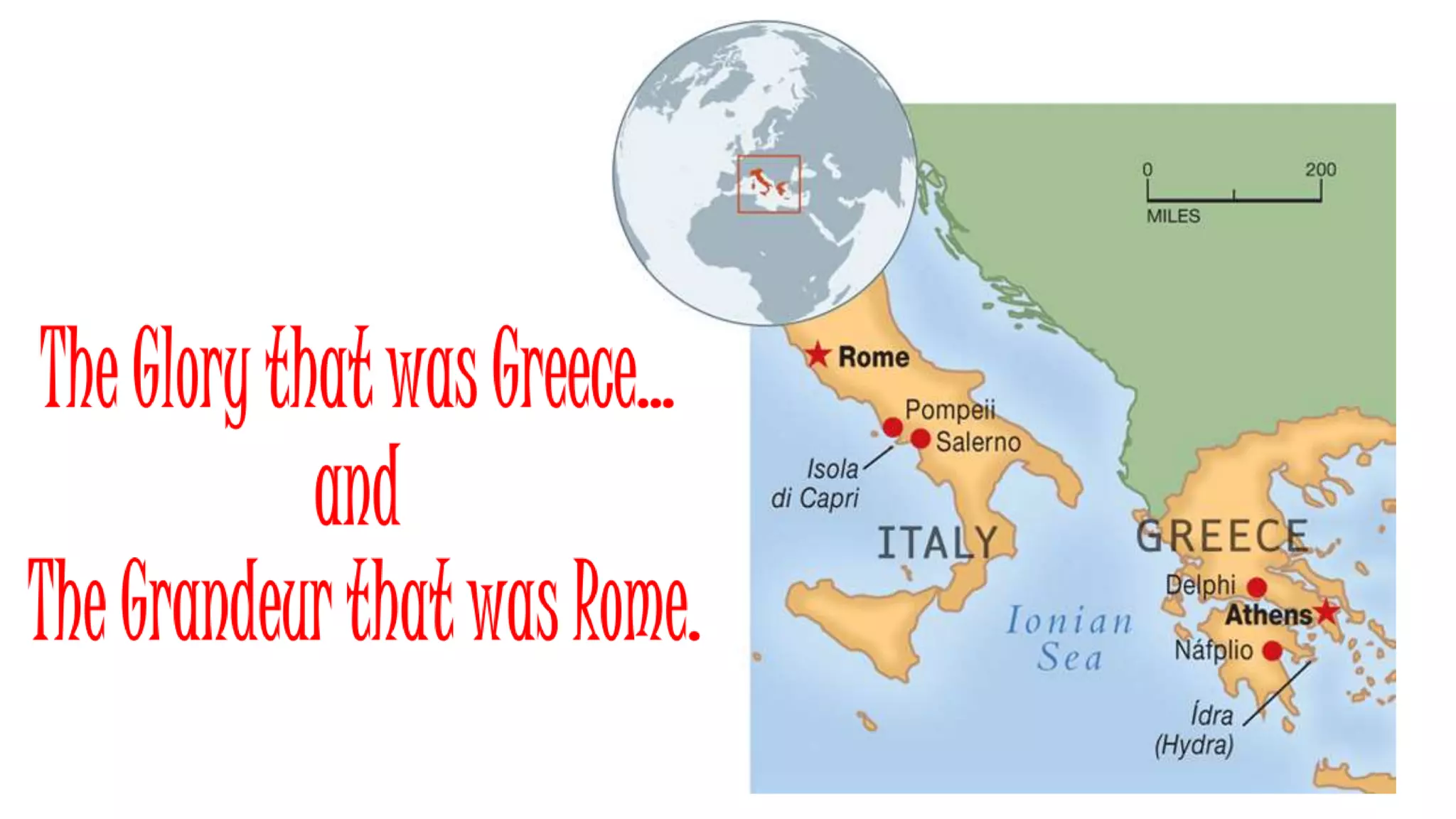
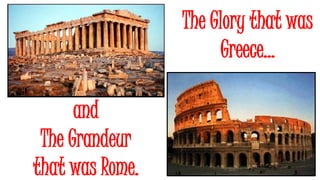
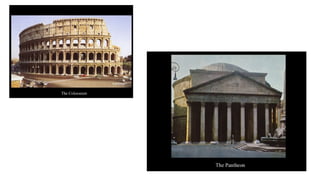
The Glory that was 
Greece… 
and 
The Grandeur 
that was Rome.
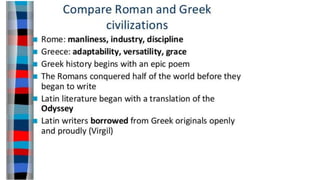
Differences between the ancient Greeks and ancient Romans. 
You can start with art. The Greeks wanted perfection in their depiction of people. The 
Romans want real life people. The Greeks statues were of perfect people. The Romans 
statues contained all the flaws of real people. 
The Greeks colonized. They sent colonies all over the Mediterranean sea. The Romans 
conquered and ruled all over the Mediterranean. 
The Romans built roads that connected their empire to Rome. The Greeks built roads to connect two specific 
cities. 
The Romans created an Empire which lasted 500 years. The Greeks were city-states and were not united under 
one central government (except for the empire of Alexander the Great). 
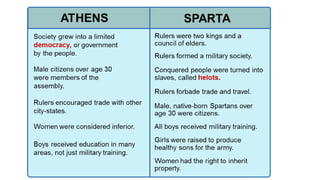
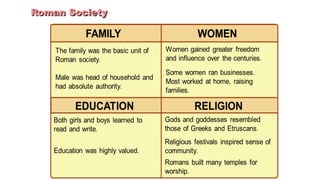
In Ancient Greece women had no rights. They were property. 
In Rome, under the king and in the republic, women were not property, but they had no rights. During the Empire, 
Roman women had quite a few rights, but were still not citizens. 
The Greeks spoke Greek. The Romans spoke Latin.
Classical Civilizations of Europe 
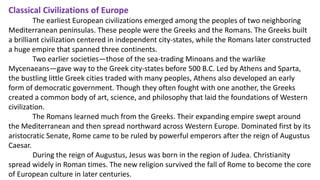
The earliest European civilizations emerged among the peoples of two neighboring 
Mediterranean peninsulas. These people were the Greeks and the Romans. The Greeks built 
a brilliant civilization centered in independent city-states, while the Romans later constructed 
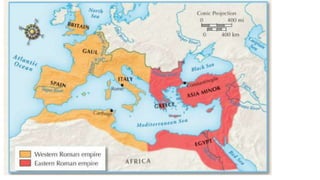
a huge empire that spanned three continents. 
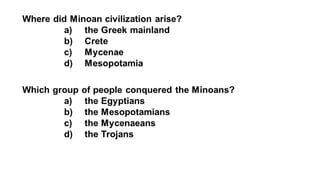
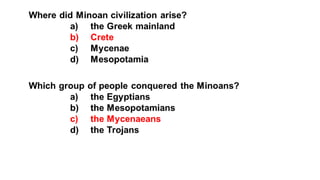
Two earlier societies—those of the sea-trading Minoans and the warlike 
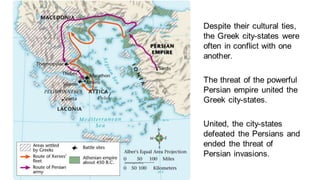
Mycenaeans—gave way to the Greek city-states before 500 B.C. Led by Athens and Sparta, 
the bustling little Greek cities traded with many peoples, Athens also developed an early 
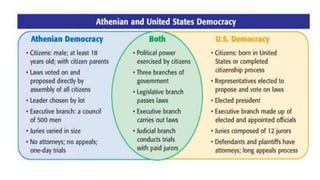
form of democratic government. Though they often fought with one another, the Greeks 
created a common body of art, science, and philosophy that laid the foundations of Western 
civilization. 
The Romans learned much from the Greeks. Their expanding empire swept around 
the Mediterranean and then spread northward across Western Europe. Dominated first by its 
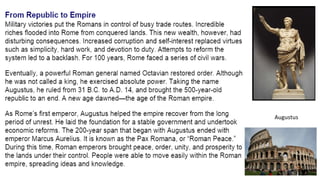
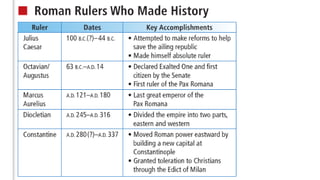
aristocratic Senate, Rome came to be ruled by powerful emperors after the reign of Augustus 
Caesar. 
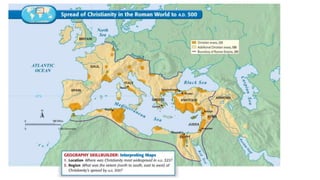
During the reign of Augustus, Jesus was born in the region of Judea. Christianity 
spread widely in Roman times. The new religion survived the fall of Rome to become the core 
of European culture in later centuries.
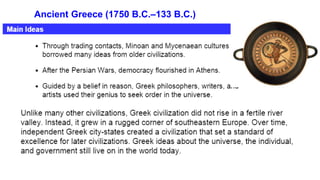
Ancient Greece (1750 B.C.–133 B.C.)
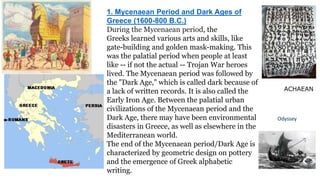
1. Mycenaean Period and Dark Ages of 
Greece (1600-800 B.C.) 
During the Mycenaean period, the 
Greeks learned various arts and skills, like 
gate-building and golden mask-making. This 
was the palatial period when people at least 
like -- if not the actual -- Trojan War heroes 
lived. The Mycenaean period was followed by 
the "Dark Age," which is called dark because of 
a lack of written records. It is also called the 
Early Iron Age. Between the palatial urban 
civilizations of the Mycenaean period and the 
Dark Age, there may have been environmental 
disasters in Greece, as well as elsewhere in the 
Mediterranean world. 
The end of the Mycenaean period/Dark Age is 
characterized by geometric design on pottery 
and the emergence of Greek alphabetic 
writing. 
ACHAEAN
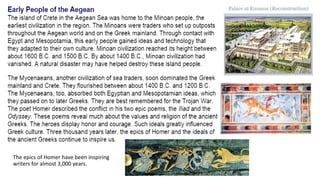
The epics of Homer have been inspiring 
writers for almost 3,000 years.
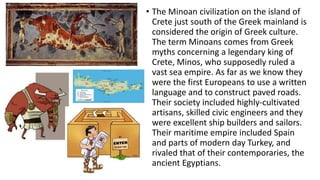
• The Minoan civilization on the island of 
Crete just south of the Greek mainland is 
considered the origin of Greek culture. 
The term Minoans comes from Greek 
myths concerning a legendary king of 
Crete, Minos, who supposedly ruled a 
vast sea empire. As far as we know they 
were the first Europeans to use a written 
language and to construct paved roads. 
Their society included highly-cultivated 
artisans, skilled civic engineers and they 
were excellent ship builders and sailors. 
Their maritime empire included Spain 
and parts of modern day Turkey, and 
rivaled that of their contemporaries, the 
ancient Egyptians.
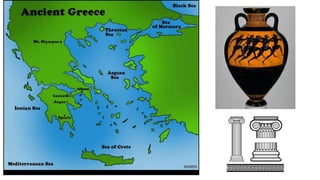
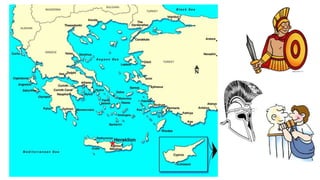
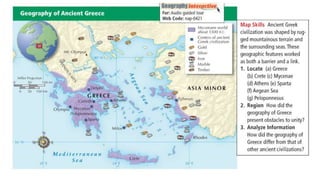
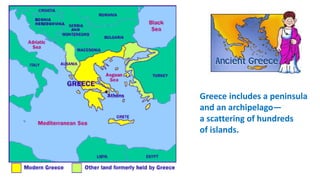
Greece includes a peninsula 
and an archipelago— 
a scattering of hundreds 
of islands.
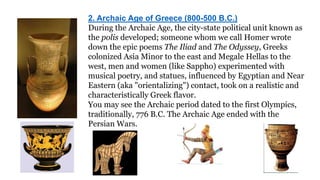
2. Archaic Age of Greece (800-500 B.C.) 
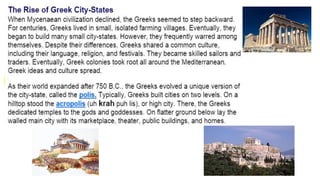
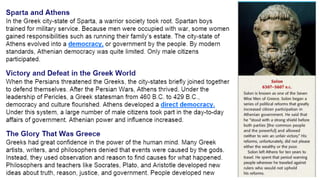
During the Archaic Age, the city-state political unit known as 
the polis developed; someone whom we call Homer wrote 
down the epic poems The Iliad and The Odyssey, Greeks 
colonized Asia Minor to the east and Megale Hellas to the 
west, men and women (like Sappho) experimented with 
musical poetry, and statues, influenced by Egyptian and Near 
Eastern (aka "orientalizing") contact, took on a realistic and 
characteristically Greek flavor. 
You may see the Archaic period dated to the first Olympics, 
traditionally, 776 B.C. The Archaic Age ended with the 
Persian Wars.
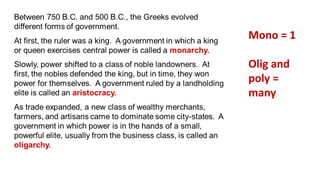
Mono = 1 
Olig and 
poly = 
many
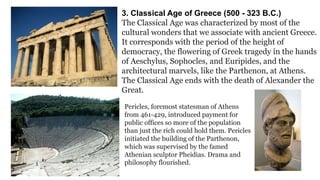
3. Classical Age of Greece (500 - 323 B.C.) 
The Classical Age was characterized by most of the 
cultural wonders that we associate with ancient Greece. 
It corresponds with the period of the height of 
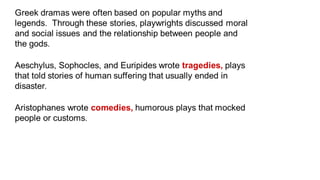
democracy, the flowering of Greek tragedy in the hands 
of Aeschylus, Sophocles, and Euripides, and the 
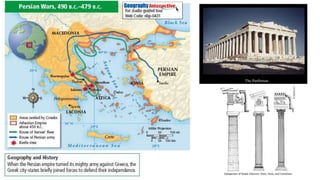
architectural marvels, like the Parthenon, at Athens. 
The Classical Age ends with the death of Alexander the 
Great. 
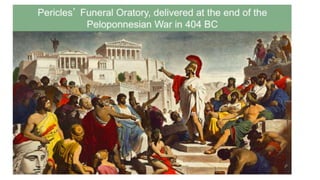
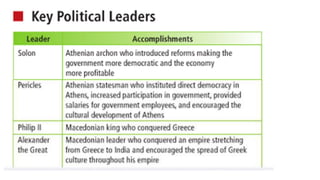
Pericles, foremost statesman of Athens 
from 461-429, introduced payment for 
public offices so more of the population 
than just the rich could hold them. Pericles 
initiated the building of the Parthenon, 
which was supervised by the famed 
Athenian sculptor Pheidias. Drama and 
philosophy flourished.
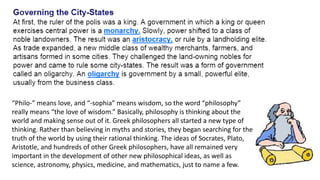
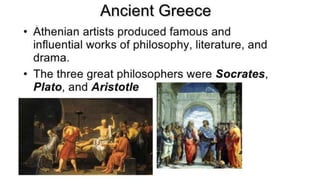
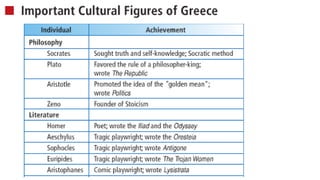
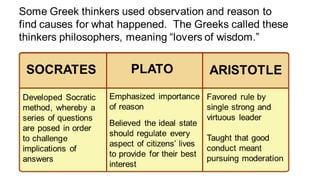
“Philo-” means love, and “-sophia” means wisdom, so the word “philosophy” 
really means “the love of wisdom.” Basically, philosophy is thinking about the 
world and making sense out of it. Greek philosophers all started a new type of 
thinking. Rather than believing in myths and stories, they began searching for the 
truth of the world by using their rational thinking. The ideas of Socrates, Plato, 
Aristotle, and hundreds of other Greek philosophers, have all remained very 
important in the development of other new philosophical ideas, as well as 
science, astronomy, physics, medicine, and mathematics, just to name a few.
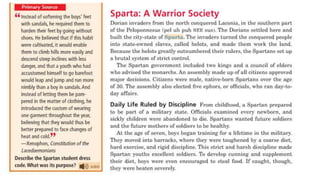
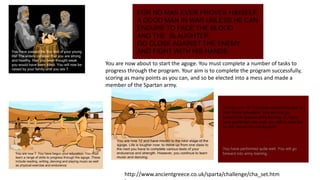
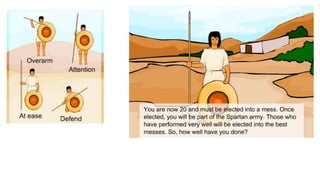
You are now about to start the agoge. You must complete a number of tasks to 
progress through the program. Your aim is to complete the program successfully, 
scoring as many points as you can, and so be elected into a mess and made a 
member of the Spartan army. 
http://www.ancientgreece.co.uk/sparta/challenge/cha_set.htm 
l
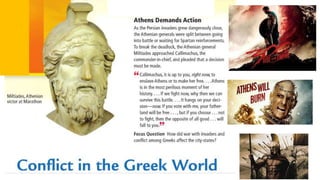
Persian Wars - Battle of Marathon - 490 B.C. A battle in the Persian Wars (499-449 B.C.) 
Probable Date: August or September 12 490 B.C. 
Winners: Maybe 10,000 Greeks (Athens and 
Plataeans) under Callimachus and Miltiades 
Losers: Maybe 25,000 Persians under Datis and 
Ataphernes 
When Greek colonists set out from mainland 
Greece, many wound up in Ionia, in Asia Minor. In 
546, the Persians took over Ionia. Ionian Greeks 
found the Persian rule oppressive and attempted to 
revolt with the aid of the mainland Greeks. Mainland 
Greece then came to the attention of the Persians, 
and war between them ensued. 
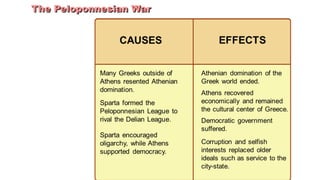
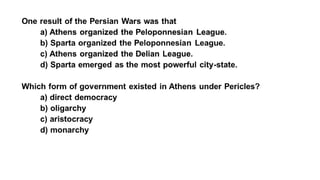
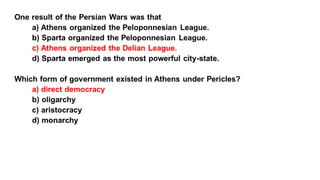
One was the Peloponnesian League, which had Sparta as 
its leader. The other leader was Athens, which controlled 
the Delian League. 
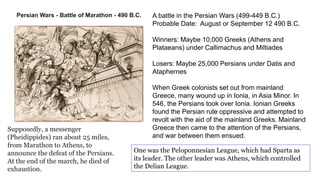
Supposedly, a messenger 
(Pheidippides) ran about 25 miles, 
from Marathon to Athens, to 
announce the defeat of the Persians. 
At the end of the march, he died of 
exhaustion.
Oracle: Athens will be 
saved by wooden 
walls= navy
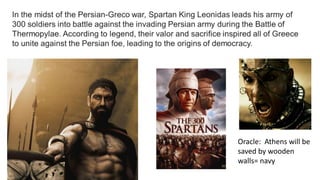
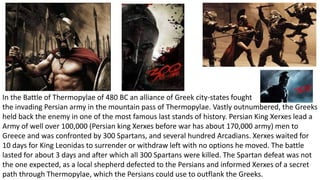
In the Battle of Thermopylae of 480 BC an alliance of Greek city-states fought 
the invading Persian army in the mountain pass of Thermopylae. Vastly outnumbered, the Greeks 
held back the enemy in one of the most famous last stands of history. Persian King Xerxes lead a 
Army of well over 100,000 (Persian king Xerxes before war has about 170,000 army) men to 
Greece and was confronted by 300 Spartans, and several hundred Arcadians. Xerxes waited for 
10 days for King Leonidas to surrender or withdraw left with no options he moved. The battle 
lasted for about 3 days and after which all 300 Spartans were killed. The Spartan defeat was not 
the one expected, as a local shepherd defected to the Persians and informed Xerxes of a secret 
path through Thermopylae, which the Persians could use to outflank the Greeks.
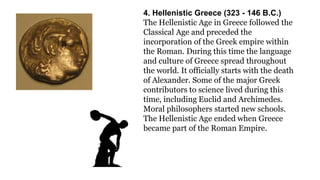
4. Hellenistic Greece (323 - 146 B.C.) 
The Hellenistic Age in Greece followed the 
Classical Age and preceded the 
incorporation of the Greek empire within 
the Roman. During this time the language 
and culture of Greece spread throughout 
the world. It officially starts with the death 
of Alexander. Some of the major Greek 
contributors to science lived during this 
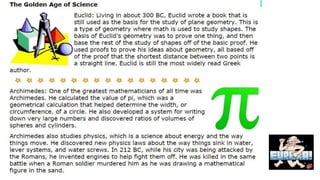
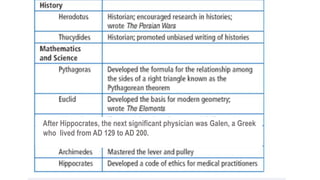
time, including Euclid and Archimedes. 
Moral philosophers started new schools. 
The Hellenistic Age ended when Greece 
became part of the Roman Empire.
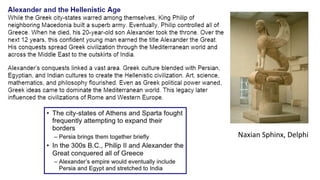
Naxian Sphinx, Delphi
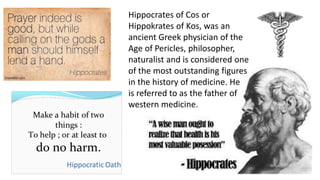
Hippocrates of Cos or 
Hippokrates of Kos, was an 
ancient Greek physician of the 
Age of Pericles, philosopher, 
naturalist and is considered one 
of the most outstanding figures 
in the history of medicine. He 
is referred to as the father of 
western medicine.
The Caduceus—the winged wand 
entwined by serpents was 
carried by Hermes, 
signifies the medical arts.
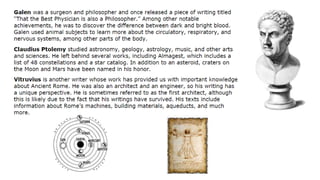
After Hippocrates, the next significant physician was Galen, a Greek 
who lived from AD 129 to AD 200.
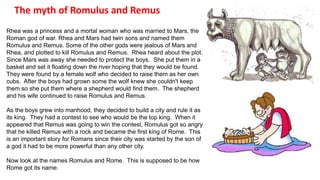
The myth of Romulus and Remus 
Rhea was a princess and a mortal woman who was married to Mars, the 
Roman god of war. Rhea and Mars had twin sons and named them 
Romulus and Remus. Some of the other gods were jealous of Mars and 
Rhea, and plotted to kill Romulus and Remus. Rhea heard about the plot. 
Since Mars was away she needed to protect the boys. She put them in a 
basket and set it floating down the river hoping that they would be found. 
They were found by a female wolf who decided to raise them as her own 
cubs. After the boys had grown some the wolf knew she couldn't keep 
them so she put them where a shepherd would find them. The shepherd 
and his wife continued to raise Romulus and Remus. 
As the boys grew into manhood, they decided to build a city and rule it as 
its king. They had a contest to see who would be the top king. When it 
appeared that Remus was going to win the contest, Romulus got so angry 
that he killed Remus with a rock and became the first king of Rome. This 
is an important story for Romans since their city was started by the son of 
a god it had to be more powerful than any other city. 
Now look at the names Romulus and Rome. This is supposed to be how 
Rome got its name.
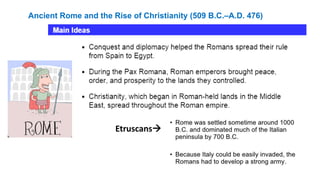
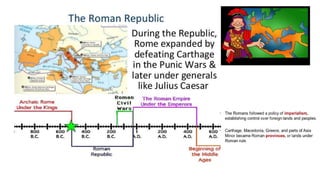
Ancient Rome and the Rise of Christianity (509 B.C.–A.D. 476) 
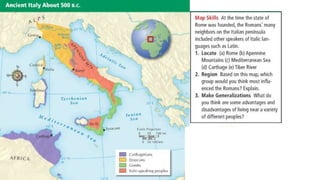
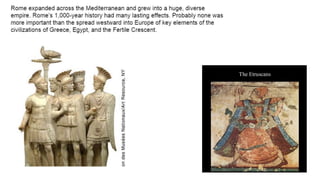
Etruscans
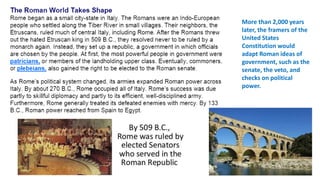
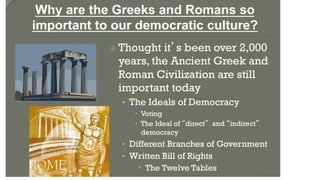
More than 2,000 years 
later, the framers of the 
United States 
Constitution would 
adapt Roman ideas of 
government, such as the 
senate, the veto, and 
checks on political 
power.
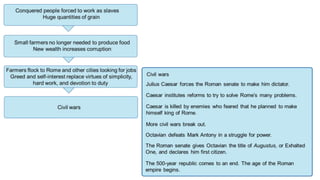
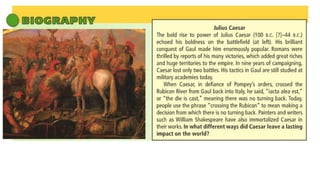
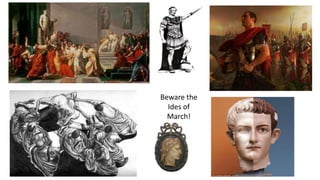
Beware the 
Ides of 
March!
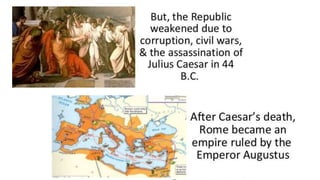
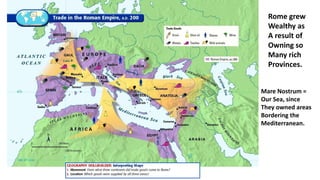
Rome grew 
Wealthy as 
A result of 
Owning so 
Many rich 
Provinces. 
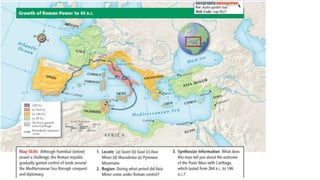
Mare Nostrum = 
Our Sea, since 
They owned areas 
Bordering the 
Mediterranean.
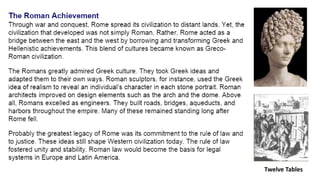
Twelve Tables
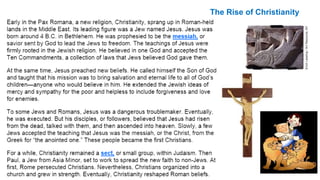
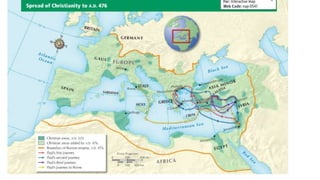
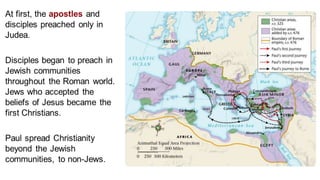
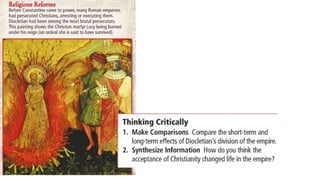
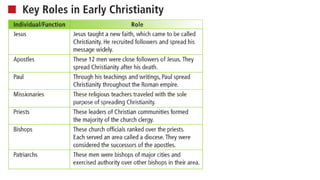
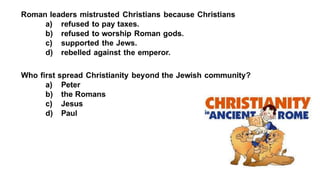
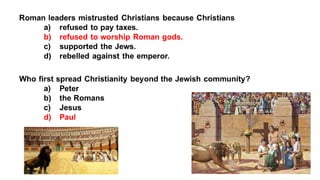
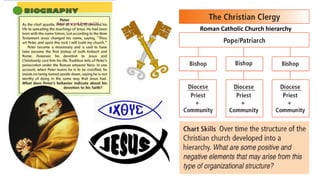
The Rise of Christianity
Roman Catholic Church hierarchy
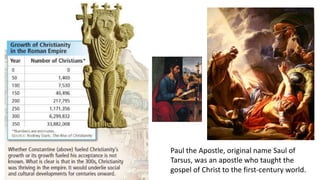
Paul the Apostle, original name Saul of 
Tarsus, was an apostle who taught the 
gospel of Christ to the first-century world.
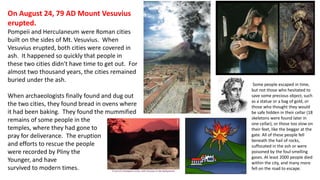
On August 24, 79 AD Mount Vesuvius 
erupted. 
Pompeii and Herculaneum were Roman cities 
built on the sides of Mt. Vesuvius. When 
Vesuvius erupted, both cities were covered in 
ash. It happened so quickly that people in 
these two cities didn't have time to get out. For 
almost two thousand years, the cities remained 
buried under the ash. 
When archaeologists finally found and dug out 
the two cities, they found bread in ovens where 
it had been baking. They found the mummified 
remains of some people in the 
temples, where they had gone to 
pray for deliverance. The eruption 
and efforts to rescue the people 
were recorded by Pliny the 
Younger, and have 
survived to modern times. 
Some people escaped in time, 
but not those who hesitated to 
save some precious object, such 
as a statue or a bag of gold, or 
those who thought they would 
be safe hidden in their cellar (18 
skeletons were found later in 
one cellar), or those too slow on 
their feet, like the beggar at the 
gate. All of these people fell 
beneath the hail of rocks, 
suffocated in the ash or were 
poisoned by the foul-smelling 
gases. At least 2000 people died 
within the city, and many more 
fell on the road to escape.
Greece and Rome
Greece and Rome
Greece and Rome
Greece and Rome
Greece and Rome
Greece and Rome

Greece and Rome

  • 2.
    The Glory thatwas Greece… and The Grandeur that was Rome.
  • 4.
    Differences between theancient Greeks and ancient Romans. You can start with art. The Greeks wanted perfection in their depiction of people. The Romans want real life people. The Greeks statues were of perfect people. The Romans statues contained all the flaws of real people. The Greeks colonized. They sent colonies all over the Mediterranean sea. The Romans conquered and ruled all over the Mediterranean. The Romans built roads that connected their empire to Rome. The Greeks built roads to connect two specific cities. The Romans created an Empire which lasted 500 years. The Greeks were city-states and were not united under one central government (except for the empire of Alexander the Great). In Ancient Greece women had no rights. They were property. In Rome, under the king and in the republic, women were not property, but they had no rights. During the Empire, Roman women had quite a few rights, but were still not citizens. The Greeks spoke Greek. The Romans spoke Latin.
  • 8.
    Classical Civilizations ofEurope The earliest European civilizations emerged among the peoples of two neighboring Mediterranean peninsulas. These people were the Greeks and the Romans. The Greeks built a brilliant civilization centered in independent city-states, while the Romans later constructed a huge empire that spanned three continents. Two earlier societies—those of the sea-trading Minoans and the warlike Mycenaeans—gave way to the Greek city-states before 500 B.C. Led by Athens and Sparta, the bustling little Greek cities traded with many peoples, Athens also developed an early form of democratic government. Though they often fought with one another, the Greeks created a common body of art, science, and philosophy that laid the foundations of Western civilization. The Romans learned much from the Greeks. Their expanding empire swept around the Mediterranean and then spread northward across Western Europe. Dominated first by its aristocratic Senate, Rome came to be ruled by powerful emperors after the reign of Augustus Caesar. During the reign of Augustus, Jesus was born in the region of Judea. Christianity spread widely in Roman times. The new religion survived the fall of Rome to become the core of European culture in later centuries.
  • 9.
    Ancient Greece (1750B.C.–133 B.C.)
  • 10.
    1. Mycenaean Periodand Dark Ages of Greece (1600-800 B.C.) During the Mycenaean period, the Greeks learned various arts and skills, like gate-building and golden mask-making. This was the palatial period when people at least like -- if not the actual -- Trojan War heroes lived. The Mycenaean period was followed by the "Dark Age," which is called dark because of a lack of written records. It is also called the Early Iron Age. Between the palatial urban civilizations of the Mycenaean period and the Dark Age, there may have been environmental disasters in Greece, as well as elsewhere in the Mediterranean world. The end of the Mycenaean period/Dark Age is characterized by geometric design on pottery and the emergence of Greek alphabetic writing. ACHAEAN
  • 11.
    The epics ofHomer have been inspiring writers for almost 3,000 years.
  • 12.
    • The Minoancivilization on the island of Crete just south of the Greek mainland is considered the origin of Greek culture. The term Minoans comes from Greek myths concerning a legendary king of Crete, Minos, who supposedly ruled a vast sea empire. As far as we know they were the first Europeans to use a written language and to construct paved roads. Their society included highly-cultivated artisans, skilled civic engineers and they were excellent ship builders and sailors. Their maritime empire included Spain and parts of modern day Turkey, and rivaled that of their contemporaries, the ancient Egyptians.
  • 13.
    Greece includes apeninsula and an archipelago— a scattering of hundreds of islands.
  • 16.
    2. Archaic Ageof Greece (800-500 B.C.) During the Archaic Age, the city-state political unit known as the polis developed; someone whom we call Homer wrote down the epic poems The Iliad and The Odyssey, Greeks colonized Asia Minor to the east and Megale Hellas to the west, men and women (like Sappho) experimented with musical poetry, and statues, influenced by Egyptian and Near Eastern (aka "orientalizing") contact, took on a realistic and characteristically Greek flavor. You may see the Archaic period dated to the first Olympics, traditionally, 776 B.C. The Archaic Age ended with the Persian Wars.
  • 17.
    Mono = 1 Olig and poly = many
  • 23.
    3. Classical Ageof Greece (500 - 323 B.C.) The Classical Age was characterized by most of the cultural wonders that we associate with ancient Greece. It corresponds with the period of the height of democracy, the flowering of Greek tragedy in the hands of Aeschylus, Sophocles, and Euripides, and the architectural marvels, like the Parthenon, at Athens. The Classical Age ends with the death of Alexander the Great. Pericles, foremost statesman of Athens from 461-429, introduced payment for public offices so more of the population than just the rich could hold them. Pericles initiated the building of the Parthenon, which was supervised by the famed Athenian sculptor Pheidias. Drama and philosophy flourished.
  • 29.
    “Philo-” means love,and “-sophia” means wisdom, so the word “philosophy” really means “the love of wisdom.” Basically, philosophy is thinking about the world and making sense out of it. Greek philosophers all started a new type of thinking. Rather than believing in myths and stories, they began searching for the truth of the world by using their rational thinking. The ideas of Socrates, Plato, Aristotle, and hundreds of other Greek philosophers, have all remained very important in the development of other new philosophical ideas, as well as science, astronomy, physics, medicine, and mathematics, just to name a few.
  • 35.
    You are nowabout to start the agoge. You must complete a number of tasks to progress through the program. Your aim is to complete the program successfully, scoring as many points as you can, and so be elected into a mess and made a member of the Spartan army. http://www.ancientgreece.co.uk/sparta/challenge/cha_set.htm l
  • 40.
    Persian Wars -Battle of Marathon - 490 B.C. A battle in the Persian Wars (499-449 B.C.) Probable Date: August or September 12 490 B.C. Winners: Maybe 10,000 Greeks (Athens and Plataeans) under Callimachus and Miltiades Losers: Maybe 25,000 Persians under Datis and Ataphernes When Greek colonists set out from mainland Greece, many wound up in Ionia, in Asia Minor. In 546, the Persians took over Ionia. Ionian Greeks found the Persian rule oppressive and attempted to revolt with the aid of the mainland Greeks. Mainland Greece then came to the attention of the Persians, and war between them ensued. One was the Peloponnesian League, which had Sparta as its leader. The other leader was Athens, which controlled the Delian League. Supposedly, a messenger (Pheidippides) ran about 25 miles, from Marathon to Athens, to announce the defeat of the Persians. At the end of the march, he died of exhaustion.
  • 41.
    Oracle: Athens willbe saved by wooden walls= navy
  • 42.
    In the Battleof Thermopylae of 480 BC an alliance of Greek city-states fought the invading Persian army in the mountain pass of Thermopylae. Vastly outnumbered, the Greeks held back the enemy in one of the most famous last stands of history. Persian King Xerxes lead a Army of well over 100,000 (Persian king Xerxes before war has about 170,000 army) men to Greece and was confronted by 300 Spartans, and several hundred Arcadians. Xerxes waited for 10 days for King Leonidas to surrender or withdraw left with no options he moved. The battle lasted for about 3 days and after which all 300 Spartans were killed. The Spartan defeat was not the one expected, as a local shepherd defected to the Persians and informed Xerxes of a secret path through Thermopylae, which the Persians could use to outflank the Greeks.
  • 44.
    4. Hellenistic Greece(323 - 146 B.C.) The Hellenistic Age in Greece followed the Classical Age and preceded the incorporation of the Greek empire within the Roman. During this time the language and culture of Greece spread throughout the world. It officially starts with the death of Alexander. Some of the major Greek contributors to science lived during this time, including Euclid and Archimedes. Moral philosophers started new schools. The Hellenistic Age ended when Greece became part of the Roman Empire.
  • 45.
  • 55.
    Hippocrates of Cosor Hippokrates of Kos, was an ancient Greek physician of the Age of Pericles, philosopher, naturalist and is considered one of the most outstanding figures in the history of medicine. He is referred to as the father of western medicine.
  • 56.
    The Caduceus—the wingedwand entwined by serpents was carried by Hermes, signifies the medical arts.
  • 64.
    After Hippocrates, thenext significant physician was Galen, a Greek who lived from AD 129 to AD 200.
  • 69.
    The myth ofRomulus and Remus Rhea was a princess and a mortal woman who was married to Mars, the Roman god of war. Rhea and Mars had twin sons and named them Romulus and Remus. Some of the other gods were jealous of Mars and Rhea, and plotted to kill Romulus and Remus. Rhea heard about the plot. Since Mars was away she needed to protect the boys. She put them in a basket and set it floating down the river hoping that they would be found. They were found by a female wolf who decided to raise them as her own cubs. After the boys had grown some the wolf knew she couldn't keep them so she put them where a shepherd would find them. The shepherd and his wife continued to raise Romulus and Remus. As the boys grew into manhood, they decided to build a city and rule it as its king. They had a contest to see who would be the top king. When it appeared that Remus was going to win the contest, Romulus got so angry that he killed Remus with a rock and became the first king of Rome. This is an important story for Romans since their city was started by the son of a god it had to be more powerful than any other city. Now look at the names Romulus and Rome. This is supposed to be how Rome got its name.
  • 71.
    Ancient Rome andthe Rise of Christianity (509 B.C.–A.D. 476) Etruscans
  • 74.
    More than 2,000years later, the framers of the United States Constitution would adapt Roman ideas of government, such as the senate, the veto, and checks on political power.
  • 83.
    Beware the Idesof March!
  • 92.
    Rome grew Wealthyas A result of Owning so Many rich Provinces. Mare Nostrum = Our Sea, since They owned areas Bordering the Mediterranean.
  • 93.
  • 95.
    The Rise ofChristianity
  • 98.
  • 100.
    Paul the Apostle,original name Saul of Tarsus, was an apostle who taught the gospel of Christ to the first-century world.
  • 122.
    On August 24,79 AD Mount Vesuvius erupted. Pompeii and Herculaneum were Roman cities built on the sides of Mt. Vesuvius. When Vesuvius erupted, both cities were covered in ash. It happened so quickly that people in these two cities didn't have time to get out. For almost two thousand years, the cities remained buried under the ash. When archaeologists finally found and dug out the two cities, they found bread in ovens where it had been baking. They found the mummified remains of some people in the temples, where they had gone to pray for deliverance. The eruption and efforts to rescue the people were recorded by Pliny the Younger, and have survived to modern times. Some people escaped in time, but not those who hesitated to save some precious object, such as a statue or a bag of gold, or those who thought they would be safe hidden in their cellar (18 skeletons were found later in one cellar), or those too slow on their feet, like the beggar at the gate. All of these people fell beneath the hail of rocks, suffocated in the ash or were poisoned by the foul-smelling gases. At least 2000 people died within the city, and many more fell on the road to escape.