Organic Cotton Labels
GOTS & OCS
By :
Ravikeerthi Rao
1
Organic
• There is a great global concern for environmental protection
on the part of governments, businesses and the public.
• Due to this concern, there is growing demand amongst the
customers for the eco-friendly products.
• According to one global consumer study, more than three-
quarters (76 %) of respondents said that the type of fabric
was important in their clothing purchase decisions.
2
Organic
• The ability to show customers that a product is made from
materials trusted as quality, high value and sustainable, can
translate to bigger business benefits.
• The fiber choice is an important way for brands to raise their
sustainability profile.
• Large organizations from Levi’s to Primark have set aggressive
sustainability goals while increasingly emerging brands are
launching with sustainability as one of their key pillars.
• Organic cotton is one of the first types of new “green”
clothing.
3
Organic
• “Organic” is in-thing and Consumers around the world have
become increasingly interested in buying food, apparel, and
other products which contain organic ingredients.
• In addition, many consumers want these ingredients
processed in a manner that preserves their organic content.
• Finally, some consumers also want to ensure that the
products they buy have provided a fair return to the farmers
who grow them, and have protected the health, safety and
economic well-being of the workers who processed them.
4
Organic
• Keeping this demand in mind, the Apparel companies are
developing programs that either use 100 percent organic
cotton, or blend small percentages of organic cotton with
conventional cotton in their products.
5
Organic
• For the consumers, to have a clear and easy choice between
organic and conventional clothing, a logical first step is to have
a standard in place that defines what actually qualifies as
organic in the textiles industry.
• In the EU, the Council Directive (EU Council Regulation No.
834-2007) on Organic Farming defines production and
certification requirements of organic crops.
• So, what is the definition of “Organic”?
6
Organic
Official definitions (as per EU Council Regulation No. 834-2007)
• ‘Organic’ means coming from or related to organic
production.
• Organic Production means the use of the production method
compliant with the rules established in this regulation, at all
stages of production, preparation and distribution.
7
Organic
• In simple terms, Organic production is an overall system of
farm management and food production that combines :
– Best environmental practices, including better water management,
– a high level of biodiversity,
– the preservation of natural resources,
– the application of high animal welfare standards, and
– production method
in line with preference of certain consumers for products.
• This sustainable method of agriculture is beyond doubt better
for our bodies, our homes, and our planet and for future
generations.
8
Organic Cotton
What Is Organic Cotton?
• Organic Cotton is the Cotton , which is grown using organic
farming (production) practices.
• Third-party certification organizations verify that organic
producers use only methods and materials allowed in organic
production.
9
Organic Cotton
• However, this method of farming does not offer as high a yield
as non-organic cotton because of restriction for use of
chemical fertilisers and high yielding genetically modified
seeds.
• Moreover, there will be some loss to insects.
• So levies are usually applied, meaning you pay a little bit more
to go organic.
10
Cotton in conversion
• Transitioning cultivation to organic certification from
conventional method usually takes place over a 36-month
(three year) period, unless using virgin land.
• It is an on-going cycle of shifting conventional farming
practices to an organic management system until the land
qualifies to be certified organic under national or international
organic standards.
11
Cotton in conversion
• Cotton “in conversion” is grown on land which has only recently
been converted to organic farming methods (typically less than 2 or
3 years. The year 1 cycle is not covered).
• Therefore, although no chemical pesticides and synthetic fertilisers
are being used, residues may still be found in the soil.
• This conversion period is very difficult for farmers, who usually
experience an initial drop in yield, while not being able to obtain
premium organic price for their crops.
• Some standards, such as The Global Organic Textile Standard
enables the labelling of cotton fibre from the organic conversion
period.
12
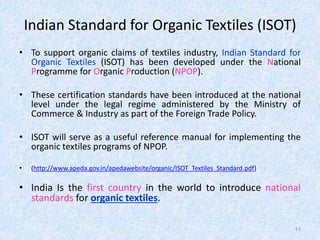
Indian Standard for Organic Textiles (ISOT)
• To support organic claims of textiles industry, Indian Standard for
Organic Textiles (ISOT) has been developed under the National
Programme for Organic Production (NPOP).
• These certification standards have been introduced at the national
level under the legal regime administered by the Ministry of
Commerce & Industry as part of the Foreign Trade Policy.
• ISOT will serve as a useful reference manual for implementing the
organic textiles programs of NPOP.
• (http://www.apeda.gov.in/apedawebsite/organic/ISOT_Textiles_Standard.pdf)
• India Is the first country in the world to introduce national
standards for organic textiles.
13
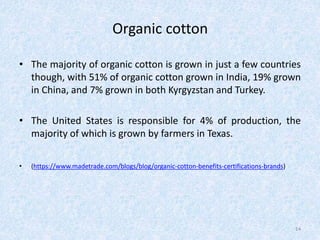
Organic cotton
• The majority of organic cotton is grown in just a few countries
though, with 51% of organic cotton grown in India, 19% grown
in China, and 7% grown in both Kyrgyzstan and Turkey.
• The United States is responsible for 4% of production, the
majority of which is grown by farmers in Texas.
• (https://www.madetrade.com/blogs/blog/organic-cotton-benefits-certifications-brands)
14
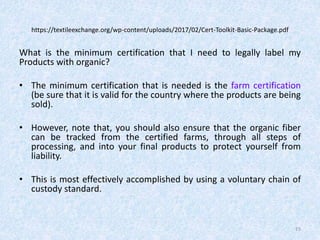
https://textileexchange.org/wp-content/uploads/2017/02/Cert-Toolkit-Basic-Package.pdf
What is the minimum certification that I need to legally label my
Products with organic?
• The minimum certification that is needed is the farm certification
(be sure that it is valid for the country where the products are being
sold).
• However, note that, you should also ensure that the organic fiber
can be tracked from the certified farms, through all steps of
processing, and into your final products to protect yourself from
liability.
• This is most effectively accomplished by using a voluntary chain of
custody standard.
15
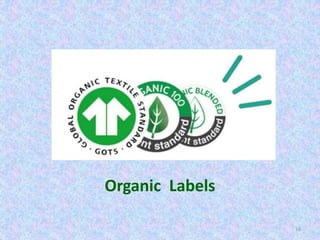
Organic Labels
16
Organic Labels
• Certifications and standards play a important role in
monitoring the textile production practices.
• Without guiding standards and investigation by an
independent third party, consumers could not be certain that
product is an “organic”, irrespective of company’s claims.
• With shoppers increasingly looking for transparency in what
they buy, certification is becoming essential.
https://icea.bio/global-organic-textile-standard-gots/?lang=en
17
Organic Labels
• This concern with credibility and impartiality led to the
formation labelling, such as GOTS, OCS, etc.
• These certificates (labels) provide credible assurance to the
consumer that the claims the sellers make are backed up.
• GOTS has been developed based on the international
standard ISO 14024 (Type-I), mentioned in the next slide.
18
International Standard
• To secure transparency and credibility when implementing
Certification / Labelling programs and to harmonize the
principles and procedures applicable to ecolabels, the
International Organization for Standardization has developed
the framework and guide for these programs.
• This standard (guide) is ISO 14024.
• This standard also establishes the certification procedures for
awarding the label, including the assessing and demonstrating
compliance.
19
Global Organic Textile Standard (GOTS)
What is the Global Organic Textile Standard?
• “The Global Organic Textile Standard (GOTS) is the worldwide
leading “textile” processing standard* for “organic fibres”.
• (* Standard means, the facilities are audited as per this standard. 3rd party
independent Certification agencies do the audit and certify the company. )
20
Global Organic Textile Standard (GOTS)
The Global Organic Textile Standard (GOTS)
• GOTS provides comprehensive guidelines for “ecological”
and “socially responsible” textile production, covering the
complete supply chain, with independent certification.
• GOTS ensures that the product is really organic and
authentic from seed to the finished product.
• GOTS enables processors and manufacturers to supply their
textiles with one certification accepted in all major selling
markets.
21
Global Organic Textile Standard (GOTS)
GOTS Scheme owner
• Global Standard gemeinnützige GmbH was established in
August 2008 and is owned by an International Working Group
(IWG) of four members:
– International Association Natural Textile Industry (IVN),
Germany,
– Soil Association (SA), England,
– Organic Trade Association (OTA), USA, and
– Japan Organic Cotton Association (JOCA), Japan.
• (All are leading standard setters , grouped together with the aim of defining
requirements that are recognised world-wide ).
22
• https://ioas.org/wp-content/uploads/2018/05/IOAS-OM-GOTS.pdf
• https://www.global-
standard.org/images/stories/GOTS_RT_US_02.2018/4_GOTS_Round_Tabl
e_USA.pdf
(GOTS PPT in PDF form)
About IVN:
(IVN stands for Internationale Verband der Naturtextilwirtschaft. The English translation is
International Association Natural Textile Industry. It is a standards setting and certifying
organization for textiles. It is based in Germany)
23
Global Organic Textile Standard (GOTS)
• The last Version 5.0 of GOTS was published on 1st of March
2017, 3 years after the Version 4.0 was introduced and 12
years after the launch of 1st Version.
• The current GOTS version 6.0 is released in March 2020 for
implementation by March 2021.
• Ref: https://www.global-standard.org/information-centre/news/347-
press-release-gots-version-6-0-released.html , for updates , related
standards , and implementation manual, etc.
24
Textile Fibers covered under GOTS
• Organic fiber including cotton, wool, hemp, flax (linen), and
other natural fibers can be certified for GOTS.
• Only textile products and that too, if contain a minimum of
70% certified organic (natural) fibres, can become GOTS
certified.
25
Global Organic Textile Standard (GOTS)
GOTS can be given for all stages of the textile value chain :
• mechanical textile processing and manufacturing operations
and their products;
• wet processing and finishing operations and their products;
• trading operations and related products;
• Approval of textile auxiliary agents (chemical inputs) on
positive lists.
(https://www.global-standard.org/the-standard/general-description.html)
26
GOTS certified Final products
• The GOTS certified final products may include, but are
not limited to :
– Fiber (post-harvesting),
– yarn,
– fabrics,
– garments,
– fashion textile accessories (carried or worn)
– textile toys,
– home textiles, including mattresses and bedding products,
as well as ,
– textile personnel care products
27
Global Organic Textile Standard (GOTS)
• GOTS does not set standards for organic fibre cultivation
itself (as it is only a textile standard and not an agricultural
standard).
• Hence, Organic fibre production is not directly covered by the
GOTS certification system.
• However, the standard requires all raw materials to be
certified “organic” as per the recognised international or
national farming standard (mentioned in the next slides).
28
Organic farming standards
• Cultivation of organic fibres is under the scope of the
governmental organic farming standards, some of them are :
– United States Department of Agriculture (USDA),
– National Organic Program (NOP), USA
– APEDA's National Program for Organic Production (NPOP),
India
– China Organic Standard GB/T196.
– The International Federation of Organic Agriculture
Movements (IFOAM),
29
Organic farming standards
• Farmers (fibre producers) must be certified according to any
of these organic farming standard mentioned in the previous
slide, to claim their fiber as “Organic”.
• This certification also helps with tracking the movement /
traceability of the Organic fiber through subsequent
different value addition processes.
30
Global Organic Textile Standard (GOTS)
Is GOTS an official standard?
• GOTS is a voluntary standard so it is not regulated by a
governmental body but rather managed by a non-profit
organization.
• However, it is supported by the U.S. Government.
• Hence, Textiles that contain NOP certified fibres and are
processed according to GOTS, can be sold as ‘organic’ in the
USA.
31
Global Organic Textile Standard (GOTS)
Approved Processes and Inputs
32
Approved Chemical Inputs
• GOTS has a long list of processes and inputs that are
allowable and non-allowable.
• Chemical inputs used by textile processors must comply with
the corresponding GOTS environmental and toxicological
criteria.
• Accordingly, manufacturers and suppliers of dyestuffs,
pigments and auxiliary agents can get their products approved
on corresponding ‘Letters of Approval' issued by certifying
agency (CB).
33
Approved Chemical Inputs
In the latest version 6.0 the following 2 new requirements have
been introduced for approved chemical formulators
1) Product Stewardship of Chemical inputs
Chemical “formulators” shall implement appropriate and
effective product stewardship practices.
Adequate systems for product testing and quality
assurance shall be in place.
34
Approved Chemical Inputs
2) Environment, Health and Safety for Chemical Suppliers
Chemical “formulators” shall undergo environmental
management and safety audit of their premises. On-site
inspection shall be performed for the first year and every
3rd year of granted Letter of Approval or Stnadard
Revision, whichever is earlier.
35
GOTS - Requirements
• GOTS don’t allow things like formaldehyde or fumigants or
other dangerous chemicals like aromatic solvents, heavy
metals, etc.
• But, there are what they call “sunset clauses” to make
allowances in a few instances where it wouldn’t be possible or
legal to make a product without using a certain input that
GOTS may not want in there.
36
GOTS - Requirements
• During the production process, the use of water and energy is
monitored. GOTS must be provided with information and
statistics on how much water and energy they are consuming
per kg of textile production.
• A functional waste water treatment plant is mandatory for
any wet-processing unit involved.
• If they are not met, target goals and procedures are put in
place to reduce water and energy consumption. These goals
must be fulfilled.
37
GOTS - Requirements
Here’s some more criteria the processes must meet:
• All organic raw materials must be clearly labelled as such at all
stages of the supply chain, and kept separately from other
conventional materials.
• This is to ensure that organic and conventional fibres are not
commingled and that organic fibres and GOTS goods are not
contaminated by contact with prohibited substances.
• Knitting/weaving oils must not contain heavy metals, other
inputs must be derived from natural source only.
38
GOTS - Requirements
• The bleaches used in the process of the product must be
oxygen based. Strictly no chlorine bleaching shall be used.
• Dyeing/Printing: Selection of dyes, pigments and auxiliaries
are restricted by GOTS. Allowed are natural dyes (with some
restrictions), synthetic dyes, pigments and auxiliaries that
meet the basic requirements set by GOTS.
• Discharge printing methods using aromatic solvents, and
Plastisol printing methods using phthalates and PVC are
prohibited. Flock printing is allowed with restrictions.
39
GOTS - Requirements
• Only mechanical or thermal finishing is allowed.
• No antimicrobial finishes, coatings, filling, stiffening,
weighting is allowed.
• No sand-blasting.
• Only GMO free enzymes can be used.
• Mercerization & Optical Brightening is allowed with
conditions.
40
GOTS - Requirements
Sizing and Weaving/Knitting:
• Allowed sizing agents are all natural base as synthetic sizing
materials are restricted with the exception of some special
products.
• In case of any synthetic size, materials can be used for no
more than 25% of the total sizing in combination with natural
substances only.
• Synthetic sizing agents that are recycled/recovered with a
ratio >80% may also be used without limitation in the total
sizing, provided, the basic hazards requirements are met.
41
GOTS - Requirements
Trims and Accessories:
• The kind of trims or accessories allowed are natural materials
including biotic material such as natural fiber, wood, leather, horn,
bone, shell and non biotic material such as minerals, metals, stone.
• Also, regenerated and synthetic materials are allowed in some
cases.
• Virgin polyester may still be used for accessories (e.g. sewing
threads, zippers or buttons).
• More material options provided for ‘not explicitly listed accessories’
(materials with required functionality and durability can be used).
42
GOTS - Requirements
• Packaging materials are also monitored.
• Packaging must not contain PVC.
• Paper / cardboard used in packaging material for the retail
trade of GOTS Goods (incl. labelling items such as hang tags or
swing tags), must be recycled or from certified sustainable
forestry management (FSC / PEFC) – this requirement is not
set for bulk packaging.
43
GOTS - Requirements
• Pesticide/ Biocide use in storeroom/ transportation has to be
only in accordance with International / National Organic
Production Standard
44
GOTS - Requirements
• There are also strong social compliance requirements to
protect the people who are doing the processing, and
• All processors must comply with these social criteria.
45
GOTS - Requirements
• It is easy to go for GOTS certification for any factory if they
already have some Social compliance certificate.
• Certification programs of which the results should be
considered and recognized in the course of GOTS inspection
are listed bellow:
– Fair Wear Foundation (FWF)
– Social Accountability 8000 (SA 8000)
– Worldwide Responsible Accredited Production (WRAP)
– Business Social Compliance Initiative (BSCI)
46
GOTS - Requirements
• The latest version of GOTS more dynamic elements have
been explicitly included.
• Certified Entities will now have to calculate the gap of actually
paid wages to 'Living Wages' (according to recognized
calculations methods). Furthermore, the companies will be
encouraged to work towards closing this gap.
• Specific references to OECD Due Diligence Guidance and Good
Practice Guidance for Social Criteria and Risk Assessment as
well as Ethical Business Practises also been included.
47
GOTS - Requirements
Environmental Management
• All companies shall assure compliance with the applicable
national and local legal environmental requirements
applicable to their processing / manufacturing stages
(including those referring to emissions to air, wastewater
discharge as well as disposal of waste and sludge.
• They shall have a written environmental policy and procedure
in place to allow monitoring and improving relevant
environmental performances in their facilities.
48
GOTS - Requirements
Technical Quality Requirements
• Any final product labeled according to this Standard shall
comply with defined technical quality parameters.
• Meeting product Quality Standards for Colourfastness and
Dimensional Stability , etc. are now mandatory.
• Even if produced in compliance with this (GOTS) standard,
textiles may carry traces of residue banned chemicals. The
limit values has been defined for these unavoidable
contamination.
49
Global Organic Textile Standard (GOTS)
Certification Process
50
Applicability of the Certification System
• The GOTS quality assurance system is based on inspection &
certification of the textile processing and trade chain.
• The applicability of the GOTS certification system starts with
the first processing step in the textile supply chain.
• Processors and manufacturers from post-harvest handling up
to garment making, as well as, traders up to the import stage,
have to undergo an on-site annual inspection cycle.
• For Subcontractors, the certification based on on-site
inspection is obligatory.
51
Applicability of the Certification System
• In the cotton supply chain the ginning is considered to be the
first processing step, whereas,
• in the wool supply chain processing normally starts with the
scouring.
52
The Certification Process
• The steps of inspection will depend on the factory(Process), but
they must include the following elements:
• Review of bookkeeping, including Tracing the organic
fibre product flow.
• Assessment of the processing and storage system
• Assessment of separation and identification system
(here, they look for areas of risk to organic integrity)
• Inspection of the chemical inputs (like dyes) used
• Inspection of wastewater treatment system as part of
the environmental management
• Assess all social criteria (they do this through interviews,
documents, on-site inspections)
• Risk assessment based on residue testing policies.
53
The Certification Process
Technical Quality Parameters: -
Residue Testing: -
• Samples for residue testing may also be taken by the auditor
during the required on-site inspection/audit, either as back-
up to the inspection process or in case of suspicion of
contamination or non-compliance.
54
The Certification Process
What is next ?
• Processors and manufacturers (like Ginning, Spinning,
Knitting, Dyeing & Printing, etc.) who have demonstrated to
the certifier that they are able to work in compliance with all
applicable GOTS criteria, in the fields of their operations,
receive a GOTS Scope certification
55
The Certification Process
• What is Scope Certificate ?
• Scope certificates (SC’s)(=Certificates of Compliance) confirm
that a company works in compliance with GOTS. Accordingly
the company/producer is considered as “Certified Entity”.
• Scope Certificates declare that the particular producer /
company (Certified Entity) is able to supply and / or process
the products / product categories mentioned therein, as per
GOTS requirements.
56
The Certification Process
• With this Scope certification , the certified entity acquires a
sub-licence which entitles it to use the GOTS logo on its
respective GOTS Goods.
• They may then accept orders for GOTS compliant processing /
manufacturing in their certified scope.
• A valid certification (Scope Certificate) is a prerequisite, in
order for final products to be labelled as GOTS certified.
57
The Certification Process
• Remember, the Scope Certificate is not a proof that specific
shipment from this company is GOTS certified.
• This is because , the standard does not apply to the facility as
a whole, but only to the production of GOTS products.
• Subcontractors and their relevant processing and
manufacturing steps become listed on a separate page of
the Scope certificates of the certified entity.
• (here the Subcontractor refers to outsourced processes like Knitting, Dyeing, Printing,
embroidery, etc. iand ownership of the product in-process is not changed)
58
The Certification Process
• GOTS is a product certificate
• It means that all the products supplied by this company is
not eligible for GOTS Label.
• GOTS certified entity can supply both Organic as well as
Conventional (non-organic) products.
59
The Certification Process
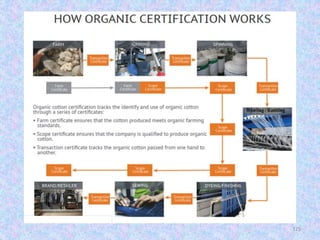
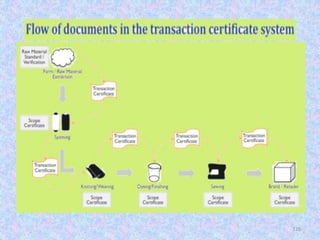
Transaction Certificates (TCs)
• In order to assure that a specific shipment of products
delivered is GOTS certified, the certified supplier shall
provide a Transaction Certificate (TC) to the purchaser /
buyer, along with the delivery challan /Invoice.
• The supplier in turn get this certificate (TC) from their
certifying body.
• The certifying body lists the concerned products and
shipment details including the purchaser’s name and address
and issue the TC after making entry in their records.
60
Transaction Certificates (TCs)
• Transaction Certificates (TCs) are obligatory for each change of
ownership
• Multiple shipments can be covered in a single TC for same
buyer and same supplier for a period up to 3 months and up
to 100 shipments.
• Wholly owned subsidiaries of a retailer are exempt from TCs
for change of ownership within the subsidiaries.
• TCs not necessary between certified entity and subcontractor,
but should be issued on request.
61
Transaction Certificates (TCs)
• Certifiers (i.e. certifying body) keep track of the quantity of
organic textile products through mass balance calculation of
purchased and sold GOTS certified textiles.
• This is to ensure that all products that are sold with GOTS
certification claim are indeed correctly certified and properly
accounted.
62
The Certification Process
• Minimum guidance for certification, normally, will be given by
the certifying agency itself but better if the supplier take
the help of consultant.
63
Global Organic Textile Standard (GOTS)
LABEL-GRADES
64
Label-grades
• The GOTS label is used as a communication tool by brands
and retailers.
• The GOTS logo may be used as on-product and consumer
label to market GOTS certified textile goods
• Intermediate Textile goods (like yarns, fabrics etc.) may also
carry the GOTS logo.
• Additives suppliers can mention about GOTS approval status
in text.
65
Label-grades
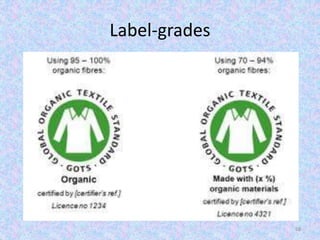
• GOTS have basically two types of label grades.
1. “Organic / Organic – in conversion”, and
2. “ Made with X % of organic / Made with X % of Organic -
in conversion material”.
• The only difference between these 2 labels is the minimum
percentage of organic material used.
• The additional fiber materials may be mixed with the organic
fibers to the fabric or used in certain details of the product.
66
Label-grades
The label-grades:
• Label-grade 1: “organic”
– When product contains ≥ 95% certified organic fibres
(excluding accessories), ≤ 5 % non-organic natural or
synthetic fibres
• Label-grade 2: “made with X% organic”
– When product contains ≥ 70% certified organic fibres
(excluding accessories), ≤ 30 % non organic fibres.
67
Label-grades
68
Label-grades
Conditions for and / or type of additional (non-organic) Fiber
Materials (Max 5% for “organic label”):
• Up to 5% of the fibre content of the products may be made of
non-organic / synthetic fibres
• And/or, Conventional natural fibres and all animal fibres,
except conventional cotton and conventional angora hair.
Blending conventional and organic fibres of the same type in the
same product is not permitted.
69
Label-grades
The following environmentally improved raw materials are
permitted up to 30% for label grade ‘made with organic’
• Recycled synthetic fibres (only recycled - polyester, polyamide,
polypropylene and polyurethane {elasthane}).
– Adequate verification to proof for chain of custody required, and
fibers shall be Certified as per :
• Recycled Claim Standard (RCS from Textile Exchange),
• Global Recycle Standard (GRS from Textile Exchange), or
• Recycled Content Standard (from SCS)
Contd……..
70
Label-grades
The following raw materials are also permitted up to 30% for
label grade ‘made with organic’
• Non-GMO Vegetable fibers and animal fibers (e.g. linen,
hemp, wool, silk, mohair, etc.)
• Regenerated fibres that are from certified organic raw
materials, sustainable forestry management (FSC / PEFC) or
recycled : only Lyocel, and protein based fibers.
• No virgin Viscose or Modal ( if materials used are not from a
sustainable forestry management program).
• (in general , the raw materials used are from certified organic origin, a sustainable
forestry management program or recycled).
Contd……..
71
Label-grades
• Virgin synthetic (polymer) fibers : only polyamide,
polypropylene and polyurethane (elastane) : the use is limited
to maximum of 10% (up to 25% for socks, leggings and
sportswear).
• No virgin Polyester.
• Regenerated fibers like Viscose or Modal: The use is limited to
maximum of 10% (up to 25% for socks, leggings and
sportswear) (raw materials used must be non-GMO).
• Stainless steel fibers and mineral fibers with exception of
asbestos, carbon and silver fibers : the use is limited to
maximum of 10%
72
Label-grades
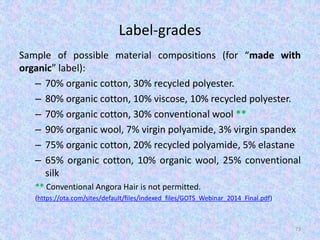
Sample of possible material compositions (for “made with
organic” label):
– 70% organic cotton, 30% recycled polyester.
– 80% organic cotton, 10% viscose, 10% recycled polyester.
– 70% organic cotton, 30% conventional wool **
– 90% organic wool, 7% virgin polyamide, 3% virgin spandex
– 75% organic cotton, 20% recycled polyamide, 5% elastane
– 65% organic cotton, 10% organic wool, 25% conventional
silk
** Conventional Angora Hair is not permitted.
(https://ota.com/sites/default/files/indexed_files/GOTS_Webinar_2014_Final.pdf)
73
Label-grades
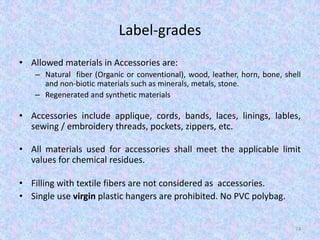
• Allowed materials in Accessories are:
– Natural fiber (Organic or conventional), wood, leather, horn, bone, shell
and non-biotic materials such as minerals, metals, stone.
– Regenerated and synthetic materials
• Accessories include applique, cords, bands, laces, linings, lables,
sewing / embroidery threads, pockets, zippers, etc.
• All materials used for accessories shall meet the applicable limit
values for chemical residues.
• Filling with textile fibers are not considered as accessories.
• Single use virgin plastic hangers are prohibited. No PVC polybag.
74
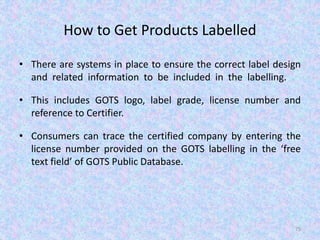
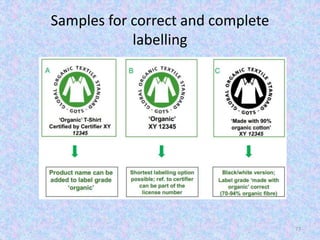
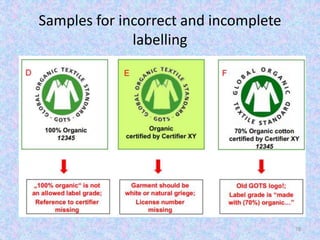
How to Get Products Labelled
• There are systems in place to ensure the correct label design
and related information to be included in the labelling.
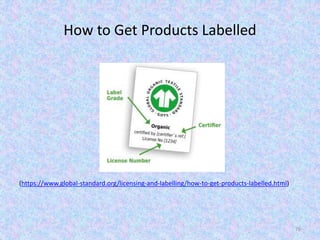
• This includes GOTS logo, label grade, license number and
reference to Certifier.
• Consumers can trace the certified company by entering the
license number provided on the GOTS labelling in the ‘free
text field’ of GOTS Public Database.
75
How to Get Products Labelled
(https://www.global-standard.org/licensing-and-labelling/how-to-get-products-labelled.html)
76
Samples for correct and complete
labelling
77
Samples for incorrect and incomplete
labelling
78
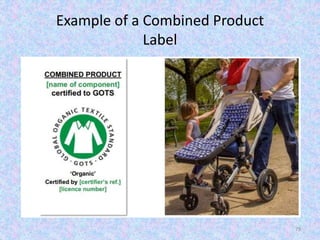
Example of a Combined Product
Label
79
Labelling and GOTS logo use by Retailers
Before selling GOTS certified and labelled final products to the
end consumer, the retailer must ensure that:
• The last operation in the textile supply chain (that is obliged
to participate in the certification chain) holds a valid scope
certificate issued by an Approved Certifier:
– If the retailer does also have a B2B trade activity (e.g. sale to
other retailers) and/or (re)packs or (re)labels the GOTS Goods,
the retailer must be certified. The same conditions for the
certification of traders shall apply.
– If the retailer does not have a B2B trade activity and does not
(re)pack or (re)label the GOTS Goods, the retailer is exempt
from the certification obligation. In this case the retailer must
assure that his seller of the ready packed and labelled GOTS
Goods is certified.
80
Labelling and GOTS logo use by Retailers
• Brand holders or retailers that are not obliged to participate in
the GOTS certification system can ask their certified supplier
to apply the logo.
• In this case the labelling would be under survey of the GOTS
certifier of the supplier and the supplier's reference (e.g.
license number) would appear on the labelling.
81
Labelling and GOTS logo use by Retailers
• Alternatively, brand holders or retailers that are not obliged to
participate in the GOTS certification system, may decide to
apply for certification on a voluntary basis.
• In this case they can apply the logo on their own under survey
of their GOTS certifier.
• Accordingly their own reference (e.g. licence number) will
appear on the labelling.
• In any case only a GOTS certified entity may apply GOTS
labelling to a product.
82
Global Organic Textile Standard (GOTS)
• The GOTS allows "in-conversion" organic material as inputs if
the applicable farming standard permit such certification.
• For the products sold in the US, no reference may be made to
“organic-in conversion”.
83
Global Organic Textile Standard (GOTS)
What about a statement that the yarn (or fabric) in a finished
product is GOTS certified?
• The GOTS licensing and labelling conditions do not permit to
use the GOTS logo or any reference to GOTS certification on
the garment / final textile product if the GOTS certification is
valid for intermediate stages (such as yarn or fabric stage) or
for specific components of the product only.
• There still may be claims but it is only a self-claim.
• Thus, you, as a customer, cannot be sure this claim is true.
84
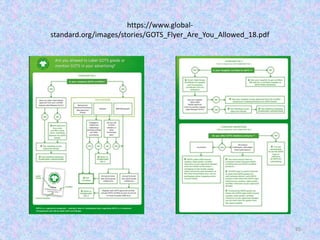
https://www.global-
standard.org/images/stories/GOTS_Flyer_Are_You_Allowed_18.pdf
85
Organic Content Standard (OCS)
86
Organic Content Standard (OCS)
• The Global Organic Textile Standard (GOTS) exists to give
textile manufacturers a robust set of requirements for organic
textile production.
• This includes social, environmental, technical requirements,
restricted substances, blending not below 70% organic
content, etc.
• But, not all manufacturers are able to meet this requirements.
• So, what is the next best option for the Retailers and
manufacturers to show to their customers that their product
too is Organic / made with Organic ? It is OCS.
87
Textile Exchange (TE)
• Textile Exchange (TE) is an international, member-supported
non-profit charitable organization.
• The organization was established in 2003 under the original
name of Organic Exchange, and in 2010 it became Textile
Exchange (TE).
88
Organic Content Standard (OCS)
• In 2007 Organic Exchange had developed 2 standards, namely,
the OE 100 and OE Blended standards, to verify the “organic
cotton” content claims on products.
• The standards established a system for tracking and
documenting the purchase, handling and use of certified
organic cotton fibre.
• Since then there has been a need for a broader organic
standard that would support content claims for all organic
inputs, not just cotton.
• To meet this need, Textile Exchange has developed the
Organic Content Standard (OCS), replacing OE 100 and OE
Blended Standard.
89
Organic Content Standard (OCS)
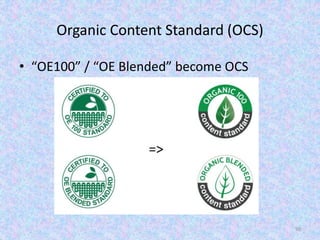
• “OE100” / “OE Blended” become OCS
90
Organic Content Standard (OCS)
• The Organic Content Standard (OCS) is a “Voluntary” Chain of
Custody Standard for tracking and verifying the “content” of
organically grown materials in a final product and is also
referred as a content claim standard.
.
• This means that the organic fiber percentage in a product is
tracked and documented throughout the supply chain.
91
Organic Content Standard (OCS)
Organic Content Standard
• The OCS allows companies to begin to use organic fiber at a
low percentage blends to slowly increase usage, thus giving
needed flexibility in order to grow the organic textile market.
• There are no other chain of custody standards for organic that
are applicable beyond textiles.
• The OCS is designed to work in any industry with any product.
92
Organic Content Standard (OCS)
OVERVIEW
• As a business-to-business tool, the OCS may be used to
ensure that products, which the companies purchase,
actually contain declared percentage of Organic Material
(Claimed Material) and they are getting what they are
paying for.
• It provides a strong tracking system (chain of custody) from
the source of the organic raw material to the final product
through Transaction Certificate(TC) to allow a corresponding
organic ‘fibre claim’ in the final textile product .
93
Organic Content Standard (OCS)
Verifying Organic Content :
• This Standard, like GOTS, does not cover the certification of
the raw material itself.
• The OCS, clearly defines the need for proper verification of
the raw material source (ie: certified to a valid organic
standard)
• Only material from certified organic farms (under one of
IFOAM’s Family of Standards) is accepted to the OCS.
• IFOAM’s Family of Standards
(https://www.ifoam.bio/sites/default/files/familyframe_web_0.pdf)
94
Organic Content Standard (OCS)
• OCS does not cover processing / processing inputs (e.g.
chemicals). So, although the organic content is tracked, there
are no requirements or limitations on the types of processing
that can be done.
• Also, the Standard does not address environmental aspects of
processing (e.g. energy or water usage), social issues, safety
issues, or legal compliance beyond the integrity of the organic
material.
• And, hence, OCS logo declares “ Made with Organically
Grown Cotton” only
95
Organic Content Standard (OCS)
• The Organic Content Standard (OCS) applies to any non-food
product containing 5-100% organic material.
• The standard verifies the presence and amount of organic
material in a final product.
• Each organization along the supply chain must take sufficient
steps to ensure the integrity and identity of the input organic
material.
• The OCS requires all Organizations to be certified beginning
with post-harvest processing sites through to the seller in the
final business-to-business transaction.
96
Organic Content Standard (OCS)
• GOTS certified Goods are accepted as inputs for OCS certified
products*.
• However, through this standard(OCS), products can claim
“organic fiber content” even if the Certified organic cotton
used the same processes and chemical inputs as conventional
fiber. There are no limitations on the types of processing (or
value additions) that can be done.
• *(https://textileexchange.org/wp-content/uploads/2016/06/CCS-Implementation-Manual-
v2.0.pdf)
97
Organic Content Standard (OCS)
Key Points in the OCS ..contd…
• The OCS supports claims of organically grown content, but
not organic product claims
• Example of supported claim:
– “This product contains 100% organically grown content.”
• Example of unsupported claim:
– “The product is 100% organic.” (This is because the OCS
does not include processing requirements.)
98
Organic Content Standard (OCS)
• Retailers/Importers are required to be certified, only if :
– they re-packages the goods in any way,
– applies the standard logo, or
– sells the products to companies other than their own.
• Retailers/Importers dealing with certified products not
required to pay a fee unless they become certified.
99
Organic Content Standard (OCS)
• As long as the sub-contracted sewing factory does not take
ownership of the goods, and the goods can be tracked
through the mandatory documentation, then it is not a
requirement to have the sub-contracted sewing factory
certified.
• This condition is same as GOTS
• (https://www.control-union.fr/control-
union/medias/File/CCS%20Implementation%20Manual%20v1_2.pdf)(Page: 17/18)
100
Organic Content Standard (OCS)
• For this standard, Product sent to a dye house under a sub-
contracting arrangement falls under the “sub-contracted
processes” and therefore exempt from inspection/
certification as long as the goods can be tracked through the
mandatory documentation.
• This condition is also same as GOTS
• However, it is strongly recommended that CB’s do at least one
initial inspection of a sub-contracted dye house to fully
understand the processes used, and the way documentation
of product flow is handled.
101
Organic Content Standard (OCS)
• The benefits of this Standard are :
– organic claims made on final products can be fully backed up
through third party certification,
– transparency is increased, and
– Consumer’s trust will improve.
• The Industry will have a clear and uniform process (of
certification), leading to:
– Greater consistency,
– Efficiency, and
– Integrity.
102
Organic Content Standard (OCS)
OCS Claim - labeling
• An OCS claim is any statement that makes reference to this
standard (OCS).
• OCS claims may include any combination of logo use, text
claims, and/or links to additional information that mention
the OCS.
• (https://textileexchange.org/wp-content/uploads/2016/06/OCS-Logo-Use-and-
Claims-Guide.pdf)
103
OCS Claim - labelling
OCS claims fall under one or more of the following categories:
1) General marketing claim:
– This type of claim indicates or implies that a company meets the
requirements of the OCS, purchases OCS Certified products, or
certifies in accordance with the OCS.
– Examples of general marketing claims include reference to the
OCS on the CSR page of a website or in a general statement that
does not refer to a product in a catalogue or point of sale
marketing / displays in the stores.
104
OCS Claim - labelling
Prerequisites for OCS General Marketing Claims
For Certified Organizations
– A2.1 Certified Organizations may make general marketing
claims about the OCS, their certification to the OCS, and about
the certification of their OCS products as long as all statements
are true, accurate, and not misleading.
105
OCS Claim - labeling
Prerequisites for OCS General Marketing Claims
For Non certified organization (may include retailers or companies)
– A2.3 Non certified organizations making general marketing
claims have to make the commitment to use OCS
products.
– B4.4 They may use the OCS logo in general marketing claims, as long
as they have taken steps to ensure that all associated statements
are true, accurate, and not misleading.
– B5.3 A non-certified organization may indicate their use of the OCS.
General marketing claims may appear in online publications,
catalogues, and any other location.
These claims may be stated in general terms, such as “We support the
Organic Content Standard in our use of organic cotton”.
106
OCS Claim - labeling
2) Business – to – business (B2B) claim:
– This type of claim uses the OCS name or OCS logo to identify
semi finished batches or lots - directly or on invoices or
shipping documents.
– For Business-to-Business claims of products, the OCS logo is not
required.
Examples of B2B claims : shipping labels or packing slips.
(https://textileexchange.org/wp-content/uploads/2016/06/OCS-Logo-Use-and-
Claims-Guide.pdf)
107
OCS Claim - labeling
3) Consumer-facing / Product specific claim:
– When any claim is attached to a specific product or group of
products, this becomes a product Specific claim, and shall meet
the requirements accordingly.
– This type of claim is directed at consumers.
(https://textileexchange.org/wp-content/uploads/2016/06/OCS-Logo-Use-and-
Claims-Guide.pdf)
108
OCS Claim - labeling
• Product specific claim:
– This type of claim indicates or implies that a specific
product meets the requirements of the OCS.
– These claims may be made on or off the products.
– Examples of product specific claims include :
• hangtags with the OCS logo, or
• reference to the OCS in the description of a product , or
• group of products in a catalogue, website, or point of sale
marketing.
109
OCS Claim - labeling
Prerequisites for OCS Consumer-facing / Product specific claims :
In order for products to be sold with Product specific / Consumer facing OCS
claims the following requirements shall be met:
• A1.1 All claimed organic Content in the product shall be OCS Certified.
• A1.2. The product shall be OCS Certified up through the seller in the final
business to business transaction.
– Example: Brand A sells OCS certified shirts to Retailer B.
– Brand A shall be OCS Certified and the products Brand A sells shall be
OCS Certified. Retailer B is not required to be certified.
– ( Note : we can replace Brand A as “Exporter”)
• Only certified Organizations may apply product specific claims with
reference to the OCS (e.g. hangtags, sewn-in labels).
110
OCS Claim - labeling
• Individual components of a product may be identified as
certified to the OCS but only in a manner that makes it
completely clear that only the identified component contains
organic content, and not the whole product.
– For example, only the upper of a shoe is made with organic
content, while the bottom/ sole is rubber.
111
OCS Claim - labelling
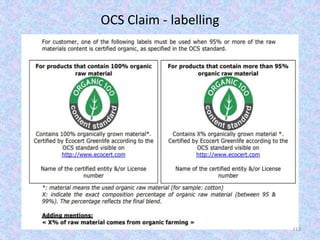
• Only for products that contain 100% Organic Material, “Made
with/Contains 100% Organically Grown Material” label can be used.
• For products that contain 95% or more Organic Material, as long as
the remaining content is not of the same type as the Organic
Material - “Made with /Contains x% Organically Grown Material”,
label can be used.
• Either of “Made with” or “Contains” may be used; it is not required
to use both.
• The use of the term “Organically Grown” gives greater clarity to the
consumer that it is the material itself that is organic, not the final
product.
112
OCS Claim - labelling
113
“OCS blended” labelling rules
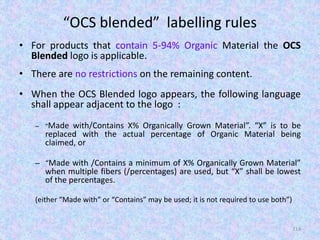
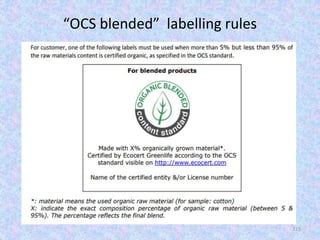
• For products that contain 5-94% Organic Material the OCS
Blended logo is applicable.
• There are no restrictions on the remaining content.
• When the OCS Blended logo appears, the following language
shall appear adjacent to the logo :
– “Made with/Contains X% Organically Grown Material”. “X” is to be
replaced with the actual percentage of Organic Material being
claimed, or
– “Made with /Contains a minimum of X% Organically Grown Material”
when multiple fibers (/percentages) are used, but “X” shall be lowest
of the percentages.
(either “Made with” or “Contains” may be used; it is not required to use both”)
114
“OCS blended” labelling rules
115
OCS Claim - labelling
• The OCS allows "in-conversion" organic material as inputs if
the applicable farming standard permit such certification.
• For the products sold in the US, no reference may be made to
“organic-in conversion” or “made with”.
• Any products being sold in the United States and making a
reference to "Organic" on the label shall have the organic
materials certified to the USDA NOP standard (As per USDA
Policy).
116
OCS Claim (to use the logo) Approval
Process
• Non certified organizations** shall send all artwork containing
Product Specific OCS Claims to the responsible Certification
Body (of the certified Organization) for approval prior to use.
Certified Organizations may apply for artwork approval on
behalf of a non certified organization.
• Certification Bodies are to review artwork for compliance with
the “OCS Logo Use and Claims Guide” and give approval
through the “Label Release Form”.
• **Third party is allowed to make reference to ECOCERT* or to the
certification only if the certified product is sold as initially, without
any modification of container or contains.
• (*ECOCERT – is the certification agency)
117
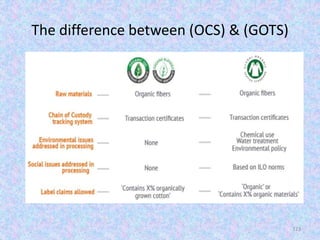
The Difference between OCS & GOTS
118
The difference between (OCS) & (GOTS)
• OCS (Organic Content Standard) provides third party
assurance that the organic content in your clothes can be
traced back to source.
• GOTS (Global Organic Textile Standard) traces the organic
content in your clothes and ensures that it is processed
socially and sustainably.
• These standards only certifies that the product contains
Organic Cotton, but they don’t certify the cotton as Organic.
119
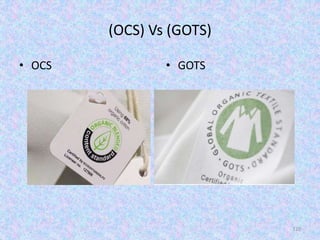
(OCS) Vs (GOTS)
• OCS • GOTS
120
(OCS) Vs (GOTS)
• While GOTS is a comprehensive standard for a ‘full product
claim’ that is setting detailed environmental and social criteria
throughout the entire textile supply chain for textiles using a
minimum of 70% organic fibres, where as,
• OCS (Organic Content Standard) is simply a content claim
standard and traces the organic fibre flow throughout the
entire textile supply chain to allow a corresponding organic
‘fibre claim’ in the final textile product without adding
environmental or social criteria in processing.
121
(OCS) Vs (GOTS)
• Both GOTS and OCS certification include recognizable logos
and allow for on- or off-product labelling.
• However, only GOTS certification has been recognized by the
USDA as acceptable verification for labelling products as
“organic.” (i.e, if you are exporting to USA - the GOTS
certificate is better option).
122
The difference between (OCS) & (GOTS)
123
(OCS) & (GOTS)
• Brands and retailers may use OCS as a stepping stone to GOTS
(e.g. a certification to cover tracking and handling while
supply chains organize themselves to comply with GOTS).
• GOTS and OCS may therefore be seen as complementary
rather than competing certification systems.
• Many companies in the supply chain even choose to be
certified to both standards - GOTS and OCS - so that they can
better meet the needs of their customers.
124
125
126
Sustainable Apparel Market
• Organic cotton, if sustainably and ethically produced, is a
beautiful alternative to conventional cotton.
• Organic textile market growth indicates an increasing
awareness of both producer and consumer responsibility.
• Overall, the rise of true organic cotton is a necessary shift
towards a sustainable apparel market.
127
Sustainable Apparel Market
• As always, if you want to have a better impact on the people
and the planet, we recommend buying less and buying better.
128
• I have mentioned the source web sites, for your further
reading, in related slides.
• If you still want some clarification, you can contact me at :
ravikeerthi.rao@rediffmail.com
129

Organic cotton labels 26.06.20

  • 1.
    Organic Cotton Labels GOTS& OCS By : Ravikeerthi Rao 1
  • 2.
    Organic • There isa great global concern for environmental protection on the part of governments, businesses and the public. • Due to this concern, there is growing demand amongst the customers for the eco-friendly products. • According to one global consumer study, more than three- quarters (76 %) of respondents said that the type of fabric was important in their clothing purchase decisions. 2
  • 3.
    Organic • The abilityto show customers that a product is made from materials trusted as quality, high value and sustainable, can translate to bigger business benefits. • The fiber choice is an important way for brands to raise their sustainability profile. • Large organizations from Levi’s to Primark have set aggressive sustainability goals while increasingly emerging brands are launching with sustainability as one of their key pillars. • Organic cotton is one of the first types of new “green” clothing. 3
  • 4.
    Organic • “Organic” isin-thing and Consumers around the world have become increasingly interested in buying food, apparel, and other products which contain organic ingredients. • In addition, many consumers want these ingredients processed in a manner that preserves their organic content. • Finally, some consumers also want to ensure that the products they buy have provided a fair return to the farmers who grow them, and have protected the health, safety and economic well-being of the workers who processed them. 4
  • 5.
    Organic • Keeping thisdemand in mind, the Apparel companies are developing programs that either use 100 percent organic cotton, or blend small percentages of organic cotton with conventional cotton in their products. 5
  • 6.
    Organic • For theconsumers, to have a clear and easy choice between organic and conventional clothing, a logical first step is to have a standard in place that defines what actually qualifies as organic in the textiles industry. • In the EU, the Council Directive (EU Council Regulation No. 834-2007) on Organic Farming defines production and certification requirements of organic crops. • So, what is the definition of “Organic”? 6
  • 7.
    Organic Official definitions (asper EU Council Regulation No. 834-2007) • ‘Organic’ means coming from or related to organic production. • Organic Production means the use of the production method compliant with the rules established in this regulation, at all stages of production, preparation and distribution. 7
  • 8.
    Organic • In simpleterms, Organic production is an overall system of farm management and food production that combines : – Best environmental practices, including better water management, – a high level of biodiversity, – the preservation of natural resources, – the application of high animal welfare standards, and – production method in line with preference of certain consumers for products. • This sustainable method of agriculture is beyond doubt better for our bodies, our homes, and our planet and for future generations. 8
  • 9.
    Organic Cotton What IsOrganic Cotton? • Organic Cotton is the Cotton , which is grown using organic farming (production) practices. • Third-party certification organizations verify that organic producers use only methods and materials allowed in organic production. 9
  • 10.
    Organic Cotton • However,this method of farming does not offer as high a yield as non-organic cotton because of restriction for use of chemical fertilisers and high yielding genetically modified seeds. • Moreover, there will be some loss to insects. • So levies are usually applied, meaning you pay a little bit more to go organic. 10
  • 11.
    Cotton in conversion •Transitioning cultivation to organic certification from conventional method usually takes place over a 36-month (three year) period, unless using virgin land. • It is an on-going cycle of shifting conventional farming practices to an organic management system until the land qualifies to be certified organic under national or international organic standards. 11
  • 12.
    Cotton in conversion •Cotton “in conversion” is grown on land which has only recently been converted to organic farming methods (typically less than 2 or 3 years. The year 1 cycle is not covered). • Therefore, although no chemical pesticides and synthetic fertilisers are being used, residues may still be found in the soil. • This conversion period is very difficult for farmers, who usually experience an initial drop in yield, while not being able to obtain premium organic price for their crops. • Some standards, such as The Global Organic Textile Standard enables the labelling of cotton fibre from the organic conversion period. 12
  • 13.
    Indian Standard forOrganic Textiles (ISOT) • To support organic claims of textiles industry, Indian Standard for Organic Textiles (ISOT) has been developed under the National Programme for Organic Production (NPOP). • These certification standards have been introduced at the national level under the legal regime administered by the Ministry of Commerce & Industry as part of the Foreign Trade Policy. • ISOT will serve as a useful reference manual for implementing the organic textiles programs of NPOP. • (http://www.apeda.gov.in/apedawebsite/organic/ISOT_Textiles_Standard.pdf) • India Is the first country in the world to introduce national standards for organic textiles. 13
  • 14.
    Organic cotton • Themajority of organic cotton is grown in just a few countries though, with 51% of organic cotton grown in India, 19% grown in China, and 7% grown in both Kyrgyzstan and Turkey. • The United States is responsible for 4% of production, the majority of which is grown by farmers in Texas. • (https://www.madetrade.com/blogs/blog/organic-cotton-benefits-certifications-brands) 14
  • 15.
    https://textileexchange.org/wp-content/uploads/2017/02/Cert-Toolkit-Basic-Package.pdf What is theminimum certification that I need to legally label my Products with organic? • The minimum certification that is needed is the farm certification (be sure that it is valid for the country where the products are being sold). • However, note that, you should also ensure that the organic fiber can be tracked from the certified farms, through all steps of processing, and into your final products to protect yourself from liability. • This is most effectively accomplished by using a voluntary chain of custody standard. 15
  • 16.
  • 17.
    Organic Labels • Certificationsand standards play a important role in monitoring the textile production practices. • Without guiding standards and investigation by an independent third party, consumers could not be certain that product is an “organic”, irrespective of company’s claims. • With shoppers increasingly looking for transparency in what they buy, certification is becoming essential. https://icea.bio/global-organic-textile-standard-gots/?lang=en 17
  • 18.
    Organic Labels • Thisconcern with credibility and impartiality led to the formation labelling, such as GOTS, OCS, etc. • These certificates (labels) provide credible assurance to the consumer that the claims the sellers make are backed up. • GOTS has been developed based on the international standard ISO 14024 (Type-I), mentioned in the next slide. 18
  • 19.
    International Standard • Tosecure transparency and credibility when implementing Certification / Labelling programs and to harmonize the principles and procedures applicable to ecolabels, the International Organization for Standardization has developed the framework and guide for these programs. • This standard (guide) is ISO 14024. • This standard also establishes the certification procedures for awarding the label, including the assessing and demonstrating compliance. 19
  • 20.
    Global Organic TextileStandard (GOTS) What is the Global Organic Textile Standard? • “The Global Organic Textile Standard (GOTS) is the worldwide leading “textile” processing standard* for “organic fibres”. • (* Standard means, the facilities are audited as per this standard. 3rd party independent Certification agencies do the audit and certify the company. ) 20
  • 21.
    Global Organic TextileStandard (GOTS) The Global Organic Textile Standard (GOTS) • GOTS provides comprehensive guidelines for “ecological” and “socially responsible” textile production, covering the complete supply chain, with independent certification. • GOTS ensures that the product is really organic and authentic from seed to the finished product. • GOTS enables processors and manufacturers to supply their textiles with one certification accepted in all major selling markets. 21
  • 22.
    Global Organic TextileStandard (GOTS) GOTS Scheme owner • Global Standard gemeinnützige GmbH was established in August 2008 and is owned by an International Working Group (IWG) of four members: – International Association Natural Textile Industry (IVN), Germany, – Soil Association (SA), England, – Organic Trade Association (OTA), USA, and – Japan Organic Cotton Association (JOCA), Japan. • (All are leading standard setters , grouped together with the aim of defining requirements that are recognised world-wide ). 22
  • 23.
    • https://ioas.org/wp-content/uploads/2018/05/IOAS-OM-GOTS.pdf • https://www.global- standard.org/images/stories/GOTS_RT_US_02.2018/4_GOTS_Round_Tabl e_USA.pdf (GOTSPPT in PDF form) About IVN: (IVN stands for Internationale Verband der Naturtextilwirtschaft. The English translation is International Association Natural Textile Industry. It is a standards setting and certifying organization for textiles. It is based in Germany) 23
  • 24.
    Global Organic TextileStandard (GOTS) • The last Version 5.0 of GOTS was published on 1st of March 2017, 3 years after the Version 4.0 was introduced and 12 years after the launch of 1st Version. • The current GOTS version 6.0 is released in March 2020 for implementation by March 2021. • Ref: https://www.global-standard.org/information-centre/news/347- press-release-gots-version-6-0-released.html , for updates , related standards , and implementation manual, etc. 24
  • 25.
    Textile Fibers coveredunder GOTS • Organic fiber including cotton, wool, hemp, flax (linen), and other natural fibers can be certified for GOTS. • Only textile products and that too, if contain a minimum of 70% certified organic (natural) fibres, can become GOTS certified. 25
  • 26.
    Global Organic TextileStandard (GOTS) GOTS can be given for all stages of the textile value chain : • mechanical textile processing and manufacturing operations and their products; • wet processing and finishing operations and their products; • trading operations and related products; • Approval of textile auxiliary agents (chemical inputs) on positive lists. (https://www.global-standard.org/the-standard/general-description.html) 26
  • 27.
    GOTS certified Finalproducts • The GOTS certified final products may include, but are not limited to : – Fiber (post-harvesting), – yarn, – fabrics, – garments, – fashion textile accessories (carried or worn) – textile toys, – home textiles, including mattresses and bedding products, as well as , – textile personnel care products 27
  • 28.
    Global Organic TextileStandard (GOTS) • GOTS does not set standards for organic fibre cultivation itself (as it is only a textile standard and not an agricultural standard). • Hence, Organic fibre production is not directly covered by the GOTS certification system. • However, the standard requires all raw materials to be certified “organic” as per the recognised international or national farming standard (mentioned in the next slides). 28
  • 29.
    Organic farming standards Organicfarming standards • Cultivation of organic fibres is under the scope of the governmental organic farming standards, some of them are : – United States Department of Agriculture (USDA), – National Organic Program (NOP), USA – APEDA's National Program for Organic Production (NPOP), India – China Organic Standard GB/T196. – The International Federation of Organic Agriculture Movements (IFOAM), 29
  • 30.
    Organic farming standards •Farmers (fibre producers) must be certified according to any of these organic farming standard mentioned in the previous slide, to claim their fiber as “Organic”. • This certification also helps with tracking the movement / traceability of the Organic fiber through subsequent different value addition processes. 30
  • 31.
    Global Organic TextileStandard (GOTS) Is GOTS an official standard? • GOTS is a voluntary standard so it is not regulated by a governmental body but rather managed by a non-profit organization. • However, it is supported by the U.S. Government. • Hence, Textiles that contain NOP certified fibres and are processed according to GOTS, can be sold as ‘organic’ in the USA. 31
  • 32.
    Global Organic TextileStandard (GOTS) Approved Processes and Inputs 32
  • 33.
    Approved Chemical Inputs •GOTS has a long list of processes and inputs that are allowable and non-allowable. • Chemical inputs used by textile processors must comply with the corresponding GOTS environmental and toxicological criteria. • Accordingly, manufacturers and suppliers of dyestuffs, pigments and auxiliary agents can get their products approved on corresponding ‘Letters of Approval' issued by certifying agency (CB). 33
  • 34.
    Approved Chemical Inputs Inthe latest version 6.0 the following 2 new requirements have been introduced for approved chemical formulators 1) Product Stewardship of Chemical inputs Chemical “formulators” shall implement appropriate and effective product stewardship practices. Adequate systems for product testing and quality assurance shall be in place. 34
  • 35.
    Approved Chemical Inputs 2)Environment, Health and Safety for Chemical Suppliers Chemical “formulators” shall undergo environmental management and safety audit of their premises. On-site inspection shall be performed for the first year and every 3rd year of granted Letter of Approval or Stnadard Revision, whichever is earlier. 35
  • 36.
    GOTS - Requirements •GOTS don’t allow things like formaldehyde or fumigants or other dangerous chemicals like aromatic solvents, heavy metals, etc. • But, there are what they call “sunset clauses” to make allowances in a few instances where it wouldn’t be possible or legal to make a product without using a certain input that GOTS may not want in there. 36
  • 37.
    GOTS - Requirements •During the production process, the use of water and energy is monitored. GOTS must be provided with information and statistics on how much water and energy they are consuming per kg of textile production. • A functional waste water treatment plant is mandatory for any wet-processing unit involved. • If they are not met, target goals and procedures are put in place to reduce water and energy consumption. These goals must be fulfilled. 37
  • 38.
    GOTS - Requirements Here’ssome more criteria the processes must meet: • All organic raw materials must be clearly labelled as such at all stages of the supply chain, and kept separately from other conventional materials. • This is to ensure that organic and conventional fibres are not commingled and that organic fibres and GOTS goods are not contaminated by contact with prohibited substances. • Knitting/weaving oils must not contain heavy metals, other inputs must be derived from natural source only. 38
  • 39.
    GOTS - Requirements •The bleaches used in the process of the product must be oxygen based. Strictly no chlorine bleaching shall be used. • Dyeing/Printing: Selection of dyes, pigments and auxiliaries are restricted by GOTS. Allowed are natural dyes (with some restrictions), synthetic dyes, pigments and auxiliaries that meet the basic requirements set by GOTS. • Discharge printing methods using aromatic solvents, and Plastisol printing methods using phthalates and PVC are prohibited. Flock printing is allowed with restrictions. 39
  • 40.
    GOTS - Requirements •Only mechanical or thermal finishing is allowed. • No antimicrobial finishes, coatings, filling, stiffening, weighting is allowed. • No sand-blasting. • Only GMO free enzymes can be used. • Mercerization & Optical Brightening is allowed with conditions. 40
  • 41.
    GOTS - Requirements Sizingand Weaving/Knitting: • Allowed sizing agents are all natural base as synthetic sizing materials are restricted with the exception of some special products. • In case of any synthetic size, materials can be used for no more than 25% of the total sizing in combination with natural substances only. • Synthetic sizing agents that are recycled/recovered with a ratio >80% may also be used without limitation in the total sizing, provided, the basic hazards requirements are met. 41
  • 42.
    GOTS - Requirements Trimsand Accessories: • The kind of trims or accessories allowed are natural materials including biotic material such as natural fiber, wood, leather, horn, bone, shell and non biotic material such as minerals, metals, stone. • Also, regenerated and synthetic materials are allowed in some cases. • Virgin polyester may still be used for accessories (e.g. sewing threads, zippers or buttons). • More material options provided for ‘not explicitly listed accessories’ (materials with required functionality and durability can be used). 42
  • 43.
    GOTS - Requirements •Packaging materials are also monitored. • Packaging must not contain PVC. • Paper / cardboard used in packaging material for the retail trade of GOTS Goods (incl. labelling items such as hang tags or swing tags), must be recycled or from certified sustainable forestry management (FSC / PEFC) – this requirement is not set for bulk packaging. 43
  • 44.
    GOTS - Requirements •Pesticide/ Biocide use in storeroom/ transportation has to be only in accordance with International / National Organic Production Standard 44
  • 45.
    GOTS - Requirements •There are also strong social compliance requirements to protect the people who are doing the processing, and • All processors must comply with these social criteria. 45
  • 46.
    GOTS - Requirements •It is easy to go for GOTS certification for any factory if they already have some Social compliance certificate. • Certification programs of which the results should be considered and recognized in the course of GOTS inspection are listed bellow: – Fair Wear Foundation (FWF) – Social Accountability 8000 (SA 8000) – Worldwide Responsible Accredited Production (WRAP) – Business Social Compliance Initiative (BSCI) 46
  • 47.
    GOTS - Requirements •The latest version of GOTS more dynamic elements have been explicitly included. • Certified Entities will now have to calculate the gap of actually paid wages to 'Living Wages' (according to recognized calculations methods). Furthermore, the companies will be encouraged to work towards closing this gap. • Specific references to OECD Due Diligence Guidance and Good Practice Guidance for Social Criteria and Risk Assessment as well as Ethical Business Practises also been included. 47
  • 48.
    GOTS - Requirements EnvironmentalManagement • All companies shall assure compliance with the applicable national and local legal environmental requirements applicable to their processing / manufacturing stages (including those referring to emissions to air, wastewater discharge as well as disposal of waste and sludge. • They shall have a written environmental policy and procedure in place to allow monitoring and improving relevant environmental performances in their facilities. 48
  • 49.
    GOTS - Requirements TechnicalQuality Requirements • Any final product labeled according to this Standard shall comply with defined technical quality parameters. • Meeting product Quality Standards for Colourfastness and Dimensional Stability , etc. are now mandatory. • Even if produced in compliance with this (GOTS) standard, textiles may carry traces of residue banned chemicals. The limit values has been defined for these unavoidable contamination. 49
  • 50.
    Global Organic TextileStandard (GOTS) Certification Process 50
  • 51.
    Applicability of theCertification System • The GOTS quality assurance system is based on inspection & certification of the textile processing and trade chain. • The applicability of the GOTS certification system starts with the first processing step in the textile supply chain. • Processors and manufacturers from post-harvest handling up to garment making, as well as, traders up to the import stage, have to undergo an on-site annual inspection cycle. • For Subcontractors, the certification based on on-site inspection is obligatory. 51
  • 52.
    Applicability of theCertification System • In the cotton supply chain the ginning is considered to be the first processing step, whereas, • in the wool supply chain processing normally starts with the scouring. 52
  • 53.
    The Certification Process •The steps of inspection will depend on the factory(Process), but they must include the following elements: • Review of bookkeeping, including Tracing the organic fibre product flow. • Assessment of the processing and storage system • Assessment of separation and identification system (here, they look for areas of risk to organic integrity) • Inspection of the chemical inputs (like dyes) used • Inspection of wastewater treatment system as part of the environmental management • Assess all social criteria (they do this through interviews, documents, on-site inspections) • Risk assessment based on residue testing policies. 53
  • 54.
    The Certification Process TechnicalQuality Parameters: - Residue Testing: - • Samples for residue testing may also be taken by the auditor during the required on-site inspection/audit, either as back- up to the inspection process or in case of suspicion of contamination or non-compliance. 54
  • 55.
    The Certification Process Whatis next ? • Processors and manufacturers (like Ginning, Spinning, Knitting, Dyeing & Printing, etc.) who have demonstrated to the certifier that they are able to work in compliance with all applicable GOTS criteria, in the fields of their operations, receive a GOTS Scope certification 55
  • 56.
    The Certification Process •What is Scope Certificate ? • Scope certificates (SC’s)(=Certificates of Compliance) confirm that a company works in compliance with GOTS. Accordingly the company/producer is considered as “Certified Entity”. • Scope Certificates declare that the particular producer / company (Certified Entity) is able to supply and / or process the products / product categories mentioned therein, as per GOTS requirements. 56
  • 57.
    The Certification Process •With this Scope certification , the certified entity acquires a sub-licence which entitles it to use the GOTS logo on its respective GOTS Goods. • They may then accept orders for GOTS compliant processing / manufacturing in their certified scope. • A valid certification (Scope Certificate) is a prerequisite, in order for final products to be labelled as GOTS certified. 57
  • 58.
    The Certification Process •Remember, the Scope Certificate is not a proof that specific shipment from this company is GOTS certified. • This is because , the standard does not apply to the facility as a whole, but only to the production of GOTS products. • Subcontractors and their relevant processing and manufacturing steps become listed on a separate page of the Scope certificates of the certified entity. • (here the Subcontractor refers to outsourced processes like Knitting, Dyeing, Printing, embroidery, etc. iand ownership of the product in-process is not changed) 58
  • 59.
    The Certification Process •GOTS is a product certificate • It means that all the products supplied by this company is not eligible for GOTS Label. • GOTS certified entity can supply both Organic as well as Conventional (non-organic) products. 59
  • 60.
    The Certification Process TransactionCertificates (TCs) • In order to assure that a specific shipment of products delivered is GOTS certified, the certified supplier shall provide a Transaction Certificate (TC) to the purchaser / buyer, along with the delivery challan /Invoice. • The supplier in turn get this certificate (TC) from their certifying body. • The certifying body lists the concerned products and shipment details including the purchaser’s name and address and issue the TC after making entry in their records. 60
  • 61.
    Transaction Certificates (TCs) •Transaction Certificates (TCs) are obligatory for each change of ownership • Multiple shipments can be covered in a single TC for same buyer and same supplier for a period up to 3 months and up to 100 shipments. • Wholly owned subsidiaries of a retailer are exempt from TCs for change of ownership within the subsidiaries. • TCs not necessary between certified entity and subcontractor, but should be issued on request. 61
  • 62.
    Transaction Certificates (TCs) •Certifiers (i.e. certifying body) keep track of the quantity of organic textile products through mass balance calculation of purchased and sold GOTS certified textiles. • This is to ensure that all products that are sold with GOTS certification claim are indeed correctly certified and properly accounted. 62
  • 63.
    The Certification Process •Minimum guidance for certification, normally, will be given by the certifying agency itself but better if the supplier take the help of consultant. 63
  • 64.
    Global Organic TextileStandard (GOTS) LABEL-GRADES 64
  • 65.
    Label-grades • The GOTSlabel is used as a communication tool by brands and retailers. • The GOTS logo may be used as on-product and consumer label to market GOTS certified textile goods • Intermediate Textile goods (like yarns, fabrics etc.) may also carry the GOTS logo. • Additives suppliers can mention about GOTS approval status in text. 65
  • 66.
    Label-grades • GOTS havebasically two types of label grades. 1. “Organic / Organic – in conversion”, and 2. “ Made with X % of organic / Made with X % of Organic - in conversion material”. • The only difference between these 2 labels is the minimum percentage of organic material used. • The additional fiber materials may be mixed with the organic fibers to the fabric or used in certain details of the product. 66
  • 67.
    Label-grades The label-grades: • Label-grade1: “organic” – When product contains ≥ 95% certified organic fibres (excluding accessories), ≤ 5 % non-organic natural or synthetic fibres • Label-grade 2: “made with X% organic” – When product contains ≥ 70% certified organic fibres (excluding accessories), ≤ 30 % non organic fibres. 67
  • 68.
  • 69.
    Label-grades Conditions for and/ or type of additional (non-organic) Fiber Materials (Max 5% for “organic label”): • Up to 5% of the fibre content of the products may be made of non-organic / synthetic fibres • And/or, Conventional natural fibres and all animal fibres, except conventional cotton and conventional angora hair. Blending conventional and organic fibres of the same type in the same product is not permitted. 69
  • 70.
    Label-grades The following environmentallyimproved raw materials are permitted up to 30% for label grade ‘made with organic’ • Recycled synthetic fibres (only recycled - polyester, polyamide, polypropylene and polyurethane {elasthane}). – Adequate verification to proof for chain of custody required, and fibers shall be Certified as per : • Recycled Claim Standard (RCS from Textile Exchange), • Global Recycle Standard (GRS from Textile Exchange), or • Recycled Content Standard (from SCS) Contd…….. 70
  • 71.
    Label-grades The following rawmaterials are also permitted up to 30% for label grade ‘made with organic’ • Non-GMO Vegetable fibers and animal fibers (e.g. linen, hemp, wool, silk, mohair, etc.) • Regenerated fibres that are from certified organic raw materials, sustainable forestry management (FSC / PEFC) or recycled : only Lyocel, and protein based fibers. • No virgin Viscose or Modal ( if materials used are not from a sustainable forestry management program). • (in general , the raw materials used are from certified organic origin, a sustainable forestry management program or recycled). Contd…….. 71
  • 72.
    Label-grades • Virgin synthetic(polymer) fibers : only polyamide, polypropylene and polyurethane (elastane) : the use is limited to maximum of 10% (up to 25% for socks, leggings and sportswear). • No virgin Polyester. • Regenerated fibers like Viscose or Modal: The use is limited to maximum of 10% (up to 25% for socks, leggings and sportswear) (raw materials used must be non-GMO). • Stainless steel fibers and mineral fibers with exception of asbestos, carbon and silver fibers : the use is limited to maximum of 10% 72
  • 73.
    Label-grades Sample of possiblematerial compositions (for “made with organic” label): – 70% organic cotton, 30% recycled polyester. – 80% organic cotton, 10% viscose, 10% recycled polyester. – 70% organic cotton, 30% conventional wool ** – 90% organic wool, 7% virgin polyamide, 3% virgin spandex – 75% organic cotton, 20% recycled polyamide, 5% elastane – 65% organic cotton, 10% organic wool, 25% conventional silk ** Conventional Angora Hair is not permitted. (https://ota.com/sites/default/files/indexed_files/GOTS_Webinar_2014_Final.pdf) 73
  • 74.
    Label-grades • Allowed materialsin Accessories are: – Natural fiber (Organic or conventional), wood, leather, horn, bone, shell and non-biotic materials such as minerals, metals, stone. – Regenerated and synthetic materials • Accessories include applique, cords, bands, laces, linings, lables, sewing / embroidery threads, pockets, zippers, etc. • All materials used for accessories shall meet the applicable limit values for chemical residues. • Filling with textile fibers are not considered as accessories. • Single use virgin plastic hangers are prohibited. No PVC polybag. 74
  • 75.
    How to GetProducts Labelled • There are systems in place to ensure the correct label design and related information to be included in the labelling. • This includes GOTS logo, label grade, license number and reference to Certifier. • Consumers can trace the certified company by entering the license number provided on the GOTS labelling in the ‘free text field’ of GOTS Public Database. 75
  • 76.
    How to GetProducts Labelled (https://www.global-standard.org/licensing-and-labelling/how-to-get-products-labelled.html) 76
  • 77.
    Samples for correctand complete labelling 77
  • 78.
    Samples for incorrectand incomplete labelling 78
  • 79.
    Example of aCombined Product Label 79
  • 80.
    Labelling and GOTSlogo use by Retailers Before selling GOTS certified and labelled final products to the end consumer, the retailer must ensure that: • The last operation in the textile supply chain (that is obliged to participate in the certification chain) holds a valid scope certificate issued by an Approved Certifier: – If the retailer does also have a B2B trade activity (e.g. sale to other retailers) and/or (re)packs or (re)labels the GOTS Goods, the retailer must be certified. The same conditions for the certification of traders shall apply. – If the retailer does not have a B2B trade activity and does not (re)pack or (re)label the GOTS Goods, the retailer is exempt from the certification obligation. In this case the retailer must assure that his seller of the ready packed and labelled GOTS Goods is certified. 80
  • 81.
    Labelling and GOTSlogo use by Retailers • Brand holders or retailers that are not obliged to participate in the GOTS certification system can ask their certified supplier to apply the logo. • In this case the labelling would be under survey of the GOTS certifier of the supplier and the supplier's reference (e.g. license number) would appear on the labelling. 81
  • 82.
    Labelling and GOTSlogo use by Retailers • Alternatively, brand holders or retailers that are not obliged to participate in the GOTS certification system, may decide to apply for certification on a voluntary basis. • In this case they can apply the logo on their own under survey of their GOTS certifier. • Accordingly their own reference (e.g. licence number) will appear on the labelling. • In any case only a GOTS certified entity may apply GOTS labelling to a product. 82
  • 83.
    Global Organic TextileStandard (GOTS) • The GOTS allows "in-conversion" organic material as inputs if the applicable farming standard permit such certification. • For the products sold in the US, no reference may be made to “organic-in conversion”. 83
  • 84.
    Global Organic TextileStandard (GOTS) What about a statement that the yarn (or fabric) in a finished product is GOTS certified? • The GOTS licensing and labelling conditions do not permit to use the GOTS logo or any reference to GOTS certification on the garment / final textile product if the GOTS certification is valid for intermediate stages (such as yarn or fabric stage) or for specific components of the product only. • There still may be claims but it is only a self-claim. • Thus, you, as a customer, cannot be sure this claim is true. 84
  • 85.
  • 86.
  • 87.
    Organic Content Standard(OCS) • The Global Organic Textile Standard (GOTS) exists to give textile manufacturers a robust set of requirements for organic textile production. • This includes social, environmental, technical requirements, restricted substances, blending not below 70% organic content, etc. • But, not all manufacturers are able to meet this requirements. • So, what is the next best option for the Retailers and manufacturers to show to their customers that their product too is Organic / made with Organic ? It is OCS. 87
  • 88.
    Textile Exchange (TE) •Textile Exchange (TE) is an international, member-supported non-profit charitable organization. • The organization was established in 2003 under the original name of Organic Exchange, and in 2010 it became Textile Exchange (TE). 88
  • 89.
    Organic Content Standard(OCS) • In 2007 Organic Exchange had developed 2 standards, namely, the OE 100 and OE Blended standards, to verify the “organic cotton” content claims on products. • The standards established a system for tracking and documenting the purchase, handling and use of certified organic cotton fibre. • Since then there has been a need for a broader organic standard that would support content claims for all organic inputs, not just cotton. • To meet this need, Textile Exchange has developed the Organic Content Standard (OCS), replacing OE 100 and OE Blended Standard. 89
  • 90.
    Organic Content Standard(OCS) • “OE100” / “OE Blended” become OCS 90
  • 91.
    Organic Content Standard(OCS) • The Organic Content Standard (OCS) is a “Voluntary” Chain of Custody Standard for tracking and verifying the “content” of organically grown materials in a final product and is also referred as a content claim standard. . • This means that the organic fiber percentage in a product is tracked and documented throughout the supply chain. 91
  • 92.
    Organic Content Standard(OCS) Organic Content Standard • The OCS allows companies to begin to use organic fiber at a low percentage blends to slowly increase usage, thus giving needed flexibility in order to grow the organic textile market. • There are no other chain of custody standards for organic that are applicable beyond textiles. • The OCS is designed to work in any industry with any product. 92
  • 93.
    Organic Content Standard(OCS) OVERVIEW • As a business-to-business tool, the OCS may be used to ensure that products, which the companies purchase, actually contain declared percentage of Organic Material (Claimed Material) and they are getting what they are paying for. • It provides a strong tracking system (chain of custody) from the source of the organic raw material to the final product through Transaction Certificate(TC) to allow a corresponding organic ‘fibre claim’ in the final textile product . 93
  • 94.
    Organic Content Standard(OCS) Verifying Organic Content : • This Standard, like GOTS, does not cover the certification of the raw material itself. • The OCS, clearly defines the need for proper verification of the raw material source (ie: certified to a valid organic standard) • Only material from certified organic farms (under one of IFOAM’s Family of Standards) is accepted to the OCS. • IFOAM’s Family of Standards (https://www.ifoam.bio/sites/default/files/familyframe_web_0.pdf) 94
  • 95.
    Organic Content Standard(OCS) • OCS does not cover processing / processing inputs (e.g. chemicals). So, although the organic content is tracked, there are no requirements or limitations on the types of processing that can be done. • Also, the Standard does not address environmental aspects of processing (e.g. energy or water usage), social issues, safety issues, or legal compliance beyond the integrity of the organic material. • And, hence, OCS logo declares “ Made with Organically Grown Cotton” only 95
  • 96.
    Organic Content Standard(OCS) • The Organic Content Standard (OCS) applies to any non-food product containing 5-100% organic material. • The standard verifies the presence and amount of organic material in a final product. • Each organization along the supply chain must take sufficient steps to ensure the integrity and identity of the input organic material. • The OCS requires all Organizations to be certified beginning with post-harvest processing sites through to the seller in the final business-to-business transaction. 96
  • 97.
    Organic Content Standard(OCS) • GOTS certified Goods are accepted as inputs for OCS certified products*. • However, through this standard(OCS), products can claim “organic fiber content” even if the Certified organic cotton used the same processes and chemical inputs as conventional fiber. There are no limitations on the types of processing (or value additions) that can be done. • *(https://textileexchange.org/wp-content/uploads/2016/06/CCS-Implementation-Manual- v2.0.pdf) 97
  • 98.
    Organic Content Standard(OCS) Key Points in the OCS ..contd… • The OCS supports claims of organically grown content, but not organic product claims • Example of supported claim: – “This product contains 100% organically grown content.” • Example of unsupported claim: – “The product is 100% organic.” (This is because the OCS does not include processing requirements.) 98
  • 99.
    Organic Content Standard(OCS) • Retailers/Importers are required to be certified, only if : – they re-packages the goods in any way, – applies the standard logo, or – sells the products to companies other than their own. • Retailers/Importers dealing with certified products not required to pay a fee unless they become certified. 99
  • 100.
    Organic Content Standard(OCS) • As long as the sub-contracted sewing factory does not take ownership of the goods, and the goods can be tracked through the mandatory documentation, then it is not a requirement to have the sub-contracted sewing factory certified. • This condition is same as GOTS • (https://www.control-union.fr/control- union/medias/File/CCS%20Implementation%20Manual%20v1_2.pdf)(Page: 17/18) 100
  • 101.
    Organic Content Standard(OCS) • For this standard, Product sent to a dye house under a sub- contracting arrangement falls under the “sub-contracted processes” and therefore exempt from inspection/ certification as long as the goods can be tracked through the mandatory documentation. • This condition is also same as GOTS • However, it is strongly recommended that CB’s do at least one initial inspection of a sub-contracted dye house to fully understand the processes used, and the way documentation of product flow is handled. 101
  • 102.
    Organic Content Standard(OCS) • The benefits of this Standard are : – organic claims made on final products can be fully backed up through third party certification, – transparency is increased, and – Consumer’s trust will improve. • The Industry will have a clear and uniform process (of certification), leading to: – Greater consistency, – Efficiency, and – Integrity. 102
  • 103.
    Organic Content Standard(OCS) OCS Claim - labeling • An OCS claim is any statement that makes reference to this standard (OCS). • OCS claims may include any combination of logo use, text claims, and/or links to additional information that mention the OCS. • (https://textileexchange.org/wp-content/uploads/2016/06/OCS-Logo-Use-and- Claims-Guide.pdf) 103
  • 104.
    OCS Claim -labelling OCS claims fall under one or more of the following categories: 1) General marketing claim: – This type of claim indicates or implies that a company meets the requirements of the OCS, purchases OCS Certified products, or certifies in accordance with the OCS. – Examples of general marketing claims include reference to the OCS on the CSR page of a website or in a general statement that does not refer to a product in a catalogue or point of sale marketing / displays in the stores. 104
  • 105.
    OCS Claim -labelling Prerequisites for OCS General Marketing Claims For Certified Organizations – A2.1 Certified Organizations may make general marketing claims about the OCS, their certification to the OCS, and about the certification of their OCS products as long as all statements are true, accurate, and not misleading. 105
  • 106.
    OCS Claim -labeling Prerequisites for OCS General Marketing Claims For Non certified organization (may include retailers or companies) – A2.3 Non certified organizations making general marketing claims have to make the commitment to use OCS products. – B4.4 They may use the OCS logo in general marketing claims, as long as they have taken steps to ensure that all associated statements are true, accurate, and not misleading. – B5.3 A non-certified organization may indicate their use of the OCS. General marketing claims may appear in online publications, catalogues, and any other location. These claims may be stated in general terms, such as “We support the Organic Content Standard in our use of organic cotton”. 106
  • 107.
    OCS Claim -labeling 2) Business – to – business (B2B) claim: – This type of claim uses the OCS name or OCS logo to identify semi finished batches or lots - directly or on invoices or shipping documents. – For Business-to-Business claims of products, the OCS logo is not required. Examples of B2B claims : shipping labels or packing slips. (https://textileexchange.org/wp-content/uploads/2016/06/OCS-Logo-Use-and- Claims-Guide.pdf) 107
  • 108.
    OCS Claim -labeling 3) Consumer-facing / Product specific claim: – When any claim is attached to a specific product or group of products, this becomes a product Specific claim, and shall meet the requirements accordingly. – This type of claim is directed at consumers. (https://textileexchange.org/wp-content/uploads/2016/06/OCS-Logo-Use-and- Claims-Guide.pdf) 108
  • 109.
    OCS Claim -labeling • Product specific claim: – This type of claim indicates or implies that a specific product meets the requirements of the OCS. – These claims may be made on or off the products. – Examples of product specific claims include : • hangtags with the OCS logo, or • reference to the OCS in the description of a product , or • group of products in a catalogue, website, or point of sale marketing. 109
  • 110.
    OCS Claim -labeling Prerequisites for OCS Consumer-facing / Product specific claims : In order for products to be sold with Product specific / Consumer facing OCS claims the following requirements shall be met: • A1.1 All claimed organic Content in the product shall be OCS Certified. • A1.2. The product shall be OCS Certified up through the seller in the final business to business transaction. – Example: Brand A sells OCS certified shirts to Retailer B. – Brand A shall be OCS Certified and the products Brand A sells shall be OCS Certified. Retailer B is not required to be certified. – ( Note : we can replace Brand A as “Exporter”) • Only certified Organizations may apply product specific claims with reference to the OCS (e.g. hangtags, sewn-in labels). 110
  • 111.
    OCS Claim -labeling • Individual components of a product may be identified as certified to the OCS but only in a manner that makes it completely clear that only the identified component contains organic content, and not the whole product. – For example, only the upper of a shoe is made with organic content, while the bottom/ sole is rubber. 111
  • 112.
    OCS Claim -labelling • Only for products that contain 100% Organic Material, “Made with/Contains 100% Organically Grown Material” label can be used. • For products that contain 95% or more Organic Material, as long as the remaining content is not of the same type as the Organic Material - “Made with /Contains x% Organically Grown Material”, label can be used. • Either of “Made with” or “Contains” may be used; it is not required to use both. • The use of the term “Organically Grown” gives greater clarity to the consumer that it is the material itself that is organic, not the final product. 112
  • 113.
    OCS Claim -labelling 113
  • 114.
    “OCS blended” labellingrules • For products that contain 5-94% Organic Material the OCS Blended logo is applicable. • There are no restrictions on the remaining content. • When the OCS Blended logo appears, the following language shall appear adjacent to the logo : – “Made with/Contains X% Organically Grown Material”. “X” is to be replaced with the actual percentage of Organic Material being claimed, or – “Made with /Contains a minimum of X% Organically Grown Material” when multiple fibers (/percentages) are used, but “X” shall be lowest of the percentages. (either “Made with” or “Contains” may be used; it is not required to use both”) 114
  • 115.
  • 116.
    OCS Claim -labelling • The OCS allows "in-conversion" organic material as inputs if the applicable farming standard permit such certification. • For the products sold in the US, no reference may be made to “organic-in conversion” or “made with”. • Any products being sold in the United States and making a reference to "Organic" on the label shall have the organic materials certified to the USDA NOP standard (As per USDA Policy). 116
  • 117.
    OCS Claim (touse the logo) Approval Process • Non certified organizations** shall send all artwork containing Product Specific OCS Claims to the responsible Certification Body (of the certified Organization) for approval prior to use. Certified Organizations may apply for artwork approval on behalf of a non certified organization. • Certification Bodies are to review artwork for compliance with the “OCS Logo Use and Claims Guide” and give approval through the “Label Release Form”. • **Third party is allowed to make reference to ECOCERT* or to the certification only if the certified product is sold as initially, without any modification of container or contains. • (*ECOCERT – is the certification agency) 117
  • 118.
    The Difference betweenOCS & GOTS 118
  • 119.
    The difference between(OCS) & (GOTS) • OCS (Organic Content Standard) provides third party assurance that the organic content in your clothes can be traced back to source. • GOTS (Global Organic Textile Standard) traces the organic content in your clothes and ensures that it is processed socially and sustainably. • These standards only certifies that the product contains Organic Cotton, but they don’t certify the cotton as Organic. 119
  • 120.
    (OCS) Vs (GOTS) •OCS • GOTS 120
  • 121.
    (OCS) Vs (GOTS) •While GOTS is a comprehensive standard for a ‘full product claim’ that is setting detailed environmental and social criteria throughout the entire textile supply chain for textiles using a minimum of 70% organic fibres, where as, • OCS (Organic Content Standard) is simply a content claim standard and traces the organic fibre flow throughout the entire textile supply chain to allow a corresponding organic ‘fibre claim’ in the final textile product without adding environmental or social criteria in processing. 121
  • 122.
    (OCS) Vs (GOTS) •Both GOTS and OCS certification include recognizable logos and allow for on- or off-product labelling. • However, only GOTS certification has been recognized by the USDA as acceptable verification for labelling products as “organic.” (i.e, if you are exporting to USA - the GOTS certificate is better option). 122
  • 123.
    The difference between(OCS) & (GOTS) 123
  • 124.
    (OCS) & (GOTS) •Brands and retailers may use OCS as a stepping stone to GOTS (e.g. a certification to cover tracking and handling while supply chains organize themselves to comply with GOTS). • GOTS and OCS may therefore be seen as complementary rather than competing certification systems. • Many companies in the supply chain even choose to be certified to both standards - GOTS and OCS - so that they can better meet the needs of their customers. 124
  • 125.
  • 126.
  • 127.
    Sustainable Apparel Market •Organic cotton, if sustainably and ethically produced, is a beautiful alternative to conventional cotton. • Organic textile market growth indicates an increasing awareness of both producer and consumer responsibility. • Overall, the rise of true organic cotton is a necessary shift towards a sustainable apparel market. 127
  • 128.
    Sustainable Apparel Market •As always, if you want to have a better impact on the people and the planet, we recommend buying less and buying better. 128
  • 129.
    • I havementioned the source web sites, for your further reading, in related slides. • If you still want some clarification, you can contact me at : ravikeerthi.rao@rediffmail.com 129