The Role of Mentoring in
Career Development
Presentation to CCS Alumni
June 2013
What
Why
How
A quick “Hello”
• On the pink index card write the biggest
professional challenge affecting your career
• At your tables, say hello and share:
– the biggest professional challenge affecting
your career
– what you would personally gain by
addressing it
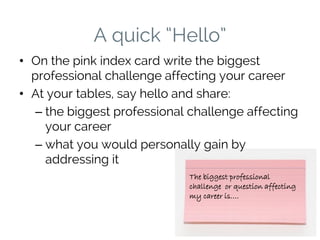
The biggest professional
challenge or question affecting
my career is….
What
Why
How
What is Mentoring?
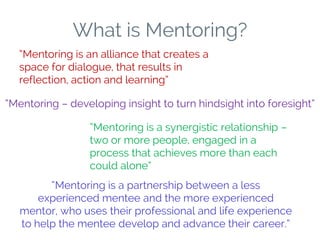
“Mentoring is an alliance that creates a
space for dialogue, that results in
reflection, action and learning”
“Mentoring – developing insight to turn hindsight into foresight”
“Mentoring is a synergistic relationship –
two or more people, engaged in a
process that achieves more than each
could alone”
“Mentoring is a partnership between a less
experienced mentee and the more experienced
mentor, who uses their professional and life experience
to help the mentee develop and advance their career.”
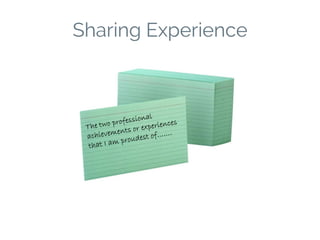
Sharing Experience
The Mentoring Philosophy
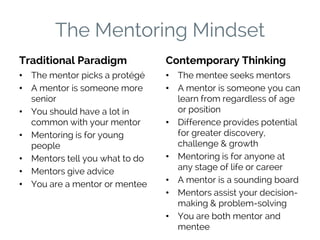
The Mentoring Mindset
Traditional Paradigm
• The mentor picks a protégé
• A mentor is someone more
senior
• You should have a lot in
common with your mentor
• Mentoring is for young
people
• Mentors tell you what to do
• Mentors give advice
• You are a mentor or mentee
Contemporary Thinking
• The mentee seeks mentors
• A mentor is someone you can
learn from regardless of age
or position
• Difference provides potential
for greater discovery,
challenge & growth
• Mentoring is for anyone at
any stage of life or career
• A mentor is a sounding board
• Mentors assist your decision-
making & problem-solving
• You are both mentor and
mentee
Mentoring and Coaching
both…..
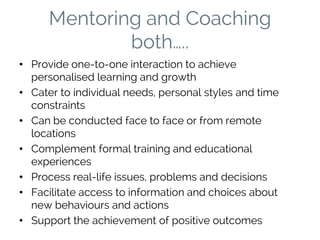
• Provide one-to-one interaction to achieve
personalised learning and growth
• Cater to individual needs, personal styles and time
constraints
• Can be conducted face to face or from remote
locations
• Complement formal training and educational
experiences
• Process real-life issues, problems and decisions
• Facilitate access to information and choices about
new behaviours and actions
• Support the achievement of positive outcomes
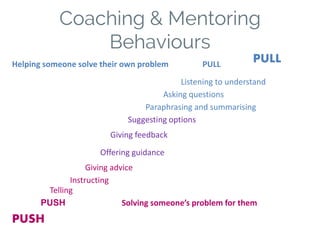
Coaching & Mentoring
Behaviours
Helping someone solve their own problem PULL
PUSH Solving someone’s problem for them
PUSH
PULL
Telling
Instructing
Giving advice
Offering guidance
Giving feedback
Suggesting options
Paraphrasing and summarising
Asking questions
Listening to understand
What’s the difference between
Coaching and Mentoring?
• Coaching is used when there is a well-
defined goal that is based on improving
skills and performance.
• Mentoring is appropriate for career
planning, providing general guidance,
setting and achieving goals, making
decisions or facilitating problem solving.
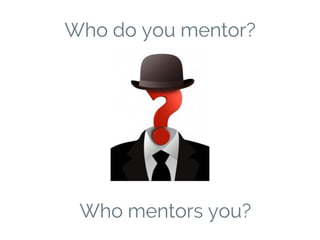
Who do you mentor?
Who mentors you?
What
Why
How
What are the Benefits of
Mentoring?
Enhanced training &
career development
Widened
professional
networksPositive attitude
& outlook
Avoided obstacles
& pitfalls
Improved
performance &
results
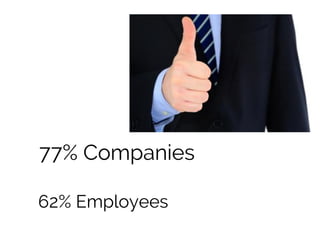
77% Companies
62% Employees
Opportunity to
practice & develop
management skills
Deeper & broader
knowledge of the
organisation
Satisfaction from
helping others
Increased
self-confidence
Wider
networks
Job enrichment
Recognition
of knowledge,
skills &
achievements
Higher visibility
Within profession
What
Why
How
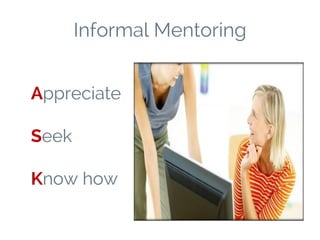
Informal Mentoring
Appreciate
Seek
Know how
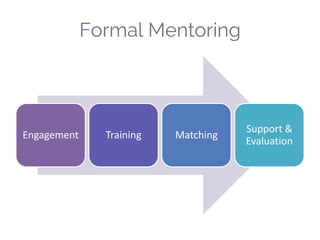
Formal Mentoring
Engagement Training Matching
Support &
Evaluation
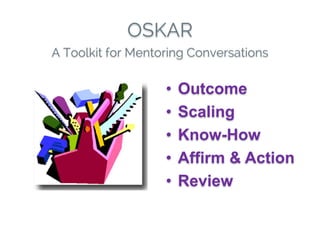
OSKAR
• Outcome
• Scaling
• Know-How
• Affirm & Action
• Review
A Toolkit for Mentoring Conversations
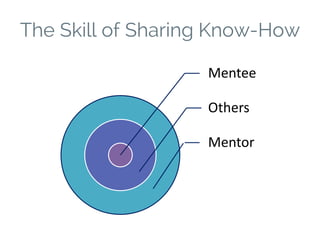
The Skill of Sharing Know-How
Mentee
Others
Mentor
Mentoring in Practice
• In pairs (or threes)
– Mentor
– Mentee
– Observer (if three)
• 20 minute Mentoring Conversation
– Mentee decide a specific focus for the
conversation
– Mentor facilitate conversation (OSKAR)
Questions?
Get in touch
Website: www.antoinetteoglethorpe.com
Email: antoinette@antoinetteoglethorpe.com
Telephone: 0191 286 4311 or 07957 604783
LinkedIn: www.linkedin.com/in/antoinetteoglethorpe
Twitter: www.twitter.com/antoinetteog

Mentoring for Career Development

  • 1.
    The Role ofMentoring in Career Development Presentation to CCS Alumni June 2013
  • 2.
  • 3.
    A quick “Hello” •On the pink index card write the biggest professional challenge affecting your career • At your tables, say hello and share: – the biggest professional challenge affecting your career – what you would personally gain by addressing it The biggest professional challenge or question affecting my career is….
  • 4.
  • 5.
    What is Mentoring? “Mentoringis an alliance that creates a space for dialogue, that results in reflection, action and learning” “Mentoring – developing insight to turn hindsight into foresight” “Mentoring is a synergistic relationship – two or more people, engaged in a process that achieves more than each could alone” “Mentoring is a partnership between a less experienced mentee and the more experienced mentor, who uses their professional and life experience to help the mentee develop and advance their career.”
  • 6.
  • 7.
  • 8.
    The Mentoring Mindset TraditionalParadigm • The mentor picks a protégé • A mentor is someone more senior • You should have a lot in common with your mentor • Mentoring is for young people • Mentors tell you what to do • Mentors give advice • You are a mentor or mentee Contemporary Thinking • The mentee seeks mentors • A mentor is someone you can learn from regardless of age or position • Difference provides potential for greater discovery, challenge & growth • Mentoring is for anyone at any stage of life or career • A mentor is a sounding board • Mentors assist your decision- making & problem-solving • You are both mentor and mentee
  • 9.
    Mentoring and Coaching both….. •Provide one-to-one interaction to achieve personalised learning and growth • Cater to individual needs, personal styles and time constraints • Can be conducted face to face or from remote locations • Complement formal training and educational experiences • Process real-life issues, problems and decisions • Facilitate access to information and choices about new behaviours and actions • Support the achievement of positive outcomes
  • 10.
    Coaching & Mentoring Behaviours Helpingsomeone solve their own problem PULL PUSH Solving someone’s problem for them PUSH PULL Telling Instructing Giving advice Offering guidance Giving feedback Suggesting options Paraphrasing and summarising Asking questions Listening to understand
  • 11.
    What’s the differencebetween Coaching and Mentoring? • Coaching is used when there is a well- defined goal that is based on improving skills and performance. • Mentoring is appropriate for career planning, providing general guidance, setting and achieving goals, making decisions or facilitating problem solving.
  • 12.
    Who do youmentor? Who mentors you?
  • 13.
  • 14.
    What are theBenefits of Mentoring?
  • 15.
    Enhanced training & careerdevelopment Widened professional networksPositive attitude & outlook Avoided obstacles & pitfalls Improved performance & results
  • 16.
  • 17.
    Opportunity to practice &develop management skills Deeper & broader knowledge of the organisation Satisfaction from helping others Increased self-confidence Wider networks Job enrichment Recognition of knowledge, skills & achievements Higher visibility Within profession
  • 18.
  • 19.
  • 20.
    Formal Mentoring Engagement TrainingMatching Support & Evaluation
  • 21.
    OSKAR • Outcome • Scaling •Know-How • Affirm & Action • Review A Toolkit for Mentoring Conversations
  • 22.
    The Skill ofSharing Know-How Mentee Others Mentor
  • 23.
    Mentoring in Practice •In pairs (or threes) – Mentor – Mentee – Observer (if three) • 20 minute Mentoring Conversation – Mentee decide a specific focus for the conversation – Mentor facilitate conversation (OSKAR)
  • 24.
  • 25.
    Get in touch Website:www.antoinetteoglethorpe.com Email: antoinette@antoinetteoglethorpe.com Telephone: 0191 286 4311 or 07957 604783 LinkedIn: www.linkedin.com/in/antoinetteoglethorpe Twitter: www.twitter.com/antoinetteog

Editor's Notes

  • #12 Coaching and mentoring are not the same, though the differences are subtle and those who coach and those who mentor use similar skills. The terms "mentor" and "coach" are often used interchangeably. Although most references agree there are differences between the two, descriptions of the roles are not uniform. So, since ideas about coaching generally derive from sporting models and mentoring is more often associated with careers, the following definitions may be useful:Coach: a person who trains, tutors or prepares an individual for improved skill and performance;Mentor: one who guides and stimulates an individual's reflection and actions for improved personal and professional outcomes.
  • #15 For the mentee?For the mentor?
  • #17 77% of companies report that mentoring programs are effective in increasing employee retention and performance. (Sources: Center for Creative Leadership; Business Finance)62% of employees who have received mentoring say they are likely to stay with their current employer. (Source: Yellowbrick)