Launching an Effective  Mentoring Program
Objectives Define mentoring Evaluate why you should mentor. Identify the responsibilities, process and outcomes of both the mentor and prot é g é . Gain knowledge about the types of mentoring. Describe the life cycle of a mentoring relationship. Gain knowledge about establishing a formal mentoring program.
Define Mentoring
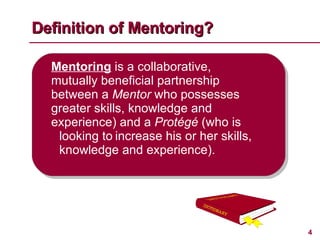
Definition of Mentoring? Mentoring  is a collaborative,  mutually beneficial partnership  between a  Mentor  who possesses  greater skills, knowledge and  experience) and a  Protégé  (who is  looking to increase his or her skills,  knowledge and experience).
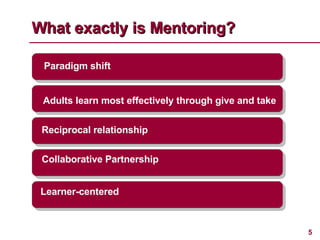
What exactly is Mentoring? Learner-centered Paradigm shift Reciprocal relationship Adults learn most effectively through give and take Collaborative Partnership
Why Should you Mentor?
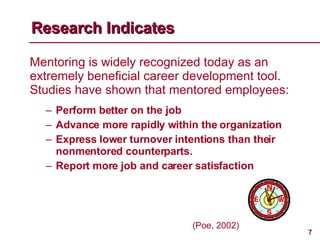
Mentoring is widely recognized today as an extremely beneficial career development tool. Studies have shown that mentored employees: Perform better on the job Advance more rapidly within the organization Express lower turnover intentions than their nonmentored counterparts. Report more job and career satisfaction Research Indicates (Poe, 2002)
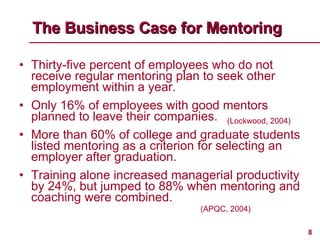
The Business Case for Mentoring Thirty-five percent of employees who do not receive regular mentoring plan to seek other employment within a year.  Only 16% of employees with good mentors planned to leave their companies.  More than 60% of college and graduate students listed mentoring as a criterion for selecting an employer after graduation. Training alone increased managerial productivity by 24%, but jumped to 88% when mentoring and coaching were combined. (Lockwood, 2004) (APQC, 2004)
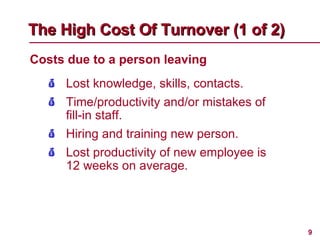
Costs due to a person leaving The High Cost Of Turnover (1 of 2)   Lost knowledge, skills, contacts. Time/productivity and/or mistakes of fill-in staff. Hiring and training new person. Lost productivity of new employee is 12 weeks on average.
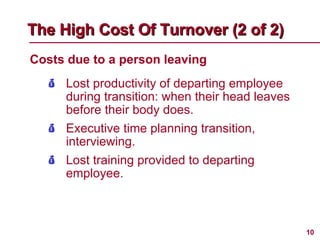
Costs due to a person leaving The High Cost Of Turnover (2 of 2)   Lost productivity of departing employee during transition: when their head leaves before their body does. Executive time planning transition, interviewing. Lost training provided to departing employee.
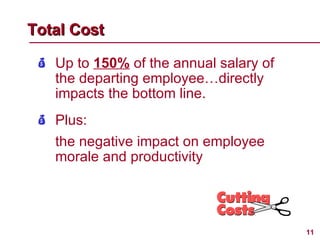
Total Cost   Up to  150%  of the annual salary of the departing employee…directly impacts the bottom line. Plus: the negative impact on employee morale and productivity
A Good Mentoring Program Can Help new employees learn the culture and inner workings faster. Help newly promoted staff understand and fulfill their new responsibilities faster. Increase communication and strengthen employee bonds. Ensure that accumulated knowledge and experience is shared and passed on, reducing the impact when employees leave. Promote underrepresented employees Develop future leaders Project a strong and positive employer brand
Responsibilities, Process and Outcomes of Mentoring
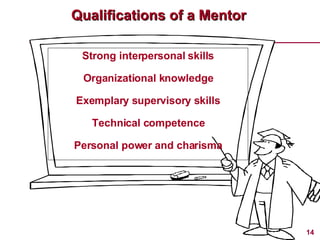
Qualifications of a Mentor Strong interpersonal skills Organizational knowledge Exemplary supervisory skills Technical competence Personal power and charisma
What are the Mentor’s Responsibilities? A  sponsor  or  champion  that helps increase exposure of the protégé Teacher  who helps solve work-related problems or creates learning opportunities Coach  that advises protégés on how to accomplish their goals Protector  that provides a safe environment in which the protégé can make mistakes without losing credibility Counselor  that enhances the protégés self-esteem through supportive, nonjudgmental discussions. Role model  that walks the talk and demonstrates the behaviors necessary for success. (Digh, 2002)
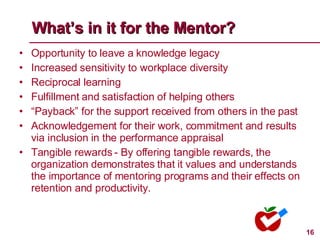
What’s in it for the Mentor? Opportunity to leave a knowledge legacy Increased sensitivity to workplace diversity Reciprocal learning Fulfillment and satisfaction of helping others “ Payback” for the support received from others in the past Acknowledgement for their work, commitment and results via inclusion in the performance appraisal Tangible rewards - By offering tangible rewards, the organization demonstrates that it values and understands the importance of mentoring programs and their effects on retention and productivity.
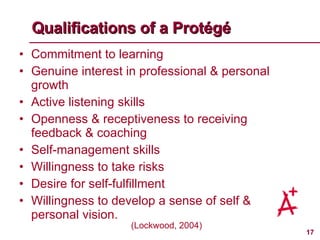
Qualifications of a Prot é g é Commitment to learning Genuine interest in professional & personal growth Active listening skills Openness & receptiveness to receiving feedback & coaching Self-management skills Willingness to take risks Desire for self-fulfillment Willingness to develop a sense of self & personal vision.  (Lockwood, 2004)
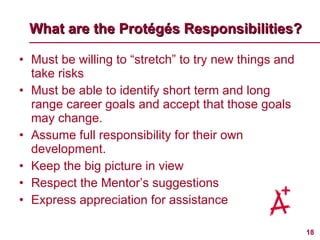
What are the Prot é g és  Responsibilities? Must be willing to “stretch” to try new things and take risks Must be able to identify short term and long range career goals and accept that those goals may change. Assume full responsibility for their own development. Keep the big picture in view Respect the Mentor’s suggestions Express appreciation for assistance
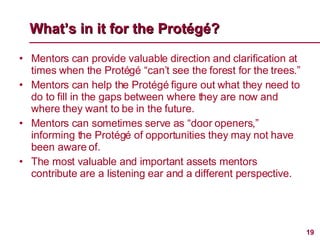
What’s in it for the Prot é g é ? Mentors can provide valuable direction and clarification at times when the Protégé “can’t see the forest for the trees.” Mentors can help the Protégé figure out what they need to do to fill in the gaps between where they are now and where they want to be in the future.  Mentors can sometimes serve as “door openers,” informing the Protégé of opportunities they may not have been aware of. The most valuable and important assets mentors contribute are a listening ear and a different perspective.
Different Types of  Mentoring
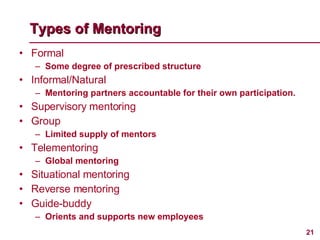
Types of Mentoring Formal Some degree of prescribed structure Informal/Natural  Mentoring partners accountable for their own participation. Supervisory mentoring Group Limited supply of mentors Telementoring Global mentoring Situational mentoring Reverse mentoring Guide-buddy Orients and supports new employees
Life Cycle of a  Mentoring Relationship
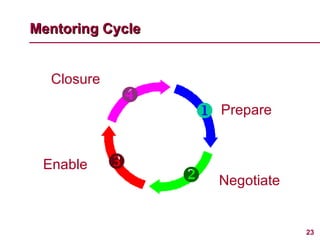
Mentoring Cycle     Prepare Negotiate Enable Closure
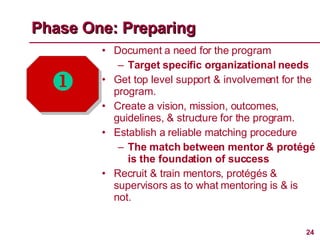
Document a need for the program Target specific organizational needs Get top level support & involvement for the program. Create a vision, mission, outcomes, guidelines, & structure for the program. Establish a reliable matching procedure The match between mentor & protégé is the foundation of success Recruit & train mentors, protégés & supervisors as to what mentoring is & is not. Phase One: Preparing 
The mentoring relationship involves setting and facilitating clearly-defined learning objectives. More detailed objectives are defined and adopted as the relationship evolves.  Effective and regular communication are required of all successful human relationships. The Mentor should take the initiative to contact the Protégé at regular intervals. Periodic real or virtual meetings should be held. The Protégé must also be encouraged to contact the mentor at any time. Beginning the Mentoring Relationship
Mentors Nominations by executives Nominations by protégés May volunteer Protégés Self nomination Supervisor nomination Sponsor nomination Placement of new hires How to Recruit
New recruits Recent grads Promising employees Satellite employees Interorganizational transferees Expatriates Populations of Potential Protégés
Work to build rapport & establish realistic expectations. Establish a mentoring contract List expectations such as: When and where the pair will meet Time commitments Types of activities Confidentiality The nature of giving feedback Establish a timeline Topics of discussion Provide for no-fault termination Phase Two: Negotiating 
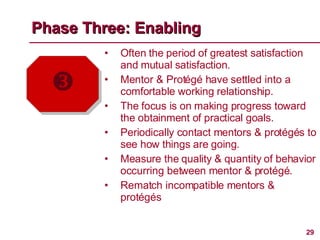
Often the period of greatest satisfaction and mutual satisfaction.  Mentor & Protégé have settled into a comfortable working relationship. The focus is on making progress toward the obtainment of practical goals. Periodically contact mentors & protégés to see how things are going. Measure the quality & quantity of behavior occurring between mentor & protégé. Rematch incompatible mentors & protégés Phase Three: Enabling 
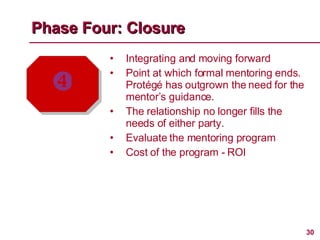
Integrating and moving forward Point at which formal mentoring ends. Protégé has outgrown the need for the mentor’s guidance.  The relationship no longer fills the needs of either party. Evaluate the mentoring program Cost of the program - ROI Phase Four: Closure 
Establishing a  Formal Mentoring Program
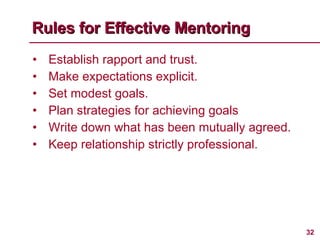
Establish rapport and trust. Make expectations explicit. Set modest goals. Plan strategies for achieving goals Write down what has been mutually agreed.  Keep relationship strictly professional. Rules for Effective Mentoring
Mentor and Protégé not a good match. Unrealistic expectations on the part of either parties. Trust and rapport never established. Lack of skills, time, or commitment on one of the parties. Protégé’s supervisor sabotages the relationship. Resentment on the part of other employees. Potential Pitfalls of Mentoring
Beginning any mentoring relationship will be a unique process based on the needs & skills of the people involved. The rewards of the relationship will also be unique, reflecting the success & challenges navigated by the pairing.  As with other types of relationships, mentoring relationships are created. At any point a relationship can be re-created. Taking responsibility for the quality of the mentoring process falls to both participants throughout the duration of the relationship. Getting Started
References American Productivity & Quality Center (2004).  Mentoring Digh, P. (2002). Mentoring to create a diverse pipeline for talent. Retrieved August 27, 2008, from SHRM Web site  http://www.shrm.org/diversity/members/articles.novdec02/covstory.asp Lockwood, N. (2004). The value of mentoring. Retrieved September 2, 2008, from SHRM Web site  http://www.shrm.org/research/briefly_published/Mentoring Poe, A. (2006). Launching a mentor program. Retrieved September 2, 2008, from SHRM Web site http://www.shrm.org/hrresources.whitepapers_published/CMS_000424.asp

Launching an Effective Mentoring Program

  • 1.
    Launching an Effective Mentoring Program
  • 2.
    Objectives Define mentoringEvaluate why you should mentor. Identify the responsibilities, process and outcomes of both the mentor and prot é g é . Gain knowledge about the types of mentoring. Describe the life cycle of a mentoring relationship. Gain knowledge about establishing a formal mentoring program.
  • 3.
  • 4.
    Definition of Mentoring?Mentoring is a collaborative, mutually beneficial partnership between a Mentor who possesses greater skills, knowledge and experience) and a Protégé (who is looking to increase his or her skills, knowledge and experience).
  • 5.
    What exactly isMentoring? Learner-centered Paradigm shift Reciprocal relationship Adults learn most effectively through give and take Collaborative Partnership
  • 6.
  • 7.
    Mentoring is widelyrecognized today as an extremely beneficial career development tool. Studies have shown that mentored employees: Perform better on the job Advance more rapidly within the organization Express lower turnover intentions than their nonmentored counterparts. Report more job and career satisfaction Research Indicates (Poe, 2002)
  • 8.
    The Business Casefor Mentoring Thirty-five percent of employees who do not receive regular mentoring plan to seek other employment within a year. Only 16% of employees with good mentors planned to leave their companies. More than 60% of college and graduate students listed mentoring as a criterion for selecting an employer after graduation. Training alone increased managerial productivity by 24%, but jumped to 88% when mentoring and coaching were combined. (Lockwood, 2004) (APQC, 2004)
  • 9.
    Costs due toa person leaving The High Cost Of Turnover (1 of 2) Lost knowledge, skills, contacts. Time/productivity and/or mistakes of fill-in staff. Hiring and training new person. Lost productivity of new employee is 12 weeks on average.
  • 10.
    Costs due toa person leaving The High Cost Of Turnover (2 of 2) Lost productivity of departing employee during transition: when their head leaves before their body does. Executive time planning transition, interviewing. Lost training provided to departing employee.
  • 11.
    Total Cost Up to 150% of the annual salary of the departing employee…directly impacts the bottom line. Plus: the negative impact on employee morale and productivity
  • 12.
    A Good MentoringProgram Can Help new employees learn the culture and inner workings faster. Help newly promoted staff understand and fulfill their new responsibilities faster. Increase communication and strengthen employee bonds. Ensure that accumulated knowledge and experience is shared and passed on, reducing the impact when employees leave. Promote underrepresented employees Develop future leaders Project a strong and positive employer brand
  • 13.
    Responsibilities, Process andOutcomes of Mentoring
  • 14.
    Qualifications of aMentor Strong interpersonal skills Organizational knowledge Exemplary supervisory skills Technical competence Personal power and charisma
  • 15.
    What are theMentor’s Responsibilities? A sponsor or champion that helps increase exposure of the protégé Teacher who helps solve work-related problems or creates learning opportunities Coach that advises protégés on how to accomplish their goals Protector that provides a safe environment in which the protégé can make mistakes without losing credibility Counselor that enhances the protégés self-esteem through supportive, nonjudgmental discussions. Role model that walks the talk and demonstrates the behaviors necessary for success. (Digh, 2002)
  • 16.
    What’s in itfor the Mentor? Opportunity to leave a knowledge legacy Increased sensitivity to workplace diversity Reciprocal learning Fulfillment and satisfaction of helping others “ Payback” for the support received from others in the past Acknowledgement for their work, commitment and results via inclusion in the performance appraisal Tangible rewards - By offering tangible rewards, the organization demonstrates that it values and understands the importance of mentoring programs and their effects on retention and productivity.
  • 17.
    Qualifications of aProt é g é Commitment to learning Genuine interest in professional & personal growth Active listening skills Openness & receptiveness to receiving feedback & coaching Self-management skills Willingness to take risks Desire for self-fulfillment Willingness to develop a sense of self & personal vision. (Lockwood, 2004)
  • 18.
    What are theProt é g és Responsibilities? Must be willing to “stretch” to try new things and take risks Must be able to identify short term and long range career goals and accept that those goals may change. Assume full responsibility for their own development. Keep the big picture in view Respect the Mentor’s suggestions Express appreciation for assistance
  • 19.
    What’s in itfor the Prot é g é ? Mentors can provide valuable direction and clarification at times when the Protégé “can’t see the forest for the trees.” Mentors can help the Protégé figure out what they need to do to fill in the gaps between where they are now and where they want to be in the future. Mentors can sometimes serve as “door openers,” informing the Protégé of opportunities they may not have been aware of. The most valuable and important assets mentors contribute are a listening ear and a different perspective.
  • 20.
  • 21.
    Types of MentoringFormal Some degree of prescribed structure Informal/Natural Mentoring partners accountable for their own participation. Supervisory mentoring Group Limited supply of mentors Telementoring Global mentoring Situational mentoring Reverse mentoring Guide-buddy Orients and supports new employees
  • 22.
    Life Cycle ofa Mentoring Relationship
  • 23.
    Mentoring Cycle    Prepare Negotiate Enable Closure
  • 24.
    Document a needfor the program Target specific organizational needs Get top level support & involvement for the program. Create a vision, mission, outcomes, guidelines, & structure for the program. Establish a reliable matching procedure The match between mentor & protégé is the foundation of success Recruit & train mentors, protégés & supervisors as to what mentoring is & is not. Phase One: Preparing 
  • 25.
    The mentoring relationshipinvolves setting and facilitating clearly-defined learning objectives. More detailed objectives are defined and adopted as the relationship evolves. Effective and regular communication are required of all successful human relationships. The Mentor should take the initiative to contact the Protégé at regular intervals. Periodic real or virtual meetings should be held. The Protégé must also be encouraged to contact the mentor at any time. Beginning the Mentoring Relationship
  • 26.
    Mentors Nominations byexecutives Nominations by protégés May volunteer Protégés Self nomination Supervisor nomination Sponsor nomination Placement of new hires How to Recruit
  • 27.
    New recruits Recentgrads Promising employees Satellite employees Interorganizational transferees Expatriates Populations of Potential Protégés
  • 28.
    Work to buildrapport & establish realistic expectations. Establish a mentoring contract List expectations such as: When and where the pair will meet Time commitments Types of activities Confidentiality The nature of giving feedback Establish a timeline Topics of discussion Provide for no-fault termination Phase Two: Negotiating 
  • 29.
    Often the periodof greatest satisfaction and mutual satisfaction. Mentor & Protégé have settled into a comfortable working relationship. The focus is on making progress toward the obtainment of practical goals. Periodically contact mentors & protégés to see how things are going. Measure the quality & quantity of behavior occurring between mentor & protégé. Rematch incompatible mentors & protégés Phase Three: Enabling 
  • 30.
    Integrating and movingforward Point at which formal mentoring ends. Protégé has outgrown the need for the mentor’s guidance. The relationship no longer fills the needs of either party. Evaluate the mentoring program Cost of the program - ROI Phase Four: Closure 
  • 31.
    Establishing a Formal Mentoring Program
  • 32.
    Establish rapport andtrust. Make expectations explicit. Set modest goals. Plan strategies for achieving goals Write down what has been mutually agreed. Keep relationship strictly professional. Rules for Effective Mentoring
  • 33.
    Mentor and Protégénot a good match. Unrealistic expectations on the part of either parties. Trust and rapport never established. Lack of skills, time, or commitment on one of the parties. Protégé’s supervisor sabotages the relationship. Resentment on the part of other employees. Potential Pitfalls of Mentoring
  • 34.
    Beginning any mentoringrelationship will be a unique process based on the needs & skills of the people involved. The rewards of the relationship will also be unique, reflecting the success & challenges navigated by the pairing. As with other types of relationships, mentoring relationships are created. At any point a relationship can be re-created. Taking responsibility for the quality of the mentoring process falls to both participants throughout the duration of the relationship. Getting Started
  • 35.
    References American Productivity& Quality Center (2004). Mentoring Digh, P. (2002). Mentoring to create a diverse pipeline for talent. Retrieved August 27, 2008, from SHRM Web site http://www.shrm.org/diversity/members/articles.novdec02/covstory.asp Lockwood, N. (2004). The value of mentoring. Retrieved September 2, 2008, from SHRM Web site http://www.shrm.org/research/briefly_published/Mentoring Poe, A. (2006). Launching a mentor program. Retrieved September 2, 2008, from SHRM Web site http://www.shrm.org/hrresources.whitepapers_published/CMS_000424.asp