

Mentoring Program
Crafted by Vinod Mehra
Vinod.mehra@gmail.com
www.vinodkmehra.com
August 26, 2012


SS 30
ORIGIN
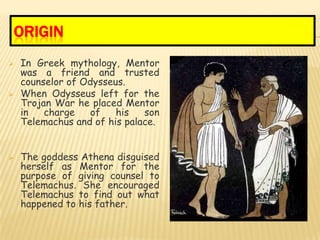
   In Greek mythology, Mentor
    was a friend and trusted
    counselor of Odysseus.
   When Odysseus left for the
    Trojan War he placed Mentor
    in   charge    of   his   son
    Telemachus and of his palace.


   The goddess Athena disguised
    herself as Mentor for the
    purpose of giving counsel to
    Telemachus. She encouraged
    Telemachus to find out what
    happened to his father.
WE REFER TO A MENTOR AS A WISE (WO)MAN


“An   experienced and trusted adviser”
      (Oxford English Dictionary )


“A   trusted counselor or guide, tutor, coach”
      (Merriam-Webster's Collegiate Dictionary )
AGENDA
   What is SmartLife Mentoring Program ( SS 30)
   Who are the party ( Mentor & Mentee)
   10 Reasons to become a Mentor
   10 Reasons to become a Mentee
   Mentor Commitment
   Mentee Commitment
   Guidelines to an effective Mentoring conversation
    CHECKLIST Preparing for the first meeting
    The Mentoring Agreement
   Rules of engagement
   Deliverables
   Result
   Do’s and Don’ts
   Habits of an Ineffective Mentor
   Mentor/Mentee Agreement
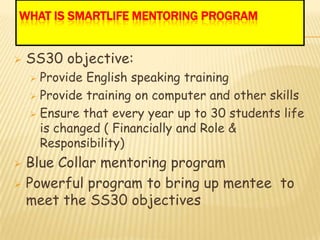
WHAT IS SMARTLIFE MENTORING PROGRAM


   SS30 objective:
     Provide English speaking training
     Provide training on computer and other skills

     Ensure that every year up to 30 students life
      is changed ( Financially and Role &
      Responsibility)
 Blue Collar mentoring program
 Powerful program to bring up mentee to
  meet the SS30 objectives
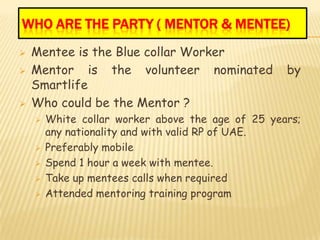
WHO ARE THE PARTY ( MENTOR & MENTEE)
   Mentee is the Blue collar Worker
   Mentor is the volunteer nominated              by
    Smartlife
   Who could be the Mentor ?
       White collar worker above the age of 25 years;
        any nationality and with valid RP of UAE.
       Preferably mobile
       Spend 1 hour a week with mentee.
       Take up mentees calls when required
       Attended mentoring training program
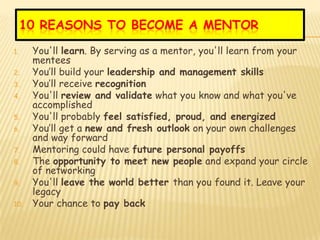
10 REASONS TO BECOME A MENTOR
1.    You'll learn. By serving as a mentor, you'll learn from your
      mentees
2.    You’ll build your leadership and management skills
3.    You’ll receive recognition
4.    You'll review and validate what you know and what you've
      accomplished
5.    You'll probably feel satisfied, proud, and energized
6.    You’ll get a new and fresh outlook on your own challenges
      and way forward
7.    Mentoring could have future personal payoffs
8.    The opportunity to meet new people and expand your circle
      of networking
9.    You'll leave the world better than you found it. Leave your
      legacy
10.   Your chance to pay back
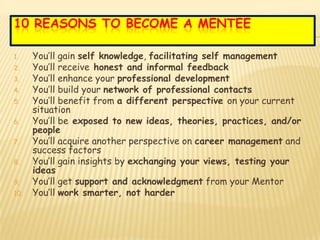
10 REASONS TO BECOME A MENTEE

1.    You’ll gain self knowledge, facilitating self management
2.    You’ll receive honest and informal feedback
3.    You’ll enhance your professional development
4.    You’ll build your network of professional contacts
5.    You’ll benefit from a different perspective on your current
      situation
6.    You’ll be exposed to new ideas, theories, practices, and/or
      people
7.    You’ll acquire another perspective on career management and
      success factors
8.    You’ll gain insights by exchanging your views, testing your
      ideas
9.    You’ll get support and acknowledgment from your Mentor
10.   You’ll work smarter, not harder
MENTOR COMMITMENT

   Develop personal connection based on trust and
    mutual respect and listen to my Mentee's needs
    and concerns
   Help Mentee to define career goals and provide
    networking opportunities to achieve those goals
   Share knowledge of educational and professional
    requirements to prepare Mentee for his/her career
   Offer information, advice, references, and
    resources to assist Mentee's needs
   Offer constructive feedback, and allow Mentee to
    learn from his/her mistakes
   Extend help and support in a non-threatening way,
    in a manner that the recipient will appreciate and
    value and that will empower them to move forward
    with confidence towards what they want to achieve
MENTEE COMMITMENT

   Responsible for my career goals and would enjoy
    the benefit of a mentor's guidance to create a plan
    for success
   Ready to listen and to share my ideas to develop a
    give and take relationship
   Ready to receive objective feedback to consider
    new ideas and new approaches suggested by my
    Mentor
   Ready to give objective feedback to my Mentor in
    order to work towards our objectives
   Realistic expectations for my Mentor relationship.
    No one is perfect and good relationships take
    honesty, effort and time
   I'm busy with work, but I'm ready to make a
    commitment by meeting up / communicating with my
    Mentor
GUIDELINES TO AN EFFECTIVE MENTORING
CONVERSATION
 It must be completely confidential
 Active Listening: ask open-ended questions rather than questions
  that can be answered with a "yes" or "no“, paraphrasing, don’t
  interrupt
 Understand that a Mentee’s/Mentor’s view of the world may be
  different from your own
 Avoid lecturing or passing judgment
 Sensitivity: be sensitive to cultural and gender differences
 Time: good mentoring takes time in active discourse and
  preparation
 Don’t avoid positive confrontation, setting challenges together
 Mentors guide Mentees through a problem-solving process rather
  than state a solution to a problem for them
 Summarize the conversation, agree on the outcome, take notes on
  insights and next steps
CHECKLIST PREPARING FOR THE FIRST
MEETING BY MENTEE ( MENTOR GUIDELINES)
   Where might I meet with my mentor where we both would feel comfortable?
     List a few ideas below.

   What are some things I could tell my mentor about myself that would help us get
     to know each other a little bit? What about me and my life story might be
     interesting and relevant to this mentor?

   What are some questions I could ask my mentor to get to know him/her a little
     bit without prying? (Write some possible open-ended questions below)

   What do I want out of the mentoring relationship – what are my hopes?

   How can I find out what my mentor hopes to get out of the relationship – what
     questions might I ask?

   Prepare a preliminary Personal Development Plan to go over during the meeting.
     Be careful to listen to how your mentor responds to your preparation. Ask
     him/her about the strengths or weaknesses of the plan. What does he/she think
     you need to work on? Can the mentor see opportunities for growth within your
     career?
THE MENTORING AGREEMENT

 Create a set of specific short term and long term objectives
    for the relationship
   List the preliminary developmental goals for the Mentee
   Note the expectations that both of you have for the
    relationship
   List the necessary contributions that both must make so the
    relationship will work
   Create a tentative schedule for your formal meetings
   Set up a procedure for handling informal contacts between
    formal sessions
   Determine who has the chief responsibility for driving the
    relationship
   Agree on confidentiality
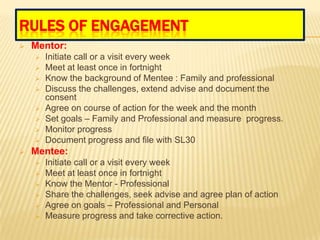
RULES OF ENGAGEMENT
   Mentor:
       Initiate call or a visit every week
       Meet at least once in fortnight
       Know the background of Mentee : Family and professional
       Discuss the challenges, extend advise and document the
        consent
       Agree on course of action for the week and the month
       Set goals – Family and Professional and measure progress.
       Monitor progress
       Document progress and file with SL30
   Mentee:
       Initiate call or a visit every week
       Meet at least once in fortnight
       Know the Mentor - Professional
       Share the challenges, seek advise and agree plan of action
       Agree on goals – Professional and Personal
       Measure progress and take corrective action.
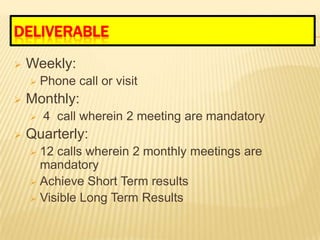
DELIVERABLE
   Weekly:
       Phone call or visit
   Monthly:
       4 call wherein 2 meeting are mandatory
   Quarterly:
     12 calls wherein 2 monthly meetings are
      mandatory
     Achieve Short Term results
     Visible Long Term Results
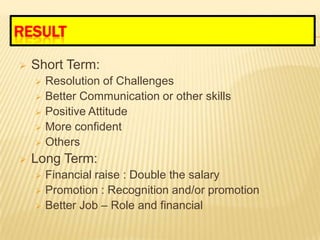
RESULT

   Short Term:
       Resolution of Challenges
       Better Communication or other skills
       Positive Attitude
       More confident
       Others
   Long Term:
       Financial raise : Double the salary
       Promotion : Recognition and/or promotion
       Better Job – Role and financial
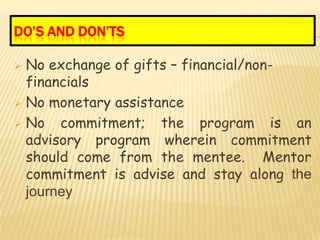
DO’S AND DON’TS

 No exchange of gifts – financial/non-
  financials
 No monetary assistance

 No   commitment; the program is an
  advisory program wherein commitment
  should come from the mentee. Mentor
  commitment is advise and stay along the
  journey
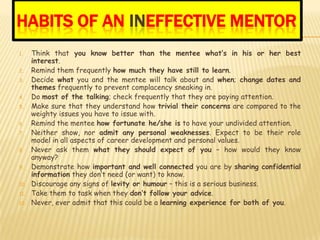
HABITS OF AN INEFFECTIVE MENTOR
1.    Think that you know better than the mentee what’s in his or her best
      interest.
2.    Remind them frequently how much they have still to learn.
3.    Decide what you and the mentee will talk about and when; change dates and
      themes frequently to prevent complacency sneaking in.
4.    Do most of the talking; check frequently that they are paying attention.
5.    Make sure that they understand how trivial their concerns are compared to the
      weighty issues you have to issue with.
6.    Remind the mentee how fortunate he/she is to have your undivided attention.
7.    Neither show, nor admit any personal weaknesses. Expect to be their role
      model in all aspects of career development and personal values.
8.    Never ask them what they should expect of you – how would they know
      anyway?
9.    Demonstrate how important and well connected you are by sharing confidential
      information they don’t need (or want) to know.
10.   Discourage any signs of levity or humour – this is a serious business.
11.   Take them to task when they don’t follow your advice.
12.   Never, ever admit that this could be a learning experience for both of you.
MENTOR/MENTEE AGREEMENT

 Achieve your agreed milestone
 Celebrate your success
Q&A

SS 30 Mentoring Program

  • 1.
    Mentoring Program Crafted byVinod Mehra Vinod.mehra@gmail.com www.vinodkmehra.com August 26, 2012 SS 30
  • 2.
    ORIGIN  In Greek mythology, Mentor was a friend and trusted counselor of Odysseus.  When Odysseus left for the Trojan War he placed Mentor in charge of his son Telemachus and of his palace.  The goddess Athena disguised herself as Mentor for the purpose of giving counsel to Telemachus. She encouraged Telemachus to find out what happened to his father.
  • 3.
    WE REFER TOA MENTOR AS A WISE (WO)MAN “An experienced and trusted adviser”  (Oxford English Dictionary ) “A trusted counselor or guide, tutor, coach”  (Merriam-Webster's Collegiate Dictionary )
  • 4.
    AGENDA  What is SmartLife Mentoring Program ( SS 30)  Who are the party ( Mentor & Mentee)  10 Reasons to become a Mentor  10 Reasons to become a Mentee  Mentor Commitment  Mentee Commitment  Guidelines to an effective Mentoring conversation  CHECKLIST Preparing for the first meeting  The Mentoring Agreement  Rules of engagement  Deliverables  Result  Do’s and Don’ts  Habits of an Ineffective Mentor  Mentor/Mentee Agreement
  • 5.
    WHAT IS SMARTLIFEMENTORING PROGRAM  SS30 objective:  Provide English speaking training  Provide training on computer and other skills  Ensure that every year up to 30 students life is changed ( Financially and Role & Responsibility)  Blue Collar mentoring program  Powerful program to bring up mentee to meet the SS30 objectives
  • 6.
    WHO ARE THEPARTY ( MENTOR & MENTEE)  Mentee is the Blue collar Worker  Mentor is the volunteer nominated by Smartlife  Who could be the Mentor ?  White collar worker above the age of 25 years; any nationality and with valid RP of UAE.  Preferably mobile  Spend 1 hour a week with mentee.  Take up mentees calls when required  Attended mentoring training program
  • 7.
    10 REASONS TOBECOME A MENTOR 1. You'll learn. By serving as a mentor, you'll learn from your mentees 2. You’ll build your leadership and management skills 3. You’ll receive recognition 4. You'll review and validate what you know and what you've accomplished 5. You'll probably feel satisfied, proud, and energized 6. You’ll get a new and fresh outlook on your own challenges and way forward 7. Mentoring could have future personal payoffs 8. The opportunity to meet new people and expand your circle of networking 9. You'll leave the world better than you found it. Leave your legacy 10. Your chance to pay back
  • 8.
    10 REASONS TOBECOME A MENTEE 1. You’ll gain self knowledge, facilitating self management 2. You’ll receive honest and informal feedback 3. You’ll enhance your professional development 4. You’ll build your network of professional contacts 5. You’ll benefit from a different perspective on your current situation 6. You’ll be exposed to new ideas, theories, practices, and/or people 7. You’ll acquire another perspective on career management and success factors 8. You’ll gain insights by exchanging your views, testing your ideas 9. You’ll get support and acknowledgment from your Mentor 10. You’ll work smarter, not harder
  • 9.
    MENTOR COMMITMENT  Develop personal connection based on trust and mutual respect and listen to my Mentee's needs and concerns  Help Mentee to define career goals and provide networking opportunities to achieve those goals  Share knowledge of educational and professional requirements to prepare Mentee for his/her career  Offer information, advice, references, and resources to assist Mentee's needs  Offer constructive feedback, and allow Mentee to learn from his/her mistakes  Extend help and support in a non-threatening way, in a manner that the recipient will appreciate and value and that will empower them to move forward with confidence towards what they want to achieve
  • 10.
    MENTEE COMMITMENT  Responsible for my career goals and would enjoy the benefit of a mentor's guidance to create a plan for success  Ready to listen and to share my ideas to develop a give and take relationship  Ready to receive objective feedback to consider new ideas and new approaches suggested by my Mentor  Ready to give objective feedback to my Mentor in order to work towards our objectives  Realistic expectations for my Mentor relationship. No one is perfect and good relationships take honesty, effort and time  I'm busy with work, but I'm ready to make a commitment by meeting up / communicating with my Mentor
  • 11.
    GUIDELINES TO ANEFFECTIVE MENTORING CONVERSATION  It must be completely confidential  Active Listening: ask open-ended questions rather than questions that can be answered with a "yes" or "no“, paraphrasing, don’t interrupt  Understand that a Mentee’s/Mentor’s view of the world may be different from your own  Avoid lecturing or passing judgment  Sensitivity: be sensitive to cultural and gender differences  Time: good mentoring takes time in active discourse and preparation  Don’t avoid positive confrontation, setting challenges together  Mentors guide Mentees through a problem-solving process rather than state a solution to a problem for them  Summarize the conversation, agree on the outcome, take notes on insights and next steps
  • 12.
    CHECKLIST PREPARING FORTHE FIRST MEETING BY MENTEE ( MENTOR GUIDELINES)  Where might I meet with my mentor where we both would feel comfortable? List a few ideas below.  What are some things I could tell my mentor about myself that would help us get to know each other a little bit? What about me and my life story might be interesting and relevant to this mentor?  What are some questions I could ask my mentor to get to know him/her a little bit without prying? (Write some possible open-ended questions below)  What do I want out of the mentoring relationship – what are my hopes?  How can I find out what my mentor hopes to get out of the relationship – what questions might I ask?  Prepare a preliminary Personal Development Plan to go over during the meeting. Be careful to listen to how your mentor responds to your preparation. Ask him/her about the strengths or weaknesses of the plan. What does he/she think you need to work on? Can the mentor see opportunities for growth within your career?
  • 13.
    THE MENTORING AGREEMENT Create a set of specific short term and long term objectives for the relationship  List the preliminary developmental goals for the Mentee  Note the expectations that both of you have for the relationship  List the necessary contributions that both must make so the relationship will work  Create a tentative schedule for your formal meetings  Set up a procedure for handling informal contacts between formal sessions  Determine who has the chief responsibility for driving the relationship  Agree on confidentiality
  • 14.
    RULES OF ENGAGEMENT  Mentor:  Initiate call or a visit every week  Meet at least once in fortnight  Know the background of Mentee : Family and professional  Discuss the challenges, extend advise and document the consent  Agree on course of action for the week and the month  Set goals – Family and Professional and measure progress.  Monitor progress  Document progress and file with SL30  Mentee:  Initiate call or a visit every week  Meet at least once in fortnight  Know the Mentor - Professional  Share the challenges, seek advise and agree plan of action  Agree on goals – Professional and Personal  Measure progress and take corrective action.
  • 15.
    DELIVERABLE  Weekly:  Phone call or visit  Monthly:  4 call wherein 2 meeting are mandatory  Quarterly:  12 calls wherein 2 monthly meetings are mandatory  Achieve Short Term results  Visible Long Term Results
  • 16.
    RESULT  Short Term:  Resolution of Challenges  Better Communication or other skills  Positive Attitude  More confident  Others  Long Term:  Financial raise : Double the salary  Promotion : Recognition and/or promotion  Better Job – Role and financial
  • 17.
    DO’S AND DON’TS No exchange of gifts – financial/non- financials  No monetary assistance  No commitment; the program is an advisory program wherein commitment should come from the mentee. Mentor commitment is advise and stay along the journey
  • 18.
    HABITS OF ANINEFFECTIVE MENTOR 1. Think that you know better than the mentee what’s in his or her best interest. 2. Remind them frequently how much they have still to learn. 3. Decide what you and the mentee will talk about and when; change dates and themes frequently to prevent complacency sneaking in. 4. Do most of the talking; check frequently that they are paying attention. 5. Make sure that they understand how trivial their concerns are compared to the weighty issues you have to issue with. 6. Remind the mentee how fortunate he/she is to have your undivided attention. 7. Neither show, nor admit any personal weaknesses. Expect to be their role model in all aspects of career development and personal values. 8. Never ask them what they should expect of you – how would they know anyway? 9. Demonstrate how important and well connected you are by sharing confidential information they don’t need (or want) to know. 10. Discourage any signs of levity or humour – this is a serious business. 11. Take them to task when they don’t follow your advice. 12. Never, ever admit that this could be a learning experience for both of you.
  • 19.
    MENTOR/MENTEE AGREEMENT  Achieveyour agreed milestone  Celebrate your success
  • 20.