B2B Mentoring
ITC Leadership Program
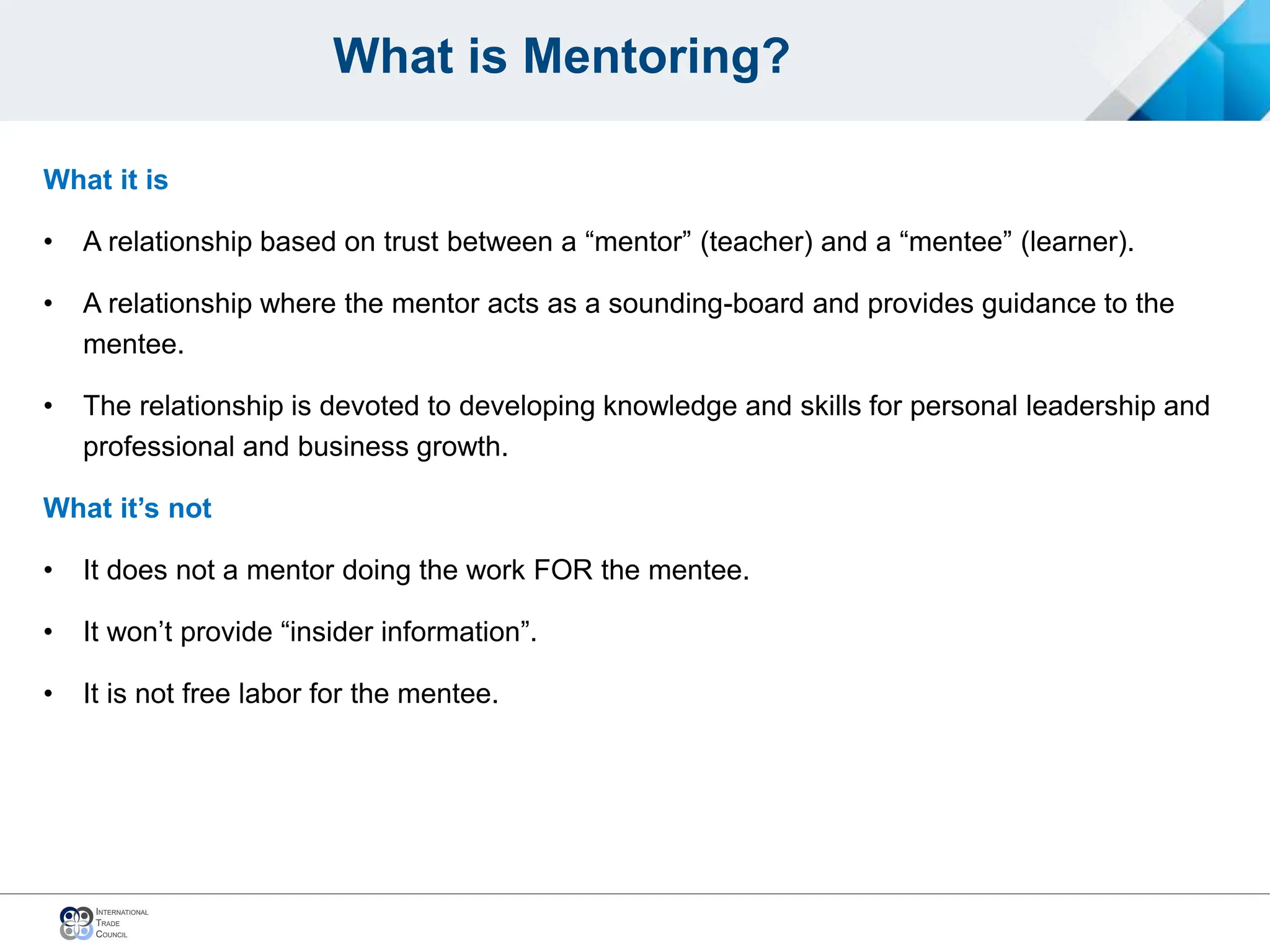
What is Mentoring?
What it is
• A relationship based on trust between a “mentor” (teacher) and a “mentee” (learner).
• A relationship where the mentor acts as a sounding-board and provides guidance to the
mentee.
• The relationship is devoted to developing knowledge and skills for personal leadership and
professional and business growth.
What it’s not
• It does not a mentor doing the work FOR the mentee.
• It won’t provide “insider information”.
• It is not free labor for the mentee.
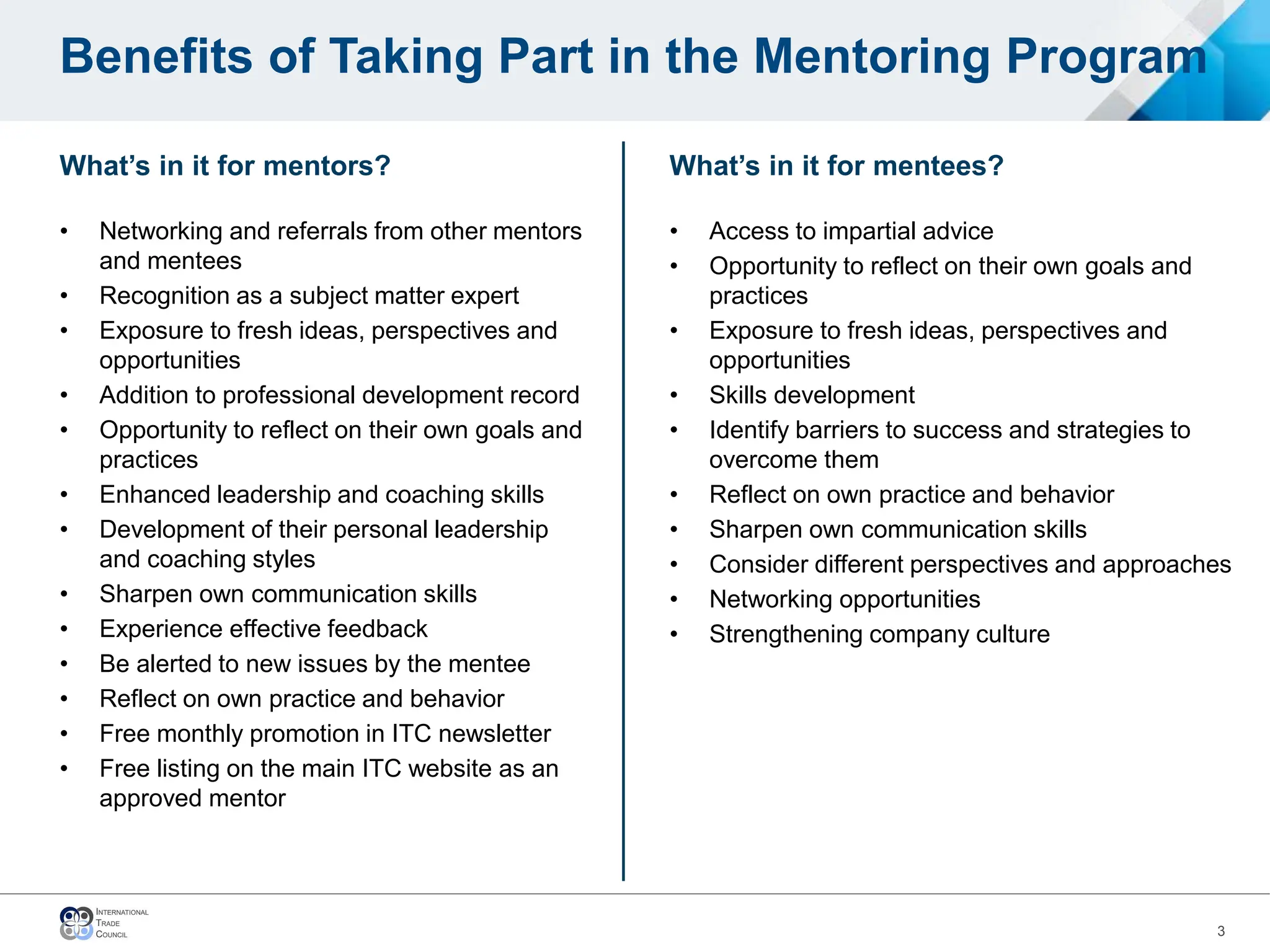
Benefits of Taking Part in the Mentoring Program
3
What’s in it for mentees?
• Access to impartial advice
• Opportunity to reflect on their own goals and
practices
• Exposure to fresh ideas, perspectives and
opportunities
• Skills development
• Identify barriers to success and strategies to
overcome them
• Reflect on own practice and behavior
• Sharpen own communication skills
• Consider different perspectives and approaches
• Networking opportunities
• Strengthening company culture
What’s in it for mentors?
• Networking and referrals from other mentors
and mentees
• Recognition as a subject matter expert
• Exposure to fresh ideas, perspectives and
opportunities
• Addition to professional development record
• Opportunity to reflect on their own goals and
practices
• Enhanced leadership and coaching skills
• Development of their personal leadership
and coaching styles
• Sharpen own communication skills
• Experience effective feedback
• Be alerted to new issues by the mentee
• Reflect on own practice and behavior
• Free monthly promotion in ITC newsletter
• Free listing on the main ITC website as an
approved mentor
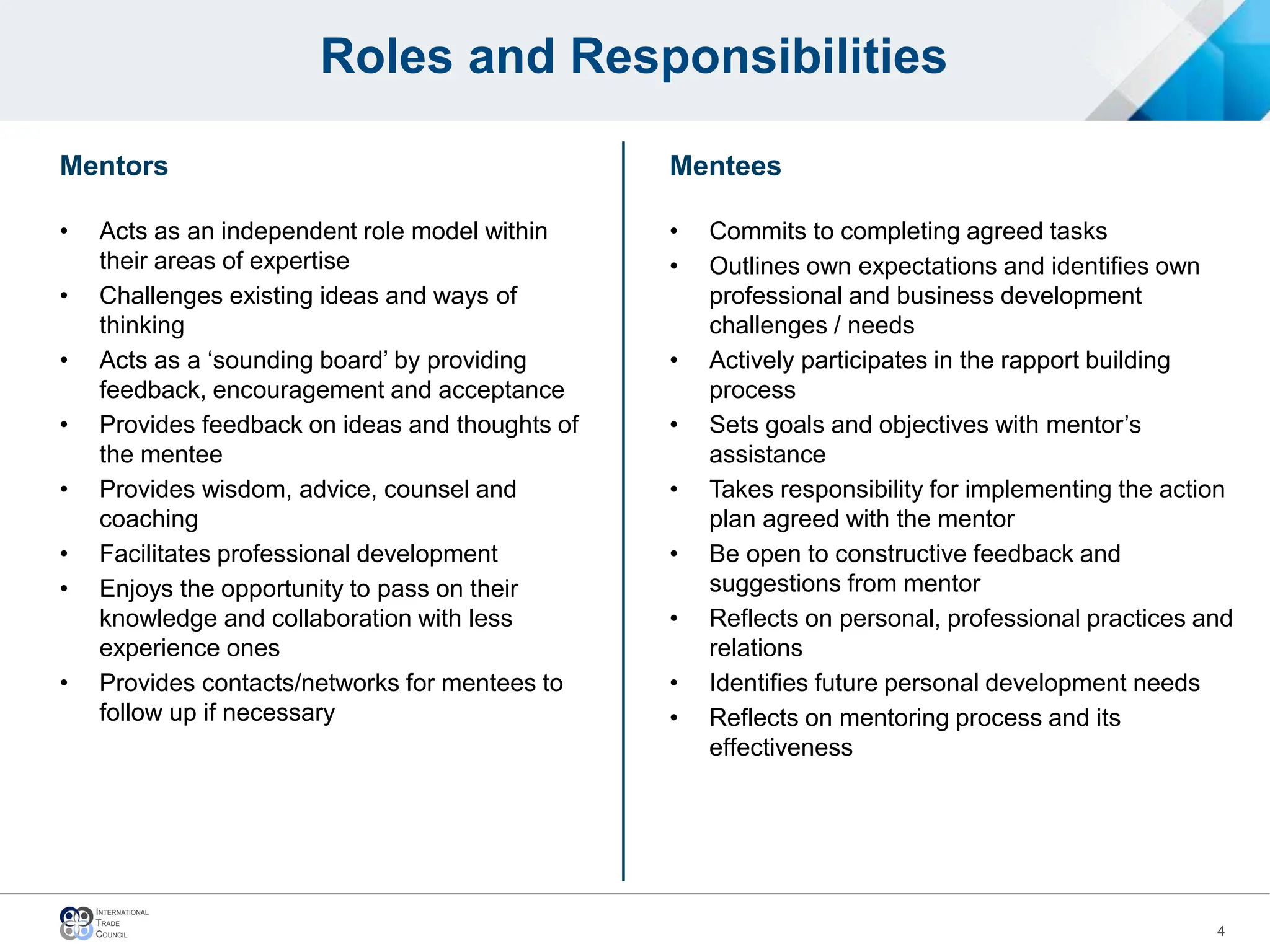
Roles and Responsibilities
4
Mentees
• Commits to completing agreed tasks
• Outlines own expectations and identifies own
professional and business development
challenges / needs
• Actively participates in the rapport building
process
• Sets goals and objectives with mentor’s
assistance
• Takes responsibility for implementing the action
plan agreed with the mentor
• Be open to constructive feedback and
suggestions from mentor
• Reflects on personal, professional practices and
relations
• Identifies future personal development needs
• Reflects on mentoring process and its
effectiveness
Mentors
• Acts as an independent role model within
their areas of expertise
• Challenges existing ideas and ways of
thinking
• Acts as a ‘sounding board’ by providing
feedback, encouragement and acceptance
• Provides feedback on ideas and thoughts of
the mentee
• Provides wisdom, advice, counsel and
coaching
• Facilitates professional development
• Enjoys the opportunity to pass on their
knowledge and collaboration with less
experience ones
• Provides contacts/networks for mentees to
follow up if necessary
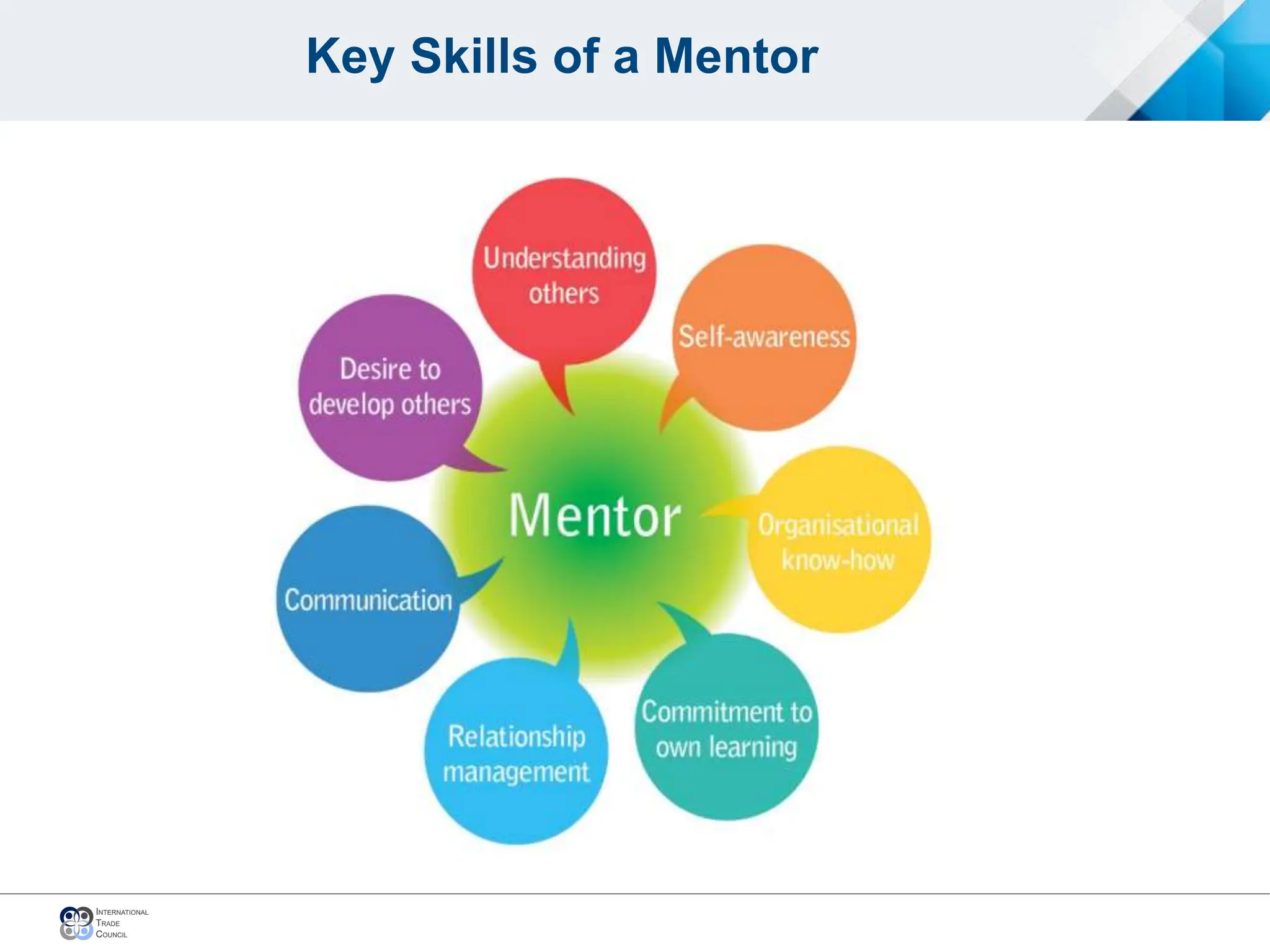
Key Skills of a Mentor
Skills and Experience of a Mentor
• Understanding others – appreciate the differences and avoid forcing their personal views
• Self-awareness – understand clearly their own strengths and weaknesses
• Business know-how – good knowledge of organizational development, network, processes
of how things work
• Commitment to own learning – enrich their own experience and inspire for excellence
• Desire to develop others – devote sufficient time to offer support and guidance
Skills and Experience of a Mentor
Relationship management
Key components for building a good rapport with the mentee:
 Trust: keep discussions confidential
 Focus: listen actively without judgement
 Empathy: understand mentee’s points of view
 Congruence: self-disclosure/sharing own experiences
 Empowerment: allow mentee to contribute
Communication
Excellent communication skills:
listen with an open mind, understand ideas and feelings
 ask appropriate questions
builds on an honest and open, trust and respect dialogue
Cautious about the use of language
explain and give constructive feedback
Mentoring Program Logistics
• The average mentorship will run for 6 months
• Mentors details, unless otherwise restricted, will be published as a list for mentees to
choose from
• Mentors will have an initial 10 minute ITC moderated discussion with prospective mentees
to ensure they are a match
• Mentors and mentees agree to meet according to a confirmed schedule
• Mentors and mentees will aim to meet twice a month (total 4 hours per month)
• Meetings can be online (e.g. skype / zoom / runtheworld)
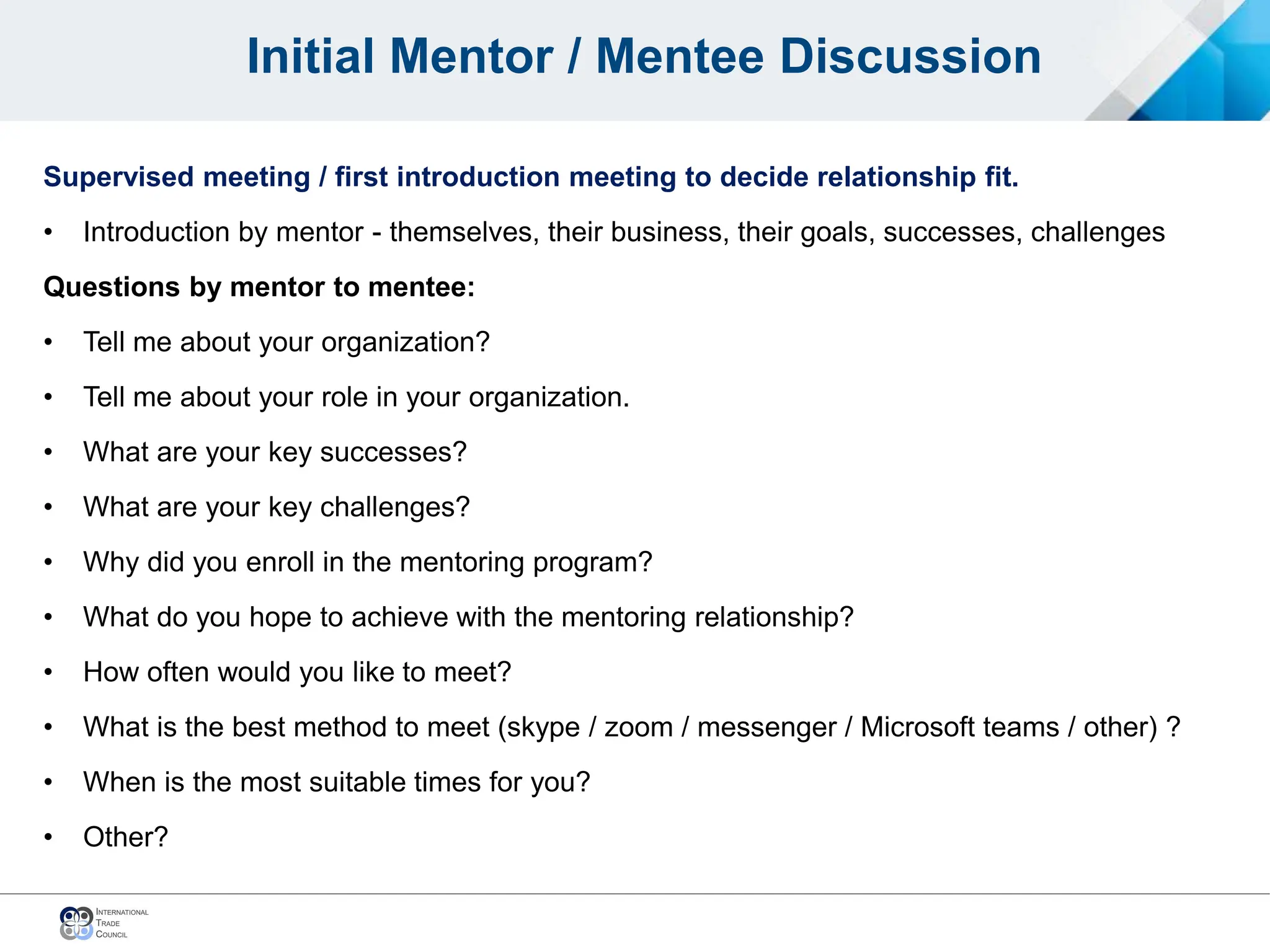
Initial Mentor / Mentee Discussion
Supervised meeting / first introduction meeting to decide relationship fit.
• Introduction by mentor - themselves, their business, their goals, successes, challenges
Questions by mentor to mentee:
• Tell me about your organization?
• Tell me about your role in your organization.
• What are your key successes?
• What are your key challenges?
• Why did you enroll in the mentoring program?
• What do you hope to achieve with the mentoring relationship?
• How often would you like to meet?
• What is the best method to meet (skype / zoom / messenger / Microsoft teams / other) ?
• When is the most suitable times for you?
• Other?
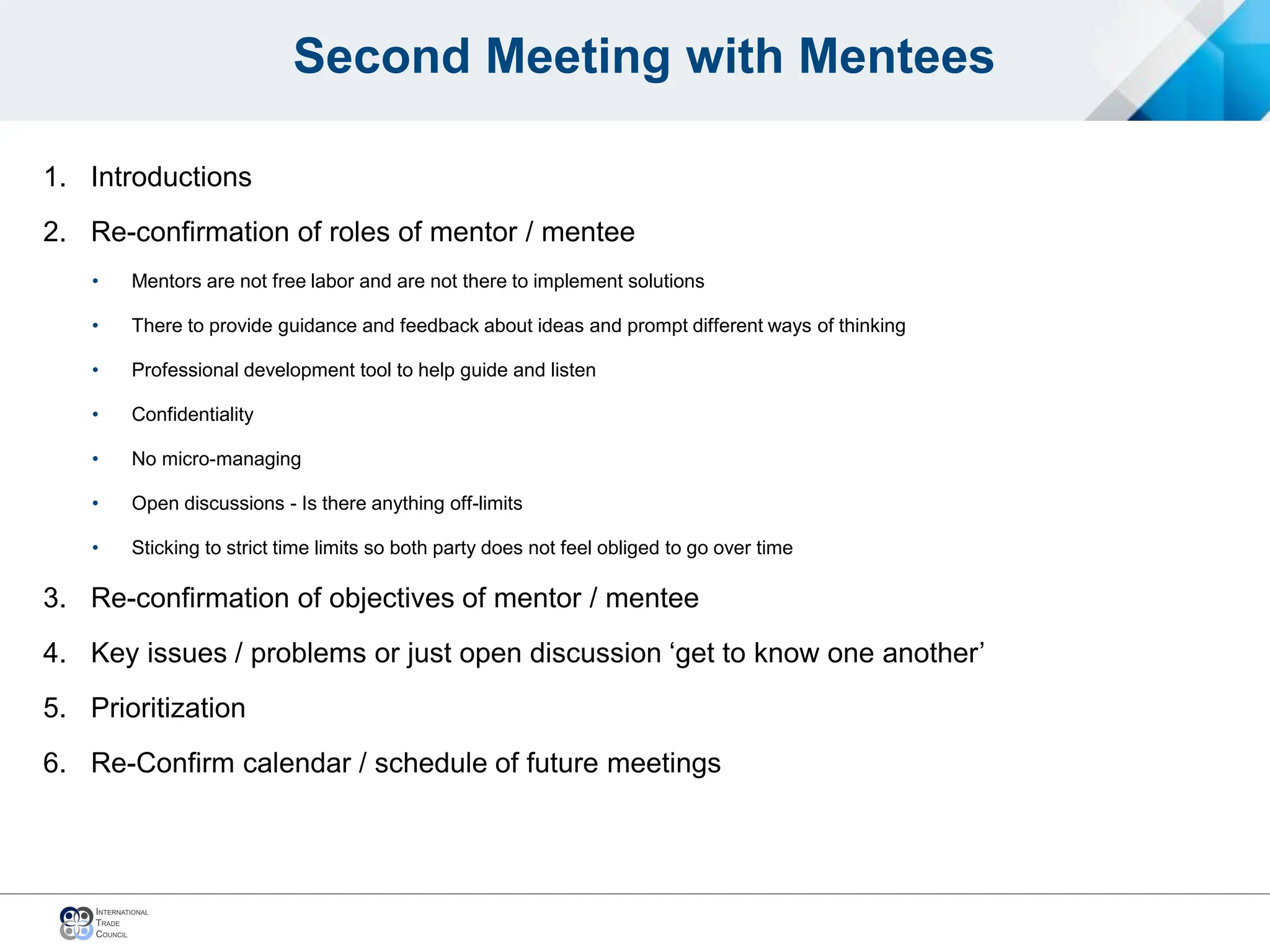
Second Meeting with Mentees
1. Introductions
2. Re-confirmation of roles of mentor / mentee
• Mentors are not free labor and are not there to implement solutions
• There to provide guidance and feedback about ideas and prompt different ways of thinking
• Professional development tool to help guide and listen
• Confidentiality
• No micro-managing
• Open discussions - Is there anything off-limits
• Sticking to strict time limits so both party does not feel obliged to go over time
3. Re-confirmation of objectives of mentor / mentee
4. Key issues / problems or just open discussion ‘get to know one another’
5. Prioritization
6. Re-Confirm calendar / schedule of future meetings
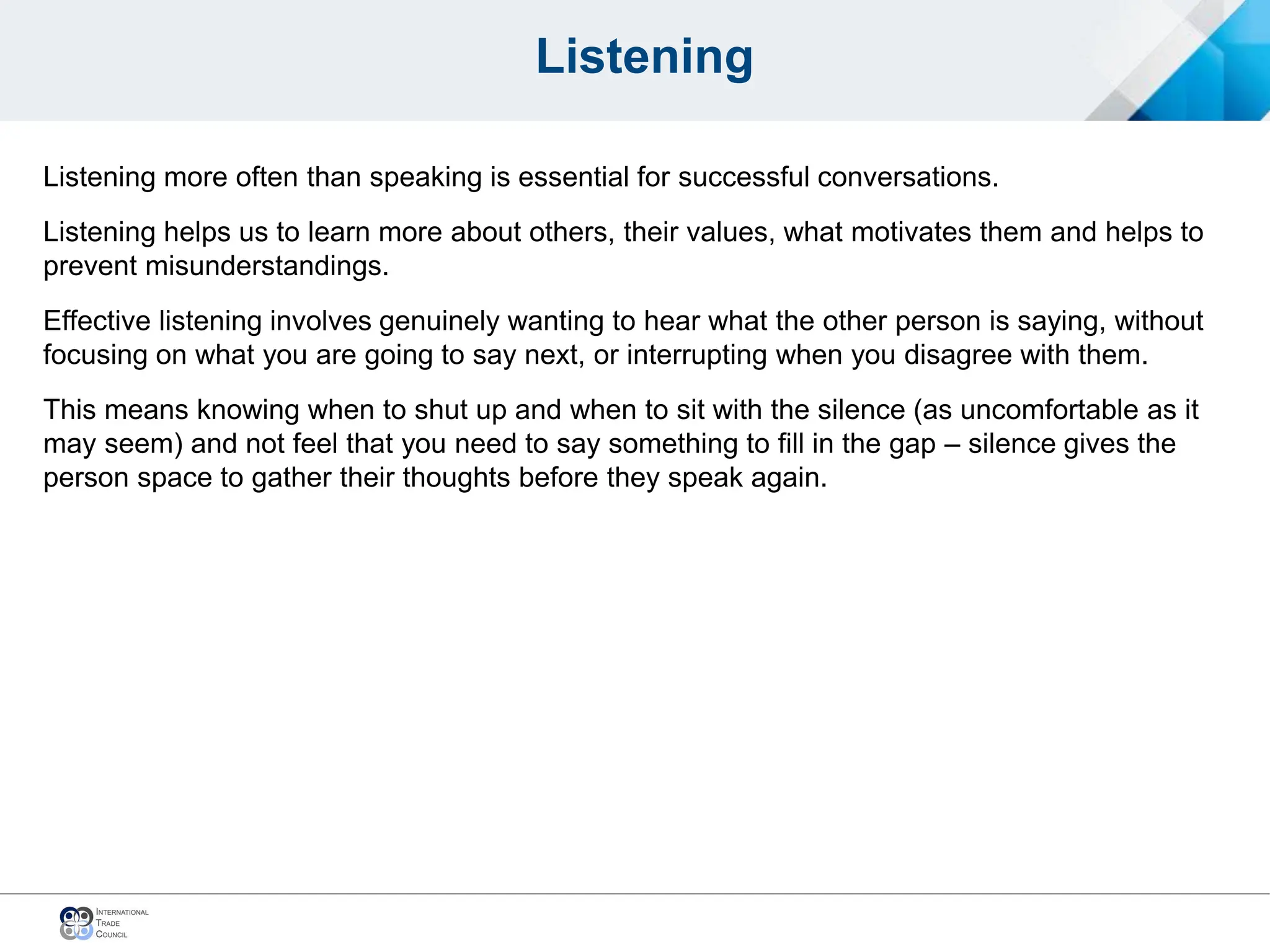
Listening
Listening more often than speaking is essential for successful conversations.
Listening helps us to learn more about others, their values, what motivates them and helps to
prevent misunderstandings.
Effective listening involves genuinely wanting to hear what the other person is saying, without
focusing on what you are going to say next, or interrupting when you disagree with them.
This means knowing when to shut up and when to sit with the silence (as uncomfortable as it
may seem) and not feel that you need to say something to fill in the gap – silence gives the
person space to gather their thoughts before they speak again.
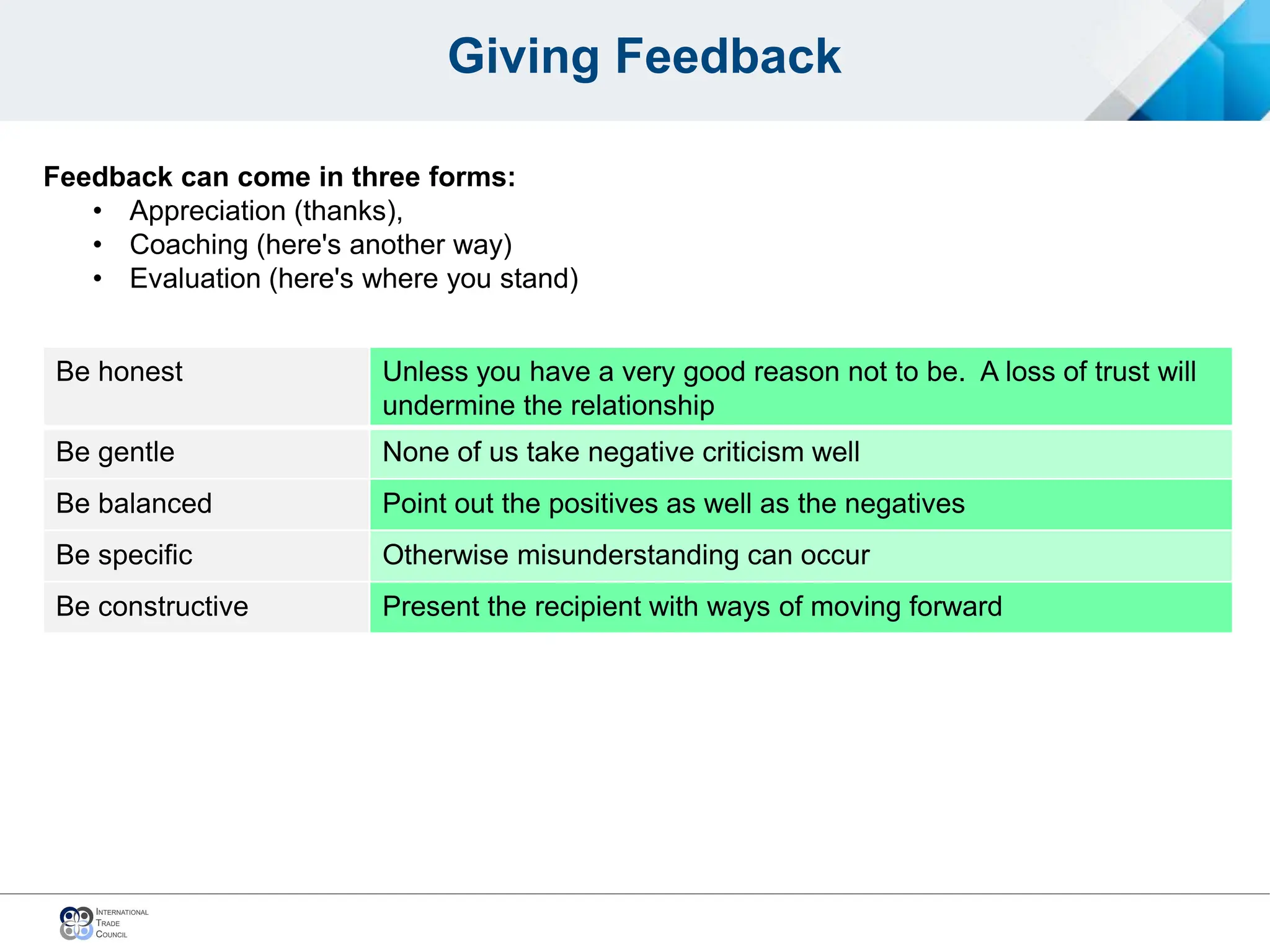
Giving Feedback
Feedback can come in three forms:
• Appreciation (thanks),
• Coaching (here's another way)
• Evaluation (here's where you stand)
Be honest Unless you have a very good reason not to be. A loss of trust will
undermine the relationship
Be gentle None of us take negative criticism well
Be balanced Point out the positives as well as the negatives
Be specific Otherwise misunderstanding can occur
Be constructive Present the recipient with ways of moving forward
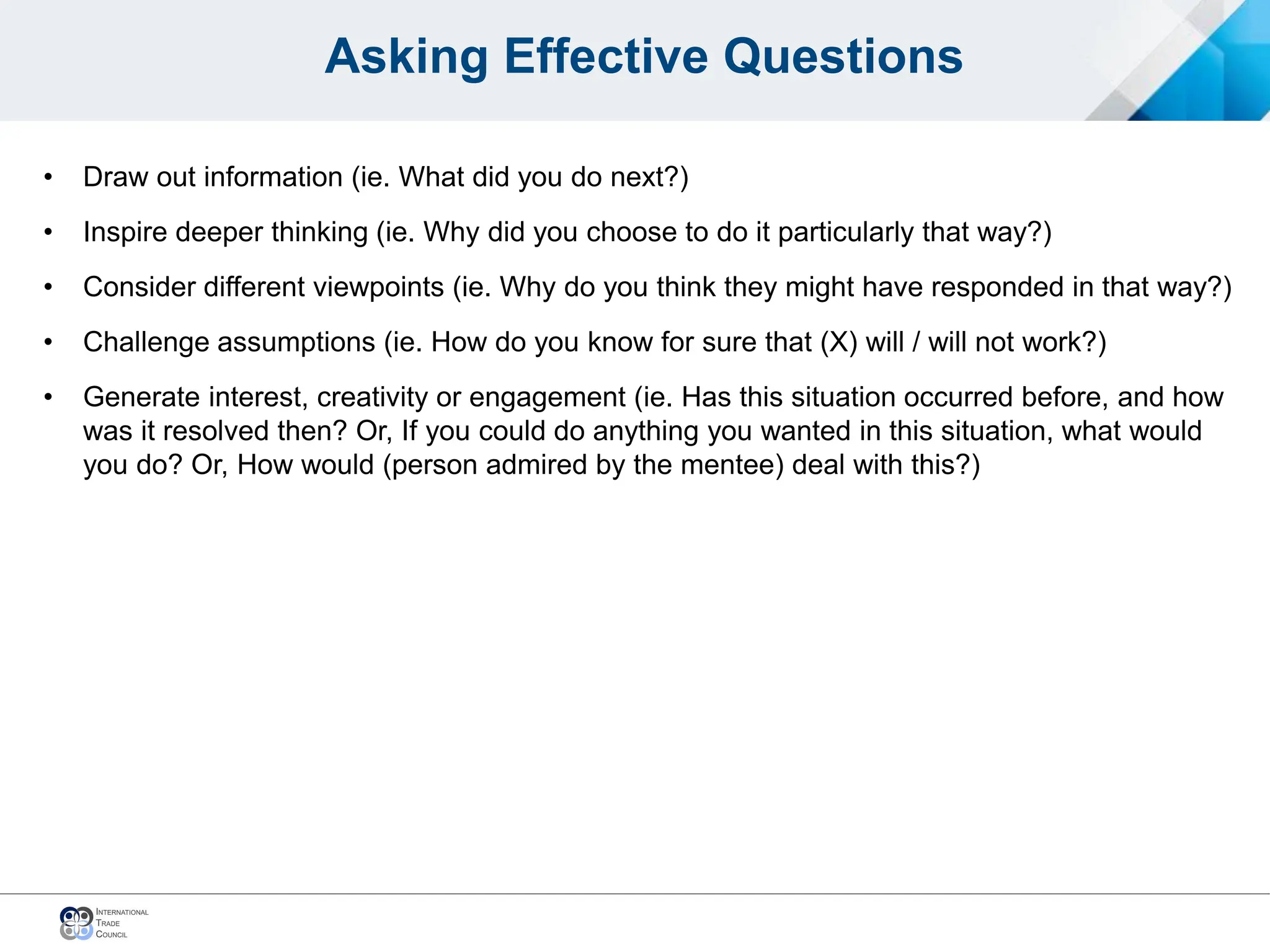
Asking Effective Questions
• Draw out information (ie. What did you do next?)
• Inspire deeper thinking (ie. Why did you choose to do it particularly that way?)
• Consider different viewpoints (ie. Why do you think they might have responded in that way?)
• Challenge assumptions (ie. How do you know for sure that (X) will / will not work?)
• Generate interest, creativity or engagement (ie. Has this situation occurred before, and how
was it resolved then? Or, If you could do anything you wanted in this situation, what would
you do? Or, How would (person admired by the mentee) deal with this?)
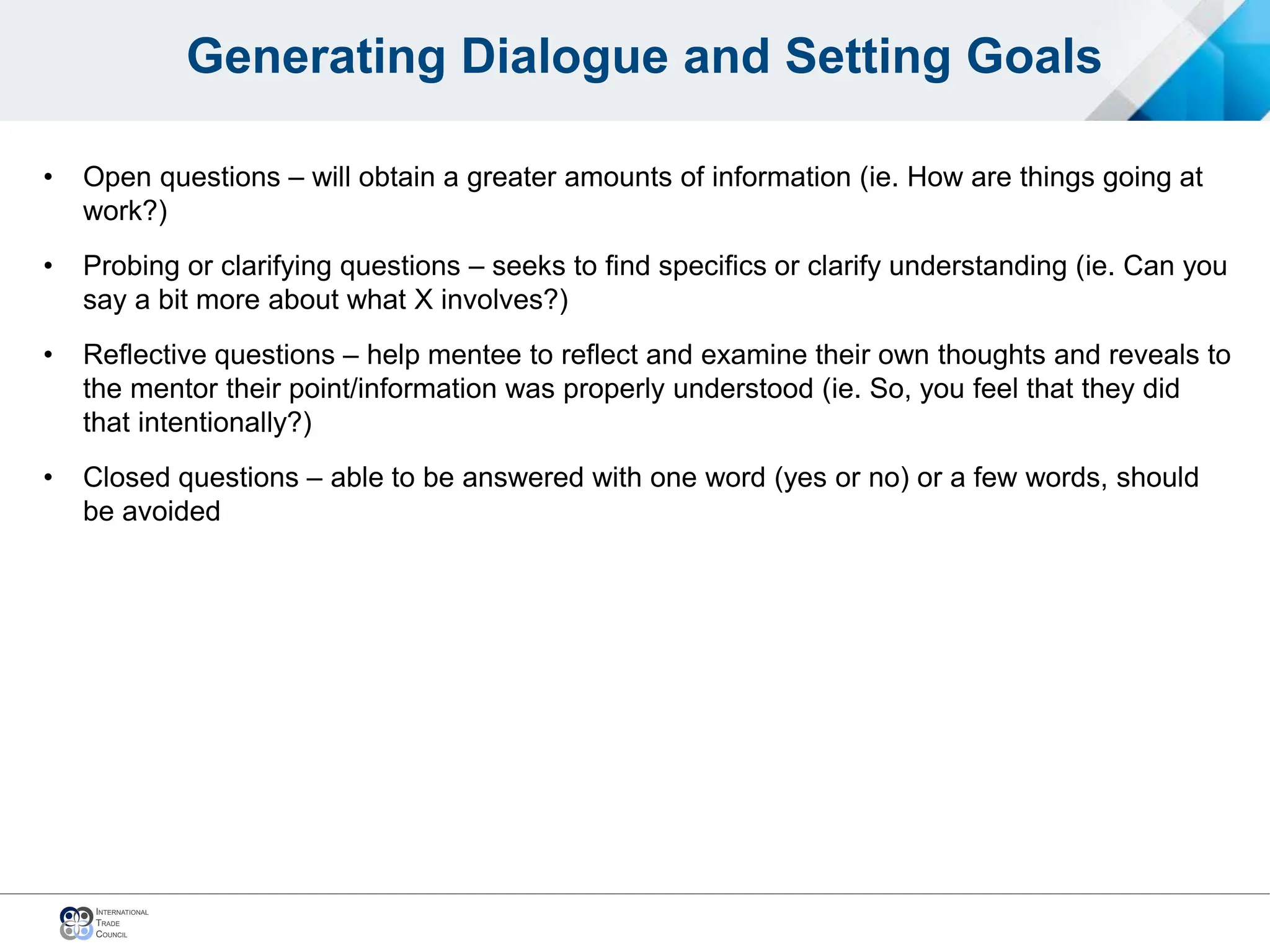
Generating Dialogue and Setting Goals
• Open questions – will obtain a greater amounts of information (ie. How are things going at
work?)
• Probing or clarifying questions – seeks to find specifics or clarify understanding (ie. Can you
say a bit more about what X involves?)
• Reflective questions – help mentee to reflect and examine their own thoughts and reveals to
the mentor their point/information was properly understood (ie. So, you feel that they did
that intentionally?)
• Closed questions – able to be answered with one word (yes or no) or a few words, should
be avoided
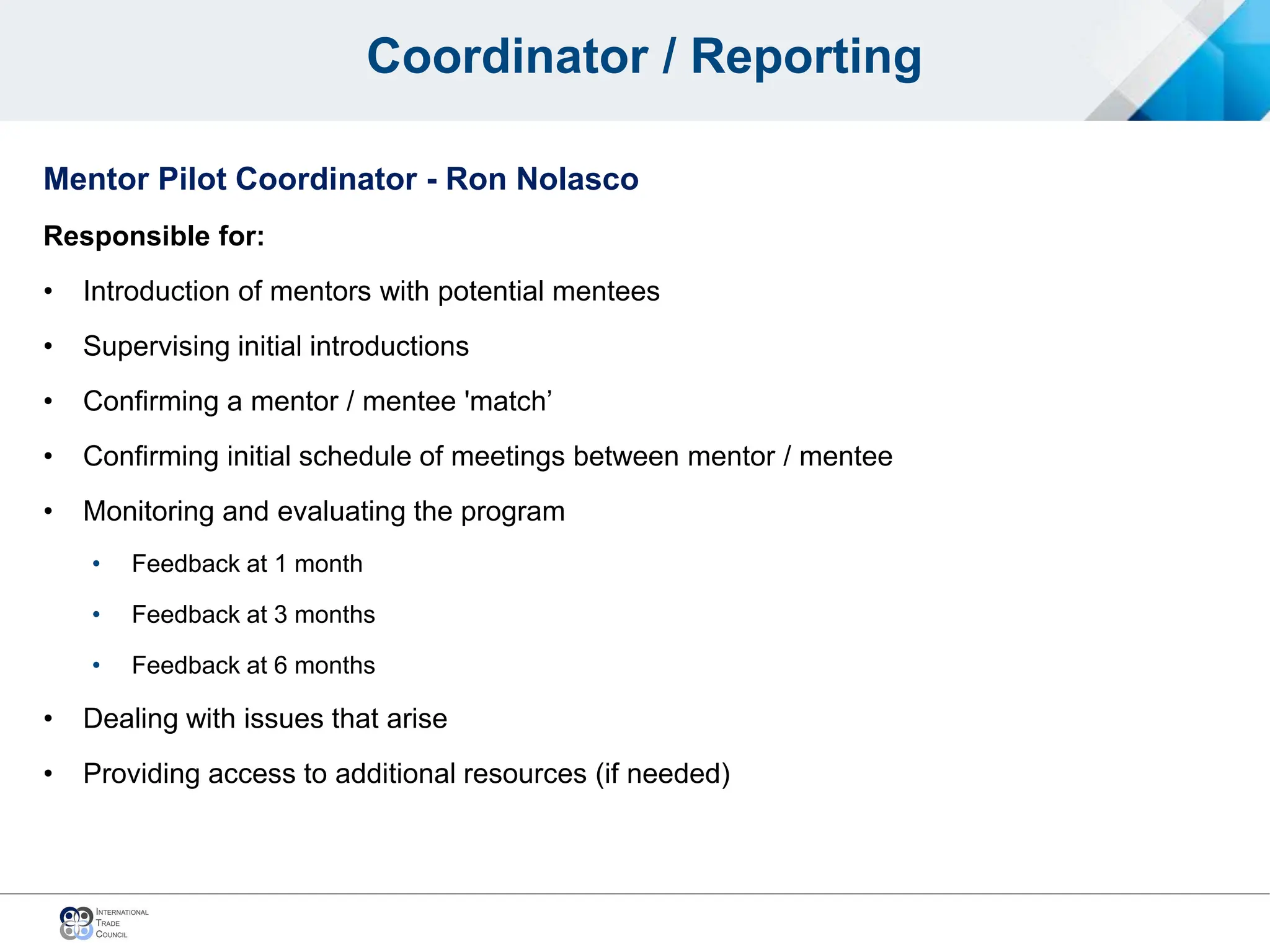
Coordinator / Reporting
Mentor Pilot Coordinator - Ron Nolasco
Responsible for:
• Introduction of mentors with potential mentees
• Supervising initial introductions
• Confirming a mentor / mentee 'match’
• Confirming initial schedule of meetings between mentor / mentee
• Monitoring and evaluating the program
• Feedback at 1 month
• Feedback at 3 months
• Feedback at 6 months
• Dealing with issues that arise
• Providing access to additional resources (if needed)
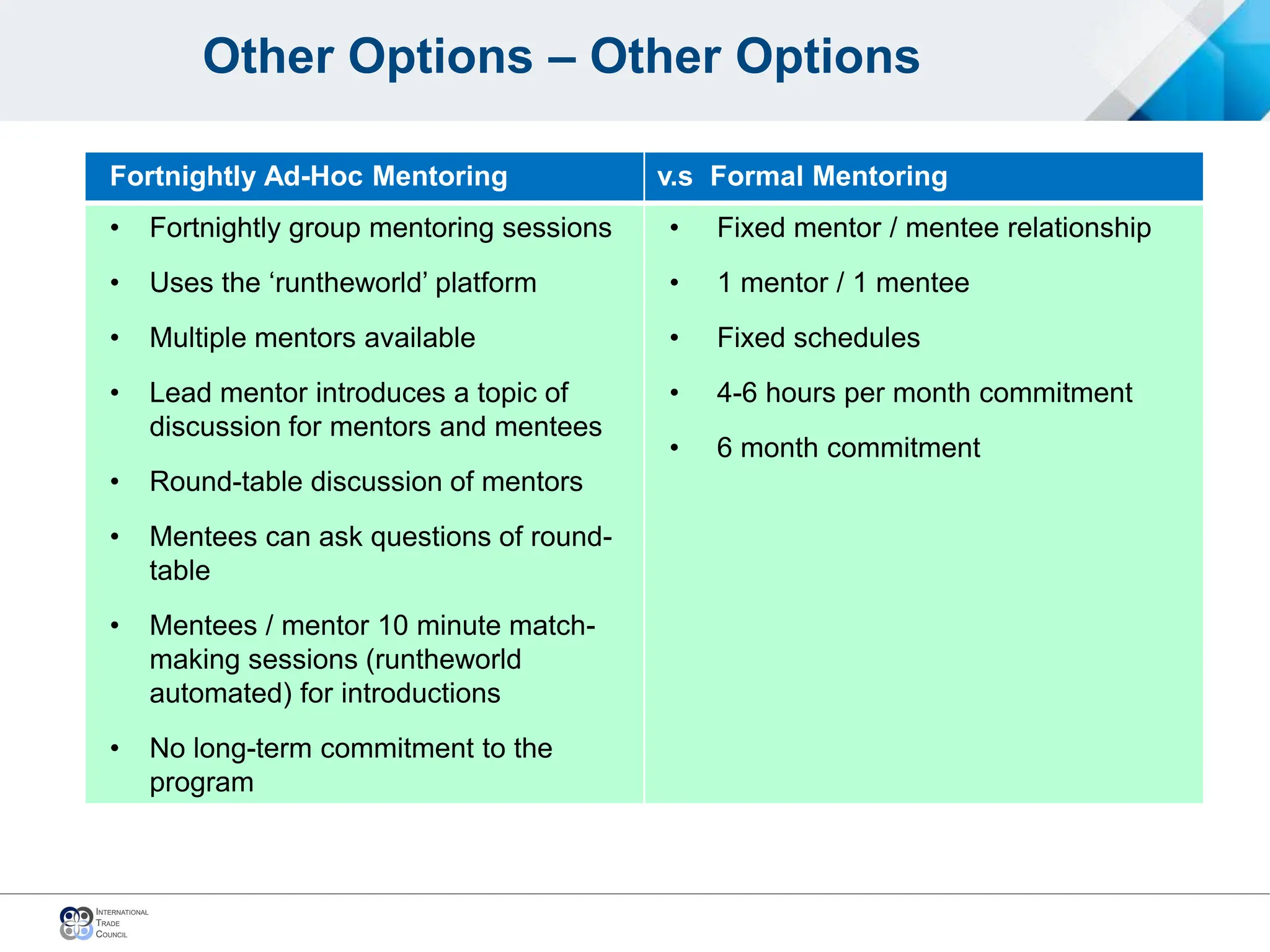
Other Options – Other Options
Fortnightly Ad-Hoc Mentoring v.s Formal Mentoring
• Fortnightly group mentoring sessions
• Uses the ‘runtheworld’ platform
• Multiple mentors available
• Lead mentor introduces a topic of
discussion for mentors and mentees
• Round-table discussion of mentors
• Mentees can ask questions of round-
table
• Mentees / mentor 10 minute match-
making sessions (runtheworld
automated) for introductions
• No long-term commitment to the
program
• Fixed mentor / mentee relationship
• 1 mentor / 1 mentee
• Fixed schedules
• 4-6 hours per month commitment
• 6 month commitment
Thank You!

B2B Mentoring itc program leadership iii

  • 1.
  • 2.
    What is Mentoring? Whatit is • A relationship based on trust between a “mentor” (teacher) and a “mentee” (learner). • A relationship where the mentor acts as a sounding-board and provides guidance to the mentee. • The relationship is devoted to developing knowledge and skills for personal leadership and professional and business growth. What it’s not • It does not a mentor doing the work FOR the mentee. • It won’t provide “insider information”. • It is not free labor for the mentee.
  • 3.
    Benefits of TakingPart in the Mentoring Program 3 What’s in it for mentees? • Access to impartial advice • Opportunity to reflect on their own goals and practices • Exposure to fresh ideas, perspectives and opportunities • Skills development • Identify barriers to success and strategies to overcome them • Reflect on own practice and behavior • Sharpen own communication skills • Consider different perspectives and approaches • Networking opportunities • Strengthening company culture What’s in it for mentors? • Networking and referrals from other mentors and mentees • Recognition as a subject matter expert • Exposure to fresh ideas, perspectives and opportunities • Addition to professional development record • Opportunity to reflect on their own goals and practices • Enhanced leadership and coaching skills • Development of their personal leadership and coaching styles • Sharpen own communication skills • Experience effective feedback • Be alerted to new issues by the mentee • Reflect on own practice and behavior • Free monthly promotion in ITC newsletter • Free listing on the main ITC website as an approved mentor
  • 4.
    Roles and Responsibilities 4 Mentees •Commits to completing agreed tasks • Outlines own expectations and identifies own professional and business development challenges / needs • Actively participates in the rapport building process • Sets goals and objectives with mentor’s assistance • Takes responsibility for implementing the action plan agreed with the mentor • Be open to constructive feedback and suggestions from mentor • Reflects on personal, professional practices and relations • Identifies future personal development needs • Reflects on mentoring process and its effectiveness Mentors • Acts as an independent role model within their areas of expertise • Challenges existing ideas and ways of thinking • Acts as a ‘sounding board’ by providing feedback, encouragement and acceptance • Provides feedback on ideas and thoughts of the mentee • Provides wisdom, advice, counsel and coaching • Facilitates professional development • Enjoys the opportunity to pass on their knowledge and collaboration with less experience ones • Provides contacts/networks for mentees to follow up if necessary
  • 5.
    Key Skills ofa Mentor
  • 6.
    Skills and Experienceof a Mentor • Understanding others – appreciate the differences and avoid forcing their personal views • Self-awareness – understand clearly their own strengths and weaknesses • Business know-how – good knowledge of organizational development, network, processes of how things work • Commitment to own learning – enrich their own experience and inspire for excellence • Desire to develop others – devote sufficient time to offer support and guidance
  • 7.
    Skills and Experienceof a Mentor Relationship management Key components for building a good rapport with the mentee:  Trust: keep discussions confidential  Focus: listen actively without judgement  Empathy: understand mentee’s points of view  Congruence: self-disclosure/sharing own experiences  Empowerment: allow mentee to contribute Communication Excellent communication skills: listen with an open mind, understand ideas and feelings  ask appropriate questions builds on an honest and open, trust and respect dialogue Cautious about the use of language explain and give constructive feedback
  • 8.
    Mentoring Program Logistics •The average mentorship will run for 6 months • Mentors details, unless otherwise restricted, will be published as a list for mentees to choose from • Mentors will have an initial 10 minute ITC moderated discussion with prospective mentees to ensure they are a match • Mentors and mentees agree to meet according to a confirmed schedule • Mentors and mentees will aim to meet twice a month (total 4 hours per month) • Meetings can be online (e.g. skype / zoom / runtheworld)
  • 9.
    Initial Mentor /Mentee Discussion Supervised meeting / first introduction meeting to decide relationship fit. • Introduction by mentor - themselves, their business, their goals, successes, challenges Questions by mentor to mentee: • Tell me about your organization? • Tell me about your role in your organization. • What are your key successes? • What are your key challenges? • Why did you enroll in the mentoring program? • What do you hope to achieve with the mentoring relationship? • How often would you like to meet? • What is the best method to meet (skype / zoom / messenger / Microsoft teams / other) ? • When is the most suitable times for you? • Other?
  • 10.
    Second Meeting withMentees 1. Introductions 2. Re-confirmation of roles of mentor / mentee • Mentors are not free labor and are not there to implement solutions • There to provide guidance and feedback about ideas and prompt different ways of thinking • Professional development tool to help guide and listen • Confidentiality • No micro-managing • Open discussions - Is there anything off-limits • Sticking to strict time limits so both party does not feel obliged to go over time 3. Re-confirmation of objectives of mentor / mentee 4. Key issues / problems or just open discussion ‘get to know one another’ 5. Prioritization 6. Re-Confirm calendar / schedule of future meetings
  • 11.
    Listening Listening more oftenthan speaking is essential for successful conversations. Listening helps us to learn more about others, their values, what motivates them and helps to prevent misunderstandings. Effective listening involves genuinely wanting to hear what the other person is saying, without focusing on what you are going to say next, or interrupting when you disagree with them. This means knowing when to shut up and when to sit with the silence (as uncomfortable as it may seem) and not feel that you need to say something to fill in the gap – silence gives the person space to gather their thoughts before they speak again.
  • 12.
    Giving Feedback Feedback cancome in three forms: • Appreciation (thanks), • Coaching (here's another way) • Evaluation (here's where you stand) Be honest Unless you have a very good reason not to be. A loss of trust will undermine the relationship Be gentle None of us take negative criticism well Be balanced Point out the positives as well as the negatives Be specific Otherwise misunderstanding can occur Be constructive Present the recipient with ways of moving forward
  • 13.
    Asking Effective Questions •Draw out information (ie. What did you do next?) • Inspire deeper thinking (ie. Why did you choose to do it particularly that way?) • Consider different viewpoints (ie. Why do you think they might have responded in that way?) • Challenge assumptions (ie. How do you know for sure that (X) will / will not work?) • Generate interest, creativity or engagement (ie. Has this situation occurred before, and how was it resolved then? Or, If you could do anything you wanted in this situation, what would you do? Or, How would (person admired by the mentee) deal with this?)
  • 14.
    Generating Dialogue andSetting Goals • Open questions – will obtain a greater amounts of information (ie. How are things going at work?) • Probing or clarifying questions – seeks to find specifics or clarify understanding (ie. Can you say a bit more about what X involves?) • Reflective questions – help mentee to reflect and examine their own thoughts and reveals to the mentor their point/information was properly understood (ie. So, you feel that they did that intentionally?) • Closed questions – able to be answered with one word (yes or no) or a few words, should be avoided
  • 15.
    Coordinator / Reporting MentorPilot Coordinator - Ron Nolasco Responsible for: • Introduction of mentors with potential mentees • Supervising initial introductions • Confirming a mentor / mentee 'match’ • Confirming initial schedule of meetings between mentor / mentee • Monitoring and evaluating the program • Feedback at 1 month • Feedback at 3 months • Feedback at 6 months • Dealing with issues that arise • Providing access to additional resources (if needed)
  • 16.
    Other Options –Other Options Fortnightly Ad-Hoc Mentoring v.s Formal Mentoring • Fortnightly group mentoring sessions • Uses the ‘runtheworld’ platform • Multiple mentors available • Lead mentor introduces a topic of discussion for mentors and mentees • Round-table discussion of mentors • Mentees can ask questions of round- table • Mentees / mentor 10 minute match- making sessions (runtheworld automated) for introductions • No long-term commitment to the program • Fixed mentor / mentee relationship • 1 mentor / 1 mentee • Fixed schedules • 4-6 hours per month commitment • 6 month commitment
  • 17.