MENTORING Roles & Responsibilities of Mentor
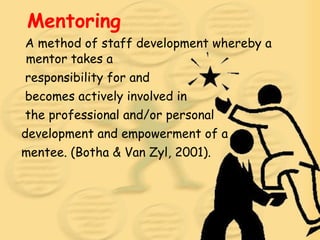
Mentoring A method of staff development whereby a mentor takes a responsibility for and becomes actively involved in the professional and/or personal development and empowerment of a mentee. (Botha & Van Zyl, 2001).
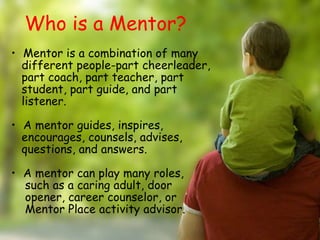
Who is a Mentor? Mentor is a combination of many different people-part cheerleader, part coach, part teacher, part student, part guide, and part listener.  A mentor guides, inspires, encourages, counsels, advises, questions, and answers. A mentor can play many roles, such as a caring adult, door opener, career counselor, or Mentor Place activity advisor.
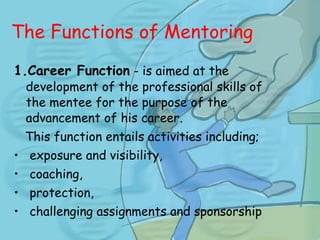
The Functions of Mentoring   1.Career Function  - is aimed at the development of the professional skills of the mentee for the purpose of the advancement of his career.  This function entails activities including; exposure and visibility, coaching, protection, challenging assignments and sponsorship
Cont’d… 2. Psychosocial Function -  aimed at the development of interpersonal skills that enhance a sense of competence, identity and effectiveness in a professional role. This function entails activities including;  acceptance and confirmation,  counseling,  role modeling and  Friendship.
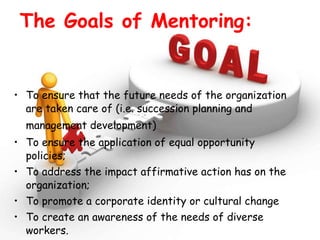
The Goals of Mentoring: To ensure that the future needs of the organization are taken care of (i.e. succession planning and management development)   To ensure the application of equal opportunity policies; To address the impact affirmative action has on the organization;  To promote a corporate identity or cultural change To create an awareness of the needs of diverse workers.
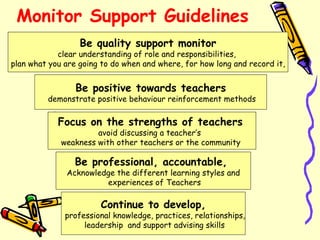
Monitor Support Guidelines   . Be quality support monitor clear understanding of role and responsibilities,  plan what you are going to do when and where, for how long and record it,  Be positive towards teachers demonstrate positive behaviour reinforcement methods Focus on the strengths of teachers   avoid discussing a teacher’s  weakness with other teachers or the community   Be professional, accountable,  Acknowledge the different learning styles and experiences of Teachers Continue to develop, professional knowledge, practices, relationships, leadership  and support advising skills
Strategies for Effective Mentoring   Put in the time (frequency and type of contact with mentee /teacher) If the teacher is stuck, provide direction and offer advice Don’t fall into the trap of being the “answer person” with the golden piece of advice Put yourself in the Mentee’s shoes Do what is asked of you - within reason
“ An effective mentor is knowledgeable, generous with his or her time, and flexible in personalizing the mentor experience to each individual.”    —Robert Gardner

Mentoring Presentation 1

  • 1.
    MENTORING Roles &Responsibilities of Mentor
  • 2.
    Mentoring A methodof staff development whereby a mentor takes a responsibility for and becomes actively involved in the professional and/or personal development and empowerment of a mentee. (Botha & Van Zyl, 2001).
  • 3.
    Who is aMentor? Mentor is a combination of many different people-part cheerleader, part coach, part teacher, part student, part guide, and part listener. A mentor guides, inspires, encourages, counsels, advises, questions, and answers. A mentor can play many roles, such as a caring adult, door opener, career counselor, or Mentor Place activity advisor.
  • 4.
    The Functions ofMentoring 1.Career Function - is aimed at the development of the professional skills of the mentee for the purpose of the advancement of his career. This function entails activities including; exposure and visibility, coaching, protection, challenging assignments and sponsorship
  • 5.
    Cont’d… 2. PsychosocialFunction - aimed at the development of interpersonal skills that enhance a sense of competence, identity and effectiveness in a professional role. This function entails activities including; acceptance and confirmation, counseling, role modeling and Friendship.
  • 6.
    The Goals ofMentoring: To ensure that the future needs of the organization are taken care of (i.e. succession planning and management development) To ensure the application of equal opportunity policies; To address the impact affirmative action has on the organization; To promote a corporate identity or cultural change To create an awareness of the needs of diverse workers.
  • 7.
    Monitor Support Guidelines . Be quality support monitor clear understanding of role and responsibilities, plan what you are going to do when and where, for how long and record it, Be positive towards teachers demonstrate positive behaviour reinforcement methods Focus on the strengths of teachers avoid discussing a teacher’s weakness with other teachers or the community Be professional, accountable, Acknowledge the different learning styles and experiences of Teachers Continue to develop, professional knowledge, practices, relationships, leadership and support advising skills
  • 8.
    Strategies for EffectiveMentoring Put in the time (frequency and type of contact with mentee /teacher) If the teacher is stuck, provide direction and offer advice Don’t fall into the trap of being the “answer person” with the golden piece of advice Put yourself in the Mentee’s shoes Do what is asked of you - within reason
  • 9.
    “ An effectivementor is knowledgeable, generous with his or her time, and flexible in personalizing the mentor experience to each individual.” —Robert Gardner