



Advocacy and Inquiry Oct 2009 Learning Organization
Advocacy and Inquiry
 
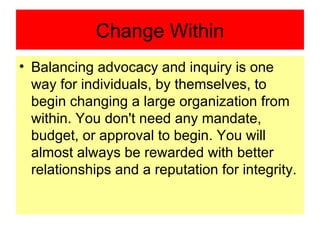
Change Within Balancing advocacy and inquiry is one way for individuals, by themselves, to begin changing a large organization from within. You don't need any mandate, budget, or approval to begin. You will almost always be rewarded with better relationships and a reputation for integrity.
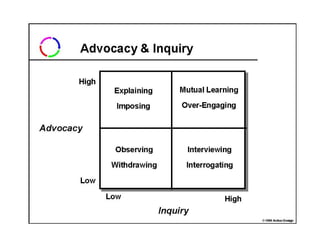
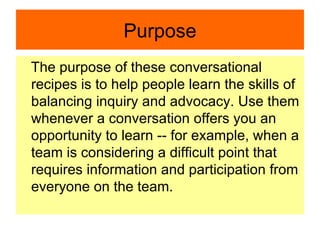
Purpose The purpose of these conversational recipes is to help people learn the skills of balancing inquiry and advocacy. Use them whenever a conversation offers you an opportunity to learn -- for example, when a team is considering a difficult point that requires information and participation from everyone on the team.
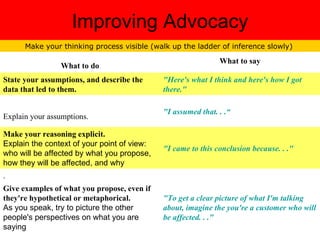
Improving Advocacy Make your thinking process visible (walk up the ladder of inference slowly)  . "To get a clear picture of what I'm talking about, imagine the you're a customer who will be affected. . ." Give examples of what you propose, even if they're hypothetical or metaphorical.  As you speak, try to picture the other people's perspectives on what you are saying . "I came to this conclusion because. . ." Make your reasoning explicit.  Explain the context of your point of view: who will be affected by what you propose, how they will be affected, and why "I assumed that. . .“ Explain your assumptions. "Here's what I think and here's how I got there." State your assumptions, and describe the data that led to them. What to say What to do
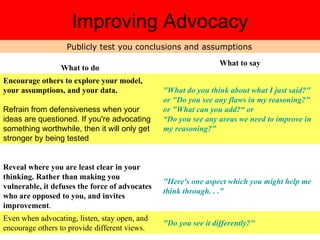
Improving Advocacy Publicly test you conclusions and assumptions   "Do you see it differently?" Even when advocating, listen, stay open, and encourage others to provide different views. "Here's one aspect which you might help me think through. . ." Reveal where you are least clear in your thinking. Rather than making you vulnerable, it defuses the force of advocates who are opposed to you, and invites improvement . "What do you think about what I just said?" or "Do you see any flaws in my reasoning?" or "What can you add?“ or “ Do you see any areas we need to improve in my reasoning?” Encourage others to explore your model, your assumptions, and your data.  Refrain from defensiveness when your ideas are questioned. If you're advocating something worthwhile, then it will only get stronger by being tested What to say What to do
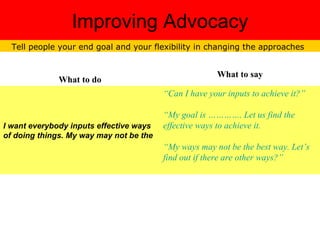
Improving Advocacy Tell people your end goal and your flexibility in changing the approaches “ Can I have your inputs to achieve it?” “ My goal is …………. Let us find the effective ways to achieve it.  “ My ways may not be the best way. Let’s find out if there are other ways?” I want everybody inputs effective ways of doing things. My way may not be the What to say What to do
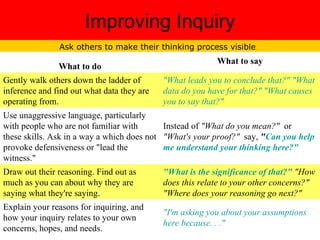
Improving Inquiry Ask others to make their thinking process visible .  "I'm asking you about your assumptions here because. . ." Explain your reasons for inquiring, and how your inquiry relates to your own concerns, hopes, and needs. "What is the significance of that?"  "How does this relate to your other concerns?" "Where does your reasoning go next?" Draw out their reasoning. Find out as much as you can about why they are saying what they're saying. Instead of  "What do you mean?"   or  "What's your proof?"   say,  " Can you help me understand your thinking here?" Use unaggressive language, particularly with people who are not familiar with these skills. Ask in a way a which does not provoke defensiveness or "lead the witness." "What leads you to conclude that?" "What data do you have for that?" "What causes you to say that?" Gently walk others down the ladder of inference and find out what data they are operating from. What to say What to do
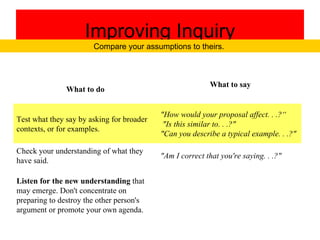
Improving Inquiry Compare your assumptions to theirs.  Listen for the new understanding  that may emerge. Don't concentrate on preparing to destroy the other person's argument or promote your own agenda. "Am I correct that you're saying. . .?" Check your understanding of what they have said. "How would your proposal affect. . .?“ "Is this similar to. . .?"  "Can you describe a typical example. . .?" Test what they say by asking for broader contexts, or for examples. What to say What to do
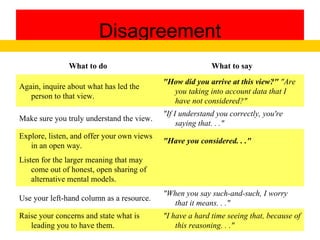
Disagreement "I have a hard time seeing that, because of this reasoning. . ." Raise your concerns and state what is leading you to have them. "When you say such-and-such, I worry that it means. . ." Use your left-hand column as a resource. Listen for the larger meaning that may come out of honest, open sharing of alternative mental models. "Have you considered. . ." Explore, listen, and offer your own views in an open way. "If I understand you correctly, you're saying that. . ." Make sure you truly understand the view. "How did you arrive at this view?"  "Are you taking into account data that I have not considered?" Again, inquire about what has led the person to that view. What to say What to do
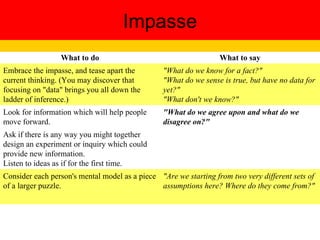
Impasse "Are we starting from two very different sets of assumptions here? Where do they come from?" Consider each person's mental model as a piece of a larger puzzle. Ask if there is any way you might together design an experiment or inquiry which could provide new information.  Listen to ideas as if for the first time. "What do we agree upon and what do we disagree on?" Look for information which will help people move forward. "What do we know for a fact?"  "What do we sense is true, but have no data for yet?"  "What don't we know?" Embrace the impasse, and tease apart the current thinking. (You may discover that focusing on "data" brings you all down the ladder of inference.) What to say What to do
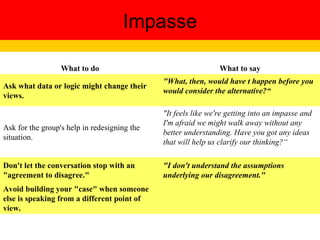
Impasse Avoid building your "case" when someone else is speaking from a different point of view. "I don't understand the assumptions underlying our disagreement." Don't let the conversation stop with an "agreement to disagree." "It feels like we're getting into an impasse and I'm afraid we might walk away without any better understanding. Have you got any ideas that will help us clarify our thinking?“ Ask for the group's help in redesigning the situation. "What, then, would have t happen before you would consider the alternative?“ Ask what data or logic might change their views. What to say What to do
Improving Inquiry


Kenneth  Beare , About.com http://esl.about.com/ Acknowledgement
Useful Phrases

Advocancy and Inquiry

  • 1.
    Advocacy and InquiryOct 2009 Learning Organization
  • 2.
  • 3.
  • 4.
    Change Within Balancingadvocacy and inquiry is one way for individuals, by themselves, to begin changing a large organization from within. You don't need any mandate, budget, or approval to begin. You will almost always be rewarded with better relationships and a reputation for integrity.
  • 5.
    Purpose The purposeof these conversational recipes is to help people learn the skills of balancing inquiry and advocacy. Use them whenever a conversation offers you an opportunity to learn -- for example, when a team is considering a difficult point that requires information and participation from everyone on the team.
  • 6.
    Improving Advocacy Makeyour thinking process visible (walk up the ladder of inference slowly) . "To get a clear picture of what I'm talking about, imagine the you're a customer who will be affected. . ." Give examples of what you propose, even if they're hypothetical or metaphorical. As you speak, try to picture the other people's perspectives on what you are saying . "I came to this conclusion because. . ." Make your reasoning explicit. Explain the context of your point of view: who will be affected by what you propose, how they will be affected, and why "I assumed that. . .“ Explain your assumptions. "Here's what I think and here's how I got there." State your assumptions, and describe the data that led to them. What to say What to do
  • 7.
    Improving Advocacy Publiclytest you conclusions and assumptions "Do you see it differently?" Even when advocating, listen, stay open, and encourage others to provide different views. "Here's one aspect which you might help me think through. . ." Reveal where you are least clear in your thinking. Rather than making you vulnerable, it defuses the force of advocates who are opposed to you, and invites improvement . "What do you think about what I just said?" or "Do you see any flaws in my reasoning?" or "What can you add?“ or “ Do you see any areas we need to improve in my reasoning?” Encourage others to explore your model, your assumptions, and your data. Refrain from defensiveness when your ideas are questioned. If you're advocating something worthwhile, then it will only get stronger by being tested What to say What to do
  • 8.
    Improving Advocacy Tellpeople your end goal and your flexibility in changing the approaches “ Can I have your inputs to achieve it?” “ My goal is …………. Let us find the effective ways to achieve it. “ My ways may not be the best way. Let’s find out if there are other ways?” I want everybody inputs effective ways of doing things. My way may not be the What to say What to do
  • 9.
    Improving Inquiry Askothers to make their thinking process visible . "I'm asking you about your assumptions here because. . ." Explain your reasons for inquiring, and how your inquiry relates to your own concerns, hopes, and needs. "What is the significance of that?" "How does this relate to your other concerns?" "Where does your reasoning go next?" Draw out their reasoning. Find out as much as you can about why they are saying what they're saying. Instead of "What do you mean?"   or "What's your proof?"   say, " Can you help me understand your thinking here?" Use unaggressive language, particularly with people who are not familiar with these skills. Ask in a way a which does not provoke defensiveness or "lead the witness." "What leads you to conclude that?" "What data do you have for that?" "What causes you to say that?" Gently walk others down the ladder of inference and find out what data they are operating from. What to say What to do
  • 10.
    Improving Inquiry Compareyour assumptions to theirs. Listen for the new understanding that may emerge. Don't concentrate on preparing to destroy the other person's argument or promote your own agenda. "Am I correct that you're saying. . .?" Check your understanding of what they have said. "How would your proposal affect. . .?“ "Is this similar to. . .?" "Can you describe a typical example. . .?" Test what they say by asking for broader contexts, or for examples. What to say What to do
  • 11.
    Disagreement "I havea hard time seeing that, because of this reasoning. . ." Raise your concerns and state what is leading you to have them. "When you say such-and-such, I worry that it means. . ." Use your left-hand column as a resource. Listen for the larger meaning that may come out of honest, open sharing of alternative mental models. "Have you considered. . ." Explore, listen, and offer your own views in an open way. "If I understand you correctly, you're saying that. . ." Make sure you truly understand the view. "How did you arrive at this view?" "Are you taking into account data that I have not considered?" Again, inquire about what has led the person to that view. What to say What to do
  • 12.
    Impasse "Are westarting from two very different sets of assumptions here? Where do they come from?" Consider each person's mental model as a piece of a larger puzzle. Ask if there is any way you might together design an experiment or inquiry which could provide new information. Listen to ideas as if for the first time. "What do we agree upon and what do we disagree on?" Look for information which will help people move forward. "What do we know for a fact?" "What do we sense is true, but have no data for yet?" "What don't we know?" Embrace the impasse, and tease apart the current thinking. (You may discover that focusing on "data" brings you all down the ladder of inference.) What to say What to do
  • 13.
    Impasse Avoid buildingyour "case" when someone else is speaking from a different point of view. "I don't understand the assumptions underlying our disagreement." Don't let the conversation stop with an "agreement to disagree." "It feels like we're getting into an impasse and I'm afraid we might walk away without any better understanding. Have you got any ideas that will help us clarify our thinking?“ Ask for the group's help in redesigning the situation. "What, then, would have t happen before you would consider the alternative?“ Ask what data or logic might change their views. What to say What to do
  • 14.
  • 15.
  • 16.
  • 17.
  • 18.
  • 19.
    Kenneth Beare, About.com http://esl.about.com/ Acknowledgement
  • 20.