Relating, Visioning &
Inventing
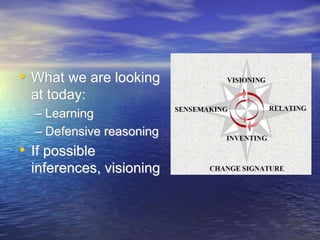
• What we are looking
at today:
– Learning
– Defensive reasoning
• If possible
inferences, visioning
• Looked at sensemaking last time
• Today: relating, visioning
• Sensemaking and relating:
– Enabling capabilities
• Visioning and inventing:
– Creative and action-oriented capabilities
The purpose of Relating
• To build better networks by building better
relationships by building better
communication
• Components of Relating:
– Inquiry
– Advocacy
– Connectedness
Inquiry
• Sharing views and developing knowledge
about each other’s assumptions
– In essence: what leads you to believe X?
• The problem is people react defensively,
and this can generate strong emotion that
hinders effective inquiry
Inquiry
• Taken from the perspective of Argyris and SchÖn
– Not as asking questions
– Learning is driven by inquiry
– We engage in inquiry (i.e. we desire to learn) when an
outcome does not meet our expectations
– i.e. an error exists (extracted cue?)
– Implicitly recognises that errors contribute to learning
– Driven to find out the cause of the mis-match
2 Questions
• How do we learn?
• What inhibits inquiry?
Learning
• knowledge based on experience
• knowledge without experience
• We cannot experience every conceivable
situation so how do we act?
• We have developed theories of action
– To produce consequence C in Situation S, do
A
Theory of action
• A master design of procedure that outlines
the action and their causal sequencing to be
effective : mental map, model
• 2 types:
– Espoused theories: The world view and values
people believe their behaviour is based on
– Theories in use: The world view and values
implied by their behaviour, or the maps they use
to take action
– Try to achieve as much congruence as possible
between the two
– Most have some idea of espoused theories, few
are aware that their theories in use and espoused
theories are different; fewer know what their
theories in use are.
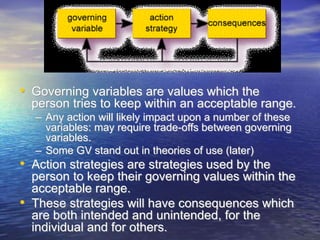
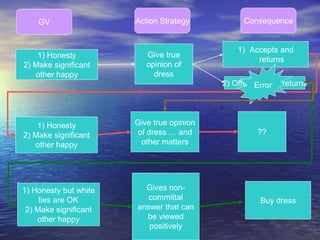
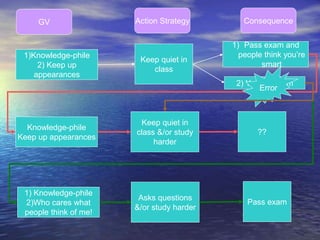
• Governing variables are values which the
person tries to keep within an acceptable range.
– Any action will likely impact upon a number of these
variables: may require trade-offs between governing
variables.
– Some GV stand out in theories of use (later)
• Action strategies are strategies used by the
person to keep their governing values within the
acceptable range.
• These strategies will have consequences which
are both intended and unintended, for the
individual and for others.
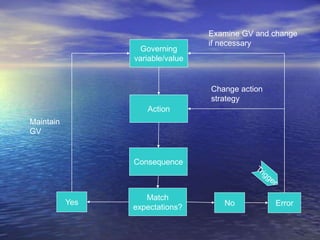
Governing
variable/value
Action
Consequence
Match
expectations?
Yes No Error
Maintain
GV
Change action
strategy
Examine GV and change
if necessary
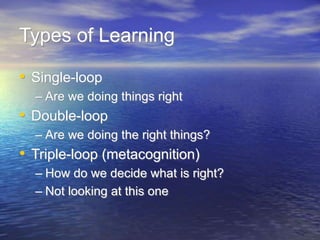
Types of Learning
• Single-loop
– Are we doing things right
• Double-loop
– Are we doing the right things?
• Triple-loop (metacognition)
– How do we decide what is right?
– Not looking at this one
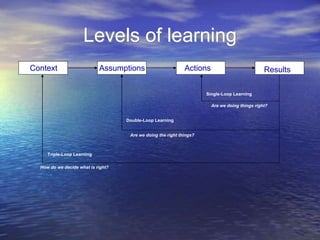
Levels of learning
Context Assumptions Actions Results
Single-Loop Learning
Double-Loop Learning
Triple-Loop Learning
Are we doing things right?
Are we doing the right things?
How do we decide what is right?
Results
Actions
Assumptions
Context
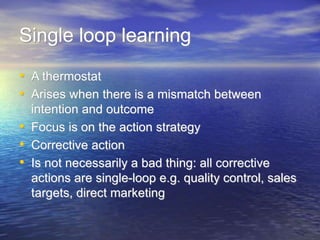
Single loop learning
• A thermostat
• Arises when there is a mismatch between
intention and outcome
• Focus is on the action strategy
• Corrective action
• Is not necessarily a bad thing: all corrective
actions are single-loop e.g. quality control, sales
targets, direct marketing
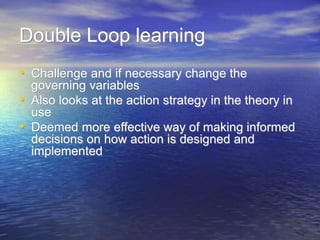
Double Loop learning
• Challenge and if necessary change the
governing variables
• Also looks at the action strategy in the theory in
use
• Deemed more effective way of making informed
decisions on how action is designed and
implemented
1) Honesty
2) Make significant
other happy
Give true
opinion of
dress
1) Accepts and
returns
1) Honesty
2) Make significant
other happy
Give true opinion
of dress … and
other matters
??
1) Honesty but white
lies are OK
2) Make significant
other happy
Gives non-
committal
answer that can
be viewed
positively
GV Action Strategy Consequence
2) Offended and returns
Error
Buy dress
1)Knowledge-phile
2) Keep up
appearances
Keep quiet in
class
1) Pass exam and
people think you’re
smart
Knowledge-phile
Keep up appearances
Keep quiet in
class &/or study
harder
??
1) Knowledge-phile
2)Who cares what
people think of me!
Asks questions
&/or study harder
Pass exam
GV Action Strategy Consequence
2) You fail exam
Error
Why concern ourselves with S & D
loop learning?
• Oversimplified reason presented here:
– Avoid defensive reasoning
• LH/RH
Defensive Reasoning
• Reasoning designed to protect the self (self
concept/ego/identity)
• Can be extended to the organisation (designed
to protect the organisation’s identity)
• Effect of defensive reasoning:
– inhibits learning by minimising inquiry
– inhibits learning when learning is most needed:
adaptive challenges
Defensive Reasoning
• Creates misunderstanding, self-fulfilling
prophecies, mistrust and rigidity
• Inhibits understanding of others
• Avoid feeling embarrassed, incompetent,
vulnerable
• Situation evaluated as zero sum
• By not addressing governing values, avoid
testing them
Significance of Defensive
Reasoning
• Limits Double-loop learning:
– Why is double loop learning important?
– It is an effective way of making informed decisions
about the way we design and implement action
– Enables congruence between espoused and theories-
in-use
• Why congruence?
Espoused and In-use
• Not merely the difference between what
people say and do.
– a theory consistent with what people say and
a theory consistent with what they do.
– Therefore the distinction is not between
"theory and action but between two different
"theories of action"
• To improve ability to communicate we first
start with ourselves. We can’t be spouting
one theory of action (espoused theories)
and then using another diametrically
opposed theory to act (theory-in-use).
– Double loop learning allows us to examine our
underlying theories (in some books Argyris
calls this assumptions instead of governing
variables)
What’s wrong with single loop?
• Nothing except it cannot cope with
dynamic, unstructured, unpredictable
situations
• Single loop learning is also associated
with what Argyris calls a ‘Model 1’
organisation
– Not going into detail here but some
understanding of Model 1 can help
Model 1
• Organisation characterised by
– Defensive reasoning
– Zero sum game:
• One of us is right … and I know it’s me
– Lack of inquiry
• Inferences
– Unilateral control: I am in charge of myself and of you
• (I will decide what to protect you from and what to expose
you to)
– Lack of testing
The alternative: Model 2
• Encourage double loop learning
• Valid info derived from open dialogue
• Model 2 is the basis for effective inquiry
Advocacy
• Another component of Relating is
advocacy
• Inquiry: surfaces different points of view
• Advocacy: arguing a position
Balance advocacy with inquiry
• Test assumptions/reality testing
– To test is to face the brutal facts (Jim Collins): Stockdale paradox
– Accept the brutal facts of reality. On the other hand, maintain an
unwavering faith in the endgame, and a commitment to prevail
as a great company despite the brutal facts.
• We must be able to inquire of others, assess the merit of
their position and change our own views if needed
(double loop learning) … but if the opposing view is
flawed (for whatever objective reason) then we must be
able to advocate our own view
• When your reality is tested, you experience stress.
– How hardy are you?
Balancing Inquiry and advocacy
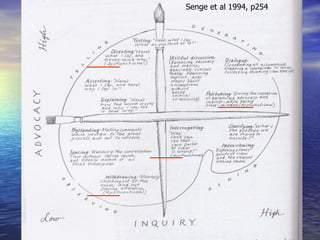
• Diagram shows combinations of inquiry and
advocacy: use different combinations as and
when appropriate
• If Inquiry is not high enough, you won’t
understand other peoples’ position and how they
got there:
– beware defensive reasoning
– Watch for your own non-verbal behaviours
• If advocacy is not high enough, you’ll feel
persecuted and engage in defensive reasoning
– How you got to your position won’t be revealed
• In action learning/problem resolution situations,
we’re looking for high-high combination
Senge et al 1994, p254
How can we go about improving
advocacy and inquiry?
• To improve inquiry and advocacy we need
to deal in facts and to understand our own
tendencies of defensive reasoning
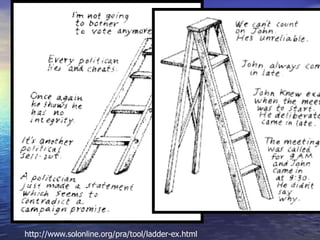
• Ladder of inference
– Aids in getting at the facts and removing
biases
• Left hand-right hand
– Understand our own tendencies to engage in
defensive reasoning
Ladder of inference
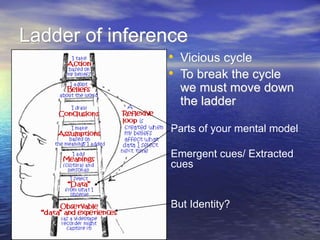
• Vicious cycle
• To break the cycle
we must move down
the ladder
Parts of your mental model
Emergent cues/ Extracted
cues
But Identity?
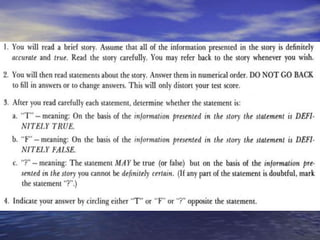
• What do you see?
Ladder of inference
• Nothing wrong with drawing inferences and
conclusions: we have to in order to act and thus
live
• Are you dealing with facts (objective)?
• We can be better at it:
– Increase awareness of own thinking and reasoning
– Make it clearer to others (advocacy)
– Inquire into others thinking and reasoning (inquiry)
• Tendency to draw inferences
http://www.solonline.org/pra/tool/ladder-ex.html
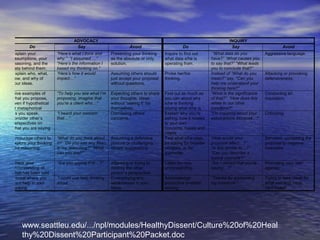
ADVOCACY INQUIRY
Do Say Avoid Do Say Avoid
Explain your
assumptions, your
reasoning, and the
data behind them.
“Here’s what I think and
why.” “I assumed …”
“Here’s the information I
based my thinking on.”
Presenting your thinking
as the absolute or only
solution.
Inquire to find out
what data s/he is
operating from.
“What data do you
have?” “What causes you
to say that?” “What leads
you to conclude that?”
Aggressive language.
Explain who, what,
how, and why of
your ideas.
“Here’s how it would
impact…”
Assuming others should
just accept your proposal
without questions.
Probe her/his
thinking.
Instead of “What do you
mean?” say, “Can you
help me understand your
thinking here?”
Attacking or provoking
defensiveness.
Give examples of
what you propose,
even if hypothetical
or metaphorical
“To help you see what I’m
proposing, imagine that
you’re a client who…”
Expecting others to share
your thoughts, ideas
without “seeing it” for
themselves.
Find out as much as
you can about why
s/he is thinking
saying what s/he is.
“What is the significance
of that?” “How does this
relate to our other
concerns?”
Conducting an
inquisition.
As you speak,
consider other’s
perspectives on
what you are saying
“I heard your concern
that…”
Dismissing others’
concerns.
Explain why you’re
asking, how it relates
to your own
concerns, hopes and
needs
“I’m inquiring about your
assumptions because…”
Criticizing.
Encourage others to
explore your thinking
and reasoning.
“What do you think about
it?” “Do you see any flaws
in my reasoning?” “What
can you add?”
Assuming a defensive
posture or challenging
others’ suggestions.
Test what s/he says
by asking for broader
contexts, or for
examples.
“How would your
proposal affect…?”
“Is this similar to…?”
“Can you describe a
typical example?”
Sarcasm; comparing the
proposal to negative
examples
Check your
understanding of
what has been said
“Are you saying that…?” Attacking or trying to
destroy the other
person’s perspective.
Listen for new
understanding.
“Am I correct that you’re
saying…?”
Promoting your own
agenda.
Reveal where you
want help in your
thinking.
“I could use help thinking
about…”
Downplaying any
weaknesses in your
ideas.
Acknowledge
productive problem
solving.
“Thanks for addressing
my concerns.”
Trying to take credit for
what you may have
contributed.
www.seattleu.edu/.../npl/modules/HealthyDissent/Culture%20of%20Heal
thy%20Dissent%20Participant%20Packet.doc
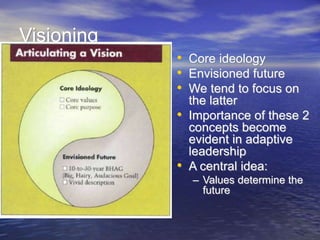
Visioning
• Core ideology
• Envisioned future
• We tend to focus on
the latter
• Importance of these 2
concepts become
evident in adaptive
leadership
• A central idea:
– Values determine the
future
BHAGs and future
• Still very much value-driven:
– Goes to the core of the company and asks
what kind of world do we want to live in and
be a part of?
– What do you care about? What does your
company care about?
– BHAGs reflect commitment and effort
A few words on inventing
• This is about implementation
• In essence you are moving (after
sensemaking, relating, visioning) from the
known to the unknown
– Do you use tried and tested methods? Would
they work?
– Or do you have to invent new ways to
implement? New structures, new processes,
new methods
New
• In with the new, out with the old
– What do you have to do to move people from
the old way to the new way
– Few people reject a a winning lottery ticket
but everyone has difficulty accepting loss
– Adaptive challenge

Session 4 - Lectures in Leadership (Relating).pptx

  • 1.
  • 2.
    • What weare looking at today: – Learning – Defensive reasoning • If possible inferences, visioning
  • 3.
    • Looked atsensemaking last time • Today: relating, visioning • Sensemaking and relating: – Enabling capabilities • Visioning and inventing: – Creative and action-oriented capabilities
  • 4.
    The purpose ofRelating • To build better networks by building better relationships by building better communication • Components of Relating: – Inquiry – Advocacy – Connectedness
  • 5.
    Inquiry • Sharing viewsand developing knowledge about each other’s assumptions – In essence: what leads you to believe X? • The problem is people react defensively, and this can generate strong emotion that hinders effective inquiry
  • 6.
    Inquiry • Taken fromthe perspective of Argyris and SchÖn – Not as asking questions – Learning is driven by inquiry – We engage in inquiry (i.e. we desire to learn) when an outcome does not meet our expectations – i.e. an error exists (extracted cue?) – Implicitly recognises that errors contribute to learning – Driven to find out the cause of the mis-match
  • 7.
    2 Questions • Howdo we learn? • What inhibits inquiry?
  • 8.
    Learning • knowledge basedon experience • knowledge without experience • We cannot experience every conceivable situation so how do we act? • We have developed theories of action – To produce consequence C in Situation S, do A
  • 9.
    Theory of action •A master design of procedure that outlines the action and their causal sequencing to be effective : mental map, model • 2 types: – Espoused theories: The world view and values people believe their behaviour is based on – Theories in use: The world view and values implied by their behaviour, or the maps they use to take action – Try to achieve as much congruence as possible between the two – Most have some idea of espoused theories, few are aware that their theories in use and espoused theories are different; fewer know what their theories in use are.
  • 10.
    • Governing variablesare values which the person tries to keep within an acceptable range. – Any action will likely impact upon a number of these variables: may require trade-offs between governing variables. – Some GV stand out in theories of use (later) • Action strategies are strategies used by the person to keep their governing values within the acceptable range. • These strategies will have consequences which are both intended and unintended, for the individual and for others.
  • 11.
  • 12.
    Types of Learning •Single-loop – Are we doing things right • Double-loop – Are we doing the right things? • Triple-loop (metacognition) – How do we decide what is right? – Not looking at this one
  • 13.
    Levels of learning ContextAssumptions Actions Results Single-Loop Learning Double-Loop Learning Triple-Loop Learning Are we doing things right? Are we doing the right things? How do we decide what is right? Results Actions Assumptions Context
  • 14.
    Single loop learning •A thermostat • Arises when there is a mismatch between intention and outcome • Focus is on the action strategy • Corrective action • Is not necessarily a bad thing: all corrective actions are single-loop e.g. quality control, sales targets, direct marketing
  • 15.
    Double Loop learning •Challenge and if necessary change the governing variables • Also looks at the action strategy in the theory in use • Deemed more effective way of making informed decisions on how action is designed and implemented
  • 16.
    1) Honesty 2) Makesignificant other happy Give true opinion of dress 1) Accepts and returns 1) Honesty 2) Make significant other happy Give true opinion of dress … and other matters ?? 1) Honesty but white lies are OK 2) Make significant other happy Gives non- committal answer that can be viewed positively GV Action Strategy Consequence 2) Offended and returns Error Buy dress
  • 17.
    1)Knowledge-phile 2) Keep up appearances Keepquiet in class 1) Pass exam and people think you’re smart Knowledge-phile Keep up appearances Keep quiet in class &/or study harder ?? 1) Knowledge-phile 2)Who cares what people think of me! Asks questions &/or study harder Pass exam GV Action Strategy Consequence 2) You fail exam Error
  • 18.
    Why concern ourselveswith S & D loop learning? • Oversimplified reason presented here: – Avoid defensive reasoning • LH/RH
  • 19.
    Defensive Reasoning • Reasoningdesigned to protect the self (self concept/ego/identity) • Can be extended to the organisation (designed to protect the organisation’s identity) • Effect of defensive reasoning: – inhibits learning by minimising inquiry – inhibits learning when learning is most needed: adaptive challenges
  • 20.
    Defensive Reasoning • Createsmisunderstanding, self-fulfilling prophecies, mistrust and rigidity • Inhibits understanding of others • Avoid feeling embarrassed, incompetent, vulnerable • Situation evaluated as zero sum • By not addressing governing values, avoid testing them
  • 21.
    Significance of Defensive Reasoning •Limits Double-loop learning: – Why is double loop learning important? – It is an effective way of making informed decisions about the way we design and implement action – Enables congruence between espoused and theories- in-use • Why congruence?
  • 22.
    Espoused and In-use •Not merely the difference between what people say and do. – a theory consistent with what people say and a theory consistent with what they do. – Therefore the distinction is not between "theory and action but between two different "theories of action"
  • 23.
    • To improveability to communicate we first start with ourselves. We can’t be spouting one theory of action (espoused theories) and then using another diametrically opposed theory to act (theory-in-use). – Double loop learning allows us to examine our underlying theories (in some books Argyris calls this assumptions instead of governing variables)
  • 24.
    What’s wrong withsingle loop? • Nothing except it cannot cope with dynamic, unstructured, unpredictable situations • Single loop learning is also associated with what Argyris calls a ‘Model 1’ organisation – Not going into detail here but some understanding of Model 1 can help
  • 25.
    Model 1 • Organisationcharacterised by – Defensive reasoning – Zero sum game: • One of us is right … and I know it’s me – Lack of inquiry • Inferences – Unilateral control: I am in charge of myself and of you • (I will decide what to protect you from and what to expose you to) – Lack of testing
  • 26.
    The alternative: Model2 • Encourage double loop learning • Valid info derived from open dialogue • Model 2 is the basis for effective inquiry
  • 27.
    Advocacy • Another componentof Relating is advocacy • Inquiry: surfaces different points of view • Advocacy: arguing a position
  • 28.
    Balance advocacy withinquiry • Test assumptions/reality testing – To test is to face the brutal facts (Jim Collins): Stockdale paradox – Accept the brutal facts of reality. On the other hand, maintain an unwavering faith in the endgame, and a commitment to prevail as a great company despite the brutal facts. • We must be able to inquire of others, assess the merit of their position and change our own views if needed (double loop learning) … but if the opposing view is flawed (for whatever objective reason) then we must be able to advocate our own view • When your reality is tested, you experience stress. – How hardy are you?
  • 29.
    Balancing Inquiry andadvocacy • Diagram shows combinations of inquiry and advocacy: use different combinations as and when appropriate • If Inquiry is not high enough, you won’t understand other peoples’ position and how they got there: – beware defensive reasoning – Watch for your own non-verbal behaviours • If advocacy is not high enough, you’ll feel persecuted and engage in defensive reasoning – How you got to your position won’t be revealed • In action learning/problem resolution situations, we’re looking for high-high combination
  • 30.
    Senge et al1994, p254
  • 31.
    How can wego about improving advocacy and inquiry? • To improve inquiry and advocacy we need to deal in facts and to understand our own tendencies of defensive reasoning • Ladder of inference – Aids in getting at the facts and removing biases • Left hand-right hand – Understand our own tendencies to engage in defensive reasoning
  • 32.
    Ladder of inference •Vicious cycle • To break the cycle we must move down the ladder Parts of your mental model Emergent cues/ Extracted cues But Identity?
  • 33.
    • What doyou see?
  • 35.
    Ladder of inference •Nothing wrong with drawing inferences and conclusions: we have to in order to act and thus live • Are you dealing with facts (objective)? • We can be better at it: – Increase awareness of own thinking and reasoning – Make it clearer to others (advocacy) – Inquire into others thinking and reasoning (inquiry) • Tendency to draw inferences
  • 36.
  • 37.
    ADVOCACY INQUIRY Do SayAvoid Do Say Avoid Explain your assumptions, your reasoning, and the data behind them. “Here’s what I think and why.” “I assumed …” “Here’s the information I based my thinking on.” Presenting your thinking as the absolute or only solution. Inquire to find out what data s/he is operating from. “What data do you have?” “What causes you to say that?” “What leads you to conclude that?” Aggressive language. Explain who, what, how, and why of your ideas. “Here’s how it would impact…” Assuming others should just accept your proposal without questions. Probe her/his thinking. Instead of “What do you mean?” say, “Can you help me understand your thinking here?” Attacking or provoking defensiveness. Give examples of what you propose, even if hypothetical or metaphorical “To help you see what I’m proposing, imagine that you’re a client who…” Expecting others to share your thoughts, ideas without “seeing it” for themselves. Find out as much as you can about why s/he is thinking saying what s/he is. “What is the significance of that?” “How does this relate to our other concerns?” Conducting an inquisition. As you speak, consider other’s perspectives on what you are saying “I heard your concern that…” Dismissing others’ concerns. Explain why you’re asking, how it relates to your own concerns, hopes and needs “I’m inquiring about your assumptions because…” Criticizing. Encourage others to explore your thinking and reasoning. “What do you think about it?” “Do you see any flaws in my reasoning?” “What can you add?” Assuming a defensive posture or challenging others’ suggestions. Test what s/he says by asking for broader contexts, or for examples. “How would your proposal affect…?” “Is this similar to…?” “Can you describe a typical example?” Sarcasm; comparing the proposal to negative examples Check your understanding of what has been said “Are you saying that…?” Attacking or trying to destroy the other person’s perspective. Listen for new understanding. “Am I correct that you’re saying…?” Promoting your own agenda. Reveal where you want help in your thinking. “I could use help thinking about…” Downplaying any weaknesses in your ideas. Acknowledge productive problem solving. “Thanks for addressing my concerns.” Trying to take credit for what you may have contributed. www.seattleu.edu/.../npl/modules/HealthyDissent/Culture%20of%20Heal thy%20Dissent%20Participant%20Packet.doc
  • 38.
    Visioning • Core ideology •Envisioned future • We tend to focus on the latter • Importance of these 2 concepts become evident in adaptive leadership • A central idea: – Values determine the future
  • 39.
    BHAGs and future •Still very much value-driven: – Goes to the core of the company and asks what kind of world do we want to live in and be a part of? – What do you care about? What does your company care about? – BHAGs reflect commitment and effort
  • 40.
    A few wordson inventing • This is about implementation • In essence you are moving (after sensemaking, relating, visioning) from the known to the unknown – Do you use tried and tested methods? Would they work? – Or do you have to invent new ways to implement? New structures, new processes, new methods
  • 41.
    New • In withthe new, out with the old – What do you have to do to move people from the old way to the new way – Few people reject a a winning lottery ticket but everyone has difficulty accepting loss – Adaptive challenge