Ten Tools
A collection of organizational and
individual methods to aid effectiveness
2
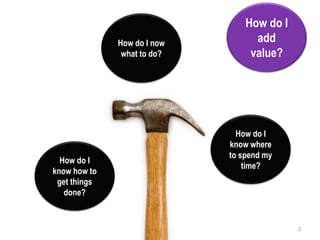
How do I now
what to do?
How do I
know how to
get things
done?
How do I
know where
to spend my
time?
How do I
add
value?
BALANCING ADVOCACY &
INQUIRY
Ten Tools Session Five
How do I…
4
• Know what to do?
– Gap analysis
– Sensemaking
– Ideal-setting
• Get things done?
– Collaboration
– Performance
• Nurture and enhance relationships?
– Collaboration
– Communication
• Develop myself?
– Personal mastery
– Gap Analysis
– Sensemaking
• Move people and their behavior from
point A to point B?
– Gap analysis
– Influence
– Performance
• Lead teams to produce desired
results?
– Collaboration
– Performance
– Facilitation
• Solve problems?
– Sense making
– Evaluation
– Performance
How do we produce results?
• What is the
sequence of
activities that leads
to a result?
• What comes before
action?
Decisions!
• And what do we know
about the best way to
make decisions?
Reality Based Decision Making
• Good decision making
requires a grasp of the
relevant reality
– observable facts and
experience, things that are
relevant and testable 
even if the testing is only
asking someone else if he
or she is observing the
same thing that you see
• Just seek a good enough
approximation
What’s ‘good enough’ reality?
• The young specialist in English
Lit…lectured me severely on the fact that in
every century people have thought they
understood the Universe at last, and in
every century they were proved to be
wrong. It follows, he said, that the one thing
we can say about our modern “knowledge”
is that it is wrong.
• …My answer to him was…”When people
thought the Earth was flat, they were
wrong. When people thought the Earth was
spherical, they were wrong. But if you think
that thinking the Earth is spherical is just as
wrong as thinking the Earth is flat, then your
view is ‘wronger’ than both of them put
together.”
– Asimov, I. (1996) The Relativity of Wrong, p. 226.
New York: Kensington Books
Goal: Be Less Wrong
Testing Our Reality
• Get to a “good enough” approximation
of reality, test it, and then change it as
needed.
• But our values tend to influence our
perceptions, and thus our decisions are
not based purely on fact, or reality.
• Many people fail to recognize that they
select certain facts and brush aside
others, guided by their “ought to be”
model.
• Many managers  senior and junior 
don’t acknowledge the subjective
element of “what ought to be” in their
decisions.
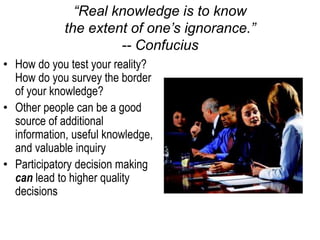
“Real knowledge is to know
the extent of one’s ignorance.”
-- Confucius
• How do you test your reality?
How do you survey the border
of your knowledge?
• Other people can be a good
source of additional
information, useful knowledge,
and valuable inquiry
• Participatory decision making
can lead to higher quality
decisions
• “Think about the meetings
you’ve attended – those that
were a hopeless waste of
time and those that produced
energy and great results.
What was the difference? It
was not the agenda, nor
whether the meeting started
on time or how disciplined it
was, and certainly not the
formal presentations. No,
the difference was the quality
of the dialogue.”
– Charan & Bossidy
What gets in the way?
US! Our Not Questioning Each Other
• Argyris & Schon found in their
research that few executives
today operate in an
environment where they can
truly speak their mind, seek
answers, and question a peer’s
or superior’s reasoning
• People made tacit agreements
with each other not to question
reasoning that appeared shaky
or based purely on self-interest
From Ross & Roberts
• “Large organisations tend
to socialise leaders to be
forceful, articulate
advocates and problem
solvers. We have been
trained, generally by the
modelling of others, about
how to present and argue
strongly for our views. “
• “These underlying
expectations are increasingly
in conflict with the need for
leaders to manage ambiguity
and complexity, where there
is no one answer and
where the only viable
option is for groups of
informed and committed
individuals to think
together to arrive at new
insights.”
Is making your point the point?
• In business
conversations, we often
believe that our
definition of what needs
to be accomplished, and
how it needs to be
accomplished, is the
only valid one.
– Fred Kofman
We seek to avoid any questioning of our
reasoning. We focus exclusively on our POV
being the one accepted
Are we stuck
in a ‘not good enough’ reality?
Our Cognitive Toolkits Create Local Optima
solutions landscape
utility
of
ideas
4
3
2
1 Individually, each of us
applies our knowledge,
perspectives and
heuristics to arrive at the
best solution we can…
…but that’s likely not the
best solution overall.
* Scott Page, The Difference
4
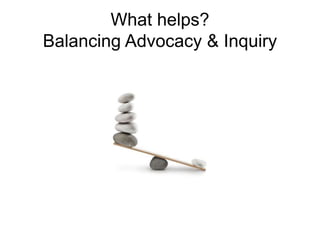
What helps?
Balancing Advocacy & Inquiry
What does it mean to balance
advocacy & inquiry?
• “When balancing advocacy
and inquiry, we lay out our
reasoning and thinking, and
then encourage others to
challenge us.
• ‘Here is my view and here is
how I have arrived at it. How
does it sound to you? What
makes sense to you and
what doesn't? Do you see
any ways I can improve it?’ “
19
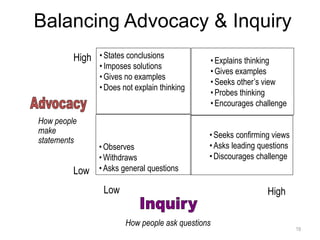
Balancing Advocacy & Inquiry
• States conclusions
• Imposes solutions
• Gives no examples
• Does not explain thinking
• Observes
• Withdraws
• Asks general questions
• Explains thinking
• Gives examples
• Seeks other’s view
• Probes thinking
• Encourages challenge
• Seeks confirming views
• Asks leading questions
• Discourages challenge
Low
Low
High
High
How people
make
statements
How people ask questions
We don't recommend inquiry alone.
• “People almost always have a
viewpoint to express, and it is
important to express it -- in a
context, which allows you to
learn more about others' views
while they learn more about
yours.
• Nor do we recommend that you
switch in rote fashion from an
adamant assertion ("Here's
what I say") to a question
("Now what do you say?") and
back again.
– Ross & Roberts
Balancing inquiry and advocacy means
developing a variety of skills.
• “It's as if all the "colors" of
conversation could be
spread out on an
imaginary palette. As the
creator of your part of the
conversation, you should
be able to incorporate
styles from all four
quadrants of the palette.”
– Ross & Roberts
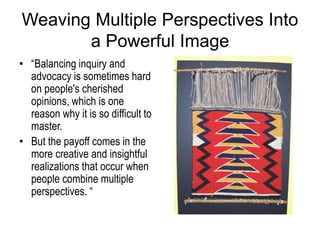
Weaving Multiple Perspectives Into
a Powerful Image
• “Balancing inquiry and
advocacy is sometimes hard
on people's cherished
opinions, which is one
reason why it is so difficult to
master.
• But the payoff comes in the
more creative and insightful
realizations that occur when
people combine multiple
perspectives. “
The Skills of
Reflective
Practice
from Joe
Raelin
25
Balancing Advocacy & Inquiry
• States conclusions
• Imposes solutions
• Gives no examples
• Does not explain thinking
• Observes
• Withdraws
• Asks general questions
• Explains thinking
• Gives examples
• Seeks other’s view
• Probes thinking
• Encourages challenge
• Seeks confirming views
• Asks leading questions
• Discourages challenge
Low
Low
High
High
How people
make
statements
How people ask questions
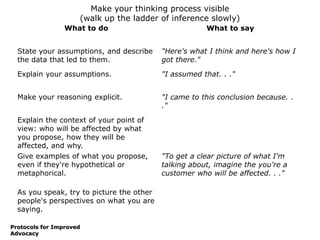
Make your thinking process visible
(walk up the ladder of inference slowly)
What to do What to say
State your assumptions, and describe
the data that led to them.
"Here's what I think and here's how I
got there."
Explain your assumptions. "I assumed that. . ."
Make your reasoning explicit. "I came to this conclusion because. .
."
Explain the context of your point of
view: who will be affected by what
you propose, how they will be
affected, and why.
Give examples of what you propose,
even if they're hypothetical or
metaphorical.
"To get a clear picture of what I'm
talking about, imagine the you're a
customer who will be affected. . ."
As you speak, try to picture the other
people's perspectives on what you are
saying.
Protocols for Improved
Advocacy
What to do What to say
Encourage others to explore your
model, your assumptions, and your
data.
"What do you think about what I just
said?" or "Do you see any flaws in my
reasoning?" or "What can you add?"
Refrain from defensiveness when your
ideas are questioned. If you're
advocating something worthwhile, then
it will only get stronger by being
tested.
Reveal where you are least clear in
your thinking. Rather than making you
vulnerable, it defuses the force of
advocates who are opposed to you,
and invites improvement.
"Here's one aspect which you might
help me think through. . ."
Even when advocating, listen, stay
open, and encourage others to provide
different views.
"Do you see it differently?"
Publicly test your conclusions and assumptions.
Protocols for Improved
Advocacy
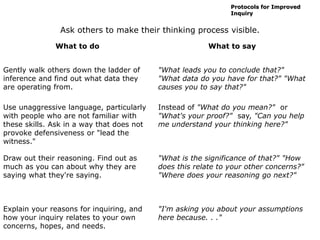
Ask others to make their thinking process visible.
What to do What to say
Gently walk others down the ladder of
inference and find out what data they
are operating from.
"What leads you to conclude that?"
"What data do you have for that?" "What
causes you to say that?"
Use unaggressive language, particularly
with people who are not familiar with
these skills. Ask in a way that does not
provoke defensiveness or "lead the
witness."
Instead of "What do you mean?" or
"What's your proof?" say, "Can you help
me understand your thinking here?"
Draw out their reasoning. Find out as
much as you can about why they are
saying what they're saying.
"What is the significance of that?" "How
does this relate to your other concerns?"
"Where does your reasoning go next?"
Explain your reasons for inquiring, and
how your inquiry relates to your own
concerns, hopes, and needs.
"I'm asking you about your assumptions
here because. . ."
Protocols for Improved
Inquiry
Compare your assumptions to theirs
Protocols for Improved
Inquiry
What to do What to say
Test what they say by asking for broader
contexts, or for examples.
"How would your proposal affect. . .?"
"Is this similar to. . .?" "Can you
describe a typical example. . .?"
Check your understanding of what they
have said.
"Am I correct that you're saying. . .?"
Listen for the new understanding that
may emerge. Don't concentrate on
preparing to destroy the other person's
argument or promote your own agenda.
Protocols for Facing a Point of View With
Which You Disagree
What to do What to say
Again, inquire about what has led the
person to that view.
"How did you arrive at this view?"
"Are you taking into account data that
I have not considered?"
Make sure you truly understand the
view.
"If I understand you correctly, you're
saying that. . ."
Explore, listen, and offer your own
views in an open way.
"Have you considered. . ."
Listen for the larger meaning that
may come out of honest, open sharing
of alternative mental models.
"When you say such-and-such, I
worry that it means. . ."
Raise your concerns and state what is
leading you to have them.
"I have a hard time seeing that,
because of this reasoning. . ."
Protocols for When
You’re At An Impasse
What to do What to say
Embrace the impasse, and tease apart the
current thinking. (You may discover that
focusing on "data" brings you all down the
ladder of inference.)
"What do we know for a fact?"
"What do we sense is true, but have no
data for yet?"
"What don't we know?"
Look for information which will help people
move forward.
"What do we agree upon and what do we
disagree on?"
Ask if there is any way you might together
design an experiment or inquiry which
could provide new information.
Listen to ideas as if for the first time.
Consider each person's mental model as a
piece of a larger puzzle.
"Are we starting from two very different
sets of assumptions here? Where do they
come from?"
Ask what data or logic might change their
views.
"What, then, would have to happen before
you would consider the alternative?"
Ask for the group's help in redesigning the
situation.
"It feels like we're getting into an impasse
and I'm afraid we might walk away without
any better understanding. Have you got
any ideas that will help us clarify our
thinking?"
Don't let the conversation stop with an
"agreement to disagree." "I don't understand the assumptions
underlying our disagreement."
Avoid building your "case" when someone
else is speaking from a different point of
view.
More Impasse Tactics
from Fred Kofman
• State the impasse or the dilemma
explicitly, and ask for help: “I’m feeling
stuck. On the one hand we need to create
a flexible system, and on the other hand
we need to cut all redundancies. I don’t
know how to do both together. Do you
have any ideas?”
• If others appear closed to inquiring into
their own views, ask what data or logic
might change their views: “Can you think
of any logical argument or piece of
information that might disconfirm your
view?”
• Ask if there is any way to obtain new
information: “Is there an experiment we
might try that will provide us with more
data?”
• Invite them to reverse roles and see the
world from a different standpoint: “If you
were in my place, how would you
proceed?”
• Ask others to teach you how to express
your view productively, i.e., in a way that
does not create defensiveness in them:
“How could I tell you about my concerns
in a non‐aggressive manner? Can you
help me state my perspective in a way
that respects your views?”
• If others are hesitant to express their
views, encourage them to talk about the
barriers: “What is it about this situation,
me, or others that is making open
exchange difficult?”
How do you know what the balance
is
between advocacy & inquiry
How Much Valid Information
Do You Seek?
Inspired by Kaner
start
obvious
decision
point
decision point
What do
you lose?
What do
you gain?
divergence convergence
non-obvious
The Groan Zone
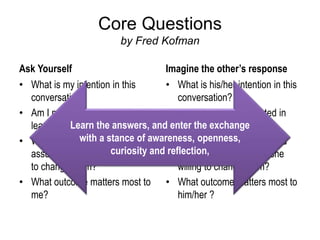
Core Questions
by Fred Kofman
Ask Yourself
• What is my intention in this
conversation?
• Am I more interested in
learning or in prevailing?
• What are my beliefs and
assumptions, and am I willing
to change them?
• What outcome matters most to
me?
Imagine the other’s response
• What is his/her intention in this
conversation?
• Is she/he more interested in
learning or in prevailing?
• What are his/her beliefs and
assumptions, and is he/she
willing to change them?
• What outcome matters most to
him/her ?
Learn the answers, and enter the exchange
with a stance of awareness, openness,
curiosity and reflection,
How will you use this tool?
Where would I use
this tool? How would I use
this tool?
What would I expect
to get out of it?

Advocacy-vs-Inquiry-2015.pptx

  • 1.
    Ten Tools A collectionof organizational and individual methods to aid effectiveness
  • 2.
    2 How do Inow what to do? How do I know how to get things done? How do I know where to spend my time? How do I add value?
  • 3.
  • 4.
    How do I… 4 •Know what to do? – Gap analysis – Sensemaking – Ideal-setting • Get things done? – Collaboration – Performance • Nurture and enhance relationships? – Collaboration – Communication • Develop myself? – Personal mastery – Gap Analysis – Sensemaking • Move people and their behavior from point A to point B? – Gap analysis – Influence – Performance • Lead teams to produce desired results? – Collaboration – Performance – Facilitation • Solve problems? – Sense making – Evaluation – Performance
  • 5.
    How do weproduce results? • What is the sequence of activities that leads to a result? • What comes before action?
  • 6.
    Decisions! • And whatdo we know about the best way to make decisions?
  • 7.
    Reality Based DecisionMaking • Good decision making requires a grasp of the relevant reality – observable facts and experience, things that are relevant and testable  even if the testing is only asking someone else if he or she is observing the same thing that you see • Just seek a good enough approximation
  • 8.
    What’s ‘good enough’reality? • The young specialist in English Lit…lectured me severely on the fact that in every century people have thought they understood the Universe at last, and in every century they were proved to be wrong. It follows, he said, that the one thing we can say about our modern “knowledge” is that it is wrong. • …My answer to him was…”When people thought the Earth was flat, they were wrong. When people thought the Earth was spherical, they were wrong. But if you think that thinking the Earth is spherical is just as wrong as thinking the Earth is flat, then your view is ‘wronger’ than both of them put together.” – Asimov, I. (1996) The Relativity of Wrong, p. 226. New York: Kensington Books Goal: Be Less Wrong
  • 9.
    Testing Our Reality •Get to a “good enough” approximation of reality, test it, and then change it as needed. • But our values tend to influence our perceptions, and thus our decisions are not based purely on fact, or reality. • Many people fail to recognize that they select certain facts and brush aside others, guided by their “ought to be” model. • Many managers  senior and junior  don’t acknowledge the subjective element of “what ought to be” in their decisions.
  • 10.
    “Real knowledge isto know the extent of one’s ignorance.” -- Confucius • How do you test your reality? How do you survey the border of your knowledge? • Other people can be a good source of additional information, useful knowledge, and valuable inquiry • Participatory decision making can lead to higher quality decisions
  • 11.
    • “Think aboutthe meetings you’ve attended – those that were a hopeless waste of time and those that produced energy and great results. What was the difference? It was not the agenda, nor whether the meeting started on time or how disciplined it was, and certainly not the formal presentations. No, the difference was the quality of the dialogue.” – Charan & Bossidy
  • 12.
    What gets inthe way? US! Our Not Questioning Each Other • Argyris & Schon found in their research that few executives today operate in an environment where they can truly speak their mind, seek answers, and question a peer’s or superior’s reasoning • People made tacit agreements with each other not to question reasoning that appeared shaky or based purely on self-interest
  • 13.
    From Ross &Roberts • “Large organisations tend to socialise leaders to be forceful, articulate advocates and problem solvers. We have been trained, generally by the modelling of others, about how to present and argue strongly for our views. “ • “These underlying expectations are increasingly in conflict with the need for leaders to manage ambiguity and complexity, where there is no one answer and where the only viable option is for groups of informed and committed individuals to think together to arrive at new insights.”
  • 14.
    Is making yourpoint the point? • In business conversations, we often believe that our definition of what needs to be accomplished, and how it needs to be accomplished, is the only valid one. – Fred Kofman We seek to avoid any questioning of our reasoning. We focus exclusively on our POV being the one accepted
  • 15.
    Are we stuck ina ‘not good enough’ reality?
  • 16.
    Our Cognitive ToolkitsCreate Local Optima solutions landscape utility of ideas 4 3 2 1 Individually, each of us applies our knowledge, perspectives and heuristics to arrive at the best solution we can… …but that’s likely not the best solution overall. * Scott Page, The Difference 4
  • 17.
  • 18.
    What does itmean to balance advocacy & inquiry? • “When balancing advocacy and inquiry, we lay out our reasoning and thinking, and then encourage others to challenge us. • ‘Here is my view and here is how I have arrived at it. How does it sound to you? What makes sense to you and what doesn't? Do you see any ways I can improve it?’ “
  • 19.
    19 Balancing Advocacy &Inquiry • States conclusions • Imposes solutions • Gives no examples • Does not explain thinking • Observes • Withdraws • Asks general questions • Explains thinking • Gives examples • Seeks other’s view • Probes thinking • Encourages challenge • Seeks confirming views • Asks leading questions • Discourages challenge Low Low High High How people make statements How people ask questions
  • 20.
    We don't recommendinquiry alone. • “People almost always have a viewpoint to express, and it is important to express it -- in a context, which allows you to learn more about others' views while they learn more about yours. • Nor do we recommend that you switch in rote fashion from an adamant assertion ("Here's what I say") to a question ("Now what do you say?") and back again. – Ross & Roberts
  • 21.
    Balancing inquiry andadvocacy means developing a variety of skills. • “It's as if all the "colors" of conversation could be spread out on an imaginary palette. As the creator of your part of the conversation, you should be able to incorporate styles from all four quadrants of the palette.” – Ross & Roberts
  • 23.
    Weaving Multiple PerspectivesInto a Powerful Image • “Balancing inquiry and advocacy is sometimes hard on people's cherished opinions, which is one reason why it is so difficult to master. • But the payoff comes in the more creative and insightful realizations that occur when people combine multiple perspectives. “
  • 24.
  • 25.
    25 Balancing Advocacy &Inquiry • States conclusions • Imposes solutions • Gives no examples • Does not explain thinking • Observes • Withdraws • Asks general questions • Explains thinking • Gives examples • Seeks other’s view • Probes thinking • Encourages challenge • Seeks confirming views • Asks leading questions • Discourages challenge Low Low High High How people make statements How people ask questions
  • 26.
    Make your thinkingprocess visible (walk up the ladder of inference slowly) What to do What to say State your assumptions, and describe the data that led to them. "Here's what I think and here's how I got there." Explain your assumptions. "I assumed that. . ." Make your reasoning explicit. "I came to this conclusion because. . ." Explain the context of your point of view: who will be affected by what you propose, how they will be affected, and why. Give examples of what you propose, even if they're hypothetical or metaphorical. "To get a clear picture of what I'm talking about, imagine the you're a customer who will be affected. . ." As you speak, try to picture the other people's perspectives on what you are saying. Protocols for Improved Advocacy
  • 27.
    What to doWhat to say Encourage others to explore your model, your assumptions, and your data. "What do you think about what I just said?" or "Do you see any flaws in my reasoning?" or "What can you add?" Refrain from defensiveness when your ideas are questioned. If you're advocating something worthwhile, then it will only get stronger by being tested. Reveal where you are least clear in your thinking. Rather than making you vulnerable, it defuses the force of advocates who are opposed to you, and invites improvement. "Here's one aspect which you might help me think through. . ." Even when advocating, listen, stay open, and encourage others to provide different views. "Do you see it differently?" Publicly test your conclusions and assumptions. Protocols for Improved Advocacy
  • 28.
    Ask others tomake their thinking process visible. What to do What to say Gently walk others down the ladder of inference and find out what data they are operating from. "What leads you to conclude that?" "What data do you have for that?" "What causes you to say that?" Use unaggressive language, particularly with people who are not familiar with these skills. Ask in a way that does not provoke defensiveness or "lead the witness." Instead of "What do you mean?" or "What's your proof?" say, "Can you help me understand your thinking here?" Draw out their reasoning. Find out as much as you can about why they are saying what they're saying. "What is the significance of that?" "How does this relate to your other concerns?" "Where does your reasoning go next?" Explain your reasons for inquiring, and how your inquiry relates to your own concerns, hopes, and needs. "I'm asking you about your assumptions here because. . ." Protocols for Improved Inquiry
  • 29.
    Compare your assumptionsto theirs Protocols for Improved Inquiry What to do What to say Test what they say by asking for broader contexts, or for examples. "How would your proposal affect. . .?" "Is this similar to. . .?" "Can you describe a typical example. . .?" Check your understanding of what they have said. "Am I correct that you're saying. . .?" Listen for the new understanding that may emerge. Don't concentrate on preparing to destroy the other person's argument or promote your own agenda.
  • 30.
    Protocols for Facinga Point of View With Which You Disagree What to do What to say Again, inquire about what has led the person to that view. "How did you arrive at this view?" "Are you taking into account data that I have not considered?" Make sure you truly understand the view. "If I understand you correctly, you're saying that. . ." Explore, listen, and offer your own views in an open way. "Have you considered. . ." Listen for the larger meaning that may come out of honest, open sharing of alternative mental models. "When you say such-and-such, I worry that it means. . ." Raise your concerns and state what is leading you to have them. "I have a hard time seeing that, because of this reasoning. . ."
  • 31.
    Protocols for When You’reAt An Impasse What to do What to say Embrace the impasse, and tease apart the current thinking. (You may discover that focusing on "data" brings you all down the ladder of inference.) "What do we know for a fact?" "What do we sense is true, but have no data for yet?" "What don't we know?" Look for information which will help people move forward. "What do we agree upon and what do we disagree on?" Ask if there is any way you might together design an experiment or inquiry which could provide new information. Listen to ideas as if for the first time. Consider each person's mental model as a piece of a larger puzzle. "Are we starting from two very different sets of assumptions here? Where do they come from?" Ask what data or logic might change their views. "What, then, would have to happen before you would consider the alternative?" Ask for the group's help in redesigning the situation. "It feels like we're getting into an impasse and I'm afraid we might walk away without any better understanding. Have you got any ideas that will help us clarify our thinking?" Don't let the conversation stop with an "agreement to disagree." "I don't understand the assumptions underlying our disagreement." Avoid building your "case" when someone else is speaking from a different point of view.
  • 32.
    More Impasse Tactics fromFred Kofman • State the impasse or the dilemma explicitly, and ask for help: “I’m feeling stuck. On the one hand we need to create a flexible system, and on the other hand we need to cut all redundancies. I don’t know how to do both together. Do you have any ideas?” • If others appear closed to inquiring into their own views, ask what data or logic might change their views: “Can you think of any logical argument or piece of information that might disconfirm your view?” • Ask if there is any way to obtain new information: “Is there an experiment we might try that will provide us with more data?” • Invite them to reverse roles and see the world from a different standpoint: “If you were in my place, how would you proceed?” • Ask others to teach you how to express your view productively, i.e., in a way that does not create defensiveness in them: “How could I tell you about my concerns in a non‐aggressive manner? Can you help me state my perspective in a way that respects your views?” • If others are hesitant to express their views, encourage them to talk about the barriers: “What is it about this situation, me, or others that is making open exchange difficult?”
  • 33.
    How do youknow what the balance is between advocacy & inquiry
  • 34.
    How Much ValidInformation Do You Seek? Inspired by Kaner start obvious decision point decision point What do you lose? What do you gain? divergence convergence non-obvious The Groan Zone
  • 35.
    Core Questions by FredKofman Ask Yourself • What is my intention in this conversation? • Am I more interested in learning or in prevailing? • What are my beliefs and assumptions, and am I willing to change them? • What outcome matters most to me? Imagine the other’s response • What is his/her intention in this conversation? • Is she/he more interested in learning or in prevailing? • What are his/her beliefs and assumptions, and is he/she willing to change them? • What outcome matters most to him/her ? Learn the answers, and enter the exchange with a stance of awareness, openness, curiosity and reflection,
  • 36.
    How will youuse this tool? Where would I use this tool? How would I use this tool? What would I expect to get out of it?